Jadavpur University
Debarati Roy
A project consists of interconnected activities which are to be executed in
a certain order before the entire task is completed.
The activities are interrelated in a logical sequence which is known as
precedence relationship.
Project is represented in the form of a network for the purpose of analytical
treatment to get solution for scheduling and controlling activities.
Techniques
CPM : Critical Path Method
PERT : Project Evolution and Review Technique
Phases Of Project Management
1. PLANNING:
Dividing the project into distinct activities.
Estimating time requirement for each activities.
Establishing precedence relationship among the activities.
Construction of the error diagram (network).
2. SCHEDULING:
Determines the start and end time of each and every activities.
3. CONTROLLING:
Uses the arrow diagram and time chart for continuous monitoring and
progress reporting.
Guidelines For Network Construction-
1. The starting event and ending event of an activity are called tail event
and head event respectively.
2. The network should have a unique starting node (tail event).
3. The network should have a unique computation (head event).
4. No activities should be represented by more than one arc in the
network.
5. No two activities should have the same starting node and same ending
node.
6. Dummy activity is an imaginary activity indicating precedence
relationship only, duration of a dummy activity is zero.
The critical path of a project network is the longest path of the network.
TWO RULES :
1. Determines earliest start times (ES) of all nodes this is called
forword pass.
2. Determines latest completion times (LC) of various nodes. This is called
backword pass.
ESj = Maxj (ESi + Dij) LCi = Minj (LCj - Dij)
Conditions Of Critical Path:
ESi = LCi (i for root event)
ESj = LCj (j for next event)
ESj - ESj = LCj - LCi = Dij
Total Floats:
It is the amount of time that the completion time of an activity can be delayed
without affecting the project completion time.
TFIJ = LCJ - ESI - DIJ
Free Float:
It is the amount of time that the activity completion time can be delayed
without affecting the earliest start time of immediate successor activities in
the network.
FFij = ESj - ESi - Dij
Any critical activity will have zero total float and zero free float, based on this
property we can determine critical activity.
We follow the two techniques to construct network
1. CRITICAL PATH METHOD
Critical path is the sequential activities from start to the end of a project.
Although many projects have only one critical path, some projects may have
more than one critical path depending on the flow logic used in the project.
GOAL OF CPM



Construct the CPM network.
Determine the critical path and project computation time.
Compute total floats and free floats for non-critical activities.
2. PROJECT EVOLUTION AND REVIEW
TECHNIQUE (PERT)
Each activity will have three time estimates:
 Optimistic time
 Most likely time
 Pessimistic time
GOAL OF PERT
a) Construction the project network
b) Find the expected duration and variation of each activity
c) Find the critical path and expected project completion time
d) What is the probability of completing the project on or before
22 weeks?
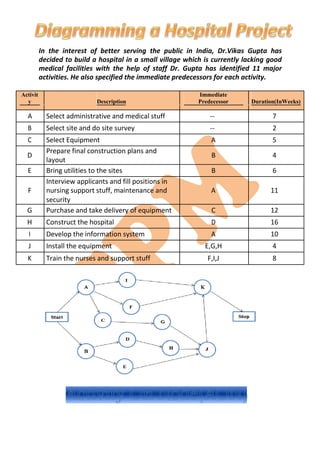
In the interest of better serving the public in India, Dr.Vikas Gupta has
decided to build a hospital in a small village which is currently lacking good
medical facilities with the help of staff Dr. Gupta has identified 11 major
activities. He also specified the immediate predecessors for each activity.
Activit
y Description
Immediate
Predecessor Duration(InWeeks)
A Select administrative and medical stuff -- 7
B Select site and do site survey -- 2
C Select Equipment A 5
D
Prepare final construction plans and
B 4
layout
E Bring utilities to the sites B 6
Interview applicants and fill positions in
F nursing support stuff, maintenance and A 11
security
G Purchase and take delivery of equipment C 12
H Construct the hospital D 16
I Develop the information system A 10
J Install the equipment E,G,H 4
K Train the nurses and support stuff F,I,J 8
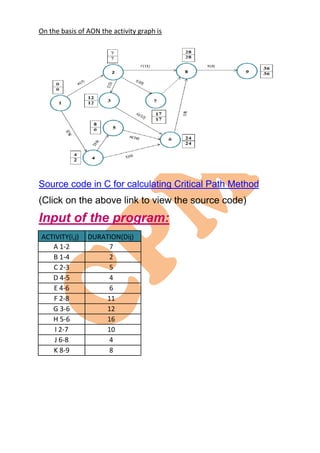
On the basis of AON the activity graph is
Source code in C for calculating Critical Path Method
(Click on the above link to view the source code)
Input of the program:
ACTIVITY(i,j) DURATION(Dij)
A 1-2 7
B 1-4 2
C 2-3 5
D 4-5 4
E 4-6 6
F 2-8 11
G 3-6 12
H 5-6 16
I 2-7 10
J 6-8 4
K 8-9 8
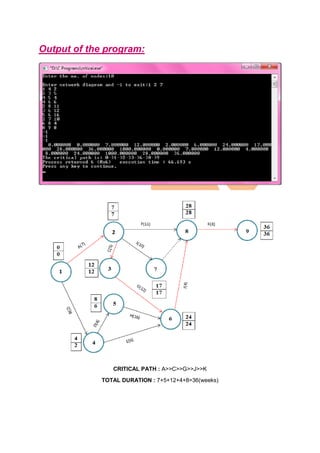
Output of the program:
CRITICAL PATH : A>>C>>G>>J>>K
TOTAL DURATION : 7+5+12+4+8=36(weeks)
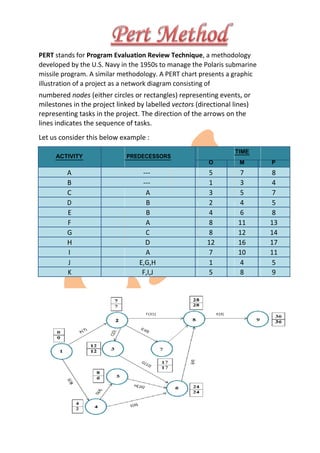
PERT stands for Program Evaluation Review Technique, a methodology
developed by the U.S. Navy in the 1950s to manage the Polaris submarine
missile program. A similar methodology. A PERT chart presents a graphic
illustration of a project as a network diagram consisting of
numbered nodes (either circles or rectangles) representing events, or
milestones in the project linked by labelled vectors (directional lines)
representing tasks in the project. The direction of the arrows on the
lines indicates the sequence of tasks.
Let us consider this below example :
ACTIVITY PREDECESSORS
TIME
O M P
A --- 5 7 8
B --- 1 3 4
C A 3 5 7
D B 2 4 5
E B 4 6 8
F A 8 11 13
G C 8 12 14
H D 12 16 17
I A 7 10 11
J E,G,H 1 4 5
K F,I,J 5 8 9
Formulas:-
Mean:-
Te=(To+4Tm+Tp)/6
Variance:-[(Tp-To)/6]2
ACTIVITY TIME MEAN DURATION VARIANCE
O M P
A 5 7 8 6.8 0.25
B 1 3 4 2.8 0.25
C 3 5 7 5 0.44
D 2 4 5 3.8 0.25
E 4 6 8 6 0.44
F 8 11 13 10.8 0.69
G 8 12 14 11.67 1
H 12 16 17 15.5 0.69
I 7 10 11 9.67 0.44
J 1 4 3 3.67 0.44
K 5 8 9 7.67 0.44
The result of Pert Method is 1>>2>>3>>6>>8>>9
CRITICAL PATH:-A->C->G->J->K
TOTAL DURATION : 7+5+12+4+8=36(weeks)(expected completion time)
Activity Mean Duration Variance
A 9.8 1.25
C 7 1.44
G 11.67 1
J 3.67 1.44
K 9.67 7.67
41.81 12.8
ᶮ=squareroot(12.8)=3.609weeks
P(x≤50)=p[(x-µ)/ᶮ≤(50-41.81)/3.609]
P[z≤2.26]=0.9447
This valueis obtained from std. normal distribution table Therefore the probability
of computing project on or before 50 weeks is 0.9447 i.e 94.47%
REFERENCES
[1] Applied Software Project Management by By Andrew Stellman, Jennifer Greene
[2] Software Project Management In Practice By Pankaj Jalote
[3] Introduction To Software Project Management By Adolfo Villafiorita

Spm

  • 1.
  • 2.
    A project consistsof interconnected activities which are to be executed in a certain order before the entire task is completed. The activities are interrelated in a logical sequence which is known as precedence relationship. Project is represented in the form of a network for the purpose of analytical treatment to get solution for scheduling and controlling activities. Techniques CPM : Critical Path Method PERT : Project Evolution and Review Technique Phases Of Project Management 1. PLANNING: Dividing the project into distinct activities. Estimating time requirement for each activities. Establishing precedence relationship among the activities. Construction of the error diagram (network). 2. SCHEDULING: Determines the start and end time of each and every activities. 3. CONTROLLING: Uses the arrow diagram and time chart for continuous monitoring and progress reporting. Guidelines For Network Construction- 1. The starting event and ending event of an activity are called tail event and head event respectively. 2. The network should have a unique starting node (tail event). 3. The network should have a unique computation (head event). 4. No activities should be represented by more than one arc in the network. 5. No two activities should have the same starting node and same ending node. 6. Dummy activity is an imaginary activity indicating precedence relationship only, duration of a dummy activity is zero.
  • 3.
    The critical pathof a project network is the longest path of the network. TWO RULES : 1. Determines earliest start times (ES) of all nodes this is called forword pass. 2. Determines latest completion times (LC) of various nodes. This is called backword pass. ESj = Maxj (ESi + Dij) LCi = Minj (LCj - Dij) Conditions Of Critical Path: ESi = LCi (i for root event) ESj = LCj (j for next event) ESj - ESj = LCj - LCi = Dij Total Floats: It is the amount of time that the completion time of an activity can be delayed without affecting the project completion time. TFIJ = LCJ - ESI - DIJ Free Float: It is the amount of time that the activity completion time can be delayed without affecting the earliest start time of immediate successor activities in the network. FFij = ESj - ESi - Dij Any critical activity will have zero total float and zero free float, based on this property we can determine critical activity. We follow the two techniques to construct network
  • 4.
    1. CRITICAL PATHMETHOD Critical path is the sequential activities from start to the end of a project. Although many projects have only one critical path, some projects may have more than one critical path depending on the flow logic used in the project. GOAL OF CPM    Construct the CPM network. Determine the critical path and project computation time. Compute total floats and free floats for non-critical activities. 2. PROJECT EVOLUTION AND REVIEW TECHNIQUE (PERT) Each activity will have three time estimates:  Optimistic time  Most likely time  Pessimistic time GOAL OF PERT a) Construction the project network b) Find the expected duration and variation of each activity c) Find the critical path and expected project completion time d) What is the probability of completing the project on or before 22 weeks?
  • 5.
    In the interestof better serving the public in India, Dr.Vikas Gupta has decided to build a hospital in a small village which is currently lacking good medical facilities with the help of staff Dr. Gupta has identified 11 major activities. He also specified the immediate predecessors for each activity. Activit y Description Immediate Predecessor Duration(InWeeks) A Select administrative and medical stuff -- 7 B Select site and do site survey -- 2 C Select Equipment A 5 D Prepare final construction plans and B 4 layout E Bring utilities to the sites B 6 Interview applicants and fill positions in F nursing support stuff, maintenance and A 11 security G Purchase and take delivery of equipment C 12 H Construct the hospital D 16 I Develop the information system A 10 J Install the equipment E,G,H 4 K Train the nurses and support stuff F,I,J 8
  • 6.
    On the basisof AON the activity graph is Source code in C for calculating Critical Path Method (Click on the above link to view the source code) Input of the program: ACTIVITY(i,j) DURATION(Dij) A 1-2 7 B 1-4 2 C 2-3 5 D 4-5 4 E 4-6 6 F 2-8 11 G 3-6 12 H 5-6 16 I 2-7 10 J 6-8 4 K 8-9 8
  • 7.
    Output of theprogram: CRITICAL PATH : A>>C>>G>>J>>K TOTAL DURATION : 7+5+12+4+8=36(weeks)
  • 8.
    PERT stands forProgram Evaluation Review Technique, a methodology developed by the U.S. Navy in the 1950s to manage the Polaris submarine missile program. A similar methodology. A PERT chart presents a graphic illustration of a project as a network diagram consisting of numbered nodes (either circles or rectangles) representing events, or milestones in the project linked by labelled vectors (directional lines) representing tasks in the project. The direction of the arrows on the lines indicates the sequence of tasks. Let us consider this below example : ACTIVITY PREDECESSORS TIME O M P A --- 5 7 8 B --- 1 3 4 C A 3 5 7 D B 2 4 5 E B 4 6 8 F A 8 11 13 G C 8 12 14 H D 12 16 17 I A 7 10 11 J E,G,H 1 4 5 K F,I,J 5 8 9
  • 9.
    Formulas:- Mean:- Te=(To+4Tm+Tp)/6 Variance:-[(Tp-To)/6]2 ACTIVITY TIME MEANDURATION VARIANCE O M P A 5 7 8 6.8 0.25 B 1 3 4 2.8 0.25 C 3 5 7 5 0.44 D 2 4 5 3.8 0.25 E 4 6 8 6 0.44 F 8 11 13 10.8 0.69 G 8 12 14 11.67 1 H 12 16 17 15.5 0.69 I 7 10 11 9.67 0.44 J 1 4 3 3.67 0.44 K 5 8 9 7.67 0.44 The result of Pert Method is 1>>2>>3>>6>>8>>9 CRITICAL PATH:-A->C->G->J->K TOTAL DURATION : 7+5+12+4+8=36(weeks)(expected completion time)
  • 10.
    Activity Mean DurationVariance A 9.8 1.25 C 7 1.44 G 11.67 1 J 3.67 1.44 K 9.67 7.67 41.81 12.8 ᶮ=squareroot(12.8)=3.609weeks P(x≤50)=p[(x-µ)/ᶮ≤(50-41.81)/3.609] P[z≤2.26]=0.9447 This valueis obtained from std. normal distribution table Therefore the probability of computing project on or before 50 weeks is 0.9447 i.e 94.47%
  • 11.
    REFERENCES [1] Applied SoftwareProject Management by By Andrew Stellman, Jennifer Greene [2] Software Project Management In Practice By Pankaj Jalote [3] Introduction To Software Project Management By Adolfo Villafiorita