PROJECT MANAGEMENT
NETWORK ANALYSIS (CPM
& PERT)
What is a Project?
• A project is an interrelated set of activities that has definite
starting and ending points and that result in a unique product
or service
• Cuts across organizational lines - they need varied skills of
different profession
• Uncertainties like new technology & external environment can
change the character of the project
• Personnel, materials, facilities etc. are temporarily assembled to
accomplish a goal within a specified time frame and then disbanded
• Upon finish, a project releases lot of resources which were
engaged in execution of the project
Examples of Project
• Hosting a College Annual Function
• Plan a Space Shuttle to Mars
• Construct a Plant to Manufacture Ball Bearings
• Plan for Wedding
• Designing and Implement a Computer System
• Designing a ABS System
• Executing Environmental Clean-up Of a Contaminated Site
• Erect a New Lab in the Dept. of Mechanical Engineering
Definition of Project
• A project is a one shot, time limited, goal directed,
major undertaking, requiring the commitment of
varied skills & resources.
• It also describes project as a combination of human
and non human resources pooled together in a
temporary organization to achieve specific purpose
Project Attributes
A project:
• Has a unique purpose.
• Is temporary.
• Is developed using progressive elaboration.
• Requires resources, often from various areas.
• Should have a primary customer or sponsor.
•The project sponsor usually provides the direction
and funding for the project.
• Involves uncertainty.
Project and Program Managers
Project managers work with project sponsors, project teams,
and other people involved in projects to meet project goals.
Program: "A group of related projects managed in a
coordinated way to obtain benefits and control not available
from managing them individually."
Program managers oversee programs and often act as bosses
for project managers.
Project management is "the application of knowledge, skills,
tools and techniques to project activities to meet project
requirements."
Project Management Tools and
Techniques
Project management tools and techniques assist project
managers and their teams in various aspects of project
management.
Specific tools and techniques include:
Project charters, scope statements, and WBS (scope).
Gantt charts, network diagrams, critical path analyses,
critical chain scheduling (time).
Cost estimates and earned value management (cost).
NETWORK ANALYSIS
Network Analysis refers to a number of techniques for the
planning and control of complex projects.
The two most frequently used forms of network planning
are:
1. Programme Evaluation and Review Technique
(PERT)
2. Critical Path Method (CPM)
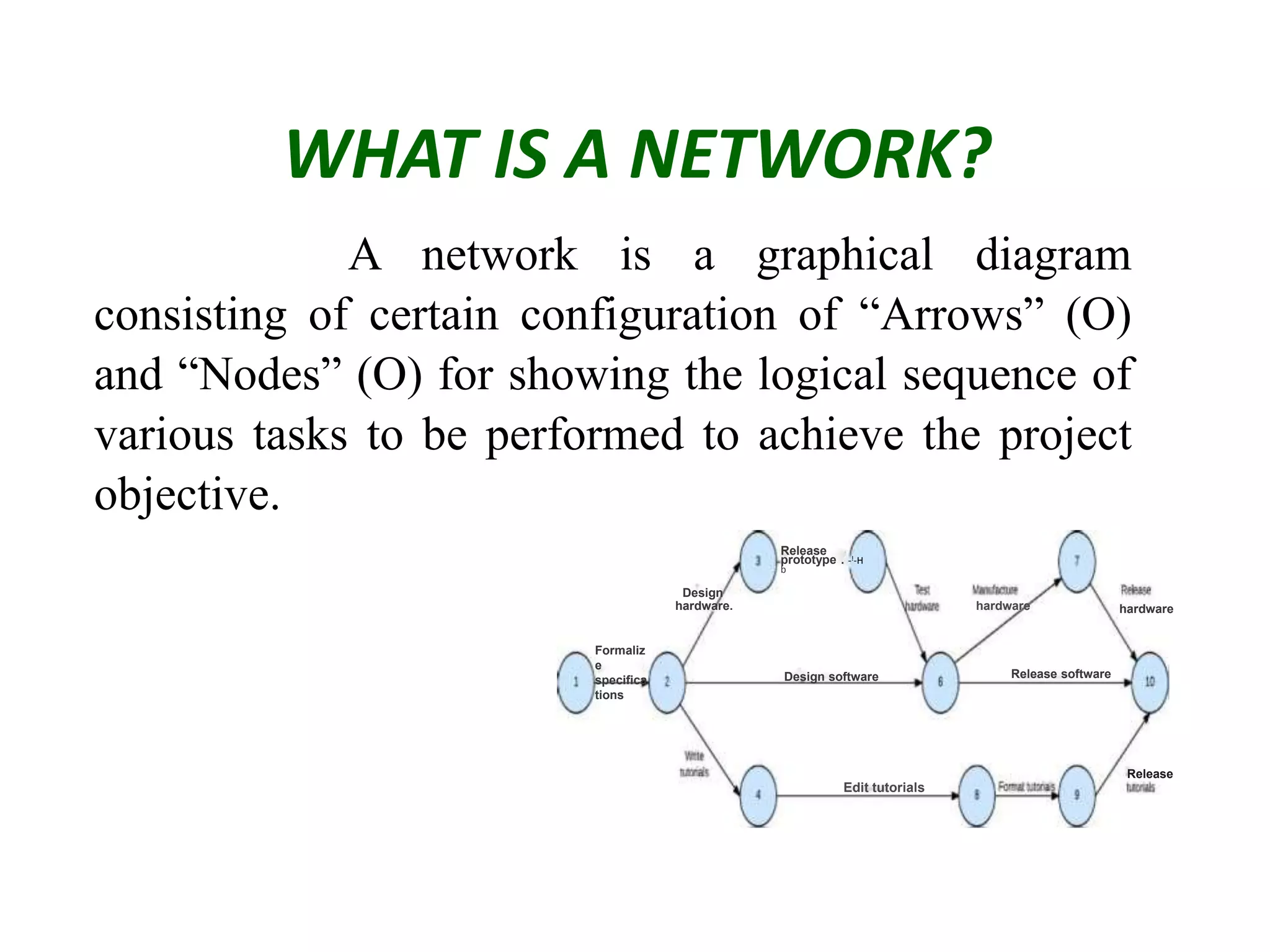
WHAT IS A NETWORK?
A network is a graphical diagram
consisting of certain configuration of “Arrows” (O)
and “Nodes” (O) for showing the logical sequence of
various tasks to be performed to achieve the project
objective.
hardware. hardware
Formaliz
e
specifica
tions
Release software
Edit tutorials
Release
prototype . -!-H
b
Design
hardware
Design software
Release
PERT / CPM Techniques
The initial step in PERT/CPM project scheduling
process is the determination of all specific
activities that comprise the project and their
relationships.
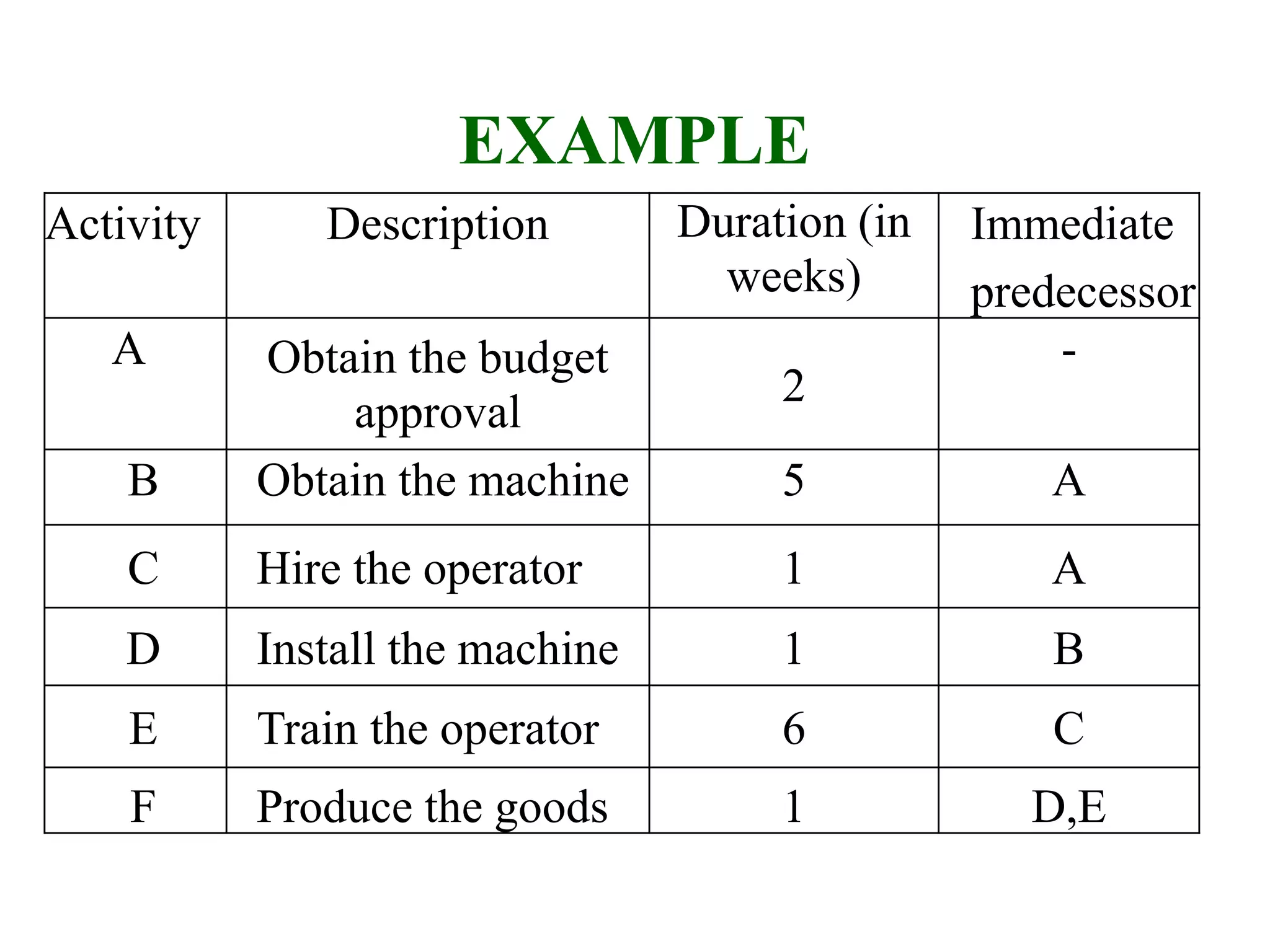
EXAMPLE
Activity Description Duration (in
weeks)
Immediate
predecessor
A Obtain the budget
approval
2
-
B Obtain the machine 5 A
C Hire the operator 1 A
D Install the machine 1 B
E Train the operator 6 C
F Produce the goods 1 D,E
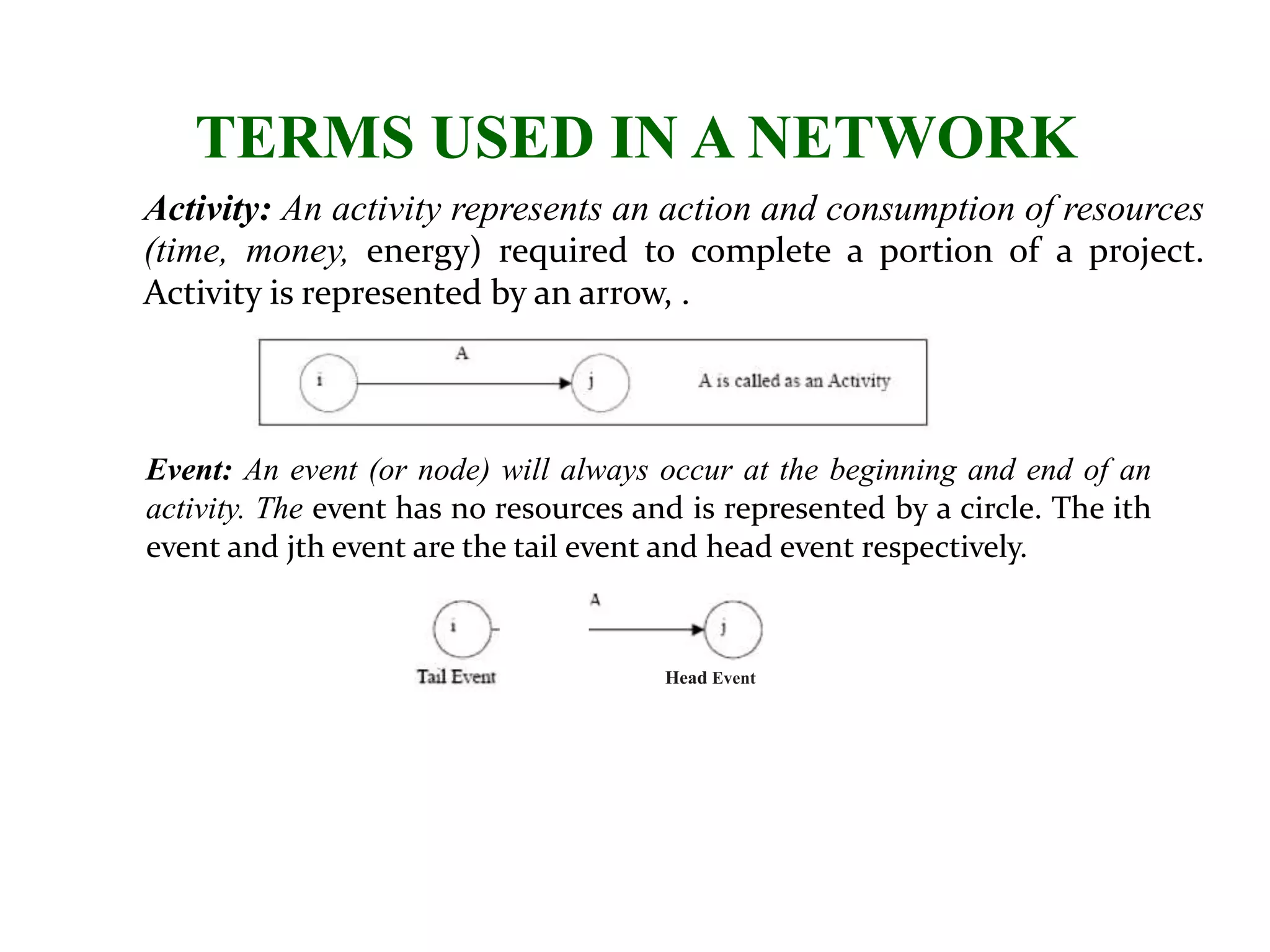
TERMS USED IN A NETWORK
Activity: An activity represents an action and consumption of resources
(time, money, energy) required to complete a portion of a project.
Activity is represented by an arrow, .
Event: An event (or node) will always occur at the beginning and end of an
activity. The event has no resources and is represented by a circle. The ith
event and jth event are the tail event and head event respectively.
Head Event
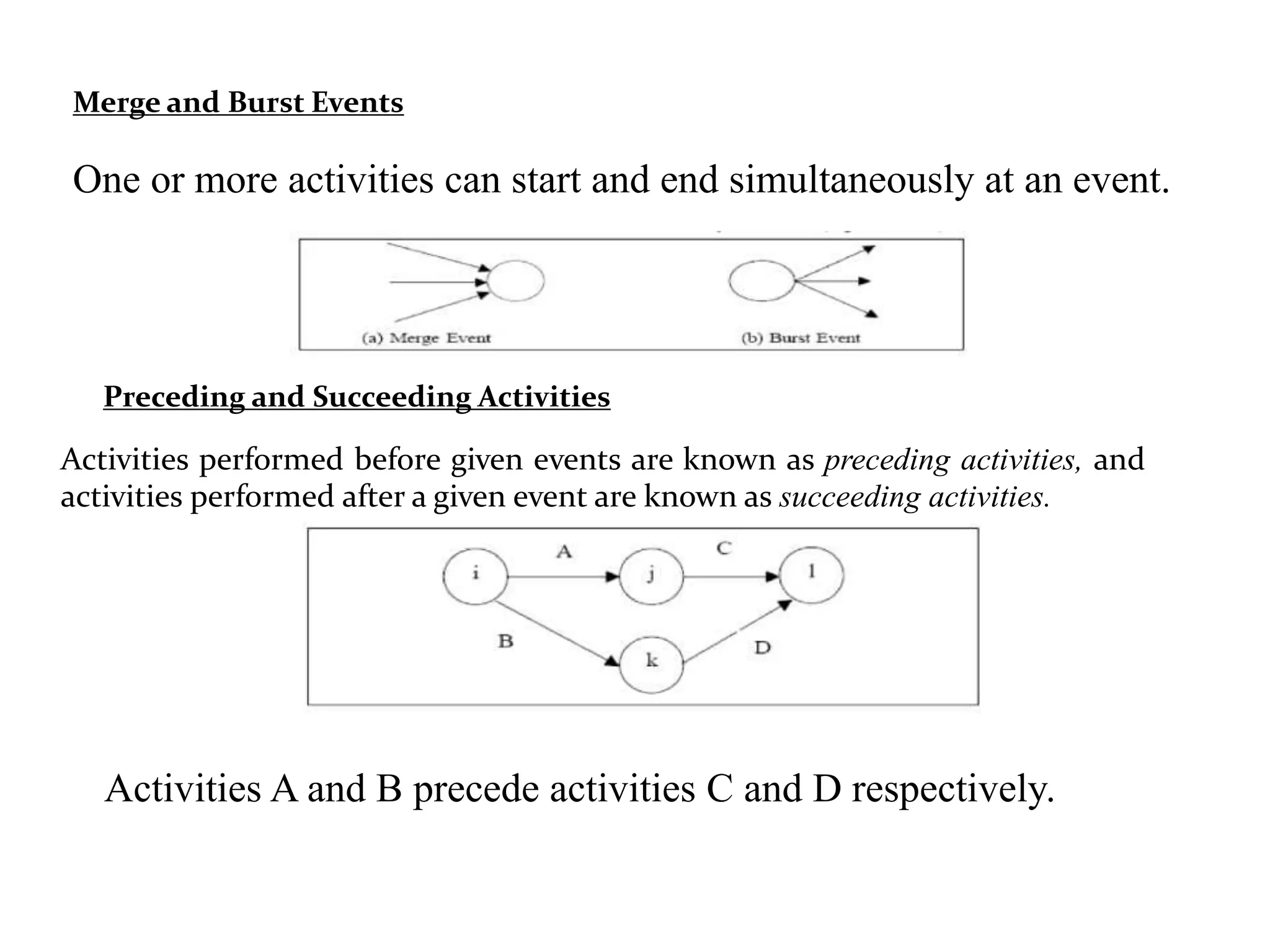
Merge and Burst Events
One or more activities can start and end simultaneously at an event.
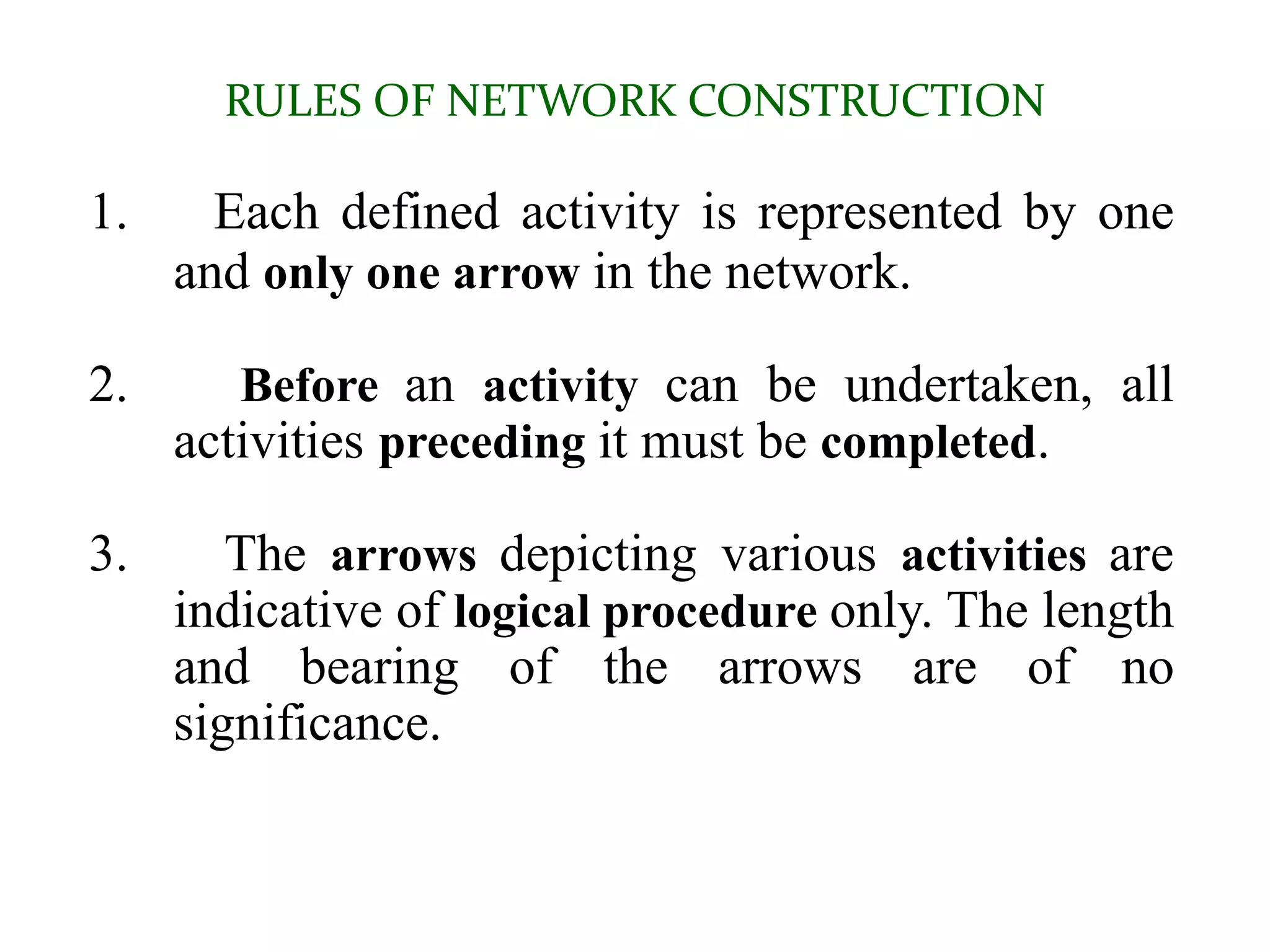
Preceding and Succeeding Activities
Activities performed before given events are known as preceding activities, and
activities performed after a given event are known as succeeding activities.
Activities A and B precede activities C and D respectively.
RULES OF NETWORK CONSTRUCTION
1. Each defined activity is represented by one
and only one arrow in the network.
2. Before an activity can be undertaken, all
activities preceding it must be completed.
3. The arrows depicting various activities are
indicative of logical procedure only. The length
and bearing of the arrows are of no
significance.
4. The arrow direction indicates the general
progression in time. Head events and Tail events.
5. When a number of activities terminate at one event,
it indicates that no activity emanating from that event
may start unless all activities terminating there have
been completed.
6. Events are identified by numbers.
7. The activities are identified by the numbers of their
starting and ending events or by alphabets.
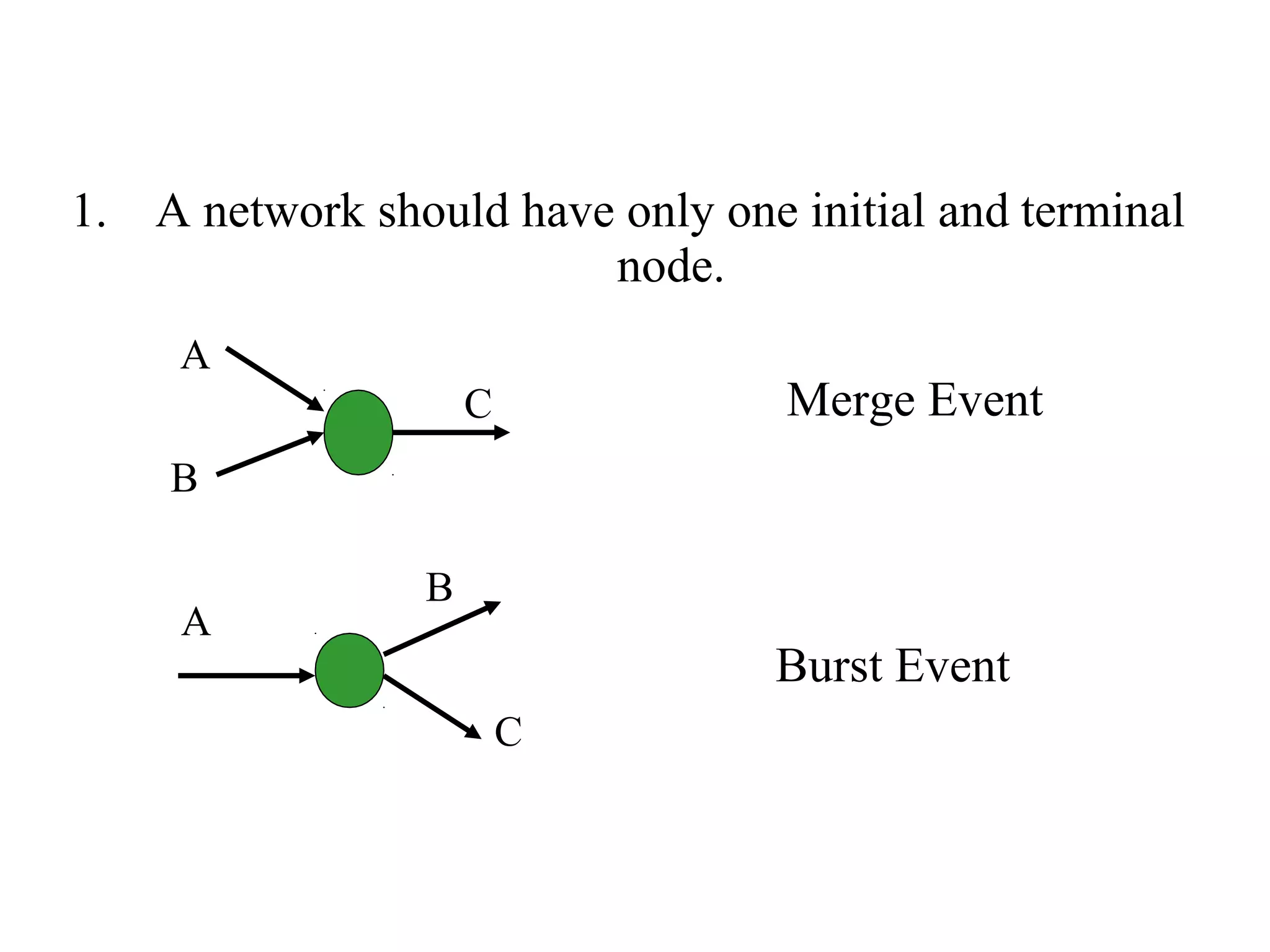
1. A network should have only one initial and terminal
node.
A
Merge Event
B
B
A
Burst Event
C
C
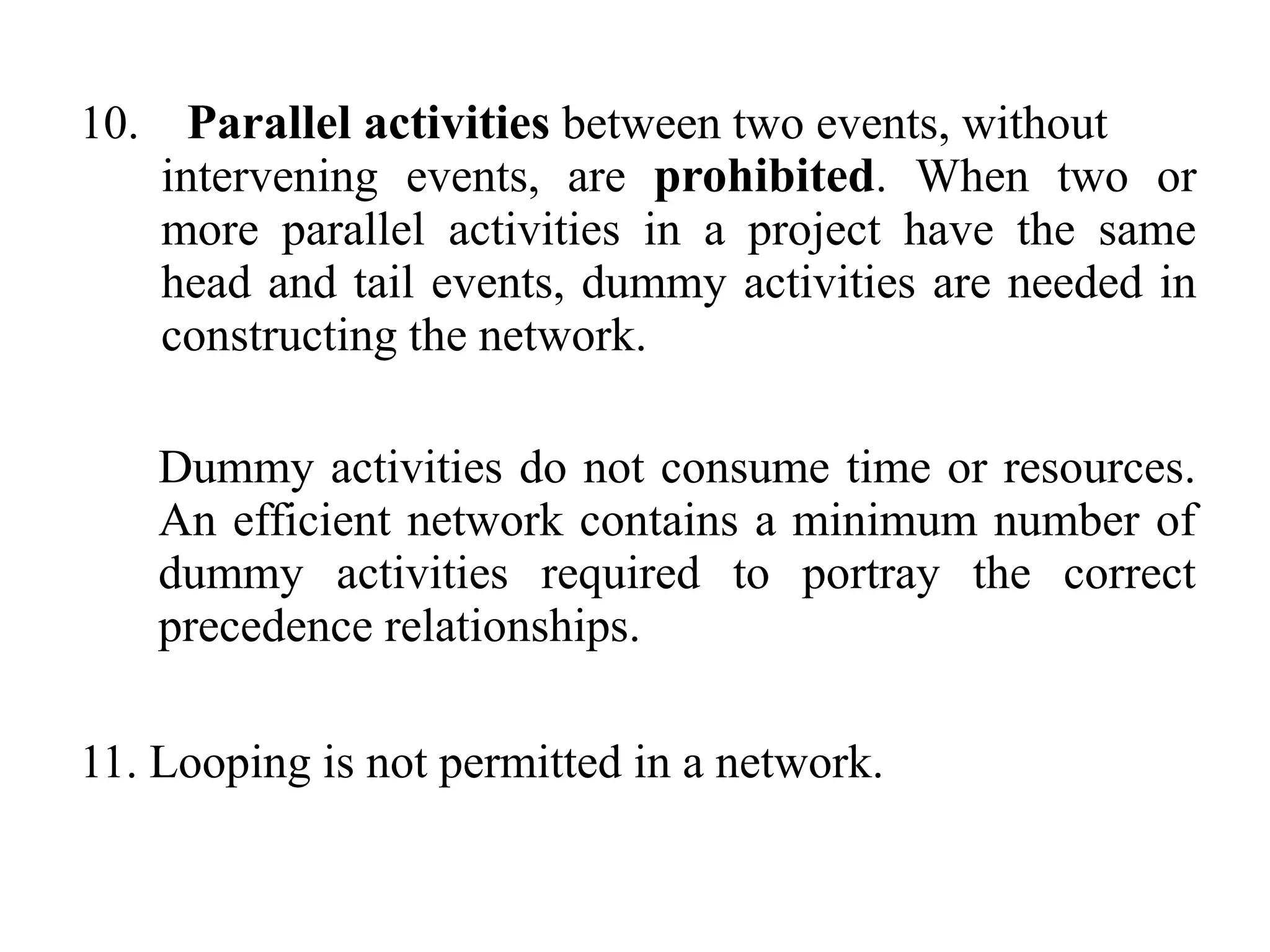
10. Parallel activities between two events, without
intervening events, are prohibited. When two or
more parallel activities in a project have the same
head and tail events, dummy activities are needed in
constructing the network.
Dummy activities do not consume time or resources.
An efficient network contains a minimum number of
dummy activities required to portray the correct
precedence relationships.
11. Looping is not permitted in a network.
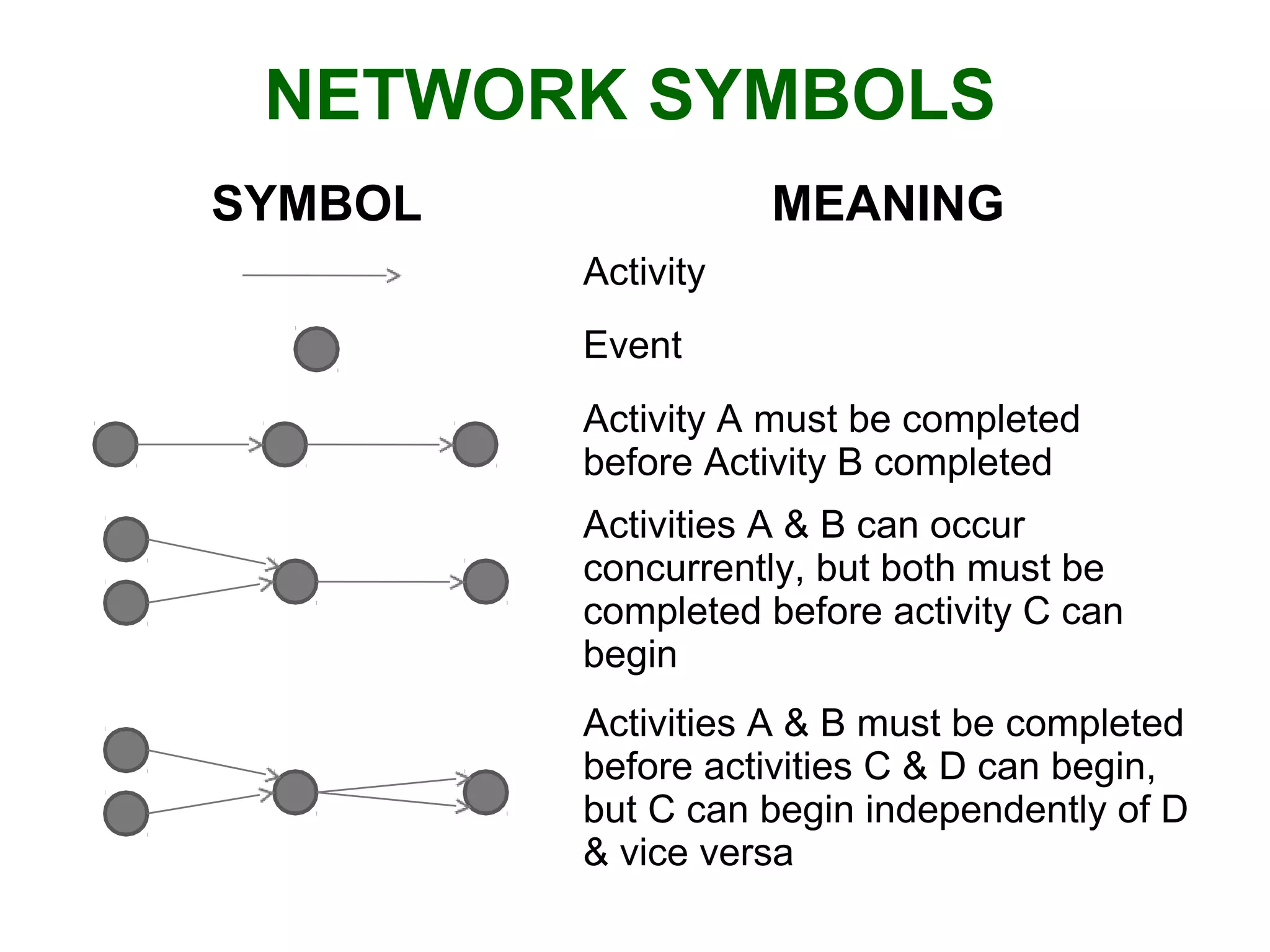
NETWORK SYMBOLS
SYMBOL MEANING
Activity
Event
Activity A must be completed
before Activity B completed
Activities A & B can occur
concurrently, but both must be
completed before activity C can
begin
Activities A & B must be completed
before activities C & D can begin,
but C can begin independently of D
& vice versa
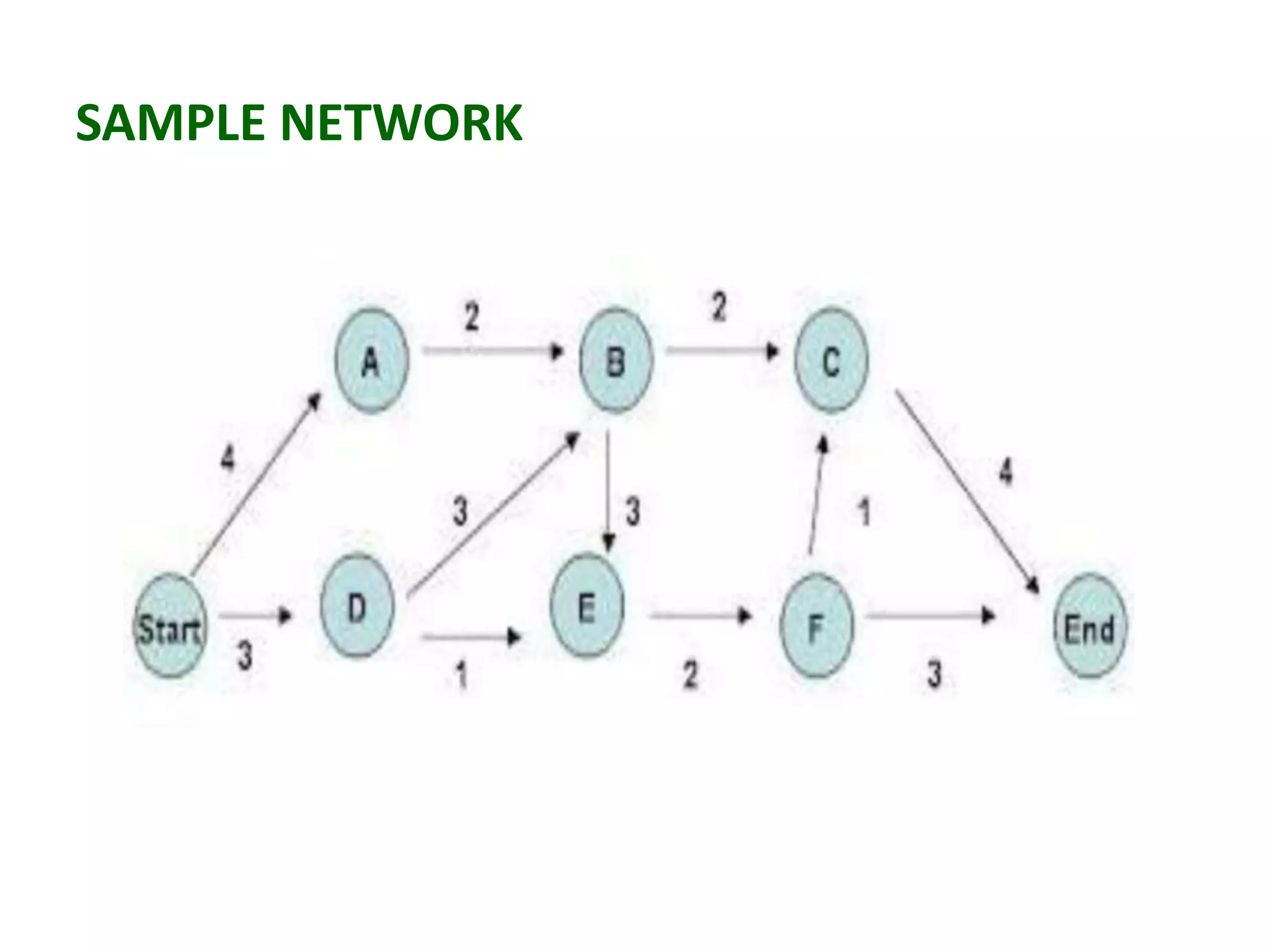
SAMPLE NETWORK
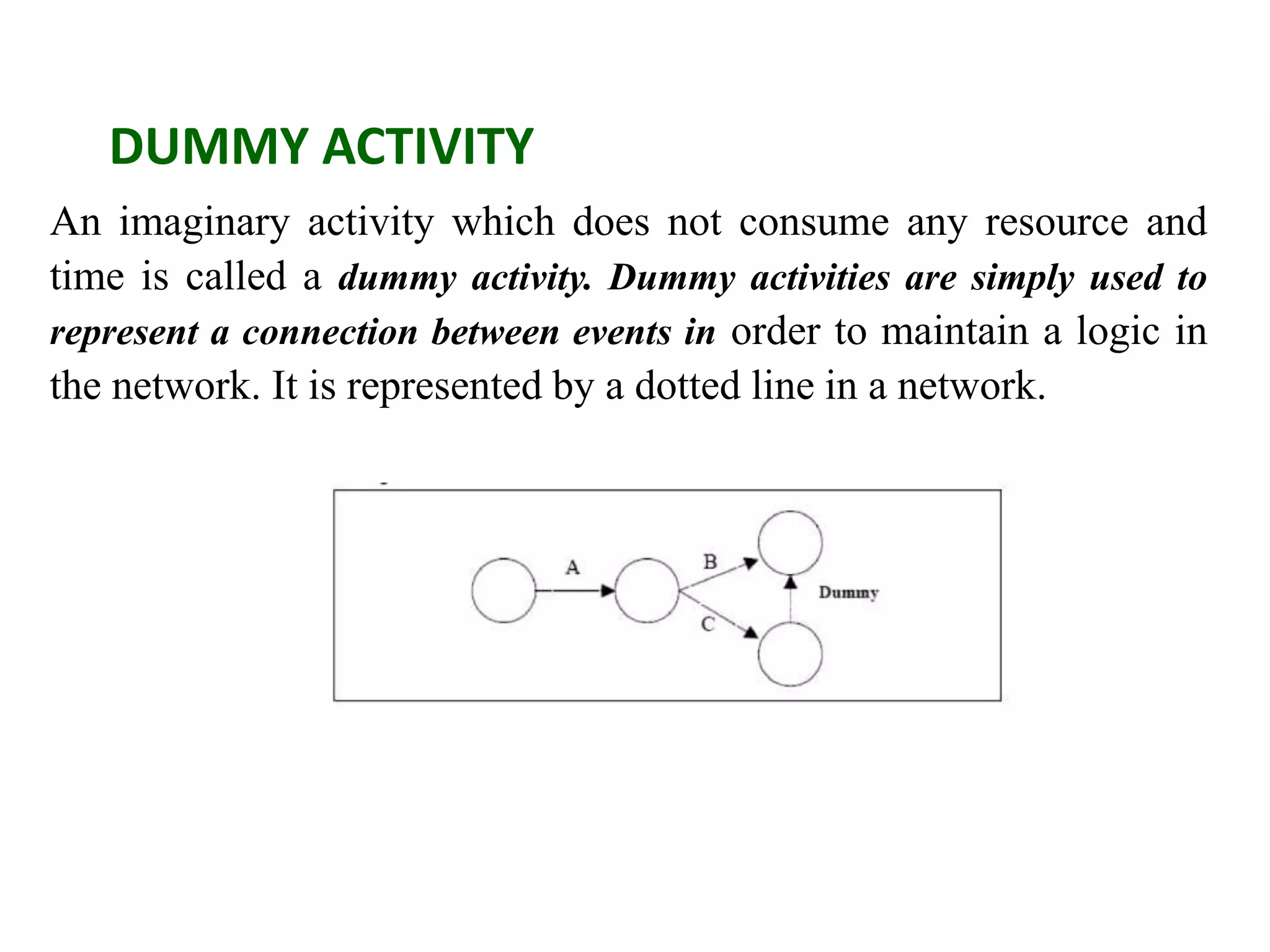
DUMMY ACTIVITY
An imaginary activity which does not consume any resource and
time is called a dummy activity. Dummy activities are simply used to
represent a connection between events in order to maintain a logic in
the network. It is represented by a dotted line in a network.
CRITICAL PATH METHOD
CPM aims at the determination of the
time to complete a project and the
important activities on which a manager
shall focus attention.
PROCEDURE
□ Consider all the paths in a project, beginning with
the start event and stopping at the end event.
□ For each path, calculate the time of execution.
□ The path with the largest time is called the critical
path and the activities along this path are called critical
activities or bottleneck activities.
1. You are required to prepare a network diagram for constructing a 5 floor apartmei
The major activities of the project are given as follows:
Activity
V
Description Immediate Predecessor
A Selection of site -
B Preparation of drawings -
C Arranging the for finance
W w
A
D Selection of contractor A
E Getting approval from Govt A
F Laying the foundation E
G Start construction D.F
H Advertise in newspaper B.C
I Allocation of tenants G.H
PERT
(Project or Program Evaluation
and Review Techniques)
PROJECT EVALUATION REVIEW TECHNIQUE
In the critical path method, the time estimates are assumed to be
known with certainty. In certain projects like research and

development, new product introductions, it is difficult to estimate the
time of various activities.
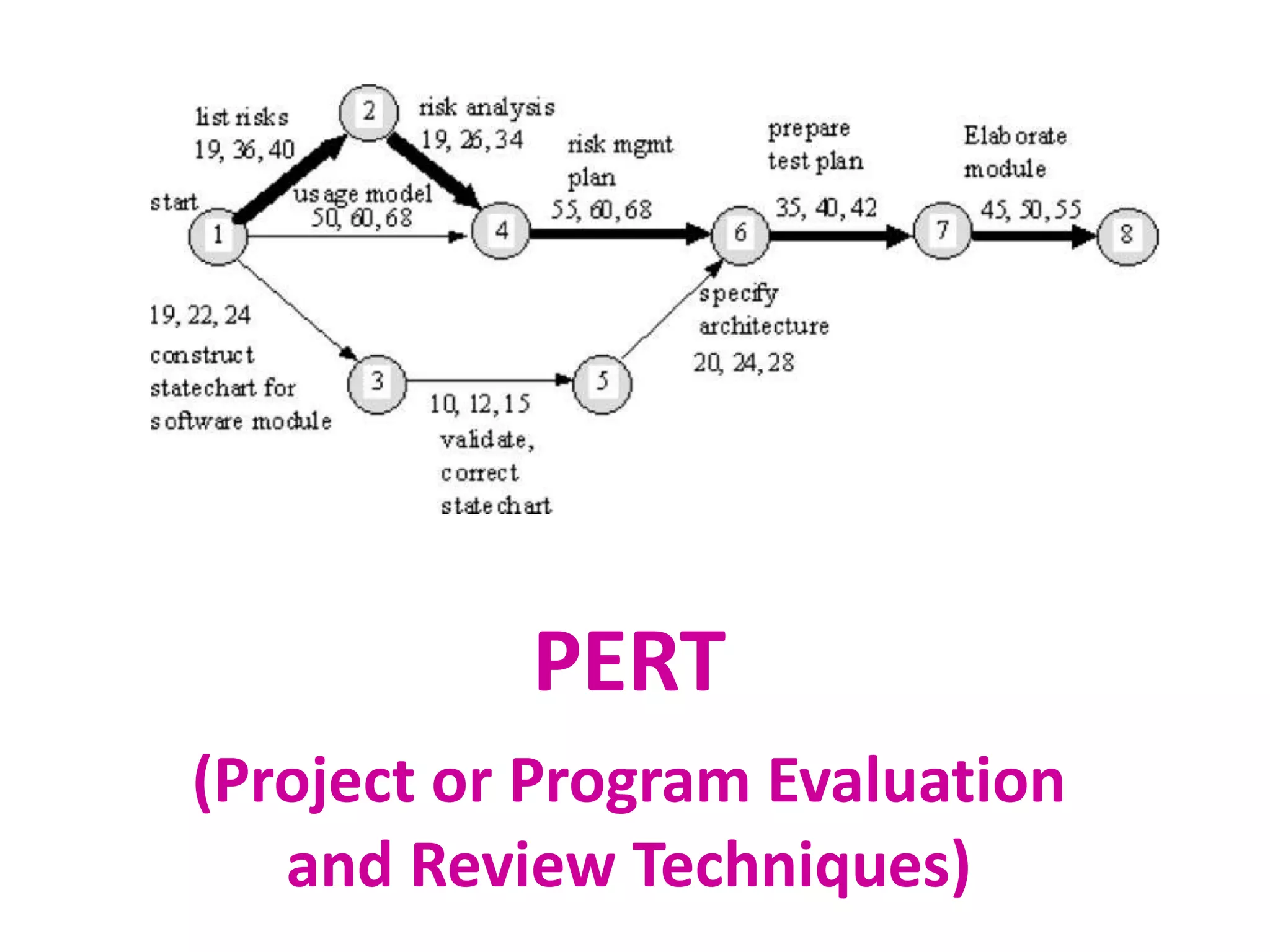
Hence PERT is used in such projects with a probabilistic method using three
time estimates for an activity, rather than a single estimate, as shown in
Figure Optimistic time tO:
It is the shortest time taken to complete the
activity. It means that if everything goes well
then there is more chance of completing the
activity within this time.
Most likely time tm:
It is the normal time taken to complete an activity,
if the activity were frequently repeated under the
same conditions.
Pessimistic time tp:
It is the longest time that an activity would take to
complete. It is the worst time estimate that an
activity would take if unexpected problems are
faced.
Beta Curve
Time duration of activity
Figure 8.22: PERT L sing Probabilistic Method with 3 Time Estimates
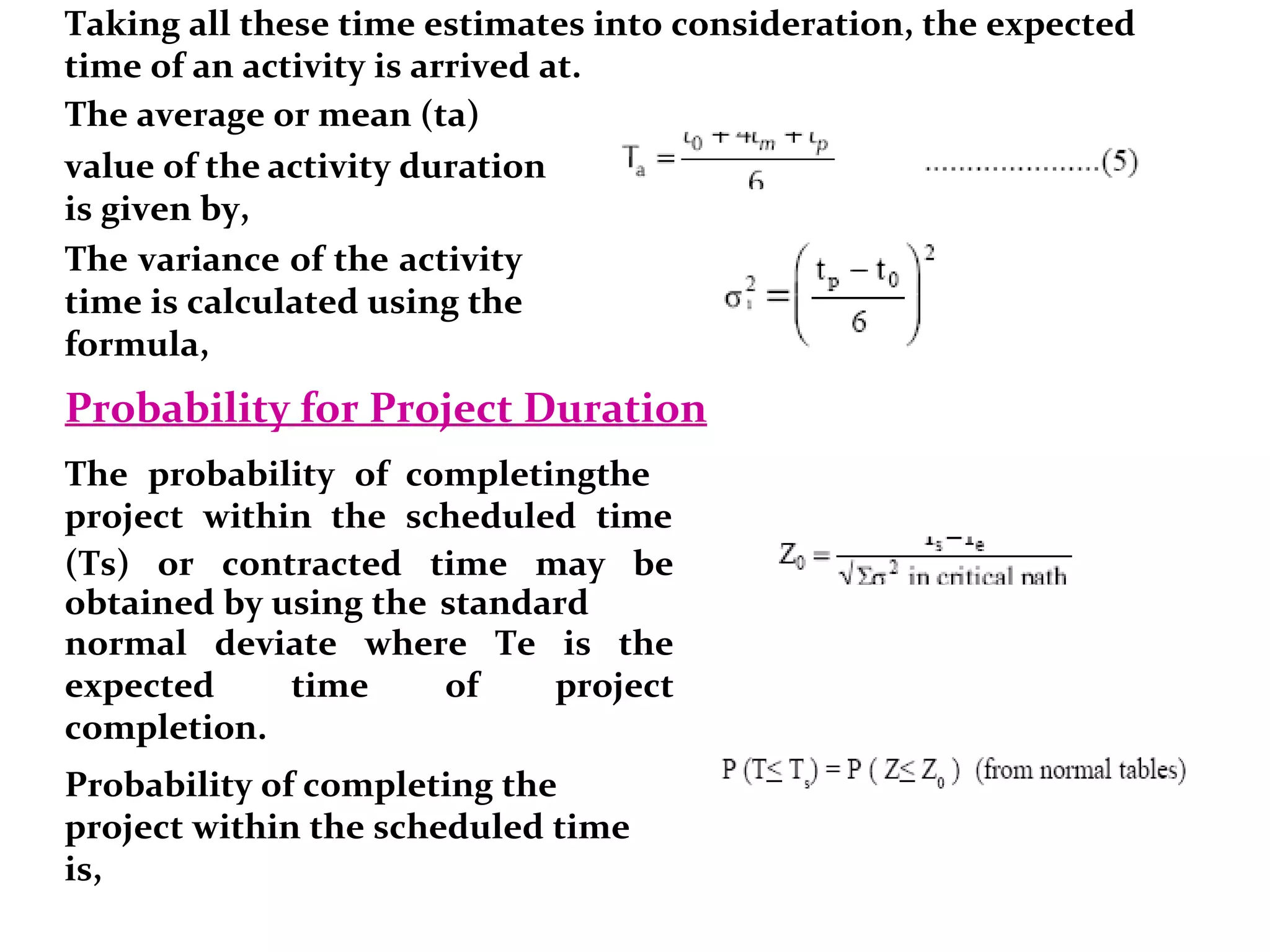
Taking all these time estimates into consideration, the expected
time of an activity is arrived at.
The average or mean (ta)
value of the activity duration
is given by,
The variance of the activity
time is calculated using the
formula,
Probability for Project Duration
The probability of completingthe
project within the scheduled time
(Ts) or contracted time may be
obtained by using the standard
normal deviate where Te is the
expected time of project
completion.
Probability of completing the
project within the scheduled time
is,
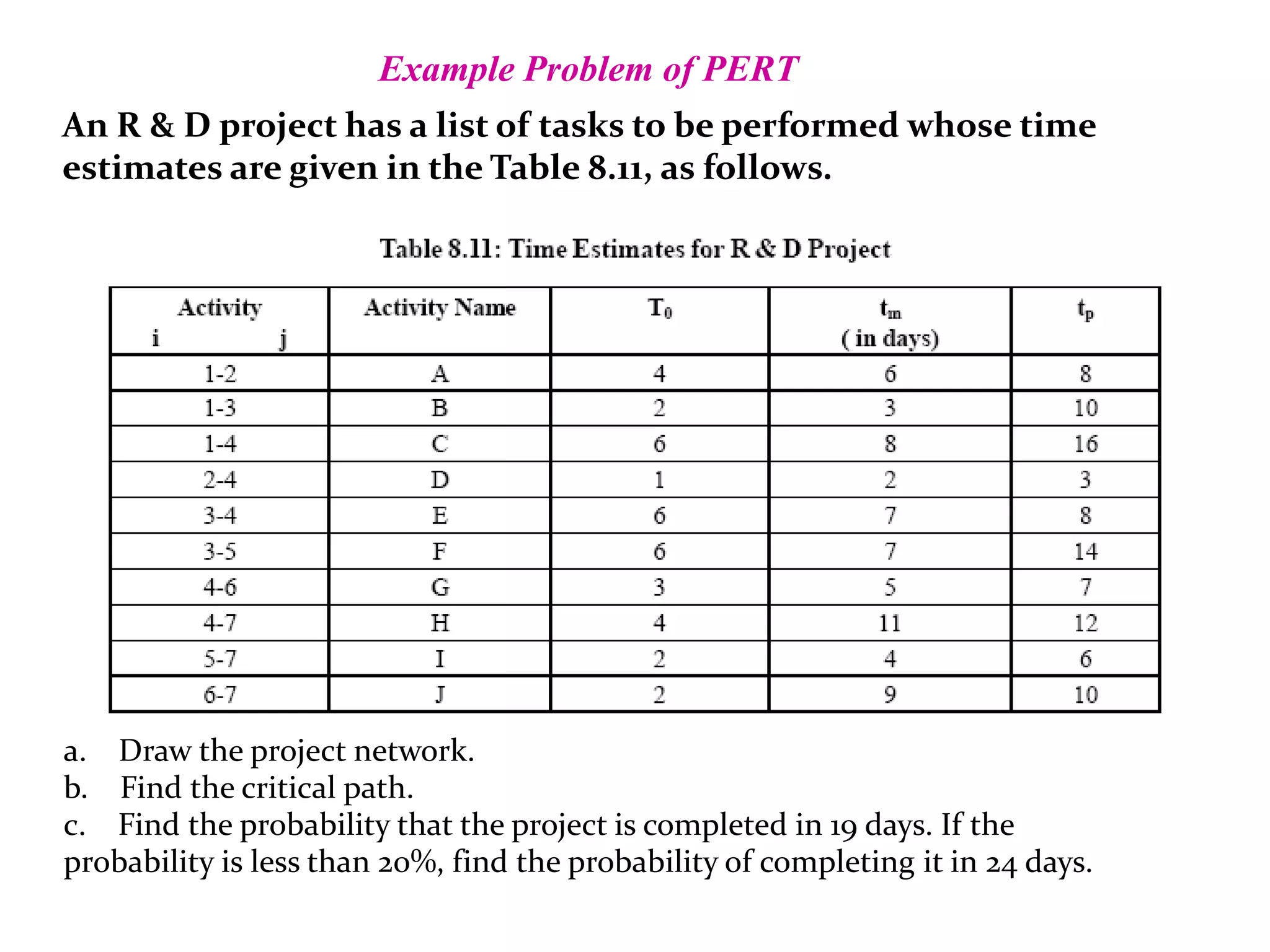
Example Problem of PERT
An R & D project has a list of tasks to be performed whose time
estimates are given in the Table 8.11, as follows.
a. Draw the project network.
b. Find the critical path.
c. Find the probability that the project is completed in 19 days. If the
probability is less than 20%, find the probability of completing it in 24 days.
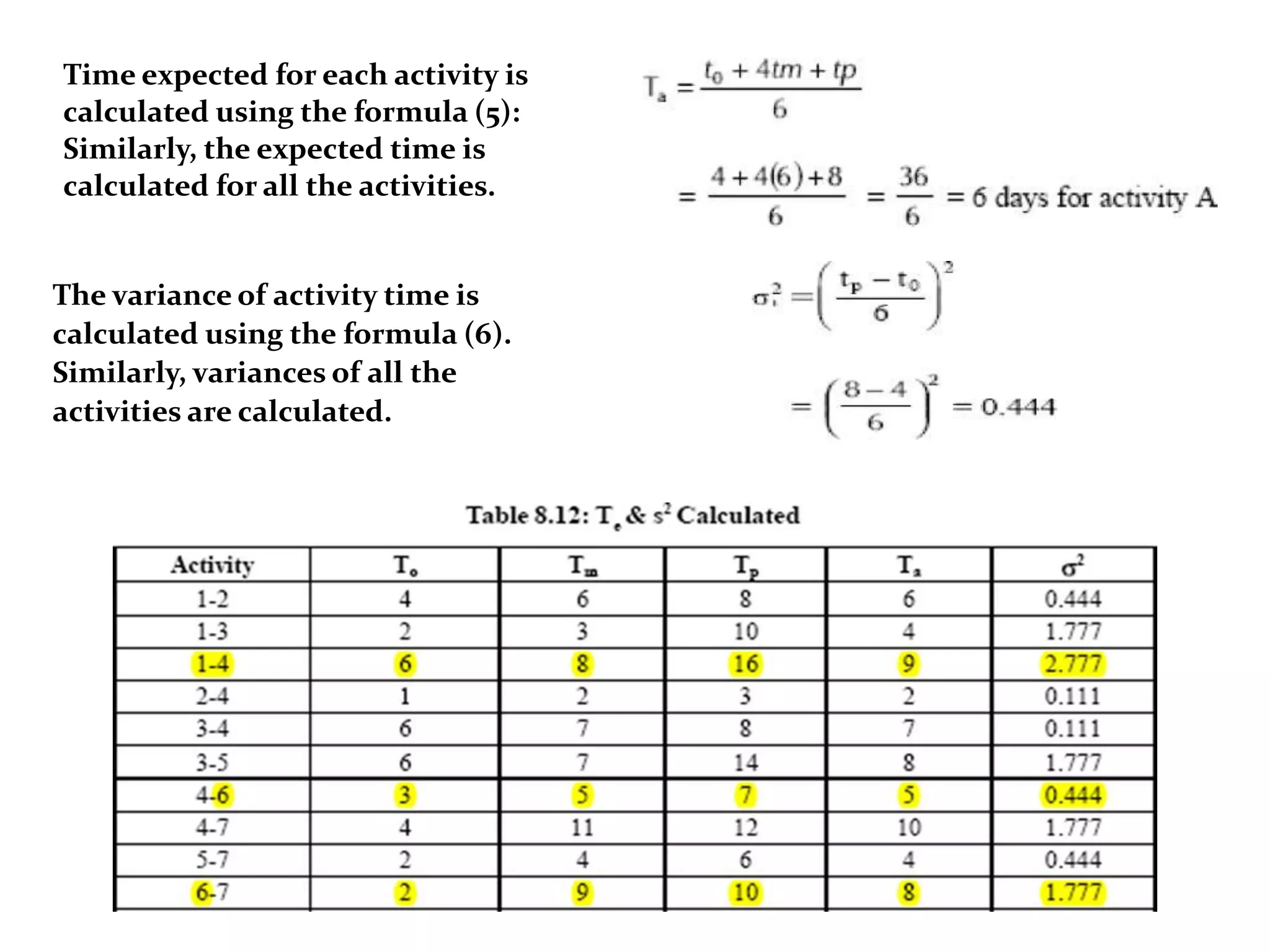
Time expected for each activity is
calculated using the formula (5):
Similarly, the expected time is
calculated for all the activities.
The variance of activity time is
calculated using the formula (6).
Similarly, variances of all the
activities are calculated.
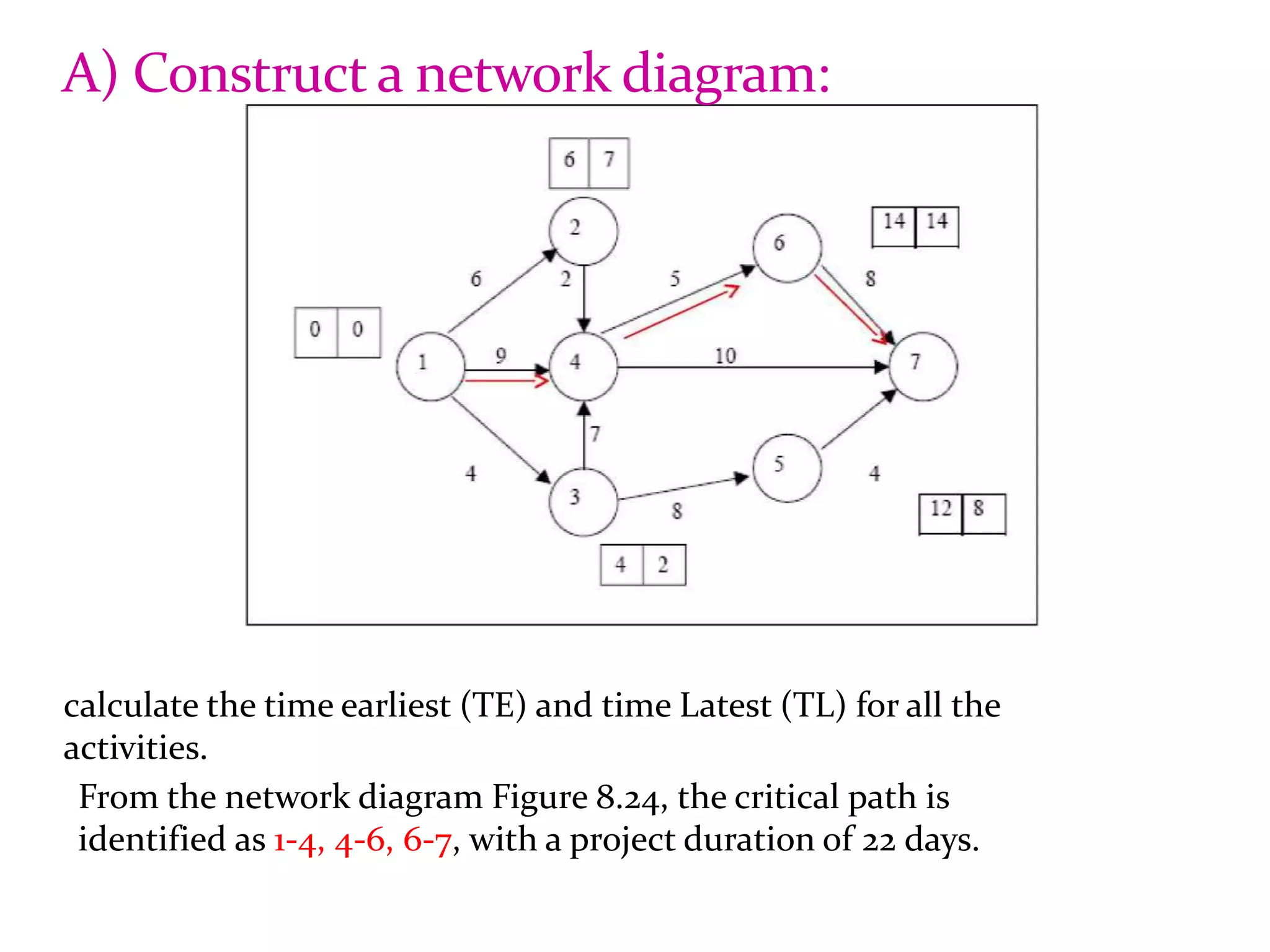
A) Construct a network diagram:
calculate the time earliest (TE) and time Latest (TL) for all the
activities.
From the network diagram Figure 8.24, the critical path is
identified as 1-4, 4-6, 6-7, with a project duration of 22 days.
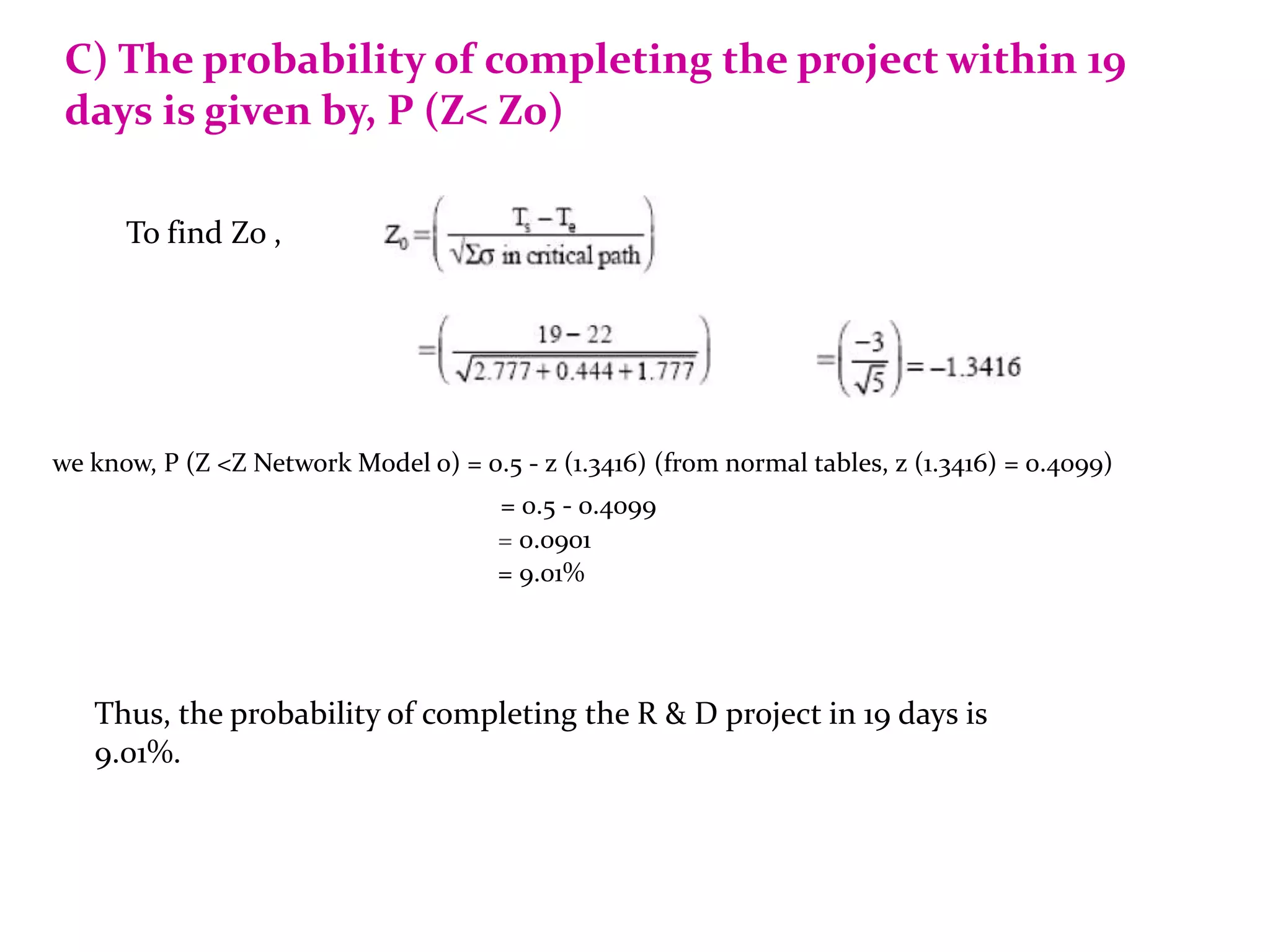
C) The probability of completing the project within 19
days is given by, P (Z< Z0)
To find Zo ,
we know, P (Z <Z Network Model o) = 0.5 - z (1.3416) (from normal tables, z (1.3416) = 0.4099)
= 0.5 - 0.4099
= 0.0901
= 9.01%
Thus, the probability of completing the R & D project in 19 days is
9.01%.
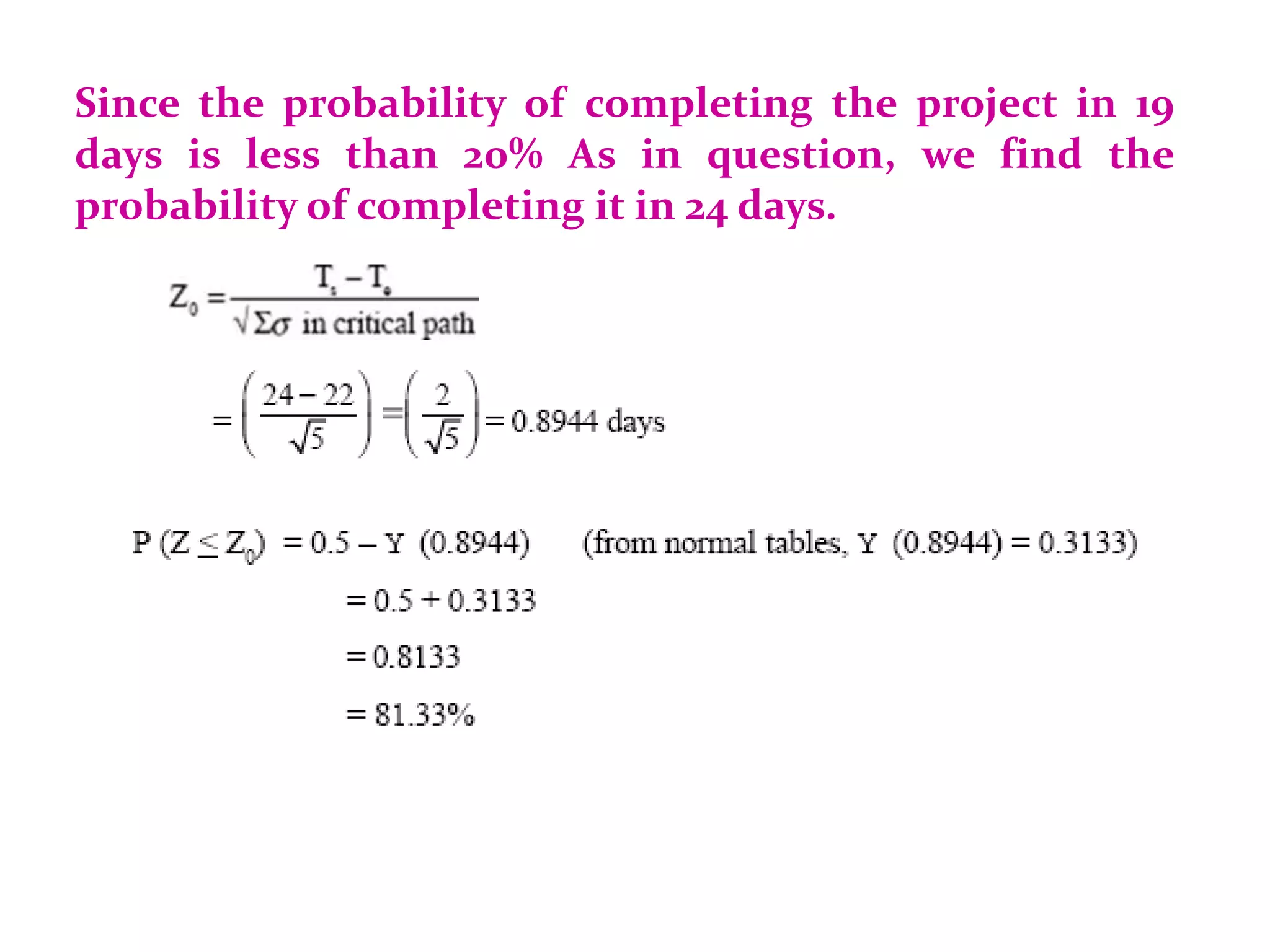
Since the probability of completing the project in 19
days is less than 20% As in question, we find the
probability of completing it in 24 days.
COST ANALYSIS
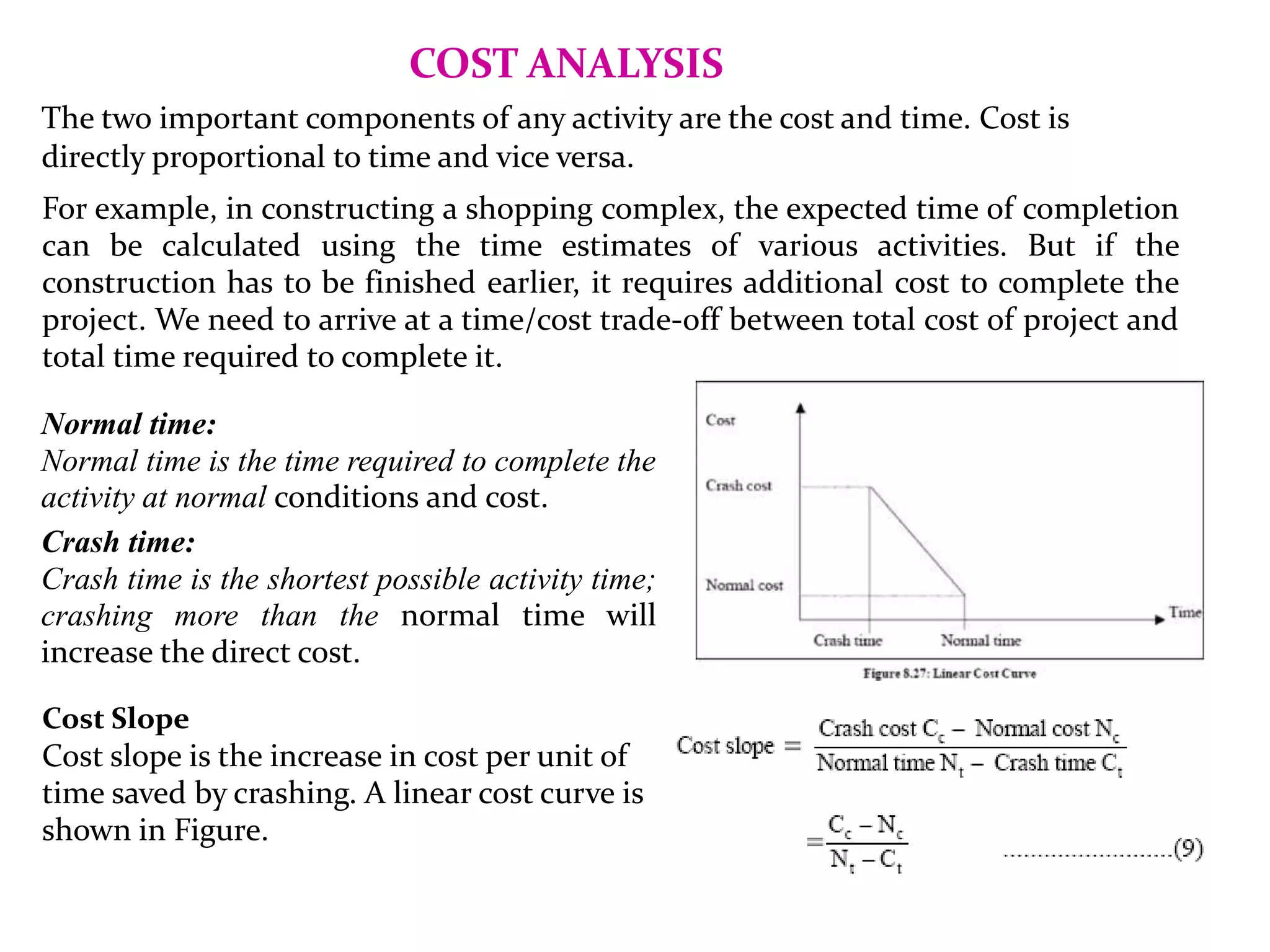
The two important components of any activity are the cost and time. Cost is
directly proportional to time and vice versa.
For example, in constructing a shopping complex, the expected time of completion
can be calculated using the time estimates of various activities. But if the
construction has to be finished earlier, it requires additional cost to complete the
project. We need to arrive at a time/cost trade-off between total cost of project and
total time required to complete it.
Normal time:
Normal time is the time required to complete the
activity at normal conditions and cost.
Crash time:
Crash time is the shortest possible activity time;
crashing more than the normal time will
increase the direct cost.
Cost Slope
Cost slope is the increase in cost per unit of
time saved by crashing. A linear cost curve is
shown in Figure.
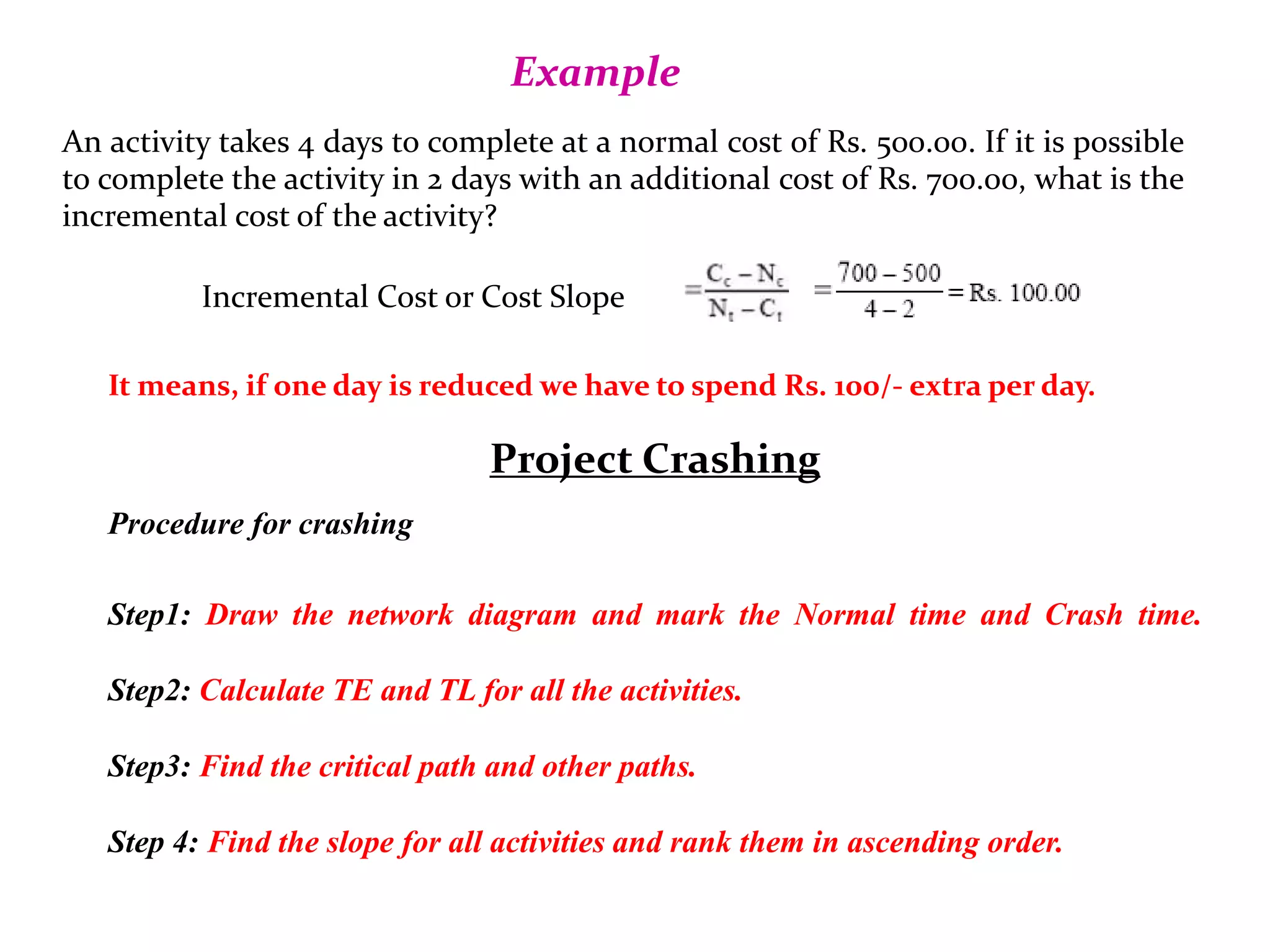
Example
An activity takes 4 days to complete at a normal cost of Rs. 500.00. If it is possible
to complete the activity in 2 days with an additional cost of Rs. 700.00, what is the
incremental cost of the activity?
Incremental Cost or Cost Slope
It means, if one day is reduced we have to spend Rs. 100/- extra per day.
Project Crashing
Procedure for crashing
Step1: Draw the network diagram and mark the Normal time and Crash time.
Step2: Calculate TE and TL for all the activities.
Step3: Find the critical path and other paths.
Step 4: Find the slope for all activities and rank them in ascending order.
Step 5: Establish a tabular column with required field.
Step 6: Select the lowest ranked activity; check whether it is a critical activity. If so,
crash the activity, else go to the next highest ranked activity.
Note: The critical path must remain critical while crashing.
Step 7: Calculate the total cost of project for each crashing Step 8: Repeat Step 6
until all the activities in the critical path are fully crashed.
Example
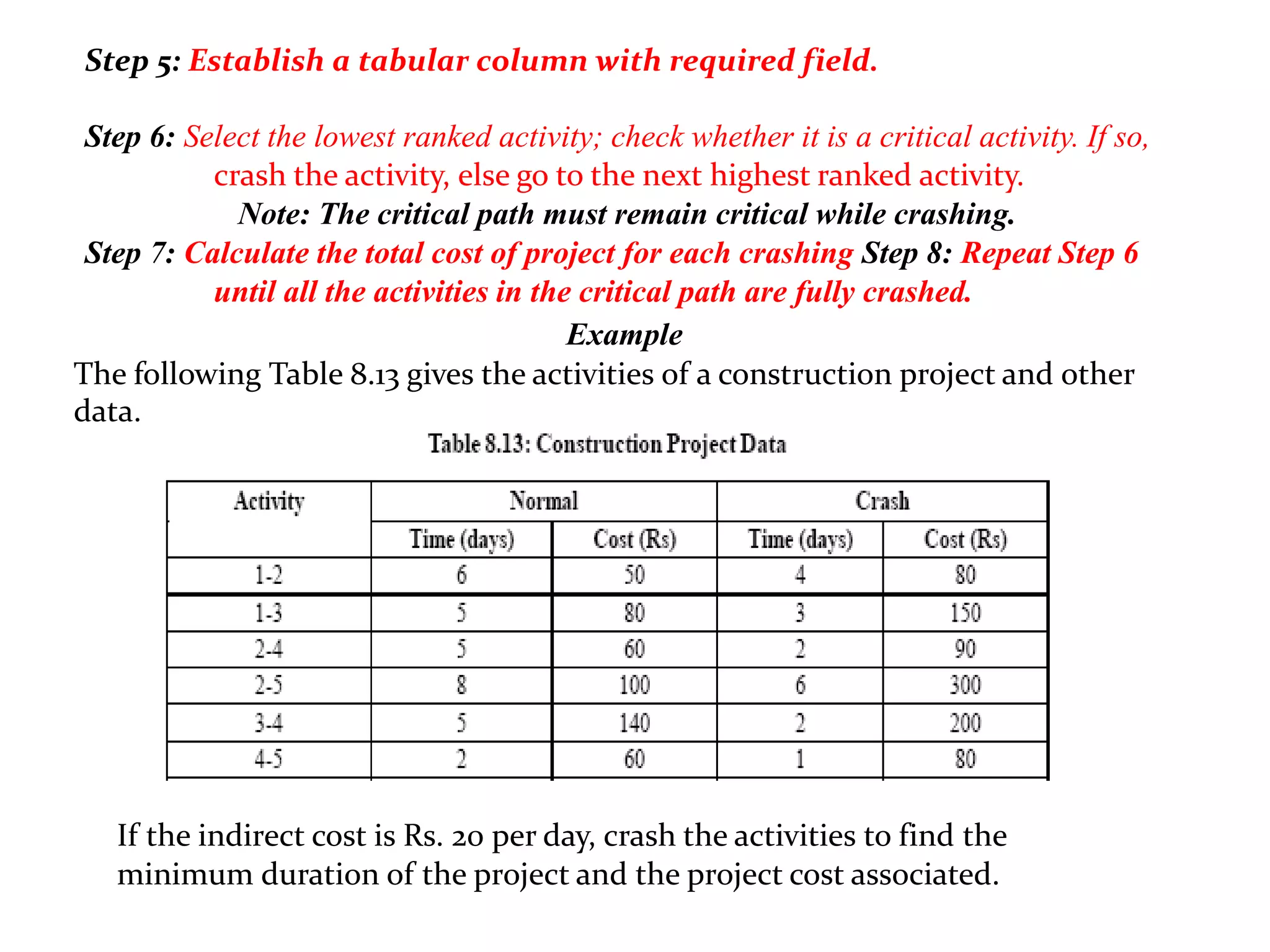
The following Table 8.13 gives the activities of a construction project and other
data.
If the indirect cost is Rs. 20 per day, crash the activities to find the
minimum duration of the project and the project cost associated.
Solution
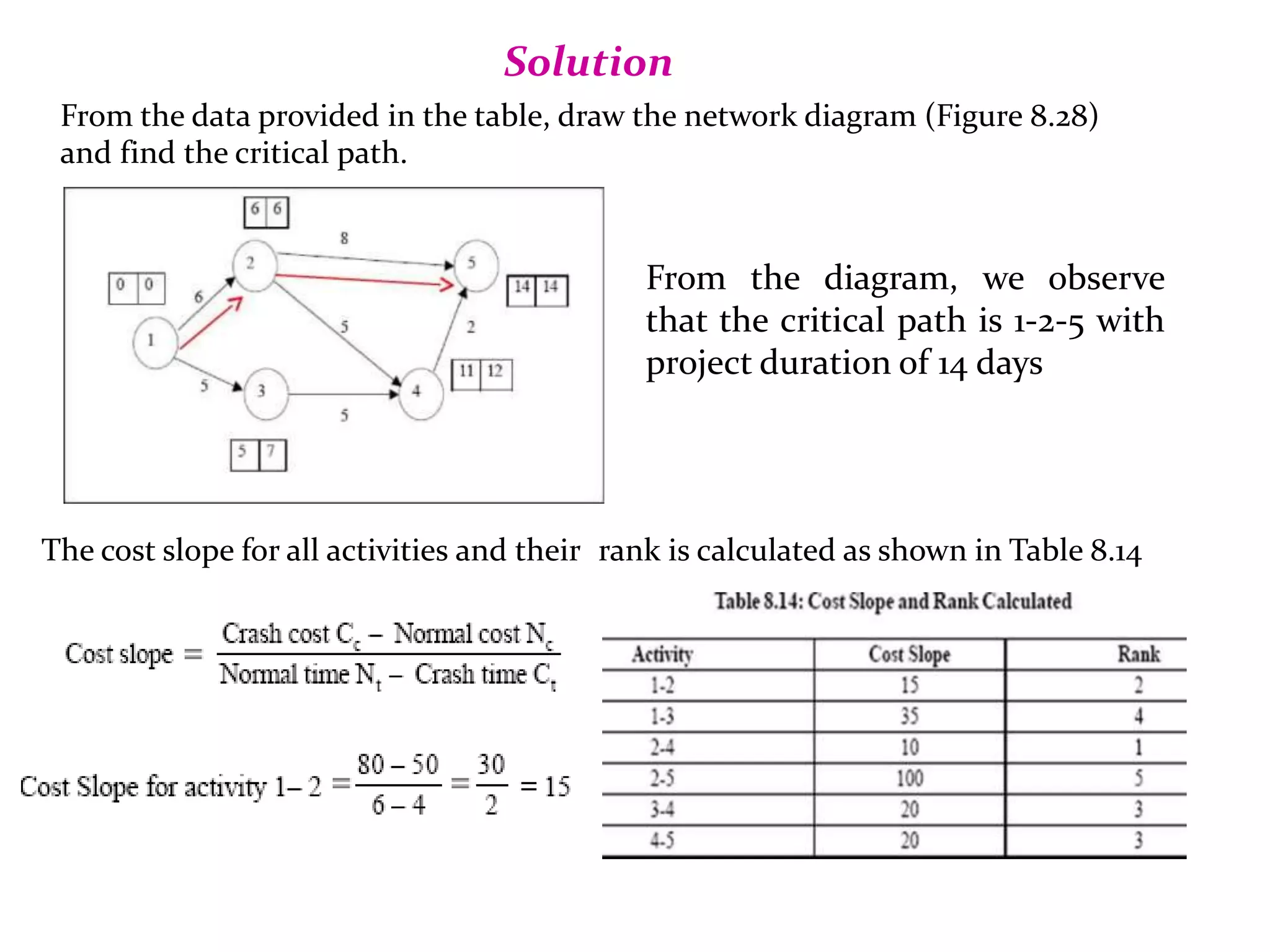
From the data provided in the table, draw the network diagram (Figure 8.28)
and find the critical path.
From the diagram, we observe
that the critical path is 1-2-5 with
project duration of 14 days
The cost slope for all activities and their rank is calculated as shown in Table 8.14
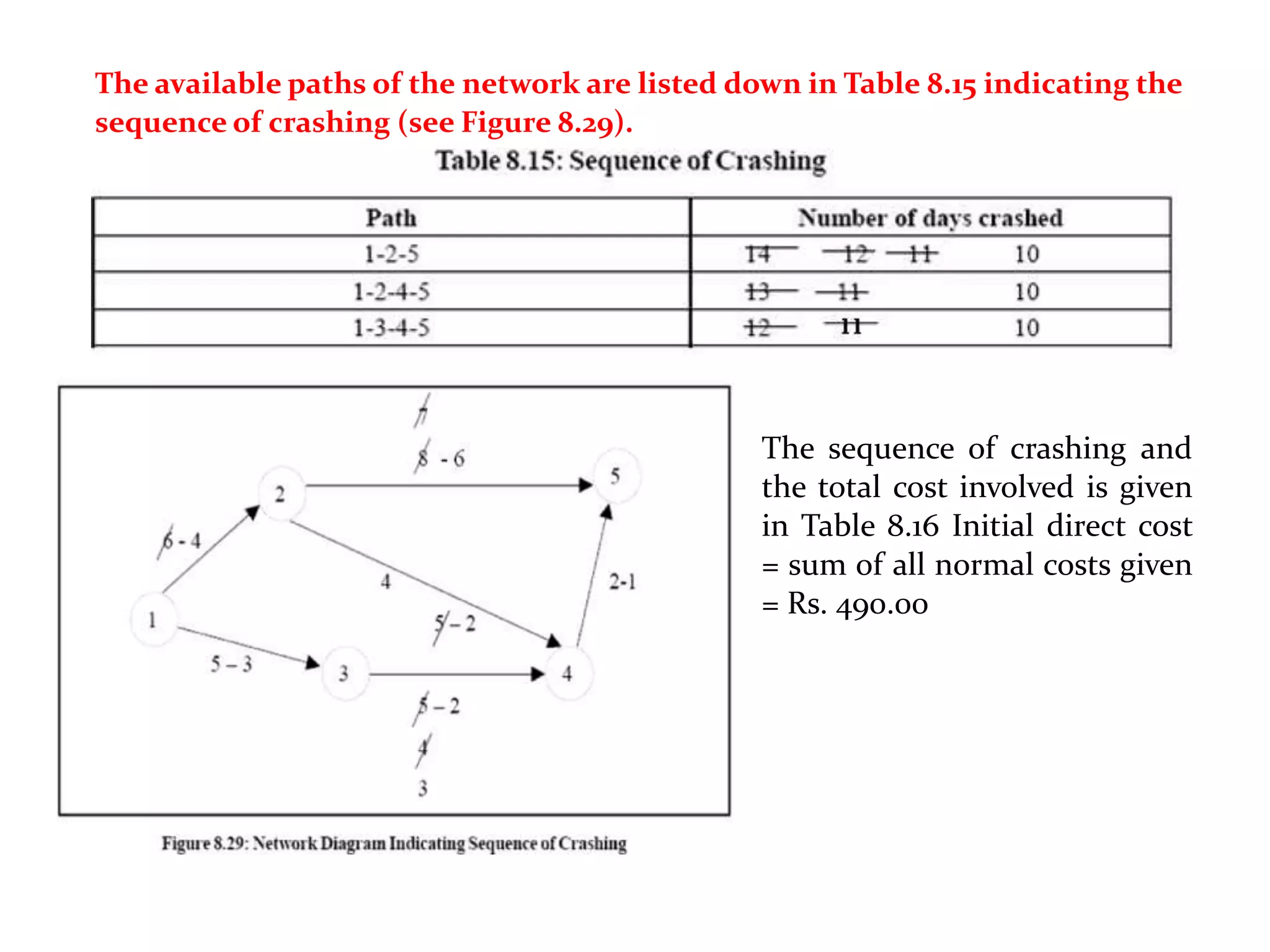
The available paths of the network are listed down in Table 8.15 indicating the
sequence of crashing (see Figure 8.29).
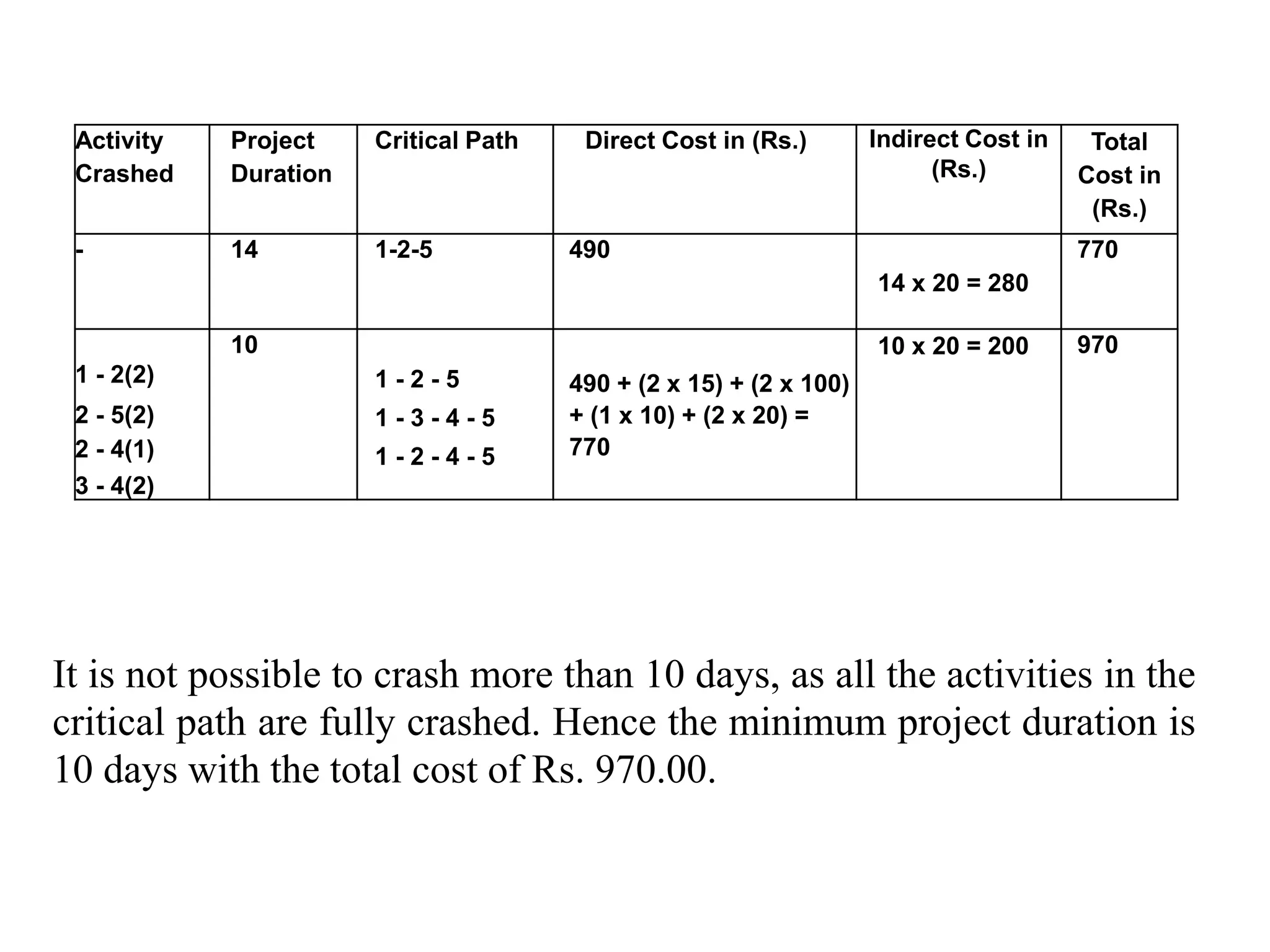
The sequence of crashing and
the total cost involved is given
in Table 8.16 Initial direct cost
= sum of all normal costs given
= Rs. 490.00
Activity
Crashed
Project
Duration
Critical Path Direct Cost in (Rs.) Indirect Cost in
(Rs.)
Total
Cost in
(Rs.)
- 14 1-2-5 490
14 x 20 = 280
770
1 - 2(2)
2 - 5(2)
2 - 4(1)
3 - 4(2)
10
1 - 2 - 5
1 - 3 - 4 - 5
1 - 2 - 4 - 5
490 + (2 x 15) + (2 x 100)
+ (1 x 10) + (2 x 20) =
770
10 x 20 = 200 970
It is not possible to crash more than 10 days, as all the activities in the
critical path are fully crashed. Hence the minimum project duration is
10 days with the total cost of Rs. 970.00.
Network analysis cpm module3 ppt

Network analysis cpm module3 ppt

  • 1.
  • 2.
    What is aProject? • A project is an interrelated set of activities that has definite starting and ending points and that result in a unique product or service • Cuts across organizational lines - they need varied skills of different profession • Uncertainties like new technology & external environment can change the character of the project • Personnel, materials, facilities etc. are temporarily assembled to accomplish a goal within a specified time frame and then disbanded • Upon finish, a project releases lot of resources which were engaged in execution of the project
  • 3.
    Examples of Project •Hosting a College Annual Function • Plan a Space Shuttle to Mars • Construct a Plant to Manufacture Ball Bearings • Plan for Wedding • Designing and Implement a Computer System • Designing a ABS System • Executing Environmental Clean-up Of a Contaminated Site • Erect a New Lab in the Dept. of Mechanical Engineering
  • 4.
    Definition of Project •A project is a one shot, time limited, goal directed, major undertaking, requiring the commitment of varied skills & resources. • It also describes project as a combination of human and non human resources pooled together in a temporary organization to achieve specific purpose
  • 5.
    Project Attributes A project: •Has a unique purpose. • Is temporary. • Is developed using progressive elaboration. • Requires resources, often from various areas. • Should have a primary customer or sponsor. •The project sponsor usually provides the direction and funding for the project. • Involves uncertainty.
  • 6.
    Project and ProgramManagers Project managers work with project sponsors, project teams, and other people involved in projects to meet project goals. Program: "A group of related projects managed in a coordinated way to obtain benefits and control not available from managing them individually." Program managers oversee programs and often act as bosses for project managers. Project management is "the application of knowledge, skills, tools and techniques to project activities to meet project requirements."
  • 7.
    Project Management Toolsand Techniques Project management tools and techniques assist project managers and their teams in various aspects of project management. Specific tools and techniques include: Project charters, scope statements, and WBS (scope). Gantt charts, network diagrams, critical path analyses, critical chain scheduling (time). Cost estimates and earned value management (cost).
  • 8.
    NETWORK ANALYSIS Network Analysisrefers to a number of techniques for the planning and control of complex projects. The two most frequently used forms of network planning are: 1. Programme Evaluation and Review Technique (PERT) 2. Critical Path Method (CPM)
  • 9.
    WHAT IS ANETWORK? A network is a graphical diagram consisting of certain configuration of “Arrows” (O) and “Nodes” (O) for showing the logical sequence of various tasks to be performed to achieve the project objective. hardware. hardware Formaliz e specifica tions Release software Edit tutorials Release prototype . -!-H b Design hardware Design software Release
  • 10.
    PERT / CPMTechniques The initial step in PERT/CPM project scheduling process is the determination of all specific activities that comprise the project and their relationships.
  • 11.
    EXAMPLE Activity Description Duration(in weeks) Immediate predecessor A Obtain the budget approval 2 - B Obtain the machine 5 A C Hire the operator 1 A D Install the machine 1 B E Train the operator 6 C F Produce the goods 1 D,E
  • 12.
    TERMS USED INA NETWORK Activity: An activity represents an action and consumption of resources (time, money, energy) required to complete a portion of a project. Activity is represented by an arrow, . Event: An event (or node) will always occur at the beginning and end of an activity. The event has no resources and is represented by a circle. The ith event and jth event are the tail event and head event respectively. Head Event
  • 13.
    Merge and BurstEvents One or more activities can start and end simultaneously at an event. Preceding and Succeeding Activities Activities performed before given events are known as preceding activities, and activities performed after a given event are known as succeeding activities. Activities A and B precede activities C and D respectively.
  • 14.
    RULES OF NETWORKCONSTRUCTION 1. Each defined activity is represented by one and only one arrow in the network. 2. Before an activity can be undertaken, all activities preceding it must be completed. 3. The arrows depicting various activities are indicative of logical procedure only. The length and bearing of the arrows are of no significance.
  • 15.
    4. The arrowdirection indicates the general progression in time. Head events and Tail events. 5. When a number of activities terminate at one event, it indicates that no activity emanating from that event may start unless all activities terminating there have been completed. 6. Events are identified by numbers. 7. The activities are identified by the numbers of their starting and ending events or by alphabets.
  • 16.
    1. A networkshould have only one initial and terminal node. A Merge Event B B A Burst Event C C
  • 17.
    10. Parallel activitiesbetween two events, without intervening events, are prohibited. When two or more parallel activities in a project have the same head and tail events, dummy activities are needed in constructing the network. Dummy activities do not consume time or resources. An efficient network contains a minimum number of dummy activities required to portray the correct precedence relationships. 11. Looping is not permitted in a network.
  • 18.
    NETWORK SYMBOLS SYMBOL MEANING Activity Event ActivityA must be completed before Activity B completed Activities A & B can occur concurrently, but both must be completed before activity C can begin Activities A & B must be completed before activities C & D can begin, but C can begin independently of D & vice versa
  • 19.
  • 20.
    DUMMY ACTIVITY An imaginaryactivity which does not consume any resource and time is called a dummy activity. Dummy activities are simply used to represent a connection between events in order to maintain a logic in the network. It is represented by a dotted line in a network.
  • 21.
    CRITICAL PATH METHOD CPMaims at the determination of the time to complete a project and the important activities on which a manager shall focus attention.
  • 22.
    PROCEDURE □ Consider allthe paths in a project, beginning with the start event and stopping at the end event. □ For each path, calculate the time of execution. □ The path with the largest time is called the critical path and the activities along this path are called critical activities or bottleneck activities.
  • 23.
    1. You arerequired to prepare a network diagram for constructing a 5 floor apartmei The major activities of the project are given as follows: Activity V Description Immediate Predecessor A Selection of site - B Preparation of drawings - C Arranging the for finance W w A D Selection of contractor A E Getting approval from Govt A F Laying the foundation E G Start construction D.F H Advertise in newspaper B.C I Allocation of tenants G.H
  • 24.
    PERT (Project or ProgramEvaluation and Review Techniques)
  • 25.
    PROJECT EVALUATION REVIEWTECHNIQUE In the critical path method, the time estimates are assumed to be known with certainty. In certain projects like research and development, new product introductions, it is difficult to estimate the time of various activities. Hence PERT is used in such projects with a probabilistic method using three time estimates for an activity, rather than a single estimate, as shown in Figure Optimistic time tO: It is the shortest time taken to complete the activity. It means that if everything goes well then there is more chance of completing the activity within this time. Most likely time tm: It is the normal time taken to complete an activity, if the activity were frequently repeated under the same conditions. Pessimistic time tp: It is the longest time that an activity would take to complete. It is the worst time estimate that an activity would take if unexpected problems are faced. Beta Curve Time duration of activity Figure 8.22: PERT L sing Probabilistic Method with 3 Time Estimates
  • 26.
    Taking all thesetime estimates into consideration, the expected time of an activity is arrived at. The average or mean (ta) value of the activity duration is given by, The variance of the activity time is calculated using the formula, Probability for Project Duration The probability of completingthe project within the scheduled time (Ts) or contracted time may be obtained by using the standard normal deviate where Te is the expected time of project completion. Probability of completing the project within the scheduled time is,
  • 27.
    Example Problem ofPERT An R & D project has a list of tasks to be performed whose time estimates are given in the Table 8.11, as follows. a. Draw the project network. b. Find the critical path. c. Find the probability that the project is completed in 19 days. If the probability is less than 20%, find the probability of completing it in 24 days.
  • 28.
    Time expected foreach activity is calculated using the formula (5): Similarly, the expected time is calculated for all the activities. The variance of activity time is calculated using the formula (6). Similarly, variances of all the activities are calculated.
  • 29.
    A) Construct anetwork diagram: calculate the time earliest (TE) and time Latest (TL) for all the activities. From the network diagram Figure 8.24, the critical path is identified as 1-4, 4-6, 6-7, with a project duration of 22 days.
  • 30.
    C) The probabilityof completing the project within 19 days is given by, P (Z< Z0) To find Zo , we know, P (Z <Z Network Model o) = 0.5 - z (1.3416) (from normal tables, z (1.3416) = 0.4099) = 0.5 - 0.4099 = 0.0901 = 9.01% Thus, the probability of completing the R & D project in 19 days is 9.01%.
  • 31.
    Since the probabilityof completing the project in 19 days is less than 20% As in question, we find the probability of completing it in 24 days.
  • 32.
    COST ANALYSIS The twoimportant components of any activity are the cost and time. Cost is directly proportional to time and vice versa. For example, in constructing a shopping complex, the expected time of completion can be calculated using the time estimates of various activities. But if the construction has to be finished earlier, it requires additional cost to complete the project. We need to arrive at a time/cost trade-off between total cost of project and total time required to complete it. Normal time: Normal time is the time required to complete the activity at normal conditions and cost. Crash time: Crash time is the shortest possible activity time; crashing more than the normal time will increase the direct cost. Cost Slope Cost slope is the increase in cost per unit of time saved by crashing. A linear cost curve is shown in Figure.
  • 33.
    Example An activity takes4 days to complete at a normal cost of Rs. 500.00. If it is possible to complete the activity in 2 days with an additional cost of Rs. 700.00, what is the incremental cost of the activity? Incremental Cost or Cost Slope It means, if one day is reduced we have to spend Rs. 100/- extra per day. Project Crashing Procedure for crashing Step1: Draw the network diagram and mark the Normal time and Crash time. Step2: Calculate TE and TL for all the activities. Step3: Find the critical path and other paths. Step 4: Find the slope for all activities and rank them in ascending order.
  • 34.
    Step 5: Establisha tabular column with required field. Step 6: Select the lowest ranked activity; check whether it is a critical activity. If so, crash the activity, else go to the next highest ranked activity. Note: The critical path must remain critical while crashing. Step 7: Calculate the total cost of project for each crashing Step 8: Repeat Step 6 until all the activities in the critical path are fully crashed. Example The following Table 8.13 gives the activities of a construction project and other data. If the indirect cost is Rs. 20 per day, crash the activities to find the minimum duration of the project and the project cost associated.
  • 35.
    Solution From the dataprovided in the table, draw the network diagram (Figure 8.28) and find the critical path. From the diagram, we observe that the critical path is 1-2-5 with project duration of 14 days The cost slope for all activities and their rank is calculated as shown in Table 8.14
  • 36.
    The available pathsof the network are listed down in Table 8.15 indicating the sequence of crashing (see Figure 8.29). The sequence of crashing and the total cost involved is given in Table 8.16 Initial direct cost = sum of all normal costs given = Rs. 490.00
  • 37.
    Activity Crashed Project Duration Critical Path DirectCost in (Rs.) Indirect Cost in (Rs.) Total Cost in (Rs.) - 14 1-2-5 490 14 x 20 = 280 770 1 - 2(2) 2 - 5(2) 2 - 4(1) 3 - 4(2) 10 1 - 2 - 5 1 - 3 - 4 - 5 1 - 2 - 4 - 5 490 + (2 x 15) + (2 x 100) + (1 x 10) + (2 x 20) = 770 10 x 20 = 200 970 It is not possible to crash more than 10 days, as all the activities in the critical path are fully crashed. Hence the minimum project duration is 10 days with the total cost of Rs. 970.00.