
What is CPM?
 ‘Path’ stands for sequence of activities.
 whereas ‘critical path’ is the sequence of activities with the longest
duration. It is the shortest time possible to complete the project.
Definition++:
 The critical path method (CPM) is a step-by-step technique for process planning .
 The Critical Path Method is a mathematically based algorithm for scheduling a set
of project activities (Further explained in picture).
 Any project with interacting individual activities can apply this method of scheduling.
 The Critical Path Method (CPM) keeps your projects on track.
 It is also known as ‘Critical Path Analysis’.
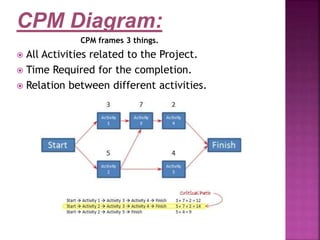
CPM Diagram:
CPM frames 3 things.
 All Activities related to the Project.
 Time Required for the completion.
 Relation between different activities.
Basic Steps:
The basic steps employed in CPM are:
 Determine required tasks
 List required tasks in sequence
 Create a flowchart including each required task
 Identify all critical and non-critical relationships (paths) among required
tasks
 Assign an expected completion/execution time for each required task
 Study all critical relationships to determine all possible alternatives or
backups for as many as possible
Benefits:…
Critical Path Analysis is an effective and powerful method of assessing:
1. †Tasks which must be carried out†.
2. Where parallel activity can be carried out. †
3. The shortest time in which a project can be completed. †
4. Resources needed to achieve a project. †
5. The sequence of activities, scheduling, and timings involved.†
6. Task priorities.
Critical Path Method presentation.

Critical Path Method presentation.

  • 3.
    What is CPM? ‘Path’ stands for sequence of activities.  whereas ‘critical path’ is the sequence of activities with the longest duration. It is the shortest time possible to complete the project. Definition++:  The critical path method (CPM) is a step-by-step technique for process planning .  The Critical Path Method is a mathematically based algorithm for scheduling a set of project activities (Further explained in picture).  Any project with interacting individual activities can apply this method of scheduling.  The Critical Path Method (CPM) keeps your projects on track.  It is also known as ‘Critical Path Analysis’.
  • 4.
    CPM Diagram: CPM frames3 things.  All Activities related to the Project.  Time Required for the completion.  Relation between different activities.
  • 6.
    Basic Steps: The basicsteps employed in CPM are:  Determine required tasks  List required tasks in sequence  Create a flowchart including each required task  Identify all critical and non-critical relationships (paths) among required tasks  Assign an expected completion/execution time for each required task  Study all critical relationships to determine all possible alternatives or backups for as many as possible
  • 7.
    Benefits:… Critical Path Analysisis an effective and powerful method of assessing: 1. †Tasks which must be carried out†. 2. Where parallel activity can be carried out. † 3. The shortest time in which a project can be completed. † 4. Resources needed to achieve a project. † 5. The sequence of activities, scheduling, and timings involved.† 6. Task priorities.