ERYTHROPOIESIS AND ITS
REGULATION AND FUNCTIONS
DR.PRIYANKA VERMA
MBBS,MD PHYSIOLOGY
DEPARTMENT OF PHYSIOLOGY
LNCT MEDICAL COLLEGE INDORE
Red Blood Cells (Mature Erythrocytes)
• Each red blood cell (RBC) - bounded by a cell membrane
• Non-nucleated
• Has no nucleus, no mitochondria and no ribosome.
• The cytoplasm of the RBC contains a special pigmented protein called the
haemoglobin.
• (Hb) - 90% of the weight of the erythrocytes.
• The red color of the RBCs and blood is due to - Hb.
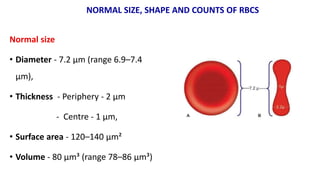
Normal size
• Diameter - 7.2 μm (range 6.9–7.4
μm),
• Thickness - Periphery - 2 μm
- Centre - 1 μm,
• Surface area - 120–140 μm²
• Volume - 80 μm³ (range 78–86 μm³)
NORMAL SIZE, SHAPE AND COUNTS OF RBCS
Normal shape
The RBCs are circular, biconcave discs
Advantages of biconcave shape are:
I. Allows considerable change in cell volume. Thus, can withstand
considerable changes of osmotic pressure and resist hemolysis.
II. Allows easy folding of RBC on itself when it passes through capillaries.
III. Haemoglobin remains distributed in the center of the RBC which
facilitates optimal and quick exchange of gases (ie. oxygen and carbon
dioxide).
Composition
i. 62.5% water
ii. 35% Haemoglobin (29.5 ± 2.5 pg/ RBC)
a) Sugar - glucose
b) Lipids - cephalin, cholesterol and lecithin
c) Protein - Glutathione, albumin like insoluble protein, acts as a reducing
agent, thus prevents damage of haemoglobin.
d) Enzymes of glycolytic system; carbonic - anhydrase and catalase.
e) Ions - Na⁺, K⁺, Ca²⁺, PO₄³⁻ and SO₄²⁻
RED CELL MEMBRANE
Structure
• Erythrocytes are covered by cell membrane.
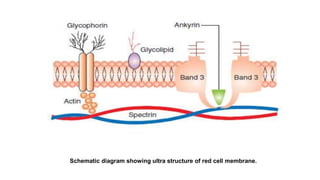
• Below the cell membrane structural proteins - Spectrin,
Ankyrin ,Actin and other proteins are present.
• These proteins are arranged in a mesh like pattern.
Schematic diagram showing ultra structure of red cell membrane.
They are responsible for
 Flexibility of RBC membrane
 Maintain the biconcave shape of RBC
 provides membrane stability and durability to the red cells
 Contain specific blood group antigen like A or B.
Common membrane defects:
• Therefore, deficiency of ankyrin and spectrin results in
membrane defects like spherocytosis, elliptocytosis and
poikilocytosis, etc.
• These defects also make the cells rigid so that the cells are
destroyed prematurely.
Permeability
• Semi-permeable membrane
• Impermeable to sodium, calcium and barium ions, fats and sugars,
• Slightly impermeable to amino acids
• Freely permeable to all anions like Cl⁻, SO₄⁻ and HCO₃⁻, and to urea,
ammonia, aldehyde, alcohol and bile salts.
Energy Sources
• Energy comes from Glycolysis (80%) and the HMP shunt pathway (20%).
• It is required for the RBC to maintain
1) Ionic gradient across its membrane,
2) Volume and
3) To keep iron in fe⁺⁺ state.
• Since mitochondria are absent, there is no citric acid cycle and electron
carrier system in the RBC.
PROPERTIES
1. Suspension stability
2. Rouleux formation
3. Sedimentation
4. Fragility
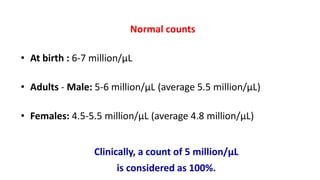
Normal counts
• At birth : 6-7 million/μL
• Adults - Male: 5-6 million/μL (average 5.5 million/μL)
• Females: 4.5-5.5 million/μL (average 4.8 million/μL)
Clinically, a count of 5 million/μL
is considered as 100%.
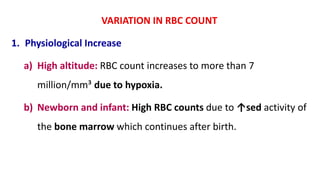
VARIATION IN RBC COUNT
1. Physiological Increase
a) High altitude: RBC count increases to more than 7
million/mm³ due to hypoxia.
b) Newborn and infant: High RBC counts due to ↑sed activity of
the bone marrow which continues after birth.
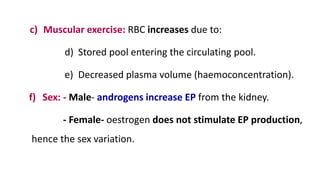
c) Muscular exercise: RBC increases due to:
d) Stored pool entering the circulating pool.
e) Decreased plasma volume (haemoconcentration).
f) Sex: - Male- androgens increase EP from the kidney.
- Female- oestrogen does not stimulate EP production,
hence the sex variation.
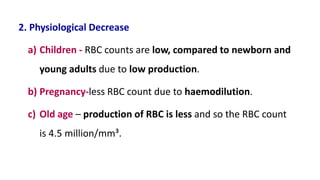
2. Physiological Decrease
a) Children - RBC counts are low, compared to newborn and
young adults due to low production.
b) Pregnancy-less RBC count due to haemodilution.
c) Old age – production of RBC is less and so the RBC count
is 4.5 million/mm³.
3. Pathological Increase
a) Polycythaemia vera- RBC count increases to 8 million/ mm³
or above. malignancies of the bone marrow.
b) Congenital heart disease - RBC increase due to hypoxia as
there is a mixing of venous blood with arterial blood.
c) Chronic lung disease - RBC increase due to hypoxia.
d) Leukemia - Increased RBC due to an increase activity of bone
marrow.
e) Cushing syndrome -Production is high. EP production increases
due to cortisol.
f) Hyperthyroidism - Production is high. EP production increases
due to higher levels of T₃ and T₄.
VARIATION IN SIZE
• Normocytes:- When the size is 7.2 μm.
• Microcyte:- The size of the RBC is smaller than normal.
 Microcytes are seen in :
1.Iron deficiency anaemia
2.Chronic infections
3.Thalassemia
4.Increased osmotic pressure in blood.
• Macrocytes: These are bigger RBC:
1. Megaloblastic anemia
2. Decreased osmotic pressure in blood
• Anisocytosis: RBC with unequal size are called anisocytes.
These are seen in pernicious anemia.
VARIATION IN STRUCTURE
1. Punctate basophilia: Small dots of basophilic material in the cytoplasm.
2. Cabot's ring: Ring shape or figure of '8' material appears in the cell.
3. Howell Jolly bodies: Small nuclear fragments are present in the
cytoplasm.
All the above are seen in lead poisoning.
4. Siderocyte: RBC containing nonhaem iron granules in the cytoplasm are
called siderocytes. seen in lead poisoning and splenectomized persons.
VARIATION IN SHAPE
• Crenation: [hypertonic solution].
• Spherocytosis: [hypotonic solution].
• Elliptocytosis: elliptical.
• Sickle cell: Crescentic shape
• Poikilocytosis: Presence of different
shaped cells [sickle cell anaemia].
FUNCTIONS OF RBC
1. O₂ transport.
2. RBC transports CO₂.
3. RBC transport nitric oxide (NO) and release in the tissue where NO causes
vasodilatation.
4. RBC participate in acid-base balance.
5. RBC contribute to the viscosity of blood.
6. RBC influence erythrocyte sedimention rate. inverse relationship.
7. Antigens of the RBC membrane are useful for identification of blood groups.
Haemopoesis
• Blood cell production is referred to as haemopoiesis.
• This includes:
a) Erythropoiesis (RBC production)
b) Leucopoiesis (WBC production)
c) Thrombopoiesis (Platelet production)
• Two theories have been proposed:
I. Monophyletic theory
II. Polyphyletic theory
• Monophyletic theory:
• According to this theory all the blood cells are produced from a single
cell called pluripotent haemopoietic stem cell or totipotent stem cell.
• Polyphyletic theory:
• According to this theory different types of blood cells take origin from
different stem cells.
Monophyletic theory has been accepted because of the evidences
available in favour of it.
SITES OF HAEMOPOIESIS
• First 2 months of gestation - yolk sac - (Mesoblastic
Stage).
• From 3rd months of gestation - till birth, liver and spleen.
(Hepatic Stage).
• From 20th week of gestation, - bone marrow and by 7th
or 8th month- main site (Myeloid Stage).
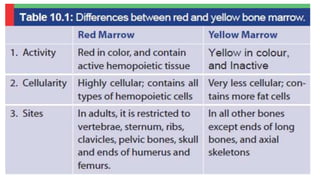
• Red Bone Marrow -active haemopoietic bone
marrow - due to marked cellularity
• Yellow Bone Marrow – Progressive fatty
replacement throughout the long bones converting
red bone marrow into yellow BM.
Extra medullary hemopoiesis after birth is abnormal:
 Hemopoiesis in liver and spleen is physiological during
intrauterine life.
 However, hemopoiesis in these organs or in any other organ
(Extramedullary hemopoiesis) after birth is considered
abnormal.
BLOOD CELL PRECURSORS
Stem cells
• The monophyletic theory - all blood cells originate from the
pluripotent or multipotent stem cell.
• Stem cells possess 2 fundamental properties:
 Self-replication - capable of cell division
 Differentiation and commitment - ability to differentiate into
specialized cells called progenitor cells.
• The mother hematopoietic stem cell is the Pluripotent
Hematopoietic Stem Cells (PHSC).
 Producing 2 important groups of stem cells.
1. Lymphoid (immune
system) stem cells which
ultimately develop into
lymphocytes
2. Myeloid (trilineage) stem
cells which later
differentiate into 3 types
of cell lines
Myeloid (trilineage) stem cells
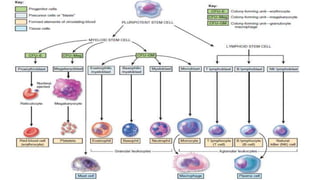
• Granulocyte–monocyte progenitors which produce all
leucocytes except the lymphocytes.
• Erythroid progenitors - produce RBCs.
• Megakaryocyte progenitors - produce platelets.
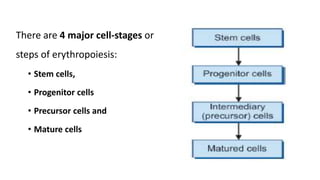
There are 4 major cell-stages or
steps of erythropoiesis:
• Stem cells,
• Progenitor cells
• Precursor cells and
• Mature cells
Progenitor Cells
• Have ability to give rise to clones (group of cells), so
they are also called colony forming cells or colony
forming units (CFU).
• CFU-GEMM (colony forming
unit–granulocyte, erythroid,
megakaryocyte and
macrophage)
• BFU-E (burst forming unit–
erythroid ) - large colonies of
erythroid series.
• CFU-E (colony forming unit–
erythroid ) - erythrocytes.
• Ba–CFU - basophil colony
forming units.
• Eo–CFU - eosinophil colony
forming units.
• M–CFU - monocyte colony
forming units.
• G–CFU -neutrophil forming
units
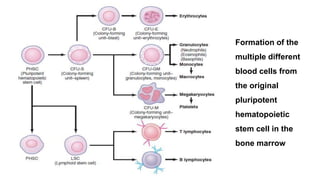
Formation of the
multiple different
blood cells from
the original
pluripotent
hematopoietic
stem cell in the
bone marrow
CONTROL OF HAEMOPOIESIS
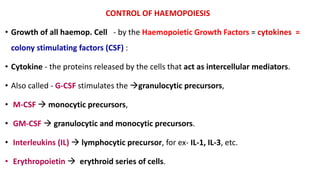
• Growth of all haemop. Cell - by the Haemopoietic Growth Factors = cytokines =
colony stimulating factors (CSF) :
• Cytokine - the proteins released by the cells that act as intercellular mediators.
• Also called - G-CSF stimulates the granulocytic precursors,
• M-CSF  monocytic precursors,
• GM-CSF  granulocytic and monocytic precursors.
• Interleukins (IL)  lymphocytic precursor, for ex- IL-1, IL-3, etc.
• Erythropoietin  erythroid series of cells.
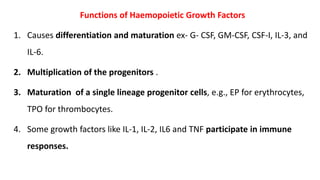
Functions of Haemopoietic Growth Factors
1. Causes differentiation and maturation ex- G- CSF, GM-CSF, CSF-I, IL-3, and
IL-6.
2. Multiplication of the progenitors .
3. Maturation of a single lineage progenitor cells, e.g., EP for erythrocytes,
TPO for thrombocytes.
4. Some growth factors like IL-1, IL-2, IL6 and TNF participate in immune
responses.
ERYTHROPOIESIS
ERYTHROPOIESIS
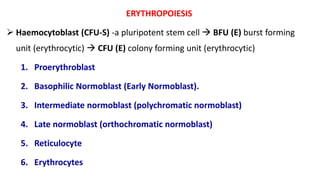
 Haemocytoblast (CFU-S) -a pluripotent stem cell  BFU (E) burst forming
unit (erythrocytic)  CFU (E) colony forming unit (erythrocytic)
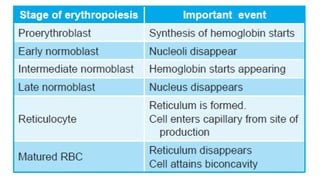
1. Proerythroblast
2. Basophilic Normoblast (Early Normoblast).
3. Intermediate normoblast (polychromatic normoblast)
4. Late normoblast (orthochromatic normoblast)
5. Reticulocyte
6. Erythrocytes
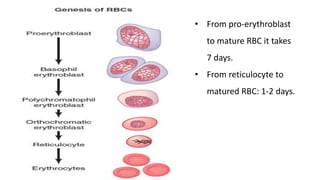
• From pro-erythroblast
to mature RBC it takes
7 days.
• From reticulocyte to
matured RBC: 1-2 days.
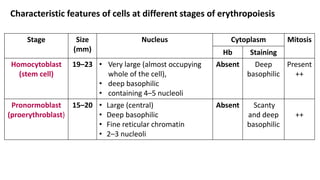
Characteristic features of cells at different stages of erythropoiesis
Stage Size
(mm)
Nucleus Cytoplasm Mitosis
Hb Staining
Homocytoblast
(stem cell)
19–23 • Very large (almost occupying
whole of the cell),
• deep basophilic
• containing 4–5 nucleoli
Absent Deep
basophilic
Present
++
Pronormoblast
(proerythroblast)
15–20 • Large (central)
• Deep basophilic
• Fine reticular chromatin
• 2–3 nucleoli
Absent Scanty
and deep
basophilic
++
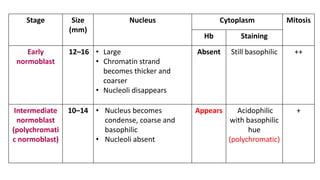
Stage Size
(mm)
Nucleus Cytoplasm Mitosis
Hb Staining
Early
normoblast
12–16 • Large
• Chromatin strand
becomes thicker and
coarser
• Nucleoli disappears
Absent Still basophilic ++
Intermediate
normoblast
(polychromati
c normoblast)
10–14 • Nucleus becomes
condense, coarse and
basophilic
• Nucleoli absent
Appears Acidophilic
with basophilic
hue
(polychromatic)
+
Stage Size
(mm)
Nucleus Cytoplasm Mitosis
Hb Staining
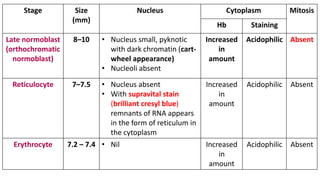
Late normoblast
(orthochromatic
normoblast)
8–10 • Nucleus small, pyknotic
with dark chromatin (cart-
wheel appearance)
• Nucleoli absent
Increased
in
amount
Acidophilic Absent
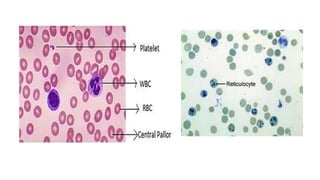
Reticulocyte 7–7.5 • Nucleus absent
• With supravital stain
(brilliant cresyl blue)
remnants of RNA appears
in the form of reticulum in
the cytoplasm
Increased
in
amount
Acidophilic Absent
Erythrocyte 7.2 – 7.4 • Nil Increased
in
amount
Acidophilic Absent
Mature Cells - Reticulocytes
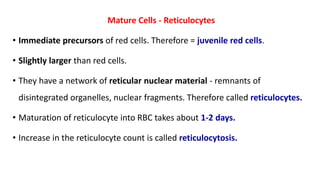
• Immediate precursors of red cells. Therefore = juvenile red cells.
• Slightly larger than red cells.
• They have a network of reticular nuclear material - remnants of
disintegrated organelles, nuclear fragments. Therefore called reticulocytes.
• Maturation of reticulocyte into RBC takes about 1-2 days.
• Increase in the reticulocyte count is called reticulocytosis.
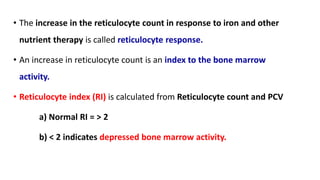
• The increase in the reticulocyte count in response to iron and other
nutrient therapy is called reticulocyte response.
• An increase in reticulocyte count is an index to the bone marrow
activity.
• Reticulocyte index (RI) is calculated from Reticulocyte count and PCV
a) Normal RI = > 2
b) < 2 indicates depressed bone marrow activity.
REGULATION OF ERYTHROPOIESIS
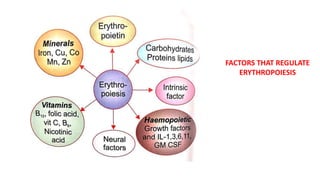
1. General factors – Erythropoietin , Hypoxia
2. Special maturation factors
• Dietary factors – Vitamins , Minerals
• Castle’s intrinsic factors
• Hormones
Erythropoietin
• Glycoprotein having molecular weight of 34,000.
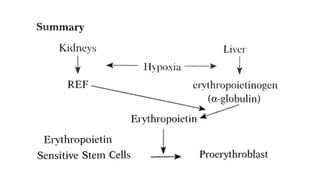
• 85% - Produced by the juxta glomerular apparatus of kidney.
• 15% - by extra renal sources like liver and tissue macrophage
system.
• Stimulant  hypoxia or ↓se in the number of RBCs (e.g. after
haemorrhage or in haemolytic anaemia).
Actions
1. EP multiplication of BFU (E), CFU (E), proerythroblasts, basophilic and
polychromatophilic normoblasts.
2. Stimulates Hb synthesis by increasing globulin synthesis.
3. Causes maturation of all stages of erythropoiesis.
4. Promotes release of RBC from bone marrow into the peripheral
circulation.
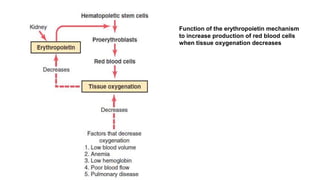
Function of the erythropoietin mechanism
to increase production of red blood cells
when tissue oxygenation decreases
Special Maturation Factors (Factors responsible for final maturation of
RBCs)
I. Proteins help in 'globin' formation.
II. Iron, manganese, copper, cobalt, nickel help in 'haem‘ formation.
III. Calcium increases iron absorption from GIT.
IV. Vitamins C -helps in absorption of iron.
V. B₆  cofactor in the formation of haem.
VI. B12 and folic acid help in synthesis of nucleic acid.
VII. Castle’s Intrinsic Factor
• Vitamin B12, intrinsic factor of Castle and folic acid
• Maturation of a RBC - essential for the synthesis of DNA
• Required for the formation of thymidine triphosphate, one
of the essential building blocks of DNA.
• Intrinsic factor helps in absorption of vitamin B₁₂ from
ileum.
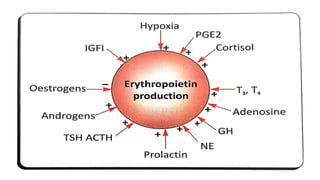
• Androgens - stimulate erythropoiesis. [Males - higher red cell count]
• Oestrogens - inhibits erythropoiesis by inhibiting erythropoietin production
and also by ↓ing the response of stem cells to erythropoietin.
• Thyroxin, Cortisol and Growth Hormone
1. Thyroxin stimulates erythropoiesis, it stimulates erythropoietin
production.
2. Growth hormone increases the mitosis and maturation of erythroid
precursors.
3. Cortisol produces mild erythrocytosis.
FACTORS THAT REGULATE
ERYTHROPOIESIS
THANK YOU

Haemopoesis Erythropoesis

  • 1.
    ERYTHROPOIESIS AND ITS REGULATIONAND FUNCTIONS DR.PRIYANKA VERMA MBBS,MD PHYSIOLOGY DEPARTMENT OF PHYSIOLOGY LNCT MEDICAL COLLEGE INDORE
  • 2.
    Red Blood Cells(Mature Erythrocytes) • Each red blood cell (RBC) - bounded by a cell membrane • Non-nucleated • Has no nucleus, no mitochondria and no ribosome. • The cytoplasm of the RBC contains a special pigmented protein called the haemoglobin. • (Hb) - 90% of the weight of the erythrocytes. • The red color of the RBCs and blood is due to - Hb.
  • 3.
    Normal size • Diameter- 7.2 μm (range 6.9–7.4 μm), • Thickness - Periphery - 2 μm - Centre - 1 μm, • Surface area - 120–140 μm² • Volume - 80 μm³ (range 78–86 μm³) NORMAL SIZE, SHAPE AND COUNTS OF RBCS
  • 4.
    Normal shape The RBCsare circular, biconcave discs Advantages of biconcave shape are: I. Allows considerable change in cell volume. Thus, can withstand considerable changes of osmotic pressure and resist hemolysis. II. Allows easy folding of RBC on itself when it passes through capillaries. III. Haemoglobin remains distributed in the center of the RBC which facilitates optimal and quick exchange of gases (ie. oxygen and carbon dioxide).
  • 5.
    Composition i. 62.5% water ii.35% Haemoglobin (29.5 ± 2.5 pg/ RBC) a) Sugar - glucose b) Lipids - cephalin, cholesterol and lecithin c) Protein - Glutathione, albumin like insoluble protein, acts as a reducing agent, thus prevents damage of haemoglobin. d) Enzymes of glycolytic system; carbonic - anhydrase and catalase. e) Ions - Na⁺, K⁺, Ca²⁺, PO₄³⁻ and SO₄²⁻
  • 6.
    RED CELL MEMBRANE Structure •Erythrocytes are covered by cell membrane. • Below the cell membrane structural proteins - Spectrin, Ankyrin ,Actin and other proteins are present. • These proteins are arranged in a mesh like pattern.
  • 7.
    Schematic diagram showingultra structure of red cell membrane.
  • 8.
    They are responsiblefor  Flexibility of RBC membrane  Maintain the biconcave shape of RBC  provides membrane stability and durability to the red cells  Contain specific blood group antigen like A or B.
  • 9.
    Common membrane defects: •Therefore, deficiency of ankyrin and spectrin results in membrane defects like spherocytosis, elliptocytosis and poikilocytosis, etc. • These defects also make the cells rigid so that the cells are destroyed prematurely.
  • 10.
    Permeability • Semi-permeable membrane •Impermeable to sodium, calcium and barium ions, fats and sugars, • Slightly impermeable to amino acids • Freely permeable to all anions like Cl⁻, SO₄⁻ and HCO₃⁻, and to urea, ammonia, aldehyde, alcohol and bile salts.
  • 11.
    Energy Sources • Energycomes from Glycolysis (80%) and the HMP shunt pathway (20%). • It is required for the RBC to maintain 1) Ionic gradient across its membrane, 2) Volume and 3) To keep iron in fe⁺⁺ state. • Since mitochondria are absent, there is no citric acid cycle and electron carrier system in the RBC.
  • 12.
    PROPERTIES 1. Suspension stability 2.Rouleux formation 3. Sedimentation 4. Fragility
  • 13.
    Normal counts • Atbirth : 6-7 million/μL • Adults - Male: 5-6 million/μL (average 5.5 million/μL) • Females: 4.5-5.5 million/μL (average 4.8 million/μL) Clinically, a count of 5 million/μL is considered as 100%.
  • 14.
    VARIATION IN RBCCOUNT 1. Physiological Increase a) High altitude: RBC count increases to more than 7 million/mm³ due to hypoxia. b) Newborn and infant: High RBC counts due to ↑sed activity of the bone marrow which continues after birth.
  • 15.
    c) Muscular exercise:RBC increases due to: d) Stored pool entering the circulating pool. e) Decreased plasma volume (haemoconcentration). f) Sex: - Male- androgens increase EP from the kidney. - Female- oestrogen does not stimulate EP production, hence the sex variation.
  • 16.
    2. Physiological Decrease a)Children - RBC counts are low, compared to newborn and young adults due to low production. b) Pregnancy-less RBC count due to haemodilution. c) Old age – production of RBC is less and so the RBC count is 4.5 million/mm³.
  • 17.
    3. Pathological Increase a)Polycythaemia vera- RBC count increases to 8 million/ mm³ or above. malignancies of the bone marrow. b) Congenital heart disease - RBC increase due to hypoxia as there is a mixing of venous blood with arterial blood. c) Chronic lung disease - RBC increase due to hypoxia.
  • 18.
    d) Leukemia -Increased RBC due to an increase activity of bone marrow. e) Cushing syndrome -Production is high. EP production increases due to cortisol. f) Hyperthyroidism - Production is high. EP production increases due to higher levels of T₃ and T₄.
  • 19.
    VARIATION IN SIZE •Normocytes:- When the size is 7.2 μm. • Microcyte:- The size of the RBC is smaller than normal.  Microcytes are seen in : 1.Iron deficiency anaemia 2.Chronic infections 3.Thalassemia 4.Increased osmotic pressure in blood.
  • 20.
    • Macrocytes: Theseare bigger RBC: 1. Megaloblastic anemia 2. Decreased osmotic pressure in blood • Anisocytosis: RBC with unequal size are called anisocytes. These are seen in pernicious anemia.
  • 21.
    VARIATION IN STRUCTURE 1.Punctate basophilia: Small dots of basophilic material in the cytoplasm. 2. Cabot's ring: Ring shape or figure of '8' material appears in the cell. 3. Howell Jolly bodies: Small nuclear fragments are present in the cytoplasm. All the above are seen in lead poisoning. 4. Siderocyte: RBC containing nonhaem iron granules in the cytoplasm are called siderocytes. seen in lead poisoning and splenectomized persons.
  • 22.
    VARIATION IN SHAPE •Crenation: [hypertonic solution]. • Spherocytosis: [hypotonic solution]. • Elliptocytosis: elliptical. • Sickle cell: Crescentic shape • Poikilocytosis: Presence of different shaped cells [sickle cell anaemia].
  • 23.
    FUNCTIONS OF RBC 1.O₂ transport. 2. RBC transports CO₂. 3. RBC transport nitric oxide (NO) and release in the tissue where NO causes vasodilatation. 4. RBC participate in acid-base balance. 5. RBC contribute to the viscosity of blood. 6. RBC influence erythrocyte sedimention rate. inverse relationship. 7. Antigens of the RBC membrane are useful for identification of blood groups.
  • 24.
  • 25.
    • Blood cellproduction is referred to as haemopoiesis. • This includes: a) Erythropoiesis (RBC production) b) Leucopoiesis (WBC production) c) Thrombopoiesis (Platelet production) • Two theories have been proposed: I. Monophyletic theory II. Polyphyletic theory
  • 26.
    • Monophyletic theory: •According to this theory all the blood cells are produced from a single cell called pluripotent haemopoietic stem cell or totipotent stem cell. • Polyphyletic theory: • According to this theory different types of blood cells take origin from different stem cells. Monophyletic theory has been accepted because of the evidences available in favour of it.
  • 27.
    SITES OF HAEMOPOIESIS •First 2 months of gestation - yolk sac - (Mesoblastic Stage). • From 3rd months of gestation - till birth, liver and spleen. (Hepatic Stage). • From 20th week of gestation, - bone marrow and by 7th or 8th month- main site (Myeloid Stage).
  • 28.
    • Red BoneMarrow -active haemopoietic bone marrow - due to marked cellularity • Yellow Bone Marrow – Progressive fatty replacement throughout the long bones converting red bone marrow into yellow BM.
  • 30.
    Extra medullary hemopoiesisafter birth is abnormal:  Hemopoiesis in liver and spleen is physiological during intrauterine life.  However, hemopoiesis in these organs or in any other organ (Extramedullary hemopoiesis) after birth is considered abnormal.
  • 31.
    BLOOD CELL PRECURSORS Stemcells • The monophyletic theory - all blood cells originate from the pluripotent or multipotent stem cell. • Stem cells possess 2 fundamental properties:  Self-replication - capable of cell division  Differentiation and commitment - ability to differentiate into specialized cells called progenitor cells.
  • 32.
    • The motherhematopoietic stem cell is the Pluripotent Hematopoietic Stem Cells (PHSC).  Producing 2 important groups of stem cells. 1. Lymphoid (immune system) stem cells which ultimately develop into lymphocytes 2. Myeloid (trilineage) stem cells which later differentiate into 3 types of cell lines
  • 33.
    Myeloid (trilineage) stemcells • Granulocyte–monocyte progenitors which produce all leucocytes except the lymphocytes. • Erythroid progenitors - produce RBCs. • Megakaryocyte progenitors - produce platelets.
  • 34.
    There are 4major cell-stages or steps of erythropoiesis: • Stem cells, • Progenitor cells • Precursor cells and • Mature cells
  • 35.
    Progenitor Cells • Haveability to give rise to clones (group of cells), so they are also called colony forming cells or colony forming units (CFU).
  • 36.
    • CFU-GEMM (colonyforming unit–granulocyte, erythroid, megakaryocyte and macrophage) • BFU-E (burst forming unit– erythroid ) - large colonies of erythroid series. • CFU-E (colony forming unit– erythroid ) - erythrocytes. • Ba–CFU - basophil colony forming units. • Eo–CFU - eosinophil colony forming units. • M–CFU - monocyte colony forming units. • G–CFU -neutrophil forming units
  • 37.
    Formation of the multipledifferent blood cells from the original pluripotent hematopoietic stem cell in the bone marrow
  • 39.
    CONTROL OF HAEMOPOIESIS •Growth of all haemop. Cell - by the Haemopoietic Growth Factors = cytokines = colony stimulating factors (CSF) : • Cytokine - the proteins released by the cells that act as intercellular mediators. • Also called - G-CSF stimulates the granulocytic precursors, • M-CSF  monocytic precursors, • GM-CSF  granulocytic and monocytic precursors. • Interleukins (IL)  lymphocytic precursor, for ex- IL-1, IL-3, etc. • Erythropoietin  erythroid series of cells.
  • 40.
    Functions of HaemopoieticGrowth Factors 1. Causes differentiation and maturation ex- G- CSF, GM-CSF, CSF-I, IL-3, and IL-6. 2. Multiplication of the progenitors . 3. Maturation of a single lineage progenitor cells, e.g., EP for erythrocytes, TPO for thrombocytes. 4. Some growth factors like IL-1, IL-2, IL6 and TNF participate in immune responses.
  • 41.
  • 42.
    ERYTHROPOIESIS  Haemocytoblast (CFU-S)-a pluripotent stem cell  BFU (E) burst forming unit (erythrocytic)  CFU (E) colony forming unit (erythrocytic) 1. Proerythroblast 2. Basophilic Normoblast (Early Normoblast). 3. Intermediate normoblast (polychromatic normoblast) 4. Late normoblast (orthochromatic normoblast) 5. Reticulocyte 6. Erythrocytes
  • 43.
    • From pro-erythroblast tomature RBC it takes 7 days. • From reticulocyte to matured RBC: 1-2 days.
  • 44.
    Characteristic features ofcells at different stages of erythropoiesis Stage Size (mm) Nucleus Cytoplasm Mitosis Hb Staining Homocytoblast (stem cell) 19–23 • Very large (almost occupying whole of the cell), • deep basophilic • containing 4–5 nucleoli Absent Deep basophilic Present ++ Pronormoblast (proerythroblast) 15–20 • Large (central) • Deep basophilic • Fine reticular chromatin • 2–3 nucleoli Absent Scanty and deep basophilic ++
  • 45.
    Stage Size (mm) Nucleus CytoplasmMitosis Hb Staining Early normoblast 12–16 • Large • Chromatin strand becomes thicker and coarser • Nucleoli disappears Absent Still basophilic ++ Intermediate normoblast (polychromati c normoblast) 10–14 • Nucleus becomes condense, coarse and basophilic • Nucleoli absent Appears Acidophilic with basophilic hue (polychromatic) +
  • 46.
    Stage Size (mm) Nucleus CytoplasmMitosis Hb Staining Late normoblast (orthochromatic normoblast) 8–10 • Nucleus small, pyknotic with dark chromatin (cart- wheel appearance) • Nucleoli absent Increased in amount Acidophilic Absent Reticulocyte 7–7.5 • Nucleus absent • With supravital stain (brilliant cresyl blue) remnants of RNA appears in the form of reticulum in the cytoplasm Increased in amount Acidophilic Absent Erythrocyte 7.2 – 7.4 • Nil Increased in amount Acidophilic Absent
  • 47.
    Mature Cells -Reticulocytes • Immediate precursors of red cells. Therefore = juvenile red cells. • Slightly larger than red cells. • They have a network of reticular nuclear material - remnants of disintegrated organelles, nuclear fragments. Therefore called reticulocytes. • Maturation of reticulocyte into RBC takes about 1-2 days. • Increase in the reticulocyte count is called reticulocytosis.
  • 48.
    • The increasein the reticulocyte count in response to iron and other nutrient therapy is called reticulocyte response. • An increase in reticulocyte count is an index to the bone marrow activity. • Reticulocyte index (RI) is calculated from Reticulocyte count and PCV a) Normal RI = > 2 b) < 2 indicates depressed bone marrow activity.
  • 50.
    REGULATION OF ERYTHROPOIESIS 1.General factors – Erythropoietin , Hypoxia 2. Special maturation factors • Dietary factors – Vitamins , Minerals • Castle’s intrinsic factors • Hormones
  • 52.
    Erythropoietin • Glycoprotein havingmolecular weight of 34,000. • 85% - Produced by the juxta glomerular apparatus of kidney. • 15% - by extra renal sources like liver and tissue macrophage system. • Stimulant  hypoxia or ↓se in the number of RBCs (e.g. after haemorrhage or in haemolytic anaemia).
  • 54.
    Actions 1. EP multiplicationof BFU (E), CFU (E), proerythroblasts, basophilic and polychromatophilic normoblasts. 2. Stimulates Hb synthesis by increasing globulin synthesis. 3. Causes maturation of all stages of erythropoiesis. 4. Promotes release of RBC from bone marrow into the peripheral circulation.
  • 55.
    Function of theerythropoietin mechanism to increase production of red blood cells when tissue oxygenation decreases
  • 56.
    Special Maturation Factors(Factors responsible for final maturation of RBCs) I. Proteins help in 'globin' formation. II. Iron, manganese, copper, cobalt, nickel help in 'haem‘ formation. III. Calcium increases iron absorption from GIT. IV. Vitamins C -helps in absorption of iron. V. B₆  cofactor in the formation of haem. VI. B12 and folic acid help in synthesis of nucleic acid. VII. Castle’s Intrinsic Factor
  • 57.
    • Vitamin B12,intrinsic factor of Castle and folic acid • Maturation of a RBC - essential for the synthesis of DNA • Required for the formation of thymidine triphosphate, one of the essential building blocks of DNA. • Intrinsic factor helps in absorption of vitamin B₁₂ from ileum.
  • 58.
    • Androgens -stimulate erythropoiesis. [Males - higher red cell count] • Oestrogens - inhibits erythropoiesis by inhibiting erythropoietin production and also by ↓ing the response of stem cells to erythropoietin. • Thyroxin, Cortisol and Growth Hormone 1. Thyroxin stimulates erythropoiesis, it stimulates erythropoietin production. 2. Growth hormone increases the mitosis and maturation of erythroid precursors. 3. Cortisol produces mild erythrocytosis.
  • 59.
  • 61.