
THYMUS
DR.DEEPAK N. KHEDEKAR
LTMMC &GH
JAN 2019
INTR0DUCTION…
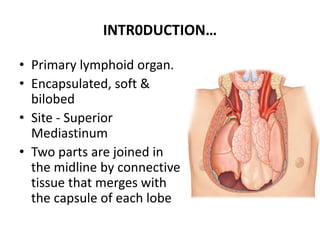
• Primary lymphoid organ.
• Encapsulated, soft &
bilobed
• Site - Superior
Mediastinum
• Two parts are joined in
the midline by connective
tissue that merges with
the capsule of each lobe
INTRODUCTION…
• Capsule may adhere to the fibrous pericardium,
which is thinner superiorly
• VIsible on CT and MRI
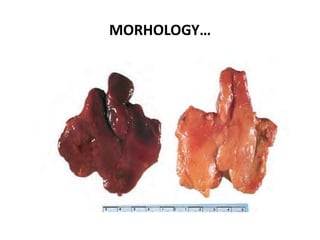
MORHOLOGY…
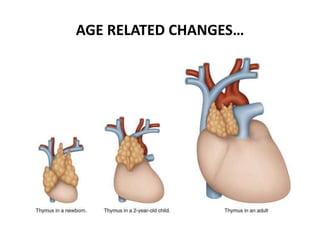
AGE RELATED CHANGES…
RELATIONS
• Largest in the early part of life, particularly
around puberty,
• Persists actively into old age
• As age advances fibrofatty degeneration (hiding
the existence of persistent thymic tissue.
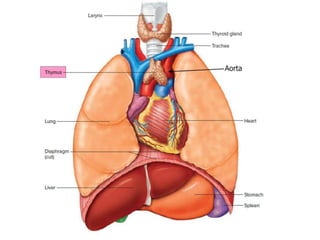
• Greater part of the thymus lies in the superior
and anterior mediastinum;
• Inferior aspect of the thymus reaches the level of
the fourth costal cartilages
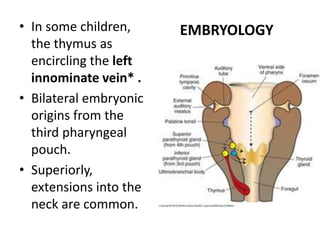
EMBRYOLOGY• In some children,
the thymus as
encircling the left
innominate vein* .
• Bilateral embryonic
origins from the
third pharyngeal
pouch.
• Superiorly,
extensions into the
neck are common.
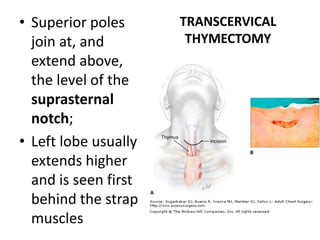
TRANSCERVICAL
THYMECTOMY
• Superior poles
join at, and
extend above,
the level of the
suprasternal
notch;
• Left lobe usually
extends higher
and is seen first
behind the strap
muscles
RELATIONS…
• Reaches to the inferior poles of the thyroid
gland or even higher
• Connected to the thyroid gland bye thyrothymic
ligament.
• Shape is largely moulded by adjacent structures.
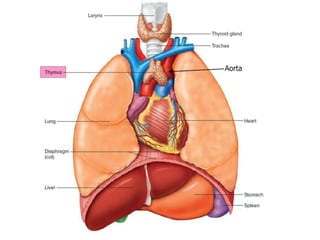
• Inferiorly, the right lobe commonly lies between
the right side of the ascending aorta and the
right lung, anterior to the superior V. cava.
ANTERIOR RELATION…
From superior to inferior…
• Sternohyoid and sternothyroid,
• Cervical fascia,
• Manubrium sterni,
• Internal thoracic vessels,
• Upper three costal cartilages,
• Pleurae lie laterally
• Phrenic nerves are anterolateral and inferior;
(Last 2 structures may be injured during
thymectomy)
POSTERIOR RELATIONS…
• Lies is in contact with the vessels/Viscera of
the superior mediastinum…
Left brachiocephalic vein.
 Inferior thyroid veins .
Superior part of the thoracic trachea.
Anterior cardiac surface (right atrium and
ventricle).
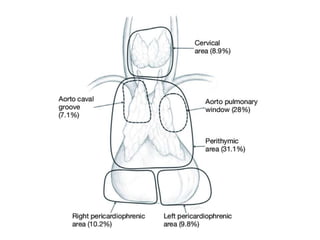
ECTOPIC THYMUS…
Often found…
Scattered around the gland
In unusual mediastinal locations.
• Accessory nodules may occur in the neck
• Representing separated portions, detached
during embryological descent.
• Sometimes reaching more superiorly than the
thyroid cartilage.
• Ectopic intrathyroidal thymi have been
reported in children.
VASCULAR SUPPLY…
• Thymic branches originating from…
Internal thoracic,
Inferior and
Superior thyroid arteries.
• As no definite hilum exists
• Arterial branches either travel along the
interlobar septa before entering the thymus at
the junction of the cortex and medulla
• Reach the thymic tissue directly through the
capsule.
VENOUS DRAINAGE…
Thymic veins drain to …
Left brachiocephalic v.,
Internal thoracic v.and
Inferior thyroid veins, and occasionally
directly into the superior vena cava.
• One or more veins often emerge medially
from each lobe of the thymus to form a
common trunk opening into the left
brachiocephalic v*.
LYMPHATIC DRAINAGE…
• No afferent lymphatics.
• Efferent lymphatics arise from the medulla and
corticomedullary junction,
• Drainage through the extravascular spaces,
accompany the supplying arteries and veins, d
• Drained in…
Brachiocephalic,
Tracheobronchial
Parasternal nodes.
INNERVATION…
Sympathetic -
• Cervicothoracic (stellate) ganglia or ansa
subclavia
• Branches from the phrenic and descending
cervical nerves (inferior roots of the ansa
cervicalis) are distributed mainly to the
capsule.
Parasympathetic - Vagi.
• Two lobes are innervated separately through
their dorsal, lateral and medial aspects.
INNERVATION…
• During development and before its descent
into the thorax , by the vagi in the neck.
• After its descent, receives a sympathetic
innervation via fibres travel along the vessels;
• Postganglionic sympathetic terminations -
branch radially and form a plexus with the
vagal fibres at the cortico-medullary junction.
FUNCTION…
Organ is important for…
• Development of immunocompetent T-cells,
• Proliferation of clones of of mature T-cells,
• Developing immunological self-tolerance,
• Secretion of hormones for T-cell development.
(thymosin, thymulin and thymopoietin )
• Hormones are produced by reticular epithelial
cells in the cortex.
HISTOLOGY…
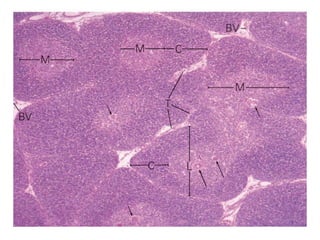
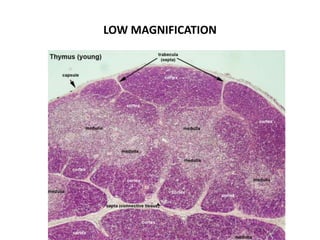
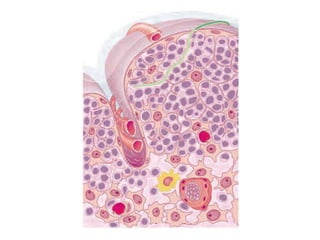
• Two lobes divided up into many incomplete
lobules.
• CORTEX - outer, more darkly staining region is
the cortex, and this is highly cellular.
• MEDULLA - inner lighter staining region,less
cellular.
• An outer connective tissue capsule and septa
divides organ into incomplete lobules.
CAPSULE AND TRABECULAE
Contain …
• Blood vessels…
• Efferent (but not afferent) lymphatic vessels
• Nerves.
• Collagen fibers and fibroblasts,
• Variable numbers of plasma cells,
granulocytes, lymphocytes, mast cells, adipose
cells,and macrophages.
CORTEX…
• Outer portion of the parenchyma,
• Markedly basophilic in (H&E) preparations
because of the closely packed developing T
lymphocytes with their intensely staining
nuclei.
Thymic parenchyma contains developing T cells
in an Extensive meshwork formed by
epithelioreticular cells.
HISTOLOGY
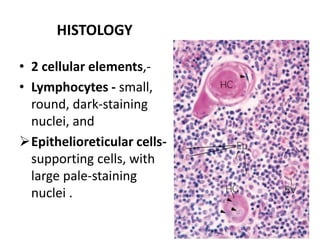
• 2 cellular elements,-
• Lymphocytes - small,
round, dark-staining
nuclei, and
Epithelioreticular cells-
supporting cells, with
large pale-staining
nuclei .
EPITHELIAO-RETICULAR CELLS
OR
RETICULAR STROMA
• Arises from Endodermal epithelium and
produces a cellular reticulum.
• No reticular fibers associated with these cells;
• Cells, designated epithelio-reticular cells,
serve as the stroma.
• Lymphocytes come to lie in the interstices of
the cellular reticulum
EPITHELIORETICULAR CELLS
• Have features of both epithelial and reticular
cells.
• Provide a framework for the developing T cells;
• Correspond to the reticular cells and their
associated reticular fibers in other lymphatic
tissues and organs.
• Reticular connective tissue cells and their fibers,
however, are not present in the thymic
parenchyma.
• Cells exhibit characteristic of epithelium such as
intercellular junctions and intermediate
filaments.
LYMPHOCYTES
Multipotential lymphoid stem cells:
• Migrate into the endodermal rudiment in the
embryo
• Derived from the yolk sac and red bone
marrow.
• Proliferate and become immunologically
competent.
• Differentiating into the thymus-dependent
lymphocytes (i.e.T lymphocytes)
FATE OF LYMPHOCYTES
• Migrate to lymph nodes and spleen. to
populate the thymus-dependent portions .
• Reside in the loose connective tissue.
• Many die or are destroyed in the thymus.
• Programmed against “self” antigens - Random
process by which they acquire the ability to
recognize and react to antigens
• Numerous macrophages are present to
phagocytize these destroyed lymphocytes.
LOW MAGNIFICATION
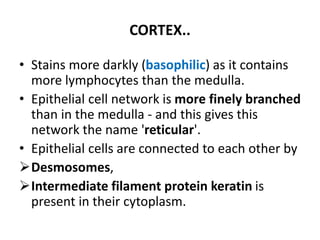
CORTEX..
• Stains more darkly (basophilic) as it contains
more lymphocytes than the medulla.
• Epithelial cell network is more finely branched
than in the medulla - and this gives this
network the name 'reticular'.
• Epithelial cells are connected to each other by
Desmosomes,
Intermediate filament protein keratin is
present in their cytoplasm.
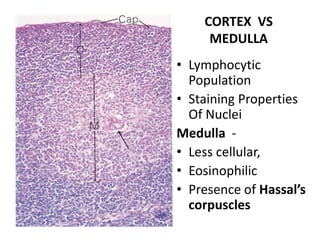
CORTEX VS
MEDULLA
• Lymphocytic
Population
• Staining Properties
Of Nuclei
Medulla -
• Less cellular,
• Eosinophilic
• Presence of Hassal’s
corpuscles
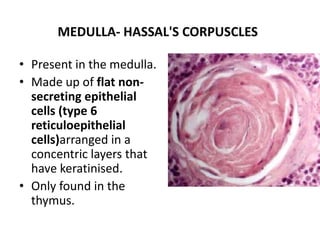
MEDULLA- HASSAL'S CORPUSCLES
• Present in the medulla.
• Made up of flat non-
secreting epithelial
cells (type 6
reticuloepithelial
cells)arranged in a
concentric layers that
have keratinised.
• Only found in the
thymus.
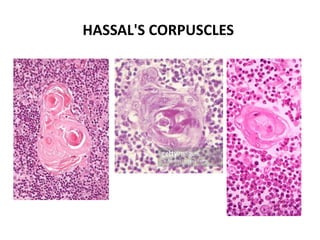
HASSAL'S CORPUSCLES
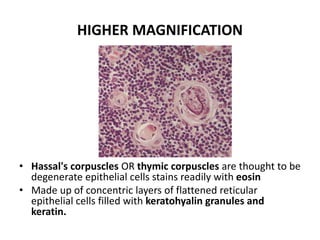
HIGHER MAGNIFICATION
• Hassal's corpuscles OR thymic corpuscles are thought to be
degenerate epithelial cells stains readily with eosin
• Made up of concentric layers of flattened reticular
epithelial cells filled with keratohyalin granules and
keratin.
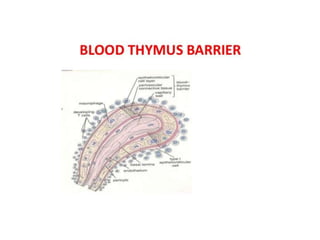
BLOOD THYMUS BARRIER.
• Blood from the inferior thyroid, and internal
thoracic arteries enters the thymus.
• Epithelial cells form a sheath around the
capillaries, to form a barrier to the entry of
antigenic material into the spaces between
the epithelial cells in the reticular network..
• Efferent lymphatics transport lymph and
lymphocytes away from this organ.
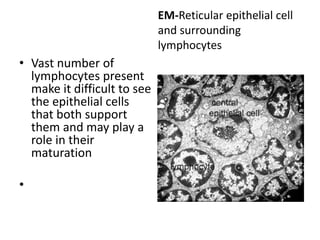
EM-Reticular epithelial cell
and surrounding
lymphocytes
• Vast number of
lymphocytes present
make it difficult to see
the epithelial cells
that both support
them and may play a
role in their
maturation
•
CROSSTALK
• Epithelioreticular cells of the thymic cortex play
an important role in the development of
immunocompetent T cells,
• Recent evidence shows that T cells at the
different stages of differentiation control the
microarchitecture of the thymic epithelioreticular
cells,
Developing lymphocytes and epithelioreticular cells
thus influence each other during T-cell
development.
Thank you

Thymus.2019

  • 1.
  • 2.
    INTR0DUCTION… • Primary lymphoidorgan. • Encapsulated, soft & bilobed • Site - Superior Mediastinum • Two parts are joined in the midline by connective tissue that merges with the capsule of each lobe
  • 4.
    INTRODUCTION… • Capsule mayadhere to the fibrous pericardium, which is thinner superiorly • VIsible on CT and MRI
  • 5.
  • 6.
  • 7.
    RELATIONS • Largest inthe early part of life, particularly around puberty, • Persists actively into old age • As age advances fibrofatty degeneration (hiding the existence of persistent thymic tissue. • Greater part of the thymus lies in the superior and anterior mediastinum; • Inferior aspect of the thymus reaches the level of the fourth costal cartilages
  • 8.
    EMBRYOLOGY• In somechildren, the thymus as encircling the left innominate vein* . • Bilateral embryonic origins from the third pharyngeal pouch. • Superiorly, extensions into the neck are common.
  • 9.
    TRANSCERVICAL THYMECTOMY • Superior poles joinat, and extend above, the level of the suprasternal notch; • Left lobe usually extends higher and is seen first behind the strap muscles
  • 10.
    RELATIONS… • Reaches tothe inferior poles of the thyroid gland or even higher • Connected to the thyroid gland bye thyrothymic ligament. • Shape is largely moulded by adjacent structures. • Inferiorly, the right lobe commonly lies between the right side of the ascending aorta and the right lung, anterior to the superior V. cava.
  • 12.
    ANTERIOR RELATION… From superiorto inferior… • Sternohyoid and sternothyroid, • Cervical fascia, • Manubrium sterni, • Internal thoracic vessels, • Upper three costal cartilages, • Pleurae lie laterally • Phrenic nerves are anterolateral and inferior; (Last 2 structures may be injured during thymectomy)
  • 13.
    POSTERIOR RELATIONS… • Liesis in contact with the vessels/Viscera of the superior mediastinum… Left brachiocephalic vein.  Inferior thyroid veins . Superior part of the thoracic trachea. Anterior cardiac surface (right atrium and ventricle).
  • 14.
    ECTOPIC THYMUS… Often found… Scatteredaround the gland In unusual mediastinal locations. • Accessory nodules may occur in the neck • Representing separated portions, detached during embryological descent. • Sometimes reaching more superiorly than the thyroid cartilage. • Ectopic intrathyroidal thymi have been reported in children.
  • 16.
    VASCULAR SUPPLY… • Thymicbranches originating from… Internal thoracic, Inferior and Superior thyroid arteries. • As no definite hilum exists • Arterial branches either travel along the interlobar septa before entering the thymus at the junction of the cortex and medulla • Reach the thymic tissue directly through the capsule.
  • 17.
    VENOUS DRAINAGE… Thymic veinsdrain to … Left brachiocephalic v., Internal thoracic v.and Inferior thyroid veins, and occasionally directly into the superior vena cava. • One or more veins often emerge medially from each lobe of the thymus to form a common trunk opening into the left brachiocephalic v*.
  • 18.
    LYMPHATIC DRAINAGE… • Noafferent lymphatics. • Efferent lymphatics arise from the medulla and corticomedullary junction, • Drainage through the extravascular spaces, accompany the supplying arteries and veins, d • Drained in… Brachiocephalic, Tracheobronchial Parasternal nodes.
  • 19.
    INNERVATION… Sympathetic - • Cervicothoracic(stellate) ganglia or ansa subclavia • Branches from the phrenic and descending cervical nerves (inferior roots of the ansa cervicalis) are distributed mainly to the capsule. Parasympathetic - Vagi. • Two lobes are innervated separately through their dorsal, lateral and medial aspects.
  • 20.
    INNERVATION… • During developmentand before its descent into the thorax , by the vagi in the neck. • After its descent, receives a sympathetic innervation via fibres travel along the vessels; • Postganglionic sympathetic terminations - branch radially and form a plexus with the vagal fibres at the cortico-medullary junction.
  • 21.
    FUNCTION… Organ is importantfor… • Development of immunocompetent T-cells, • Proliferation of clones of of mature T-cells, • Developing immunological self-tolerance, • Secretion of hormones for T-cell development. (thymosin, thymulin and thymopoietin ) • Hormones are produced by reticular epithelial cells in the cortex.
  • 22.
    HISTOLOGY… • Two lobesdivided up into many incomplete lobules. • CORTEX - outer, more darkly staining region is the cortex, and this is highly cellular. • MEDULLA - inner lighter staining region,less cellular. • An outer connective tissue capsule and septa divides organ into incomplete lobules.
  • 23.
    CAPSULE AND TRABECULAE Contain… • Blood vessels… • Efferent (but not afferent) lymphatic vessels • Nerves. • Collagen fibers and fibroblasts, • Variable numbers of plasma cells, granulocytes, lymphocytes, mast cells, adipose cells,and macrophages.
  • 25.
    CORTEX… • Outer portionof the parenchyma, • Markedly basophilic in (H&E) preparations because of the closely packed developing T lymphocytes with their intensely staining nuclei. Thymic parenchyma contains developing T cells in an Extensive meshwork formed by epithelioreticular cells.
  • 26.
    HISTOLOGY • 2 cellularelements,- • Lymphocytes - small, round, dark-staining nuclei, and Epithelioreticular cells- supporting cells, with large pale-staining nuclei .
  • 27.
    EPITHELIAO-RETICULAR CELLS OR RETICULAR STROMA •Arises from Endodermal epithelium and produces a cellular reticulum. • No reticular fibers associated with these cells; • Cells, designated epithelio-reticular cells, serve as the stroma. • Lymphocytes come to lie in the interstices of the cellular reticulum
  • 28.
    EPITHELIORETICULAR CELLS • Havefeatures of both epithelial and reticular cells. • Provide a framework for the developing T cells; • Correspond to the reticular cells and their associated reticular fibers in other lymphatic tissues and organs. • Reticular connective tissue cells and their fibers, however, are not present in the thymic parenchyma. • Cells exhibit characteristic of epithelium such as intercellular junctions and intermediate filaments.
  • 29.
    LYMPHOCYTES Multipotential lymphoid stemcells: • Migrate into the endodermal rudiment in the embryo • Derived from the yolk sac and red bone marrow. • Proliferate and become immunologically competent. • Differentiating into the thymus-dependent lymphocytes (i.e.T lymphocytes)
  • 30.
    FATE OF LYMPHOCYTES •Migrate to lymph nodes and spleen. to populate the thymus-dependent portions . • Reside in the loose connective tissue. • Many die or are destroyed in the thymus. • Programmed against “self” antigens - Random process by which they acquire the ability to recognize and react to antigens • Numerous macrophages are present to phagocytize these destroyed lymphocytes.
  • 31.
  • 32.
    CORTEX.. • Stains moredarkly (basophilic) as it contains more lymphocytes than the medulla. • Epithelial cell network is more finely branched than in the medulla - and this gives this network the name 'reticular'. • Epithelial cells are connected to each other by Desmosomes, Intermediate filament protein keratin is present in their cytoplasm.
  • 33.
    CORTEX VS MEDULLA • Lymphocytic Population •Staining Properties Of Nuclei Medulla - • Less cellular, • Eosinophilic • Presence of Hassal’s corpuscles
  • 34.
    MEDULLA- HASSAL'S CORPUSCLES •Present in the medulla. • Made up of flat non- secreting epithelial cells (type 6 reticuloepithelial cells)arranged in a concentric layers that have keratinised. • Only found in the thymus.
  • 35.
  • 36.
    HIGHER MAGNIFICATION • Hassal'scorpuscles OR thymic corpuscles are thought to be degenerate epithelial cells stains readily with eosin • Made up of concentric layers of flattened reticular epithelial cells filled with keratohyalin granules and keratin.
  • 37.
    BLOOD THYMUS BARRIER. •Blood from the inferior thyroid, and internal thoracic arteries enters the thymus. • Epithelial cells form a sheath around the capillaries, to form a barrier to the entry of antigenic material into the spaces between the epithelial cells in the reticular network.. • Efferent lymphatics transport lymph and lymphocytes away from this organ.
  • 40.
    EM-Reticular epithelial cell andsurrounding lymphocytes • Vast number of lymphocytes present make it difficult to see the epithelial cells that both support them and may play a role in their maturation •
  • 41.
    CROSSTALK • Epithelioreticular cellsof the thymic cortex play an important role in the development of immunocompetent T cells, • Recent evidence shows that T cells at the different stages of differentiation control the microarchitecture of the thymic epithelioreticular cells, Developing lymphocytes and epithelioreticular cells thus influence each other during T-cell development.
  • 42.