APPROACH TO HEADACHE
Dr. Navin Adhikari
Headache
• The most common presentation for medical attention.
• Responsible for more disability than any other neurologic
problem
• Primary headaches are those in which headache and its
associated features are the disorder itself.
• Secondary headaches are those caused by underlying
pathology.
• As many as 90 percent of all primary headaches fall under a
few categories, including migraine, tension-type, and cluster
headache.
• Episodic tension-type headache (TTH) is the most frequent
headache type in population-based studies.
• Migraine is the most common diagnosis in patients presenting
to primary care physicians with headache.
PRIMARY HEADACES
MIGRANE
• affects 12 to 15 percent of the general population.
• more frequent in women than in men, with attacks occurring
in up to 17 percent of women and 6 percent of men each year.
• is a major cause of disability and ranked second after low back
pain worldwide
Clinical Features
• Progresses through four phases: the prodrome, the aura, the
headache, and the postdrome
Migraine prodrome
• occurs in up to 77 percent of migraineurs
• appear 24 to 48 hours prior to the onset of headache
• symptoms include increased yawning, euphoria, depression,
irritability, food cravings, constipation, and neck stiffness
AURA
• 25 percent of people with migraines experience it.
• characterized by gradual development, duration no longer
than one hour, a mix of positive and negative features, and
complete reversibility
• positive symptoms can be visual (eg, bright lines, shapes,
objects), auditory (eg, tinnitus, noises, music), somatosensory
(eg, burning, pain, paresthesia), or motor (eg, jerking or
repetitive rhythmic movements).
• Negative symptoms indicate an absence or loss of function,
such as loss of vision, hearing, feeling, or ability to move a
part of the body.
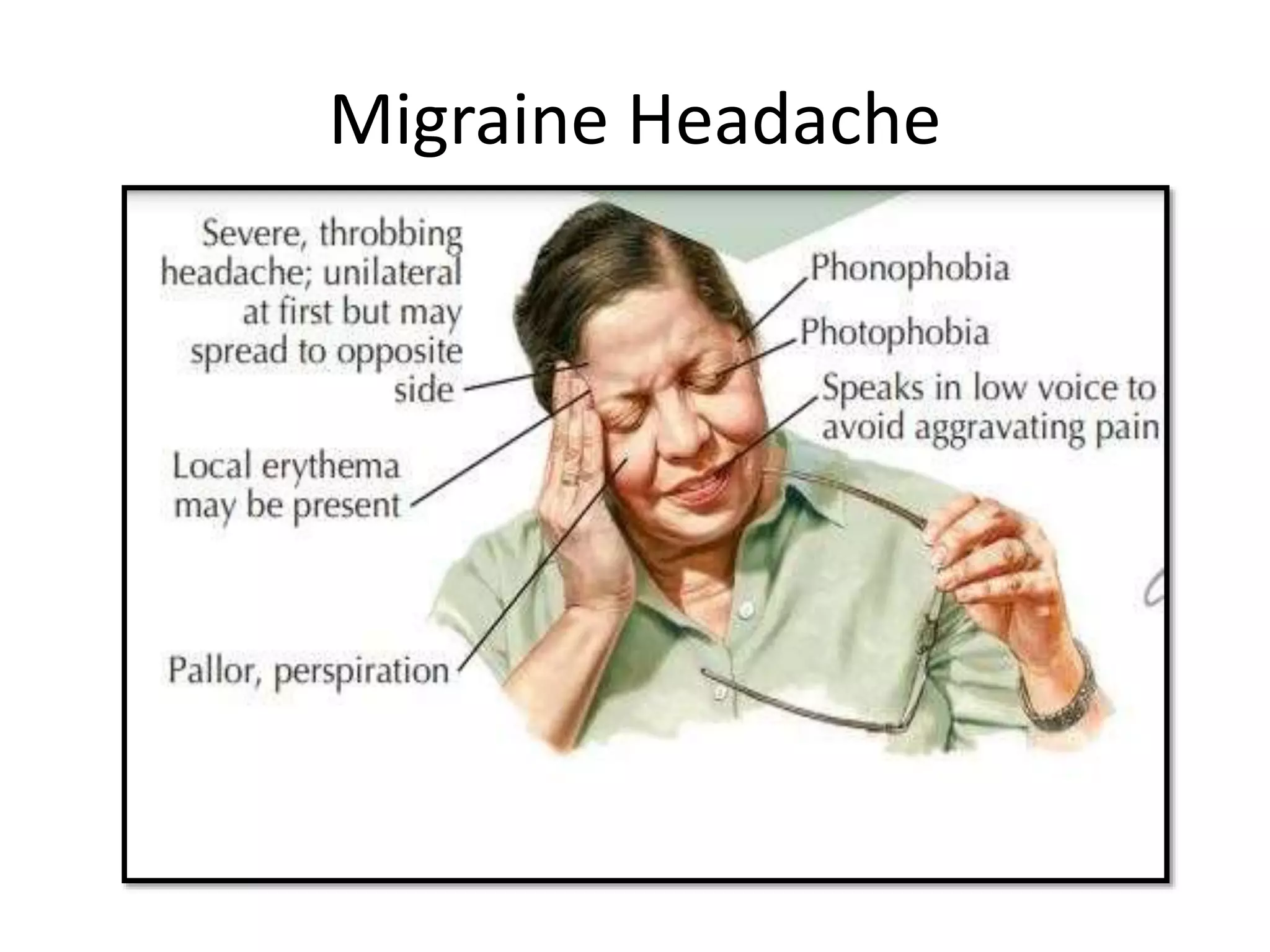
Migraine Headache
Migraine postdrome
• sudden head movement transiently causes pain in the
location of the antecedent headache.
• patients often feel drained or exhausted, although some
report a feeling of mild elation or euphoria.
Trigger factors
• Emotional stress (80 percent)
• Hormones in women (65 percent)
• Not eating (57 percent)
• Weather (53 percent)
• Sleep disturbances (50 percent)
• Odors (44 percent)
• Neck pain (38 percent)
• Lights (38 percent)
• Alcohol (38 percent)
• Smoke (36 percent)
• Sleeping late (32 percent)
• Heat (30 percent)
• Food (27 percent)
• Exercise (22 percent)
• Sexual activity (5 percent )
Complications
• Status migrainosus is a debilitating migraine attack
lasting for more than 72 hours
• Persistent aura without infarction is defined by aura
symptoms persisting for one week or more with no
evidence of infarction on neuroimaging.
• Migrainous infarction is defined by a migraine attack,
occurring in a patient with migraine with aura, in which
one or more aura symptoms persist for more than one
hour and neuroimaging shows an infarction in a
relevant brain area.
• Migraine aura-triggered seizure is a seizure triggered
by an attack of migraine with aura
MIGRAINE SUBTYPES
• Migraine with brainstem aura
• Hemiplegic migraine
• Retinal migraine
• Vestibular migraine
• Menstrual migraine
Neuroimaging in Migraine
• Patients with an unexplained abnormal finding on neurologic
examination.
• Patients with atypical headache features or headaches that do
not fulfill the strict definition of migraine or other primary
headache disorder or have some additional risk factor, such as
immune deficiency.
Differentials
• Other types of primary headaches, such as tension-type
headache and trigeminal autonomic cephalalgias such as
cluster headache and secondary headaches.
• For migraine aura includes transient ischemic attack (TIA),
seizure, syncope, and vestibular disorders
Tension-type headache
• Previously known as stress or tension headache, muscle-
contraction headache, psychomyogenic headache, and
psychogenic headache
• Types
1. Infrequent episodic TTH, with headache episodes less than
one day a month
2. Frequent episodic TTH, with headache episodes 1 to 14 days a
month
3. Chronic TTH, with headaches 15 or more days a month
CLINICAL FEATURES
• mild to moderate intensity, bilateral, nonthrobbing headache
without other associated features. Descriptions of TTH pain
are characteristically nondescript: "dull," "pressure," "head
fullness," "head feels large," or, more descriptively, "like a
tight cap," "band-like," or a "heavy weight on my head or
shoulders.
• Increased pericranial muscle tenderness is the most
important abnormal finding in patients with TTH
• Manual palpation is performed by applying firm pressure with
the second and third finger and making small rotating
movements on the pericranial muscles, including the frontal,
temporal, masseter, pterygoid, sternocleidomastoid, splenius,
and trapezius muscles
TRIGEMINAL AUTONOMIC
CEPHALALGIAS
• primary headaches including cluster headache, paroxysmal
hemicrania (PH) and SUNCT (short-lasting unilateral
neuralgiform headache attacks with conjunctival injection and
tearing), and hemicrania continua.
• ACs are characterized by relatively short-lasting attacks of
head pain associated with cranial autonomic symptoms, such
as lacrimation, conjunctival injection, aural fullness, or nasal
congestion
Differential
• Trigeminal neuralgia — Classic trigeminal neuralgia is an
important consideration in the differential diagnosis of cluster
headache and SUNCT. In trigeminal neuralgia, unlike cluster
and SUNCT syndrome, autonomic symptoms are not
prominent. Unlike short-lasting unilateral neuralgiform
headache attacks, triggered attacks in trigeminal neuralgia
have a clear refractory period.
• Other primary headaches.
• Secondary cluster headaches; Meningiomas, Pituitary
macroadenomas, Intracranial large artery aneurysms.
Other primary headaches
• Primary Cough Headache
• Primary Exercise Headache
• Primary Headache Associated with Sexual Activity- are not
always benign; 5–12% of cases of subarachnoid hemorrhage
are precipitated by sexual intercourse.
• Cold-Stimulus Headache
• External Pressure Headache
• Hypnic Headache
• mnemonic SNNOOP10 is a reminder of the danger signs ("red flags") for
the presence of serious underlying disorders that can cause acute or
subacute headache.
• Systemic symptoms including fever
• Neoplasm history
• Neurologic deficit (including decreased consciousness)
• Onset is sudden or abrupt
• Older age (onset after age 50 years)
• Pattern change or recent onset of new headache
• Positional headache
• Precipitated by sneezing, coughing, or exercise
• Papilledema
• Progressive headache and atypical presentations
• Pregnancy or puerperium
• Painful eye with autonomic features
• Post-traumatic onset of headache
• Pathology of the immune system such as HIV
• Painkiller (analgesic) overuse (eg, medication overuse headache) or new
drug at onset of headache
Headache requiring emergency
evaluation
• Sudden onset "thunderclap" headache
• Acute or subacute neck pain or headache with Horner
syndrome and/or neurologic deficit
• Headache with suspected meningitis or encephalitis
• Headache with global or focal neurologic deficit or
papilledema
• Headache with orbital or periorbital symptoms
• Headache and possible carbon monoxide exposure
Approach to Headache
• Rule out serious underlying pathology and look for other
secondary causes of headache .
• Determine the type of primary headache using the patient
history as the primary diagnostic tool .
• There may be overlap in symptoms, particularly between
migraine and tension-type headache (TTH) and between
migraine and some secondary causes of headache such as
sinus disease.
• A headache diary can be helpful in further clarifying the
headache diagnosis, the frequency of headache, potential
triggers, and the disability from the headache
Suspicion of SAH
No suspicion of SAH/thunderclap
headache
Suspicion of Intracranial lesion
Management
Treatment of migraine
• Educate migraine sufferers about their condition and its
treatment and encourage them to participate in their own
management.
• Use migraine-specific agents (eg, triptans, CGRP antagonists,
lasmiditan, dihydroergotamine) for patients with more severe
migraine and in those whose headaches respond poorly to
NSAIDs or combination analgesics.
• Select a nonoral route of administration for patients whose
migraines present early with significant nausea or vomiting.
• Consider a self-administered rescue medication for patients
with severe migraines that do not respond well to other
treatments.
• Guard against medication overuse headache by educating
patients about risk and using prophylactic medications in
patients with frequent headaches.
Mild to moderate migraine attacks
• Not associated with vomiting or severe nausea, initial
treatment with simple analgesics, including nonsteroidal anti-
inflammatory drugs (NSAIDs) or acetaminophen, rather than
migraine-specific agents.
• For patients unresponsive to analgesics, the combined use of
an NSAID with a triptan may be effective.
• When attacks are associated with severe nausea or vomiting,
an antiemetic drug can be used along with analgesics
MODERATE TO SEVERE MIGRAINE
ATTACKS
• Treatment with a triptan or the combination of sumatriptan-
naproxen, rather than other migraine-specific agents.
• Patients who do not respond well to one triptan
• Alternative options include calcitonin gene-related peptide
(CGRP) antagonists, lasmiditan, antiemetic drug,may respond
to a different triptan.
• Migraine attacks who present to the hospital emergency
department (ED), initial treatment with either subcutaneous
sumatriptan or a parenteral antiemetic agent metoclopramide
or prochlorperazine.
• Treatment with IV or intramuscular dexamethasone to reduce
the risk of early headache recurrence
Status migrainosus
• Combination of intravenous fluids plus parenteral
medications, including ketorolac and a dopamine receptor
blocker (eg, prochlorperazine, metoclopramide,
chlorpromazine).
• Other options include valproate and/or dihydroergotamine
Prophylactic treatment
Indications
• Frequent or long-lasting migraine headaches(more than four
headaches per month or headaches that last longer than 12
hours
• Migraine attacks that cause significant disability or diminished
quality of life despite appropriate acute treatment
• Contraindication to acute therapies
• Failure of acute therapies
• Serious adverse effects of acute therapies
• Risk of medication overuse headache
• Menstrual migraine
• risk of neurologic damage and/or impairment in the presence
of uncommon migraine conditions like hemilegic migraine,
Migraine with brainstem aura, Migrainous infarction.
Tension-Type Headache Treatment
• Simple analgesics such as acetaminophen, aspirin, or NSAIDs
• Behavioral approaches including relaxation can also be
effective
• For chronic TTH, amitriptyline is the only proven treatment.
Cluster Headache treatment
ACUTE ATTACK TREATMENT
• 100% oxygen at 10–12 L/min for 15–20 min
• Sumatriptan 6 mg SC is rapid in onset and will usually shorten
an attack to 10–15 min.
• Oral sumatriptan is not effective for prevention or for acute
treatment of cluster headache.
Hemicrania Continua
• Treatment consists of indomethacin, other NSAIDs appear to
be of little or no benefit.
• The IM injection of 100 mg of indomethacin has been
proposed as a diagnostic tool.
• Alternatively, a trial of oral indomethacin, starting with 25 mg
tid, then 50 mg tid, and then 75 mg tid, can be given. Up to 2
weeks at the maximal dose may be necessary to assess
whether a dose has a useful effect.
References
• Harrison's Principles of Internal Medicine,
20th Edition
• Kumar & Clark's Clinical Medicine, 7th Edition
• Uptodate 2020

Approach to Headache

  • 1.
  • 2.
    Headache • The mostcommon presentation for medical attention. • Responsible for more disability than any other neurologic problem • Primary headaches are those in which headache and its associated features are the disorder itself. • Secondary headaches are those caused by underlying pathology.
  • 7.
    • As manyas 90 percent of all primary headaches fall under a few categories, including migraine, tension-type, and cluster headache. • Episodic tension-type headache (TTH) is the most frequent headache type in population-based studies. • Migraine is the most common diagnosis in patients presenting to primary care physicians with headache.
  • 8.
  • 9.
    MIGRANE • affects 12to 15 percent of the general population. • more frequent in women than in men, with attacks occurring in up to 17 percent of women and 6 percent of men each year. • is a major cause of disability and ranked second after low back pain worldwide
  • 10.
    Clinical Features • Progressesthrough four phases: the prodrome, the aura, the headache, and the postdrome Migraine prodrome • occurs in up to 77 percent of migraineurs • appear 24 to 48 hours prior to the onset of headache • symptoms include increased yawning, euphoria, depression, irritability, food cravings, constipation, and neck stiffness
  • 11.
    AURA • 25 percentof people with migraines experience it. • characterized by gradual development, duration no longer than one hour, a mix of positive and negative features, and complete reversibility • positive symptoms can be visual (eg, bright lines, shapes, objects), auditory (eg, tinnitus, noises, music), somatosensory (eg, burning, pain, paresthesia), or motor (eg, jerking or repetitive rhythmic movements). • Negative symptoms indicate an absence or loss of function, such as loss of vision, hearing, feeling, or ability to move a part of the body.
  • 15.
  • 16.
    Migraine postdrome • suddenhead movement transiently causes pain in the location of the antecedent headache. • patients often feel drained or exhausted, although some report a feeling of mild elation or euphoria.
  • 17.
  • 18.
    • Emotional stress(80 percent) • Hormones in women (65 percent) • Not eating (57 percent) • Weather (53 percent) • Sleep disturbances (50 percent) • Odors (44 percent) • Neck pain (38 percent) • Lights (38 percent) • Alcohol (38 percent) • Smoke (36 percent) • Sleeping late (32 percent) • Heat (30 percent) • Food (27 percent) • Exercise (22 percent) • Sexual activity (5 percent )
  • 19.
    Complications • Status migrainosusis a debilitating migraine attack lasting for more than 72 hours • Persistent aura without infarction is defined by aura symptoms persisting for one week or more with no evidence of infarction on neuroimaging. • Migrainous infarction is defined by a migraine attack, occurring in a patient with migraine with aura, in which one or more aura symptoms persist for more than one hour and neuroimaging shows an infarction in a relevant brain area. • Migraine aura-triggered seizure is a seizure triggered by an attack of migraine with aura
  • 20.
    MIGRAINE SUBTYPES • Migrainewith brainstem aura • Hemiplegic migraine • Retinal migraine • Vestibular migraine • Menstrual migraine
  • 22.
    Neuroimaging in Migraine •Patients with an unexplained abnormal finding on neurologic examination. • Patients with atypical headache features or headaches that do not fulfill the strict definition of migraine or other primary headache disorder or have some additional risk factor, such as immune deficiency.
  • 23.
    Differentials • Other typesof primary headaches, such as tension-type headache and trigeminal autonomic cephalalgias such as cluster headache and secondary headaches. • For migraine aura includes transient ischemic attack (TIA), seizure, syncope, and vestibular disorders
  • 24.
    Tension-type headache • Previouslyknown as stress or tension headache, muscle- contraction headache, psychomyogenic headache, and psychogenic headache • Types 1. Infrequent episodic TTH, with headache episodes less than one day a month 2. Frequent episodic TTH, with headache episodes 1 to 14 days a month 3. Chronic TTH, with headaches 15 or more days a month
  • 25.
    CLINICAL FEATURES • mildto moderate intensity, bilateral, nonthrobbing headache without other associated features. Descriptions of TTH pain are characteristically nondescript: "dull," "pressure," "head fullness," "head feels large," or, more descriptively, "like a tight cap," "band-like," or a "heavy weight on my head or shoulders. • Increased pericranial muscle tenderness is the most important abnormal finding in patients with TTH • Manual palpation is performed by applying firm pressure with the second and third finger and making small rotating movements on the pericranial muscles, including the frontal, temporal, masseter, pterygoid, sternocleidomastoid, splenius, and trapezius muscles
  • 27.
    TRIGEMINAL AUTONOMIC CEPHALALGIAS • primaryheadaches including cluster headache, paroxysmal hemicrania (PH) and SUNCT (short-lasting unilateral neuralgiform headache attacks with conjunctival injection and tearing), and hemicrania continua. • ACs are characterized by relatively short-lasting attacks of head pain associated with cranial autonomic symptoms, such as lacrimation, conjunctival injection, aural fullness, or nasal congestion
  • 31.
    Differential • Trigeminal neuralgia— Classic trigeminal neuralgia is an important consideration in the differential diagnosis of cluster headache and SUNCT. In trigeminal neuralgia, unlike cluster and SUNCT syndrome, autonomic symptoms are not prominent. Unlike short-lasting unilateral neuralgiform headache attacks, triggered attacks in trigeminal neuralgia have a clear refractory period. • Other primary headaches. • Secondary cluster headaches; Meningiomas, Pituitary macroadenomas, Intracranial large artery aneurysms.
  • 32.
    Other primary headaches •Primary Cough Headache • Primary Exercise Headache • Primary Headache Associated with Sexual Activity- are not always benign; 5–12% of cases of subarachnoid hemorrhage are precipitated by sexual intercourse. • Cold-Stimulus Headache • External Pressure Headache • Hypnic Headache
  • 33.
    • mnemonic SNNOOP10is a reminder of the danger signs ("red flags") for the presence of serious underlying disorders that can cause acute or subacute headache. • Systemic symptoms including fever • Neoplasm history • Neurologic deficit (including decreased consciousness) • Onset is sudden or abrupt • Older age (onset after age 50 years) • Pattern change or recent onset of new headache • Positional headache • Precipitated by sneezing, coughing, or exercise • Papilledema • Progressive headache and atypical presentations • Pregnancy or puerperium • Painful eye with autonomic features • Post-traumatic onset of headache • Pathology of the immune system such as HIV • Painkiller (analgesic) overuse (eg, medication overuse headache) or new drug at onset of headache
  • 34.
    Headache requiring emergency evaluation •Sudden onset "thunderclap" headache • Acute or subacute neck pain or headache with Horner syndrome and/or neurologic deficit • Headache with suspected meningitis or encephalitis • Headache with global or focal neurologic deficit or papilledema • Headache with orbital or periorbital symptoms • Headache and possible carbon monoxide exposure
  • 37.
    Approach to Headache •Rule out serious underlying pathology and look for other secondary causes of headache . • Determine the type of primary headache using the patient history as the primary diagnostic tool . • There may be overlap in symptoms, particularly between migraine and tension-type headache (TTH) and between migraine and some secondary causes of headache such as sinus disease. • A headache diary can be helpful in further clarifying the headache diagnosis, the frequency of headache, potential triggers, and the disability from the headache
  • 39.
  • 40.
    No suspicion ofSAH/thunderclap headache
  • 41.
  • 43.
  • 44.
    Treatment of migraine •Educate migraine sufferers about their condition and its treatment and encourage them to participate in their own management. • Use migraine-specific agents (eg, triptans, CGRP antagonists, lasmiditan, dihydroergotamine) for patients with more severe migraine and in those whose headaches respond poorly to NSAIDs or combination analgesics. • Select a nonoral route of administration for patients whose migraines present early with significant nausea or vomiting. • Consider a self-administered rescue medication for patients with severe migraines that do not respond well to other treatments. • Guard against medication overuse headache by educating patients about risk and using prophylactic medications in patients with frequent headaches.
  • 45.
    Mild to moderatemigraine attacks • Not associated with vomiting or severe nausea, initial treatment with simple analgesics, including nonsteroidal anti- inflammatory drugs (NSAIDs) or acetaminophen, rather than migraine-specific agents. • For patients unresponsive to analgesics, the combined use of an NSAID with a triptan may be effective. • When attacks are associated with severe nausea or vomiting, an antiemetic drug can be used along with analgesics
  • 46.
    MODERATE TO SEVEREMIGRAINE ATTACKS • Treatment with a triptan or the combination of sumatriptan- naproxen, rather than other migraine-specific agents. • Patients who do not respond well to one triptan • Alternative options include calcitonin gene-related peptide (CGRP) antagonists, lasmiditan, antiemetic drug,may respond to a different triptan. • Migraine attacks who present to the hospital emergency department (ED), initial treatment with either subcutaneous sumatriptan or a parenteral antiemetic agent metoclopramide or prochlorperazine. • Treatment with IV or intramuscular dexamethasone to reduce the risk of early headache recurrence
  • 47.
    Status migrainosus • Combinationof intravenous fluids plus parenteral medications, including ketorolac and a dopamine receptor blocker (eg, prochlorperazine, metoclopramide, chlorpromazine). • Other options include valproate and/or dihydroergotamine
  • 51.
    Prophylactic treatment Indications • Frequentor long-lasting migraine headaches(more than four headaches per month or headaches that last longer than 12 hours • Migraine attacks that cause significant disability or diminished quality of life despite appropriate acute treatment • Contraindication to acute therapies • Failure of acute therapies • Serious adverse effects of acute therapies • Risk of medication overuse headache • Menstrual migraine • risk of neurologic damage and/or impairment in the presence of uncommon migraine conditions like hemilegic migraine, Migraine with brainstem aura, Migrainous infarction.
  • 54.
    Tension-Type Headache Treatment •Simple analgesics such as acetaminophen, aspirin, or NSAIDs • Behavioral approaches including relaxation can also be effective • For chronic TTH, amitriptyline is the only proven treatment.
  • 56.
    Cluster Headache treatment ACUTEATTACK TREATMENT • 100% oxygen at 10–12 L/min for 15–20 min • Sumatriptan 6 mg SC is rapid in onset and will usually shorten an attack to 10–15 min. • Oral sumatriptan is not effective for prevention or for acute treatment of cluster headache.
  • 58.
    Hemicrania Continua • Treatmentconsists of indomethacin, other NSAIDs appear to be of little or no benefit. • The IM injection of 100 mg of indomethacin has been proposed as a diagnostic tool. • Alternatively, a trial of oral indomethacin, starting with 25 mg tid, then 50 mg tid, and then 75 mg tid, can be given. Up to 2 weeks at the maximal dose may be necessary to assess whether a dose has a useful effect.
  • 59.
    References • Harrison's Principlesof Internal Medicine, 20th Edition • Kumar & Clark's Clinical Medicine, 7th Edition • Uptodate 2020