SpinFET
Raja Shekar Baddula – 134366001
Sreejith K P – 133076005
Titto Thomas – 133079015
Nandakumar S R - 133070053
Need of Nanostructure device





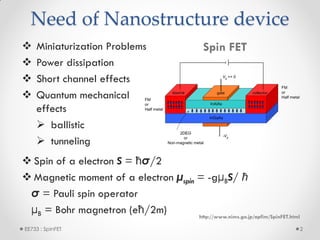
Miniaturization Problems
Power dissipation
Short channel effects
Quantum mechanical
effects
 ballistic
 tunneling

Spin FET

 Spin of a electron S = ħσ/2
 Magnetic moment of a electron µspin = -gµBS/ ħ
σ = Pauli spin operator
µB = Bohr magnetron (eħ/2m)
http://www.nims.go.jp/apfim/SpinFET.html
EE733 : SpinFET

2
Spin-Orbit interaction

Heterojunction:

Atomic case
Enucleus

ˆ
Ze r

4 0 r 2

AlGaAs

j  Zev

InGaAs

 In analogy with the atomic
case Rashba S-O term

 In Electron rest frame
Amperes' law
B

0 j  r
4 r 2

E

Beff  0 0 (v  Enucleus )

S O    spin Beff 

H S O

g B S
(v  E )
2
hc

g  B

( p  V )
2
2mc

  ,k  x   ,k 

k y
k

  ,k  y   ,k 

  ,k  z   ,k  0
EE733 : SpinFET

kx
k

dV
ˆ
V  z
g B dz

dV
H S O 
[ ( p  z
)]
2
2mc
dz
g B
dV
H S O 
[z
(  p)]
2
2mc
dz

H S O 
[ z (  p)]
h

1

2
2
H
( px  p y )  ( x p y   y px )
2m
h
3
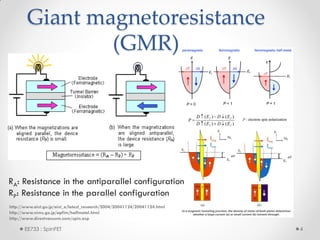
Giant magnetoresistance
(GMR)

RA: Resistance in the antiparallel configuration
RP: Resistance in the parallel configuration
http://www.aist.go.jp/aist_e/latest_research/2004/20041124/20041124.html
http://www.nims.go.jp/apfim/halfmetal.html
http://www.directvacuum.com/spin.asp

EE733 : SpinFET

4
Origin of GMR
 Mott Model
 Different resistivities

 Scattering is :

Parallel

Antiparallel

 Strong for electrons with
spin antiparallel to the
magnetization direction
 Weak for electrons with
spin parallel to the
magnetization direction
H. Ehrenreich and F. Spaepen, Academic Press, 2001, Vol. 56 pp.113-237
http://physics.unl.edu/tsymbal/reference/giant_magnetoresistance/origin_of_gmr.shtml
EE733 : SpinFET

5
SpinFET : Structure &
Working

EE733 : SpinFET

6
Electron spin

photon polarization

Supriyo Datta & Biswajit Das, Electronic analog of the eiectro-optic modulator, APL ,1989
http://nanohub.org/resources/11128
EE733 : SpinFET

7
Structure & Working of spinFET

=

Supriyo Datta & Biswajit Das, Electronic analog of the eiectro-optic modulator, APL ,1989
Satoshi Sugahara and Junsaku Nitta, Spin-Transistor Electronics: An Overview and Outlook, 2010
http://nanohub.org/resources/11128
EE733 : SpinFET

8
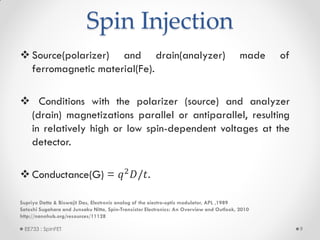
Spin Injection
 Source(polarizer) and drain(analyzer)
ferromagnetic material(Fe).

made

of

 Conditions with the polarizer (source) and analyzer
(drain) magnetizations parallel or antiparallel, resulting
in relatively high or low spin-dependent voltages at the
detector.
 Conductance(G) = 𝑞2 𝐷/𝑡.
Supriyo Datta & Biswajit Das, Electronic analog of the eiectro-optic modulator, APL ,1989
Satoshi Sugahara and Junsaku Nitta, Spin-Transistor Electronics: An Overview and Outlook, 2010
http://nanohub.org/resources/11128
EE733 : SpinFET

9
Channel Requirements
 2DEGs in narrow band gap semiconductor
 Ballistic tranport
 Avoid spin relaxation[1]

 Elliot Yafet

[2]

 D'yakonov-Perl
 Bir-Aronov-Pikus

[1] J. Fabian and S. Das Sarma, Spin relaxation of conduction electrons, 1993
[2] Satoshi Sugahara and Junsaku Nitta, Spin-Transistor Electronics: An Overview and Outlook, 2010
EE733 : SpinFET

10
Electrostatic control of spin
 Aharonov – Bohm

Experiment [1]
Conductance
[2]

variation
Phase difference in the

 Applied potential controls
the polarization of the
electron

wave vector
𝟐 𝒎∗ 𝜼𝒍
∆𝜽 =
ћ𝟐

[1] J. Nitta, F. E. Meijer, and H. Takayanagi, Spin-interference device, 1999
[2] Satoshi Sugahara and Junsaku Nitta, Spin-Transistor Electronics: An Overview and Outlook, 2010
EE733 : SpinFET

11
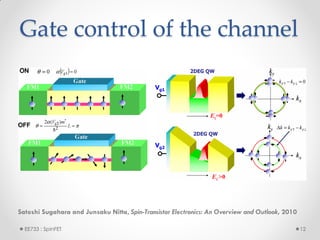
Gate control of the channel

Satoshi Sugahara and Junsaku Nitta, Spin-Transistor Electronics: An Overview and Outlook, 2010
EE733 : SpinFET

12
Non-ballistic SpinFET
Scattering tolerent
Dresselhaus spin-orbit
coupling
Making both the
coefficients equal

[1]

J. Schliemann, J. C. Egues, and D. Loss, Nonballistic spin-field-effect transistor, 2003
[1] Satoshi Sugahara and Junsaku Nitta, Spin-Transistor Electronics: An Overview and Outlook, 2010
EE733 : SpinFET

13
SpinFET improvemts
 Improvements

[1]

 Holes as carriers
 Strain engineering to shift the hole subbands
 Modified device structure
 Gate control hinderance [2]
 Fano resonance

 Ramsauer resonance
 Dual gate as an option
[1] D. M. Gvozdie, U. Ekenberg, and I. Thylen, Comparison of performance of spin transistors with conventional transistors, 2005
[2] J. Wan, M. Cahay, and S. Bandyopadhyay, Proposal for a dual-gate spin field effect transistor: A device with very small
switching voltage and a large ON to OFF conductance ratio, 2008
EE733 : SpinFET

14
Spintronics so far..

EE733 : SpinFET

15
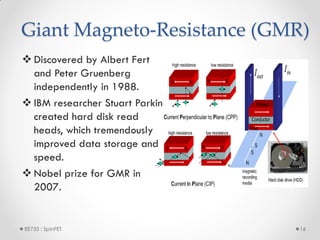
Giant Magneto-Resistance (GMR)
 Discovered by Albert Fert
and Peter Gruenberg
independently in 1988.
 IBM researcher Stuart Parkin
created hard disk read
heads, which tremendously
improved data storage and
speed.
 Nobel prize for GMR in
2007.

EE733 : SpinFET

16
Memory Applications
MRAM
Non-volatile
Lower power consumption
than a DRAM
Write power only slightly
greater than read.
Slightly lower performance
than SRAM
Viewed as a universal
memory element.
EE733 : SpinFET

17
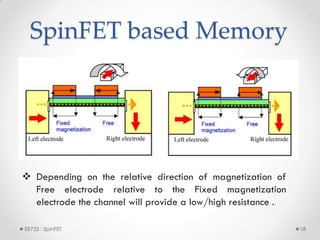
SpinFET based Memory

 Depending on the relative direction of magnetization of
Free electrode relative to the Fixed magnetization
electrode the channel will provide a low/high resistance .
EE733 : SpinFET

18
Logic Applications
AND Logic

NAND Logic

Magnetoelectric Spin-FET for Memory, Logic,and Amplifier Applications, S. G. Tan et al., 2005
EE733 : SpinFET

19
Things that gives hope..
 A family of silicon-based semiconductors that exhibit
magnetic properties has been discovered in 2004.
 A team of Princeton scientists has turned semiconductors into
magnets by the precise placement of metal atoms within a
material from which chips are made in 2006.
 Scientists prove the existence of a spin battery.

EE733 : SpinFET

20
Thank You

EE733 : SpinFET

21

SpinFET

  • 1.
    SpinFET Raja Shekar Baddula– 134366001 Sreejith K P – 133076005 Titto Thomas – 133079015 Nandakumar S R - 133070053
  • 2.
    Need of Nanostructuredevice     Miniaturization Problems Power dissipation Short channel effects Quantum mechanical effects  ballistic  tunneling Spin FET  Spin of a electron S = ħσ/2  Magnetic moment of a electron µspin = -gµBS/ ħ σ = Pauli spin operator µB = Bohr magnetron (eħ/2m) http://www.nims.go.jp/apfim/SpinFET.html EE733 : SpinFET 2
  • 3.
    Spin-Orbit interaction Heterojunction: Atomic case Enucleus ˆ Zer  4 0 r 2 AlGaAs j  Zev InGaAs  In analogy with the atomic case Rashba S-O term  In Electron rest frame Amperes' law B 0 j  r 4 r 2 E Beff  0 0 (v  Enucleus ) S O    spin Beff  H S O g B S (v  E ) 2 hc g  B  ( p  V ) 2 2mc   ,k  x   ,k  k y k   ,k  y   ,k    ,k  z   ,k  0 EE733 : SpinFET kx k dV ˆ V  z g B dz dV H S O  [ ( p  z )] 2 2mc dz g B dV H S O  [z (  p)] 2 2mc dz  H S O  [ z (  p)] h 1  2 2 H ( px  p y )  ( x p y   y px ) 2m h 3
  • 4.
    Giant magnetoresistance (GMR) RA: Resistancein the antiparallel configuration RP: Resistance in the parallel configuration http://www.aist.go.jp/aist_e/latest_research/2004/20041124/20041124.html http://www.nims.go.jp/apfim/halfmetal.html http://www.directvacuum.com/spin.asp EE733 : SpinFET 4
  • 5.
    Origin of GMR Mott Model  Different resistivities  Scattering is : Parallel Antiparallel  Strong for electrons with spin antiparallel to the magnetization direction  Weak for electrons with spin parallel to the magnetization direction H. Ehrenreich and F. Spaepen, Academic Press, 2001, Vol. 56 pp.113-237 http://physics.unl.edu/tsymbal/reference/giant_magnetoresistance/origin_of_gmr.shtml EE733 : SpinFET 5
  • 6.
    SpinFET : Structure& Working EE733 : SpinFET 6
  • 7.
    Electron spin photon polarization SupriyoDatta & Biswajit Das, Electronic analog of the eiectro-optic modulator, APL ,1989 http://nanohub.org/resources/11128 EE733 : SpinFET 7
  • 8.
    Structure & Workingof spinFET = Supriyo Datta & Biswajit Das, Electronic analog of the eiectro-optic modulator, APL ,1989 Satoshi Sugahara and Junsaku Nitta, Spin-Transistor Electronics: An Overview and Outlook, 2010 http://nanohub.org/resources/11128 EE733 : SpinFET 8
  • 9.
    Spin Injection  Source(polarizer)and drain(analyzer) ferromagnetic material(Fe). made of  Conditions with the polarizer (source) and analyzer (drain) magnetizations parallel or antiparallel, resulting in relatively high or low spin-dependent voltages at the detector.  Conductance(G) = 𝑞2 𝐷/𝑡. Supriyo Datta & Biswajit Das, Electronic analog of the eiectro-optic modulator, APL ,1989 Satoshi Sugahara and Junsaku Nitta, Spin-Transistor Electronics: An Overview and Outlook, 2010 http://nanohub.org/resources/11128 EE733 : SpinFET 9
  • 10.
    Channel Requirements  2DEGsin narrow band gap semiconductor  Ballistic tranport  Avoid spin relaxation[1]  Elliot Yafet [2]  D'yakonov-Perl  Bir-Aronov-Pikus [1] J. Fabian and S. Das Sarma, Spin relaxation of conduction electrons, 1993 [2] Satoshi Sugahara and Junsaku Nitta, Spin-Transistor Electronics: An Overview and Outlook, 2010 EE733 : SpinFET 10
  • 11.
    Electrostatic control ofspin  Aharonov – Bohm Experiment [1] Conductance [2] variation Phase difference in the  Applied potential controls the polarization of the electron wave vector 𝟐 𝒎∗ 𝜼𝒍 ∆𝜽 = ћ𝟐 [1] J. Nitta, F. E. Meijer, and H. Takayanagi, Spin-interference device, 1999 [2] Satoshi Sugahara and Junsaku Nitta, Spin-Transistor Electronics: An Overview and Outlook, 2010 EE733 : SpinFET 11
  • 12.
    Gate control ofthe channel Satoshi Sugahara and Junsaku Nitta, Spin-Transistor Electronics: An Overview and Outlook, 2010 EE733 : SpinFET 12
  • 13.
    Non-ballistic SpinFET Scattering tolerent Dresselhausspin-orbit coupling Making both the coefficients equal [1] J. Schliemann, J. C. Egues, and D. Loss, Nonballistic spin-field-effect transistor, 2003 [1] Satoshi Sugahara and Junsaku Nitta, Spin-Transistor Electronics: An Overview and Outlook, 2010 EE733 : SpinFET 13
  • 14.
    SpinFET improvemts  Improvements [1] Holes as carriers  Strain engineering to shift the hole subbands  Modified device structure  Gate control hinderance [2]  Fano resonance  Ramsauer resonance  Dual gate as an option [1] D. M. Gvozdie, U. Ekenberg, and I. Thylen, Comparison of performance of spin transistors with conventional transistors, 2005 [2] J. Wan, M. Cahay, and S. Bandyopadhyay, Proposal for a dual-gate spin field effect transistor: A device with very small switching voltage and a large ON to OFF conductance ratio, 2008 EE733 : SpinFET 14
  • 15.
  • 16.
    Giant Magneto-Resistance (GMR) Discovered by Albert Fert and Peter Gruenberg independently in 1988.  IBM researcher Stuart Parkin created hard disk read heads, which tremendously improved data storage and speed.  Nobel prize for GMR in 2007. EE733 : SpinFET 16
  • 17.
    Memory Applications MRAM Non-volatile Lower powerconsumption than a DRAM Write power only slightly greater than read. Slightly lower performance than SRAM Viewed as a universal memory element. EE733 : SpinFET 17
  • 18.
    SpinFET based Memory Depending on the relative direction of magnetization of Free electrode relative to the Fixed magnetization electrode the channel will provide a low/high resistance . EE733 : SpinFET 18
  • 19.
    Logic Applications AND Logic NANDLogic Magnetoelectric Spin-FET for Memory, Logic,and Amplifier Applications, S. G. Tan et al., 2005 EE733 : SpinFET 19
  • 20.
    Things that giveshope..  A family of silicon-based semiconductors that exhibit magnetic properties has been discovered in 2004.  A team of Princeton scientists has turned semiconductors into magnets by the precise placement of metal atoms within a material from which chips are made in 2006.  Scientists prove the existence of a spin battery. EE733 : SpinFET 20
  • 21.