Course name : Power System Analysis
Course code : 00697
Topic : Presentation on “QUANTUM
TUNNELING COMPOSITE”
Section : E
Submitted to : Rethwan Faiz(course instructor)
Name :ID
Haque,Md Rashidul : 13-24186-2
HaqueTahsin,Shamsul Arefin : 12-21353-2
 Haq, Shezan Ehsanul :13-24109-2
Azmaeen,Mesbah Hossain : 13-24003-2
Consequence of the wave nature of matter
First used to explain alpha decay of heavier
elements in 1928 by George Gamow
Shown experimentally by Leona Esaki in 1958 in
the tunneling diode
At the quantum level, matter has corpuscular and wave-like
properties
Tunneling can only be explained by the wave nature of
matter as described by quantum mechanics
Classically, when a particle is incident on a barrier of greater
energy than the particle, reflection occurs
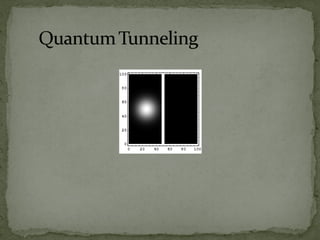
When described as a wave, the particle has a probability of
existing within the barrier region, and even on the other
side of it
An engineered material made from two or
more constituents with significantly
different physical or chemical properties
which remain separate and distinct on a
macroscopic level within the finished
structure.
particles do not actually need to touch each other
The nickel particles are not smooth spheres;
The particles are surrounded or wetted by an
insulating layer of silicone rubber which prevents
them from touching even when pressure is applied.
The spikes on the particles allow a higher
concentration of electrons
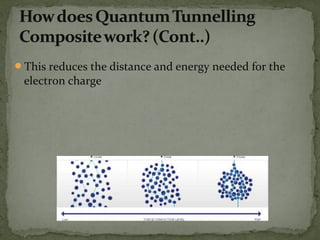
This reduces the distance and energy needed for the
electron charge
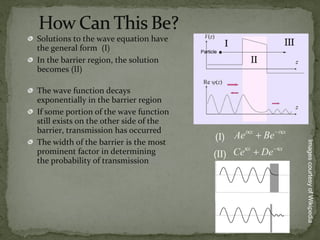
Solutions to the wave equation have
the general form (I)
In the barrier region, the solution
becomes (II)
The wave function decays
exponentially in the barrier region
If some portion of the wave function
still exists on the other side of the
barrier, transmission has occurred
The width of the barrier is the most
prominent factor in determining
the probability of transmission
(I)
(II)
ImagescourtesyofWikipedia
University of Colorado Tunneling Program
From
http://phet.colorado.edu/new/simulations/sims.ph
p?sim=Quantum_Tunneling_and_Wave_Packets
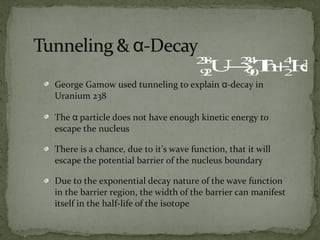
George Gamow used tunneling to explain α-decay in
Uranium 238
The α particle does not have enough kinetic energy to
escape the nucleus
There is a chance, due to it’s wave function, that it will
escape the potential barrier of the nucleus boundary
Due to the exponential decay nature of the wave function
in the barrier region, the width of the barrier can manifest
itself in the half-life of the isotope
92
238
U→90
234
Th+2
4
He
As microchip developers create smaller production
processes, we reach the limit of classical computer
technology
The feature size of the most advanced microchip today is
45 nm
With such small widths, the electrons in the channel can
tunnel out with relative ease, possibly affecting other
transistors in the chip
Current approximations show that the minimum feature
size is about 4 nm
After that point tunneling is not only possible, but highly
likely and the chip would fail
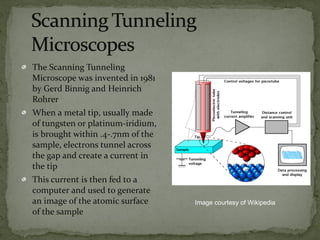
The Scanning Tunneling
Microscope was invented in 1981
by Gerd Binnig and Heinrich
Rohrer
When a metal tip, usually made
of tungsten or platinum-iridium,
is brought within .4-.7nm of the
sample, electrons tunnel across
the gap and create a current in
the tip
This current is then fed to a
computer and used to generate
an image of the atomic surface
of the sample
Image courtesy of Wikipedia
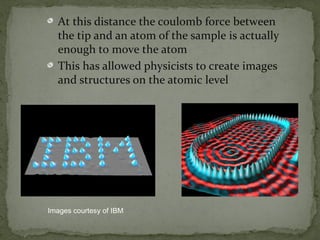
At this distance the coulomb force between
the tip and an atom of the sample is actually
enough to move the atom
This has allowed physicists to create images
and structures on the atomic level
Images courtesy of IBM
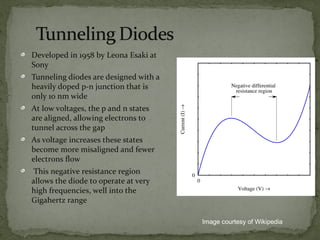
Developed in 1958 by Leona Esaki at
Sony
Tunneling diodes are designed with a
heavily doped p-n junction that is
only 10 nm wide
At low voltages, the p and n states
are aligned, allowing electrons to
tunnel across the gap
As voltage increases these states
become more misaligned and fewer
electrons flow
This negative resistance region
allows the diode to operate at very
high frequencies, well into the
Gigahertz range
Image courtesy of Wikipedia
A UK company is developing flexible force sensors that use
quantum tunneling
These sensors are made out of Quantum Tunneling Composite
materials
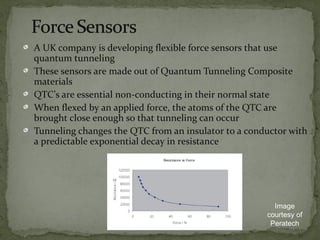
QTC’s are essential non-conducting in their normal state
When flexed by an applied force, the atoms of the QTC are
brought close enough so that tunneling can occur
Tunneling changes the QTC from an insulator to a conductor with
a predictable exponential decay in resistance
Image
courtesy of
Peratech
Toys and Games
QTC may be used to replace existing switches
and sensors in games controllers and computer
mice to give increased sensitivity for greater
control.
QTC in Sport
can be used as a sensor in many areas, from force
sensors in training dummies for boxing to
fencing jackets which incorporate touch sensors.
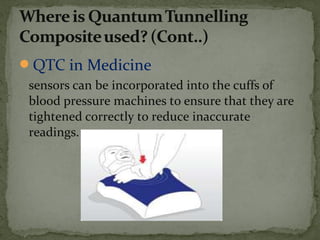
QTC in Medicine
sensors can be incorporated into the cuffs of
blood pressure machines to ensure that they are
tightened correctly to reduce inaccurate
readings.
QTC in Clothing
Wearable applications include mp3
player controllers built into the sleeves
of jackets.
QTC in Tools
incorporated into the handles of power
tools to act as a cut out switch or
variable controller.
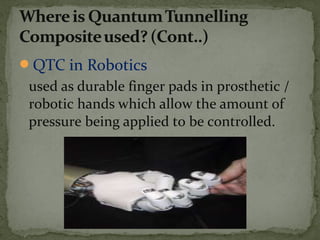
QTC in Robotics
used as durable finger pads in prosthetic /
robotic hands which allow the amount of
pressure being applied to be controlled.
QTC in Keyboards
used to make a flexible, durable, portable
QWERTY keyboard which can be
connected to a mobile phone, laptop or
other device using Bluetooth.
http://www.peratech.co.uk/science.htm
http://en.wikipedia.org/wiki/Tunnel_diode
http://en.wikipedia.org/wiki/Quantum_tunneling
http://en.wikipedia.org/wiki/Scanning_tunneling_microscope
http://psi.phys.wits.ac.za/teaching/Connell/phys284/2005/lectur
e-02/lecture_02/node13.html
Rex, A. & Thornton, S. T. (2006) Modern Physics for Scientists and
Engineers 3rd ed. Belmont CA: Thomson Brooks/Cole
http://www.almaden.ibm.com/vis/stm/gallery.html
Quantum tunneling composite

Quantum tunneling composite

  • 1.
    Course name :Power System Analysis Course code : 00697 Topic : Presentation on “QUANTUM TUNNELING COMPOSITE” Section : E Submitted to : Rethwan Faiz(course instructor)
  • 2.
    Name :ID Haque,Md Rashidul: 13-24186-2 HaqueTahsin,Shamsul Arefin : 12-21353-2  Haq, Shezan Ehsanul :13-24109-2 Azmaeen,Mesbah Hossain : 13-24003-2
  • 4.
    Consequence of thewave nature of matter First used to explain alpha decay of heavier elements in 1928 by George Gamow Shown experimentally by Leona Esaki in 1958 in the tunneling diode
  • 5.
    At the quantumlevel, matter has corpuscular and wave-like properties Tunneling can only be explained by the wave nature of matter as described by quantum mechanics Classically, when a particle is incident on a barrier of greater energy than the particle, reflection occurs When described as a wave, the particle has a probability of existing within the barrier region, and even on the other side of it
  • 6.
    An engineered materialmade from two or more constituents with significantly different physical or chemical properties which remain separate and distinct on a macroscopic level within the finished structure.
  • 7.
    particles do notactually need to touch each other The nickel particles are not smooth spheres; The particles are surrounded or wetted by an insulating layer of silicone rubber which prevents them from touching even when pressure is applied. The spikes on the particles allow a higher concentration of electrons
  • 8.
    This reduces thedistance and energy needed for the electron charge
  • 9.
    Solutions to thewave equation have the general form (I) In the barrier region, the solution becomes (II) The wave function decays exponentially in the barrier region If some portion of the wave function still exists on the other side of the barrier, transmission has occurred The width of the barrier is the most prominent factor in determining the probability of transmission (I) (II) ImagescourtesyofWikipedia
  • 10.
    University of ColoradoTunneling Program From http://phet.colorado.edu/new/simulations/sims.ph p?sim=Quantum_Tunneling_and_Wave_Packets
  • 11.
    George Gamow usedtunneling to explain α-decay in Uranium 238 The α particle does not have enough kinetic energy to escape the nucleus There is a chance, due to it’s wave function, that it will escape the potential barrier of the nucleus boundary Due to the exponential decay nature of the wave function in the barrier region, the width of the barrier can manifest itself in the half-life of the isotope 92 238 U→90 234 Th+2 4 He
  • 12.
    As microchip developerscreate smaller production processes, we reach the limit of classical computer technology The feature size of the most advanced microchip today is 45 nm With such small widths, the electrons in the channel can tunnel out with relative ease, possibly affecting other transistors in the chip Current approximations show that the minimum feature size is about 4 nm After that point tunneling is not only possible, but highly likely and the chip would fail
  • 13.
    The Scanning Tunneling Microscopewas invented in 1981 by Gerd Binnig and Heinrich Rohrer When a metal tip, usually made of tungsten or platinum-iridium, is brought within .4-.7nm of the sample, electrons tunnel across the gap and create a current in the tip This current is then fed to a computer and used to generate an image of the atomic surface of the sample Image courtesy of Wikipedia
  • 14.
    At this distancethe coulomb force between the tip and an atom of the sample is actually enough to move the atom This has allowed physicists to create images and structures on the atomic level Images courtesy of IBM
  • 15.
    Developed in 1958by Leona Esaki at Sony Tunneling diodes are designed with a heavily doped p-n junction that is only 10 nm wide At low voltages, the p and n states are aligned, allowing electrons to tunnel across the gap As voltage increases these states become more misaligned and fewer electrons flow This negative resistance region allows the diode to operate at very high frequencies, well into the Gigahertz range Image courtesy of Wikipedia
  • 16.
    A UK companyis developing flexible force sensors that use quantum tunneling These sensors are made out of Quantum Tunneling Composite materials QTC’s are essential non-conducting in their normal state When flexed by an applied force, the atoms of the QTC are brought close enough so that tunneling can occur Tunneling changes the QTC from an insulator to a conductor with a predictable exponential decay in resistance Image courtesy of Peratech
  • 17.
    Toys and Games QTCmay be used to replace existing switches and sensors in games controllers and computer mice to give increased sensitivity for greater control.
  • 18.
    QTC in Sport canbe used as a sensor in many areas, from force sensors in training dummies for boxing to fencing jackets which incorporate touch sensors.
  • 19.
    QTC in Medicine sensorscan be incorporated into the cuffs of blood pressure machines to ensure that they are tightened correctly to reduce inaccurate readings.
  • 20.
    QTC in Clothing Wearableapplications include mp3 player controllers built into the sleeves of jackets.
  • 21.
    QTC in Tools incorporatedinto the handles of power tools to act as a cut out switch or variable controller.
  • 22.
    QTC in Robotics usedas durable finger pads in prosthetic / robotic hands which allow the amount of pressure being applied to be controlled.
  • 23.
    QTC in Keyboards usedto make a flexible, durable, portable QWERTY keyboard which can be connected to a mobile phone, laptop or other device using Bluetooth.
  • 24.