Synthesis and
characterization of
pyrochlore (Gd2Ti2O7)
Gadolinium Titanium Oxide
UDIT GUPTA
INTRODUCTION
 CERAMIC MATERIALS
 Ceramics are inorganic and non-metallic materials.
 These are composed of more than one element (e.g., two in Al2O3)
 The crystallinity of ceramic materials ranges from highly oriented to semi-crystalline,
vitrified and often completely amorphous (e.g. glass).
 most ceramic materials are good thermal and electrical insulators due to varying
crystallinity and electron consumption in the ionic and covalent bonds
 Due their exception radiation stability, good thermal and mechanical properties, these
materials are proposed as a host for the immobilization of the high level radioactive waste
 PYROCHLORES
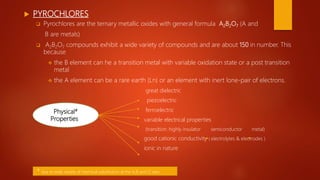
 Pyrochlores are the ternary metallic oxides with general formula A2B2O7 (A and
B are metals)
 A2B2O7 compounds exhibit a wide variety of compounds and are about 150 in number. This
because
 the B element can he a transition metal with variable oxidation state or a post transition
metal
 the A element can be a rare earth (Ln) or an element with inert lone-pair of electrons.
great dielectric
piezoelectric
ferroelectric
variable electrical properties
(transition: highly insulator semiconductor metal)
good cationic conductivity ( electrolytes & electrodes )
ionic in nature
Physical#
Properties#
# due to wide variety of chemical substitution at the A,B and O sites
STRUCTURE OF THE PYROCHLORES
 The general formula of the oxide pyrochlores can be written as A2B2O6O’.
 There are eight molecules per unit cell (Z=8).
 The structure is composed of two types of cation coordination polyhedron.
 The A cation (usually ~1%ionic radius) are eight coordinated and are located within
distorted cubes that contain six equally spaced anions (O'-atoms)
 The smaller B cations (~0.6A ionic radius) are six coordinated and are located within
trigonal antiprisms
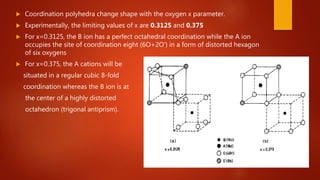
 Coordination polyhedra change shape with the oxygen x parameter.
 Experimentally, the limiting values of x are 0.3125 and 0.375
 For x=0.3125, the B ion has a perfect octahedral coordination while the A ion
occupies the site of coordination eight (6O+2O') in a form of distorted hexagon
of six oxygens
 For x=0.375, the A cations will be
situated in a regular cubic 8-fold
coordination whereas the B ion is at
the center of a highly distorted
octahedron (trigonal antiprism).
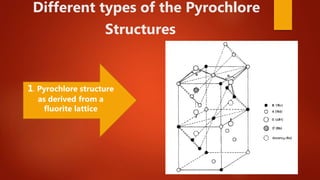
Different types of the Pyrochlore
Structures
1. Pyrochlore structure
as derived from a
fluorite lattice
Pyrochlore structure
based on corner shared
BO6 octahedral.
Pyrochlore structure as two
interpenetrating networks of BO
6 octahedral and A20' chains
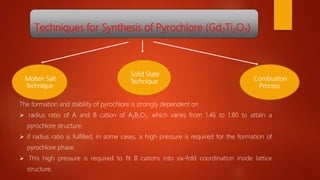
Techniques for Synthesis of Pyrochlore (Gd2Ti2O7)
Molten Salt
Technique
Solid State
Technique Combustion
Process
The formation and stability of pyrochlore is strongly dependent on
 radius ratio of A and B cation of A2B2O7, which varies from 1.46 to 1.80 to attain a
pyrochlore structure.
 if radius ratio is fulfilled, in some cases, a high pressure is required for the formation of
pyrochlore phase.
 This high pressure is required to fit B cations into six-fold coordination inside lattice
structure.
MOLTEN SALT TECHNIQUE :
 Precursors gadolinium oxide (Gd2O3) + metitanic acid (H2TiO3) are
mixed in stoichiometric ratios and then it is grinded using mortar and
pestle.
 The grinded mixture is further mixed in LiCl-KCl (1:1) salt mixture which
acts as a reaction medium.
 This final mixture is then kept in alumina crucible and heated at 750°c for
10 hr.
 Precursors get dissolved and diffuse in the molten flux to form Gd2Ti2O7
Gd2O3 + 2H2TiO3 → Gd2Ti2O7 +2H2O
 Gd2Ti2O7 crystals are taken out and washed with 10 % HCl solution
followed by hot distilled water to remove impurity.
 Crystals are then dried at 100°C to remove moisture.
COMBUSTION PROCESS:
 Gadolinium oxide (Gd2O3) + titanium oxide (TiO2) + nitric acid + distilled
water to form an aqueous solution.
 Citric acid is then added to the aqueous solution keeping its citric acid to
(Gd3+, Ti4+) ratio to 1:1.
 This mixture is stirred and then ammonium hydroxide NH4OH is added to
maintain a ph of 7 [NH4OH act as an oxidant].
 The whole mixture is heated at 250° c on hot plate.
 After some time, dehydration occur forming a dark foam.
 On persistent heating this dark foam gets auto ignited to give a fluffy powder.
 The prepared powder is calcined at 600°c to remove carbon content to give
pure Gd2Ti2O7 crystals.
SOLID STATE TECHNIQUE :
 Reagents used highly pure (>99.999 %) Gd2O3 and TiO2.
 Taken in the stoichiometry of (1 Gd2O3 : 2 TiO3).
 Reagents then calcenated at the temperature of 200° c for 12 hours in the
atmosphere to evaporate water impurity.
 The compound then weighed out
 mixed manually
 placed for annealing for 22 hours.
Gd2O3 + 2TiO2 → Gd2Ti2O7
EXPERIMENTAL DETAILS
Synthesis of
Gd2Ti2O7
Pyrochlore by
Solid State
Reaction
Grinding
Calcination
Pellets
Formation
Reagents and
Weighing
Annealing
Reagents:
 Reagents used are the compound consists of gadonilium oxide (Gd2O3)
molecular weight of 362.5 g/mole and titanium oxide (TiO2) with molecular
weight 79.866 g/mole.
 They prepare crystalline compounds by solid state technique.
Weighing :
 Mass % of Gd2O3 =
𝟑𝟔𝟐.𝟓𝟗 ×𝟏𝟎𝟎
𝟓𝟐𝟐.𝟐𝟐𝟗𝟖𝟗 = 69.41%
 Mass % of TiO2=
𝟕𝟗.𝟖𝟔𝟔 ×𝟏𝟎𝟎
𝟓𝟐𝟐.𝟐𝟐𝟗𝟖𝟗 = 30.586%
 In our experiment we have use 5gm compound for formation of 1inch pellet.
 In which mass of TiO2 = 1.529325 gm and mass of Gd2O3 =3.4705 gm. Is
used.
Calcination :
 The reactants are dried thoroughly prior to weighing.
 Calcination is done to remove volatile moisture present in compounds, if any.
 In order to evaporate water impurity, reagents were
calcinated at the temperature of 200° C for 2 hours
in the air atmosphere followed by natural furnace
cooling at the room temperature.
 As the volatile liquids get evaporated during the
calcinations this leading to no changes in the
chemical composition.
Grinding:
 After the reactants have been weighed out in the
required amount, they are mixed.
 We did manual mixing and grinding of gadolinium
oxide and titanium oxide for 8 hours so that the
materials are properly mixed and the bonding
become stronger.
Pellets Formation:
 After 8 hours of grinding, the reactants were mixed
with a small amount (about 1 small spatula) of PVA.
 Then pellets are made using 1 mm dye.
 The pellets are formed by applying 4 Ton force in
a pelletizer.
Annealing:
 Sample is heated at high temperature which should be preferably below the
melting point of sample.
 Pellets of the Gd2Ti2O7 powder were annealed for 22 hours furnace at the
rate of 40C per minute
 12 hours on temperature at constant temperature 1200 oC
 10 hours for rising and cooling temperature
 20 oC to 1200 oC (rising temperature for 5hours)
 1200 oC to 20 oC (cooling temperature for 5 hours)
CHARACTERIZATION OF GD2TI2O7 PELLETS
USING X-RAY DIFFRACTOMETER (XRD)
TECHNIQUE
 X-ray diffraction (XRD) is a rapid analytical technique which provide
information on unit cell dimensions and is used for phase identification of a
crystalline material .
 XRD is based on constructive interference of monochromatic X-rays and a
crystalline sample.
 X-rays are generated in a cathode ray tube by heating a filament to produce
electrons, accelerating the electrons toward a target by applying a voltage,
and bombarding the target material with electrons.
 The basic principle of this law is that “it relates the wavelength of
electromagnetic radiation to the diffraction angle and the lattice spacing(d) in
a crystalline sample” and follow Bragg's Law (nλ=2d sin θ). These diffracted X-
rays are then detected, processed and counted
 The sample is scanned by 2θ angles i.e. all possible diffraction directions of the
lattice should be attained due to the random orientation of the planes in the
material.
 The conversion of the diffraction peaks to d-spacing’s and (h,k,l) planes allow us to
identify the crystallography of mineral.
 When the Bragg Equation is satisfied, constructive interference occurs and a peak
in intensity occurs. A detector records and processes this X-ray signal and converts
the signal to a count rate which is then output to a device such as a printer or
computer monitor.
In this project, we have used Bruker D8 advanced XRD which is
equipped with Cu-Kα radiation source (λ=1.5404 Å) mainly for
structural and phase stability analysis.
EXPERIMENTAL RESULT
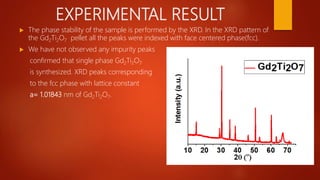
 The phase stability of the sample is performed by the XRD. In the XRD pattern of
the Gd2Ti2O7 pellet all the peaks were indexed with face centered phase(fcc).
 We have not observed any impurity peaks
confirmed that single phase Gd2Ti2O7
is synthesized. XRD peaks corresponding
to the fcc phase with lattice constant
a= 1.01843 nm of Gd2Ti2O7.
Applications of oxide pyrochlores
 The main properties of oxide pyrochlores are electrical, magnetic, dielectric, optical
and catalytic behavior.
These properties are nominally controlled by the parameters such as ionic
size, polarizability of the ions, electronic configuration.
 Electronic Materials
 High permittivity ceramics
 Thermistors
 Thick film resistors and materials for screen printing
 Switching elements
 Pyrochlores as Electrodes in MHD Power Generation and as Heating Elements
 Pyrochlores as Oxygen Electrodes
 Role of Pyrochlores in the Radioactive Waste Disposal
 Pyrochlores as Semiconductor Electrodes for Solar Energy Conversion
 Pyrochlores as Solid Electrolytes
Thanking
You

Synthesis and characterization of pyrochlore (Gd2Ti2O7)

  • 1.
    Synthesis and characterization of pyrochlore(Gd2Ti2O7) Gadolinium Titanium Oxide UDIT GUPTA
  • 2.
    INTRODUCTION  CERAMIC MATERIALS Ceramics are inorganic and non-metallic materials.  These are composed of more than one element (e.g., two in Al2O3)  The crystallinity of ceramic materials ranges from highly oriented to semi-crystalline, vitrified and often completely amorphous (e.g. glass).  most ceramic materials are good thermal and electrical insulators due to varying crystallinity and electron consumption in the ionic and covalent bonds  Due their exception radiation stability, good thermal and mechanical properties, these materials are proposed as a host for the immobilization of the high level radioactive waste
  • 3.
     PYROCHLORES  Pyrochloresare the ternary metallic oxides with general formula A2B2O7 (A and B are metals)  A2B2O7 compounds exhibit a wide variety of compounds and are about 150 in number. This because  the B element can he a transition metal with variable oxidation state or a post transition metal  the A element can be a rare earth (Ln) or an element with inert lone-pair of electrons. great dielectric piezoelectric ferroelectric variable electrical properties (transition: highly insulator semiconductor metal) good cationic conductivity ( electrolytes & electrodes ) ionic in nature Physical# Properties# # due to wide variety of chemical substitution at the A,B and O sites
  • 4.
    STRUCTURE OF THEPYROCHLORES  The general formula of the oxide pyrochlores can be written as A2B2O6O’.  There are eight molecules per unit cell (Z=8).  The structure is composed of two types of cation coordination polyhedron.  The A cation (usually ~1%ionic radius) are eight coordinated and are located within distorted cubes that contain six equally spaced anions (O'-atoms)  The smaller B cations (~0.6A ionic radius) are six coordinated and are located within trigonal antiprisms
  • 5.
     Coordination polyhedrachange shape with the oxygen x parameter.  Experimentally, the limiting values of x are 0.3125 and 0.375  For x=0.3125, the B ion has a perfect octahedral coordination while the A ion occupies the site of coordination eight (6O+2O') in a form of distorted hexagon of six oxygens  For x=0.375, the A cations will be situated in a regular cubic 8-fold coordination whereas the B ion is at the center of a highly distorted octahedron (trigonal antiprism).
  • 6.
    Different types ofthe Pyrochlore Structures 1. Pyrochlore structure as derived from a fluorite lattice
  • 7.
    Pyrochlore structure based oncorner shared BO6 octahedral. Pyrochlore structure as two interpenetrating networks of BO 6 octahedral and A20' chains
  • 8.
    Techniques for Synthesisof Pyrochlore (Gd2Ti2O7) Molten Salt Technique Solid State Technique Combustion Process The formation and stability of pyrochlore is strongly dependent on  radius ratio of A and B cation of A2B2O7, which varies from 1.46 to 1.80 to attain a pyrochlore structure.  if radius ratio is fulfilled, in some cases, a high pressure is required for the formation of pyrochlore phase.  This high pressure is required to fit B cations into six-fold coordination inside lattice structure.
  • 9.
    MOLTEN SALT TECHNIQUE:  Precursors gadolinium oxide (Gd2O3) + metitanic acid (H2TiO3) are mixed in stoichiometric ratios and then it is grinded using mortar and pestle.  The grinded mixture is further mixed in LiCl-KCl (1:1) salt mixture which acts as a reaction medium.  This final mixture is then kept in alumina crucible and heated at 750°c for 10 hr.  Precursors get dissolved and diffuse in the molten flux to form Gd2Ti2O7 Gd2O3 + 2H2TiO3 → Gd2Ti2O7 +2H2O  Gd2Ti2O7 crystals are taken out and washed with 10 % HCl solution followed by hot distilled water to remove impurity.  Crystals are then dried at 100°C to remove moisture.
  • 10.
    COMBUSTION PROCESS:  Gadoliniumoxide (Gd2O3) + titanium oxide (TiO2) + nitric acid + distilled water to form an aqueous solution.  Citric acid is then added to the aqueous solution keeping its citric acid to (Gd3+, Ti4+) ratio to 1:1.  This mixture is stirred and then ammonium hydroxide NH4OH is added to maintain a ph of 7 [NH4OH act as an oxidant].  The whole mixture is heated at 250° c on hot plate.  After some time, dehydration occur forming a dark foam.  On persistent heating this dark foam gets auto ignited to give a fluffy powder.  The prepared powder is calcined at 600°c to remove carbon content to give pure Gd2Ti2O7 crystals.
  • 11.
    SOLID STATE TECHNIQUE:  Reagents used highly pure (>99.999 %) Gd2O3 and TiO2.  Taken in the stoichiometry of (1 Gd2O3 : 2 TiO3).  Reagents then calcenated at the temperature of 200° c for 12 hours in the atmosphere to evaporate water impurity.  The compound then weighed out  mixed manually  placed for annealing for 22 hours. Gd2O3 + 2TiO2 → Gd2Ti2O7
  • 12.
    EXPERIMENTAL DETAILS Synthesis of Gd2Ti2O7 Pyrochloreby Solid State Reaction Grinding Calcination Pellets Formation Reagents and Weighing Annealing
  • 13.
    Reagents:  Reagents usedare the compound consists of gadonilium oxide (Gd2O3) molecular weight of 362.5 g/mole and titanium oxide (TiO2) with molecular weight 79.866 g/mole.  They prepare crystalline compounds by solid state technique. Weighing :  Mass % of Gd2O3 = 𝟑𝟔𝟐.𝟓𝟗 ×𝟏𝟎𝟎 𝟓𝟐𝟐.𝟐𝟐𝟗𝟖𝟗 = 69.41%  Mass % of TiO2= 𝟕𝟗.𝟖𝟔𝟔 ×𝟏𝟎𝟎 𝟓𝟐𝟐.𝟐𝟐𝟗𝟖𝟗 = 30.586%  In our experiment we have use 5gm compound for formation of 1inch pellet.  In which mass of TiO2 = 1.529325 gm and mass of Gd2O3 =3.4705 gm. Is used.
  • 14.
    Calcination :  Thereactants are dried thoroughly prior to weighing.  Calcination is done to remove volatile moisture present in compounds, if any.  In order to evaporate water impurity, reagents were calcinated at the temperature of 200° C for 2 hours in the air atmosphere followed by natural furnace cooling at the room temperature.  As the volatile liquids get evaporated during the calcinations this leading to no changes in the chemical composition.
  • 15.
    Grinding:  After thereactants have been weighed out in the required amount, they are mixed.  We did manual mixing and grinding of gadolinium oxide and titanium oxide for 8 hours so that the materials are properly mixed and the bonding become stronger. Pellets Formation:  After 8 hours of grinding, the reactants were mixed with a small amount (about 1 small spatula) of PVA.  Then pellets are made using 1 mm dye.  The pellets are formed by applying 4 Ton force in a pelletizer.
  • 16.
    Annealing:  Sample isheated at high temperature which should be preferably below the melting point of sample.  Pellets of the Gd2Ti2O7 powder were annealed for 22 hours furnace at the rate of 40C per minute  12 hours on temperature at constant temperature 1200 oC  10 hours for rising and cooling temperature  20 oC to 1200 oC (rising temperature for 5hours)  1200 oC to 20 oC (cooling temperature for 5 hours)
  • 17.
    CHARACTERIZATION OF GD2TI2O7PELLETS USING X-RAY DIFFRACTOMETER (XRD) TECHNIQUE  X-ray diffraction (XRD) is a rapid analytical technique which provide information on unit cell dimensions and is used for phase identification of a crystalline material .  XRD is based on constructive interference of monochromatic X-rays and a crystalline sample.  X-rays are generated in a cathode ray tube by heating a filament to produce electrons, accelerating the electrons toward a target by applying a voltage, and bombarding the target material with electrons.  The basic principle of this law is that “it relates the wavelength of electromagnetic radiation to the diffraction angle and the lattice spacing(d) in a crystalline sample” and follow Bragg's Law (nλ=2d sin θ). These diffracted X- rays are then detected, processed and counted
  • 18.
     The sampleis scanned by 2θ angles i.e. all possible diffraction directions of the lattice should be attained due to the random orientation of the planes in the material.  The conversion of the diffraction peaks to d-spacing’s and (h,k,l) planes allow us to identify the crystallography of mineral.  When the Bragg Equation is satisfied, constructive interference occurs and a peak in intensity occurs. A detector records and processes this X-ray signal and converts the signal to a count rate which is then output to a device such as a printer or computer monitor. In this project, we have used Bruker D8 advanced XRD which is equipped with Cu-Kα radiation source (λ=1.5404 Å) mainly for structural and phase stability analysis.
  • 20.
    EXPERIMENTAL RESULT  Thephase stability of the sample is performed by the XRD. In the XRD pattern of the Gd2Ti2O7 pellet all the peaks were indexed with face centered phase(fcc).  We have not observed any impurity peaks confirmed that single phase Gd2Ti2O7 is synthesized. XRD peaks corresponding to the fcc phase with lattice constant a= 1.01843 nm of Gd2Ti2O7.
  • 21.
    Applications of oxidepyrochlores  The main properties of oxide pyrochlores are electrical, magnetic, dielectric, optical and catalytic behavior. These properties are nominally controlled by the parameters such as ionic size, polarizability of the ions, electronic configuration.  Electronic Materials  High permittivity ceramics  Thermistors  Thick film resistors and materials for screen printing  Switching elements  Pyrochlores as Electrodes in MHD Power Generation and as Heating Elements  Pyrochlores as Oxygen Electrodes  Role of Pyrochlores in the Radioactive Waste Disposal  Pyrochlores as Semiconductor Electrodes for Solar Energy Conversion  Pyrochlores as Solid Electrolytes
  • 22.