Spintronics
SAMEER PATEL|AAKASH MASAND
Why Spintronics?

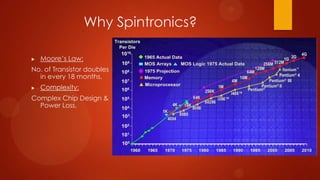
   Moore‟s Law:
No. of Transistor doubles
  in every 18 months.
   Complexity:
Complex Chip Design &
  Power Loss.
Introduction To Spintronics


   Conventional electronic devices rely on the transport of electrical charge
    carriers – electrons – in a semiconductor such as silicon.
    Now, however, physicists are trying to exploit the „spin‟ of the electron
    rather than its charge to create a remarkable new generation of
    „spintronic‟ devices which will be smaller, more versatile and more robust
    than those currently making up silicon chips and circuit elements. The
    potential market is worth hundreds of billions of dollars a year.
The „Spin‟

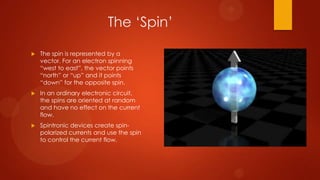
   The spin is represented by a
    vector. For an electron spinning
    “west to east”, the vector points
    “north” or “up” and it points
    “down” for the opposite spin.
   In an ordinary electronic circuit,
    the spins are oriented at random
    and have no effect on the current
    flow.
   Spintronic devices create spin-
    polarized currents and use the spin
    to control the current flow.
The Giant Magneto Resistance
   A Nano scale phenomena.
   Giant refers to giant change in
    resistance due to current.
   It is a quantum mechanical magneto
    resistance effect observed in thin-film
    structures composed of alternating
    ferromagnetic and non-magnetic layers.


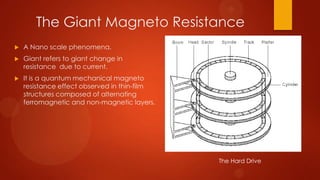
                                              The Hard Drive
The Structure and Working of GMR
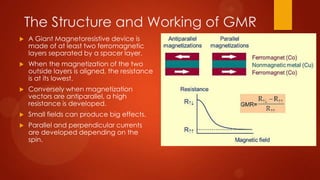
   A Giant Magnetoresistive device is
    made of at least two ferromagnetic
    layers separated by a spacer layer.
   When the magnetization of the two
    outside layers is aligned, the resistance
    is at its lowest.
   Conversely when magnetization
    vectors are antiparallel, a high
    resistance is developed.
   Small fields can produce big effects.
   Parallel and perpendicular currents
    are developed depending on the
    spin.
Magneto Resistive RAM

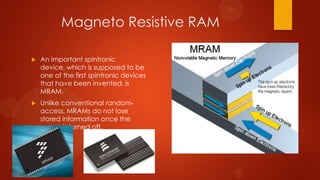
   An important spintronic
    device, which is supposed to be
    one of the first spintronic devices
    that have been invented, is
    MRAM.
   Unlike conventional random-
    access, MRAMs do not lose
    stored information once the
    power is turned off.
Quantum Computing
   A quantum computer is a machine that
    performs calculations based on the laws of
    quantum mechanics, which is the
    behavior of particles at the sub-atomic
    level.
   A bit of data is represented by a single
    atom that is in one of two states denoted
    by |0> and |1>. A single bit of this form is
    known as a qubit.
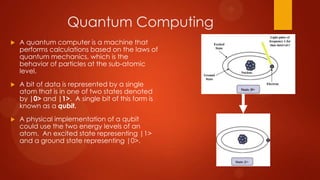
   A physical implementation of a qubit
    could use the two energy levels of an
    atom. An excited state representing |1>
    and a ground state representing |0>.
Advantages of Spintronics

   Low power consumption.
   Less heat dissipation.
   Takes up lesser space on chip, thus more compact.
   Spin manipulation is faster.
   Spintronics does not require unique and specialized semiconductors.
      Common metals such as Fe, Al, etc. can be used.
Questions?

Spintronics

  • 1.
  • 2.
    Why Spintronics?  Moore‟s Law: No. of Transistor doubles in every 18 months.  Complexity: Complex Chip Design & Power Loss.
  • 3.
    Introduction To Spintronics  Conventional electronic devices rely on the transport of electrical charge carriers – electrons – in a semiconductor such as silicon. Now, however, physicists are trying to exploit the „spin‟ of the electron rather than its charge to create a remarkable new generation of „spintronic‟ devices which will be smaller, more versatile and more robust than those currently making up silicon chips and circuit elements. The potential market is worth hundreds of billions of dollars a year.
  • 4.
    The „Spin‟  The spin is represented by a vector. For an electron spinning “west to east”, the vector points “north” or “up” and it points “down” for the opposite spin.  In an ordinary electronic circuit, the spins are oriented at random and have no effect on the current flow.  Spintronic devices create spin- polarized currents and use the spin to control the current flow.
  • 5.
    The Giant MagnetoResistance  A Nano scale phenomena.  Giant refers to giant change in resistance due to current.  It is a quantum mechanical magneto resistance effect observed in thin-film structures composed of alternating ferromagnetic and non-magnetic layers. The Hard Drive
  • 6.
    The Structure andWorking of GMR  A Giant Magnetoresistive device is made of at least two ferromagnetic layers separated by a spacer layer.  When the magnetization of the two outside layers is aligned, the resistance is at its lowest.  Conversely when magnetization vectors are antiparallel, a high resistance is developed.  Small fields can produce big effects.  Parallel and perpendicular currents are developed depending on the spin.
  • 7.
    Magneto Resistive RAM  An important spintronic device, which is supposed to be one of the first spintronic devices that have been invented, is MRAM.  Unlike conventional random- access, MRAMs do not lose stored information once the power is turned off.
  • 8.
    Quantum Computing  A quantum computer is a machine that performs calculations based on the laws of quantum mechanics, which is the behavior of particles at the sub-atomic level.  A bit of data is represented by a single atom that is in one of two states denoted by |0> and |1>. A single bit of this form is known as a qubit.  A physical implementation of a qubit could use the two energy levels of an atom. An excited state representing |1> and a ground state representing |0>.
  • 9.
    Advantages of Spintronics  Low power consumption.  Less heat dissipation.  Takes up lesser space on chip, thus more compact.  Spin manipulation is faster.  Spintronics does not require unique and specialized semiconductors. Common metals such as Fe, Al, etc. can be used.
  • 10.