OFET Sensors
Titto Thomas
133079015
M.Tech Seminar
Introduction
 Sensors
 Transducer

 Conversion into signals

 Applications

[2]

 Organic conducting polymers
 Discovery [1]
 Applications
 Organic Thin Film Transistor (OTFT)
[1] H. Shirakawa et al. , “Synthesis of electrically conducting organic polymers: halogen derivatives of
polyacetylene, (ch),”, 1977
[2] P. Lin and F. Yan, “Organic thin-film transistors for chemical and biological sensing,” 2012
OFET Sensors : IIT Bombay

2
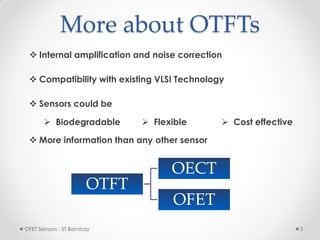
More about OTFTs
 Internal amplification and noise correction
 Compatibility with existing VLSI Technology
 Sensors could be
 Biodegradable

 Flexible

 Cost effective

 More information than any other sensor

OTFT
OFET Sensors : IIT Bombay

OECT
OFET
3
Device Structure & Working
 OECT
 Source & Drain electrodes
 OSC channel

 Electrolytic layer on top
 OFET
 Similar to OECT
 Direct interaction with analyte
 Two configurations

[1]

[1] P. Lin and F. Yan, “Organic thin-film transistors for chemical and biological sensing,”, 2012
OFET Sensors : IIT Bombay

4
OFETs in detail
 Two configurations
 Top contact
 Bottom contact

 Lower mobility in the channel
 Follows standard MOSFET equations

[1]
[1] H. Ma, et al., “Multifunctional phosphoric acid self-assembled monolayers on metal oxides as
dielectrics, interface modification layers and semiconductors for low-voltage high-performance organic
field-effect transistors,”, 2012
OFET Sensors : IIT Bombay

5
OFET Sensors in detail
OFET Sensors
Bio-Sensors
DNA
Proteins
Glucose
Others

OFET Sensors : IIT Bombay

Gas Sensors

Chemical
Sensors
Ions
Humidity

Other sensors
X-ray
Others

pH

Others
6
Bio-sensors : DNA
[2]

 Zhang et al. used pentacene as the OSC channel
 DNA adsorption  VT shift  Electron extraction by DNA
 Improvement suggestions
 Reducing film thickness or
current

 Increase substrate
temperature

[3]

 Yan et al. proposed another device using P3HT
[2]

[1]

[1]http://www.intechopen.com/books/biosensors/design-and-fabrication-of-nanowire-basedconductance-biosensor-using-spacer-patterning-techniq
[2] Q. Zhang and V. Subramanian, 2012
[3] F. Yan, S. M. Mok, J. Yu, H. L. Chan, and M. Yang, 2009
OFET Sensors : IIT Bombay

7
Bio-sensors : Glucose & Others
[1]

 J.Liu et al. proposed PEDOT-PSS organic channel with GOx
entrapped
 GOx entrapped during polymerization
 Redox reaction channel and glucose with Gox
catalysis
[2]

 Sensor based on Ta2O5 and P3HT , by Bartic et al.
 GOx anchored on surface
 Cyanopropyltrichlorosilane treatment
[3]

 Roberts et al. OFET to detect glucose, cystein, and MPA by
 DDFTTF as the OSC channel
[1] J. Liu, M. Agarwal, and K. Varahramyan, “Glucose sensor based on organic thin film transistor using glucose
oxidase and conducting polymer,” , 2008
[2] C. Bartic, A. Campitelli, and S. Borghs, “Field-effect detection of chemical species with hybrid
organic/inorganic transistors,” , 2003
[3] M. E. Roberts, S. C. B. Mannsfeld, N. Queralt, C. Reese, J. Locklin, W. Knoll, and Z. Bao, “Water-stable organic
transistors and their application in chemical and biological sensors,”

OFET Sensors : IIT Bombay

8
Bio-sensors : Overview

OFET Sensors : IIT Bombay

9
Chemical Sensors : Ions & pH
[1]

 Ji et al. P3HT as the OSC, with Ta2O5 and valinomycin
subsequently deposited on top
+ +
 Detects K , H ions and pH levels
[2]

 Scarpa et al. used P3HT as channel
+ +
2+
 K , Na, Ca ions and pH levels even at 0.001%
[3]

 Maddalena et al. had a sulfate receptor with incorporated
thiol group, coupled polystyrene layer
 Detects sulphate ions with 1mM
[1] T. Ji, P. Rai, S. Jung, and V. K. Varadan, “In vitro evaluation of flexible ph and potassium ion-sensitive organic
field effect transistor sensors,” 2008
[2] G. Scarpa, A.-L. Idzko, A. Yadav, and S. Thalhammer, “Organic ISFET based on poly (3-hexylthiophene),” 2010
[3] F. Maddalena, M. J. Kuiper, B. Poolman, F. Brouwer, J. C. Hummelen, D. M. de Leeuw, B. De Boer, and
P. W. M. Blom, “Organic field-effect transistor-based biosensors functionalized with protein receptors,” , 2010

OFET Sensors : IIT Bombay

10
Chemical Sensors : Ions & pH
[1]

 Bartic et al. reported a P3HT OSC OFET
 Indicates the pH values after in-situ amplification
 Coating with arachidic acid improves the sensitivity
[2]

 Pentacene OSC based OFET proposed by Loi et al.

 variations in charge at the gate-channel interface
 coating the floating gate with thioaminic groups
 Water stable OFET which can detect pH 3 to 11, using DFTTF
OSC channel by Roberts et al.[3]
[1] C. Bartic, A. Campitelli, and S. Borghs, “Field-effect detection of chemical species with hybrid
organic/inorganic transistors,” 2003
[2] A. Loi, I. Manunza, and A. Bonfiglio, “Flexible, organic, ion-sensitive field-effect transistor,” 2005
[3] M. E. Roberts, S. C. B. Mannsfeld, N. Queralt, C. Reese, J. Locklin, W. Knoll, and Z. Bao, “Water-stable organic
transistors and their application in chemical and biological sensors,” 2008

OFET Sensors : IIT Bombay

11
Chemical sensors : Overview

OFET Sensors : IIT Bombay

12
Gas Sensors
[1]

 Laurs et al. observed that oxygen, iodine and bromine could
vary the current through the OFET fabricated with
phthalocyanines (Pcs) as the OSC.
[2]

 Torsi et al. fabricated NTCDA
based OFET, and found four
characteristic parameters to
be varying.
[3]

[4]

 Someya et al. and Torsi et al.
Reported the dependancy of
sensitivity on grain size.

[1] H. Laurs and G. Heiland, “Electrical and optical properties of phthalocyanine films,” 1987
[2] L. Torsi, A. Dodabalapur, L. Sabbatini, and P. Zambonin, “Multi-parameter gas sensors based on organic thinfilm-transistors,” 2000
[3] T. Someya, A. Dodabalapur, A. Gelperin, H. E. Katz, and Z. Bao, “Integration and response of organic
electronics with aqueous microfluidics,” 2002
[4] L. Torsi, A. J. Lovinger, B. Crone, T. Someya, A. Dodabalapur, H. E.Katz, and A. Gelperin, “Correlation between
oligothiophene thin film transistor morphology and vapor responses,” 2002

OFET Sensors : IIT Bombay

13
Gas sensors : overview

OFET Sensors : IIT Bombay

14
Explosive vapor sensor
 A particular type of gas sensor
 OFETs as explosive sensors
 RDX

[1]

 TNT

 Materials proposed to be
used as OSC channel
 Poly 3-hexylthiophene
(P3HT)

[2]

II

 Cu tetraphenylpophyrin
(CuTPP)
[1] Ravishankar S. et al. “Explosive vapor sensor using poly 3-hexylthiophene and Cu tetraphenylporphyrin
composite based organic field effect transistors“ 2008
[2] http://www.aist.go.jp/aist_e/aist_laboratories/2information

OFET Sensors : IIT Bombay

15
Device structure and fabrication

[1]

 SiO2 layer grown on n silicon wafer
 Au / Ti Source & Drains are patterned
 HMDS Surface enhancement
 CuTPP & P3HT dissolved in chloroform is spin coated
[1] Ravishankar S. et al. “Explosive vapor sensor using poly 3-hexylthiophene and Cu tetraphenylporphyrin
composite based organic field effect transistors“ 2008

OFET Sensors : IIT Bombay

16
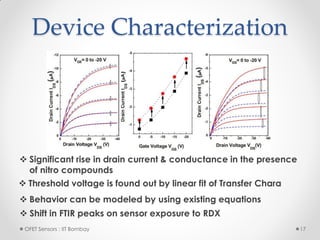
Device Characterization

 Significant rise in drain current & conductance in the presence
of nitro compounds
 Threshold voltage is found out by linear fit of Transfer Chara
 Behavior can be modeled by using existing equations
 Shift in FTIR peaks on sensor exposure to RDX
OFET Sensors : IIT Bombay

17
OFET explosive vapor sensor :
Results & Conclusion
 Selectivity of
the sensor for
various vapors

 The OFET formed has high sensitivity to nitro based explosives
 ION & S parameters can be evaluated to check the presence

OFET Sensors : IIT Bombay

18
Conclusions & Future Scope
 OFETs are effective sensors for detecting various types of
materials
 Many materials being tried out to be used in sensors have a
promising performance
 Also there is a need for new structures and modifications to
enhance the sensing abilities of sensors
 Sensitivity, selectivity, stability all have to be improved before
using them in real life applications

OFET Sensors : IIT Bombay

19
Thank You
OFET Sensors : IIT Bombay

20

OFET sensors

  • 1.
  • 2.
    Introduction  Sensors  Transducer Conversion into signals  Applications [2]  Organic conducting polymers  Discovery [1]  Applications  Organic Thin Film Transistor (OTFT) [1] H. Shirakawa et al. , “Synthesis of electrically conducting organic polymers: halogen derivatives of polyacetylene, (ch),”, 1977 [2] P. Lin and F. Yan, “Organic thin-film transistors for chemical and biological sensing,” 2012 OFET Sensors : IIT Bombay 2
  • 3.
    More about OTFTs Internal amplification and noise correction  Compatibility with existing VLSI Technology  Sensors could be  Biodegradable  Flexible  Cost effective  More information than any other sensor OTFT OFET Sensors : IIT Bombay OECT OFET 3
  • 4.
    Device Structure &Working  OECT  Source & Drain electrodes  OSC channel  Electrolytic layer on top  OFET  Similar to OECT  Direct interaction with analyte  Two configurations [1] [1] P. Lin and F. Yan, “Organic thin-film transistors for chemical and biological sensing,”, 2012 OFET Sensors : IIT Bombay 4
  • 5.
    OFETs in detail Two configurations  Top contact  Bottom contact  Lower mobility in the channel  Follows standard MOSFET equations [1] [1] H. Ma, et al., “Multifunctional phosphoric acid self-assembled monolayers on metal oxides as dielectrics, interface modification layers and semiconductors for low-voltage high-performance organic field-effect transistors,”, 2012 OFET Sensors : IIT Bombay 5
  • 6.
    OFET Sensors indetail OFET Sensors Bio-Sensors DNA Proteins Glucose Others OFET Sensors : IIT Bombay Gas Sensors Chemical Sensors Ions Humidity Other sensors X-ray Others pH Others 6
  • 7.
    Bio-sensors : DNA [2] Zhang et al. used pentacene as the OSC channel  DNA adsorption  VT shift  Electron extraction by DNA  Improvement suggestions  Reducing film thickness or current  Increase substrate temperature [3]  Yan et al. proposed another device using P3HT [2] [1] [1]http://www.intechopen.com/books/biosensors/design-and-fabrication-of-nanowire-basedconductance-biosensor-using-spacer-patterning-techniq [2] Q. Zhang and V. Subramanian, 2012 [3] F. Yan, S. M. Mok, J. Yu, H. L. Chan, and M. Yang, 2009 OFET Sensors : IIT Bombay 7
  • 8.
    Bio-sensors : Glucose& Others [1]  J.Liu et al. proposed PEDOT-PSS organic channel with GOx entrapped  GOx entrapped during polymerization  Redox reaction channel and glucose with Gox catalysis [2]  Sensor based on Ta2O5 and P3HT , by Bartic et al.  GOx anchored on surface  Cyanopropyltrichlorosilane treatment [3]  Roberts et al. OFET to detect glucose, cystein, and MPA by  DDFTTF as the OSC channel [1] J. Liu, M. Agarwal, and K. Varahramyan, “Glucose sensor based on organic thin film transistor using glucose oxidase and conducting polymer,” , 2008 [2] C. Bartic, A. Campitelli, and S. Borghs, “Field-effect detection of chemical species with hybrid organic/inorganic transistors,” , 2003 [3] M. E. Roberts, S. C. B. Mannsfeld, N. Queralt, C. Reese, J. Locklin, W. Knoll, and Z. Bao, “Water-stable organic transistors and their application in chemical and biological sensors,” OFET Sensors : IIT Bombay 8
  • 9.
    Bio-sensors : Overview OFETSensors : IIT Bombay 9
  • 10.
    Chemical Sensors :Ions & pH [1]  Ji et al. P3HT as the OSC, with Ta2O5 and valinomycin subsequently deposited on top + +  Detects K , H ions and pH levels [2]  Scarpa et al. used P3HT as channel + + 2+  K , Na, Ca ions and pH levels even at 0.001% [3]  Maddalena et al. had a sulfate receptor with incorporated thiol group, coupled polystyrene layer  Detects sulphate ions with 1mM [1] T. Ji, P. Rai, S. Jung, and V. K. Varadan, “In vitro evaluation of flexible ph and potassium ion-sensitive organic field effect transistor sensors,” 2008 [2] G. Scarpa, A.-L. Idzko, A. Yadav, and S. Thalhammer, “Organic ISFET based on poly (3-hexylthiophene),” 2010 [3] F. Maddalena, M. J. Kuiper, B. Poolman, F. Brouwer, J. C. Hummelen, D. M. de Leeuw, B. De Boer, and P. W. M. Blom, “Organic field-effect transistor-based biosensors functionalized with protein receptors,” , 2010 OFET Sensors : IIT Bombay 10
  • 11.
    Chemical Sensors :Ions & pH [1]  Bartic et al. reported a P3HT OSC OFET  Indicates the pH values after in-situ amplification  Coating with arachidic acid improves the sensitivity [2]  Pentacene OSC based OFET proposed by Loi et al.  variations in charge at the gate-channel interface  coating the floating gate with thioaminic groups  Water stable OFET which can detect pH 3 to 11, using DFTTF OSC channel by Roberts et al.[3] [1] C. Bartic, A. Campitelli, and S. Borghs, “Field-effect detection of chemical species with hybrid organic/inorganic transistors,” 2003 [2] A. Loi, I. Manunza, and A. Bonfiglio, “Flexible, organic, ion-sensitive field-effect transistor,” 2005 [3] M. E. Roberts, S. C. B. Mannsfeld, N. Queralt, C. Reese, J. Locklin, W. Knoll, and Z. Bao, “Water-stable organic transistors and their application in chemical and biological sensors,” 2008 OFET Sensors : IIT Bombay 11
  • 12.
    Chemical sensors :Overview OFET Sensors : IIT Bombay 12
  • 13.
    Gas Sensors [1]  Laurset al. observed that oxygen, iodine and bromine could vary the current through the OFET fabricated with phthalocyanines (Pcs) as the OSC. [2]  Torsi et al. fabricated NTCDA based OFET, and found four characteristic parameters to be varying. [3] [4]  Someya et al. and Torsi et al. Reported the dependancy of sensitivity on grain size. [1] H. Laurs and G. Heiland, “Electrical and optical properties of phthalocyanine films,” 1987 [2] L. Torsi, A. Dodabalapur, L. Sabbatini, and P. Zambonin, “Multi-parameter gas sensors based on organic thinfilm-transistors,” 2000 [3] T. Someya, A. Dodabalapur, A. Gelperin, H. E. Katz, and Z. Bao, “Integration and response of organic electronics with aqueous microfluidics,” 2002 [4] L. Torsi, A. J. Lovinger, B. Crone, T. Someya, A. Dodabalapur, H. E.Katz, and A. Gelperin, “Correlation between oligothiophene thin film transistor morphology and vapor responses,” 2002 OFET Sensors : IIT Bombay 13
  • 14.
    Gas sensors :overview OFET Sensors : IIT Bombay 14
  • 15.
    Explosive vapor sensor A particular type of gas sensor  OFETs as explosive sensors  RDX [1]  TNT  Materials proposed to be used as OSC channel  Poly 3-hexylthiophene (P3HT) [2] II  Cu tetraphenylpophyrin (CuTPP) [1] Ravishankar S. et al. “Explosive vapor sensor using poly 3-hexylthiophene and Cu tetraphenylporphyrin composite based organic field effect transistors“ 2008 [2] http://www.aist.go.jp/aist_e/aist_laboratories/2information OFET Sensors : IIT Bombay 15
  • 16.
    Device structure andfabrication [1]  SiO2 layer grown on n silicon wafer  Au / Ti Source & Drains are patterned  HMDS Surface enhancement  CuTPP & P3HT dissolved in chloroform is spin coated [1] Ravishankar S. et al. “Explosive vapor sensor using poly 3-hexylthiophene and Cu tetraphenylporphyrin composite based organic field effect transistors“ 2008 OFET Sensors : IIT Bombay 16
  • 17.
    Device Characterization  Significantrise in drain current & conductance in the presence of nitro compounds  Threshold voltage is found out by linear fit of Transfer Chara  Behavior can be modeled by using existing equations  Shift in FTIR peaks on sensor exposure to RDX OFET Sensors : IIT Bombay 17
  • 18.
    OFET explosive vaporsensor : Results & Conclusion  Selectivity of the sensor for various vapors  The OFET formed has high sensitivity to nitro based explosives  ION & S parameters can be evaluated to check the presence OFET Sensors : IIT Bombay 18
  • 19.
    Conclusions & FutureScope  OFETs are effective sensors for detecting various types of materials  Many materials being tried out to be used in sensors have a promising performance  Also there is a need for new structures and modifications to enhance the sensing abilities of sensors  Sensitivity, selectivity, stability all have to be improved before using them in real life applications OFET Sensors : IIT Bombay 19
  • 20.
    Thank You OFET Sensors: IIT Bombay 20