Ferromagnetism
Ferromagnetism
The atomic moments in these materials exhibit very
strong interactions, resulting in a parallel or
antiparallel alignment of atomic moments.
Exchange forces are very large, equivalent to a field
on the order of 1000 Tesla, or approximately a 100
million times the strength of the earth's field.
The exchange force is a quantum mechanical
phenomenon due to the relative orientation of the
spins of two electron.
Ferromagnetism
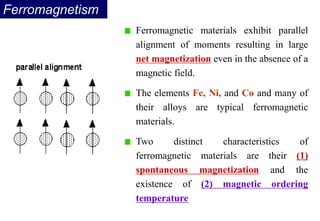
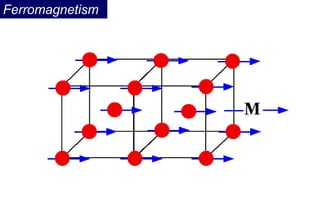
Ferromagnetic materials exhibit parallel
alignment of moments resulting in large
net magnetization even in the absence of a
magnetic field.
The elements Fe, Ni, and Co and many of
their alloys are typical ferromagnetic
materials.
Two distinct characteristics of
ferromagnetic materials are their (1)
spontaneous magnetization and the
existence of (2) magnetic ordering
temperature
Ferromagnetism
Hund’s rule
Fe: [Ar]3d64s2
Origin of Ferromagnetism
Ferromagnetism
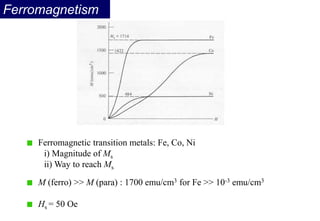
Ferromagnetic transition metals: Fe, Co, Ni
i) Magnitude of Ms
ii) Way to reach Ms
M (ferro) >> M (para) : 1700 emu/cm3 for Fe >> 10-3 emu/cm3
Hs = 50 Oe
Weiss' Assumption
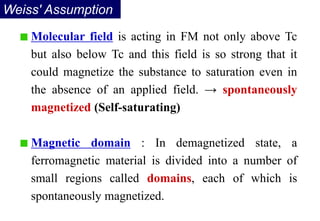
Molecular field is acting in FM not only above Tc
but also below Tc and this field is so strong that it
could magnetize the substance to saturation even in
the absence of an applied field. → spontaneously
magnetized (Self-saturating)
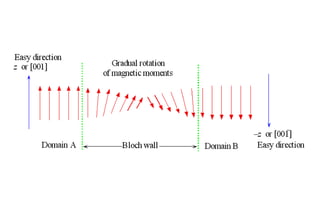
Magnetic domain : In demagnetized state, a
ferromagnetic material is divided into a number of
small regions called domains, each of which is
spontaneously magnetized.
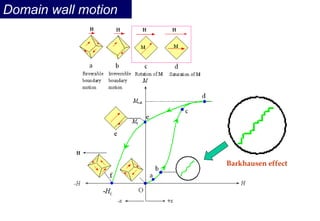
Magnetization process
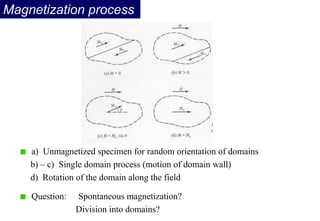
a) Unmagnetized specimen for random orientation of domains
b) – c) Single domain process (motion of domain wall)
d) Rotation of the domain along the field
Question: Spontaneous magnetization?
Division into domains?
Ms Ms Ms
(a) (b) (c)
Ms Ms Ms
(a) (b) (c)
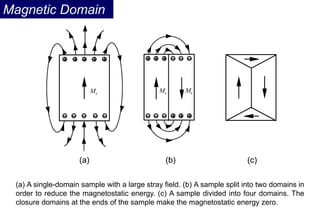
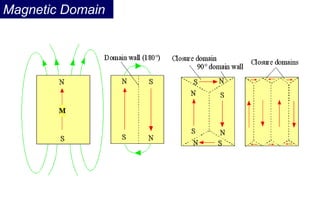
(a) A single-domain sample with a large stray field. (b) A sample split into two domains in
order to reduce the magnetostatic energy. (c) A sample divided into four domains. The
closure domains at the ends of the sample make the magnetostatic energy zero.
Magnetic Domain
Magnetic Domain
Domain wall motion
Barkhausen effect
Magnetic Order
Are ferromagnets already in
an ordered state before a
magnetic field is applied or is
the order by the field?
Explanation of magnetic order in ferromagnets
Weber (1852): The material could already have
small atomic magnetic moments within the solid
which are randomly aligned in the demagnetized but
which became ordered under the action of a magnetic
field.
Poisson (1983) : The atomic magnetic moments may
not exist at all in the demagnetized state but could be
induced by a mangetic field.
Explanation of magnetic order in ferromagnets
• Ampère (1827): The origin of the atomic moments
was suggested that they were due to electrical
currents continually circulating within the atom.
• Ewing (1893): Followed Weber’s idea and interested
in explaining hysteresis.
Atomic magnetic moments were in permanent
existence (Weber’s hypothesis)
Atomic magnetic moments were ordered even in the
demagnetized state. It was the domains only which
were randomly aligned in the demagnetized state.
The magnetization process consisting of reorienting
the domains so that more domains were aligned with
field.
Weiss domain theory
Magnetic Domain
In order to minimize its magnetostatic energy, the
magnetic material divides up into magnetic domains.
Weiss (1907): concept of magnetic domains. A
magnetic material consisted of a number of distinct
regions termed ‘domains’ each of which was saturated in
a different direction.
The concept of domains is able to explain why
ferromagnetic materials can be demagnetized even
below their Curie temperature.
What is the origin of the alignment of the atomic
magnetic moments?
It is the Weiss mean field (later the “molecular
field”, further later exchange coupling from
quantum mechanics)
Weiss Mean Field Theory
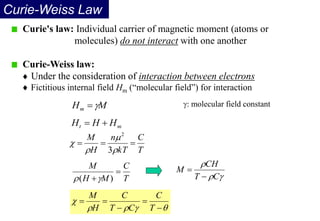
Curie-Weiss Law
Curie's law: Individual carrier of magnetic moment (atoms or
molecules) do not interact with one another
Curie-Weiss law:
 Under the consideration of interaction between electrons
 Fictitious internal field Hm (“molecular field”) for interaction
: molecular field constant
M
Hm 

m
t H
H
H 

T
C
kT
n
H
M







3
2
T
C
M
H
M

 )
( 
 


C
T
CH
M












T
C
C
T
C
H
M
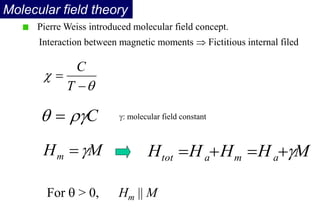
Molecular field theory
Pierre Weiss introduced molecular field concept.
Interaction between magnetic moments  Fictitious internal filed




T
C
C

 
M
Hm 

For  > 0, Hm || M
: molecular field constant
M
H
H
H
H a
m
a
tot 




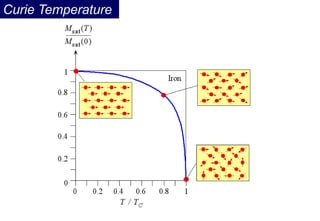
Curie Temperature
Curie Temperature
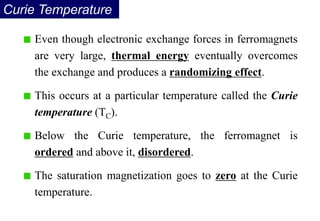
Even though electronic exchange forces in ferromagnets
are very large, thermal energy eventually overcomes
the exchange and produces a randomizing effect.
This occurs at a particular temperature called the Curie
temperature (TC).
Below the Curie temperature, the ferromagnet is
ordered and above it, disordered.
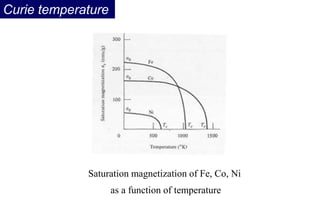
The saturation magnetization goes to zero at the Curie
temperature.
Curie temperature
Saturation magnetization of Fe, Co, Ni
as a function of temperature
Exchange Energy
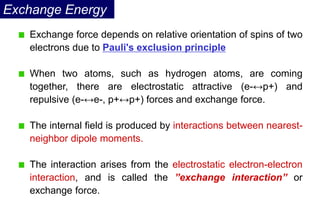
Exchange force depends on relative orientation of spins of two
electrons due to Pauli's exclusion principle
When two atoms, such as hydrogen atoms, are coming
together, there are electrostatic attractive (e-↔p+) and
repulsive (e-↔e-, p+↔p+) forces and exchange force.
The internal field is produced by interactions between nearest-
neighbor dipole moments.
The interaction arises from the electrostatic electron-electron
interaction, and is called the ”exchange interaction” or
exchange force.
Exchange Energy: Heisenberg Model
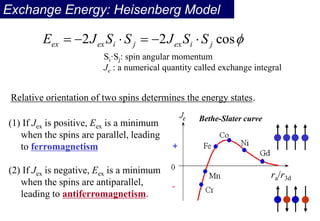
Si·Sj: spin angular momentum
Je : a numerical quantity called exchange integral

cos
2
2 j
i
ex
j
i
ex
ex S
S
J
S
S
J
E 





ra/r3d
Bethe-Slater curve
(1) If Jex is positive, Eex is a minimum
when the spins are parallel, leading
to ferromagnetism
(2) If Jex is negative, Eex is a minimum
when the spins are antiparallel,
leading to antiferromagnetism.
Relative orientation of two spins determines the energy states.
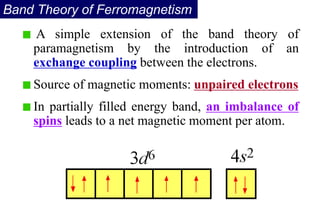
Band Theory of Ferromagnetism
A simple extension of the band theory of
paramagnetism by the introduction of an
exchange coupling between the electrons.
Source of magnetic moments: unpaired electrons
In partially filled energy band, an imbalance of
spins leads to a net magnetic moment per atom.
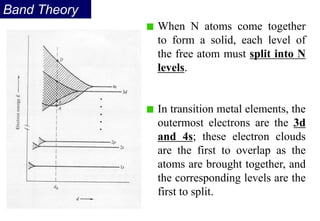
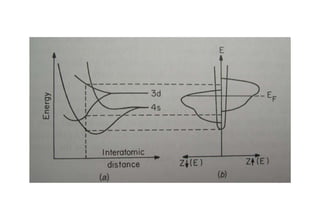
Band Theory
When N atoms come together
to form a solid, each level of
the free atom must split into N
levels.
In transition metal elements, the
outermost electrons are the 3d
and 4s; these electron clouds
are the first to overlap as the
atoms are brought together, and
the corresponding levels are the
first to split.
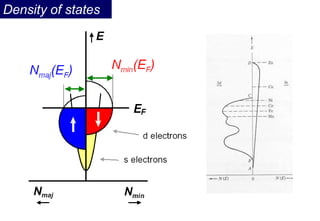
Density of states
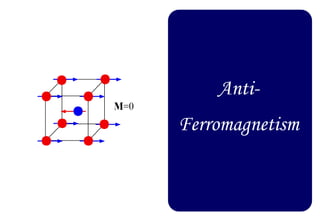
Anti-
Ferromagnetism
Anti-ferromagnetism
If the A and B sublattice moments are exactly equal
but opposite, the net moment is zero. This type of
magnetic ordering is called antiferromagnetism.
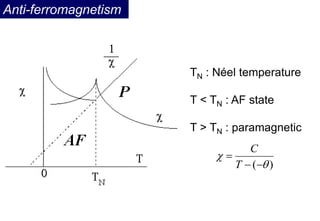
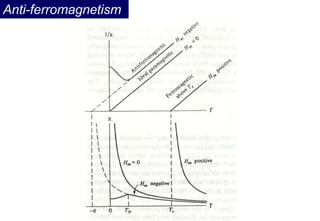
The clue to antiferromagnetism is the behavior of
susceptibility above a critical temperature, called the
Néel temperature (TN).
Above TN, the susceptibility obeys the Curie-Weiss
law for paramagnets but with a negative intercept
indicating negative exchange interactions.
Wess Model on Anti-ferromagnetism
Two identical sublattices A and B: While the
interaction with the moments on other sublattices
with a negative coupling coefficient, interaction
with the moments on their own sublattice with a
positive coupling coefficient
On the basis of nearest-neighbor interactions,
with a negative interaction between nearest
neighbors, this leads to simple antiferromagnetism
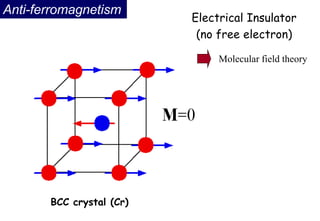
Anti-ferromagnetism
BCC crystal (Cr)
Electrical Insulator
(no free electron)
Molecular field theory
Anti-ferromagnetism
TN : Néel temperature
T < TN : AF state
T > TN : paramagnetic
)
( 




T
C
Anti-ferromagnetism
Ferrimagnetism
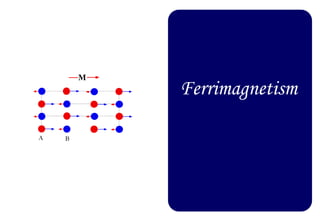
In ferrimagnets, the magnetic moments of the A and
B sublattices are not equal and result in a net
magnetic moment.
Ferrimagnetism is therefore similar to
ferromagnetism. It exhibits all the hallmarks of
ferromagnetic behavior- spontaneous magnetization,
Curie temperatures, hysteresis, and remanence.
However, ferro- and ferrimagnets have very different
magnetic ordering.
Ferrimagnetism
Ferrimagnetism
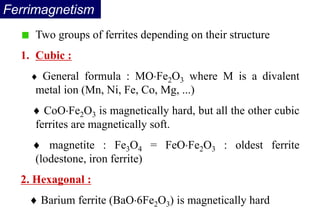
Two groups of ferrites depending on their structure
1. Cubic :
 General formula : MOFe2O3 where M is a divalent
metal ion (Mn, Ni, Fe, Co, Mg, ...)
 CoOFe2O3 is magnetically hard, but all the other cubic
ferrites are magnetically soft.
 magnetite : Fe3O4 = FeOFe2O3 : oldest ferrite
(lodestone, iron ferrite)
2. Hexagonal :
 Barium ferrite (BaO6Fe2O3) is magnetically hard
Cubic ferrites (Spinel structure)
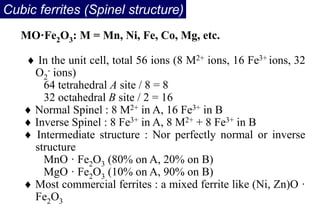
MO·Fe2O3: M = Mn, Ni, Fe, Co, Mg, etc.
 In the unit cell, total 56 ions (8 M2+ ions, 16 Fe3+ ions, 32
O2
- ions)
64 tetrahedral A site / 8 = 8
32 octahedral B site / 2 = 16
 Normal Spinel : 8 M2+ in A, 16 Fe3+ in B
 Inverse Spinel : 8 Fe3+ in A, 8 M2+ + 8 Fe3+ in B
 Intermediate structure : Nor perfectly normal or inverse
structure
MnO · Fe2O3 (80% on A, 20% on B)
MgO · Fe2O3 (10% on A, 90% on B)
 Most commercial ferrites : a mixed ferrite like (Ni, Zn)O ·
Fe2O3
Hexagonal Ferrites
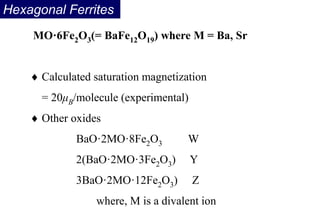
MO·6Fe2O3(= BaFe12O19) where M = Ba, Sr
 Calculated saturation magnetization
= 20μB/molecule (experimental)
 Other oxides
BaO·2MO·8Fe2O3 W
2(BaO·2MO·3Fe2O3) Y
3BaO·2MO·12Fe2O3) Z
where, M is a divalent ion
Other Ferrites
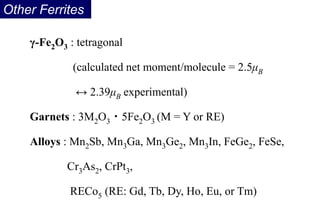
γ-Fe2O3 : tetragonal
(calculated net moment/molecule = 2.5μB
↔ 2.39μB experimental)
Garnets : 3M2O3・5Fe2O3 (M = Y or RE)
Alloys : Mn2Sb, Mn3Ga, Mn3Ge2, Mn3In, FeGe2, FeSe,
Cr3As2, CrPt3,
RECo5 (RE: Gd, Tb, Dy, Ho, Eu, or Tm)
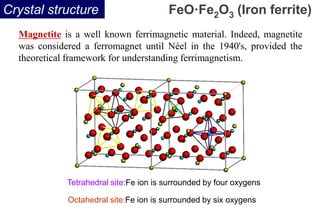
Crystal structure
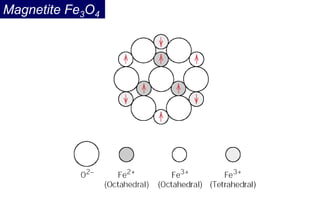
Tetrahedral site:Fe ion is surrounded by four oxygens
Octahedral site:Fe ion is surrounded by six oxygens
FeO·Fe2O3 (Iron ferrite)
Magnetite is a well known ferrimagnetic material. Indeed, magnetite
was considered a ferromagnet until Néel in the 1940's, provided the
theoretical framework for understanding ferrimagnetism.
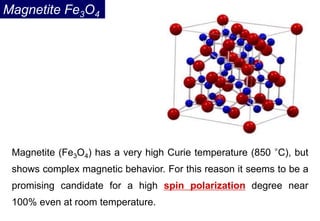
Magnetite (Fe3O4) has a very high Curie temperature (850 °C), but
shows complex magnetic behavior. For this reason it seems to be a
promising candidate for a high spin polarization degree near
100% even at room temperature.
Magnetite Fe3O4
Magnetite Fe3O4
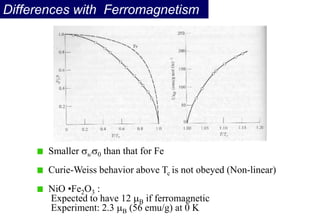
Differences with Ferromagnetism
Smaller s/0 than that for Fe
Curie-Weiss behavior above Tc is not obeyed (Non-linear)
NiO •Fe2O3 :
Expected to have 12 B if ferromagnetic
Experiment: 2.3 B (56 emu/g) at 0 K
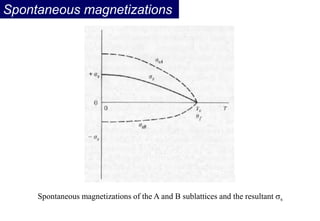
Spontaneous magnetizations
Spontaneous magnetizations of the A and B sublattices and the resultant s
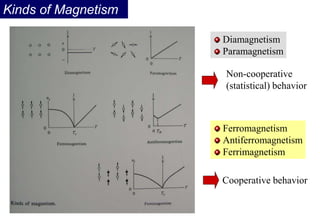
Kinds of Magnetism
Diamagnetism
Paramagnetism
Non-cooperative
(statistical) behavior
Ferromagnetism
Antiferromagnetism
Ferrimagnetism
Cooperative behavior
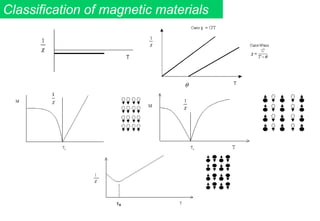
Classification of magnetic materials

2. Magnetism 1.ppt

  • 1.
  • 2.
    Ferromagnetism The atomic momentsin these materials exhibit very strong interactions, resulting in a parallel or antiparallel alignment of atomic moments. Exchange forces are very large, equivalent to a field on the order of 1000 Tesla, or approximately a 100 million times the strength of the earth's field. The exchange force is a quantum mechanical phenomenon due to the relative orientation of the spins of two electron.
  • 3.
    Ferromagnetism Ferromagnetic materials exhibitparallel alignment of moments resulting in large net magnetization even in the absence of a magnetic field. The elements Fe, Ni, and Co and many of their alloys are typical ferromagnetic materials. Two distinct characteristics of ferromagnetic materials are their (1) spontaneous magnetization and the existence of (2) magnetic ordering temperature
  • 4.
  • 5.
  • 6.
    Ferromagnetism Ferromagnetic transition metals:Fe, Co, Ni i) Magnitude of Ms ii) Way to reach Ms M (ferro) >> M (para) : 1700 emu/cm3 for Fe >> 10-3 emu/cm3 Hs = 50 Oe
  • 7.
    Weiss' Assumption Molecular fieldis acting in FM not only above Tc but also below Tc and this field is so strong that it could magnetize the substance to saturation even in the absence of an applied field. → spontaneously magnetized (Self-saturating) Magnetic domain : In demagnetized state, a ferromagnetic material is divided into a number of small regions called domains, each of which is spontaneously magnetized.
  • 8.
    Magnetization process a) Unmagnetizedspecimen for random orientation of domains b) – c) Single domain process (motion of domain wall) d) Rotation of the domain along the field Question: Spontaneous magnetization? Division into domains?
  • 9.
    Ms Ms Ms (a)(b) (c) Ms Ms Ms (a) (b) (c) (a) A single-domain sample with a large stray field. (b) A sample split into two domains in order to reduce the magnetostatic energy. (c) A sample divided into four domains. The closure domains at the ends of the sample make the magnetostatic energy zero. Magnetic Domain
  • 10.
  • 12.
  • 13.
    Magnetic Order Are ferromagnetsalready in an ordered state before a magnetic field is applied or is the order by the field?
  • 14.
    Explanation of magneticorder in ferromagnets Weber (1852): The material could already have small atomic magnetic moments within the solid which are randomly aligned in the demagnetized but which became ordered under the action of a magnetic field. Poisson (1983) : The atomic magnetic moments may not exist at all in the demagnetized state but could be induced by a mangetic field.
  • 15.
    Explanation of magneticorder in ferromagnets • Ampère (1827): The origin of the atomic moments was suggested that they were due to electrical currents continually circulating within the atom. • Ewing (1893): Followed Weber’s idea and interested in explaining hysteresis.
  • 16.
    Atomic magnetic momentswere in permanent existence (Weber’s hypothesis) Atomic magnetic moments were ordered even in the demagnetized state. It was the domains only which were randomly aligned in the demagnetized state. The magnetization process consisting of reorienting the domains so that more domains were aligned with field. Weiss domain theory
  • 17.
    Magnetic Domain In orderto minimize its magnetostatic energy, the magnetic material divides up into magnetic domains. Weiss (1907): concept of magnetic domains. A magnetic material consisted of a number of distinct regions termed ‘domains’ each of which was saturated in a different direction. The concept of domains is able to explain why ferromagnetic materials can be demagnetized even below their Curie temperature.
  • 18.
    What is theorigin of the alignment of the atomic magnetic moments? It is the Weiss mean field (later the “molecular field”, further later exchange coupling from quantum mechanics) Weiss Mean Field Theory
  • 19.
    Curie-Weiss Law Curie's law:Individual carrier of magnetic moment (atoms or molecules) do not interact with one another Curie-Weiss law:  Under the consideration of interaction between electrons  Fictitious internal field Hm (“molecular field”) for interaction : molecular field constant M Hm   m t H H H   T C kT n H M        3 2 T C M H M   ) (      C T CH M             T C C T C H M
  • 20.
    Molecular field theory PierreWeiss introduced molecular field concept. Interaction between magnetic moments  Fictitious internal filed     T C C    M Hm   For  > 0, Hm || M : molecular field constant M H H H H a m a tot     
  • 21.
  • 22.
    Curie Temperature Even thoughelectronic exchange forces in ferromagnets are very large, thermal energy eventually overcomes the exchange and produces a randomizing effect. This occurs at a particular temperature called the Curie temperature (TC). Below the Curie temperature, the ferromagnet is ordered and above it, disordered. The saturation magnetization goes to zero at the Curie temperature.
  • 23.
    Curie temperature Saturation magnetizationof Fe, Co, Ni as a function of temperature
  • 24.
    Exchange Energy Exchange forcedepends on relative orientation of spins of two electrons due to Pauli's exclusion principle When two atoms, such as hydrogen atoms, are coming together, there are electrostatic attractive (e-↔p+) and repulsive (e-↔e-, p+↔p+) forces and exchange force. The internal field is produced by interactions between nearest- neighbor dipole moments. The interaction arises from the electrostatic electron-electron interaction, and is called the ”exchange interaction” or exchange force.
  • 25.
    Exchange Energy: HeisenbergModel Si·Sj: spin angular momentum Je : a numerical quantity called exchange integral  cos 2 2 j i ex j i ex ex S S J S S J E       ra/r3d Bethe-Slater curve (1) If Jex is positive, Eex is a minimum when the spins are parallel, leading to ferromagnetism (2) If Jex is negative, Eex is a minimum when the spins are antiparallel, leading to antiferromagnetism. Relative orientation of two spins determines the energy states.
  • 26.
    Band Theory ofFerromagnetism A simple extension of the band theory of paramagnetism by the introduction of an exchange coupling between the electrons. Source of magnetic moments: unpaired electrons In partially filled energy band, an imbalance of spins leads to a net magnetic moment per atom.
  • 27.
    Band Theory When Natoms come together to form a solid, each level of the free atom must split into N levels. In transition metal elements, the outermost electrons are the 3d and 4s; these electron clouds are the first to overlap as the atoms are brought together, and the corresponding levels are the first to split.
  • 28.
  • 30.
  • 31.
    Anti-ferromagnetism If the Aand B sublattice moments are exactly equal but opposite, the net moment is zero. This type of magnetic ordering is called antiferromagnetism. The clue to antiferromagnetism is the behavior of susceptibility above a critical temperature, called the Néel temperature (TN). Above TN, the susceptibility obeys the Curie-Weiss law for paramagnets but with a negative intercept indicating negative exchange interactions.
  • 32.
    Wess Model onAnti-ferromagnetism Two identical sublattices A and B: While the interaction with the moments on other sublattices with a negative coupling coefficient, interaction with the moments on their own sublattice with a positive coupling coefficient On the basis of nearest-neighbor interactions, with a negative interaction between nearest neighbors, this leads to simple antiferromagnetism
  • 33.
    Anti-ferromagnetism BCC crystal (Cr) ElectricalInsulator (no free electron) Molecular field theory
  • 34.
    Anti-ferromagnetism TN : Néeltemperature T < TN : AF state T > TN : paramagnetic ) (      T C
  • 35.
  • 36.
  • 37.
    In ferrimagnets, themagnetic moments of the A and B sublattices are not equal and result in a net magnetic moment. Ferrimagnetism is therefore similar to ferromagnetism. It exhibits all the hallmarks of ferromagnetic behavior- spontaneous magnetization, Curie temperatures, hysteresis, and remanence. However, ferro- and ferrimagnets have very different magnetic ordering. Ferrimagnetism
  • 38.
    Ferrimagnetism Two groups offerrites depending on their structure 1. Cubic :  General formula : MOFe2O3 where M is a divalent metal ion (Mn, Ni, Fe, Co, Mg, ...)  CoOFe2O3 is magnetically hard, but all the other cubic ferrites are magnetically soft.  magnetite : Fe3O4 = FeOFe2O3 : oldest ferrite (lodestone, iron ferrite) 2. Hexagonal :  Barium ferrite (BaO6Fe2O3) is magnetically hard
  • 39.
    Cubic ferrites (Spinelstructure) MO·Fe2O3: M = Mn, Ni, Fe, Co, Mg, etc.  In the unit cell, total 56 ions (8 M2+ ions, 16 Fe3+ ions, 32 O2 - ions) 64 tetrahedral A site / 8 = 8 32 octahedral B site / 2 = 16  Normal Spinel : 8 M2+ in A, 16 Fe3+ in B  Inverse Spinel : 8 Fe3+ in A, 8 M2+ + 8 Fe3+ in B  Intermediate structure : Nor perfectly normal or inverse structure MnO · Fe2O3 (80% on A, 20% on B) MgO · Fe2O3 (10% on A, 90% on B)  Most commercial ferrites : a mixed ferrite like (Ni, Zn)O · Fe2O3
  • 40.
    Hexagonal Ferrites MO·6Fe2O3(= BaFe12O19)where M = Ba, Sr  Calculated saturation magnetization = 20μB/molecule (experimental)  Other oxides BaO·2MO·8Fe2O3 W 2(BaO·2MO·3Fe2O3) Y 3BaO·2MO·12Fe2O3) Z where, M is a divalent ion
  • 41.
    Other Ferrites γ-Fe2O3 :tetragonal (calculated net moment/molecule = 2.5μB ↔ 2.39μB experimental) Garnets : 3M2O3・5Fe2O3 (M = Y or RE) Alloys : Mn2Sb, Mn3Ga, Mn3Ge2, Mn3In, FeGe2, FeSe, Cr3As2, CrPt3, RECo5 (RE: Gd, Tb, Dy, Ho, Eu, or Tm)
  • 42.
    Crystal structure Tetrahedral site:Feion is surrounded by four oxygens Octahedral site:Fe ion is surrounded by six oxygens FeO·Fe2O3 (Iron ferrite) Magnetite is a well known ferrimagnetic material. Indeed, magnetite was considered a ferromagnet until Néel in the 1940's, provided the theoretical framework for understanding ferrimagnetism.
  • 43.
    Magnetite (Fe3O4) hasa very high Curie temperature (850 °C), but shows complex magnetic behavior. For this reason it seems to be a promising candidate for a high spin polarization degree near 100% even at room temperature. Magnetite Fe3O4
  • 44.
  • 45.
    Differences with Ferromagnetism Smallers/0 than that for Fe Curie-Weiss behavior above Tc is not obeyed (Non-linear) NiO •Fe2O3 : Expected to have 12 B if ferromagnetic Experiment: 2.3 B (56 emu/g) at 0 K
  • 46.
    Spontaneous magnetizations Spontaneous magnetizationsof the A and B sublattices and the resultant s
  • 47.
    Kinds of Magnetism Diamagnetism Paramagnetism Non-cooperative (statistical)behavior Ferromagnetism Antiferromagnetism Ferrimagnetism Cooperative behavior
  • 48.