Spintronics
     “A Spin to Remember”


Submitted To:-          Presented By:-
Er. Pieush Vyas         Abhishek Shringi
(Associate Professor)   08/33/106
(Unit In charge EC)     VIII Sem ECE
Outline

•   Spintronics basics
•   The giant magneto resistance
•   Applications of GMR
•   Spin devices
•   Injections & detection of spin
•   The MRAM
•   Recent trends
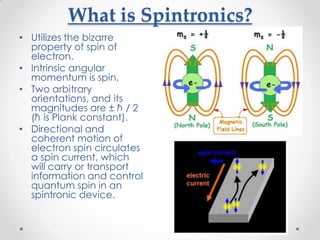
What is Spintronics?
• Utilizes the bizarre
  property of spin of
  electron.
• Intrinsic angular
  momentum is spin.
• Two arbitrary
  orientations, and its
  magnitudes are ± ħ / 2
  (ħ is Plank constant).
• Directional and
  coherent motion of
  electron spin circulates
  a spin current, which
  will carry or transport
  information and control
  quantum spin in an
  spintronic device.
Why Spintronics?
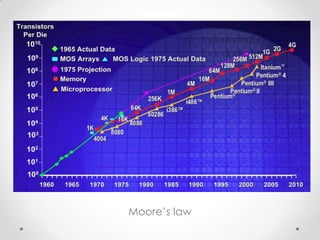
• Moore’s Law:
No. of Transistor doubles in every 18 months.

•Complexity:
Complex Chip Design & Power Loss.

• Motivation:
Spintronics-Information is carried not by electron
       charge but by it’s spin.
Moore’s law
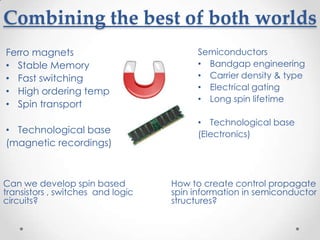
Combining the best of both worlds
Ferro magnets                            Semiconductors
• Stable Memory                          • Bandgap engineering
• Fast switching                         • Carrier density & type
• High ordering temp                     • Electrical gating
                                         • Long spin lifetime
• Spin transport
                                         • Technological base
• Technological base                     (Electronics)
(magnetic recordings)


Can we develop spin based          How to create control propagate
transistors , switches and logic   spin information in semiconductor
circuits?                          structures?
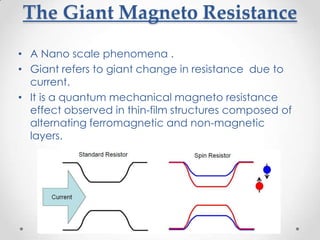
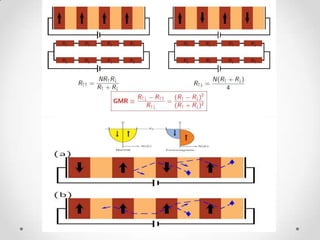
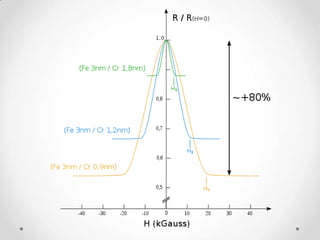
The Giant Magneto Resistance
• A Nano scale phenomena .
• Giant refers to giant change in resistance due to
  current.
• It is a quantum mechanical magneto resistance
  effect observed in thin-film structures composed of
  alternating ferromagnetic and non-magnetic
  layers.
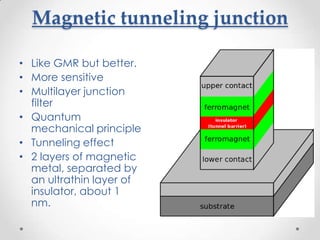
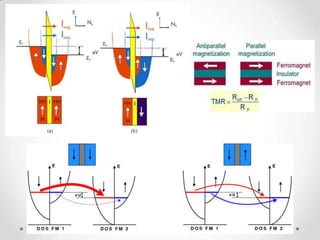
Magnetic tunneling junction

• Like GMR but better.
• More sensitive
• Multilayer junction
  filter
• Quantum
  mechanical principle
• Tunneling effect
• 2 layers of magnetic
  metal, separated by
  an ultrathin layer of
  insulator, about 1
  nm.
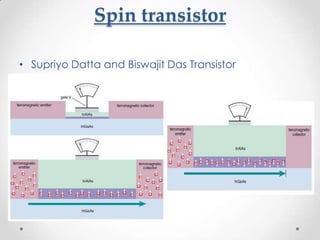
Spin transistor

• Supriyo Datta and Biswajit Das Transistor
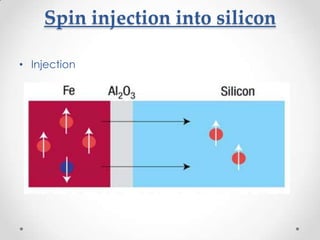
Spin injection into silicon

• Injection
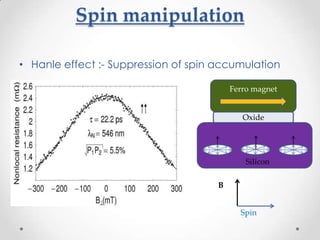
Spin manipulation

• Hanle effect :- Suppression of spin accumulation

                                          Ferro magnet


                                             Oxide


                                              Silicon

                                      B


                                            Spin
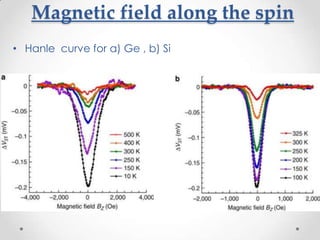
Magnetic field along the spin
• Hanle curve for a) Ge , b) Si
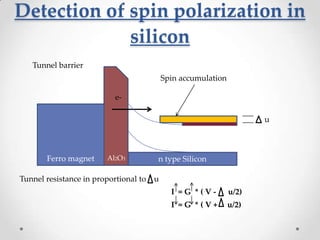
Detection of spin polarization in
             silicon
   Tunnel barrier
                                           Spin accumulation

                           e-

                                                                      u


       Ferro magnet     Al2O3          n type Silicon

Tunnel resistance in proportional to   u
                                             I =G *(V-         u/2)
                                             I =G *(V+         u/2)
MRAM
      Magneto resistive RAM
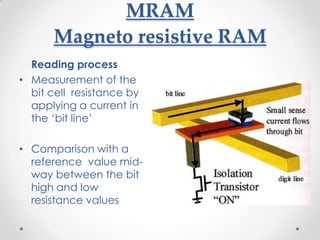
  Reading process
• Measurement of the
  bit cell resistance by
  applying a current in
  the ‘bit line’

• Comparison with a
  reference value mid-
  way between the bit
  high and low
  resistance values
MRAM
       Magneto resistive RAM
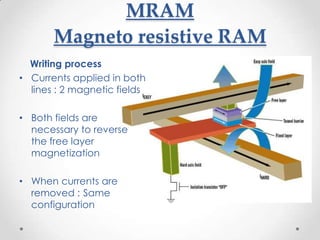
  Writing process
• Currents applied in both
  lines : 2 magnetic fields

• Both fields are
  necessary to reverse
  the free layer
  magnetization

• When currents are
  removed : Same
  configuration
MRAM
       Magneto resistive RAM
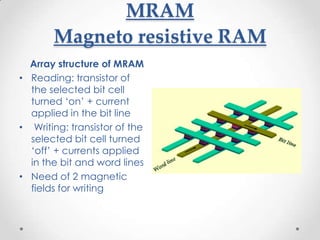
  Array structure of MRAM
• Reading: transistor of
  the selected bit cell
  turned ‘on’ + current
  applied in the bit line
• Writing: transistor of the
  selected bit cell turned
  ‘off’ + currents applied
  in the bit and word lines
• Need of 2 magnetic
  fields for writing
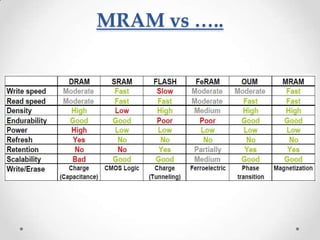
MRAM vs …..
MRAM
         Magneto resistive RAM


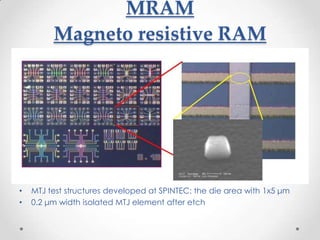
•   MTJ test structures developed at SPINTEC: the die area with 1x5 μm
•   0.2 μm width isolated MTJ element after etch
Advantages of Spintronics
 Low power consumption.

 Less heat dissipation.

 Spintronic memory is non-volatile.

 Takes up lesser space on chip, thus more compact.

 Spin manipulation is faster , so greater read & write speed.

 Spintronics does not require unique and specialized
  semiconductors.
  Common metals such as Fe, Al, Ag , etc. can be used.
Conclusion
• Spin property of electrons are yet to mastered.
• Researcher and scientist are taking keen interest.
• Universities and electronic industries collaborating .
• Span of last two decade major milestones.
• It holds vast opportunities for physics , material &
  device engineering & technology
• Last year PTB, Germany, have achieved a (2GBit/s)
  write cycle
• Potential of the field is colossal and
  continuous development is required.
Spintronics ppt
Spintronics ppt

Spintronics ppt

  • 1.
    Spintronics “A Spin to Remember” Submitted To:- Presented By:- Er. Pieush Vyas Abhishek Shringi (Associate Professor) 08/33/106 (Unit In charge EC) VIII Sem ECE
  • 2.
    Outline • Spintronics basics • The giant magneto resistance • Applications of GMR • Spin devices • Injections & detection of spin • The MRAM • Recent trends
  • 3.
    What is Spintronics? •Utilizes the bizarre property of spin of electron. • Intrinsic angular momentum is spin. • Two arbitrary orientations, and its magnitudes are ± ħ / 2 (ħ is Plank constant). • Directional and coherent motion of electron spin circulates a spin current, which will carry or transport information and control quantum spin in an spintronic device.
  • 4.
    Why Spintronics? • Moore’sLaw: No. of Transistor doubles in every 18 months. •Complexity: Complex Chip Design & Power Loss. • Motivation: Spintronics-Information is carried not by electron charge but by it’s spin.
  • 5.
  • 6.
    Combining the bestof both worlds Ferro magnets Semiconductors • Stable Memory • Bandgap engineering • Fast switching • Carrier density & type • High ordering temp • Electrical gating • Long spin lifetime • Spin transport • Technological base • Technological base (Electronics) (magnetic recordings) Can we develop spin based How to create control propagate transistors , switches and logic spin information in semiconductor circuits? structures?
  • 7.
    The Giant MagnetoResistance • A Nano scale phenomena . • Giant refers to giant change in resistance due to current. • It is a quantum mechanical magneto resistance effect observed in thin-film structures composed of alternating ferromagnetic and non-magnetic layers.
  • 10.
    Magnetic tunneling junction •Like GMR but better. • More sensitive • Multilayer junction filter • Quantum mechanical principle • Tunneling effect • 2 layers of magnetic metal, separated by an ultrathin layer of insulator, about 1 nm.
  • 12.
    Spin transistor • SupriyoDatta and Biswajit Das Transistor
  • 13.
    Spin injection intosilicon • Injection
  • 14.
    Spin manipulation • Hanleeffect :- Suppression of spin accumulation Ferro magnet Oxide Silicon B Spin
  • 15.
    Magnetic field alongthe spin • Hanle curve for a) Ge , b) Si
  • 16.
    Detection of spinpolarization in silicon Tunnel barrier Spin accumulation e- u Ferro magnet Al2O3 n type Silicon Tunnel resistance in proportional to u I =G *(V- u/2) I =G *(V+ u/2)
  • 17.
    MRAM Magneto resistive RAM Reading process • Measurement of the bit cell resistance by applying a current in the ‘bit line’ • Comparison with a reference value mid- way between the bit high and low resistance values
  • 18.
    MRAM Magneto resistive RAM Writing process • Currents applied in both lines : 2 magnetic fields • Both fields are necessary to reverse the free layer magnetization • When currents are removed : Same configuration
  • 19.
    MRAM Magneto resistive RAM Array structure of MRAM • Reading: transistor of the selected bit cell turned ‘on’ + current applied in the bit line • Writing: transistor of the selected bit cell turned ‘off’ + currents applied in the bit and word lines • Need of 2 magnetic fields for writing
  • 20.
  • 21.
    MRAM Magneto resistive RAM • MTJ test structures developed at SPINTEC: the die area with 1x5 μm • 0.2 μm width isolated MTJ element after etch
  • 22.
    Advantages of Spintronics Low power consumption.  Less heat dissipation.  Spintronic memory is non-volatile.  Takes up lesser space on chip, thus more compact.  Spin manipulation is faster , so greater read & write speed.  Spintronics does not require unique and specialized semiconductors. Common metals such as Fe, Al, Ag , etc. can be used.
  • 23.
    Conclusion • Spin propertyof electrons are yet to mastered. • Researcher and scientist are taking keen interest. • Universities and electronic industries collaborating . • Span of last two decade major milestones. • It holds vast opportunities for physics , material & device engineering & technology • Last year PTB, Germany, have achieved a (2GBit/s) write cycle • Potential of the field is colossal and continuous development is required.