Introduction 
Neurogrid's Design Choices 
Neurogrid System 
Neurogrid Neuron 
Data Transfer 
Comparison 
Neurogrid: A Mixed-Analog-Digital Multichip System for 
Large-Scale Neural Simulations 
Group 7 
Ashlesha Patil 
Nithin Nethipudi 
Titto Thomas 
EE 746 : Literature Review 1/29
Introduction 
Neurogrid's Design Choices 
Neurogrid System 
Neurogrid Neuron 
Data Transfer 
Comparison 
Neurogrid 
Neurogrid : Introduction 
) First hardware system with the capability of performing biological real-time 
simulations of a million neurons and their synaptic connections. 
) It's a system for simulating large-scale neural models in real time. 
) Four neural elements are axonal arbor, synapse, dendritic tree and soma are realized 
by emulating their structure. 
) 3 Major design choices for such a system 
Emulate the four neural elements with dedicated or shared electronic circuits 
Implement these electronic circuits in an analog or digital manner 
Interconnect arrays of these neurons with mesh or tree network 
EE 746 : Literature Review 2/29
Introduction 
Neurogrid's Design Choices 
Neurogrid System 
Neurogrid Neuron 
Data Transfer 
Comparison 
Neurogrid 
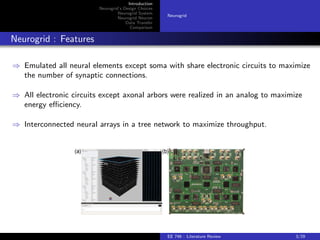
Neurogrid : Features 
) Emulated all neural elements except soma with share electronic circuits to maximize 
the number of synaptic connections. 
) All electronic circuits except axonal arbors were realized in an analog to maximize 
energy eciency. 
) Interconnected neural arrays in a tree network to maximize throughput. 
EE 746 : Literature Review 3/29
Introduction 
Neurogrid's Design Choices 
Neurogrid System 
Neurogrid Neuron 
Data Transfer 
Comparison 
Hardware Realization 
Architecture 
Realizations 
Spike routing networks 
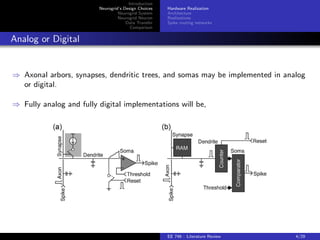
Analog or Digital 
) Axonal arbors, synapses, dendritic trees, and somas may be implemented in analog 
or digital. 
) Fully analog and fully digital implementations will be, 
EE 746 : Literature Review 4/29
Introduction 
Neurogrid's Design Choices 
Neurogrid System 
Neurogrid Neuron 
Data Transfer 
Comparison 
Hardware Realization 
Architecture 
Realizations 
Spike routing networks 
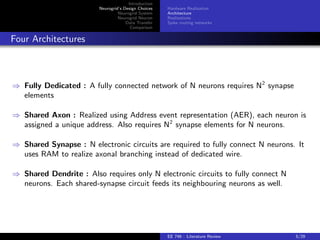
Four Architectures 
) Fully Dedicated : A fully connected network of N neurons requires N2 synapse 
elements 
) Shared Axon : Realized using Address event representation (AER), each neuron is 
assigned a unique address. Also requires N2 synapse elements for N neurons. 
) Shared Synapse : N electronic circuits are required to fully connect N neurons. It 
uses RAM to realize axonal branching instead of dedicated wire. 
) Shared Dendrite : Also requires only N electronic circuits to fully connect N 
neurons. Each shared-synapse circuit feeds its neighbouring neurons as well. 
EE 746 : Literature Review 5/29
Introduction 
Neurogrid's Design Choices 
Neurogrid System 
Neurogrid Neuron 
Data Transfer 
Comparison 
Hardware Realization 
Architecture 
Realizations 
Spike routing networks 
Four Architectures (Contd.) 
) (a) Fully dedicated, (b) Shared axon, (c) Shared synapse, (d) Shared dendrite 
EE 746 : Literature Review 6/29
Introduction 
Neurogrid's Design Choices 
Neurogrid System 
Neurogrid Neuron 
Data Transfer 
Comparison 
Hardware Realization 
Architecture 
Realizations 
Spike routing networks 
Realization Comparison 
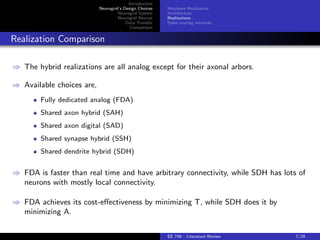
) The hybrid realizations are all analog except for their axonal arbors. 
) Available choices are, 
Fully dedicated analog (FDA) 
Shared axon hybrid (SAH) 
Shared axon digital (SAD) 
Shared synapse hybrid (SSH) 
Shared dendrite hybrid (SDH) 
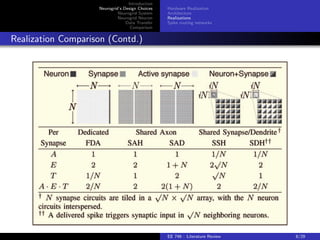
) FDA is faster than real time and have arbitrary connectivity, while SDH has lots of 
neurons with mostly local connectivity. 
) FDA achieves its cost-eectiveness by minimizing T, while SDH does it by 
minimizing A. 
EE 746 : Literature Review 7/29
Introduction 
Neurogrid's Design Choices 
Neurogrid System 
Neurogrid Neuron 
Data Transfer 
Comparison 
Hardware Realization 
Architecture 
Realizations 
Spike routing networks 
Realization Comparison (Contd.) 
EE 746 : Literature Review 8/29
Introduction 
Neurogrid's Design Choices 
Neurogrid System 
Neurogrid Neuron 
Data Transfer 
Comparison 
Hardware Realization 
Architecture 
Realizations 
Spike routing networks 
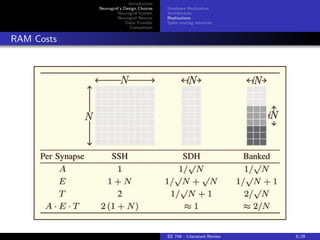
RAM Costs 
EE 746 : Literature Review 9/29
Introduction 
Neurogrid's Design Choices 
Neurogrid System 
Neurogrid Neuron 
Data Transfer 
Comparison 
Hardware Realization 
Architecture 
Realizations 
Spike routing networks 
) Meshes and trees have been explored for routing spikes between neural-element 
arrays. 
) Meshes oer high bandwidth, but have long latency. 
) Trees oer short latency, but have low bandwidth 
) Unlike meshes, however, trees support deadlock-free multicast communication, 
enabling them to utilize their limited bandwidth eciently, and thereby maximize 
throughput. 
) Neurogrid targets can use multicast to realize secondary axon-branching, so they 
chose tree. 
EE 746 : Literature Review 10/29
Introduction 
Neurogrid's Design Choices 
Neurogrid System 
Neurogrid Neuron 
Data Transfer 
Comparison 
The system 
Neurogrid System 
) Two main components 
Software to perform interactive visualization 
Hardware to perform real-time simulation 
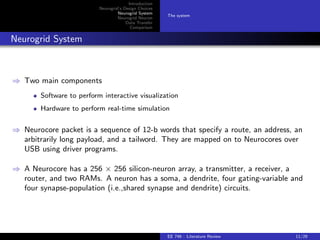
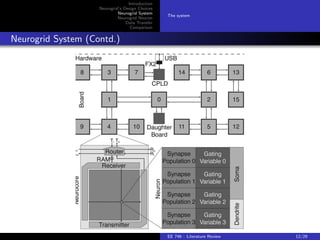
) Neurocore packet is a sequence of 12-b words that specify a route, an address, an 
arbitrarily long payload, and a tailword. They are mapped on to Neurocores over 
USB using driver programs. 
) A Neurocore has a 256  256 silicon-neuron array, a transmitter, a receiver, a 
router, and two RAMs. A neuron has a soma, a dendrite, four gating-variable and 
four synapse-population (i.e.,shared synapse and dendrite) circuits. 
EE 746 : Literature Review 11/29
Introduction 
Neurogrid's Design Choices 
Neurogrid System 
Neurogrid Neuron 
Data Transfer 
Comparison 
The system 
Neurogrid System (Contd.) 
EE 746 : Literature Review 12/29
Introduction 
Neurogrid's Design Choices 
Neurogrid System 
Neurogrid Neuron 
Data Transfer 
Comparison 
The system 
Neurocore 
) RAM0 provides 256 locations for target synapse types (or no connection). RAM1 
stores 18 con
guration bits and 61 analog biases, common to all the Neurocores 
silicon neurons. 
) DACs produce the analog biases. RstMB provides
ve resets and generates DACs 
reference current. ADCs digitize four analog signals from a selected neuron. 
) Ti02, To02, Li02, L002, Ri02, and Ro02 communicate with parent or either 
child. 
) The 12  14 mm 2 die, with 23 M transistors and 180 pads, fabricated in a 180nm 
complementary CMOS process. 
EE 746 : Literature Review 13/29
Introduction 
Neurogrid's Design Choices 
Neurogrid System 
Neurogrid Neuron 
Data Transfer 
Comparison 
Dimensionless Models 
Soma and Dendrite 
Synapse and Ion channel population 
Circuit Realization 
Circuit Realization 
Passive membrane model 
) Models composed of conductors, capacitors, voltage, and current sources may be 
converted to dimensionless form. 
) A passive membrane model is given by, 
C _V 
= Gleak (V  Eleak ) + Iin 
) Change the reference voltage to Eleak and normalize with GleakVn to give 
v_ = v + u 
EE 746 : Literature Review 14/29
Introduction 
Neurogrid's Design Choices 
Neurogrid System 
Neurogrid Neuron 
Data Transfer 
Comparison 
Dimensionless Models 
Soma and Dendrite 
Synapse and Ion channel population 
Circuit Realization 
Circuit Realization 
Soma model 
) Soma model is given by, 
sv_s = vs + isin + 
1 
2 
v2 
s  gkvs  gresvspres (t) + vd 
) s - membrane time constant, isin - input current, vd - dendritic input. 
2 v2 
) Quadratic positive feedback 1 
s models the spike-generating sodium current 
) The reset conductance gres , active for the duration tres of a unit-amplitude pulse pres , 
models the refractory period 
) High-threshold potassium conductance gK models spike-frequency adaptation. 
K g_K = gK + gK1pres (t) 
K - decay time constant, gK1 - saturation value 
EE 746 : Literature Review 15/29
Introduction 
Neurogrid's Design Choices 
Neurogrid System 
Neurogrid Neuron 
Data Transfer 
Comparison 
Dimensionless Models 
Soma and Dendrite 
Synapse and Ion channel population 
Circuit Realization 
Circuit Realization 
Dendrite model 
) Dendrite model is given by, 
dv_d = vd + idin  ibppres (t) + gch(ech  vd ) 
) vd - membrane time constant, idin - input current, ibp - back propagating input, and 
gch - channel populations conductance, ech - reversal potential 
) Soma and dendrite could receive synaptic inputs. 
EE 746 : Literature Review 16/29
Introduction 
Neurogrid's Design Choices 
Neurogrid System 
Neurogrid Neuron 
Data Transfer 
Comparison 
Dimensionless Models 
Soma and Dendrite 
Synapse and Ion channel population 
Circuit Realization 
Circuit Realization 
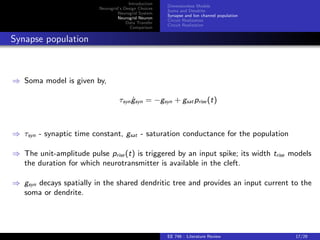
Synapse population 
) Soma model is given by, 
syng_syn = gsyn + gsatprise (t) 
) syn - synaptic time constant, gsat - saturation conductance for the population 
) The unit-amplitude pulse prise (t) is triggered by an input spike; its width trise models 
the duration for which neurotransmitter is available in the cleft. 
) gsyn decays spatially in the shared dendritic tree and provides an input current to the 
soma or dendrite. 
EE 746 : Literature Review 17/29
Introduction 
Neurogrid's Design Choices 
Neurogrid System 
Neurogrid Neuron 
Data Transfer 
Comparison 
Dimensionless Models 
Soma and Dendrite 
Synapse and Ion channel population 
Circuit Realization 
Circuit Realization 
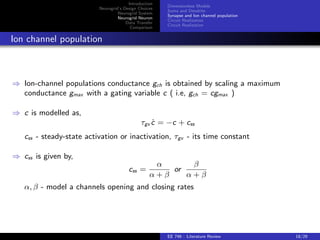
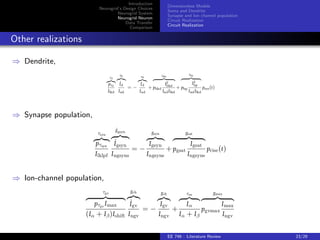
Ion channel population 
) Ion-channel populations conductance gch is obtained by scaling a maximum 
conductance gmax with a gating variable c ( i.e, gch = cgmax ) 
) c is modelled as, 
gv _ c = c + css 
css - steady-state activation or inactivation, gv - its time constant 
) css is given by, 
css = 
 
 +
or
+
;
- model a channels opening and closing rates 
EE 746 : Literature Review 18/29
Introduction 
Neurogrid's Design Choices 
Neurogrid System 
Neurogrid Neuron 
Data Transfer 
Comparison 
Dimensionless Models 
Soma and Dendrite 
Synapse and Ion channel population 
Circuit Realization 
Circuit Realization 
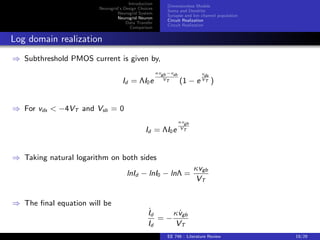
Log domain realization 
) Subthreshold PMOS current is given by, 
Id = I0e 
vgbvsb 
VT (1  e 
vds 
VT ) 
) For vds  4VT and Vsb = 0 
Id = I0e 
vgb 
VT 
) Taking natural logarithm on both sides 
lnId  lnI0  ln = 
vgb 
VT 
) The
nal equation will be 
_Id 
Id 
=  
v_gb 
VT 
EE 746 : Literature Review 19/29
Introduction 
Neurogrid's Design Choices 
Neurogrid System 
Neurogrid Neuron 
Data Transfer 
Comparison 
Dimensionless Models 
Soma and Dendrite 
Synapse and Ion channel population 
Circuit Realization 
Circuit Realization 
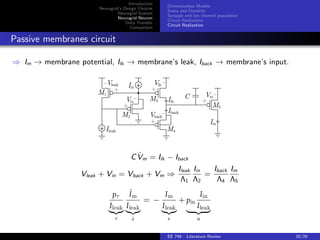
Passive membranes circuit 
) Im ! membrane potential, Ilk ! membrane's leak, Iback ! membrane's input. 
C _V 
m = Ilk  Iback 
Vleak + Vin = Vback + Vm ) 
Ileak 
1 
Iin 
2 
= 
Iback 
4 
Im 
5 
EE 746 : Literature Review 20/29
Introduction 
Neurogrid's Design Choices 
Neurogrid System 
Neurogrid Neuron 
Data Transfer 
Comparison 
Dimensionless Models 
Soma and Dendrite 
Synapse and Ion channel population 
Circuit Realization 
Circuit Realization 
Soma circuit 
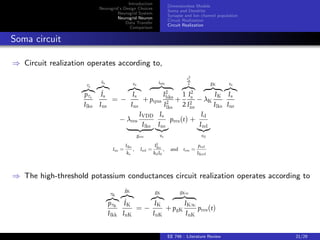
) Circuit realization operates according to, 
) The high-threshold potassium conductances circuit realization operates according to 
EE 746 : Literature Review 21/29
Introduction 
Neurogrid's Design Choices 
Neurogrid System 
Neurogrid Neuron 
Data Transfer 
Comparison 
Dimensionless Models 
Soma and Dendrite 
Synapse and Ion channel population 
Circuit Realization 
Circuit Realization 
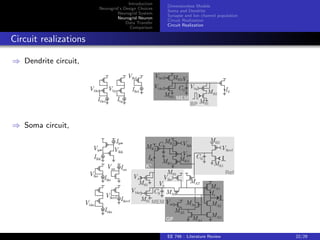
Circuit realizations 
) Dendrite circuit, 
) Soma circuit, 
EE 746 : Literature Review 22/29

Neurogrid : A Mixed-Analog-Digital Multichip System for Large-Scale Neural Simulations

  • 1.
    Introduction Neurogrid's DesignChoices Neurogrid System Neurogrid Neuron Data Transfer Comparison Neurogrid: A Mixed-Analog-Digital Multichip System for Large-Scale Neural Simulations Group 7 Ashlesha Patil Nithin Nethipudi Titto Thomas EE 746 : Literature Review 1/29
  • 2.
    Introduction Neurogrid's DesignChoices Neurogrid System Neurogrid Neuron Data Transfer Comparison Neurogrid Neurogrid : Introduction ) First hardware system with the capability of performing biological real-time simulations of a million neurons and their synaptic connections. ) It's a system for simulating large-scale neural models in real time. ) Four neural elements are axonal arbor, synapse, dendritic tree and soma are realized by emulating their structure. ) 3 Major design choices for such a system Emulate the four neural elements with dedicated or shared electronic circuits Implement these electronic circuits in an analog or digital manner Interconnect arrays of these neurons with mesh or tree network EE 746 : Literature Review 2/29
  • 3.
    Introduction Neurogrid's DesignChoices Neurogrid System Neurogrid Neuron Data Transfer Comparison Neurogrid Neurogrid : Features ) Emulated all neural elements except soma with share electronic circuits to maximize the number of synaptic connections. ) All electronic circuits except axonal arbors were realized in an analog to maximize energy eciency. ) Interconnected neural arrays in a tree network to maximize throughput. EE 746 : Literature Review 3/29
  • 4.
    Introduction Neurogrid's DesignChoices Neurogrid System Neurogrid Neuron Data Transfer Comparison Hardware Realization Architecture Realizations Spike routing networks Analog or Digital ) Axonal arbors, synapses, dendritic trees, and somas may be implemented in analog or digital. ) Fully analog and fully digital implementations will be, EE 746 : Literature Review 4/29
  • 5.
    Introduction Neurogrid's DesignChoices Neurogrid System Neurogrid Neuron Data Transfer Comparison Hardware Realization Architecture Realizations Spike routing networks Four Architectures ) Fully Dedicated : A fully connected network of N neurons requires N2 synapse elements ) Shared Axon : Realized using Address event representation (AER), each neuron is assigned a unique address. Also requires N2 synapse elements for N neurons. ) Shared Synapse : N electronic circuits are required to fully connect N neurons. It uses RAM to realize axonal branching instead of dedicated wire. ) Shared Dendrite : Also requires only N electronic circuits to fully connect N neurons. Each shared-synapse circuit feeds its neighbouring neurons as well. EE 746 : Literature Review 5/29
  • 6.
    Introduction Neurogrid's DesignChoices Neurogrid System Neurogrid Neuron Data Transfer Comparison Hardware Realization Architecture Realizations Spike routing networks Four Architectures (Contd.) ) (a) Fully dedicated, (b) Shared axon, (c) Shared synapse, (d) Shared dendrite EE 746 : Literature Review 6/29
  • 7.
    Introduction Neurogrid's DesignChoices Neurogrid System Neurogrid Neuron Data Transfer Comparison Hardware Realization Architecture Realizations Spike routing networks Realization Comparison ) The hybrid realizations are all analog except for their axonal arbors. ) Available choices are, Fully dedicated analog (FDA) Shared axon hybrid (SAH) Shared axon digital (SAD) Shared synapse hybrid (SSH) Shared dendrite hybrid (SDH) ) FDA is faster than real time and have arbitrary connectivity, while SDH has lots of neurons with mostly local connectivity. ) FDA achieves its cost-eectiveness by minimizing T, while SDH does it by minimizing A. EE 746 : Literature Review 7/29
  • 8.
    Introduction Neurogrid's DesignChoices Neurogrid System Neurogrid Neuron Data Transfer Comparison Hardware Realization Architecture Realizations Spike routing networks Realization Comparison (Contd.) EE 746 : Literature Review 8/29
  • 9.
    Introduction Neurogrid's DesignChoices Neurogrid System Neurogrid Neuron Data Transfer Comparison Hardware Realization Architecture Realizations Spike routing networks RAM Costs EE 746 : Literature Review 9/29
  • 10.
    Introduction Neurogrid's DesignChoices Neurogrid System Neurogrid Neuron Data Transfer Comparison Hardware Realization Architecture Realizations Spike routing networks Spike routing networks ) Meshes and trees have been explored for routing spikes between neural-element arrays. ) Meshes oer high bandwidth, but have long latency. ) Trees oer short latency, but have low bandwidth ) Unlike meshes, however, trees support deadlock-free multicast communication, enabling them to utilize their limited bandwidth eciently, and thereby maximize throughput. ) Neurogrid targets can use multicast to realize secondary axon-branching, so they chose tree. EE 746 : Literature Review 10/29
  • 11.
    Introduction Neurogrid's DesignChoices Neurogrid System Neurogrid Neuron Data Transfer Comparison The system Neurogrid System ) Two main components Software to perform interactive visualization Hardware to perform real-time simulation ) Neurocore packet is a sequence of 12-b words that specify a route, an address, an arbitrarily long payload, and a tailword. They are mapped on to Neurocores over USB using driver programs. ) A Neurocore has a 256 256 silicon-neuron array, a transmitter, a receiver, a router, and two RAMs. A neuron has a soma, a dendrite, four gating-variable and four synapse-population (i.e.,shared synapse and dendrite) circuits. EE 746 : Literature Review 11/29
  • 12.
    Introduction Neurogrid's DesignChoices Neurogrid System Neurogrid Neuron Data Transfer Comparison The system Neurogrid System (Contd.) EE 746 : Literature Review 12/29
  • 13.
    Introduction Neurogrid's DesignChoices Neurogrid System Neurogrid Neuron Data Transfer Comparison The system Neurocore ) RAM0 provides 256 locations for target synapse types (or no connection). RAM1 stores 18 con
  • 14.
    guration bits and61 analog biases, common to all the Neurocores silicon neurons. ) DACs produce the analog biases. RstMB provides
  • 15.
    ve resets andgenerates DACs reference current. ADCs digitize four analog signals from a selected neuron. ) Ti02, To02, Li02, L002, Ri02, and Ro02 communicate with parent or either child. ) The 12 14 mm 2 die, with 23 M transistors and 180 pads, fabricated in a 180nm complementary CMOS process. EE 746 : Literature Review 13/29
  • 16.
    Introduction Neurogrid's DesignChoices Neurogrid System Neurogrid Neuron Data Transfer Comparison Dimensionless Models Soma and Dendrite Synapse and Ion channel population Circuit Realization Circuit Realization Passive membrane model ) Models composed of conductors, capacitors, voltage, and current sources may be converted to dimensionless form. ) A passive membrane model is given by, C _V = Gleak (V Eleak ) + Iin ) Change the reference voltage to Eleak and normalize with GleakVn to give v_ = v + u EE 746 : Literature Review 14/29
  • 17.
    Introduction Neurogrid's DesignChoices Neurogrid System Neurogrid Neuron Data Transfer Comparison Dimensionless Models Soma and Dendrite Synapse and Ion channel population Circuit Realization Circuit Realization Soma model ) Soma model is given by, sv_s = vs + isin + 1 2 v2 s gkvs gresvspres (t) + vd ) s - membrane time constant, isin - input current, vd - dendritic input. 2 v2 ) Quadratic positive feedback 1 s models the spike-generating sodium current ) The reset conductance gres , active for the duration tres of a unit-amplitude pulse pres , models the refractory period ) High-threshold potassium conductance gK models spike-frequency adaptation. K g_K = gK + gK1pres (t) K - decay time constant, gK1 - saturation value EE 746 : Literature Review 15/29
  • 18.
    Introduction Neurogrid's DesignChoices Neurogrid System Neurogrid Neuron Data Transfer Comparison Dimensionless Models Soma and Dendrite Synapse and Ion channel population Circuit Realization Circuit Realization Dendrite model ) Dendrite model is given by, dv_d = vd + idin ibppres (t) + gch(ech vd ) ) vd - membrane time constant, idin - input current, ibp - back propagating input, and gch - channel populations conductance, ech - reversal potential ) Soma and dendrite could receive synaptic inputs. EE 746 : Literature Review 16/29
  • 19.
    Introduction Neurogrid's DesignChoices Neurogrid System Neurogrid Neuron Data Transfer Comparison Dimensionless Models Soma and Dendrite Synapse and Ion channel population Circuit Realization Circuit Realization Synapse population ) Soma model is given by, syng_syn = gsyn + gsatprise (t) ) syn - synaptic time constant, gsat - saturation conductance for the population ) The unit-amplitude pulse prise (t) is triggered by an input spike; its width trise models the duration for which neurotransmitter is available in the cleft. ) gsyn decays spatially in the shared dendritic tree and provides an input current to the soma or dendrite. EE 746 : Literature Review 17/29
  • 20.
    Introduction Neurogrid's DesignChoices Neurogrid System Neurogrid Neuron Data Transfer Comparison Dimensionless Models Soma and Dendrite Synapse and Ion channel population Circuit Realization Circuit Realization Ion channel population ) Ion-channel populations conductance gch is obtained by scaling a maximum conductance gmax with a gating variable c ( i.e, gch = cgmax ) ) c is modelled as, gv _ c = c + css css - steady-state activation or inactivation, gv - its time constant ) css is given by, css = +
  • 21.
  • 22.
  • 23.
  • 24.
    - model achannels opening and closing rates EE 746 : Literature Review 18/29
  • 25.
    Introduction Neurogrid's DesignChoices Neurogrid System Neurogrid Neuron Data Transfer Comparison Dimensionless Models Soma and Dendrite Synapse and Ion channel population Circuit Realization Circuit Realization Log domain realization ) Subthreshold PMOS current is given by, Id = I0e vgbvsb VT (1 e vds VT ) ) For vds 4VT and Vsb = 0 Id = I0e vgb VT ) Taking natural logarithm on both sides lnId lnI0 ln = vgb VT ) The
  • 26.
    nal equation willbe _Id Id = v_gb VT EE 746 : Literature Review 19/29
  • 27.
    Introduction Neurogrid's DesignChoices Neurogrid System Neurogrid Neuron Data Transfer Comparison Dimensionless Models Soma and Dendrite Synapse and Ion channel population Circuit Realization Circuit Realization Passive membranes circuit ) Im ! membrane potential, Ilk ! membrane's leak, Iback ! membrane's input. C _V m = Ilk Iback Vleak + Vin = Vback + Vm ) Ileak 1 Iin 2 = Iback 4 Im 5 EE 746 : Literature Review 20/29
  • 28.
    Introduction Neurogrid's DesignChoices Neurogrid System Neurogrid Neuron Data Transfer Comparison Dimensionless Models Soma and Dendrite Synapse and Ion channel population Circuit Realization Circuit Realization Soma circuit ) Circuit realization operates according to, ) The high-threshold potassium conductances circuit realization operates according to EE 746 : Literature Review 21/29
  • 29.
    Introduction Neurogrid's DesignChoices Neurogrid System Neurogrid Neuron Data Transfer Comparison Dimensionless Models Soma and Dendrite Synapse and Ion channel population Circuit Realization Circuit Realization Circuit realizations ) Dendrite circuit, ) Soma circuit, EE 746 : Literature Review 22/29
  • 30.
    Introduction Neurogrid's DesignChoices Neurogrid System Neurogrid Neuron Data Transfer Comparison Dimensionless Models Soma and Dendrite Synapse and Ion channel population Circuit Realization Circuit Realization Other realizations ) Dendrite, ) Synapse population, ) Ion-channel population, EE 746 : Literature Review 23/29
  • 31.
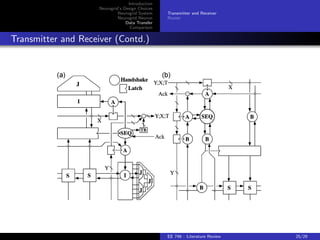
    Introduction Neurogrid's DesignChoices Neurogrid System Neurogrid Neuron Data Transfer Comparison Transmitter and Receiver Router Transmitter and Receiver ) AER : Realize multiple virtual point-to-point channels with a single physical link by representing a communication on any channel with its input-ports address. ) Encodes the spikes row and column addresses, conveying these addresses to another chip, and decoding them to recreate the spike at its destination. ) Two M-way arbiters, built with M-1 two-way arbiters connected in a binary tree generate a log2 (M)-bit address for each row or column selected. ) Latches allow the next packets addresses to be decoded while the current ones spikes are being delivered to the array. EE 746 : Literature Review 24/29
  • 32.
    Introduction Neurogrid's DesignChoices Neurogrid System Neurogrid Neuron Data Transfer Comparison Transmitter and Receiver Router Transmitter and Receiver (Contd.) EE 746 : Literature Review 25/29
  • 33.
    Introduction Neurogrid's DesignChoices Neurogrid System Neurogrid Neuron Data Transfer Comparison Transmitter and Receiver Router Transmitter and Receiver (Contd.) ) 256 256 version of the transmitter and a 2048 256 version of the receiver - its eight lines per row select one of four shared-synapses to activate, one of three sets of analog signals to sample, or a neuron to disable ) 86 ns is needed to transfer a rows spikes to the arrays periphery and 23 ns to encode each spikes column address. ) Pipelining and parallelism enable the transmitter to sustain a maximum transmission rate of 43.4 Mspike/s, or 663 spike/s per neuron. receiver decodes an additional column address every 16 ns, sustaining a maximum rate of 62.5 Mspike/s, or 956 spike/s per neuron EE 746 : Literature Review 26/29
  • 34.
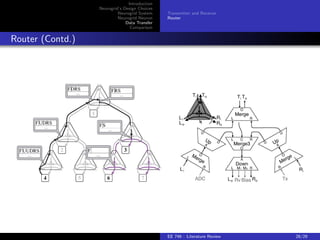
    Introduction Neurogrid's DesignChoices Neurogrid System Neurogrid Neuron Data Transfer Comparison Transmitter and Receiver Router Router ) Realizes the primary and secondary axon branching using the multicast capability and the Neurocores embedded memory. ) Two distinct phases: a point-to-point phase and a branching phase. ) Point-to-point phase : the router steers the packet up/down or left/right, based on a bit in the packets
  • 35.
    rst word. Branchingphase : the router copies the packet to both left and right ports. ) If ood bit (F) set, the packet recursively branches to all descendants ( ood mode), Otherwise, delivered to exclusively (target mode). ) In F mode Depending on how the SRAM is programmed, the packet is either
  • 36.
    ltered or delivered.If the packet is delivered, current system appends two additional bits retrieved from the SRAM to its row address. ) The obtained rates were 234 Mspike/s in normal mode and up to 1.17 Gspike/s in burst mode. EE 746 : Literature Review 27/29
  • 37.
    Introduction Neurogrid's DesignChoices Neurogrid System Neurogrid Neuron Data Transfer Comparison Transmitter and Receiver Router Router (Contd.) EE 746 : Literature Review 28/29
  • 38.
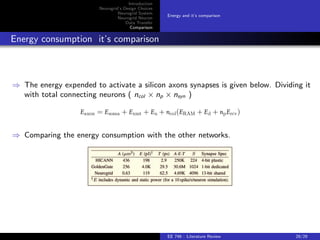
    Introduction Neurogrid's DesignChoices Neurogrid System Neurogrid Neuron Data Transfer Comparison Energy and it's comparison Energy consumption it's comparison ) The energy expended to activate a silicon axons synapses is given below. Dividing it with total connecting neurons ( ncol np nsyn ) ) Comparing the energy consumption with the other networks. EE 746 : Literature Review 29/29