Amit Kr Bhardwaj
DNA
EXTRACTION
SPIN COLUMN METHOD
 DNA, or deoxyribonucleic
acid, other is the hereditary
material in humans and almost
all organisms. Most DNA is
located in the cell nucleus
(where it is called nuclear
DNA), but a small amount of
DNA can also be found in the
mitochondria (where it is called
mitochondrial DNA).
WHAT IS DNA ?
SOURCEOFDNASAMPLE
DNA extraction can be used in
investigations, like relation ship
testing ,PCR, HLA Typing etc.
The biological material used to
determine a DNA profile include
blood, semen, saliva, urine, hair,
teeth, bone, tissue and cells.
PURPOSE OF DNA EXTRACTION
SOURCE OF DNA SAMPLE
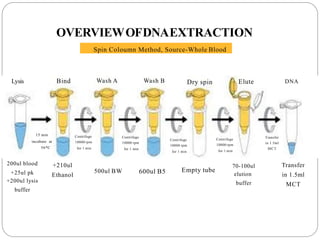
200ul blood
+25ul pk
+200ul lysis
buffer
Lysis Bind Wash A Wash B Dry spin Elute DNA
15 min
incubate at
56*C
+210ul
Ethanol
Centrifuge
10000 rpm
for 1 min
Centrifuge
10000 rpm
for 1 min
Transfer
in 1.5ml
MCT
600ul B5
500ul BW Empty tube
70-100ul
elution
buffer
Transfer
in 1.5ml
MCT
OVERVIEWOFDNAEXTRACTION
Spin Coloumn Method, Source-Whole Blood
Centrifuge
10000 rpm
for 1 min
Centrifuge
10000 rpm
for 1 min
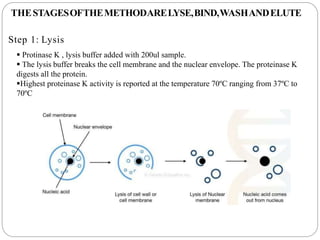
THESTAGESOFTHEMETHODARELYSE,BIND,WASHANDELUTE
Step 1: Lysis
 Protinase K , lysis buffer added with 200ul sample.
 The lysis buffer breaks the cell membrane and the nuclear envelope. The proteinase K
digests all the protein.
Highest proteinase K activity is reported at the temperature 70ºC ranging from 37ºC to
70ºC
Step 2: Binding
Step 3: Wash
The presence of chaotropic salts or high salt concentration is
essential for denaturation of proteins which optimizes the
selective binding of negatively charged nucleicacids to silica
based membrane. In addition, to enhance and influence the
binding of nucleic acids to silica membrane, alcohol is also added
to the binding buffer. These conditions lead to an energetically
favorable situation for nucleic acids to adsorb to the silica
membrane. During the DNA adsorption step, impurities like
salts, enzymes, unincorporated nucleotides, detergents, oils and
proteins will flow through without binding to the silica column.
Nucleicacids are adsorbed to the silica surface, while majority of theother
molecules pass through the column. However, the membrane is stillcontaminated
with residual proteins and salts. The nucleic acids bound to the silica column are
then washed by applying appropriate buffersolutions to the column to remove
any impurities, proteins and pfrom the sample.
Step 4: Dry Spin
After the ethanol wash, most protocols have a centrifugation step to
dry the column. This is to remove the ethanol and is essential for a
clean eluate (DNA / RNA).Skipping the drying step may result in
lower yields of nucleicacids.
Step 5: Elution
The pre-heated elution buffer (10 mM Tris buffer at a pH between
8-9 is used) contains a higher pH than the extraction buffer. Once we
add the elution buffer to the spin column, the nucleic acids become
hydrated and are released into the buffer. TE buffer is called as DNA
preservative which stores DNA in intact form for a longer period of time,
without degrading it.
THANK YOU

DNA EXTRACTION.pptx

  • 1.
  • 2.
     DNA, ordeoxyribonucleic acid, other is the hereditary material in humans and almost all organisms. Most DNA is located in the cell nucleus (where it is called nuclear DNA), but a small amount of DNA can also be found in the mitochondria (where it is called mitochondrial DNA). WHAT IS DNA ?
  • 3.
    SOURCEOFDNASAMPLE DNA extraction canbe used in investigations, like relation ship testing ,PCR, HLA Typing etc. The biological material used to determine a DNA profile include blood, semen, saliva, urine, hair, teeth, bone, tissue and cells. PURPOSE OF DNA EXTRACTION SOURCE OF DNA SAMPLE
  • 4.
    200ul blood +25ul pk +200ullysis buffer Lysis Bind Wash A Wash B Dry spin Elute DNA 15 min incubate at 56*C +210ul Ethanol Centrifuge 10000 rpm for 1 min Centrifuge 10000 rpm for 1 min Transfer in 1.5ml MCT 600ul B5 500ul BW Empty tube 70-100ul elution buffer Transfer in 1.5ml MCT OVERVIEWOFDNAEXTRACTION Spin Coloumn Method, Source-Whole Blood Centrifuge 10000 rpm for 1 min Centrifuge 10000 rpm for 1 min
  • 5.
    THESTAGESOFTHEMETHODARELYSE,BIND,WASHANDELUTE Step 1: Lysis Protinase K , lysis buffer added with 200ul sample.  The lysis buffer breaks the cell membrane and the nuclear envelope. The proteinase K digests all the protein. Highest proteinase K activity is reported at the temperature 70ºC ranging from 37ºC to 70ºC
  • 6.
    Step 2: Binding Step3: Wash The presence of chaotropic salts or high salt concentration is essential for denaturation of proteins which optimizes the selective binding of negatively charged nucleicacids to silica based membrane. In addition, to enhance and influence the binding of nucleic acids to silica membrane, alcohol is also added to the binding buffer. These conditions lead to an energetically favorable situation for nucleic acids to adsorb to the silica membrane. During the DNA adsorption step, impurities like salts, enzymes, unincorporated nucleotides, detergents, oils and proteins will flow through without binding to the silica column. Nucleicacids are adsorbed to the silica surface, while majority of theother molecules pass through the column. However, the membrane is stillcontaminated with residual proteins and salts. The nucleic acids bound to the silica column are then washed by applying appropriate buffersolutions to the column to remove any impurities, proteins and pfrom the sample.
  • 7.
    Step 4: DrySpin After the ethanol wash, most protocols have a centrifugation step to dry the column. This is to remove the ethanol and is essential for a clean eluate (DNA / RNA).Skipping the drying step may result in lower yields of nucleicacids. Step 5: Elution The pre-heated elution buffer (10 mM Tris buffer at a pH between 8-9 is used) contains a higher pH than the extraction buffer. Once we add the elution buffer to the spin column, the nucleic acids become hydrated and are released into the buffer. TE buffer is called as DNA preservative which stores DNA in intact form for a longer period of time, without degrading it.
  • 8.