SPIN BASED LED
M.Uzair (17441510-099)
Maria Khizar (17441510-100)
Nayab Tahir (17441510-097)
Osama Munawar (17441510-098)
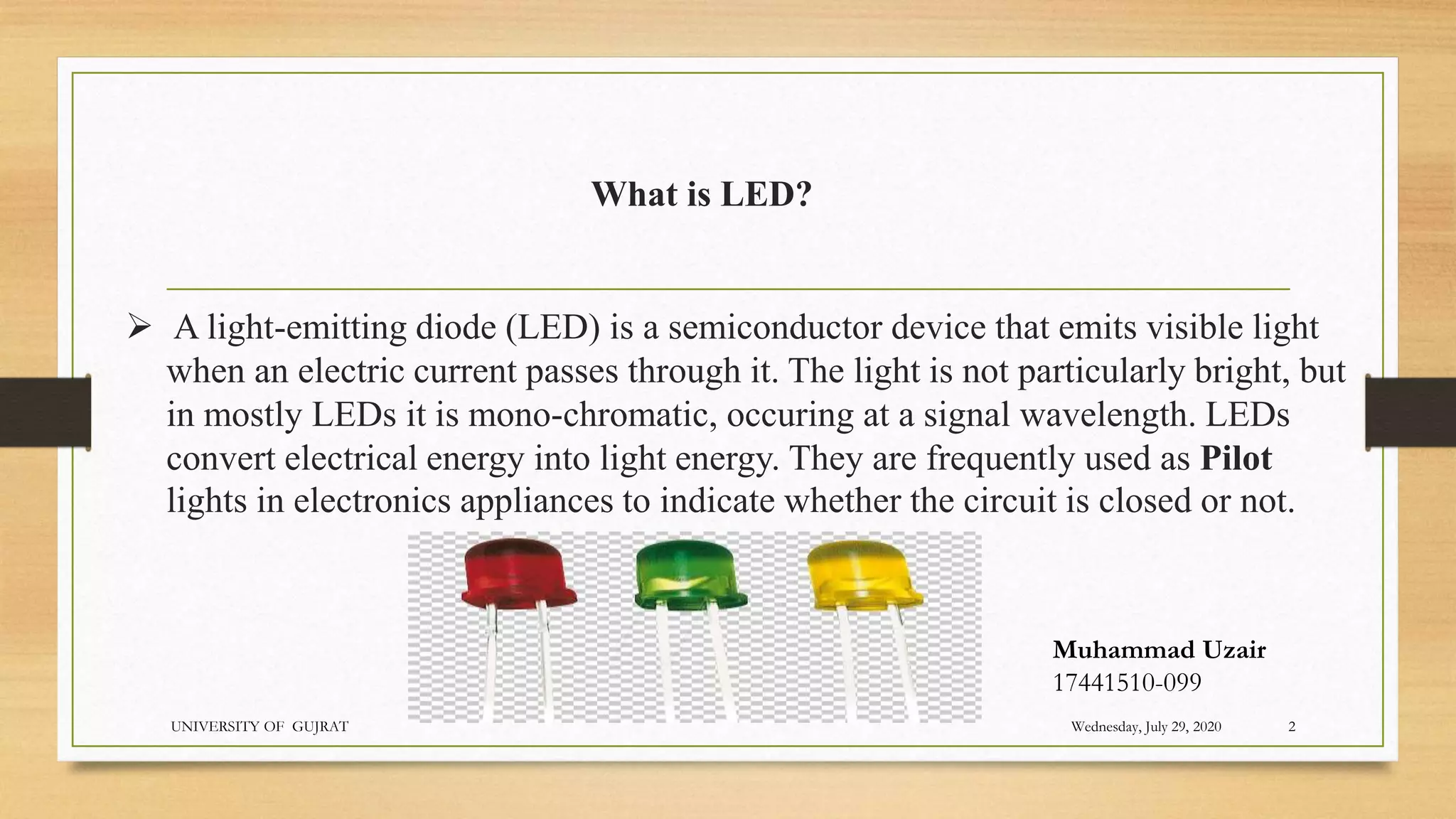
 A light-emitting diode (LED) is a semiconductor device that emits visible light
when an electric current passes through it. The light is not particularly bright, but
in mostly LEDs it is mono-chromatic, occuring at a signal wavelength. LEDs
convert electrical energy into light energy. They are frequently used as Pilot
lights in electronics appliances to indicate whether the circuit is closed or not.
What is LED?
Wednesday, July 29, 2020
UNIVERSITY OF GUJRAT 2
Muhammad Uzair
17441510-099
Working of LEDs
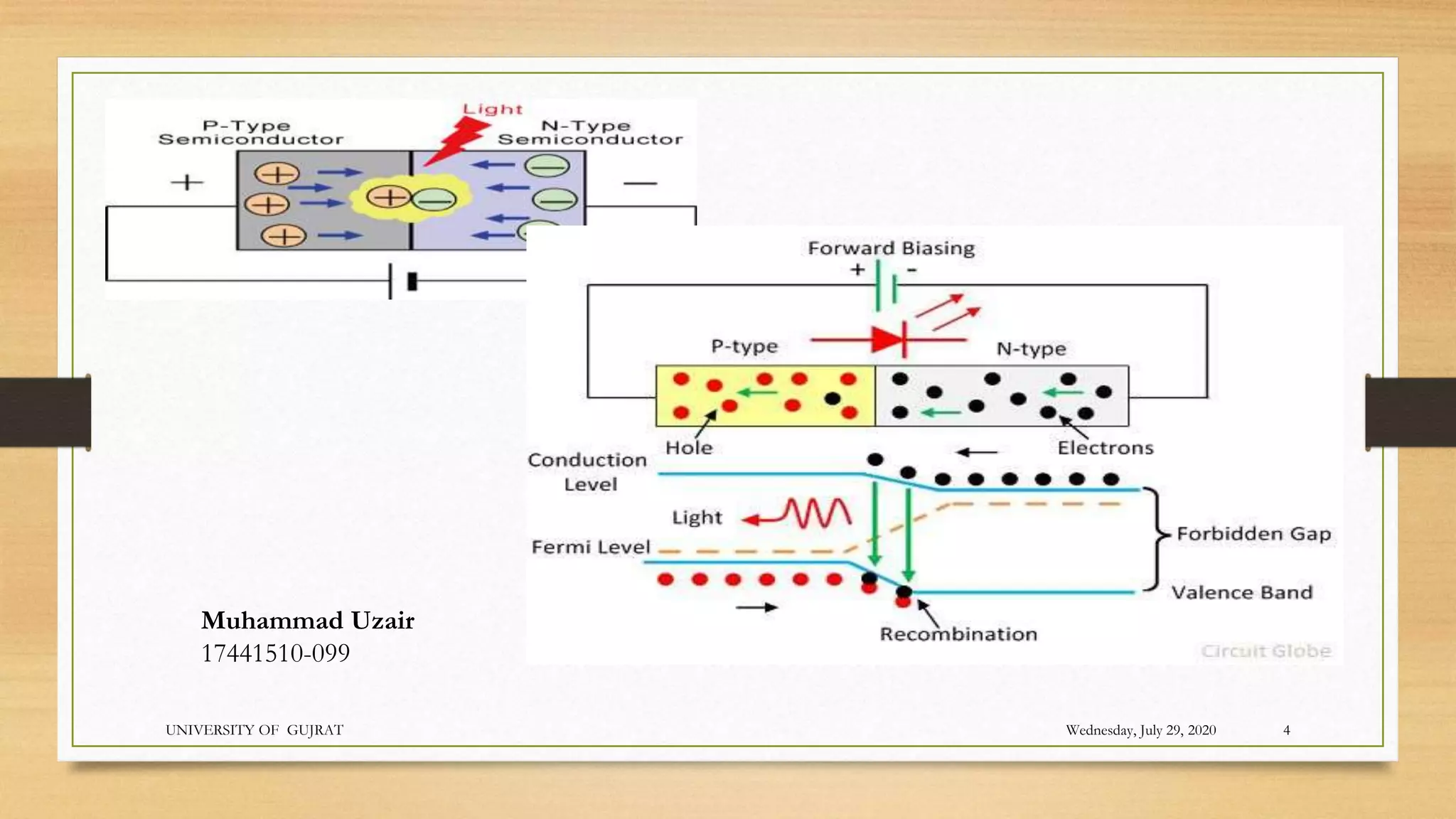
A P-N junction can convert absorbed light energy into a proportional electrical
energy. The same process is reversed here. The charge carriers recombine in a
forward-biased P-N junction as the electron cross from the N-region and
recombine with the holes existing in the P-region. Free electrons are in the
conduction band of energy levels, while holes are in the valence energy band.
Thus the energy level of the holes will be lesser then the energy levels of the
electrons. Some portion of energy must be dissipated in order to recombine the
electrons and the holes. This energy is emitted in the form of heat and light.
Wednesday, July 29, 2020
UNIVERSITY OF GUJRAT 3
Muhammad Uzair
17441510-099
Wednesday, July 29, 2020
UNIVERSITY OF GUJRAT 4
Muhammad Uzair
17441510-099
History of spin -LED
 In 1999, the concept of a spin light emitting diode spin- LED was introduced, demonstrating the
ability to determine the degree of spin injection from a magnetic injector layer into the underlying
semiconductor LED structure by measuring the degree of circular polarization of the emitted light.
 The first significant demonstration of spin injection in a LED structure was achieved by
Fiederling et al with a II-VI DMS ferromagnetic injector on top of an AlGaAS/GaAS QW LED
structure .
 Significant advances have been made over the past decade toward efficient spin injection in spin-
LEDs.
Wednesday, July 29, 2020
UNIVERSITY OF GUJRAT 5
Maria Khizar
17441510-100
SPIN BASED LED
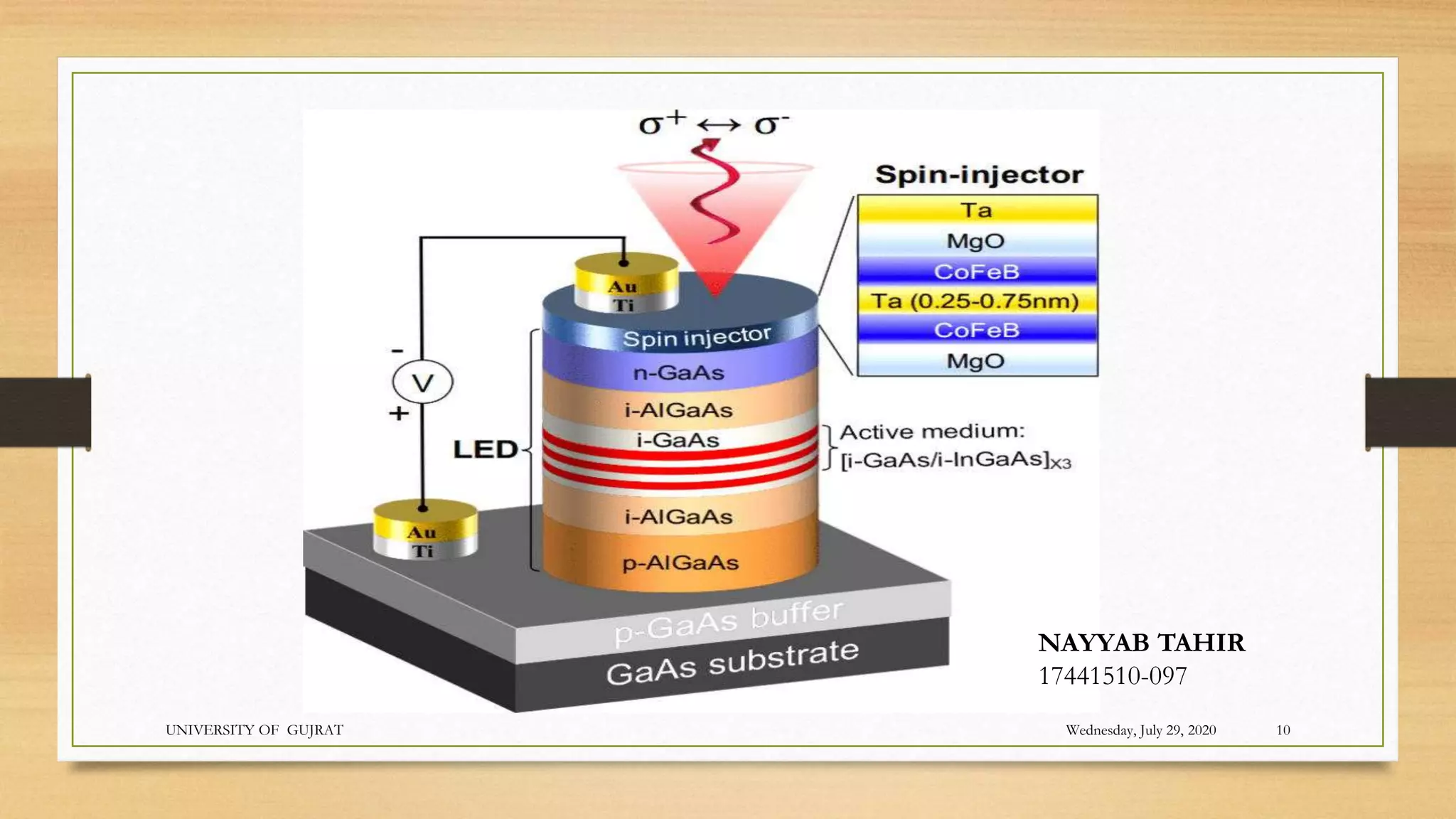
 A Spin-LED is a Light Emitting Diode structure spin-LED has ferromagnetic electrode
on the semiconductor LED structure. It can emit the circularly polarized
light Spin polarized electron injected from ferromagnetic electrode through atomic
barrier into the gallium arsenide with the semiconductor LED structure.
 The LED structure is typically a semiconductor hetero structure including an electron
reservoir (n-doped region) and a hole reservoir (p-doped region) separated by a lightly
doped "near" intrinsic semiconductor region.
 spin-injection from a ferromagnetic material into a semiconductor
Wednesday, July 29, 2020
UNIVERSITY OF GUJRAT 6
Maria Khizar
17441510-100
SPIN LEDS
 In recent years, a new field “spintronics”, that is an idea to use the spin of electrons in electronic
devices, progresses remarkably. whose quantum states can be controlled and operated using spin-
polarized carriers.
 We find that the electroluminescence circular polarization is at room temperature with the range of
values obtained from the QW spin –LEDs. of pure circular polarization electroluminescence at
room temperature with no external magnetic fields. They are obtained by electrically injecting
moderately high density of spins into semiconductor double hetero structures .
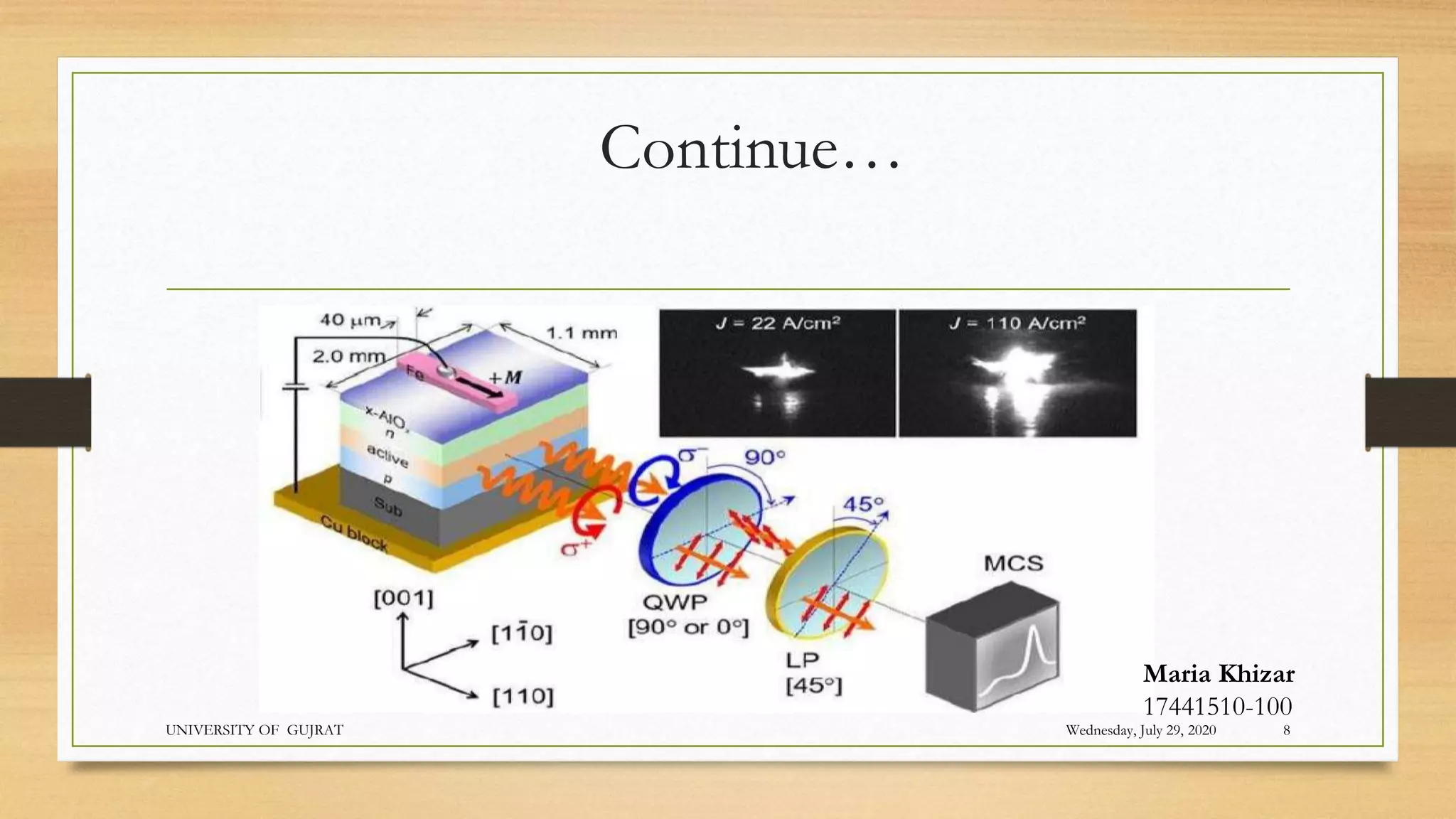
 A schematic experimental setup for EL measurements, showing, from upper left to lower right, a
wire-bonded rectangle spin-LED chip on a copper block, a quarter-wave plate (QWP), a linear
polarizer (LP), and a multi-channel spectrometer (MCS)
 Straight orange arrows accompanied by both-headed arrows represent light waves converted into
linear polarization by QWP. Thin dotted, blue arrows on polarizers represent optical axes.
Wednesday, July 29, 2020
UNIVERSITY OF GUJRAT 7
Maria Khizar
17441510-100
Continue…
Wednesday, July 29, 2020
UNIVERSITY OF GUJRAT 8
Maria Khizar
17441510-100
Pure CP (EL) WITH SPIN POLARIZED IED
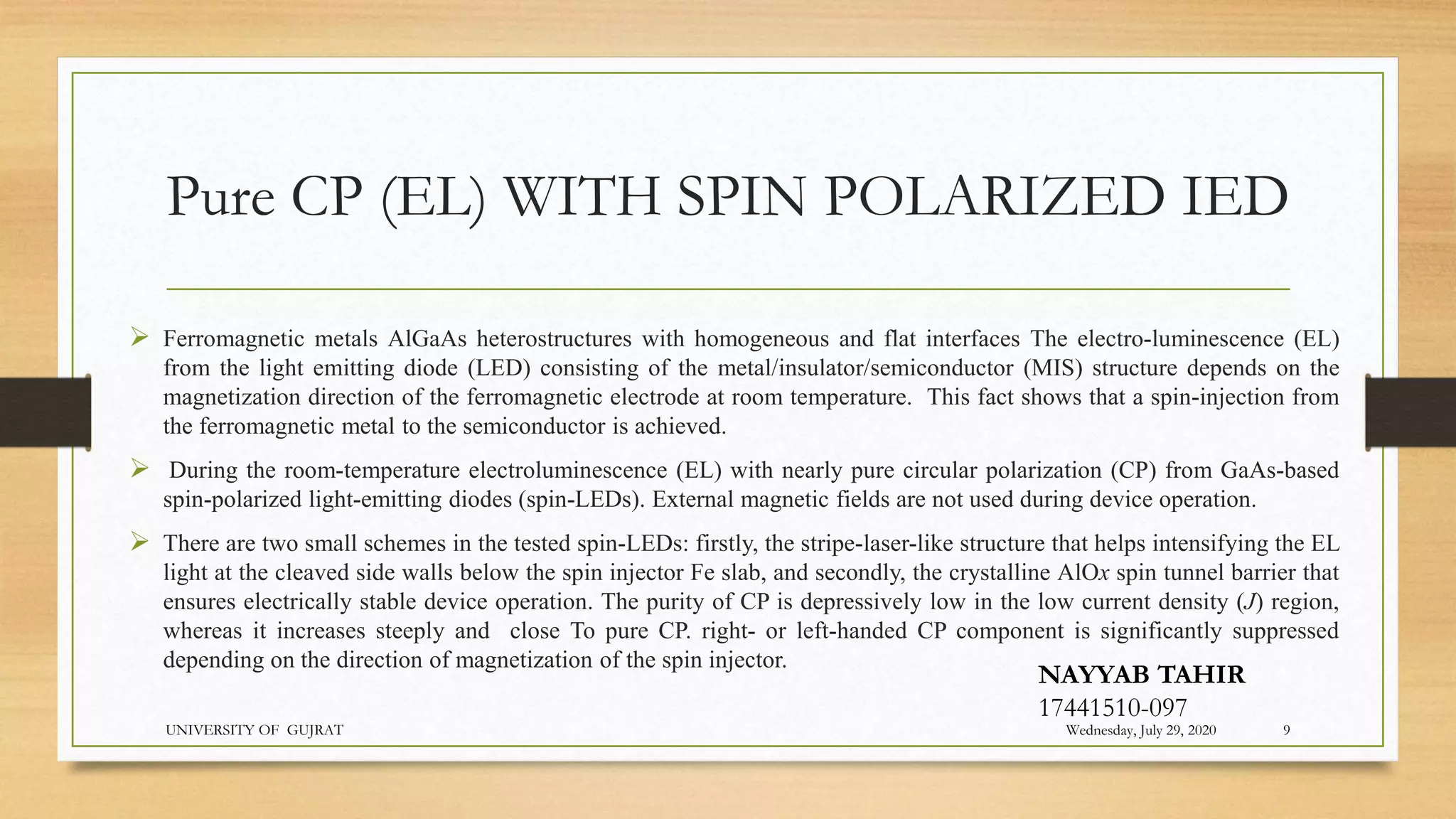
 Ferromagnetic metals AlGaAs heterostructures with homogeneous and flat interfaces The electro-luminescence (EL)
from the light emitting diode (LED) consisting of the metal/insulator/semiconductor (MIS) structure depends on the
magnetization direction of the ferromagnetic electrode at room temperature. This fact shows that a spin-injection from
the ferromagnetic metal to the semiconductor is achieved.
 During the room-temperature electroluminescence (EL) with nearly pure circular polarization (CP) from GaAs-based
spin-polarized light-emitting diodes (spin-LEDs). External magnetic fields are not used during device operation.
 There are two small schemes in the tested spin-LEDs: firstly, the stripe-laser-like structure that helps intensifying the EL
light at the cleaved side walls below the spin injector Fe slab, and secondly, the crystalline AlOx spin tunnel barrier that
ensures electrically stable device operation. The purity of CP is depressively low in the low current density (J) region,
whereas it increases steeply and close To pure CP. right- or left-handed CP component is significantly suppressed
depending on the direction of magnetization of the spin injector.
Wednesday, July 29, 2020
UNIVERSITY OF GUJRAT 9
NAYYAB TAHIR
17441510-097
Wednesday, July 29, 2020
UNIVERSITY OF GUJRAT 10
NAYYAB TAHIR
17441510-097
Working Principle
• A n-i-p semiconductor structure is a diode with a wide, lightly doped "near" intrinsic
semiconductor region between a p-type semiconductor and an n-type semiconductor
region. The p-type and n-type regions are typically heavily doped as they are used for
ohmic contacts. The addition of an intrinsic layer changes properties of the p-n junction.
• When reverse biased, a n-i-p diode enable the emission of light from the intrinsic region.
By energetically concentrating the radiative recombinations, the i-region reduces the
spectral enlargement emerging from the layers in-homogeneities. Compared to
conventional p-n diodes, the emitted wavelength is not submitted to a commonly
observed redshift when emission happens from a doped region.
Wednesday, July 29, 2020
UNIVERSITY OF GUJRAT 11
NAYYAB TAHIR
17441510-097
Cont.
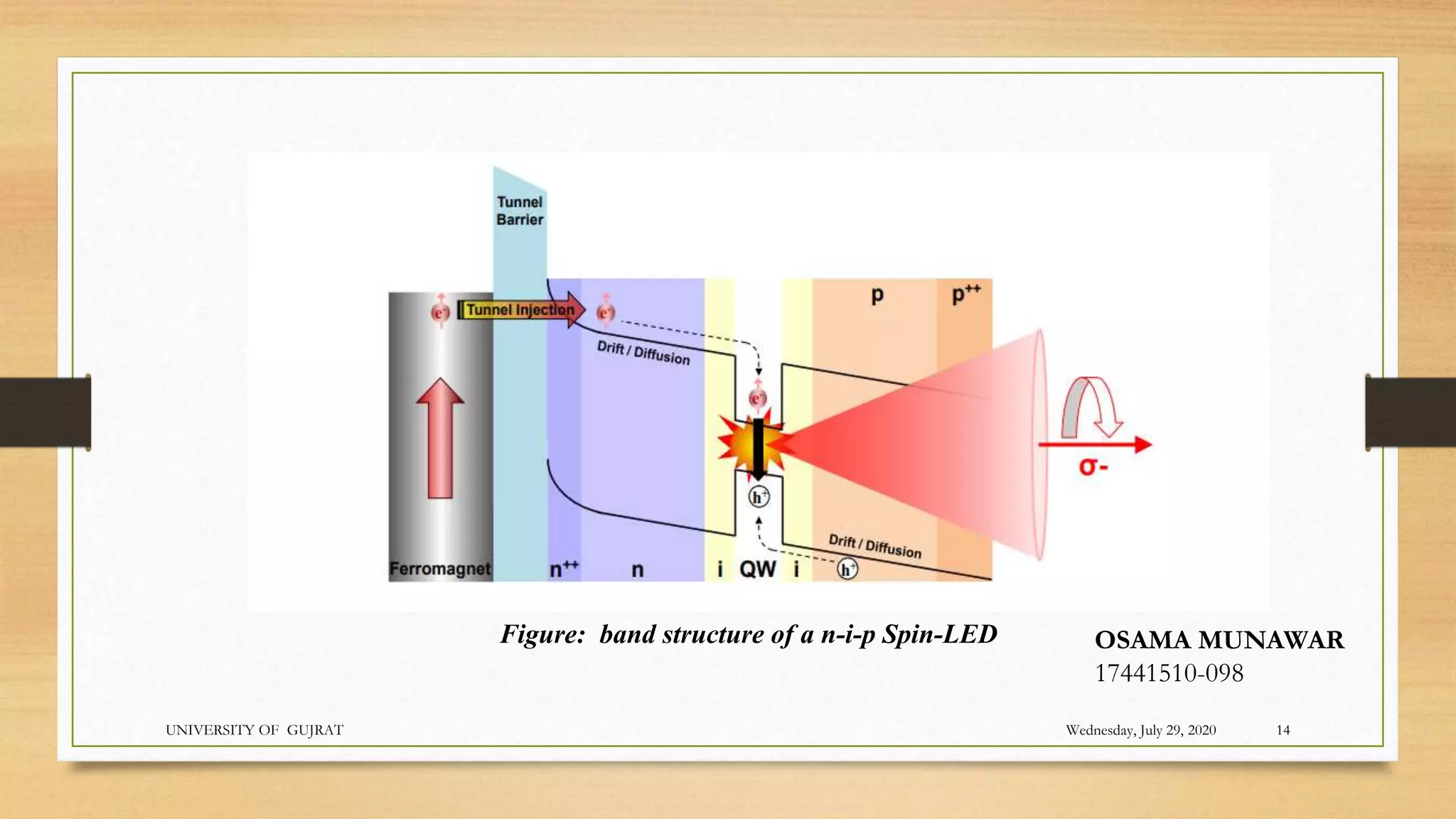
• It is also possible to introduce a conned potential such as QWs or QDs in the intrinsic
region (Figure Shown). In addition of increasing the radiative recombination efficiency,
this gives an additional degree of freedom to modulate the emitted wavelength according
to the dimensions and strains of the QWs/QDs.
• When the diode is forward biased, the injected carrier concentration is typically several
orders of magnitude higher than the intrinsic level carrier concentration. Due to this high
injection level ( through depletion process) the electric field extends deeply into the
region.
Wednesday, July 29, 2020
UNIVERSITY OF GUJRAT 12
OSAMA MUNAWAR
17441510-098
Cont.
• This electric field helps to speed up the transport of charge carriers from the P region to
the N region. This process results in faster operation of the diode making it a suitable
device for high frequency operations. When reversed biased, a n-i-p diode can be use as
an ultra-fast photo-detector with a bandwidth of several GHz.
• Indeed, the small carrier density in the intrinsic region provides a relatively long lifetime
to the photo-generated 𝑒−
− ℎ+
pairs by the reason of a low recombination probability.
This translates in a highly efficient photo-generation. Compare to conventional p-n
diodes, the wide intrinsic region makes the n-i-p diode an inferior rectifier (one typical
function of a diode). But, on the other hand, it makes the n-i-p diode suitable for
attenuators, fast switches, photo-detectors, and high voltage power electronics
applications.
Wednesday, July 29, 2020
UNIVERSITY OF GUJRAT 13
OSAMA MUNAWAR
17441510-098
Wednesday, July 29, 2020
UNIVERSITY OF GUJRAT 14
Figure: band structure of a n-i-p Spin-LED OSAMA MUNAWAR
17441510-098
APPLICATIONS
• In the recent advance study, spin based LEDs (GaAs) can used in the early diagnosis of
Cancer.
• Now we are using MRI for the study of body organs. But spin based LED used for the
manufacturing of Optically Enhanced Nuclei Imaging.
• It can also be used in the Optical Communication Network ( Fiber Optics).
Wednesday, July 29, 2020
UNIVERSITY OF GUJRAT 15
OSAMA MUNAWAR
17441510-098

Spin Based LED and its applications in Daily life

  • 1.
    SPIN BASED LED M.Uzair(17441510-099) Maria Khizar (17441510-100) Nayab Tahir (17441510-097) Osama Munawar (17441510-098)
  • 2.
     A light-emittingdiode (LED) is a semiconductor device that emits visible light when an electric current passes through it. The light is not particularly bright, but in mostly LEDs it is mono-chromatic, occuring at a signal wavelength. LEDs convert electrical energy into light energy. They are frequently used as Pilot lights in electronics appliances to indicate whether the circuit is closed or not. What is LED? Wednesday, July 29, 2020 UNIVERSITY OF GUJRAT 2 Muhammad Uzair 17441510-099
  • 3.
    Working of LEDs AP-N junction can convert absorbed light energy into a proportional electrical energy. The same process is reversed here. The charge carriers recombine in a forward-biased P-N junction as the electron cross from the N-region and recombine with the holes existing in the P-region. Free electrons are in the conduction band of energy levels, while holes are in the valence energy band. Thus the energy level of the holes will be lesser then the energy levels of the electrons. Some portion of energy must be dissipated in order to recombine the electrons and the holes. This energy is emitted in the form of heat and light. Wednesday, July 29, 2020 UNIVERSITY OF GUJRAT 3 Muhammad Uzair 17441510-099
  • 4.
    Wednesday, July 29,2020 UNIVERSITY OF GUJRAT 4 Muhammad Uzair 17441510-099
  • 5.
    History of spin-LED  In 1999, the concept of a spin light emitting diode spin- LED was introduced, demonstrating the ability to determine the degree of spin injection from a magnetic injector layer into the underlying semiconductor LED structure by measuring the degree of circular polarization of the emitted light.  The first significant demonstration of spin injection in a LED structure was achieved by Fiederling et al with a II-VI DMS ferromagnetic injector on top of an AlGaAS/GaAS QW LED structure .  Significant advances have been made over the past decade toward efficient spin injection in spin- LEDs. Wednesday, July 29, 2020 UNIVERSITY OF GUJRAT 5 Maria Khizar 17441510-100
  • 6.
    SPIN BASED LED A Spin-LED is a Light Emitting Diode structure spin-LED has ferromagnetic electrode on the semiconductor LED structure. It can emit the circularly polarized light Spin polarized electron injected from ferromagnetic electrode through atomic barrier into the gallium arsenide with the semiconductor LED structure.  The LED structure is typically a semiconductor hetero structure including an electron reservoir (n-doped region) and a hole reservoir (p-doped region) separated by a lightly doped "near" intrinsic semiconductor region.  spin-injection from a ferromagnetic material into a semiconductor Wednesday, July 29, 2020 UNIVERSITY OF GUJRAT 6 Maria Khizar 17441510-100
  • 7.
    SPIN LEDS  Inrecent years, a new field “spintronics”, that is an idea to use the spin of electrons in electronic devices, progresses remarkably. whose quantum states can be controlled and operated using spin- polarized carriers.  We find that the electroluminescence circular polarization is at room temperature with the range of values obtained from the QW spin –LEDs. of pure circular polarization electroluminescence at room temperature with no external magnetic fields. They are obtained by electrically injecting moderately high density of spins into semiconductor double hetero structures .  A schematic experimental setup for EL measurements, showing, from upper left to lower right, a wire-bonded rectangle spin-LED chip on a copper block, a quarter-wave plate (QWP), a linear polarizer (LP), and a multi-channel spectrometer (MCS)  Straight orange arrows accompanied by both-headed arrows represent light waves converted into linear polarization by QWP. Thin dotted, blue arrows on polarizers represent optical axes. Wednesday, July 29, 2020 UNIVERSITY OF GUJRAT 7 Maria Khizar 17441510-100
  • 8.
    Continue… Wednesday, July 29,2020 UNIVERSITY OF GUJRAT 8 Maria Khizar 17441510-100
  • 9.
    Pure CP (EL)WITH SPIN POLARIZED IED  Ferromagnetic metals AlGaAs heterostructures with homogeneous and flat interfaces The electro-luminescence (EL) from the light emitting diode (LED) consisting of the metal/insulator/semiconductor (MIS) structure depends on the magnetization direction of the ferromagnetic electrode at room temperature. This fact shows that a spin-injection from the ferromagnetic metal to the semiconductor is achieved.  During the room-temperature electroluminescence (EL) with nearly pure circular polarization (CP) from GaAs-based spin-polarized light-emitting diodes (spin-LEDs). External magnetic fields are not used during device operation.  There are two small schemes in the tested spin-LEDs: firstly, the stripe-laser-like structure that helps intensifying the EL light at the cleaved side walls below the spin injector Fe slab, and secondly, the crystalline AlOx spin tunnel barrier that ensures electrically stable device operation. The purity of CP is depressively low in the low current density (J) region, whereas it increases steeply and close To pure CP. right- or left-handed CP component is significantly suppressed depending on the direction of magnetization of the spin injector. Wednesday, July 29, 2020 UNIVERSITY OF GUJRAT 9 NAYYAB TAHIR 17441510-097
  • 10.
    Wednesday, July 29,2020 UNIVERSITY OF GUJRAT 10 NAYYAB TAHIR 17441510-097
  • 11.
    Working Principle • An-i-p semiconductor structure is a diode with a wide, lightly doped "near" intrinsic semiconductor region between a p-type semiconductor and an n-type semiconductor region. The p-type and n-type regions are typically heavily doped as they are used for ohmic contacts. The addition of an intrinsic layer changes properties of the p-n junction. • When reverse biased, a n-i-p diode enable the emission of light from the intrinsic region. By energetically concentrating the radiative recombinations, the i-region reduces the spectral enlargement emerging from the layers in-homogeneities. Compared to conventional p-n diodes, the emitted wavelength is not submitted to a commonly observed redshift when emission happens from a doped region. Wednesday, July 29, 2020 UNIVERSITY OF GUJRAT 11 NAYYAB TAHIR 17441510-097
  • 12.
    Cont. • It isalso possible to introduce a conned potential such as QWs or QDs in the intrinsic region (Figure Shown). In addition of increasing the radiative recombination efficiency, this gives an additional degree of freedom to modulate the emitted wavelength according to the dimensions and strains of the QWs/QDs. • When the diode is forward biased, the injected carrier concentration is typically several orders of magnitude higher than the intrinsic level carrier concentration. Due to this high injection level ( through depletion process) the electric field extends deeply into the region. Wednesday, July 29, 2020 UNIVERSITY OF GUJRAT 12 OSAMA MUNAWAR 17441510-098
  • 13.
    Cont. • This electricfield helps to speed up the transport of charge carriers from the P region to the N region. This process results in faster operation of the diode making it a suitable device for high frequency operations. When reversed biased, a n-i-p diode can be use as an ultra-fast photo-detector with a bandwidth of several GHz. • Indeed, the small carrier density in the intrinsic region provides a relatively long lifetime to the photo-generated 𝑒− − ℎ+ pairs by the reason of a low recombination probability. This translates in a highly efficient photo-generation. Compare to conventional p-n diodes, the wide intrinsic region makes the n-i-p diode an inferior rectifier (one typical function of a diode). But, on the other hand, it makes the n-i-p diode suitable for attenuators, fast switches, photo-detectors, and high voltage power electronics applications. Wednesday, July 29, 2020 UNIVERSITY OF GUJRAT 13 OSAMA MUNAWAR 17441510-098
  • 14.
    Wednesday, July 29,2020 UNIVERSITY OF GUJRAT 14 Figure: band structure of a n-i-p Spin-LED OSAMA MUNAWAR 17441510-098
  • 15.
    APPLICATIONS • In therecent advance study, spin based LEDs (GaAs) can used in the early diagnosis of Cancer. • Now we are using MRI for the study of body organs. But spin based LED used for the manufacturing of Optically Enhanced Nuclei Imaging. • It can also be used in the Optical Communication Network ( Fiber Optics). Wednesday, July 29, 2020 UNIVERSITY OF GUJRAT 15 OSAMA MUNAWAR 17441510-098