PRESENTATION
OPTICAL FIBER COMMUNICATION 

ETEG 422
BY:-
Sujeet Kumar Jha (41009)
FORMATION OF THE p–n
JUNCTION
 When donor impurities are introduced into one side and acceptors into the
other side of a single crystal semiconductor through various sophisticated
microelectronic device-fabricating techniques, a p–n junction is formed.
 The presence of a concentration gradient between two materials in such
intimate contact results in a diffusion of carriers that tends to neutralize this
gradient. This process is known as the diffusion process.
 The nature of the p–n junction so formed may, in general, be of two types:
A step-graded junction:- In a step-graded semiconductor junction, the
impurity density in the semiconductor is constant.
A linearly-graded junction:- In a linearly-graded junction, the impurity
density varies linearly with distance away from the junction.
A semiconductor p–n junction
ENERGY BAND DIAGRAMS
 The discussion in this section is based on the realistic assumption that a
junction is made up of uniformly doped p-type and n-type crystals forming a
step-graded junction.
 The p–n Junction at Thermal Equilibrium
p-type and n-type semiconductors just before
contact
From the discussion of the law of mass action, the carrier concentrations on
either side away from the junction are given by:
(where pn is the hole concentration in n-type semiconductors, np is the
electron concentration in p-type semiconductors; nn and pp are the electron
and hole concentrations in n- and p-type semiconductors respectively.)
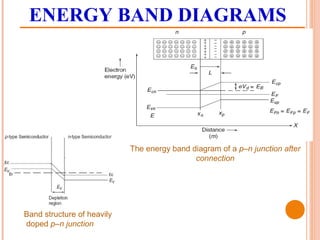
The energy band diagram of a p–n junction after
connection
Band structure of heavily
doped p–n junction
ENERGY BAND DIAGRAMS
CONCEPTS OF JUNCTION
POTENTIAL
MODES OF THE p–n JUNCTION
 The p–n Junction with External Applied Voltage
If an external voltage Va is applied across the p–n junction, the
height of the potential barrier is either increased or diminished as
compared to Va, depending upon the polarity of the applied voltage.
The energy band distribution, with applied external voltage, is
shown in below figure. For these non-equilibrium conditions, the
Fermi level can no longer be identified. In order to describe the
behaviour of the p–n junction, quasi- Fermi levels are introduced.
MODES OF THE p–n JUNCTION
 Rectifying Voltage–Current Characteristics of a p–n Junction
 If the polarity of the applied voltage is such that the p-type region is
made negative with respect to the n-type, the height of the potential-
barrier is increased.
 Under this reverse-biased condition, it is relatively harder for the
majority of the carriers to surmount the potential-barrier.
 The increase in the potential barrier height is essentially equal to
the applied voltage.
 Under an external applied voltage, the carrier concentrations near
the junction are:
(where, the plus and minus signs are for the reverse-biased and the
forward-biased conditions.)
MODES OF THE p–n JUNCTION
There are two modes of switching of a p–n junction diode.
 Forward-biased p–n
junction
 When the positive
terminal of a battery is
connected to the p-type
side and the negative
terminals to the n-type side
of a p–n junction, the
junction allows a large
current to flow through it
due to the low resistance
level offered by the
junction. In this case the
junction is said to be
forward biased. Energy band diagram of
Forward-biased p–n junction
 Reverse-biased p–n
junction
When the terminals of
the battery are reversed
i.e., when the positive
terminal is connected to
the n-type side and the
negative terminal is
connected to the p-type
side, the junction allows a
very little current to flow
through it due to the high
resistance level offered by
the junction. Under this
condition, the p–n junction
is said to be reverse-
biased.
Energy band diagram of
Reverse-biased p–n junction
MODES OF THE p–n JUNCTION
Light Emitting Diode (LED)
• LED is a semiconductor diode; the construction of the LED is same
as other diode but the other regular diode is loss the recombination
energy in the thermal.
• LED is used the recombination energy into radiation spectrum of
light.
• LEDs have relatively large emitting areas and as a result are not as
good light sources as LDs.
• However, they are widely used for short to moderate transmission
distances because they are much more economical, quite linear in
terms of light output versus electrical current input and stable in
terms of light output versus ambient operating temperature.
LED Materials
• There are many material in construct LED, for
example GaAlAs (gallium aluminum arsenide)
for short-wavelength devices. Long-wavelength
devices generally incorporate InGaAsP (indium
gallium arsenide phosphide).
• These material gives different energy gap as
shown in table 1 below .Different material also
will gives different wavelength for different
application
LED Materials (Cont’1)
Material Energy gap
Eg (eV)
Wavelength
Si 1.17 1067
Ge 0.775 1610
GaAs 1.424 876
lnP 1.35 924
lnGaAs 0.75-1.24 1664-1006
AlGaAs 1.42-1.92 879
lnGaAsP 0.75-1.35 1664-924
LED Materials (Cont’2)
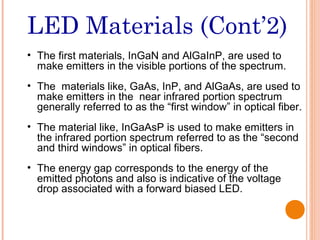
• The first materials, InGaN and AlGaInP, are used to
make emitters in the visible portions of the spectrum.
• The materials like, GaAs, InP, and AlGaAs, are used to
make emitters in the near infrared portion spectrum
generally referred to as the “first window” in optical fiber.
• The material like, InGaAsP is used to make emitters in
the infrared portion spectrum referred to as the “second
and third windows” in optical fibers.
• The energy gap corresponds to the energy of the
emitted photons and also is indicative of the voltage
drop associated with a forward biased LED.
 Homostructure.
Surface Led (SLED).
Emitting Led(ELED).
o Hetrostructure.
LED Structure
Contd.
 The p-n junction of the basic GaAs LED called
a homojunction because only one type of
semiconductor material is used in the junction
with different dopants to produce the junction
itself. The possible structure of an LED made
from such semiconductor known as homo
structure.
 There are two basic arrangement of LED.
Surface Emitting and Edge Emitting.
Contd.
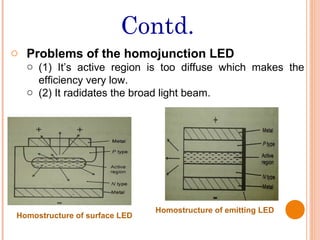
o Problems of the homojunction LED
o (1) It’s active region is too diffuse which makes the
efficiency very low.
o (2) It radidates the broad light beam.
Homostructure of emitting LED
Homostructure of surface LED
Contd.
 Hetrostructured LEDs are are made from the different
type of semiconductor materials ,each type having
different energy gap.
 The same concept is implemented ,for indium
phosphide – indium gallium arsenide phosphide (In-
InGaAsP)
 Advantages of a heterojunction LED
Higher quantum and coupling efficiency
(1) Do not suffer from poor surface conditions since
the active region is not near the surface..
(2) Increased carrier injection efficiency due to the low
doping active layer.
o DOUBLE-HETEROSTRUCTURE
CONFIGURATION
Led Radiation Pattern
o LEDs come in two forms, viz., (i) surface emitting and (ii)
edge emitting.
o Surface emitting LEDs radiate light at a wide angle, the
source is nearly Lambertian .
• They are not suitable as sources for coupling to an optical
fiber because the radiation is highly incoherent. Such LEDs
are usually used as signaling devices and as indicators in
panels and instruments.
o Edge emitting LEDs radiate at a relatively narrower angle.
The emitting area is smaller as a result of which the coupling
to the end of a fiber is more efficient. These LEDs are
generally temperature sensitive and must be maintained
under environmental control.
Contd.
Surface emitting LED
(Lambertian source)
Edge-Emiting LED
LED emission efficiency
Contd.
o Efficiency of an LED refers to the percentage of power
output in relation to input.
o Internal quantum efficiency:- as a fraction of the
electron hole pairs injected into the depletion layer
which recombine to generate light.
ηi =  nr/(r +nr)
r : radiative lifetime
nr : non-radiative lifetime
External quantum efficiency:- as the fraction of the
number of photons which are generated within the
semiconductor which are emitted outside.
External quantum efficiency is important because in view
of the high refractive indices of semiconductors
( n=3.5 ),the critical angle for total internal reflection is
rather small.
ηe : the ratio of the power emitted by the surface of the
LED to the input power
Contd.
Contd.
Optical presentation

Optical presentation

  • 1.
    PRESENTATION OPTICAL FIBER COMMUNICATION   ETEG422 BY:- Sujeet Kumar Jha (41009)
  • 2.
    FORMATION OF THEp–n JUNCTION  When donor impurities are introduced into one side and acceptors into the other side of a single crystal semiconductor through various sophisticated microelectronic device-fabricating techniques, a p–n junction is formed.  The presence of a concentration gradient between two materials in such intimate contact results in a diffusion of carriers that tends to neutralize this gradient. This process is known as the diffusion process.  The nature of the p–n junction so formed may, in general, be of two types: A step-graded junction:- In a step-graded semiconductor junction, the impurity density in the semiconductor is constant. A linearly-graded junction:- In a linearly-graded junction, the impurity density varies linearly with distance away from the junction. A semiconductor p–n junction
  • 3.
    ENERGY BAND DIAGRAMS The discussion in this section is based on the realistic assumption that a junction is made up of uniformly doped p-type and n-type crystals forming a step-graded junction.  The p–n Junction at Thermal Equilibrium p-type and n-type semiconductors just before contact From the discussion of the law of mass action, the carrier concentrations on either side away from the junction are given by: (where pn is the hole concentration in n-type semiconductors, np is the electron concentration in p-type semiconductors; nn and pp are the electron and hole concentrations in n- and p-type semiconductors respectively.)
  • 4.
    The energy banddiagram of a p–n junction after connection Band structure of heavily doped p–n junction ENERGY BAND DIAGRAMS
  • 5.
  • 6.
    MODES OF THEp–n JUNCTION  The p–n Junction with External Applied Voltage If an external voltage Va is applied across the p–n junction, the height of the potential barrier is either increased or diminished as compared to Va, depending upon the polarity of the applied voltage. The energy band distribution, with applied external voltage, is shown in below figure. For these non-equilibrium conditions, the Fermi level can no longer be identified. In order to describe the behaviour of the p–n junction, quasi- Fermi levels are introduced.
  • 7.
    MODES OF THEp–n JUNCTION  Rectifying Voltage–Current Characteristics of a p–n Junction  If the polarity of the applied voltage is such that the p-type region is made negative with respect to the n-type, the height of the potential- barrier is increased.  Under this reverse-biased condition, it is relatively harder for the majority of the carriers to surmount the potential-barrier.  The increase in the potential barrier height is essentially equal to the applied voltage.  Under an external applied voltage, the carrier concentrations near the junction are: (where, the plus and minus signs are for the reverse-biased and the forward-biased conditions.)
  • 8.
    MODES OF THEp–n JUNCTION There are two modes of switching of a p–n junction diode.  Forward-biased p–n junction  When the positive terminal of a battery is connected to the p-type side and the negative terminals to the n-type side of a p–n junction, the junction allows a large current to flow through it due to the low resistance level offered by the junction. In this case the junction is said to be forward biased. Energy band diagram of Forward-biased p–n junction
  • 9.
     Reverse-biased p–n junction Whenthe terminals of the battery are reversed i.e., when the positive terminal is connected to the n-type side and the negative terminal is connected to the p-type side, the junction allows a very little current to flow through it due to the high resistance level offered by the junction. Under this condition, the p–n junction is said to be reverse- biased. Energy band diagram of Reverse-biased p–n junction MODES OF THE p–n JUNCTION
  • 10.
    Light Emitting Diode(LED) • LED is a semiconductor diode; the construction of the LED is same as other diode but the other regular diode is loss the recombination energy in the thermal. • LED is used the recombination energy into radiation spectrum of light. • LEDs have relatively large emitting areas and as a result are not as good light sources as LDs. • However, they are widely used for short to moderate transmission distances because they are much more economical, quite linear in terms of light output versus electrical current input and stable in terms of light output versus ambient operating temperature.
  • 11.
    LED Materials • Thereare many material in construct LED, for example GaAlAs (gallium aluminum arsenide) for short-wavelength devices. Long-wavelength devices generally incorporate InGaAsP (indium gallium arsenide phosphide). • These material gives different energy gap as shown in table 1 below .Different material also will gives different wavelength for different application
  • 12.
    LED Materials (Cont’1) MaterialEnergy gap Eg (eV) Wavelength Si 1.17 1067 Ge 0.775 1610 GaAs 1.424 876 lnP 1.35 924 lnGaAs 0.75-1.24 1664-1006 AlGaAs 1.42-1.92 879 lnGaAsP 0.75-1.35 1664-924
  • 13.
    LED Materials (Cont’2) •The first materials, InGaN and AlGaInP, are used to make emitters in the visible portions of the spectrum. • The materials like, GaAs, InP, and AlGaAs, are used to make emitters in the near infrared portion spectrum generally referred to as the “first window” in optical fiber. • The material like, InGaAsP is used to make emitters in the infrared portion spectrum referred to as the “second and third windows” in optical fibers. • The energy gap corresponds to the energy of the emitted photons and also is indicative of the voltage drop associated with a forward biased LED.
  • 14.
     Homostructure. Surface Led(SLED). Emitting Led(ELED). o Hetrostructure. LED Structure
  • 15.
    Contd.  The p-njunction of the basic GaAs LED called a homojunction because only one type of semiconductor material is used in the junction with different dopants to produce the junction itself. The possible structure of an LED made from such semiconductor known as homo structure.  There are two basic arrangement of LED. Surface Emitting and Edge Emitting.
  • 16.
    Contd. o Problems ofthe homojunction LED o (1) It’s active region is too diffuse which makes the efficiency very low. o (2) It radidates the broad light beam. Homostructure of emitting LED Homostructure of surface LED
  • 17.
    Contd.  Hetrostructured LEDsare are made from the different type of semiconductor materials ,each type having different energy gap.  The same concept is implemented ,for indium phosphide – indium gallium arsenide phosphide (In- InGaAsP)  Advantages of a heterojunction LED Higher quantum and coupling efficiency (1) Do not suffer from poor surface conditions since the active region is not near the surface.. (2) Increased carrier injection efficiency due to the low doping active layer.
  • 18.
  • 19.
    Led Radiation Pattern oLEDs come in two forms, viz., (i) surface emitting and (ii) edge emitting. o Surface emitting LEDs radiate light at a wide angle, the source is nearly Lambertian . • They are not suitable as sources for coupling to an optical fiber because the radiation is highly incoherent. Such LEDs are usually used as signaling devices and as indicators in panels and instruments. o Edge emitting LEDs radiate at a relatively narrower angle. The emitting area is smaller as a result of which the coupling to the end of a fiber is more efficient. These LEDs are generally temperature sensitive and must be maintained under environmental control.
  • 20.
  • 21.
  • 22.
    Contd. o Efficiency ofan LED refers to the percentage of power output in relation to input. o Internal quantum efficiency:- as a fraction of the electron hole pairs injected into the depletion layer which recombine to generate light. ηi =  nr/(r +nr) r : radiative lifetime nr : non-radiative lifetime
  • 24.
    External quantum efficiency:-as the fraction of the number of photons which are generated within the semiconductor which are emitted outside. External quantum efficiency is important because in view of the high refractive indices of semiconductors ( n=3.5 ),the critical angle for total internal reflection is rather small. ηe : the ratio of the power emitted by the surface of the LED to the input power Contd.
  • 25.