SRIT
20EC001- Electron Devices
Module-5
Special Semiconductor Devices
LED
Ms.J.Shiny Christobel
Assistant Professor
Department of ECE
SRIT
LED- Light Emitting Diode
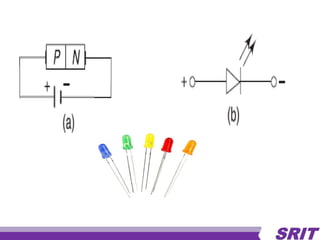
❖ The Light Emitting Diode (LED) is a PN junction device which
emits light when forward biased, by a phenomenon called
electroluminescence.
❖ In all semiconductor PN junctions, some of the energy will be
radiated as heat and some in the form of photons.
❖ In silicon and germanium, greater percentage of energy is given
out in the form of heat and the emitted light is insignificant.
❖ In other materials such as gallium phosphide (GaP) or gallium
arsenide phosphide (GaAsP), the number of photons of light
energy emitted is sufficient to create a visible light source.
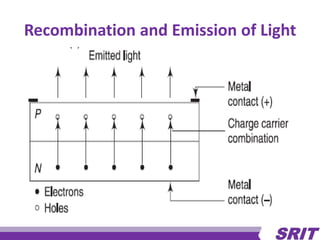
❖ Here, the charge carrier recombination takes place when
electrons from the N-side cross the junction and recombine with
the holes on the P-side.
SRIT
SRIT
❖ When an LED is forward biased, the electrons and holes move
towards the junction and recombination takes place.
❖ As a result of recombination, the electrons lying in the
conduction bands of N-region fall into the holes lying in the
valence band of a P-region.
❖ The difference of energy between the conduction band and the
valence band is radiated in the form of light energy.
❖ Each recombination causes radiation of light energy.
❖ Light is generated by recombination of electrons and holes
whereby their excess energy is transferred to an emitted
photon.
❖ The brightness of the emitted light is directly proportional to the
forward-bias current.
SRIT
Recombination and Emission of Light
SRIT
❖An N-type layer is grown on a substrate and a P-type is
deposited on it by diffusion.
❖Since carrier recombination takes place in the P-layer, it
is kept uppermost.
❖The metal anode connections are made at the outer
edges of the P-layer so as to allow more central surface
area for the light to escape.
❖LEDs are manufactured with domed lenses in order to
reduce the reabsorption problem.
❖ A metal (gold) film is applied to the bottom of the
substrate for reflecting as much light as possible to the
surface of the device and also to provide cathode
connection.
❖LEDs are always encased to protect their delicate wires.
SRIT
Efficiency of LED
❖The efficiency of generation of light increases
with the increases in injected current and with
a decrease in temperature.
❖ The light is concentrated near the junction as
the carriers are available within a diffusion
length of the junction.
SRIT
LED in different Colours
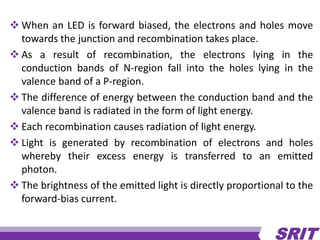
❖LEDs radiate different colours such as red, green,
yellow, orange, blue and white.
❖Some of the LEDs emit infrared (invisible) light also.
❖The wavelength of emitted light depends on the
energy gap of the material.
❖Hence, the colour of the emitted light depends on
the type of material used is given as follows.
❖Gallium arsenide (GaAs) – infrared radiation
(invisible)
❖Gallium phosphide (GaP) – red or green
❖Gallium arsenide phosphide (GaAsP) – red or
yellow
SRIT
❖In order to protect LEDs, resistance of 1 kW or 1.5
kW must be connected in series with the LED.
❖LEDs emit no light when reverse biased. LEDs
operate at voltage levels from 1.5 to 3.3 V, with
the current of some tens of milliamperes.
❖The power requirement is typically from 10 to
150 mW with a lifetime of 1,00,000 + hours.
❖LEDs can be switched ON and OFF at a very fast
speed of 1 ns.
SRIT
Applications of LED
They are used in
❖ burglar alarm systems
❖ picture phones
❖ Multimeters
❖ Calculators
❖ Digital meters
❖ Microprocessors
❖ Digital computers
❖ Electronic telephone exchange
❖ Intercoms
❖ Electronic panels
❖ Digital watches
❖ Solid state video displays
❖ optical communication systems.
❖ Also, there are two-lead LED lamps which contain two LEDs, so that a reversal in
biasing will change the colour from green to red, or viceversa.

Electron Devices - Special Semiconductor Devices -LED

  • 1.
    SRIT 20EC001- Electron Devices Module-5 SpecialSemiconductor Devices LED Ms.J.Shiny Christobel Assistant Professor Department of ECE
  • 2.
    SRIT LED- Light EmittingDiode ❖ The Light Emitting Diode (LED) is a PN junction device which emits light when forward biased, by a phenomenon called electroluminescence. ❖ In all semiconductor PN junctions, some of the energy will be radiated as heat and some in the form of photons. ❖ In silicon and germanium, greater percentage of energy is given out in the form of heat and the emitted light is insignificant. ❖ In other materials such as gallium phosphide (GaP) or gallium arsenide phosphide (GaAsP), the number of photons of light energy emitted is sufficient to create a visible light source. ❖ Here, the charge carrier recombination takes place when electrons from the N-side cross the junction and recombine with the holes on the P-side.
  • 3.
  • 4.
    SRIT ❖ When anLED is forward biased, the electrons and holes move towards the junction and recombination takes place. ❖ As a result of recombination, the electrons lying in the conduction bands of N-region fall into the holes lying in the valence band of a P-region. ❖ The difference of energy between the conduction band and the valence band is radiated in the form of light energy. ❖ Each recombination causes radiation of light energy. ❖ Light is generated by recombination of electrons and holes whereby their excess energy is transferred to an emitted photon. ❖ The brightness of the emitted light is directly proportional to the forward-bias current.
  • 5.
  • 6.
    SRIT ❖An N-type layeris grown on a substrate and a P-type is deposited on it by diffusion. ❖Since carrier recombination takes place in the P-layer, it is kept uppermost. ❖The metal anode connections are made at the outer edges of the P-layer so as to allow more central surface area for the light to escape. ❖LEDs are manufactured with domed lenses in order to reduce the reabsorption problem. ❖ A metal (gold) film is applied to the bottom of the substrate for reflecting as much light as possible to the surface of the device and also to provide cathode connection. ❖LEDs are always encased to protect their delicate wires.
  • 7.
    SRIT Efficiency of LED ❖Theefficiency of generation of light increases with the increases in injected current and with a decrease in temperature. ❖ The light is concentrated near the junction as the carriers are available within a diffusion length of the junction.
  • 8.
    SRIT LED in differentColours ❖LEDs radiate different colours such as red, green, yellow, orange, blue and white. ❖Some of the LEDs emit infrared (invisible) light also. ❖The wavelength of emitted light depends on the energy gap of the material. ❖Hence, the colour of the emitted light depends on the type of material used is given as follows. ❖Gallium arsenide (GaAs) – infrared radiation (invisible) ❖Gallium phosphide (GaP) – red or green ❖Gallium arsenide phosphide (GaAsP) – red or yellow
  • 9.
    SRIT ❖In order toprotect LEDs, resistance of 1 kW or 1.5 kW must be connected in series with the LED. ❖LEDs emit no light when reverse biased. LEDs operate at voltage levels from 1.5 to 3.3 V, with the current of some tens of milliamperes. ❖The power requirement is typically from 10 to 150 mW with a lifetime of 1,00,000 + hours. ❖LEDs can be switched ON and OFF at a very fast speed of 1 ns.
  • 10.
    SRIT Applications of LED Theyare used in ❖ burglar alarm systems ❖ picture phones ❖ Multimeters ❖ Calculators ❖ Digital meters ❖ Microprocessors ❖ Digital computers ❖ Electronic telephone exchange ❖ Intercoms ❖ Electronic panels ❖ Digital watches ❖ Solid state video displays ❖ optical communication systems. ❖ Also, there are two-lead LED lamps which contain two LEDs, so that a reversal in biasing will change the colour from green to red, or viceversa.