UNIVERSITY OF GONDAR
COLLEGE OF MEDICINE AND HEALTH SCIENCE
COMPREHENSIVE SPECIALISED HOSPITAL
DEPARTMENT OF OPTOMETRY
Presentation on soft contact lens fitting procedure and assessment
Prepared by; Getenet Shumet (BSc, MSc student)
Moderator; Haile woretaw (MSc,F-LVPEI,Ass’t prof)
Gondar, Ethiopia
July, 2021
Outline
Objectives
Introduction
Factors which affects lens fit
Soft contact lens fitting steps
• Baseline measurement
• Trial lens parameter
• Fitting assessment
Steps for insertion and removal
Summary
References
2
OBJECTIVES
At the end of this presentation we will able to;
Define soft contact lens
Describe the types of soft contact lens fitting
List factors affecting soft contact lens fitting
List and describe each steps of soft contact lens fitting
Describe the soft contact lens fitting assessment
List steps of soft contact lens insertion and removal
3
Introduction
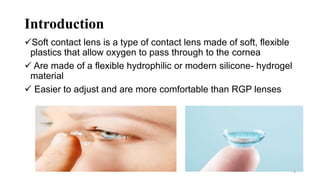
Soft contact lens is a type of contact lens made of soft, flexible
plastics that allow oxygen to pass through to the cornea
 Are made of a flexible hydrophilic or modern silicone- hydrogel
material
 Easier to adjust and are more comfortable than RGP lenses
4
Cont…
Have a wide spherical and toric power range
Soft contact lenses continue to dominate most contact lens
markets
The first lens is fit empirically
Fitting procedure and assessment is depend on the lens type
There are different ways of fitting assessment of soft contact
lens
5
Soft contact lens fitting
Contact lens fitting can be:
Empirical fitting: without use of any trial lens
Diagnostic fitting: use of trial lens
6
Factors which affect lens fit
 Manufacturing method
 Water content
 K- readings
 Modulus of elasticity
 Lid tonus
 Tear film
7
Fitting steps
Complete process of SCL fitting can be divided in to three
segments:
A. Baseline measurement
B. Trial lens parameter
C. Fitting assessment
8
A. Baseline measurement
History and SLE
HVID
Palpebral fissure height
Pupil size
Refraction
Keratometry
9
A. Baseline measurement
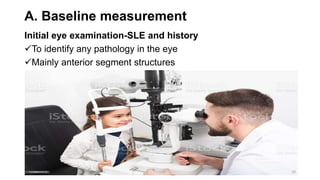
Initial eye examination-SLE and history
To identify any pathology in the eye
Mainly anterior segment structures
10
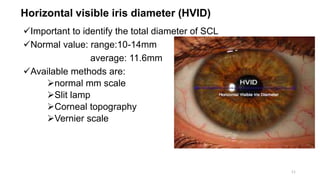
Horizontal visible iris diameter (HVID)
Important to identify the total diameter of SCL
Normal value: range:10-14mm
average: 11.6mm
Available methods are:
normal mm scale
Slit lamp
Corneal topography
Vernier scale
11
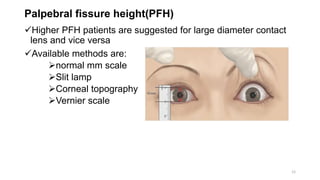
Palpebral fissure height(PFH)
Higher PFH patients are suggested for large diameter contact
lens and vice versa
Available methods are:
normal mm scale
Slit lamp
Corneal topography
Vernier scale
12
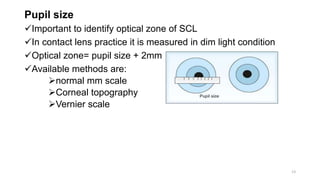
Pupil size
Important to identify optical zone of SCL
In contact lens practice it is measured in dim light condition
Optical zone= pupil size + 2mm
Available methods are:
normal mm scale
Corneal topography
Vernier scale
13
Keratometry
To identify base curve(B.C)
Refraction
Base line for the contact lens power
14
B. Trial lens parameter
 Base curve
Total diameter
 Power
15
Base curve
It is the radius of curvature of back surface of the contact lens
Should be 0.6 to 1.0 mm flatter than average K reading
Formula: B.C = 337.5/D
D= dioptric power of average K
BC for SCL’s are specified as:
-Steep (8.0mm to 8.3mm)
-Medium (8.4mm to 8.6mm)
-Flat (8.7mm to 9.0mm)
16
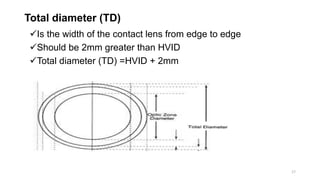
Total diameter (TD)
Is the width of the contact lens from edge to edge
Should be 2mm greater than HVID
Total diameter (TD) =HVID + 2mm
17
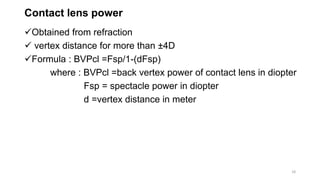
Contact lens power
Obtained from refraction
 vertex distance for more than ±4D
Formula : BVPcl =Fsp/1-(dFsp)
where : BVPcl =back vertex power of contact lens in diopter
Fsp = spectacle power in diopter
d =vertex distance in meter
18
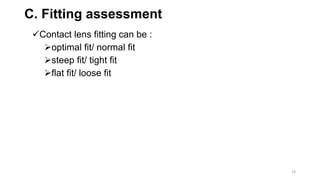
C. Fitting assessment
Contact lens fitting can be :
optimal fit/ normal fit
steep fit/ tight fit
flat fit/ loose fit
19
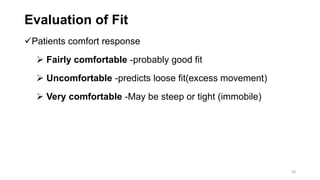
Evaluation of Fit
Patients comfort response
 Fairly comfortable -probably good fit
 Uncomfortable -predicts loose fit(excess movement)
 Very comfortable -May be steep or tight (immobile)
20
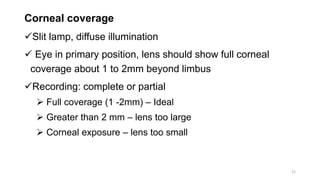
Corneal coverage
Slit lamp, diffuse illumination
 Eye in primary position, lens should show full corneal
coverage about 1 to 2mm beyond limbus
Recording: complete or partial
 Full coverage (1 -2mm) – Ideal
 Greater than 2 mm – lens too large
 Corneal exposure – lens too small
21
Lens centration
 Is the superimposition of center of cornea and center of
contact lens
Equally centered in all distance beyond limbus in all directions
Centered in all position – ideal
Centered – steep fit
decentered with corneal exposure in any position of gaze-
flat/ loose fit
22
Movement
Movement is required due to :
Removes and disperses ocular debris
Promotes tear exchange
Patient asked to look straight in primary gaze and asked to
blink normally
Estimated in diffuse light and moderate to high magnification
with blink
 0.2mm – 0.4 mm ---- ideal
Less than 0.2 mm …..steep fit
Greater than 1.0 mm …flat fit
23
Push up test
Patients looks straight and examiner pushes the lens up
vertically through the pressure of lid
 Easy displacement- smooth recovery – ideal fit
 Resistance to displacement – may not re center – tight fit
 Easy displacement- quick recovery – Loose fit
24
Lens Lag
Is the resistance of the lens to move with the eye to any gaze
from its primary position
Patient asked to look up and lens move down slightly –Lag
 1mm to 1.5 mm – Ideal
Little or no – steep fit
Greater than 2 mm-flat fit
25
Edge Alignment
Edge of the lens is observed with reference to the conjunctiva
 If the edge is sliding smoothly and aligning with conjunctiva
is the ideal
 If indent on cornea- tight or steep
 If it stands off - loose
26
Other responses
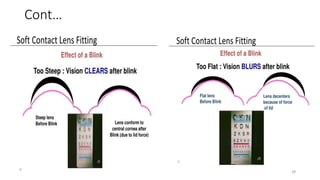
Vision before and After blink
If vision will remain same and clear- ideal fit
If vision clears with blink – steep fit
If vision gets blur with blink- flat fit
 Keratometry: Clarity of mires is observed
27
Cont…
28
Soft toric lenses Fitting assessment
Is same as soft spherical contact lenses except lens rotation
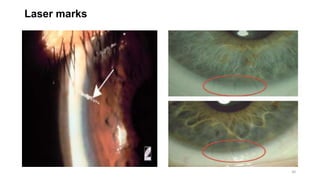
Reference marks:
Different reference laser marks imprinted on the toric lenses
But it does not indicate the axis/meridian of astigmatism
Location of laser marks varies from company to company
Based on laser marks, rotation of lens is assessed
29
Laser marks
30
Rotation :
When we insert a lens in the eye there may be the following
situations
Same position during the blink and after the blink
Displace during the blink but may retain its location after the
blink
It may not be in the same position it moves because of blink
effect
If it rotates, the axis may rotate
so we add or subtract the amount of rotation to the axis of the
prescription
31
Cont...
LARS Rule:
This is used to assess the rotation of lens and prescribe correct
axis with markings at 6 o'clock position
First, estimate the degree of lens rotation
If the lens moves towards left add the degree of mislocation to
the Rx axis
If the lens moves towards right subtract the degree of
mislocation to the Rx axis
32
Cont…
The CAAS mnemonic is useful for lenses with markings at
3 & 9 o’clock:
Rotation CLOCKWISE = ADD, Rotation ANTICLOCKWISE
= SUBTRACT
33
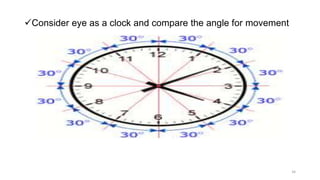
Consider eye as a clock and compare the angle for movement
34
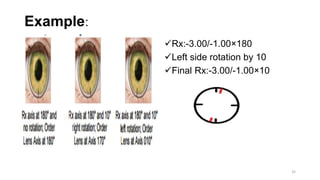
Example:
Rx:-3.00/-1.00×180
Left side rotation by 10
Final Rx:-3.00/-1.00×10
35
Modifications for fittings
Alter the lens if ideal fit is not achieved by changing;
Base curve
Diameter
Thickness
Rule of thumb- 0.3mm change in the base curve = 0.5 mm
change in Diameter.
36
Cont…
Correcting a Flat fit
Tighten/decrease the base
curve, but keep the diameter
the same
Increase the diameter and
keep the base curve the
same
• Always recheck the
modification with a trial lens
Correcting a Steep fit
Loosen/increase the base
curve, but keep the diameter
the same
Decrease the diameter and
keep the base curve the
same
37
Over refraction
Refraction over trial lens
 Algebraically add power
Note- additional power needed should be less than 4D
If cyl required –fit toric
It the VA is not as clear as expected do over refraction
38
Signs and symptoms of steep fit
Fluctuating VA, clears after each blink (Little or no movement
up on each blink)
Comfortable at first, then not
Circumcorneal injection ,and indentation
Conjunctival drag
Keratometry mires distorted, then clear after each blink
Air bubbles centrally, over pupil
39
Signs and symptoms of flat fit
VA unstable with each blink
Patient awareness of the lens
Too much movement with each blink
Lens may be falls out
Air bubble under the lens, especially on the periphery of the
lens
“K” mires are blurred after each blink
40
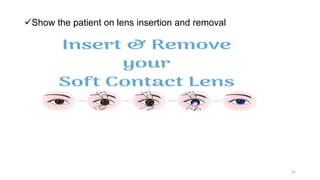
Show the patient on lens insertion and removal
41
Final Order
BC
Power
Diameter
Water content
Tint
 Material
Manufacturer
42
SUMMARY
Proper fitting of the contact lens is important
Consider the base curve, diameter and lens power for fitting
Make modifications of fitting if necessary
An ideally fitting:
Comfort
Crisp, clear and stable vision
Full corneal coverage in all gaze positions
 Regular edge alignment to conjunctiva
 Smooth recovery from push-up
Adequate movement for tear exchange 0.2 – 0.4mm
Explain insertion and removal, care and handling and cleaning
to the patient!!!
43
REFERENCES
Young G. Evaluation of soft contact lens fitting characteristics. Optometry
and vision science. 1996;73(4):247-54.
Morgan PB, et al. International contact lens prescribing in 2019. Contact
Lens Spectrum
The ABCs of Fitting Soft Contact Lenses
Juniper publisher
Essential Contact Lens Practice
Fitting assessment of various contact lenses: Optometry Zone
Smart optometry videos on soft contact lens fitting
44
THANK YOU!
Any Q regarding…
45

Gech scl final

  • 1.
    UNIVERSITY OF GONDAR COLLEGEOF MEDICINE AND HEALTH SCIENCE COMPREHENSIVE SPECIALISED HOSPITAL DEPARTMENT OF OPTOMETRY Presentation on soft contact lens fitting procedure and assessment Prepared by; Getenet Shumet (BSc, MSc student) Moderator; Haile woretaw (MSc,F-LVPEI,Ass’t prof) Gondar, Ethiopia July, 2021
  • 2.
    Outline Objectives Introduction Factors which affectslens fit Soft contact lens fitting steps • Baseline measurement • Trial lens parameter • Fitting assessment Steps for insertion and removal Summary References 2
  • 3.
    OBJECTIVES At the endof this presentation we will able to; Define soft contact lens Describe the types of soft contact lens fitting List factors affecting soft contact lens fitting List and describe each steps of soft contact lens fitting Describe the soft contact lens fitting assessment List steps of soft contact lens insertion and removal 3
  • 4.
    Introduction Soft contact lensis a type of contact lens made of soft, flexible plastics that allow oxygen to pass through to the cornea  Are made of a flexible hydrophilic or modern silicone- hydrogel material  Easier to adjust and are more comfortable than RGP lenses 4
  • 5.
    Cont… Have a widespherical and toric power range Soft contact lenses continue to dominate most contact lens markets The first lens is fit empirically Fitting procedure and assessment is depend on the lens type There are different ways of fitting assessment of soft contact lens 5
  • 6.
    Soft contact lensfitting Contact lens fitting can be: Empirical fitting: without use of any trial lens Diagnostic fitting: use of trial lens 6
  • 7.
    Factors which affectlens fit  Manufacturing method  Water content  K- readings  Modulus of elasticity  Lid tonus  Tear film 7
  • 8.
    Fitting steps Complete processof SCL fitting can be divided in to three segments: A. Baseline measurement B. Trial lens parameter C. Fitting assessment 8
  • 9.
    A. Baseline measurement Historyand SLE HVID Palpebral fissure height Pupil size Refraction Keratometry 9
  • 10.
    A. Baseline measurement Initialeye examination-SLE and history To identify any pathology in the eye Mainly anterior segment structures 10
  • 11.
    Horizontal visible irisdiameter (HVID) Important to identify the total diameter of SCL Normal value: range:10-14mm average: 11.6mm Available methods are: normal mm scale Slit lamp Corneal topography Vernier scale 11
  • 12.
    Palpebral fissure height(PFH) HigherPFH patients are suggested for large diameter contact lens and vice versa Available methods are: normal mm scale Slit lamp Corneal topography Vernier scale 12
  • 13.
    Pupil size Important toidentify optical zone of SCL In contact lens practice it is measured in dim light condition Optical zone= pupil size + 2mm Available methods are: normal mm scale Corneal topography Vernier scale 13
  • 14.
    Keratometry To identify basecurve(B.C) Refraction Base line for the contact lens power 14
  • 15.
    B. Trial lensparameter  Base curve Total diameter  Power 15
  • 16.
    Base curve It isthe radius of curvature of back surface of the contact lens Should be 0.6 to 1.0 mm flatter than average K reading Formula: B.C = 337.5/D D= dioptric power of average K BC for SCL’s are specified as: -Steep (8.0mm to 8.3mm) -Medium (8.4mm to 8.6mm) -Flat (8.7mm to 9.0mm) 16
  • 17.
    Total diameter (TD) Isthe width of the contact lens from edge to edge Should be 2mm greater than HVID Total diameter (TD) =HVID + 2mm 17
  • 18.
    Contact lens power Obtainedfrom refraction  vertex distance for more than ±4D Formula : BVPcl =Fsp/1-(dFsp) where : BVPcl =back vertex power of contact lens in diopter Fsp = spectacle power in diopter d =vertex distance in meter 18
  • 19.
    C. Fitting assessment Contactlens fitting can be : optimal fit/ normal fit steep fit/ tight fit flat fit/ loose fit 19
  • 20.
    Evaluation of Fit Patientscomfort response  Fairly comfortable -probably good fit  Uncomfortable -predicts loose fit(excess movement)  Very comfortable -May be steep or tight (immobile) 20
  • 21.
    Corneal coverage Slit lamp,diffuse illumination  Eye in primary position, lens should show full corneal coverage about 1 to 2mm beyond limbus Recording: complete or partial  Full coverage (1 -2mm) – Ideal  Greater than 2 mm – lens too large  Corneal exposure – lens too small 21
  • 22.
    Lens centration  Isthe superimposition of center of cornea and center of contact lens Equally centered in all distance beyond limbus in all directions Centered in all position – ideal Centered – steep fit decentered with corneal exposure in any position of gaze- flat/ loose fit 22
  • 23.
    Movement Movement is requireddue to : Removes and disperses ocular debris Promotes tear exchange Patient asked to look straight in primary gaze and asked to blink normally Estimated in diffuse light and moderate to high magnification with blink  0.2mm – 0.4 mm ---- ideal Less than 0.2 mm …..steep fit Greater than 1.0 mm …flat fit 23
  • 24.
    Push up test Patientslooks straight and examiner pushes the lens up vertically through the pressure of lid  Easy displacement- smooth recovery – ideal fit  Resistance to displacement – may not re center – tight fit  Easy displacement- quick recovery – Loose fit 24
  • 25.
    Lens Lag Is theresistance of the lens to move with the eye to any gaze from its primary position Patient asked to look up and lens move down slightly –Lag  1mm to 1.5 mm – Ideal Little or no – steep fit Greater than 2 mm-flat fit 25
  • 26.
    Edge Alignment Edge ofthe lens is observed with reference to the conjunctiva  If the edge is sliding smoothly and aligning with conjunctiva is the ideal  If indent on cornea- tight or steep  If it stands off - loose 26
  • 27.
    Other responses Vision beforeand After blink If vision will remain same and clear- ideal fit If vision clears with blink – steep fit If vision gets blur with blink- flat fit  Keratometry: Clarity of mires is observed 27
  • 28.
  • 29.
    Soft toric lensesFitting assessment Is same as soft spherical contact lenses except lens rotation Reference marks: Different reference laser marks imprinted on the toric lenses But it does not indicate the axis/meridian of astigmatism Location of laser marks varies from company to company Based on laser marks, rotation of lens is assessed 29
  • 30.
  • 31.
    Rotation : When weinsert a lens in the eye there may be the following situations Same position during the blink and after the blink Displace during the blink but may retain its location after the blink It may not be in the same position it moves because of blink effect If it rotates, the axis may rotate so we add or subtract the amount of rotation to the axis of the prescription 31
  • 32.
    Cont... LARS Rule: This isused to assess the rotation of lens and prescribe correct axis with markings at 6 o'clock position First, estimate the degree of lens rotation If the lens moves towards left add the degree of mislocation to the Rx axis If the lens moves towards right subtract the degree of mislocation to the Rx axis 32
  • 33.
    Cont… The CAAS mnemonicis useful for lenses with markings at 3 & 9 o’clock: Rotation CLOCKWISE = ADD, Rotation ANTICLOCKWISE = SUBTRACT 33
  • 34.
    Consider eye asa clock and compare the angle for movement 34
  • 35.
    Example: Rx:-3.00/-1.00×180 Left side rotationby 10 Final Rx:-3.00/-1.00×10 35
  • 36.
    Modifications for fittings Alterthe lens if ideal fit is not achieved by changing; Base curve Diameter Thickness Rule of thumb- 0.3mm change in the base curve = 0.5 mm change in Diameter. 36
  • 37.
    Cont… Correcting a Flatfit Tighten/decrease the base curve, but keep the diameter the same Increase the diameter and keep the base curve the same • Always recheck the modification with a trial lens Correcting a Steep fit Loosen/increase the base curve, but keep the diameter the same Decrease the diameter and keep the base curve the same 37
  • 38.
    Over refraction Refraction overtrial lens  Algebraically add power Note- additional power needed should be less than 4D If cyl required –fit toric It the VA is not as clear as expected do over refraction 38
  • 39.
    Signs and symptomsof steep fit Fluctuating VA, clears after each blink (Little or no movement up on each blink) Comfortable at first, then not Circumcorneal injection ,and indentation Conjunctival drag Keratometry mires distorted, then clear after each blink Air bubbles centrally, over pupil 39
  • 40.
    Signs and symptomsof flat fit VA unstable with each blink Patient awareness of the lens Too much movement with each blink Lens may be falls out Air bubble under the lens, especially on the periphery of the lens “K” mires are blurred after each blink 40
  • 41.
    Show the patienton lens insertion and removal 41
  • 42.
  • 43.
    SUMMARY Proper fitting ofthe contact lens is important Consider the base curve, diameter and lens power for fitting Make modifications of fitting if necessary An ideally fitting: Comfort Crisp, clear and stable vision Full corneal coverage in all gaze positions  Regular edge alignment to conjunctiva  Smooth recovery from push-up Adequate movement for tear exchange 0.2 – 0.4mm Explain insertion and removal, care and handling and cleaning to the patient!!! 43
  • 44.
    REFERENCES Young G. Evaluationof soft contact lens fitting characteristics. Optometry and vision science. 1996;73(4):247-54. Morgan PB, et al. International contact lens prescribing in 2019. Contact Lens Spectrum The ABCs of Fitting Soft Contact Lenses Juniper publisher Essential Contact Lens Practice Fitting assessment of various contact lenses: Optometry Zone Smart optometry videos on soft contact lens fitting 44
  • 45.
    THANK YOU! Any Qregarding… 45

Editor's Notes

  • #6 The first lens is fit empirically; often the lens chosen is one that the manufacturer reports "will fit 80% of patients Soft contact lenses continue to dominate most contact lens markets, accounting for about 90 percent of all fits worldwide
  • #32 Rotation : When we insert a lens in the eye there may be two situations, It may be in the same position during the blink and after the the blink. It may displace during the blink but may retain its location after the blink. It may not be in the same position it moves because of blink effect. If it rotates, the axis may rotate, So to avoid this cylinder in unwanted axis we add or subtract the amount of rotation to the axis of the prescription so that the axis of the cylinder coincides with the axis of the eye.