
Soft Toric Lens Fitting
Optom. Ankit S. Varshney
M.Optom, Ph.D. in Optometry (pursuing) Fellow of IACLE (Aus.), Fellow of ASCO(Mum.)
Prof. at (Shree Bharatimaiya College of Optometry & Physiotherapy, Surat)
Life Member of Indian Optometric Association (IOA)
Associate Member of Association of Schools and Colleges of Optometry(ASCO)
Member of Optometry Council of India(OCI)
Educator Member of International Association of Contact lense Educators (Australia)(IACLE)
Mail id: ankitsvarshney@yahoo.com
Whatsapp no. +918155955820
Course objectives
 Upon completion of this presentation, you will
know
– The need for soft toric lenses
– Patient selection for soft toric lenses
– Soft toric designs and stabilizing forces
– Power selection for soft toric lenses
– Fit evaluation
– Problem solving
 Resultant cross cylinder
 LARS compensation
14 July 2020 Optom. Ankit Varshney 2
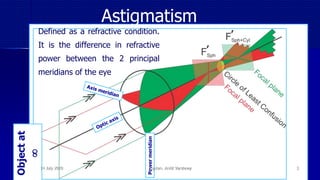
Astigmatism
Defined as a refractive condition.
It is the difference in refractive
power between the 2 principal
meridians of the eye
Powermeridian
Objectat

14 July 2020 Optom. Ankit Varshney 3
Classification & its type
1. Classification by focal line
2. Classification by structure
3. Classification by type
4. Classification by orientation- meridional
5. Classification by magnitude
14 July 2020 Optom. Ankit Varshney 4
14 July 2020 Optom. Ankit Varshney 5
 Regular
‒ principal meridians, 90 ° apart
 Irregular
‒ principal meridians not 90o apart
‒ >2 principal meridians
‒ no principal meridians
‒ often acquired (i.e. secondary to)
‒ trauma
‒ disease
14 July 2020 Optom. Ankit Varshney 6
 Corneal
 Lenticular
 Other internal astigmatism
 Total
14 July 2020 Optom. Ankit Varshney 7
 Simple hyperopic astigmatism (SHA)
 Compound hyperopic astigmatism (CHA)
 Simple myopic astigmatism (SMA)
 Compound myopic astigmatism (CMA)
 Mixed astigmatism (MA)
14 July 2020 Optom. Ankit Varshney 8
 Regular
‒ with-the-rule (WTR)
‒ against-the-rule (ATR)
‒ oblique
 Negligible 0.75 D Cyl
 Low 1.00 to 1.50 D Cyl
 Moderate 1.75 to 2.50 D Cyl
 High > 2.50 D Cyl
14 July 2020 Optom. Ankit Varshney 9
Contact lens options to
correct astigmatism
1. Soft SCLs
2. Spherical RGP lenses/ Toric RGP lenses
3. Toric Soft lenses
14 July 2020 Optom. Ankit Varshney 10
Flashback..
Patient
walking in..
14 July 2020 Optom. Ankit Varshney 11
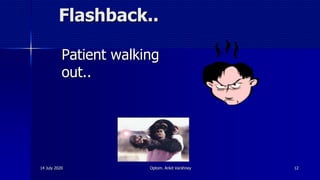
Flashback..
Patient walking
out..
14 July 2020 Optom. Ankit Varshney 12
Day Before Yesterday..
 Only Spherical Soft
Contact Lenses
 On top cylindrical
spectacle correction
 4 : 1 Sphere – cylinder
ratio
14 July 2020 Optom. Ankit Varshney 13
Yesterday..
 Entry of Toric soft contact lenses
 Initial reluctance of the practitioners
 Lengthy fitting procedure
 Unpredictable outcome
 Low satisfaction level
14 July 2020 Optom. Ankit Varshney 14
Today..
 About 7% of total soft contact lens market
 More competent practitioners
 Positive approach
 Increased awareness amongst consumers on
toric lens option
 Increased No. of patients moving to
disposable modality
14 July 2020 Optom. Ankit Varshney 15
Today..
Superior Products
14 July 2020 Optom. Ankit Varshney 16
Lesson We Learnt..
There is nothing in a caterpillar that tells us
it’s going to be a butterfly
14 July 2020 Optom. Ankit Varshney 17
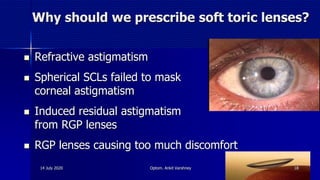
Why should we prescribe soft toric lenses?
 Refractive astigmatism
 Spherical SCLs failed to mask
corneal astigmatism
 Induced residual astigmatism
from RGP lenses
 RGP lenses causing too much discomfort
14 July 2020 Optom. Ankit Varshney 18
Who should wear soft torics?
 - Poor Quality of vision with spherical soft lenses,
just not clear
- Refractive astigmatism > 0.75 D
- Refractive astigmatism > 25 % of sphere power
14 July 2020 Optom. Ankit Varshney 19
Who should wear soft torics?
– Cylinder power should be between 1.00 to
3.00 diopters
– Cylinder axis should be with or against the
rule, and not oblique
– Not hyper-sensitive to axis shift
14 July 2020 Optom. Ankit Varshney 20
Twist Test
sensitivity to axis fluctuations
 Have refraction in phoropter
 Rotate the best cylinder correction until the
patient reports a blur in vision
 Determine the amount of degrees the cylinder
can be “off axis” and not effect vision
 Less than 5 degrees indicates high sensitivity and
may NOT be a good candidate for soft toric
lenses.14 July 2020 Optom. Ankit Varshney 21
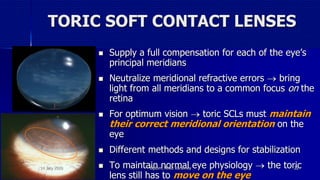
TORIC SOFT CONTACT LENSES
 Supply a full compensation for each of the eye’s
principal meridians
 Neutralize meridional refractive errors  bring
light from all meridians to a common focus on the
retina
 For optimum vision  toric SCLs must maintain
their correct meridional orientation on the
eye
 Different methods and designs for stabilization
 To maintain normal eye physiology  the toric
lens still has to move on the eye
14 July 2020 Optom. Ankit Varshney 22
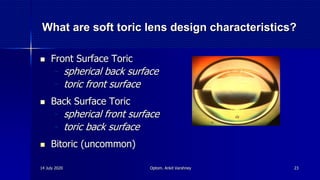
What are soft toric lens design characteristics?
 Front Surface Toric
- spherical back surface
- toric front surface
 Back Surface Toric
- spherical front surface
- toric back surface
 Bitoric (uncommon)
14 July 2020 Optom. Ankit Varshney 23
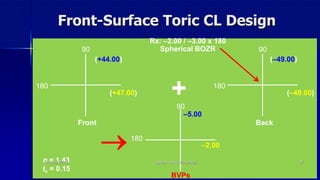
Front-Surface Toric CL Design
180
Rx: –2.00 / –3.00 x 180
Spherical BOZR90
Front
(+47.00)
(+44.00)
90
Back
180
(–49.00)
(–49.00)
90
BVPs
180
–2.00
–5.00

n = 1.43
tc = 0.15
+
14 July 2020 Optom. Ankit Varshney 24
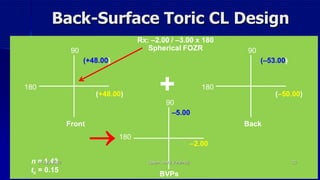
Back-Surface Toric CL Design
Rx: –2.00 / –3.00 x 180
Spherical FOZR90
Front
180
(+48.00)
(+48.00)
90
Back
180
(–50.00)
(–53.00)
90
BVPs
180
–2.00
–5.00
n = 1.43
tc = 0.15

+
14 July 2020 Optom. Ankit Varshney 25
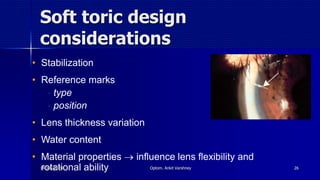
Soft toric design
considerations
• Stabilization
• Reference marks
- type
- position
• Lens thickness variation
• Water content
• Material properties  influence lens flexibility and
rotational ability14 July 2020 Optom. Ankit Varshney 26
How are soft toric lenses
stablized?
14 July 2020 Optom. Ankit Varshney 27
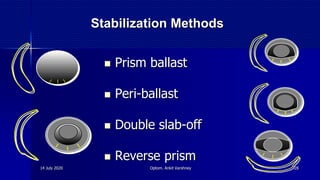
Stabilization Methods
 Prism ballast
 Peri-ballast
 Double slab-off
 Reverse prism
14 July 2020 Optom. Ankit Varshney 28
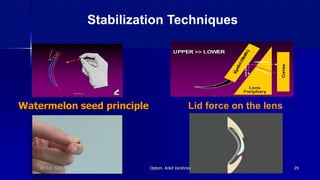
Watermelon seed principle
Stabilization Techniques
Lid force on the lens
14 July 2020 Optom. Ankit Varshney 29
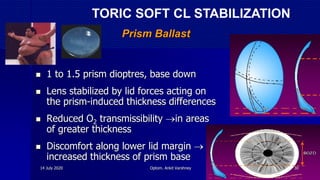
Prism Ballast
 1 to 1.5 prism dioptres, base down
 Lens stabilized by lid forces acting on
the prism-induced thickness differences
 Reduced O2 transmissibility in areas
of greater thickness
 Discomfort along lower lid margin 
increased thickness of prism base
TORIC SOFT CL STABILIZATION
14 July 2020 Optom. Ankit Varshney 30
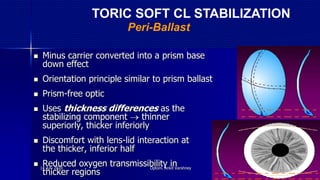
 Minus carrier converted into a prism base
down effect
 Orientation principle similar to prism ballast
 Prism-free optic
 Uses thickness differences as the
stabilizing component  thinner
superiorly, thicker inferiorly
 Discomfort with lens-lid interaction at
the thicker, inferior half
 Reduced oxygen transmissibility in
thicker regions
Peri-Ballast
TORIC SOFT CL STABILIZATION
14 July 2020 Optom. Ankit Varshney 31
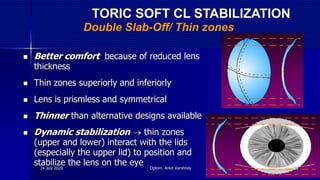
 Better comfort because of reduced lens
thickness
 Thin zones superiorly and inferiorly
 Lens is prismless and symmetrical
 Thinner than alternative designs available
 Dynamic stabilization  thin zones
(upper and lower) interact with the lids
(especially the upper lid) to position and
stabilize the lens on the eye
Double Slab-Off/ Thin zones
TORIC SOFT CL STABILIZATION
14 July 2020 Optom. Ankit Varshney 32
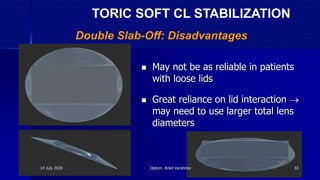
 May not be as reliable in patients
with loose lids
 Great reliance on lid interaction 
may need to use larger total lens
diameters
Double Slab-Off: Disadvantages
TORIC SOFT CL STABILIZATION
14 July 2020 Optom. Ankit Varshney 33
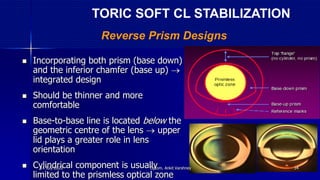
 Incorporating both prism (base down)
and the inferior chamfer (base up) 
integrated design
 Should be thinner and more
comfortable
 Base-to-base line is located below the
geometric centre of the lens  upper
lid plays a greater role in lens
orientation
 Cylindrical component is usually
limited to the prismless optical zone
Reverse Prism Designs
TORIC SOFT CL STABILIZATION
14 July 2020 Optom. Ankit Varshney 34
How does stabilization method
affect fit and physiology?
14 July 2020 Optom. Ankit Varshney 35
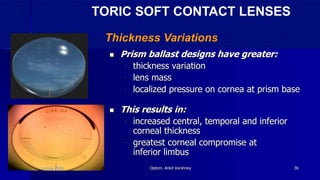
 Prism ballast designs have greater:
- thickness variation
- lens mass
- localized pressure on cornea at prism base
 This results in:
- increased central, temporal and inferior
corneal thickness
- greatest corneal compromise at
inferior limbus
TORIC SOFT CONTACT LENSES
Thickness Variations
14 July 2020 Optom. Ankit Varshney 36
Implications for Oxygen Transmissibility:
Harris and Chu (1972)
 Thickness differences mean Dk/t can vary greatly
 Increased thickness differential indicates a decline in oxygen
transmissibility from one lens region to the next
Average Thickness Measurements:
Wechsler(1985)
• Average lens thickness a better indicator of Dk/t
• WTR lenses have lower average thickness than ATR in
prism ballast designs
TORIC SOFT CONTACT LENSES
Thickness Variations
14 July 2020 Optom. Ankit Varshney 37
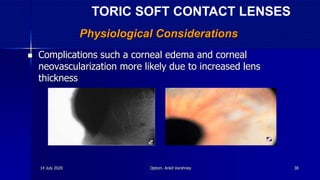
Physiological Considerations
 Complications such a corneal edema and corneal
neovascularization more likely due to increased lens
thickness
TORIC SOFT CONTACT LENSES
14 July 2020 Optom. Ankit Varshney 38
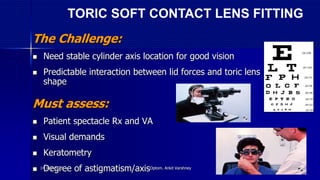
The Challenge:
 Need stable cylinder axis location for good vision
 Predictable interaction between lid forces and toric lens
shape
Must assess:
 Patient spectacle Rx and VA
 Visual demands
 Keratometry
 Degree of astigmatism/axis
TORIC SOFT CONTACT LENS FITTING
14 July 2020 Optom. Ankit Varshney 39
Soft Toric Contact Lenses
 Does this patient need a soft toric lens?
 Which type of soft toric is appropriate?
 What parameters should be used?
 Does the lens fit?
 What power should be ordered?
14 July 2020 Optom. Ankit Varshney 40
How should Lens Parameters be
Selected?
 Base curve
– Be sure lens fits!… Equilibration can take up to
30 minutes. Fit the flattest base curve that is
stable
 Over all diameter
– larger sizes allow scleral support, more stable.
Normal size is 14.2 to 14.5
14 July 2020 Optom. Ankit Varshney 41
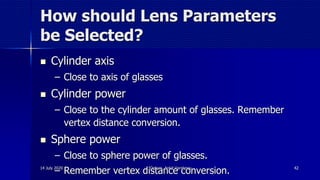
How should Lens Parameters
be Selected?
 Cylinder axis
– Close to axis of glasses
 Cylinder power
– Close to the cylinder amount of glasses. Remember
vertex distance conversion.
 Sphere power
– Close to sphere power of glasses.
– Remember vertex distance conversion.14 July 2020 Optom. Ankit Varshney 42
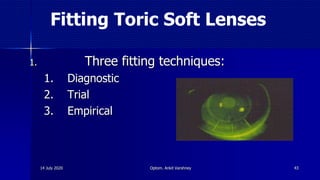
Fitting Toric Soft Lenses
1. Three fitting techniques:
1. Diagnostic
2. Trial
3. Empirical
4314 July 2020 Optom. Ankit Varshney
 Use a trial lens which incorporates cylinder
 Stabilization features of the trial lens should be
representative of any lens ordered from the same
series
 Most reliable technique for toric SCL fitting
Toric Trial Lens Method
TORIC SOFT CONTACT LENS FITTING
14 July 2020 Optom. Ankit Varshney 44
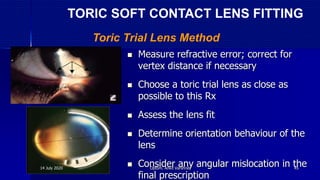
 Measure refractive error; correct for
vertex distance if necessary
 Choose a toric trial lens as close as
possible to this Rx
 Assess the lens fit
 Determine orientation behaviour of the
lens
 Consider any angular mislocation in the
final prescription
Toric Trial Lens Method
TORIC SOFT CONTACT LENS FITTING
14 July 2020 Optom. Ankit Varshney 45
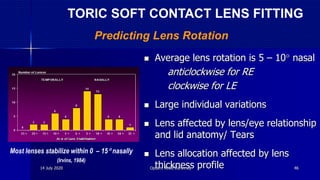
 Average lens rotation is 5 – 10 nasal
- anticlockwise for RE
- clockwise for LE
 Large individual variations
 Lens affected by lens/eye relationship
and lid anatomy/ Tears
 Lens allocation affected by lens
thickness profile
Most lenses stabilize within 0 – 15 nasally
(Irvins, 1984)
Predicting Lens Rotation
TORIC SOFT CONTACT LENS FITTING
14 July 2020 Optom. Ankit Varshney 46
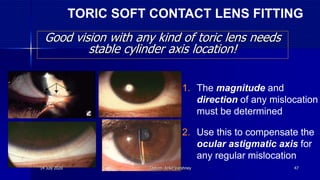
Good vision with any kind of toric lens needs
stable cylinder axis location!
1. The magnitude and
direction of any mislocation
must be determined
2. Use this to compensate the
ocular astigmatic axis for
any regular mislocation
TORIC SOFT CONTACT LENS FITTING
14 July 2020 Optom. Ankit Varshney 47
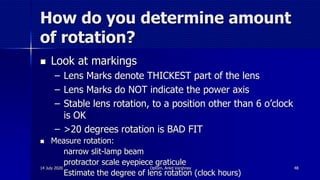
How do you determine amount
of rotation?
 Look at markings
– Lens Marks denote THICKEST part of the lens
– Lens Marks do NOT indicate the power axis
– Stable lens rotation, to a position other than 6 o’clock
is OK
– >20 degrees rotation is BAD FIT
 Measure rotation:
- narrow slit-lamp beam
- protractor scale eyepiece graticule
- Estimate the degree of lens rotation (clock hours)
14 July 2020 Optom. Ankit Varshney 48
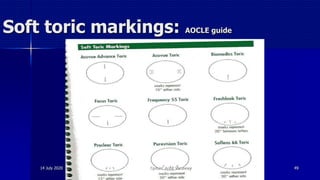
Soft toric markings: AOCLE guide
14 July 2020 Optom. Ankit Varshney 49
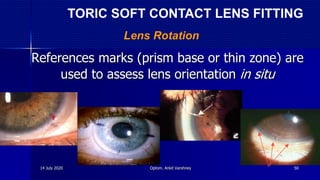
References marks (prism base or thin zone) are
used to assess lens orientation in situ
Lens Rotation
TORIC SOFT CONTACT LENS FITTING
14 July 2020 Optom. Ankit Varshney 50
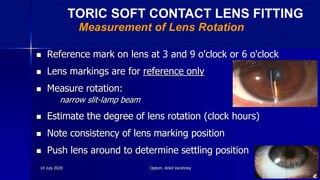
 Reference mark on lens at 3 and 9 o'clock or 6 o'clock
 Lens markings are for reference only
 Measure rotation:
- narrow slit-lamp beam
 Estimate the degree of lens rotation (clock hours)
 Note consistency of lens marking position
 Push lens around to determine settling position
Measurement of Lens Rotation
TORIC SOFT CONTACT LENS FITTING
14 July 2020 Optom. Ankit Varshney 51
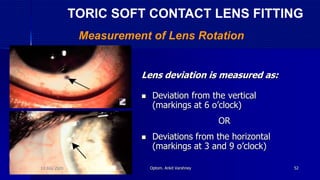
Lens deviation is measured as:
 Deviation from the vertical
(markings at 6 o’clock)
OR
 Deviations from the horizontal
(markings at 3 and 9 o’clock)
Measurement of Lens Rotation
TORIC SOFT CONTACT LENS FITTING
14 July 2020 Optom. Ankit Varshney 52
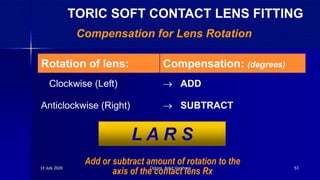
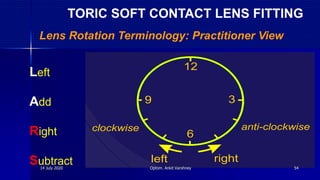
Rotation of lens: Compensation: (degrees)
Clockwise (Left)  ADD
Anticlockwise (Right)  SUBTRACT
Compensation for Lens Rotation
L A R S
Add or subtract amount of rotation to the
axis of the contact lens Rx
TORIC SOFT CONTACT LENS FITTING
14 July 2020 Optom. Ankit Varshney 53
Lens Rotation Terminology: Practitioner View
left
anti-clockwiseclockwise
right
12
6
9 3
Terminology: practitioner viewTerminology: practitioner view
Left
Add
Right
Subtract
TORIC SOFT CONTACT LENS FITTING
14 July 2020 Optom. Ankit Varshney 54
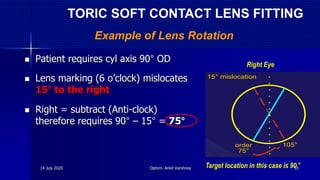
 Patient requires cyl axis 90° OD
 Lens marking (6 o’clock) mislocates
15° to the right
 Right = subtract (Anti-clock)
therefore requires 90° – 15° = 75°
order
75°
105°
15° mislocation
Example of Lens Rotation
Target location in this case is 90°
Right Eye
TORIC SOFT CONTACT LENS FITTING
14 July 2020 Optom. Ankit Varshney 55
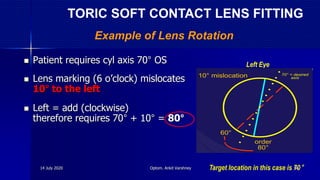
 Patient requires cyl axis 70° OS
 Lens marking (6 o’clock) mislocates
10° to the left
 Left = add (clockwise)
therefore requires 70° + 10° = 80°
Target location in this case is 70°
Left Eye
order
80°
60°
10° mislocation 70° = desired
axis
Example of Lens Rotation
TORIC SOFT CONTACT LENS FITTING
14 July 2020 Optom. Ankit Varshney 56
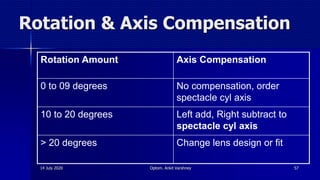
Rotation & Axis Compensation
Rotation Amount Axis Compensation
0 to 09 degrees No compensation, order
spectacle cyl axis
10 to 20 degrees Left add, Right subtract to
spectacle cyl axis
> 20 degrees Change lens design or fit
14 July 2020 Optom. Ankit Varshney 57
How to make the patient see
 Do spherical over refraction first
 If VA not acceptable, do sphere-cylinder over
refraction
 Use cross cylinder calculators from labs
 Or use the lensometer cross cylinder technique
14 July 2020 Optom. Ankit Varshney 58
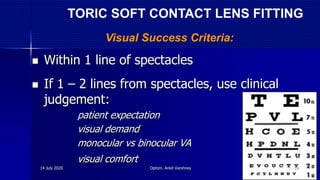
 Within 1 line of spectacles
 If 1 – 2 lines from spectacles, use clinical
judgement:
- patient expectation
- visual demand
- monocular vs binocular VA
- visual comfort
Visual Success Criteria:
TORIC SOFT CONTACT LENS FITTING
14 July 2020 Optom. Ankit Varshney 59
Induced power due to axis
rotation
 Induced cylinder power equals ½ the contact
lens cylinder when lens is rotated 15 degrees.
 CLP= -1.00-2.00x180
 Rotates 15 degrees
– Induces about -1.00 cylinder!
 Lower powers (<1.25) not as significant as
higher powers.
14 July 2020 Optom. Ankit Varshney 60
13 steps in learning Trial Toric
SCL selection
Step 1 - Refraction and cylinder in MINUS cylinder form
e.g- R/E - -3.00 /-2.50 x 170 degrees
L/E - +3.00 /+2.00 x 160 degrees
Step 2 - Unlike spherical lenses there is no need to do
spherical equivalent
Step 3 - Do vertex distance compensation of the sphere &
cylinder separately
6114 July 2020 Optom. Ankit Varshney
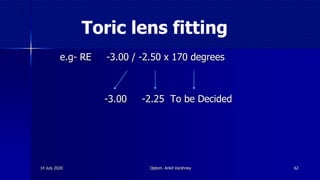
Toric lens fitting
e.g- RE -3.00 / -2.50 x 170 degrees
-3.00 -2.25 To be Decided
6214 July 2020 Optom. Ankit Varshney
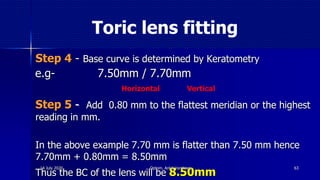
Toric lens fitting
Step 4 - Base curve is determined by Keratometry
e.g- 7.50mm / 7.70mm
Step 5 - Add 0.80 mm to the flattest meridian or the highest
reading in mm.
In the above example 7.70 mm is flatter than 7.50 mm hence
7.70mm + 0.80mm = 8.50mm
Thus the BC of the lens will be 8.50mm
Horizontal Vertical
6314 July 2020 Optom. Ankit Varshney
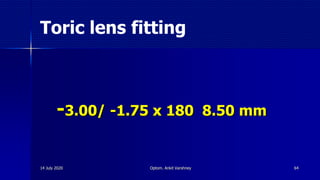
Toric lens fitting
-3.00/ -1.75 x 180 8.50 mm
6414 July 2020 Optom. Ankit Varshney
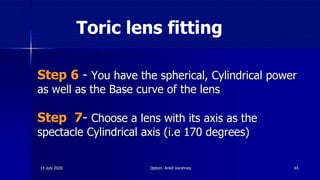
Toric lens fitting
Step 6 - You have the spherical, Cylindrical power
as well as the Base curve of the lens
Step 7- Choose a lens with its axis as the
spectacle Cylindrical axis (i.e 170 degrees)
6514 July 2020 Optom. Ankit Varshney
Toric lens fitting
Step 8- Give the trial to the patient - wait for 15-20
minutes before assessing fit of the lens
Step 9 -Assess fit of the lens by assessing
– Full Corneal Coverage
– Centration
– Movement
– Comfort
– Stable vision 6614 July 2020 Optom. Ankit Varshney
Toric lens fitting
Step 10 - It is possible to show vision to a patient
as lens axis matches spectacle axis
Step 11 - If first 4 factors are fine then axis
finalization is done
6714 July 2020 Optom. Ankit Varshney
Toric lens fitting
Step 12 - For axis finalization concentrate on
the 3 laser guide marks at the inferior or lower
portion of the lens
6814 July 2020 Optom. Ankit Varshney
Toric axis finalisation
3 things can happen while assessing toric lens rotation
 No rotation or minimal rotation of 5 degrees
 Rotation to L.H.S ( with reference to Practitioner)
 Rotation to R.H.S (Practitioner)
6914 July 2020 Optom. Ankit Varshney
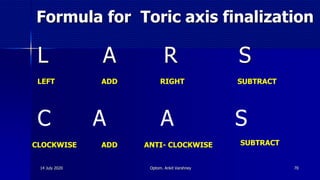
Formula for Toric axis finalization
L A R S
LEFT ADD RIGHT SUBTRACT
70
C A A S
LEFT
CLOCKWISE ADD SUBTRACTANTI- CLOCKWISE
14 July 2020 Optom. Ankit Varshney
Toric axis finalisation
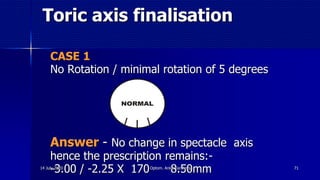
CASE 1
No Rotation / minimal rotation of 5 degrees
Answer - No change in spectacle axis
hence the prescription remains:-
-3.00 / -2.25 X 170 8.50mm 7114 July 2020 Optom. Ankit Varshney
Toric axis finalization
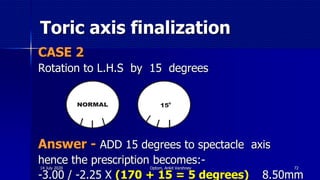
CASE 2
Rotation to L.H.S by 15 degrees
Answer - ADD 15 degrees to spectacle axis
hence the prescription becomes:-
-3.00 / -2.25 X (170 + 15 = 5 degrees) 8.50mm
150
7214 July 2020 Optom. Ankit Varshney
Toric axis finalization
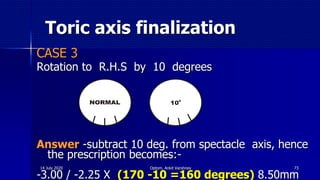
CASE 3
Rotation to R.H.S by 10 degrees
Answer -subtract 10 deg. from spectacle axis, hence
the prescription becomes:-
-3.00 / -2.25 X (170 -10 =160 degrees) 8.50mm
100
7314 July 2020 Optom. Ankit Varshney
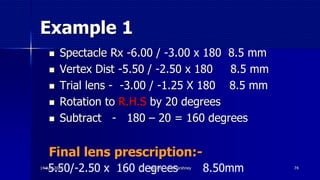
Example 1
 Spectacle Rx -6.00 / -3.00 x 180 8.5 mm
 Vertex Dist -5.50 / -2.50 x 180 8.5 mm
 Trial lens - -3.00 / -1.25 X 180 8.5 mm
 Rotation to R.H.S by 20 degrees
 Subtract - 180 – 20 = 160 degrees
Final lens prescription:-
74
-5.50/-2.50 x 160 degrees 8.50mm14 July 2020 Optom. Ankit Varshney
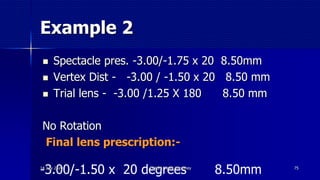
Example 2
 Spectacle pres. -3.00/-1.75 x 20 8.50mm
 Vertex Dist - -3.00 / -1.50 x 20 8.50 mm
 Trial lens - -3.00 /1.25 X 180 8.50 mm
No Rotation
Final lens prescription:-
75
-3.00/-1.50 x 20 degrees 8.50mm14 July 2020 Optom. Ankit Varshney
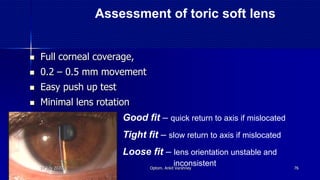
 Full corneal coverage,
 0.2 – 0.5 mm movement
 Easy push up test
 Minimal lens rotation
Good fit – quick return to axis if mislocated
Tight fit – slow return to axis if mislocated
Loose fit – lens orientation unstable and
inconsistent
Assessment of toric soft lens
14 July 2020 Optom. Ankit Varshney 76
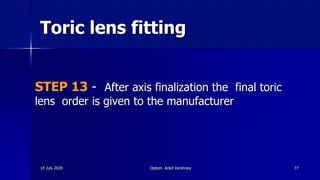
Toric lens fitting
STEP 13 - After axis finalization the final toric
lens order is given to the manufacturer
7714 July 2020 Optom. Ankit Varshney
Things to Remember
 Do not make any changes in trial lens axis
 Choose trial lens axis same as spectacle
axis or as close as possible
 Like the trial lens, final lens would also show
similar rotation
7814 July 2020 Optom. Ankit Varshney
 Low or no spherical component
e.g. Plano / –2.50 x 180
 Oblique cylinders
e.g. – 2.00 / – 2.00 x 45
 High cylinders
e.g. +4.00 / – 6.00 x 80
Difficult Cases
TORIC SCL FITTING
14 July 2020 Optom. Ankit Varshney 79
 Teacher
 Age: 35 years
 Plays sport
 Spec Rx
OD –5.00 / –2.00 x 80 OS –6.00 / –1.75x110
 K readings
OD 44.00 / 43.50@ 90 OS 43.50 / 43.00@ 95
Case 1
TORIC SCL FITTING
14 July 2020 Optom. Ankit Varshney 80
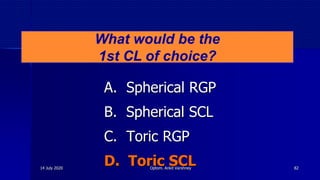
A. Spherical RGP
B. Spherical SCL
C. Toric RGP
D. Toric SCL
What would be the
1st CL of choice?
14 July 2020 Optom. Ankit Varshney 81
A. Spherical RGP
B. Spherical SCL
C. Toric RGP
D. Toric SCL
What would be the
1st CL of choice?
14 July 2020 Optom. Ankit Varshney 82
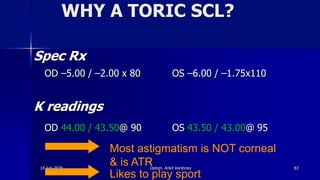
WHY A TORIC SCL?
Spec Rx
OD –5.00 / –2.00 x 80 OS –6.00 / –1.75x110
K readings
OD 44.00 / 43.50@ 90 OS 43.50 / 43.00@ 95
Most astigmatism is NOT corneal
& is ATR
Likes to play sport
14 July 2020 Optom. Ankit Varshney 83
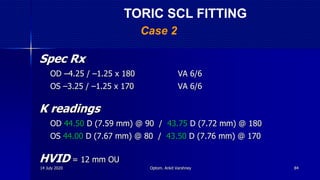
Spec Rx
OD –4.25 / –1.25 x 180 VA 6/6
OS –3.25 / –1.25 x 170 VA 6/6
K readings
OD 44.50 D (7.59 mm) @ 90 / 43.75 D (7.72 mm) @ 180
OS 44.00 D (7.67 mm) @ 80 / 43.50 D (7.76 mm) @ 170
HVID = 12 mm OU
Case 2
TORIC SCL FITTING
14 July 2020 Optom. Ankit Varshney 84
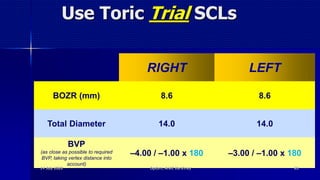
Use Toric Trial SCLs
RIGHT LEFT
BOZR (mm) 8.6 8.6
Total Diameter 14.0 14.0
BVP
(as close as possible to required
BVP, taking vertex distance into
account)
–4.00 / –1.00 x 180 –3.00 / –1.00 x 180
14 July 2020 Optom. Ankit Varshney 85
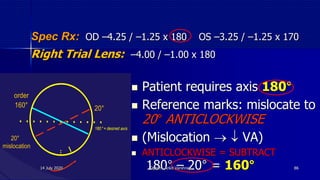
Spec Rx: OD –4.25 / –1.25 x 180 OS –3.25 / –1.25 x 170
Right Trial Lens: –4.00 / –1.00 x 180
 Patient requires axis 180°
 Reference marks: mislocate to
20° ANTICLOCKWISE
 (Mislocation   VA)
 ANTICLOCKWISE = SUBTRACT
180° – 20° = 160°
– with spherical over RX
equires axis 180°
rking: mislocates 20° to the right
ARS, therefore, require 180° – 20° = 160°
order
20°160°
20°
mislocation
180° = desired axis
14 July 2020 Optom. Ankit Varshney 86
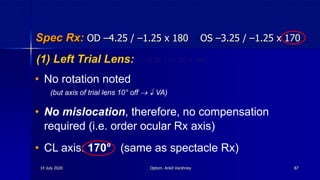
Spec Rx: OD –4.25 / –1.25 x 180 OS –3.25 / –1.25 x 170
• No rotation noted
(but axis of trial lens 10° off   VA)
• No mislocation, therefore, no compensation
required (i.e. order ocular Rx axis)
• CL axis: 170° (same as spectacle Rx)
(1) Left Trial Lens: –3.00 / –1.00 x 180
14 July 2020 Optom. Ankit Varshney 87
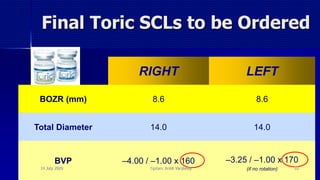
RIGHT LEFT
BOZR (mm) 8.6 8.6
Total Diameter 14.0 14.0
BVP –4.00 / –1.00 x 160 –3.25 / –1.00 x 170
(if no rotation)
Final Toric SCLs to be Ordered
14 July 2020 Optom. Ankit Varshney 88
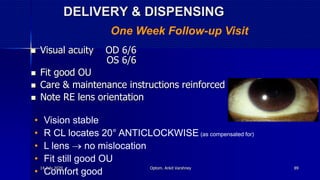
DELIVERY & DISPENSING
 Visual acuity OD 6/6
OS 6/6
 Fit good OU
 Care & maintenance instructions reinforced
 Note RE lens orientation
One Week Follow-up Visit
• Vision stable
• R CL locates 20° ANTICLOCKWISE (as compensated for)
• L lens  no mislocation
• Fit still good OU
• Comfort good
14 July 2020 Optom. Ankit Varshney 89
Over-Refraction
 If  VA with toric CL, possible reasons are:
– delivered CL not rotating to the same position as trial
CL did
– CL axis is inaccurate (±8⁰ is acceptable in
manufacturing but has significant effect on VA)
– patient’s Rx is incorrect or has changed
Perform an over-Rx to see if VA improves14 July 2020 Optom. Ankit Varshney 90
Over-Rx
 If over-Rx VA:
– add obliquely crossed-cylinders (the contact lens Rx &
the over-Rx sphero-cyl) and resultant will be new Rx
(?)
 Use a lensometer to determine the new Rx by adding the
spheres & the cylinders together
 Go online to CooperVision, CIBA Vision or J&J and use their
toric calculators to find the resultant cyl.
 See ICLC Module 3 where you will find a table that shows you
the resultant cylinders14 July 2020 Optom. Ankit Varshney 91
 Patient happy with good vision and comfort
 Best contact lens option given for this patient
As a practitioner, you can offer more
than basic contact lens practice!
OUTCOME
14 July 2020 Optom. Ankit Varshney 92
Thanks
 Any questions?????????????????
14 July 2020 Optom. Ankit Varshney 93

Toric soft contact lenses by optom ankit varshney

  • 1.
    Soft Toric LensFitting Optom. Ankit S. Varshney M.Optom, Ph.D. in Optometry (pursuing) Fellow of IACLE (Aus.), Fellow of ASCO(Mum.) Prof. at (Shree Bharatimaiya College of Optometry & Physiotherapy, Surat) Life Member of Indian Optometric Association (IOA) Associate Member of Association of Schools and Colleges of Optometry(ASCO) Member of Optometry Council of India(OCI) Educator Member of International Association of Contact lense Educators (Australia)(IACLE) Mail id: ankitsvarshney@yahoo.com Whatsapp no. +918155955820
  • 2.
    Course objectives  Uponcompletion of this presentation, you will know – The need for soft toric lenses – Patient selection for soft toric lenses – Soft toric designs and stabilizing forces – Power selection for soft toric lenses – Fit evaluation – Problem solving  Resultant cross cylinder  LARS compensation 14 July 2020 Optom. Ankit Varshney 2
  • 3.
    Astigmatism Defined as arefractive condition. It is the difference in refractive power between the 2 principal meridians of the eye Powermeridian Objectat  14 July 2020 Optom. Ankit Varshney 3
  • 4.
    Classification & itstype 1. Classification by focal line 2. Classification by structure 3. Classification by type 4. Classification by orientation- meridional 5. Classification by magnitude 14 July 2020 Optom. Ankit Varshney 4
  • 5.
    14 July 2020Optom. Ankit Varshney 5  Regular ‒ principal meridians, 90 ° apart  Irregular ‒ principal meridians not 90o apart ‒ >2 principal meridians ‒ no principal meridians ‒ often acquired (i.e. secondary to) ‒ trauma ‒ disease
  • 6.
    14 July 2020Optom. Ankit Varshney 6  Corneal  Lenticular  Other internal astigmatism  Total
  • 7.
    14 July 2020Optom. Ankit Varshney 7  Simple hyperopic astigmatism (SHA)  Compound hyperopic astigmatism (CHA)  Simple myopic astigmatism (SMA)  Compound myopic astigmatism (CMA)  Mixed astigmatism (MA)
  • 8.
    14 July 2020Optom. Ankit Varshney 8  Regular ‒ with-the-rule (WTR) ‒ against-the-rule (ATR) ‒ oblique
  • 9.
     Negligible 0.75D Cyl  Low 1.00 to 1.50 D Cyl  Moderate 1.75 to 2.50 D Cyl  High > 2.50 D Cyl 14 July 2020 Optom. Ankit Varshney 9
  • 10.
    Contact lens optionsto correct astigmatism 1. Soft SCLs 2. Spherical RGP lenses/ Toric RGP lenses 3. Toric Soft lenses 14 July 2020 Optom. Ankit Varshney 10
  • 11.
    Flashback.. Patient walking in.. 14 July2020 Optom. Ankit Varshney 11
  • 12.
    Flashback.. Patient walking out.. 14 July2020 Optom. Ankit Varshney 12
  • 13.
    Day Before Yesterday.. Only Spherical Soft Contact Lenses  On top cylindrical spectacle correction  4 : 1 Sphere – cylinder ratio 14 July 2020 Optom. Ankit Varshney 13
  • 14.
    Yesterday..  Entry ofToric soft contact lenses  Initial reluctance of the practitioners  Lengthy fitting procedure  Unpredictable outcome  Low satisfaction level 14 July 2020 Optom. Ankit Varshney 14
  • 15.
    Today..  About 7%of total soft contact lens market  More competent practitioners  Positive approach  Increased awareness amongst consumers on toric lens option  Increased No. of patients moving to disposable modality 14 July 2020 Optom. Ankit Varshney 15
  • 16.
    Today.. Superior Products 14 July2020 Optom. Ankit Varshney 16
  • 17.
    Lesson We Learnt.. Thereis nothing in a caterpillar that tells us it’s going to be a butterfly 14 July 2020 Optom. Ankit Varshney 17
  • 18.
    Why should weprescribe soft toric lenses?  Refractive astigmatism  Spherical SCLs failed to mask corneal astigmatism  Induced residual astigmatism from RGP lenses  RGP lenses causing too much discomfort 14 July 2020 Optom. Ankit Varshney 18
  • 19.
    Who should wearsoft torics?  - Poor Quality of vision with spherical soft lenses, just not clear - Refractive astigmatism > 0.75 D - Refractive astigmatism > 25 % of sphere power 14 July 2020 Optom. Ankit Varshney 19
  • 20.
    Who should wearsoft torics? – Cylinder power should be between 1.00 to 3.00 diopters – Cylinder axis should be with or against the rule, and not oblique – Not hyper-sensitive to axis shift 14 July 2020 Optom. Ankit Varshney 20
  • 21.
    Twist Test sensitivity toaxis fluctuations  Have refraction in phoropter  Rotate the best cylinder correction until the patient reports a blur in vision  Determine the amount of degrees the cylinder can be “off axis” and not effect vision  Less than 5 degrees indicates high sensitivity and may NOT be a good candidate for soft toric lenses.14 July 2020 Optom. Ankit Varshney 21
  • 22.
    TORIC SOFT CONTACTLENSES  Supply a full compensation for each of the eye’s principal meridians  Neutralize meridional refractive errors  bring light from all meridians to a common focus on the retina  For optimum vision  toric SCLs must maintain their correct meridional orientation on the eye  Different methods and designs for stabilization  To maintain normal eye physiology  the toric lens still has to move on the eye 14 July 2020 Optom. Ankit Varshney 22
  • 23.
    What are softtoric lens design characteristics?  Front Surface Toric - spherical back surface - toric front surface  Back Surface Toric - spherical front surface - toric back surface  Bitoric (uncommon) 14 July 2020 Optom. Ankit Varshney 23
  • 24.
    Front-Surface Toric CLDesign 180 Rx: –2.00 / –3.00 x 180 Spherical BOZR90 Front (+47.00) (+44.00) 90 Back 180 (–49.00) (–49.00) 90 BVPs 180 –2.00 –5.00  n = 1.43 tc = 0.15 + 14 July 2020 Optom. Ankit Varshney 24
  • 25.
    Back-Surface Toric CLDesign Rx: –2.00 / –3.00 x 180 Spherical FOZR90 Front 180 (+48.00) (+48.00) 90 Back 180 (–50.00) (–53.00) 90 BVPs 180 –2.00 –5.00 n = 1.43 tc = 0.15  + 14 July 2020 Optom. Ankit Varshney 25
  • 26.
    Soft toric design considerations •Stabilization • Reference marks - type - position • Lens thickness variation • Water content • Material properties  influence lens flexibility and rotational ability14 July 2020 Optom. Ankit Varshney 26
  • 27.
    How are softtoric lenses stablized? 14 July 2020 Optom. Ankit Varshney 27
  • 28.
    Stabilization Methods  Prismballast  Peri-ballast  Double slab-off  Reverse prism 14 July 2020 Optom. Ankit Varshney 28
  • 29.
    Watermelon seed principle StabilizationTechniques Lid force on the lens 14 July 2020 Optom. Ankit Varshney 29
  • 30.
    Prism Ballast  1to 1.5 prism dioptres, base down  Lens stabilized by lid forces acting on the prism-induced thickness differences  Reduced O2 transmissibility in areas of greater thickness  Discomfort along lower lid margin  increased thickness of prism base TORIC SOFT CL STABILIZATION 14 July 2020 Optom. Ankit Varshney 30
  • 31.
     Minus carrierconverted into a prism base down effect  Orientation principle similar to prism ballast  Prism-free optic  Uses thickness differences as the stabilizing component  thinner superiorly, thicker inferiorly  Discomfort with lens-lid interaction at the thicker, inferior half  Reduced oxygen transmissibility in thicker regions Peri-Ballast TORIC SOFT CL STABILIZATION 14 July 2020 Optom. Ankit Varshney 31
  • 32.
     Better comfortbecause of reduced lens thickness  Thin zones superiorly and inferiorly  Lens is prismless and symmetrical  Thinner than alternative designs available  Dynamic stabilization  thin zones (upper and lower) interact with the lids (especially the upper lid) to position and stabilize the lens on the eye Double Slab-Off/ Thin zones TORIC SOFT CL STABILIZATION 14 July 2020 Optom. Ankit Varshney 32
  • 33.
     May notbe as reliable in patients with loose lids  Great reliance on lid interaction  may need to use larger total lens diameters Double Slab-Off: Disadvantages TORIC SOFT CL STABILIZATION 14 July 2020 Optom. Ankit Varshney 33
  • 34.
     Incorporating bothprism (base down) and the inferior chamfer (base up)  integrated design  Should be thinner and more comfortable  Base-to-base line is located below the geometric centre of the lens  upper lid plays a greater role in lens orientation  Cylindrical component is usually limited to the prismless optical zone Reverse Prism Designs TORIC SOFT CL STABILIZATION 14 July 2020 Optom. Ankit Varshney 34
  • 35.
    How does stabilizationmethod affect fit and physiology? 14 July 2020 Optom. Ankit Varshney 35
  • 36.
     Prism ballastdesigns have greater: - thickness variation - lens mass - localized pressure on cornea at prism base  This results in: - increased central, temporal and inferior corneal thickness - greatest corneal compromise at inferior limbus TORIC SOFT CONTACT LENSES Thickness Variations 14 July 2020 Optom. Ankit Varshney 36
  • 37.
    Implications for OxygenTransmissibility: Harris and Chu (1972)  Thickness differences mean Dk/t can vary greatly  Increased thickness differential indicates a decline in oxygen transmissibility from one lens region to the next Average Thickness Measurements: Wechsler(1985) • Average lens thickness a better indicator of Dk/t • WTR lenses have lower average thickness than ATR in prism ballast designs TORIC SOFT CONTACT LENSES Thickness Variations 14 July 2020 Optom. Ankit Varshney 37
  • 38.
    Physiological Considerations  Complicationssuch a corneal edema and corneal neovascularization more likely due to increased lens thickness TORIC SOFT CONTACT LENSES 14 July 2020 Optom. Ankit Varshney 38
  • 39.
    The Challenge:  Needstable cylinder axis location for good vision  Predictable interaction between lid forces and toric lens shape Must assess:  Patient spectacle Rx and VA  Visual demands  Keratometry  Degree of astigmatism/axis TORIC SOFT CONTACT LENS FITTING 14 July 2020 Optom. Ankit Varshney 39
  • 40.
    Soft Toric ContactLenses  Does this patient need a soft toric lens?  Which type of soft toric is appropriate?  What parameters should be used?  Does the lens fit?  What power should be ordered? 14 July 2020 Optom. Ankit Varshney 40
  • 41.
    How should LensParameters be Selected?  Base curve – Be sure lens fits!… Equilibration can take up to 30 minutes. Fit the flattest base curve that is stable  Over all diameter – larger sizes allow scleral support, more stable. Normal size is 14.2 to 14.5 14 July 2020 Optom. Ankit Varshney 41
  • 42.
    How should LensParameters be Selected?  Cylinder axis – Close to axis of glasses  Cylinder power – Close to the cylinder amount of glasses. Remember vertex distance conversion.  Sphere power – Close to sphere power of glasses. – Remember vertex distance conversion.14 July 2020 Optom. Ankit Varshney 42
  • 43.
    Fitting Toric SoftLenses 1. Three fitting techniques: 1. Diagnostic 2. Trial 3. Empirical 4314 July 2020 Optom. Ankit Varshney
  • 44.
     Use atrial lens which incorporates cylinder  Stabilization features of the trial lens should be representative of any lens ordered from the same series  Most reliable technique for toric SCL fitting Toric Trial Lens Method TORIC SOFT CONTACT LENS FITTING 14 July 2020 Optom. Ankit Varshney 44
  • 45.
     Measure refractiveerror; correct for vertex distance if necessary  Choose a toric trial lens as close as possible to this Rx  Assess the lens fit  Determine orientation behaviour of the lens  Consider any angular mislocation in the final prescription Toric Trial Lens Method TORIC SOFT CONTACT LENS FITTING 14 July 2020 Optom. Ankit Varshney 45
  • 46.
     Average lensrotation is 5 – 10 nasal - anticlockwise for RE - clockwise for LE  Large individual variations  Lens affected by lens/eye relationship and lid anatomy/ Tears  Lens allocation affected by lens thickness profile Most lenses stabilize within 0 – 15 nasally (Irvins, 1984) Predicting Lens Rotation TORIC SOFT CONTACT LENS FITTING 14 July 2020 Optom. Ankit Varshney 46
  • 47.
    Good vision withany kind of toric lens needs stable cylinder axis location! 1. The magnitude and direction of any mislocation must be determined 2. Use this to compensate the ocular astigmatic axis for any regular mislocation TORIC SOFT CONTACT LENS FITTING 14 July 2020 Optom. Ankit Varshney 47
  • 48.
    How do youdetermine amount of rotation?  Look at markings – Lens Marks denote THICKEST part of the lens – Lens Marks do NOT indicate the power axis – Stable lens rotation, to a position other than 6 o’clock is OK – >20 degrees rotation is BAD FIT  Measure rotation: - narrow slit-lamp beam - protractor scale eyepiece graticule - Estimate the degree of lens rotation (clock hours) 14 July 2020 Optom. Ankit Varshney 48
  • 49.
    Soft toric markings:AOCLE guide 14 July 2020 Optom. Ankit Varshney 49
  • 50.
    References marks (prismbase or thin zone) are used to assess lens orientation in situ Lens Rotation TORIC SOFT CONTACT LENS FITTING 14 July 2020 Optom. Ankit Varshney 50
  • 51.
     Reference markon lens at 3 and 9 o'clock or 6 o'clock  Lens markings are for reference only  Measure rotation: - narrow slit-lamp beam  Estimate the degree of lens rotation (clock hours)  Note consistency of lens marking position  Push lens around to determine settling position Measurement of Lens Rotation TORIC SOFT CONTACT LENS FITTING 14 July 2020 Optom. Ankit Varshney 51
  • 52.
    Lens deviation ismeasured as:  Deviation from the vertical (markings at 6 o’clock) OR  Deviations from the horizontal (markings at 3 and 9 o’clock) Measurement of Lens Rotation TORIC SOFT CONTACT LENS FITTING 14 July 2020 Optom. Ankit Varshney 52
  • 53.
    Rotation of lens:Compensation: (degrees) Clockwise (Left)  ADD Anticlockwise (Right)  SUBTRACT Compensation for Lens Rotation L A R S Add or subtract amount of rotation to the axis of the contact lens Rx TORIC SOFT CONTACT LENS FITTING 14 July 2020 Optom. Ankit Varshney 53
  • 54.
    Lens Rotation Terminology:Practitioner View left anti-clockwiseclockwise right 12 6 9 3 Terminology: practitioner viewTerminology: practitioner view Left Add Right Subtract TORIC SOFT CONTACT LENS FITTING 14 July 2020 Optom. Ankit Varshney 54
  • 55.
     Patient requirescyl axis 90° OD  Lens marking (6 o’clock) mislocates 15° to the right  Right = subtract (Anti-clock) therefore requires 90° – 15° = 75° order 75° 105° 15° mislocation Example of Lens Rotation Target location in this case is 90° Right Eye TORIC SOFT CONTACT LENS FITTING 14 July 2020 Optom. Ankit Varshney 55
  • 56.
     Patient requirescyl axis 70° OS  Lens marking (6 o’clock) mislocates 10° to the left  Left = add (clockwise) therefore requires 70° + 10° = 80° Target location in this case is 70° Left Eye order 80° 60° 10° mislocation 70° = desired axis Example of Lens Rotation TORIC SOFT CONTACT LENS FITTING 14 July 2020 Optom. Ankit Varshney 56
  • 57.
    Rotation & AxisCompensation Rotation Amount Axis Compensation 0 to 09 degrees No compensation, order spectacle cyl axis 10 to 20 degrees Left add, Right subtract to spectacle cyl axis > 20 degrees Change lens design or fit 14 July 2020 Optom. Ankit Varshney 57
  • 58.
    How to makethe patient see  Do spherical over refraction first  If VA not acceptable, do sphere-cylinder over refraction  Use cross cylinder calculators from labs  Or use the lensometer cross cylinder technique 14 July 2020 Optom. Ankit Varshney 58
  • 59.
     Within 1line of spectacles  If 1 – 2 lines from spectacles, use clinical judgement: - patient expectation - visual demand - monocular vs binocular VA - visual comfort Visual Success Criteria: TORIC SOFT CONTACT LENS FITTING 14 July 2020 Optom. Ankit Varshney 59
  • 60.
    Induced power dueto axis rotation  Induced cylinder power equals ½ the contact lens cylinder when lens is rotated 15 degrees.  CLP= -1.00-2.00x180  Rotates 15 degrees – Induces about -1.00 cylinder!  Lower powers (<1.25) not as significant as higher powers. 14 July 2020 Optom. Ankit Varshney 60
  • 61.
    13 steps inlearning Trial Toric SCL selection Step 1 - Refraction and cylinder in MINUS cylinder form e.g- R/E - -3.00 /-2.50 x 170 degrees L/E - +3.00 /+2.00 x 160 degrees Step 2 - Unlike spherical lenses there is no need to do spherical equivalent Step 3 - Do vertex distance compensation of the sphere & cylinder separately 6114 July 2020 Optom. Ankit Varshney
  • 62.
    Toric lens fitting e.g-RE -3.00 / -2.50 x 170 degrees -3.00 -2.25 To be Decided 6214 July 2020 Optom. Ankit Varshney
  • 63.
    Toric lens fitting Step4 - Base curve is determined by Keratometry e.g- 7.50mm / 7.70mm Step 5 - Add 0.80 mm to the flattest meridian or the highest reading in mm. In the above example 7.70 mm is flatter than 7.50 mm hence 7.70mm + 0.80mm = 8.50mm Thus the BC of the lens will be 8.50mm Horizontal Vertical 6314 July 2020 Optom. Ankit Varshney
  • 64.
    Toric lens fitting -3.00/-1.75 x 180 8.50 mm 6414 July 2020 Optom. Ankit Varshney
  • 65.
    Toric lens fitting Step6 - You have the spherical, Cylindrical power as well as the Base curve of the lens Step 7- Choose a lens with its axis as the spectacle Cylindrical axis (i.e 170 degrees) 6514 July 2020 Optom. Ankit Varshney
  • 66.
    Toric lens fitting Step8- Give the trial to the patient - wait for 15-20 minutes before assessing fit of the lens Step 9 -Assess fit of the lens by assessing – Full Corneal Coverage – Centration – Movement – Comfort – Stable vision 6614 July 2020 Optom. Ankit Varshney
  • 67.
    Toric lens fitting Step10 - It is possible to show vision to a patient as lens axis matches spectacle axis Step 11 - If first 4 factors are fine then axis finalization is done 6714 July 2020 Optom. Ankit Varshney
  • 68.
    Toric lens fitting Step12 - For axis finalization concentrate on the 3 laser guide marks at the inferior or lower portion of the lens 6814 July 2020 Optom. Ankit Varshney
  • 69.
    Toric axis finalisation 3things can happen while assessing toric lens rotation  No rotation or minimal rotation of 5 degrees  Rotation to L.H.S ( with reference to Practitioner)  Rotation to R.H.S (Practitioner) 6914 July 2020 Optom. Ankit Varshney
  • 70.
    Formula for Toricaxis finalization L A R S LEFT ADD RIGHT SUBTRACT 70 C A A S LEFT CLOCKWISE ADD SUBTRACTANTI- CLOCKWISE 14 July 2020 Optom. Ankit Varshney
  • 71.
    Toric axis finalisation CASE1 No Rotation / minimal rotation of 5 degrees Answer - No change in spectacle axis hence the prescription remains:- -3.00 / -2.25 X 170 8.50mm 7114 July 2020 Optom. Ankit Varshney
  • 72.
    Toric axis finalization CASE2 Rotation to L.H.S by 15 degrees Answer - ADD 15 degrees to spectacle axis hence the prescription becomes:- -3.00 / -2.25 X (170 + 15 = 5 degrees) 8.50mm 150 7214 July 2020 Optom. Ankit Varshney
  • 73.
    Toric axis finalization CASE3 Rotation to R.H.S by 10 degrees Answer -subtract 10 deg. from spectacle axis, hence the prescription becomes:- -3.00 / -2.25 X (170 -10 =160 degrees) 8.50mm 100 7314 July 2020 Optom. Ankit Varshney
  • 74.
    Example 1  SpectacleRx -6.00 / -3.00 x 180 8.5 mm  Vertex Dist -5.50 / -2.50 x 180 8.5 mm  Trial lens - -3.00 / -1.25 X 180 8.5 mm  Rotation to R.H.S by 20 degrees  Subtract - 180 – 20 = 160 degrees Final lens prescription:- 74 -5.50/-2.50 x 160 degrees 8.50mm14 July 2020 Optom. Ankit Varshney
  • 75.
    Example 2  Spectaclepres. -3.00/-1.75 x 20 8.50mm  Vertex Dist - -3.00 / -1.50 x 20 8.50 mm  Trial lens - -3.00 /1.25 X 180 8.50 mm No Rotation Final lens prescription:- 75 -3.00/-1.50 x 20 degrees 8.50mm14 July 2020 Optom. Ankit Varshney
  • 76.
     Full cornealcoverage,  0.2 – 0.5 mm movement  Easy push up test  Minimal lens rotation Good fit – quick return to axis if mislocated Tight fit – slow return to axis if mislocated Loose fit – lens orientation unstable and inconsistent Assessment of toric soft lens 14 July 2020 Optom. Ankit Varshney 76
  • 77.
    Toric lens fitting STEP13 - After axis finalization the final toric lens order is given to the manufacturer 7714 July 2020 Optom. Ankit Varshney
  • 78.
    Things to Remember Do not make any changes in trial lens axis  Choose trial lens axis same as spectacle axis or as close as possible  Like the trial lens, final lens would also show similar rotation 7814 July 2020 Optom. Ankit Varshney
  • 79.
     Low orno spherical component e.g. Plano / –2.50 x 180  Oblique cylinders e.g. – 2.00 / – 2.00 x 45  High cylinders e.g. +4.00 / – 6.00 x 80 Difficult Cases TORIC SCL FITTING 14 July 2020 Optom. Ankit Varshney 79
  • 80.
     Teacher  Age:35 years  Plays sport  Spec Rx OD –5.00 / –2.00 x 80 OS –6.00 / –1.75x110  K readings OD 44.00 / 43.50@ 90 OS 43.50 / 43.00@ 95 Case 1 TORIC SCL FITTING 14 July 2020 Optom. Ankit Varshney 80
  • 81.
    A. Spherical RGP B.Spherical SCL C. Toric RGP D. Toric SCL What would be the 1st CL of choice? 14 July 2020 Optom. Ankit Varshney 81
  • 82.
    A. Spherical RGP B.Spherical SCL C. Toric RGP D. Toric SCL What would be the 1st CL of choice? 14 July 2020 Optom. Ankit Varshney 82
  • 83.
    WHY A TORICSCL? Spec Rx OD –5.00 / –2.00 x 80 OS –6.00 / –1.75x110 K readings OD 44.00 / 43.50@ 90 OS 43.50 / 43.00@ 95 Most astigmatism is NOT corneal & is ATR Likes to play sport 14 July 2020 Optom. Ankit Varshney 83
  • 84.
    Spec Rx OD –4.25/ –1.25 x 180 VA 6/6 OS –3.25 / –1.25 x 170 VA 6/6 K readings OD 44.50 D (7.59 mm) @ 90 / 43.75 D (7.72 mm) @ 180 OS 44.00 D (7.67 mm) @ 80 / 43.50 D (7.76 mm) @ 170 HVID = 12 mm OU Case 2 TORIC SCL FITTING 14 July 2020 Optom. Ankit Varshney 84
  • 85.
    Use Toric TrialSCLs RIGHT LEFT BOZR (mm) 8.6 8.6 Total Diameter 14.0 14.0 BVP (as close as possible to required BVP, taking vertex distance into account) –4.00 / –1.00 x 180 –3.00 / –1.00 x 180 14 July 2020 Optom. Ankit Varshney 85
  • 86.
    Spec Rx: OD–4.25 / –1.25 x 180 OS –3.25 / –1.25 x 170 Right Trial Lens: –4.00 / –1.00 x 180  Patient requires axis 180°  Reference marks: mislocate to 20° ANTICLOCKWISE  (Mislocation   VA)  ANTICLOCKWISE = SUBTRACT 180° – 20° = 160° – with spherical over RX equires axis 180° rking: mislocates 20° to the right ARS, therefore, require 180° – 20° = 160° order 20°160° 20° mislocation 180° = desired axis 14 July 2020 Optom. Ankit Varshney 86
  • 87.
    Spec Rx: OD–4.25 / –1.25 x 180 OS –3.25 / –1.25 x 170 • No rotation noted (but axis of trial lens 10° off   VA) • No mislocation, therefore, no compensation required (i.e. order ocular Rx axis) • CL axis: 170° (same as spectacle Rx) (1) Left Trial Lens: –3.00 / –1.00 x 180 14 July 2020 Optom. Ankit Varshney 87
  • 88.
    RIGHT LEFT BOZR (mm)8.6 8.6 Total Diameter 14.0 14.0 BVP –4.00 / –1.00 x 160 –3.25 / –1.00 x 170 (if no rotation) Final Toric SCLs to be Ordered 14 July 2020 Optom. Ankit Varshney 88
  • 89.
    DELIVERY & DISPENSING Visual acuity OD 6/6 OS 6/6  Fit good OU  Care & maintenance instructions reinforced  Note RE lens orientation One Week Follow-up Visit • Vision stable • R CL locates 20° ANTICLOCKWISE (as compensated for) • L lens  no mislocation • Fit still good OU • Comfort good 14 July 2020 Optom. Ankit Varshney 89
  • 90.
    Over-Refraction  If VA with toric CL, possible reasons are: – delivered CL not rotating to the same position as trial CL did – CL axis is inaccurate (±8⁰ is acceptable in manufacturing but has significant effect on VA) – patient’s Rx is incorrect or has changed Perform an over-Rx to see if VA improves14 July 2020 Optom. Ankit Varshney 90
  • 91.
    Over-Rx  If over-RxVA: – add obliquely crossed-cylinders (the contact lens Rx & the over-Rx sphero-cyl) and resultant will be new Rx (?)  Use a lensometer to determine the new Rx by adding the spheres & the cylinders together  Go online to CooperVision, CIBA Vision or J&J and use their toric calculators to find the resultant cyl.  See ICLC Module 3 where you will find a table that shows you the resultant cylinders14 July 2020 Optom. Ankit Varshney 91
  • 92.
     Patient happywith good vision and comfort  Best contact lens option given for this patient As a practitioner, you can offer more than basic contact lens practice! OUTCOME 14 July 2020 Optom. Ankit Varshney 92
  • 93.
    Thanks  Any questions????????????????? 14July 2020 Optom. Ankit Varshney 93