SOFT CONTACT LENS
BABLI SHARMA
B.OPTOM ,M.OPTOM
INDICATIONS
• Optical- Anisometropia, unilateral aphakia, myopia, low
astigmatism
• Therapeutic- corneal scar, iris abnormalities, post
keratoplasty, microbial keratitis, amblyopia ( opaque lens)
glaucoma etc.
• Cosmetic- corneal scar, phthsis bulbi
• Occupational- sportsman, pilots, actors
CONTRAINDICATIONS
• Mental incompetence/ poor motivation
• Dry eye syndrome
• Corneal dystropies and degenerations
• Recurrent diseases- episcleritis, iridocyclitis, stye etc
• Irregular astigmatism
ADVANTAGES
• Initial comfort
• Rapid adaptation
• Easy to fit
• Suitable for frequent changes b/w contact lens and glasses.
• Low risk of toxic or allergic reactions
• Suitable for extended wear
• Less expensive
DISADVANTAGES
• Lenses are fragile
• Decreased oxygen transmission
• High risk of infection
• more surface depositions
• Easily dry out
COMPLICATIONS
• Giant papillary conjunctivitis
• Contact lens acute red eye
• Keratitis
• Neovascularization
• Corneal deposits
• Corneal abrasions
• Corneal edema
CLASSIFICATION
On the basis of wearing modality-
• Daily wear- Worn for day and removed before sleeping
• Extended wear- designed for 7 days and 6 consecutive nights.
• Continuous wear- used for day and night upto 1 week to 1
month
• Flexible wear- extended wear as 2-3 nights then daily wear
Initial examination
• Slit lamp evaluation
• Tear film evaluation- TBUT ( tear breakup time)
• Accurate refraction ( cylinder<0.75D or spherical: cylindrical
power= 4:1 ratio)
• Corneal curvature- keratometer or corneal topography
• HVID ( horizontal visible iris diameter)
• Selection of lens type, water contact , material, thickness,
modality, etc.
• Selection of trial lens
LENS PARAMETERS
• Lens diameter-=HVID+2mm
 Range available- 12-15.5 mm
• Base curve= mean K+1
 Range available- 7.6-9.6 mm
• Power/ back vertex power-
 If spectacle power<4.0 D: CL power same spectacle Rx
 If spectacle power <4.0 D sph with ≤ 0.75 D cyl : contact lens
power = spherical equivalent.
 If spectacle power>4.0 D: back vertex compensation
 If spectacle power >4.0 D sph with cyl: sph equivalent then
back vertex compensation.
 Back vertex compensation
Fc = Fs/1-dFs
where Fc= contact lens power, Fs= spectacle power, d= back
vertex distance
 Spherical equivalent= sph+1/2cyl
• Lens thickness-
 Thick- 1mm-1.5 mm
 Thin-0.5mm to 1mm
 Ultra thin-<0.6mm
Rule of thumb
CL INSERTION
The One-Hand Placement Technique
• Place the lens on your index finger. Be sure the lens is right-
side-out (the edges should turn up, not out).
• With your head up, looking straight ahead, pull down your
lower eyelid with the middle finger of your placement hand
• Look up steadily at a point above you. Then place the lens on
the lower white part of your eye.
• Remove your index finger and slowly release the lower lid.
• Look down to position the lens properly.
• Close your eyes for a moment: the lens will center itself on
your eye.
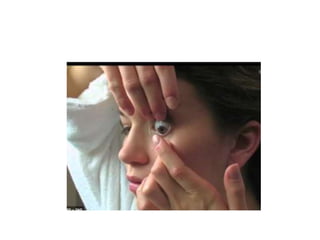
The Two-Hand Placement Technique
• With the lens on your index finger, use the middle finger of
the other hand to pull the upper lid against the brow.
• Use the middle finger of your placement hand to pull down
the lower lid and then place the lens centrally on your eye.
• While holding this position, look downward to position the
lens properly.
• Slowly release your eyelids.
FITTING EVALUATION
• On the basis of initial comfort-
 fairly comfortable- probably good fit
 Uncomfortable- loose fit
 Very comfortable- steep fit
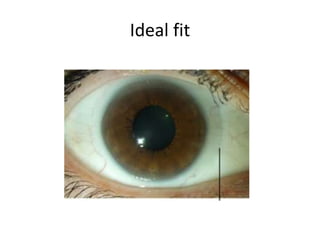
• Corneal coverage- limbus to limbus
 Ideal: 1-2 mm
 Lens too large: >2mm
 lens too small: corneal exposure
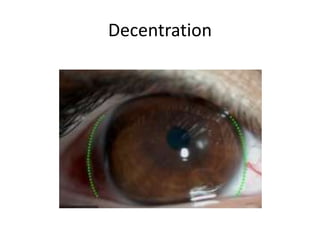
• Lens centration-
 Ideal- centred in all position of gaze
 0.2- 0.75 mm decentration is acceptable in primary gaze
• Lens movement-
 Ideal: 0.2-0.4mm (thin lenses) and 1-2mm (thick lenses)
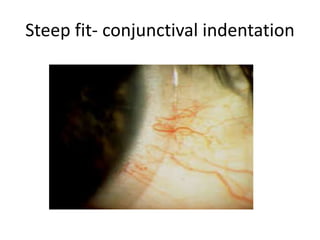
 Steep fit - less movement
 loose fit- much movement
• Edge alignment-
 Edges should be smoothly aligned with conjunctiva
-
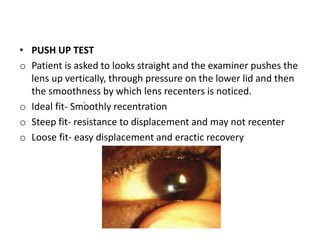
• PUSH UP TEST
o Patient is asked to looks straight and the examiner pushes the
lens up vertically, through pressure on the lower lid and then
the smoothness by which lens recenters is noticed.
o Ideal fit- Smoothly recentration
o Steep fit- resistance to displacement and may not recenter
o Loose fit- easy displacement and eractic recovery
.
• Blinking-
 Ideal fit- Vision remain same before and blinking.
 Steep fit- vision clear with blink
 Loose fit- vision blurs with blink
Ideal fit
Steep fit- conjunctival indentation
Decentration
CL REMOVAL
• Wash, rinse, and dry your hands thoroughly.
• Always be sure that the lens is in the correct position on your
eye before you try to remove it (a simple check of your vision,
closing one eye at a time, will tell you if the lens is in the
correct position). Look up and slowly pull down your lower lid
with the middle finger of your removal hand and place your
index finger on the lower edge of the lens. Squeeze the lens
lightly between the thumb and index finger and remove it.
Avoid sticking the edges of the lens together.
• Remove the other lens by following the same procedure.
THANK YOU

Soft contact lens (1) (1)

  • 1.
    SOFT CONTACT LENS BABLISHARMA B.OPTOM ,M.OPTOM
  • 2.
    INDICATIONS • Optical- Anisometropia,unilateral aphakia, myopia, low astigmatism • Therapeutic- corneal scar, iris abnormalities, post keratoplasty, microbial keratitis, amblyopia ( opaque lens) glaucoma etc. • Cosmetic- corneal scar, phthsis bulbi • Occupational- sportsman, pilots, actors
  • 3.
    CONTRAINDICATIONS • Mental incompetence/poor motivation • Dry eye syndrome • Corneal dystropies and degenerations • Recurrent diseases- episcleritis, iridocyclitis, stye etc • Irregular astigmatism
  • 4.
    ADVANTAGES • Initial comfort •Rapid adaptation • Easy to fit • Suitable for frequent changes b/w contact lens and glasses. • Low risk of toxic or allergic reactions • Suitable for extended wear • Less expensive
  • 5.
    DISADVANTAGES • Lenses arefragile • Decreased oxygen transmission • High risk of infection • more surface depositions • Easily dry out
  • 6.
    COMPLICATIONS • Giant papillaryconjunctivitis • Contact lens acute red eye • Keratitis • Neovascularization • Corneal deposits • Corneal abrasions • Corneal edema
  • 7.
    CLASSIFICATION On the basisof wearing modality- • Daily wear- Worn for day and removed before sleeping • Extended wear- designed for 7 days and 6 consecutive nights. • Continuous wear- used for day and night upto 1 week to 1 month • Flexible wear- extended wear as 2-3 nights then daily wear
  • 8.
    Initial examination • Slitlamp evaluation • Tear film evaluation- TBUT ( tear breakup time) • Accurate refraction ( cylinder<0.75D or spherical: cylindrical power= 4:1 ratio) • Corneal curvature- keratometer or corneal topography • HVID ( horizontal visible iris diameter) • Selection of lens type, water contact , material, thickness, modality, etc. • Selection of trial lens
  • 9.
    LENS PARAMETERS • Lensdiameter-=HVID+2mm  Range available- 12-15.5 mm • Base curve= mean K+1  Range available- 7.6-9.6 mm • Power/ back vertex power-  If spectacle power<4.0 D: CL power same spectacle Rx  If spectacle power <4.0 D sph with ≤ 0.75 D cyl : contact lens power = spherical equivalent.  If spectacle power>4.0 D: back vertex compensation  If spectacle power >4.0 D sph with cyl: sph equivalent then back vertex compensation.
  • 10.
     Back vertexcompensation Fc = Fs/1-dFs where Fc= contact lens power, Fs= spectacle power, d= back vertex distance  Spherical equivalent= sph+1/2cyl • Lens thickness-  Thick- 1mm-1.5 mm  Thin-0.5mm to 1mm  Ultra thin-<0.6mm
  • 11.
  • 12.
    CL INSERTION The One-HandPlacement Technique • Place the lens on your index finger. Be sure the lens is right- side-out (the edges should turn up, not out). • With your head up, looking straight ahead, pull down your lower eyelid with the middle finger of your placement hand • Look up steadily at a point above you. Then place the lens on the lower white part of your eye. • Remove your index finger and slowly release the lower lid. • Look down to position the lens properly. • Close your eyes for a moment: the lens will center itself on your eye.
  • 13.
    The Two-Hand PlacementTechnique • With the lens on your index finger, use the middle finger of the other hand to pull the upper lid against the brow. • Use the middle finger of your placement hand to pull down the lower lid and then place the lens centrally on your eye. • While holding this position, look downward to position the lens properly. • Slowly release your eyelids.
  • 15.
    FITTING EVALUATION • Onthe basis of initial comfort-  fairly comfortable- probably good fit  Uncomfortable- loose fit  Very comfortable- steep fit • Corneal coverage- limbus to limbus  Ideal: 1-2 mm  Lens too large: >2mm  lens too small: corneal exposure
  • 16.
    • Lens centration- Ideal- centred in all position of gaze  0.2- 0.75 mm decentration is acceptable in primary gaze • Lens movement-  Ideal: 0.2-0.4mm (thin lenses) and 1-2mm (thick lenses)  Steep fit - less movement  loose fit- much movement • Edge alignment-  Edges should be smoothly aligned with conjunctiva -
  • 17.
    • PUSH UPTEST o Patient is asked to looks straight and the examiner pushes the lens up vertically, through pressure on the lower lid and then the smoothness by which lens recenters is noticed. o Ideal fit- Smoothly recentration o Steep fit- resistance to displacement and may not recenter o Loose fit- easy displacement and eractic recovery .
  • 18.
    • Blinking-  Idealfit- Vision remain same before and blinking.  Steep fit- vision clear with blink  Loose fit- vision blurs with blink
  • 19.
  • 20.
  • 21.
  • 22.
    CL REMOVAL • Wash,rinse, and dry your hands thoroughly. • Always be sure that the lens is in the correct position on your eye before you try to remove it (a simple check of your vision, closing one eye at a time, will tell you if the lens is in the correct position). Look up and slowly pull down your lower lid with the middle finger of your removal hand and place your index finger on the lower edge of the lens. Squeeze the lens lightly between the thumb and index finger and remove it. Avoid sticking the edges of the lens together. • Remove the other lens by following the same procedure.
  • 23.