Farrukh Mahmood
LecturerVision Sciences
Soft Contact Lens Fitting
Trial Lens Settling Period
 An assessment of the trial lens should be recorded after a 5
minute
 Settling time may depend on water content, BVP and
material chemistry.
 Water content can influence lens parameters and therefore,
the lens fit.
 High water and high power lenses take longer to settle
(equilibrate with their environment)
 Can be done after 3 - 4 hours or at the progress evaluation
stage after lenses have been dispensed.
What to Assess During Lens Trial
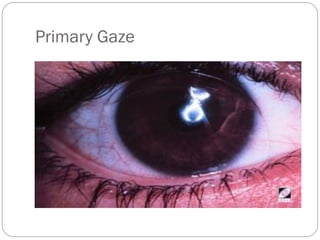
 Lens centration.
 In the primary gaze position, decentrations of 0.2 – 0.75 mm
are acceptable.
 Position and movement of the lens
 Outcome of a lower lid push-up test in primary gaze
position.
 Edge buckling or lifting.
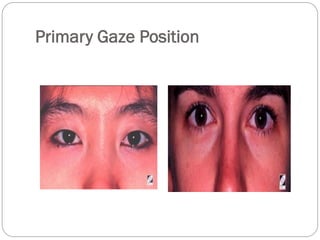
Primary Gaze Position
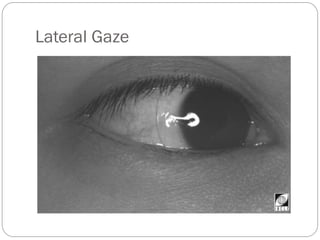
Lateral Gaze, Lateral Versions
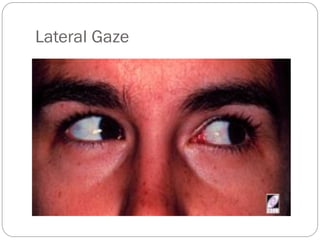
 Directing fixation laterally or requesting the fixation
alternate rapidly (e.g. between right and left) can reveal
much about the fitting behaviour of a lens.
 Of greatest interest are any tendencies for the lens to
decentre or for the lens position and movement to lag behind
that of the eye’s.
 Excessive decentration or lag may indicate the lens is too
loose or flat.
 No lag or decentration could mean that the lens is too tight.
Lateral Gaze
Lens decentration and/or lag
 Primary gaze (while 0.2 to 0.5 mm is more common, 1.0 mm is
probably excessive, depending on lens flexibility).
 31% of tightly fitting lenses showed > 0.3 mm decentration
 0.3 mm was the optimum cut-off point for identifying loose
lenses.
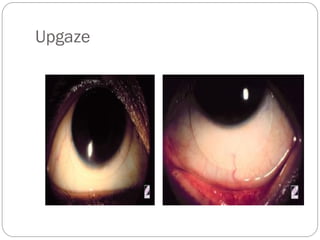
 Upgaze (up to 1.5 mm acceptable provided it is consistent).
 Lateral eye movements (up to 1.5 mm acceptable providing it is
consistent).
 Very flexible lenses move little due to conformity, the resulting
thin post-lens tear film and the larger shear forces thin films
induce.
 Corneal coverage under all reasonable circumstances is still
required.This needs to be ascertained.
The Need for Corneal Coverage
Optical
 Centration (soft lenses often decentre up and sometimes up
and out)
 Shape regularity
 A decentred lens, when conforming to the anterior eye
shape, may affect the optical performance
 Post-lens tear film uniformity
 A decentred, conforming soft lens will have some localized
thinning of the postlens tear film in the regions of heaviest
touch (greatest bearing pressure).
The Need for Corneal Coverage
Mechanical
 Prevent trauma of Cornea, Limbus and Conjunctiva.
 Comfort
 A decentred lens, especially a mobile decentred lens, may be
less comfortable than a centred lens exhibiting optimal soft
lens movement.
The Need for Corneal Coverage
Physiological
 Corneal exposure can lead to discomfort
 Corneal dessication in the areas exposed
 Any loss of the aqueous phase of the tears by evaporation may
lead to corneal desiccation.
 Tear film disturbance, lens and eye wettability.
 Loss of the aqueous phase may lead to lipid contamination of
the mucin layer potentially affecting the eye’s wettability.
 About 1 mm symmetrical overlap, and in all positions of
gaze, is considered ideal.
Effect of a Blink
 Too steep:
 −Vision clears immediately after a blink and then quickly
reverts to a lesser quality.
 The pressure of the lids during a blink forces the lens to
conform to the central cornea.This results in a transient
improvement in the vision quality.
 However, this is very unlikely as all soft lenses are fitted
flatter than the cornea.
Too flat
 Vision is generally good in the primary gaze position but
blurs immediately after a blink.
 It may then revert to its previous better quality.
 A loose fitting lens will tend to decentre.
 Regardless of the direction, the decentred lens will be forced
to conform to the shape of the anterior eye.
Lens Movement
 A slight inferior lag in the primary position may assist debris
dispersal by lens movement. Lowgrade inflammation may be
a consequence of excessive tightness.
Lens Movement
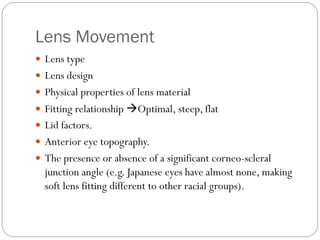
 Lens type
 Lens design
 Physical properties of lens material
 Fitting relationship Optimal, steep, flat
 Lid factors.
 Anterior eye topography.
 The presence or absence of a significant corneo-scleral
junction angle (e.g. Japanese eyes have almost none, making
soft lens fitting different to other racial groups).
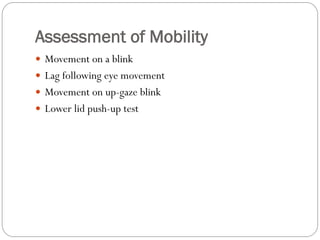
Assessment of Mobility
 Movement on a blink
 Lag following eye movement
 Movement on up-gaze blink
 Lower lid push-up test
Primary Gaze
Upgaze
Lateral Gaze
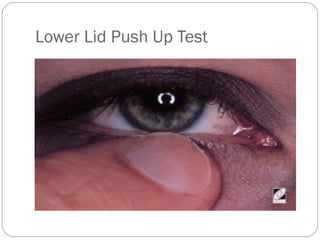
Lower Lid Push Up Test
 When performing this test it is important to keep the square
rear lid margin apposed to the globe so that the lens can be
engaged usefully.
 When a finger is applied to the centre of the lower lid there
is a natural tendency for the lower lid to‘gape’ away from the
globe thus rendering this test impossible.
Lower Lid Push Up Test
 What is desired is an easy displacement of the lens across or
over from the cornea while the eye is in the primary
position.
 Once lid manipulation is ceased, it is expected that the lens
will rapidly and reliably recentre on the cornea.
 Should the lens be difficult to displace, and then be sluggish
to recentre, it can be assumed that the lens fit is tending
towards tight.
 If the lens fails to return at all then the fit is tight to very tight.
Lower Lid Push Up Test
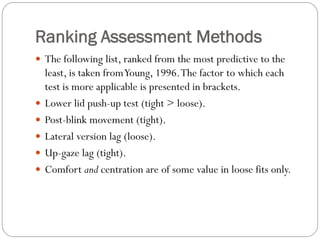
Ranking Assessment Methods
 The following list, ranked from the most predictive to the
least, is taken fromYoung, 1996.The factor to which each
test is more applicable is presented in brackets.
 Lower lid push-up test (tight > loose).
 Post-blink movement (tight).
 Lateral version lag (loose).
 Up-gaze lag (tight).
 Comfort and centration are of some value in loose fits only.
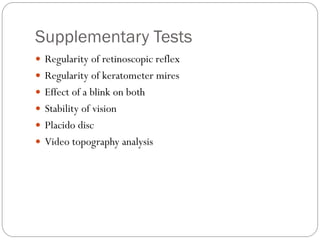
Supplementary Tests
 Regularity of retinoscopic reflex
 Regularity of keratometer mires
 Effect of a blink on both
 Stability of vision
 Placido disc
 Video topography analysis
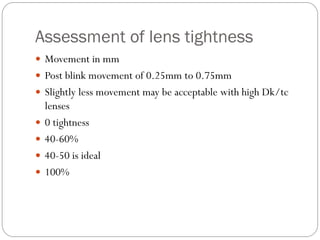
Assessment of lens tightness
 Movement in mm
 Post blink movement of 0.25mm to 0.75mm
 Slightly less movement may be acceptable with high Dk/tc
lenses
 0 tightness
 40-60%
 40-50 is ideal
 100%
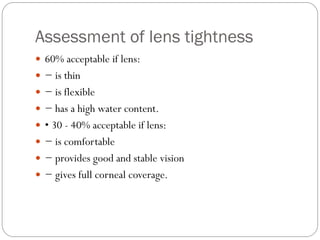
Assessment of lens tightness
 60% acceptable if lens:
 − is thin
 − is flexible
 − has a high water content.
 • 30 - 40% acceptable if lens:
 − is comfortable
 − provides good and stable vision
 − gives full corneal coverage.
What is unacceptable
 Lens edge curling/wrinkling
 Conjunctival indentation
 Excessive decentration leading to corneal exposure
 Excessive movement producing visual disturbances, e.g. poor
vision or fluctuating vision
 No movement even if a‘push-up’ test is satisfactory
 Corneal exposure under any circumstances
 Fits which result in blink-related visual disturbances
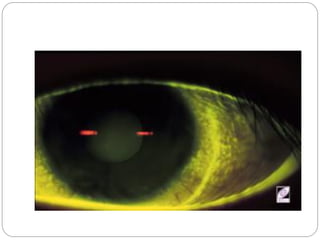
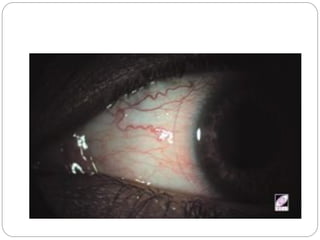
Tight fitting lens
 Lens is immobile even when lower lid push-up manipulation
is attempted.
 Conjunctival indentation at the lens edge.
 Blood flow constriction in peri-limbal conjunctival vessels
under lens periphery.
 Low-grade inflammation
 Vision is better immediately after a blink
Flat fitting lens
 If extreme, lens will not stay in eye
 • Excessive lens movement
 •Wrinkling/buckling of lens edge
 •Vision variable but worse immediately after blink if
decentred
 - if lens centred blink may be little or no difference
Flat fitting lens
 Inferior lens lag even in primary eye position
 Lens may slip off cornea in up-gaze and/or up-gaze blink
 Subjective discomfort due to lens mobility
Final decision
 BVP for Spherical SCLs:
 4:1 Rule:As a very general rule, if the sphere component of an
astigmatic Rx is ≥ 4X the cylinder component, there is a
reasonable chance that the vision with the Rx’s best sphere result,
will be acceptable.This rule-of thumb may not be applicable to
cases where the magnitude of the cylinder is considerable ( ≥ 1.50
D).
 ReducedV/A may be acceptable for some‘social’, occupational
and other occasional wear situations.
 Other occupations may require high acuities and compromises
may be unacceptable.
 Some wearers have higher expectations than others and
compromises may be unacceptable to them.
Final decision
 If the best sphere fails to provide the acuity required, a toric
lens will be required if contact lenses are to be pursued
further.
 •The final BVP should be close ( ±0.25 D, ±0.50 D at the
most) to the ocular Rx (sphere or best sphere).

Soft Contact Lens Fitting.pdf

  • 1.
  • 2.
    Trial Lens SettlingPeriod  An assessment of the trial lens should be recorded after a 5 minute  Settling time may depend on water content, BVP and material chemistry.  Water content can influence lens parameters and therefore, the lens fit.  High water and high power lenses take longer to settle (equilibrate with their environment)  Can be done after 3 - 4 hours or at the progress evaluation stage after lenses have been dispensed.
  • 3.
    What to AssessDuring Lens Trial  Lens centration.  In the primary gaze position, decentrations of 0.2 – 0.75 mm are acceptable.  Position and movement of the lens  Outcome of a lower lid push-up test in primary gaze position.  Edge buckling or lifting.
  • 4.
  • 5.
    Lateral Gaze, LateralVersions  Directing fixation laterally or requesting the fixation alternate rapidly (e.g. between right and left) can reveal much about the fitting behaviour of a lens.  Of greatest interest are any tendencies for the lens to decentre or for the lens position and movement to lag behind that of the eye’s.  Excessive decentration or lag may indicate the lens is too loose or flat.  No lag or decentration could mean that the lens is too tight.
  • 6.
  • 7.
    Lens decentration and/orlag  Primary gaze (while 0.2 to 0.5 mm is more common, 1.0 mm is probably excessive, depending on lens flexibility).  31% of tightly fitting lenses showed > 0.3 mm decentration  0.3 mm was the optimum cut-off point for identifying loose lenses.  Upgaze (up to 1.5 mm acceptable provided it is consistent).  Lateral eye movements (up to 1.5 mm acceptable providing it is consistent).  Very flexible lenses move little due to conformity, the resulting thin post-lens tear film and the larger shear forces thin films induce.  Corneal coverage under all reasonable circumstances is still required.This needs to be ascertained.
  • 8.
    The Need forCorneal Coverage Optical  Centration (soft lenses often decentre up and sometimes up and out)  Shape regularity  A decentred lens, when conforming to the anterior eye shape, may affect the optical performance  Post-lens tear film uniformity  A decentred, conforming soft lens will have some localized thinning of the postlens tear film in the regions of heaviest touch (greatest bearing pressure).
  • 9.
    The Need forCorneal Coverage Mechanical  Prevent trauma of Cornea, Limbus and Conjunctiva.  Comfort  A decentred lens, especially a mobile decentred lens, may be less comfortable than a centred lens exhibiting optimal soft lens movement.
  • 10.
    The Need forCorneal Coverage Physiological  Corneal exposure can lead to discomfort  Corneal dessication in the areas exposed  Any loss of the aqueous phase of the tears by evaporation may lead to corneal desiccation.  Tear film disturbance, lens and eye wettability.  Loss of the aqueous phase may lead to lipid contamination of the mucin layer potentially affecting the eye’s wettability.  About 1 mm symmetrical overlap, and in all positions of gaze, is considered ideal.
  • 11.
    Effect of aBlink  Too steep:  −Vision clears immediately after a blink and then quickly reverts to a lesser quality.  The pressure of the lids during a blink forces the lens to conform to the central cornea.This results in a transient improvement in the vision quality.  However, this is very unlikely as all soft lenses are fitted flatter than the cornea.
  • 12.
    Too flat  Visionis generally good in the primary gaze position but blurs immediately after a blink.  It may then revert to its previous better quality.  A loose fitting lens will tend to decentre.  Regardless of the direction, the decentred lens will be forced to conform to the shape of the anterior eye.
  • 13.
    Lens Movement  Aslight inferior lag in the primary position may assist debris dispersal by lens movement. Lowgrade inflammation may be a consequence of excessive tightness.
  • 14.
    Lens Movement  Lenstype  Lens design  Physical properties of lens material  Fitting relationship Optimal, steep, flat  Lid factors.  Anterior eye topography.  The presence or absence of a significant corneo-scleral junction angle (e.g. Japanese eyes have almost none, making soft lens fitting different to other racial groups).
  • 15.
    Assessment of Mobility Movement on a blink  Lag following eye movement  Movement on up-gaze blink  Lower lid push-up test
  • 16.
  • 17.
  • 18.
  • 19.
    Lower Lid PushUp Test  When performing this test it is important to keep the square rear lid margin apposed to the globe so that the lens can be engaged usefully.  When a finger is applied to the centre of the lower lid there is a natural tendency for the lower lid to‘gape’ away from the globe thus rendering this test impossible.
  • 20.
    Lower Lid PushUp Test  What is desired is an easy displacement of the lens across or over from the cornea while the eye is in the primary position.  Once lid manipulation is ceased, it is expected that the lens will rapidly and reliably recentre on the cornea.  Should the lens be difficult to displace, and then be sluggish to recentre, it can be assumed that the lens fit is tending towards tight.  If the lens fails to return at all then the fit is tight to very tight.
  • 21.
  • 22.
    Ranking Assessment Methods The following list, ranked from the most predictive to the least, is taken fromYoung, 1996.The factor to which each test is more applicable is presented in brackets.  Lower lid push-up test (tight > loose).  Post-blink movement (tight).  Lateral version lag (loose).  Up-gaze lag (tight).  Comfort and centration are of some value in loose fits only.
  • 23.
    Supplementary Tests  Regularityof retinoscopic reflex  Regularity of keratometer mires  Effect of a blink on both  Stability of vision  Placido disc  Video topography analysis
  • 24.
    Assessment of lenstightness  Movement in mm  Post blink movement of 0.25mm to 0.75mm  Slightly less movement may be acceptable with high Dk/tc lenses  0 tightness  40-60%  40-50 is ideal  100%
  • 25.
    Assessment of lenstightness  60% acceptable if lens:  − is thin  − is flexible  − has a high water content.  • 30 - 40% acceptable if lens:  − is comfortable  − provides good and stable vision  − gives full corneal coverage.
  • 26.
    What is unacceptable Lens edge curling/wrinkling  Conjunctival indentation  Excessive decentration leading to corneal exposure  Excessive movement producing visual disturbances, e.g. poor vision or fluctuating vision  No movement even if a‘push-up’ test is satisfactory  Corneal exposure under any circumstances  Fits which result in blink-related visual disturbances
  • 27.
    Tight fitting lens Lens is immobile even when lower lid push-up manipulation is attempted.  Conjunctival indentation at the lens edge.  Blood flow constriction in peri-limbal conjunctival vessels under lens periphery.  Low-grade inflammation  Vision is better immediately after a blink
  • 30.
    Flat fitting lens If extreme, lens will not stay in eye  • Excessive lens movement  •Wrinkling/buckling of lens edge  •Vision variable but worse immediately after blink if decentred  - if lens centred blink may be little or no difference
  • 31.
    Flat fitting lens Inferior lens lag even in primary eye position  Lens may slip off cornea in up-gaze and/or up-gaze blink  Subjective discomfort due to lens mobility
  • 32.
    Final decision  BVPfor Spherical SCLs:  4:1 Rule:As a very general rule, if the sphere component of an astigmatic Rx is ≥ 4X the cylinder component, there is a reasonable chance that the vision with the Rx’s best sphere result, will be acceptable.This rule-of thumb may not be applicable to cases where the magnitude of the cylinder is considerable ( ≥ 1.50 D).  ReducedV/A may be acceptable for some‘social’, occupational and other occasional wear situations.  Other occupations may require high acuities and compromises may be unacceptable.  Some wearers have higher expectations than others and compromises may be unacceptable to them.
  • 33.
    Final decision  Ifthe best sphere fails to provide the acuity required, a toric lens will be required if contact lenses are to be pursued further.  •The final BVP should be close ( ±0.25 D, ±0.50 D at the most) to the ocular Rx (sphere or best sphere).