DISEASES OF IRIS
MS. MEGHNA VERMA
ASSISSTANT PROFESSOR
DEPT OF OPTOMETRY
RAMA UNIVERSITY
CONTENTS
DISEASE OF IRIS –
• Congenital Anomalies
• Inflammations [Anterior uveitis]
• Types Of Iridocyclitis
• Degeneration of iris
• Cyst and tumours of iris
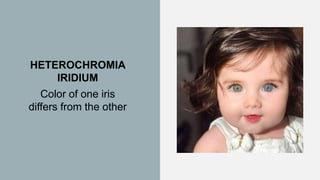
HETEROCHROMIA
IRIDIUM
Color of one iris
differs from the other
CONGENITAL ANOMALIES
HETEROCHROMIA OF IRIS
Heterochromia is a variation in coloration most often used to
describe color differences of the iris, but can also be applied to
color variation of hair[1] or skin.
In heterochromia iridium, color of one iris differs from the other.
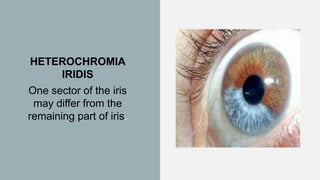
In heterochromia iridis, one sector of the iris may differ from the
remainder of iris.
HETEROCHROMIA
IRIDIS
One sector of the iris
may differ from the
remaining part of iris.
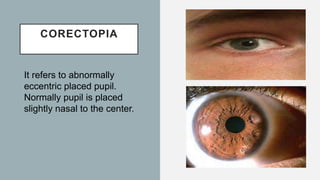
CORECTOPIA
It refers to abnormally
eccentric placed pupil.
Normally pupil is placed
slightly nasal to the center.
POLYCORIA
Polycoria is a pathological
condition of
the eye characterized by more
than one pupillary opening in
the iris.[1]
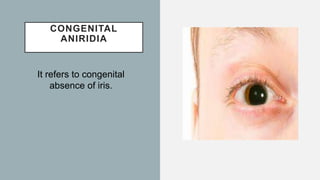
CONGENITAL
ANIRIDIA
It refers to congenital
absence of iris.
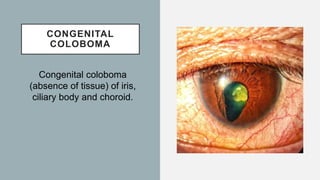
CONGENITAL
COLOBOMA
Congenital coloboma
(absence of tissue) of iris,
ciliary body and choroid.
ANTERIOR
UVEITIS
It is inflammation of the uveal tissue from iris up to
pars plicata of ciliary body.
It may be subdivided into :
Iritis, inflammation of iris.
Irido-cyctitis, inflammation of iris and pars plicata part
of ciliary body are equally involved.
Cyclitis, inflammation of pars plicata part of ciliary body.
SYMPTOMS
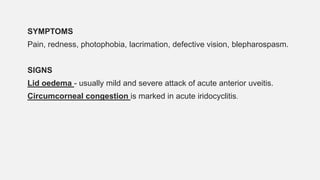
Pain, redness, photophobia, lacrimation, defective vision, blepharospasm.
SIGNS
Lid oedema - usually mild and severe attack of acute anterior uveitis.
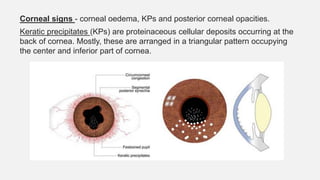
Circumcorneal congestion is marked in acute iridocyclitis.
Corneal signs - corneal oedema, KPs and posterior corneal opacities.
Keratic precipitates (KPs) are proteinaceous cellular deposits occurring at the
back of cornea. Mostly, these are arranged in a triangular pattern occupying
the center and inferior part of cornea.
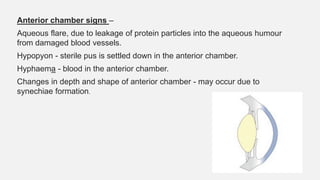
Anterior chamber signs –
Aqueous flare, due to leakage of protein particles into the aqueous humour
from damaged blood vessels.
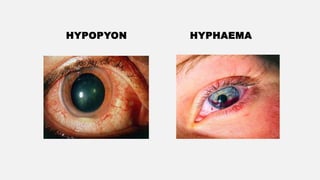
Hypopyon - sterile pus is settled down in the anterior chamber.
Hyphaema - blood in the anterior chamber.
Changes in depth and shape of anterior chamber - may occur due to
synechiae formation.
HYPOPYON HYPHAEMA
Iris signs -
Loss of normal pattern - occurs due to oedema.
Changes in iris colour due to hyperpigmentation and
depigmentation.
Posterior synechiae - adhesions b/w posterior surface of iris &
anterior part of lens.
Pupillary signs –
Narrow pupil - due to irritation of sphincter pupillae by toxins.
Irregular pupil shape - results from segmental posterior synechiae
formation. [festooned pupil]
Pupillary reaction becomes sluggish or absent due to oedema and
hyperaemia of iris.
Changes in the lens -
Exudates may be deposited on the lens acute iridocyclitis.
Complicated cataract may develop as a complication of iridocyclitis.
Change in the vitreous -
Anterior vitreous may show exudates and inflammatory cells after an attack
of iridocyclitis.
COMPLICATIONS
Complicated cataract, secondary glaucoma, choroiditis, retinal
complications, macular oedema, retinal detachment and Papillitis.
INVESTIGATIONS
TLC, DLC, ESR, blood sugar level, serological test, urine examination, stool
examination, radiological examination and skin test.
TREATMENT OF IRIDOCYCLITIS
1. Non-specific treatment
• Local therapy
Mydriatic-cycloplegic drugs, corticosteroids and antibiotic eyedrops.
• Systemic therapy
Corticosteroids, NSAIDS, immunosuppressive drugs,
• Physical measures
Hot fomentation, dark goggles
2. Specific treatment of the cause
3. Treatment of the complications
DEGENERATION OF
IRIS
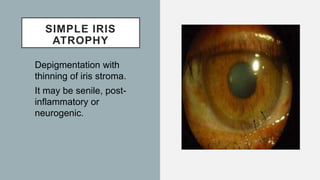
SIMPLE IRIS
ATROPHY
Depigmentation with
thinning of iris stroma.
It may be senile, post-
inflammatory or
neurogenic.
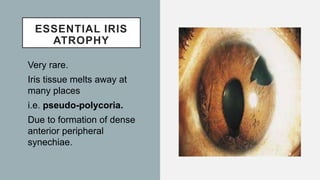
ESSENTIAL IRIS
ATROPHY
Very rare.
Iris tissue melts away at
many places
i.e. pseudo-polycoria.
Due to formation of dense
anterior peripheral
synechiae.
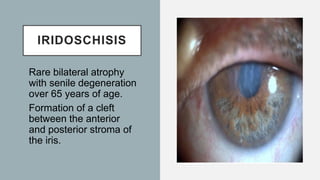
IRIDOSCHISIS
Rare bilateral atrophy
with senile degeneration
over 65 years of age.
Formation of a cleft
between the anterior
and posterior stroma of
the iris.
TUMOURS OF IRIS
BENIGN
TUMOUR MALIGNANT
TUMOUR
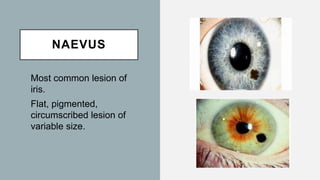
NAEVUS
Most common lesion of
iris.
Flat, pigmented,
circumscribed lesion of
variable size.
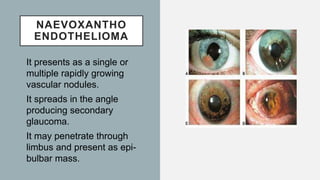
NAEVOXANTHO
ENDOTHELIOMA
It presents as a single or
multiple rapidly growing
vascular nodules.
It spreads in the angle
producing secondary
glaucoma.
It may penetrate through
limbus and present as epi-
bulbar mass.
REFERENCES
• Kumar P (2017). "Focal Scalp Hair Heterochromia in an Infant". Sultan
Qaboos University Medical Journal. 17 (1): e116–
118. doi:10.18295/squmj.2016.17.01.022. PMC 5380409. PMID 284170
41
• Cassin, B. and Solomon, S. Dictionary of Eye Terminology. Gainesville,
Florida: Triad Publishing Company, 1990.
DISEASES OF IRIS.pptx

DISEASES OF IRIS.pptx

  • 1.
    DISEASES OF IRIS MS.MEGHNA VERMA ASSISSTANT PROFESSOR DEPT OF OPTOMETRY RAMA UNIVERSITY
  • 2.
    CONTENTS DISEASE OF IRIS– • Congenital Anomalies • Inflammations [Anterior uveitis] • Types Of Iridocyclitis • Degeneration of iris • Cyst and tumours of iris
  • 3.
    HETEROCHROMIA IRIDIUM Color of oneiris differs from the other
  • 4.
    CONGENITAL ANOMALIES HETEROCHROMIA OFIRIS Heterochromia is a variation in coloration most often used to describe color differences of the iris, but can also be applied to color variation of hair[1] or skin. In heterochromia iridium, color of one iris differs from the other. In heterochromia iridis, one sector of the iris may differ from the remainder of iris.
  • 5.
    HETEROCHROMIA IRIDIS One sector ofthe iris may differ from the remaining part of iris.
  • 6.
    CORECTOPIA It refers toabnormally eccentric placed pupil. Normally pupil is placed slightly nasal to the center.
  • 7.
    POLYCORIA Polycoria is apathological condition of the eye characterized by more than one pupillary opening in the iris.[1]
  • 8.
    CONGENITAL ANIRIDIA It refers tocongenital absence of iris.
  • 9.
    CONGENITAL COLOBOMA Congenital coloboma (absence oftissue) of iris, ciliary body and choroid.
  • 10.
  • 11.
    It is inflammationof the uveal tissue from iris up to pars plicata of ciliary body. It may be subdivided into : Iritis, inflammation of iris. Irido-cyctitis, inflammation of iris and pars plicata part of ciliary body are equally involved. Cyclitis, inflammation of pars plicata part of ciliary body.
  • 12.
    SYMPTOMS Pain, redness, photophobia,lacrimation, defective vision, blepharospasm. SIGNS Lid oedema - usually mild and severe attack of acute anterior uveitis. Circumcorneal congestion is marked in acute iridocyclitis.
  • 13.
    Corneal signs -corneal oedema, KPs and posterior corneal opacities. Keratic precipitates (KPs) are proteinaceous cellular deposits occurring at the back of cornea. Mostly, these are arranged in a triangular pattern occupying the center and inferior part of cornea.
  • 14.
    Anterior chamber signs– Aqueous flare, due to leakage of protein particles into the aqueous humour from damaged blood vessels. Hypopyon - sterile pus is settled down in the anterior chamber. Hyphaema - blood in the anterior chamber. Changes in depth and shape of anterior chamber - may occur due to synechiae formation.
  • 15.
  • 16.
    Iris signs - Lossof normal pattern - occurs due to oedema. Changes in iris colour due to hyperpigmentation and depigmentation. Posterior synechiae - adhesions b/w posterior surface of iris & anterior part of lens. Pupillary signs – Narrow pupil - due to irritation of sphincter pupillae by toxins. Irregular pupil shape - results from segmental posterior synechiae formation. [festooned pupil] Pupillary reaction becomes sluggish or absent due to oedema and hyperaemia of iris.
  • 17.
    Changes in thelens - Exudates may be deposited on the lens acute iridocyclitis. Complicated cataract may develop as a complication of iridocyclitis. Change in the vitreous - Anterior vitreous may show exudates and inflammatory cells after an attack of iridocyclitis. COMPLICATIONS Complicated cataract, secondary glaucoma, choroiditis, retinal complications, macular oedema, retinal detachment and Papillitis. INVESTIGATIONS TLC, DLC, ESR, blood sugar level, serological test, urine examination, stool examination, radiological examination and skin test.
  • 18.
    TREATMENT OF IRIDOCYCLITIS 1.Non-specific treatment • Local therapy Mydriatic-cycloplegic drugs, corticosteroids and antibiotic eyedrops. • Systemic therapy Corticosteroids, NSAIDS, immunosuppressive drugs, • Physical measures Hot fomentation, dark goggles 2. Specific treatment of the cause 3. Treatment of the complications
  • 19.
  • 20.
    SIMPLE IRIS ATROPHY Depigmentation with thinningof iris stroma. It may be senile, post- inflammatory or neurogenic.
  • 21.
    ESSENTIAL IRIS ATROPHY Very rare. Iristissue melts away at many places i.e. pseudo-polycoria. Due to formation of dense anterior peripheral synechiae.
  • 22.
    IRIDOSCHISIS Rare bilateral atrophy withsenile degeneration over 65 years of age. Formation of a cleft between the anterior and posterior stroma of the iris.
  • 23.
  • 24.
    NAEVUS Most common lesionof iris. Flat, pigmented, circumscribed lesion of variable size.
  • 25.
    NAEVOXANTHO ENDOTHELIOMA It presents asa single or multiple rapidly growing vascular nodules. It spreads in the angle producing secondary glaucoma. It may penetrate through limbus and present as epi- bulbar mass.
  • 26.
    REFERENCES • Kumar P(2017). "Focal Scalp Hair Heterochromia in an Infant". Sultan Qaboos University Medical Journal. 17 (1): e116– 118. doi:10.18295/squmj.2016.17.01.022. PMC 5380409. PMID 284170 41 • Cassin, B. and Solomon, S. Dictionary of Eye Terminology. Gainesville, Florida: Triad Publishing Company, 1990.