Presented ByPresented By
Sonya Akter Rupa
ID-315161009
Department of CSE
Presented ToPresented To
Pro.Dr.Abu Zafor Ziauddin Ahamed
Lecturer of Physics
Hamdard University Bangladesh
(r, θ)
• A coordinate system represents a point in the
plane by an ordered pair of numbers called
coordinates.
• Usually, we use Cartesian coordinates, which are
directed distances from two perpendicular axes.
• A coordinate system introduced by Newton, called
the polar coordinate system.
Polar Co-ordinate system
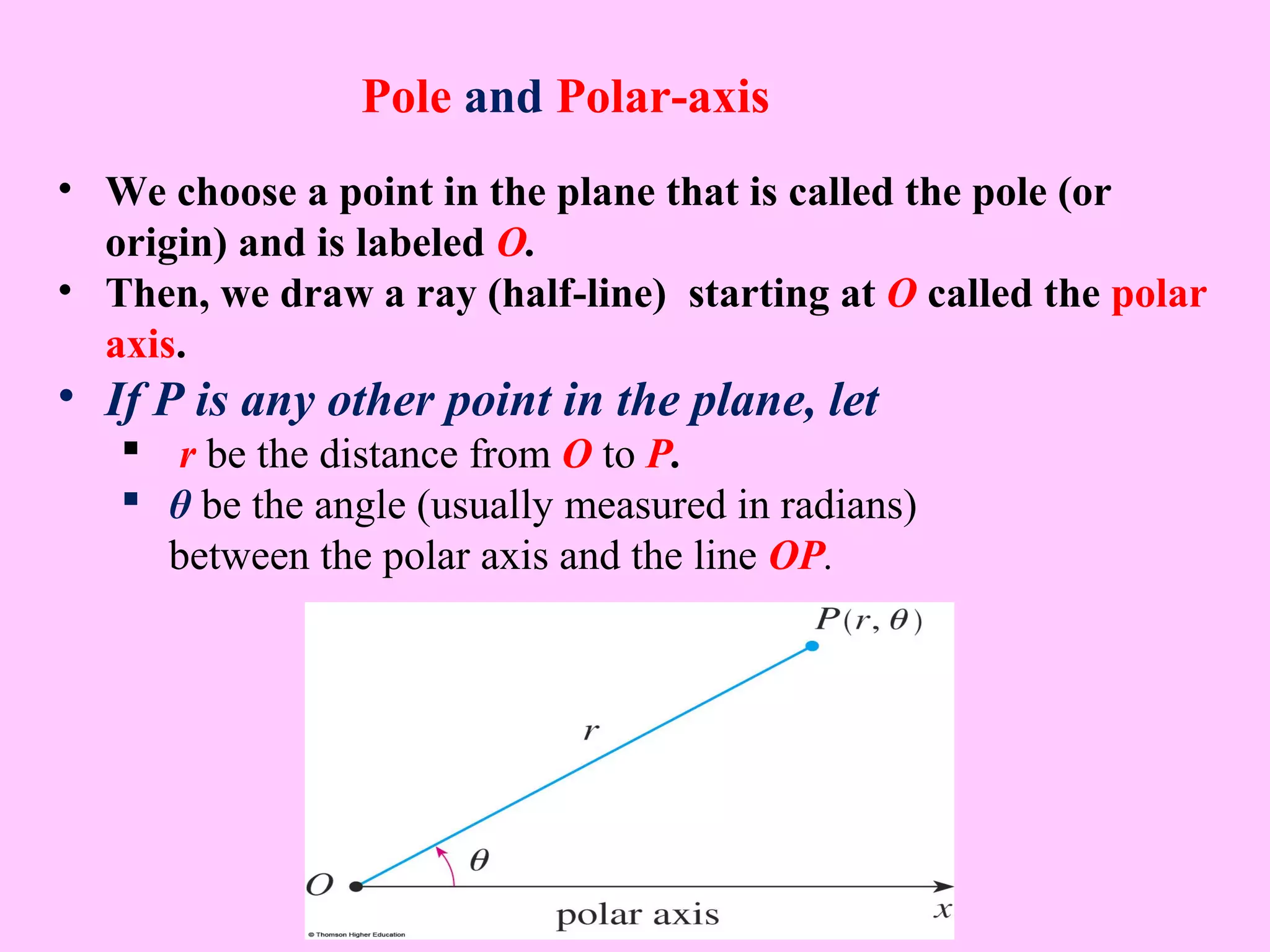
• We choose a point in the plane that is called the pole (or
origin) and is labeled O.
• Then, we draw a ray (half-line) starting at O called the polar
axis.
• If P is any other point in the plane, let
 r be the distance from O to P.
 θ be the angle (usually measured in radians)
between the polar axis and the line OP.
Pole and Polar-axis
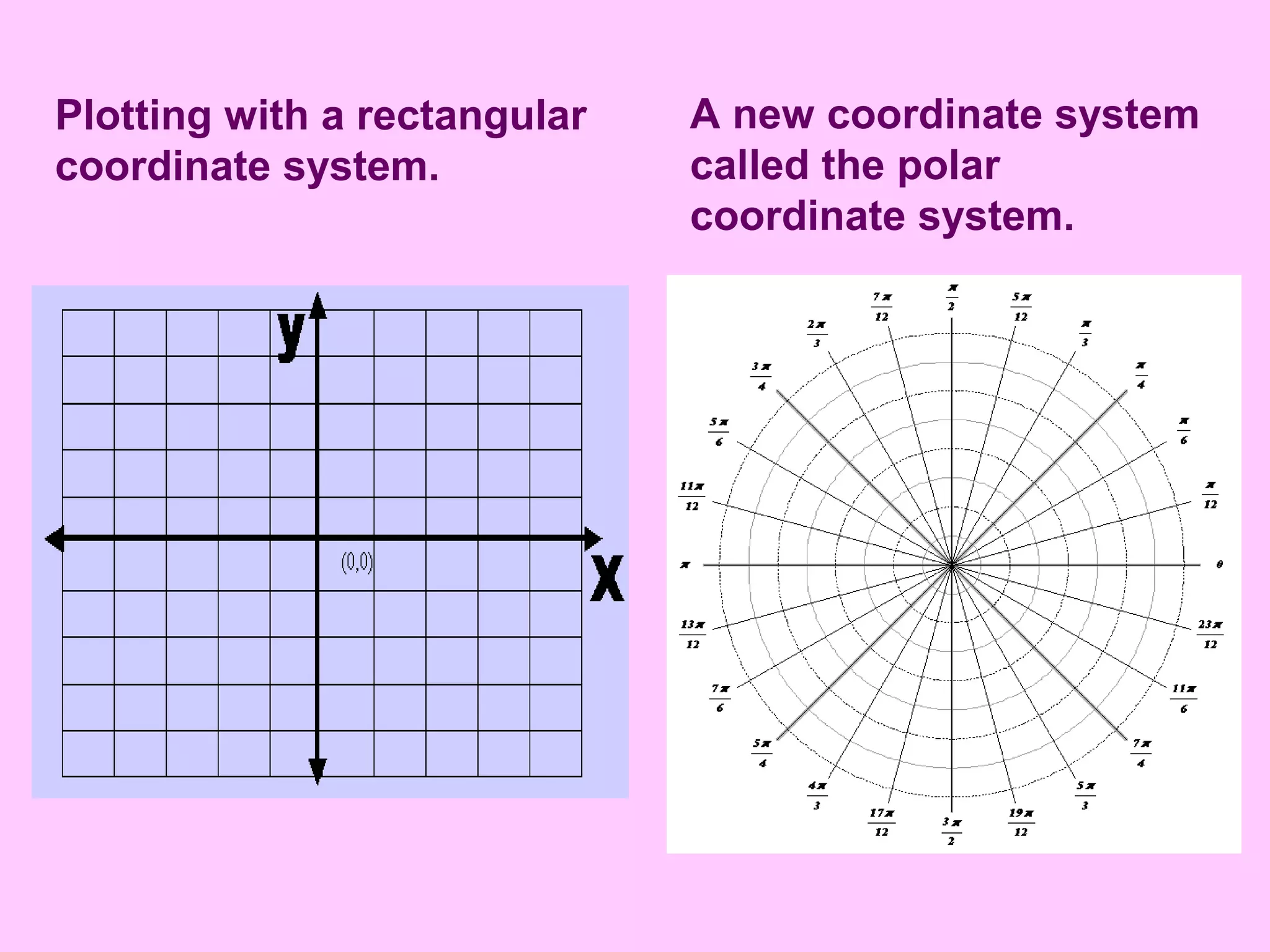
Plotting with a rectangular
coordinate system.
A new coordinate system
called the polar
coordinate system.
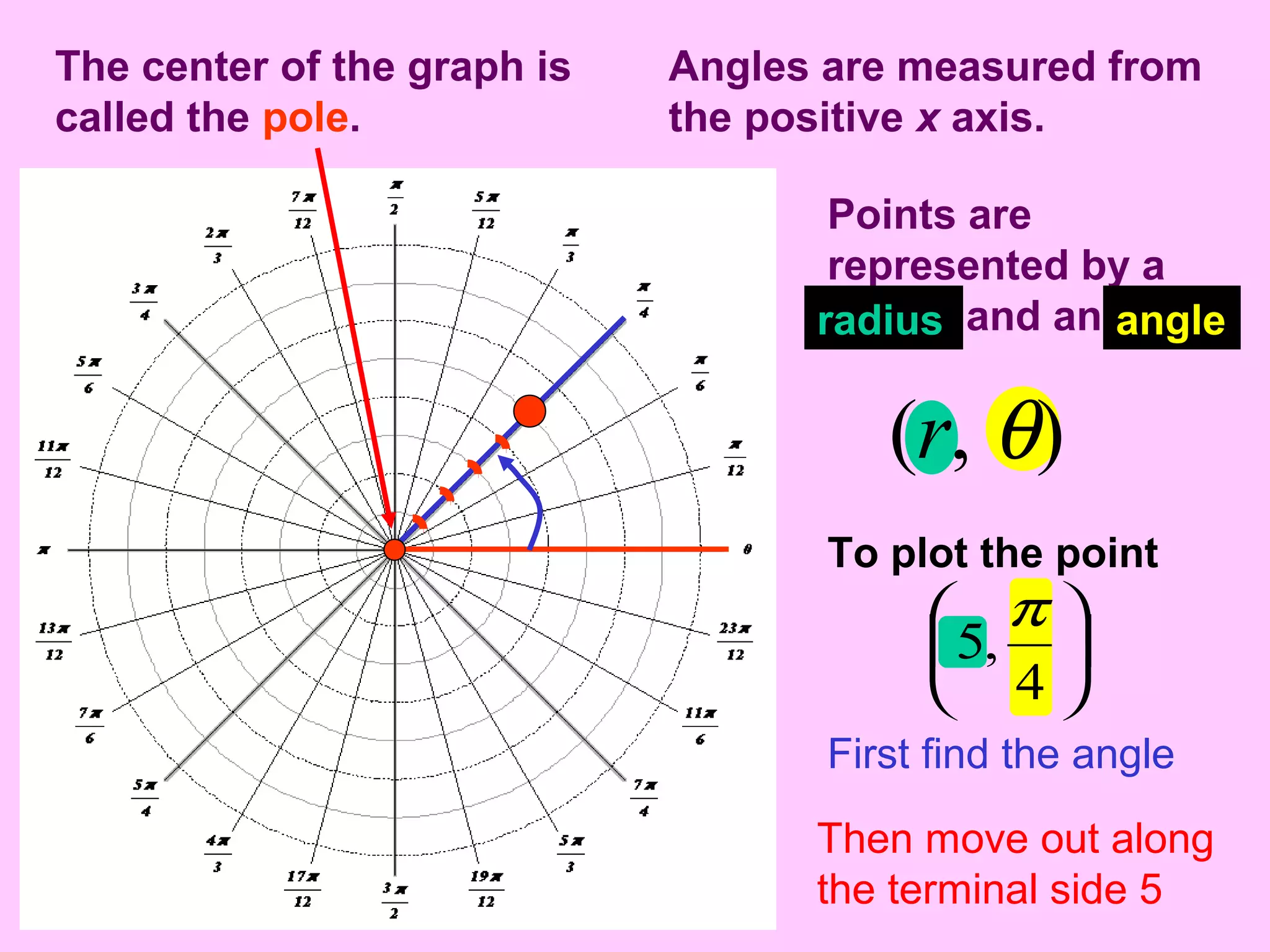
The center of the graph is
called the pole.
Angles are measured from
the positive x axis.
Points are
represented by a
radius and an angle
(r, θ)
radius angle
To plot the point






4
,5
π
First find the angle
Then move out along
the terminal side 5
CARTESIAN & POLAR COORDINATES
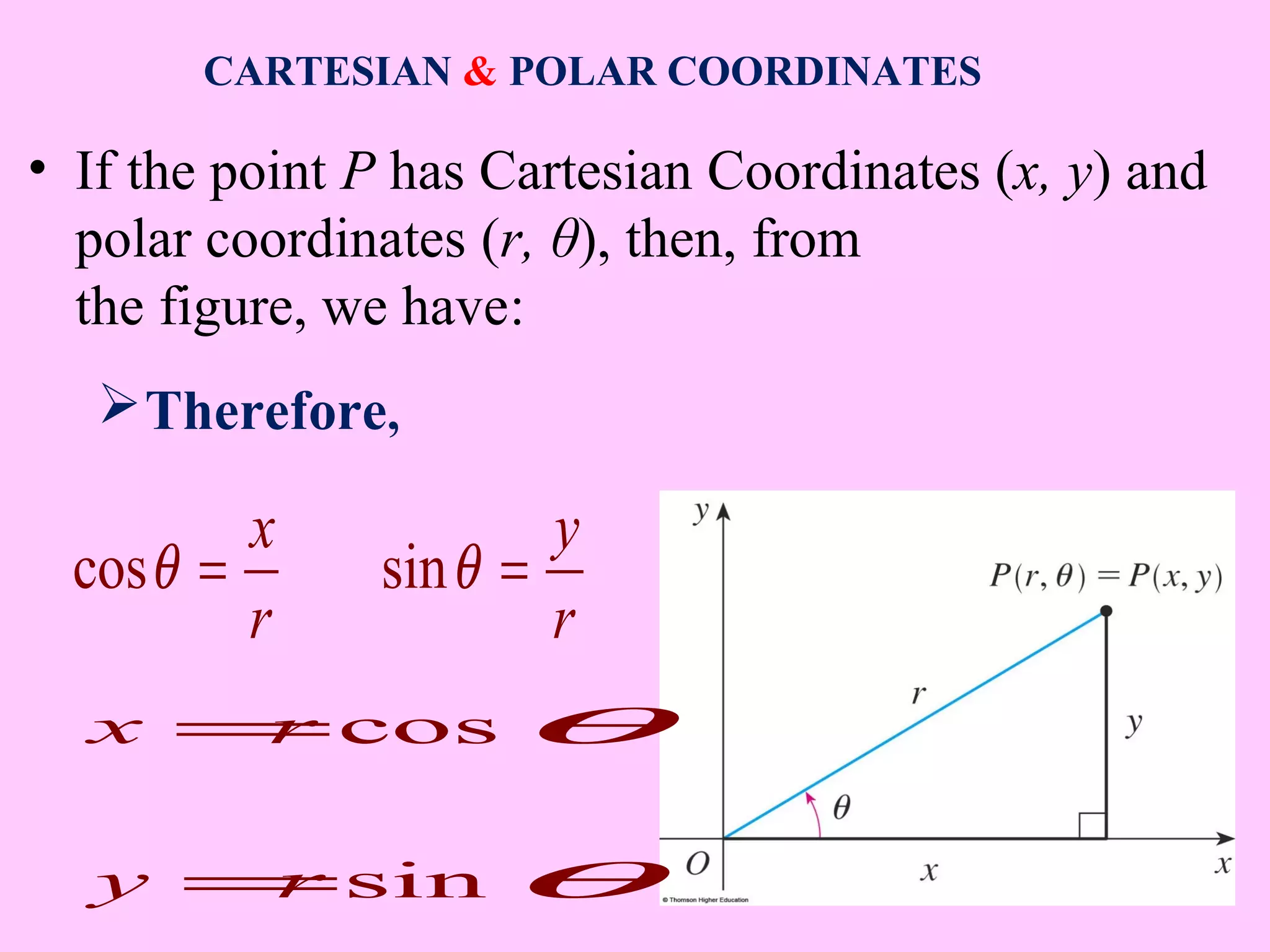
• If the point P has Cartesian Coordinates (x, y) and
polar coordinates (r, θ), then, from
the figure, we have:
cos sin
x y
r r
θ θ= =
Therefore,
cos
sin
x r
y r
θ
θ
=
=
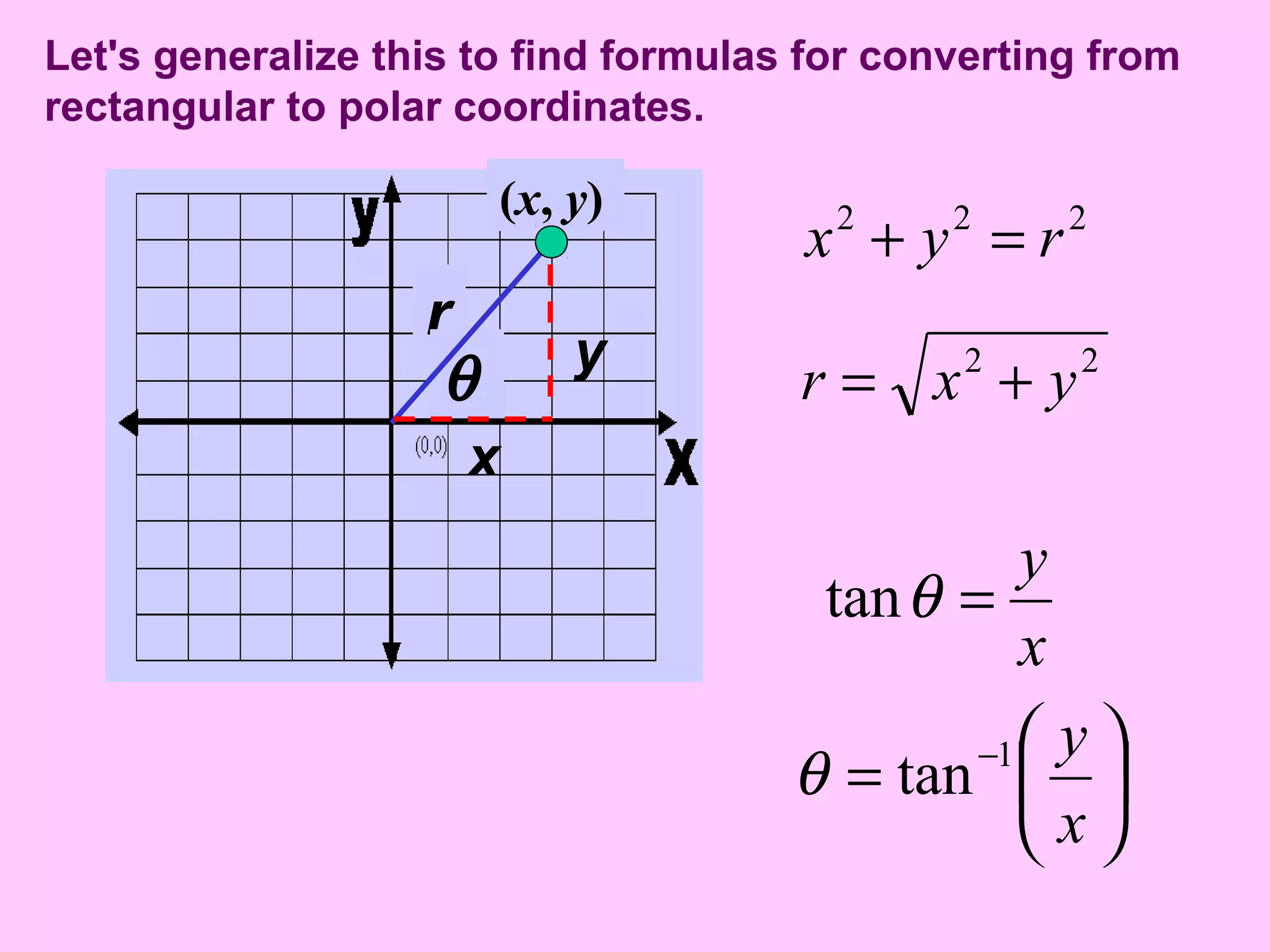
Let's generalize this to find formulas for converting from
rectangular to polar coordinates.
(x, y)
r
θ y
x
222
ryx =+
x
y
=θtan
22
yxr +=






= −
x
y1
tanθ
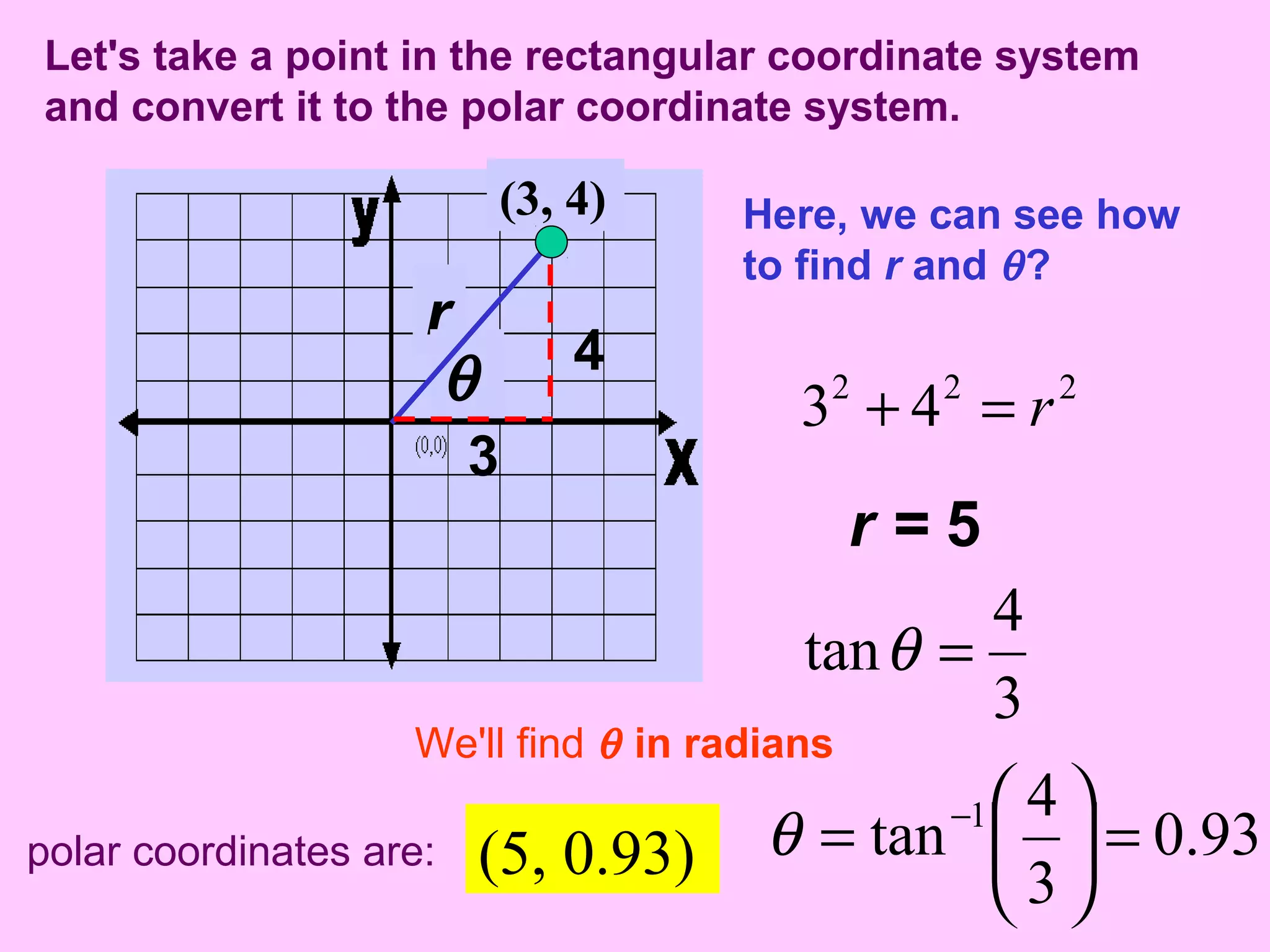
Let's take a point in the rectangular coordinate system
and convert it to the polar coordinate system.
(3, 4)
r
θ
Here, we can see how
to find r and θ?
4
3
r = 5
222
43 r=+
3
4
tan =θ
93.0
3
4
tan 1
=





= −
θ
We'll find θ in radians
(5, 0.93)polar coordinates are:
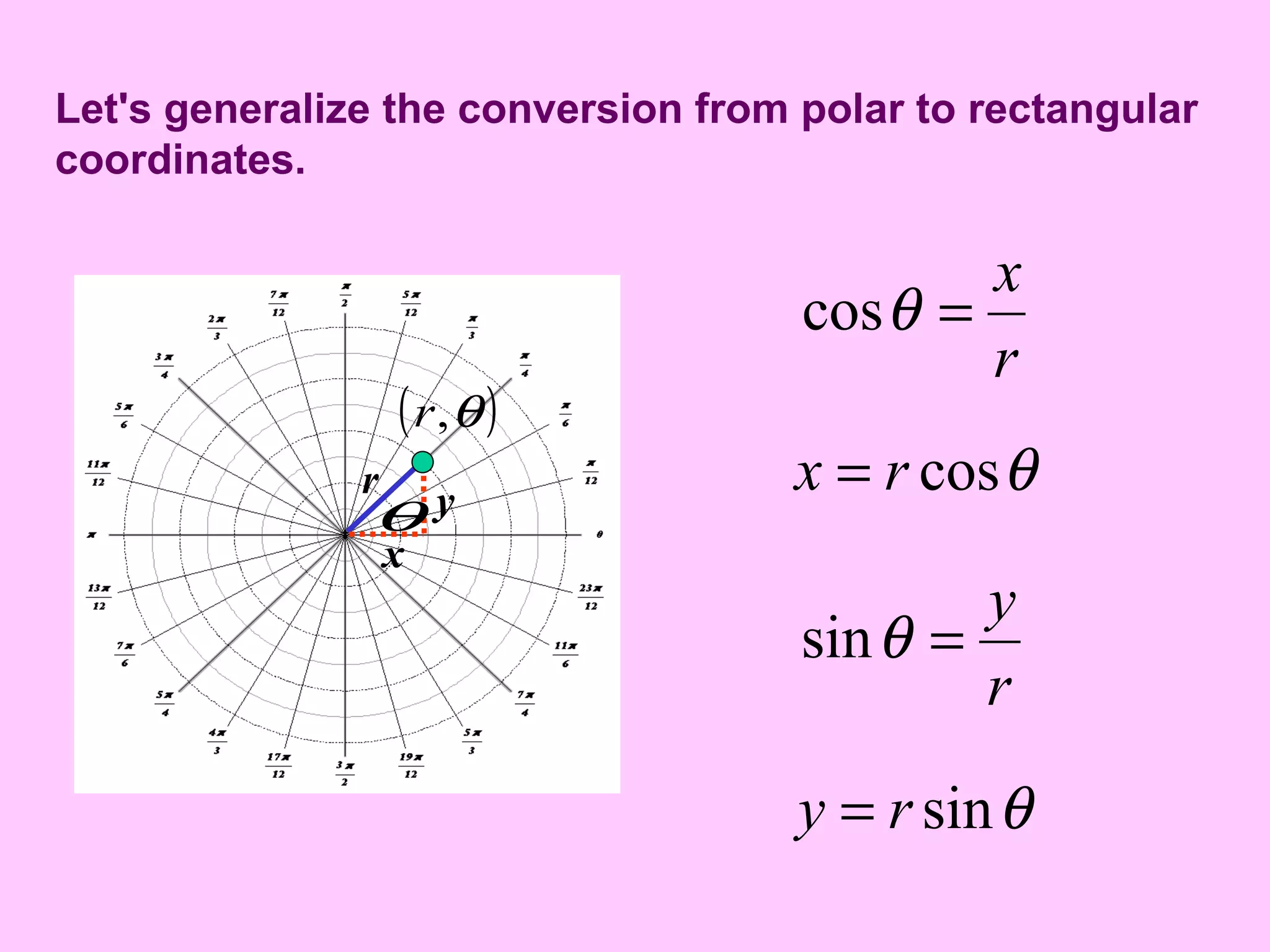
Let's generalize the conversion from polar to rectangular
coordinates.
r
x
=θcos
( )θ,r
r
y
x
θ
r
y
=θsin
θcosrx =
θsinry =
Spherical Polar Coordinate System- physics II

Spherical Polar Coordinate System- physics II

  • 2.
    Presented ByPresented By SonyaAkter Rupa ID-315161009 Department of CSE
  • 3.
    Presented ToPresented To Pro.Dr.AbuZafor Ziauddin Ahamed Lecturer of Physics Hamdard University Bangladesh
  • 4.
  • 5.
    • A coordinatesystem represents a point in the plane by an ordered pair of numbers called coordinates. • Usually, we use Cartesian coordinates, which are directed distances from two perpendicular axes. • A coordinate system introduced by Newton, called the polar coordinate system. Polar Co-ordinate system
  • 6.
    • We choosea point in the plane that is called the pole (or origin) and is labeled O. • Then, we draw a ray (half-line) starting at O called the polar axis. • If P is any other point in the plane, let  r be the distance from O to P.  θ be the angle (usually measured in radians) between the polar axis and the line OP. Pole and Polar-axis
  • 7.
    Plotting with arectangular coordinate system. A new coordinate system called the polar coordinate system.
  • 8.
    The center ofthe graph is called the pole. Angles are measured from the positive x axis. Points are represented by a radius and an angle (r, θ) radius angle To plot the point       4 ,5 π First find the angle Then move out along the terminal side 5
  • 9.
    CARTESIAN & POLARCOORDINATES • If the point P has Cartesian Coordinates (x, y) and polar coordinates (r, θ), then, from the figure, we have: cos sin x y r r θ θ= = Therefore, cos sin x r y r θ θ = =
  • 10.
    Let's generalize thisto find formulas for converting from rectangular to polar coordinates. (x, y) r θ y x 222 ryx =+ x y =θtan 22 yxr +=       = − x y1 tanθ
  • 11.
    Let's take apoint in the rectangular coordinate system and convert it to the polar coordinate system. (3, 4) r θ Here, we can see how to find r and θ? 4 3 r = 5 222 43 r=+ 3 4 tan =θ 93.0 3 4 tan 1 =      = − θ We'll find θ in radians (5, 0.93)polar coordinates are:
  • 12.
    Let's generalize theconversion from polar to rectangular coordinates. r x =θcos ( )θ,r r y x θ r y =θsin θcosrx = θsinry =