1
Spherical Trigonometry
SOLO HERMELIN
Updated 12.11.12http://www.solohermelin.com
2
SOLO
TABLE OF CONTENT
Spherical Trigonometry
History
Sine and Cosine Laws in Spherical Triangles
Half Angles Formulas
Delambre-Gauss Equations
Napier’s Equations
References
Applications: Flight on Earth Great Circles
3
SOLO
History
Spherical triangles were studied by early Greek
mathematicians such as Menelaus of Alexandria, who
wrote a book on spherical triangles called “Sphaerica “
and developed Menelaus' Theorem. E. S. Kennedy,
however, points out that while it was possible in ancient
mathematics to compute the magnitudes of a spherical
figure, in principle, by use of the table of chords and
Menelaus' theorem, the application of the theorem to
spherical problems was very difficult in practice
Further advances were made in the Islamic world. In order to observe holy days of
the Islamic calendar for which timings were determined by phases of the moon,
astronomers initially used Menalaus' method to calculate the place of the moon and
stars, though this method proved to be clumsy and difficult. It involved setting up two
intersecting right triangles; by applying Menelaus' theorem it was possible to solve
one of the six sides, but only if the other five sides were known. To tell the time from
the sun's altitude, for instance, repeated applications of Menelaus' theorem were
required. For medieval Islamic astronomers, there was an obvious challenge to find a
simpler trigonometric method.
Spherical Trigonometry
4
SOLO
History (continue - 1)
In the early 9th century, the Persian mathematician Muhammad
ibn Mūsā al-Khwārizmi was a pioneer in spherical trigonometry
and wrote a treatise on the subject. In the 10th century, another
Persian mathematician, Abū al-Wafā' al-Būzjāni, established the
angle addition formulas, e.g. for sin(a + b), and discovered the
sine formula for spherical trigonometry
Abū Abdallāh Mu ammadʿ ḥ
ibn Mūsā al-Khwārizmī[
(c. 780 – c. 850)
Abū al-Wafā , Mu ammad ibnʾ ḥ
Mu ammad ibn Ya yā ibn Ismā īlḥ ḥ ʿ
ibn al- Abbās al-Būzjānīʿ
(940 –998)
Here, a, b, and c are the angles at the centre of the
sphere subtended by the three sides of the triangle,
and α, β, and γ are the angles between the sides, where
angle α is opposite the side which subtends angle a,
and so forth
Spherical Trigonometry
5
SOLO
History (continue - 2)
Al-Jayyani (989–1079), an Arabic mathematician in the Islamic
Iberian Peninsula, wrote what some consider the first treatise on
spherical trigonometry, circa 1060, entitled The book of
unknown arcs of a sphere,[6]
in which spherical trigonometry was
brought into its modern form. Al-Jayyani's book "contains
formulae for right-angle triangles, the general law of sines and
the solution of a spherical triangle by means of the polar
triangle". This treatise later had a "strong influence on
European mathematics", and his "definition of ratios as
numbers" and "method of solving a spherical triangle when all
sides are unknown" are likely to have influenced
Regiomontanus.
In the 13th century, Persian mathematician Nasīr al-Dīn al-Tūsī
was the first to treat trigonometry as a mathematical discipline
independent from astronomy, and he further developed spherical
trigonometry, bringing it to its present form.[7]
He listed the six
distinct cases of a right-angled triangle in spherical
trigonometry. In his On the Sector Figure, he also stated the law
of sines for plane and spherical triangles, and discovered the law
of tangents for spherical triangles
Khawaja Muhammad ibn
Muhammad
ibn Hasan Tūsī
(1201 -1274 )
Abū Abd Allāh Mu ammadʿ ḥ
ibn Mu ādh al-Jayyānīʿ [1]
(989– 1079
Spherical Trigonometry
Return to Table of Content
6
SOLO
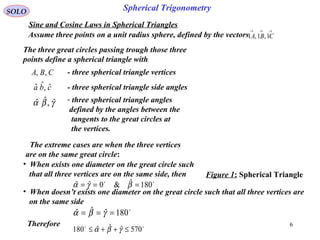
Assume three points on a unit radius sphere, defined by the vectors
→→→
CBA 1,1,1
Figure 1: Spherical Triangle
The three great circles passing trough those three
points define a spherical triangle with
- three spherical triangle verticesCBA ,,
- three spherical triangle side anglescba ˆ,ˆˆ
- three spherical triangle angles
defined by the angles between the
tangents to the great circles at
the vertices.
γβα ˆ,ˆˆ
The extreme cases are when the three vertices
are on the same great circle:
• When exists one diameter on the great circle such
that all three vertices are on the same side, then

180ˆ&0ˆˆ === βγα
• When doesn’t exists one diameter on the great circle such that all three vertices are
on the same side

180ˆˆˆ === γβα
Therefore 
570ˆˆˆ180 ≤++≤ γβα
Spherical Trigonometry
Sine and Cosine Laws in Spherical Triangles
7
SOLO
Those angles can be defined using unit vectors as follows
→→→
CBA 1,1,1

180ˆ,ˆ,ˆ0
11ˆsin&11ˆcos
11ˆsin&11ˆcos
11ˆsin&11ˆcos
≤≤
×=⋅=
×=⋅=
×=⋅=
→→→→
→→→→
→→→→
cba
BAcBAc
ACbACb
CBaCBa
0ˆsin&0ˆsin&0ˆsin
ˆsinˆsin
1111
ˆsin&
ˆsinˆsin
1111
ˆcos
ˆsinˆsin
1111
ˆsin&
ˆsinˆsin
1111
ˆcos
ˆsinˆsin
1111
ˆsin&
ˆsinˆsin
1111
ˆcos
≠≠≠






××





×
=






×⋅





×
=






××





×
=






×⋅





×
=






××





×
=






×⋅





×
=
→→→→→→→→
→→→→→→→→
→→→→→→→→
cba
ab
BCAC
ab
BCAC
ca
ABCB
ca
ABCB
bc
CABA
bc
CABA
γγ
ββ
αα

180ˆ,ˆ,ˆ0 ≤≤ γβα
1
2
Spherical Trigonometry
Sine and Cosine Laws in Spherical Triangles
8
SOLO
We will use the following vector identities
→→→→→→→→→






⋅−





⋅≡





×× wvuvwuwvu
→→→→→→→→→
⋅





×≡⋅





×≡⋅





× vuwuwvwvu
to perform the following computations
3
4
abcBCACBACCBCACBCACab
cabABCBACBBABCBABCBca
bcaCABACBAACABACABAbc
ˆcosˆcosˆcos1111111111111111ˆsinˆsinˆcos
1
1
1
−=





⋅





⋅−





⋅





⋅=











××⋅=





×⋅





×=
−=





⋅





⋅−





⋅





⋅=











××⋅=





×⋅





×=
−=





⋅





⋅−





⋅





⋅=











××⋅=





×⋅





×=
→→→→→→→→→→→→→→→→
→→→→→→→→→→→→→→→→
→→→→→→→→→→→→→→→→



γ
β
α
5
We obtained the Laws of Cosines for Spherical Triangle Sides
6
Spherical Trigonometry
Sine and Cosine Laws in Spherical Triangles
γ
β
α
ˆcosˆsinˆsinˆcosˆcosˆcos
babac
cacab
cbcba
+=
+=
+=
9
SOLO
ab
abc
ca
cab
bc
bca
ˆsinˆsin
ˆcosˆcosˆcos
ˆcos
ˆsinˆsin
ˆcosˆcosˆcosˆcos
ˆsinˆsin
ˆcosˆcosˆcos
ˆcos
−
=
−
=
−
=
γ
β
α
6
Let compute
( )( )
ab
abccba
ab
abcabcab
ab
abcabc
ab
abc
ˆsinˆsin
ˆcosˆcosˆcos2ˆcosˆcosˆcos1
ˆsinˆsin
ˆcosˆcosˆcos2ˆcosˆcosˆcosˆcos1ˆcos1
ˆsinˆsin
ˆcosˆcosˆcos2ˆcosˆcosˆcos
1
ˆsinˆsin
ˆcosˆcosˆcos
1ˆcos1ˆsin
22
222
22
22222
22
222
2
22
+−−−
=
+−−−−
=
−+
−=






 −
−=−= γγ
from which
abccbaab ˆcosˆcosˆcos2ˆcosˆcosˆcos1ˆsinˆsinˆsin 222
+−−−=γ7
The plus sign is used since, by definition, 0ˆsin,ˆsin,ˆsin ≥abγ
Spherical Trigonometry
Sine and Cosine Laws in Spherical Triangles
10
SOLO
γβα ˆsin,ˆsin,ˆsin
From the definitions of, given by (1) and (2), we have
→→→→→→→→→→→→→→→
→→→→→→→→→→→→→→→
→→→→→→→→→→→→→→→
⋅





×=





⋅





×−





⋅





×=





××





×=
⋅





×=





⋅





×−





⋅





×=





××





×=
⋅





×=





⋅





×−





⋅





×=





××





×=
BACACACCBACBCACab
ACBABCBBACBABCBca
CBACABAACBACABAbc
111111111111111ˆsinˆsinˆsin
0
0
0
  
  
  
γ
β
α
But since
→→→→→→→→→
⋅





×=⋅





×=⋅





× BACACBCBA 111111111
we have
abccba
abcabc
ˆcosˆcosˆcos2ˆcosˆcosˆcos1
ˆsinˆsinˆsinˆsinˆsinˆsinˆsinˆsinˆsin
222
+−−−=
== γβα
by dividing this equation by we obtain the Law of Sines for
Spherical Triangle
bca ˆsinˆsinˆsin
cba
abccba
cba ˆsinˆsinˆsin
ˆcosˆcosˆcos2ˆcosˆcosˆcos1
ˆsin
ˆsin
ˆsin
ˆsin
ˆsin
ˆsin
222
+−−−
===
γβα
8
9
Spherical Trigonometry
Sine and Cosine Laws in Spherical Triangles
11
SOLO
10
Let compute the expression
bca
bcacba
a
bca
bcacba
a
bca
bcacaabbcbcaaa
ab
abc
ca
cab
bc
bca
ˆsinˆsinˆsin
ˆcosˆcosˆcos2ˆcosˆcosˆcos1
ˆcos
ˆsinˆsinˆsin
ˆcosˆcosˆcos2ˆcosˆcosˆsin
ˆcos
ˆsinˆsinˆsin
ˆcosˆcosˆcosˆcosˆcosˆcosˆcosˆcosˆcosˆcosˆcosˆsinˆcosˆsin
ˆsinˆsin
ˆcosˆcosˆcos
ˆsinˆsin
ˆcosˆcosˆcos
ˆsinˆsin
ˆcosˆcosˆcos
ˆcosˆcosˆcos
2
222
2
222
2
22222
+−−−
=
+−−
=
+−−+−
=
−−
+
−
=+ γβα
But from (8)
( )( )abcaabccba ˆsinˆsinˆsinˆsinˆsinˆsinˆcosˆcosˆcos2ˆcosˆcosˆcos1 222
γβ=+−−−
Substituting this in (10) gives γβγβα ˆsinˆsinˆcosˆcosˆcosˆcos a=+
Finally we can write the Laws of Cosines for Spherical Triangle Angles.
11
Spherical Trigonometry
Sine and Cosine Laws in Spherical Triangles
Return to Table of Content
c
b
a
ˆcosˆsinˆsinˆcosˆcosˆcos
βαβαγ
γαγαβ
γβγβα
+−=
+−=
+−=
12
SOLO
Half Angles Formulas
From (6)
bc
bca
ˆsinˆsin
ˆcosˆcosˆcos
ˆcos
−
=α
Using the half angle formulas from trigonometry, we have
( )
bc
b
cba
c
cba
bc
cbacba
bc
acb
bc
bcabc
ˆsinˆsin
ˆ
2
ˆˆˆ
sinˆ
2
ˆˆˆ
sin
ˆsinˆsin2
2
ˆˆˆ
sin
2
ˆˆˆ
sin2
ˆsinˆsin2
ˆcosˆˆcos
ˆsinˆsin2
ˆcosˆcosˆcosˆsinˆsin
2
ˆcos1
2
ˆ
sin 2








−
++








−
++
=







 +−







 −+
=
−−
=
+−
=
−
=
αα
If we define
2
ˆˆˆ
:ˆ
cba
p
++
=
we obtain
( ) ( )
bc
bpcp
ˆsinˆsin
ˆˆsinˆˆsin
2
ˆ
sin
−−
=
α
12
Spherical Trigonometry
13
SOLO
Half Angles Formulas (continue – 1)
13
In the same way
( )
( ) ( )
bc
app
bc
acbcba
bc
cba
bc
bcabc
ˆsinˆsin
ˆˆsinˆsin
ˆsinˆsin2
2
ˆˆˆ
sin
2
ˆˆˆ
sin2
ˆsinˆsin2
ˆˆcosˆcos
ˆsinˆsin2
ˆcosˆcosˆcosˆsinˆsin
2
ˆcos1
2
ˆ
cos2
−
=







 −+







 ++
=
+−
=
−+
=
+
=
αα
( ) ( )
bc
app
ˆsinˆsin
ˆˆsinˆsin
2
ˆ
cos
−
=
α
or
From (12) and (13)
( ) ( )
( )app
bpcp
ˆˆsinˆsin
ˆˆsinˆˆsin
2
ˆ
tan
−
−−
=
α
14
2
ˆˆˆ
:ˆ
cba
p
++
=
Spherical Trigonometry
14
SOLO
Half Angles Formulas (continue – 2)
and
( ) ( ) ( )
bc
cpbpapp
ˆsinˆsin
ˆˆsinˆˆsinˆˆsinˆsin
2
ˆ
cos
2
ˆ
sin2ˆsin
−−−
==
αα
α
2
ˆˆˆ
:ˆ
cba
p
++
=
from this equation and (8) we obtain
( ) ( ) ( )
abccba
cpbpappbc
ˆcosˆcosˆcos2ˆcosˆcosˆcos1
ˆˆsinˆˆsinˆˆsinˆsinˆsinˆsinˆsin
222
+−−−=
−−−=α
15
Spherical Trigonometry
15
SOLO
Half Angles Formulas (continue – 3)
In the same way from (11)
16
βγ
βγα
ˆsinˆsin
ˆcosˆcosˆcos
ˆcos
+
=a
we can write
( )
βγ
α
αβγβγα
βγ
αβγβγα
βγ
βγα
βγ
βγαβγ
ˆsinˆsin
ˆ
2
ˆˆˆ
cos
2
ˆˆˆ
cos
ˆsinˆsin2
2
ˆˆˆ
cos
2
ˆˆˆ
cos2
ˆsinˆsin2
ˆˆcosˆcos
ˆsinˆsin2
ˆcosˆcosˆcosˆsinˆsin
2
ˆcos1
2
ˆ
sin2








−
++







 ++
−=







 −+







 ++
−=
++
−=
−−
=
−
=
aa
If we define
2
ˆˆˆ
:ˆ
βγα
σ
++
=
we obtain
( ) ( )
βγ
ασσ
ˆsinˆsin
ˆˆcosˆcos
2
ˆ
sin
−
−=
a
17
Spherical Trigonometry
16
SOLO
Half Angles Formulas (continue – 4)
Also
18
( )
( ) ( )
βγ
βσγσ
βγ
γβαγβα
βγ
γβα
βγ
βγαβγ
ˆsinˆsin
ˆˆcosˆˆcos
ˆsinˆsin2
2
ˆˆˆ
cos
2
ˆˆˆ
cos2
ˆsinˆsin2
ˆˆcosˆcos
ˆsinˆsin2
ˆcosˆcosˆcosˆsinˆsin
2
ˆcos1
2
ˆ
cos2
−−
=







 +−







 −+
=
−+
=
++
=
+
=
aa
from which
( ) ( )
βγ
βσγσ
ˆsinˆsin
ˆˆcosˆˆcos
2
ˆ
cos
−−
=
a
From (17) and (18)
( ) ( )
( ) ( )βσγσ
ασσ
ˆˆcosˆˆcos
ˆˆcosˆcos
2
ˆ
tan
−−
−
−=
a
19
Spherical Trigonometry
17
SOLO
Half Angles Formulas (continue – 5)
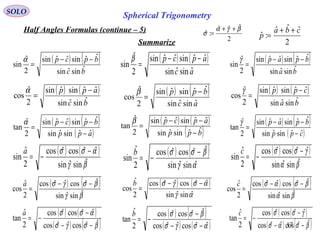
Summarize
Spherical Trigonometry
( ) ( )
βγ
βσγσ
ˆsinˆsin
ˆˆcosˆˆcos
2
ˆ
cos
−−
=
a
( ) ( )
( ) ( )βσγσ
ασσ
ˆˆcosˆˆcos
ˆˆcosˆcos
2
ˆ
tan
−−
−
−=
a
( ) ( )
βγ
ασσ
ˆsinˆsin
ˆˆcosˆcos
2
ˆ
sin
−
−=
a
( ) ( )
bc
app
ˆsinˆsin
ˆˆsinˆsin
2
ˆ
cos
−
=
α
( ) ( )
( )app
bpcp
ˆˆsinˆsin
ˆˆsinˆˆsin
2
ˆ
tan
−
−−
=
α
( ) ( )
bc
bpcp
ˆsinˆsin
ˆˆsinˆˆsin
2
ˆ
sin
−−
=
α
( ) ( )
αγ
ασγσ
ˆsinˆsin
ˆˆcosˆˆcos
2
ˆ
cos
−−
=
b
( ) ( )
( ) ( )ασγσ
βσσ
ˆˆcosˆˆcos
ˆˆcosˆcos
2
ˆ
tan
−−
−
−=
b
( ) ( )
αγ
βσσ
ˆsinˆsin
ˆˆcosˆcos
2
ˆ
sin
−
−=
b
( ) ( )
( )cpp
bpap
ˆˆsinˆsin
ˆˆsinˆˆsin
2
ˆ
tan
−
−−
=
γ
( ) ( )
βα
βσασ
ˆsinˆsin
ˆˆcosˆˆcos
2
ˆ
cos
−−
=
c
( ) ( )
( ) ( )βσασ
γσσ
ˆˆcosˆˆcos
ˆˆcosˆcos
2
ˆ
tan
−−
−
−=
c
( ) ( )
βα
γσσ
ˆsinˆsin
ˆˆcosˆcos
2
ˆ
sin
−
−=
c
( ) ( )
( )bpp
apcp
ˆˆsinˆsin
ˆˆsinˆˆsin
2
ˆ
tan
−
−−
=
β
( ) ( )
ac
bpp
ˆsinˆsin
ˆˆsinˆsin
2
ˆ
cos
−
=
β
( ) ( )
ac
apcp
ˆsinˆsin
ˆˆsinˆˆsin
2
ˆ
sin
−−
=
β
( ) ( )
ba
cpp
ˆsinˆsin
ˆˆsinˆsin
2
ˆ
cos
−
=
γ
( ) ( )
ba
bpap
ˆsinˆsin
ˆˆsinˆˆsin
2
ˆ
sin
−−
=
γ
2
ˆˆˆ
:ˆ
βγα
σ
++
=
2
ˆˆˆ
:ˆ
cba
p
++
=
18
SOLO
Half Angles Formulas (continue – 6)
And
20
( ) ( ) ( ) ( )
βγ
γσβσασσ
ˆsinˆsin
ˆˆcosˆˆcosˆˆcosˆcos
2
ˆ
cos
2
ˆ
sin2ˆsin
−−−−
==
aa
a
( ) ( ) ( ) ( )γσβσασσβγ ˆˆcosˆˆcosˆˆcosˆcosˆsinˆsinˆsin −−−−=a
or
By cyclic substitution of the angles we obtain
( ) ( ) ( ) ( )γσβσασσ
βαγαγβ
ˆˆcosˆˆcosˆˆcosˆcos
ˆsinˆsinˆsinˆsinˆsinˆsinˆsinˆsinˆsin
−−−−=
== cba
γβα ˆsinˆsinˆsinLet divide by this equation to recover the Law of Sines (9)
( ) ( ) ( ) ( )
( ) ( ) ( ) ( ) ( )
cba
cpbpapp
cba
abccba
cba
ˆsinˆsinˆsin
ˆˆsinˆˆsinˆˆsinˆsin
ˆsinˆsinˆsin
ˆcosˆcosˆcos2ˆcosˆcosˆcos1
ˆˆcosˆˆcosˆˆcosˆcos
ˆsinˆsinˆsin
ˆsin
ˆsin
ˆsin
ˆsin
ˆsin
ˆsin
152229 −−−
=
+−−−
=
−−−−
===
γσβσασσ
γβαγβα
21
22
Spherical Trigonometry
Return to Table of Content
19
SOLO
Delambre-Gauss Equations
Jean Baptiste Joseph
chevalier Delambre
(1749 –1822)
Using (12) and (13) we can write
2
ˆ
sin
2
ˆ
cos
2
ˆ
cos
2
ˆ
sin
2
ˆˆ
sin
βαβαβα
±=
±
( ) ( ) ( ) ( ) ( ) ( )
ca
cpap
cb
app
ca
bpp
bc
bpcp
ˆsinˆsin
ˆˆsinˆˆsin
ˆsinˆsin
ˆˆsinˆsin
ˆsinˆsin
ˆˆsinˆsin
ˆsinˆsin
ˆˆsinˆˆsin −−−
±
−−−
=
( ) ( ) ( )[ ]














 −







 +
−







 −







 +
−
=−±−
−
=
2
ˆˆ
sin
2
ˆˆ
ˆcos2
2
ˆˆ
cos
2
ˆˆ
ˆsin2
2
ˆ
cos
ˆsin
1
ˆˆsinˆˆsin
ˆsinˆsin
ˆˆsinˆsin
ˆsin
1
baba
p
baba
p
c
apbp
ba
cpp
c
γ











−
−
=







−
−
=
2
ˆ
cos
2
ˆ
sin
2
ˆˆ
sin
2
ˆ
cos
2
ˆ
cos
2
ˆˆ
cos
2
ˆˆ
sin
2
ˆ
cos2
2
ˆˆ
cos
2
ˆ
sin2
2
ˆ
cos
2
ˆ
cos
2
ˆ
sin2
1
γ
γ
γ
c
ba
c
ba
bac
bac
cc
Spherical Trigonometry
Carl Friedrich
Gauss
(1777 – 1855)
20
SOLO
Delambre-Gauss Equations (continue – 1)
Jean Baptiste Joseph
chevalier Delambre
(1749 –1822)
Therefore
2
ˆ
cos
2
ˆˆ
cos
2
ˆ
cos
2
ˆˆ
sin
γβα bac −
=
+
23
2
ˆ
cos
2
ˆˆ
sin
2
ˆ
sin
2
ˆˆ
sin
γβα bac −
=
−24
Spherical Trigonometry
Carl Friedrich
Gauss
(1777 – 1855)
The Delambre-Gauss Formulas were first discovered by Delambre in 1807
(published in 1809) and rediscovered independently by Gauss.
Delambre: Director of Paris Observatory (1804 – 1822)
Gauss : Director of Gőttingen Observatory (1807 – 1855)
21
SOLO
Delambre-Gauss Equations (continue – 2)
Jean Baptiste Joseph
chevalier Delambre
(1749 –1822)
25
Also
2
ˆ
sin
2
ˆ
sin
2
ˆ
cos
2
ˆ
cos
2
ˆˆ
cos
βαβαβα
=
±
( ) ( ) ( ) ( ) ( ) ( )
ca
cpap
bc
bpcp
ca
bpp
cb
app
ˆsinˆsin
ˆˆsinˆˆsin
ˆsinˆsin
ˆˆsinˆˆsin
ˆsinˆsin
ˆˆsinˆsin
ˆsinˆsin
ˆˆsinˆsin −−−−−−
= 
( ) ( ) ( )[ ]













−






−
=−
−−
=
2
ˆ
ˆsin
2
ˆ
cos2
2
ˆ
ˆcos
2
ˆ
sin2
2
ˆ
sin
ˆsin
1
ˆˆsinˆsin
ˆsinˆsin
ˆˆsinˆˆsin
ˆsin
1
c
p
c
c
p
c
c
cpp
ba
apbp
c
γ












+
+
=







+
+
=
2
ˆ
sin
2
ˆ
sin
2
ˆˆ
sin
2
ˆ
sin
2
ˆ
cos
2
ˆˆ
cos
2
ˆˆ
sin
2
ˆ
cos2
2
ˆˆ
cos
2
ˆ
sin2
2
ˆ
sin
2
ˆ
cos
2
ˆ
sin2
1
γ
γ
γ
c
ba
c
ba
bac
bac
cc
Therefore
2
ˆ
sin
2
ˆˆ
cos
2
ˆ
cos
2
ˆˆ
cos
γβα bac +
=
+
2
ˆ
sin
2
ˆˆ
sin
2
ˆ
sin
2
ˆˆ
cos
γβα bac +
=
−26
Spherical Trigonometry
Return to Table of Content
Carl Friedrich
Gauss
(1777 – 1855)
22
SOLO
Napier’s Equations [4]
John Napier
of Merchiston
(1550 –1617)
Divide (23) by (25)
2
ˆ
cot
2
ˆˆ
cos
2
ˆˆ
cos
2
ˆˆ
tan
γβα
ba
ba
+
−
=
+
to obtain
28
Divide (24) by (26)
2
ˆ
cot
2
ˆˆ
sin
2
ˆˆ
sin
2
ˆˆ
tan
γβα
ba
ba
+
−
=
−
to obtain
27
Spherical Trigonometry
2
ˆˆ
sin
2
ˆˆ
sin
2
ˆ
cot
2
ˆˆ
tan
ba
ba
+
−
=
−
γ
βα
2
ˆˆ
cos
2
ˆˆ
cos
2
ˆ
cot
2
ˆˆ
tan
ba
ba
+
−
=
+
γ
βα
23
SOLO
Napier’s Equations (continue)
Divide (24) by (23)
to obtain
29
Divide (26) by (25)
to obtain
30
2
ˆˆ
tan
2
ˆ
tan
2
ˆˆ
sin
2
ˆˆ
sin
bac −
=
+
−
βα
βα
2
ˆˆ
tan
2
ˆ
tan
2
ˆˆ
cos
2
ˆˆ
cos
bac +
=
+
−
βα
βα
Spherical Trigonometry
John Napier
of Merchiston
(1550 –1617)
Return to Table of Content
2
ˆˆ
sin
2
ˆˆ
sin
2
ˆ
tan
2
ˆˆ
tan
βα
βα
+
−
=
−
c
ba
2
ˆˆ
cos
2
ˆˆ
cos
2
ˆ
tan
2
ˆˆ
tan
βα
βα
+
−
=
+
c
ba
24
SOLO
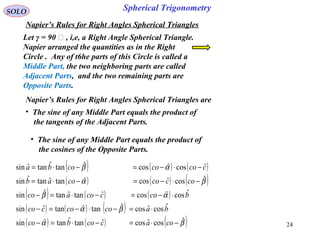
Napier’s Rules for Right Angles Spherical Triangles
Let γ = 90 ͦ , i,e, a Right Angle Spherical Triangle.
Napier arranged the quantities as in the Right
Circle . Any of t6he parts of this Circle is called a
Middle Part, the two neighboring parts are called
Adjacent Parts, and the two remaining parts are
Opposite Parts.
( ) ( ) ( )
( ) ( ) ( )
( ) ( ) ( )
( ) ( ) ( )
( ) ( ) ( )βα
βα
αβ
βα
αβ
ˆcosˆcosˆtanˆtanˆsin
−⋅=−⋅=−
⋅=−⋅−=−
⋅−=−⋅=−
−⋅−=−⋅=
−⋅−=−⋅=
coaccobco
bacococco
bcoccoaco
coccocoab
ccococoba
Spherical Trigonometry
Napier’s Rules for Right Angles Spherical Triangles are
• The sine of any Middle Part equals the product of
the tangents of the Adjacent Parts.
• The sine of any Middle Part equals the product of
the cosines of the Opposite Parts.
25
SOLO
Napier’s Rules for Right Angles Spherical Triangles
Let γ = 90 ͦ , i,e, a Right Angle Spherical Triangle.
Napier arranged the quantities as in the Right
Circle . Any of t6he parts of this Circle is called a
Middle Part, the two neighboring parts are called
Adjacent Parts, and the two remaining parts are
Opposite Parts.
βα
βα
αβ
βα
αβ
ˆsinˆcosˆcotˆtanˆcos
ˆcosˆcosˆcotˆcotˆcos
ˆcosˆsinˆcotˆtanˆcos
ˆsinˆsinˆcotˆtanˆsin
⋅=⋅=
⋅=⋅=
⋅=⋅=
⋅=⋅=
⋅=⋅=
acb
bac
bca
cab
cba
Spherical Trigonometry
Return to Table of Content
Napier’s Rules for Right Angles Spherical Triangles are
• The sine of any Middle Part equals the product of
the tangents of the Adjacent Parts.
• The sine of any Middle Part equals the product of
the cosines of the Opposite Parts.
The final result is
26
NavigationSOLO
Flight on Earth Great Circles
The Shortest Flight Path between
two points 1 and 2 on the
Earth is on the Great Circles
(centered at Earth Center)
passing through those points.
The Great Circle Distance between two points 1 and 2 is ρ.
The average Radius on the Great Circle is a = (R1+R2)/2
θρ ⋅= a kmNmNma 852.11deg/76.60/ =≈ρ
1
2
111 ,, λφR
222 ,, λφR
R – radius
- Latitudeϕ
λ - Longitude
27
NavigationSOLO
Flight on Earth Great Circles
The Great Circle Distance between two points 1 and
2 is ρ.
θρ ⋅= a
1
2
111 ,, λφR
222 ,, λφR
R – radius
- Latitudeϕ
λ - Longitude
( )
( ) ( ) ( ) ( ) ( )212121 cos90sin90sin90cos90cos
/coscos
λλφφφφ
ρθ
−⋅−⋅−+−⋅−=
=

a
From the Law of Cosines for Spherical Triangles
or
( ) ( )212121 coscoscossinsin/cos λλφφφφρ −⋅⋅+⋅=a
( ){ }212121
1
coscoscossinsincos λλφφφφρ −⋅⋅+⋅⋅= −
a
The Initial Heading Angle ψ0 can be obtained using the
Law of Cosines for Spherical Triangles as follows
( )
( )a
a
/sincos
/cossinsin
cos
1
12
0
ρφ
ρφφ
ψ
⋅
⋅−
=
( )[ ]
( )[ ]2
222
22221
coscoscossinsin1cos
coscoscossinsinsinsin
cos
λλφφφφφ
λλφφφφφφ
ψ
−⋅⋅+⋅−⋅
−⋅⋅+⋅⋅−
= −
The Heading Angle ψ from the Present Position (R, ,λ) to Destination Point (Rϕ 2,ϕ2,λ2)
28
NavigationSOLO
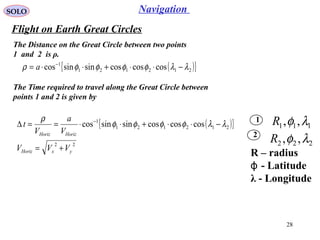
Flight on Earth Great Circles
The Distance on the Great Circle between two points
1 and 2 is ρ.
1
2
111 ,, λφR
222 ,, λφR
R – radius
- Latitudeϕ
λ - Longitude
The Time required to travel along the Great Circle between
points 1 and 2 is given by
( ){ }
22
212121
1
coscoscossinsincos
yxHoriz
HorizHoriz
VVV
V
a
V
t
+=
−⋅⋅+⋅⋅==∆ −
λλφφφφ
ρ
( ){ }212121
1
coscoscossinsincos λλφφφφρ −⋅⋅+⋅⋅= −
a
29
NavigationSOLO
Flight on Earth Great Circles
1
2
111 ,, λφR
222 ,, λφR
If the Aircraft flies with an Heading Error Δψ we want to calculate the Down Range
Error Xd and Cross Range Error Yd, in the Spherical Triangle APB.
R – radius
- Latitudeϕ
λ - Longitude
Using the Law of Cosines for Spherical Triangle APB we have
( ) ( )aaYd /sin
90sin
/sin
sin
ρ
ψ 
=
∆
( ) ( ) ( )
( ) ( ) 2/sin/sin
/cos/cos/cos
0ˆcos 21
90ˆ
RR
a
aYaX
aYaXa
P
dd
dd
P +
=
⋅
⋅−
==
= ρ

Using the Law of Sines for Spherical Triangle APB we have
( )
( )





⋅= −
aY
a
aX
d
d
/cos
/cos
cos 1 ρ
( )[ ]ψρ ∆⋅⋅= −
sin/sinsin 1
aaYd
Return to Table of Content
30
SOLO
References
http://en.wikipedia.org/wiki/
[1] Lass H, “Vector and Tensor Analysis”, McGraw-Hill, 1950, pp.25-27
[2] Wertz, J. editor, “Spacecraft Attitude Determination
andControl”,
Appendix A, D.Reidel Publishing Company, 1985
[3] “ASM Handbook of Engineering Mathematics”, American Society for
Metals, 1983, pp.86-89
[4] Tuma, J.J., “Engineering Mathematics Handbook”, 3 Edition,
McGraw-Hill, pp.34-35
Spherical Trigonometry
Return to Table of Content
http://mathworld.wolfram.com/SphericalTrigonometry.html
January 6, 2015 31
SOLO
Technion
Israeli Institute of Technology
1964 – 1968 BSc EE
1968 – 1971 MSc EE
Israeli Air Force
1970 – 1974
RAFAEL
Israeli Armament Development Authority
1974 – 2013
Stanford University
1983 – 1986 PhD AA

Spherical trigonometry

  • 1.
    1 Spherical Trigonometry SOLO HERMELIN Updated12.11.12http://www.solohermelin.com
  • 2.
    2 SOLO TABLE OF CONTENT SphericalTrigonometry History Sine and Cosine Laws in Spherical Triangles Half Angles Formulas Delambre-Gauss Equations Napier’s Equations References Applications: Flight on Earth Great Circles
  • 3.
    3 SOLO History Spherical triangles werestudied by early Greek mathematicians such as Menelaus of Alexandria, who wrote a book on spherical triangles called “Sphaerica “ and developed Menelaus' Theorem. E. S. Kennedy, however, points out that while it was possible in ancient mathematics to compute the magnitudes of a spherical figure, in principle, by use of the table of chords and Menelaus' theorem, the application of the theorem to spherical problems was very difficult in practice Further advances were made in the Islamic world. In order to observe holy days of the Islamic calendar for which timings were determined by phases of the moon, astronomers initially used Menalaus' method to calculate the place of the moon and stars, though this method proved to be clumsy and difficult. It involved setting up two intersecting right triangles; by applying Menelaus' theorem it was possible to solve one of the six sides, but only if the other five sides were known. To tell the time from the sun's altitude, for instance, repeated applications of Menelaus' theorem were required. For medieval Islamic astronomers, there was an obvious challenge to find a simpler trigonometric method. Spherical Trigonometry
  • 4.
    4 SOLO History (continue -1) In the early 9th century, the Persian mathematician Muhammad ibn Mūsā al-Khwārizmi was a pioneer in spherical trigonometry and wrote a treatise on the subject. In the 10th century, another Persian mathematician, Abū al-Wafā' al-Būzjāni, established the angle addition formulas, e.g. for sin(a + b), and discovered the sine formula for spherical trigonometry Abū Abdallāh Mu ammadʿ ḥ ibn Mūsā al-Khwārizmī[ (c. 780 – c. 850) Abū al-Wafā , Mu ammad ibnʾ ḥ Mu ammad ibn Ya yā ibn Ismā īlḥ ḥ ʿ ibn al- Abbās al-Būzjānīʿ (940 –998) Here, a, b, and c are the angles at the centre of the sphere subtended by the three sides of the triangle, and α, β, and γ are the angles between the sides, where angle α is opposite the side which subtends angle a, and so forth Spherical Trigonometry
  • 5.
    5 SOLO History (continue -2) Al-Jayyani (989–1079), an Arabic mathematician in the Islamic Iberian Peninsula, wrote what some consider the first treatise on spherical trigonometry, circa 1060, entitled The book of unknown arcs of a sphere,[6] in which spherical trigonometry was brought into its modern form. Al-Jayyani's book "contains formulae for right-angle triangles, the general law of sines and the solution of a spherical triangle by means of the polar triangle". This treatise later had a "strong influence on European mathematics", and his "definition of ratios as numbers" and "method of solving a spherical triangle when all sides are unknown" are likely to have influenced Regiomontanus. In the 13th century, Persian mathematician Nasīr al-Dīn al-Tūsī was the first to treat trigonometry as a mathematical discipline independent from astronomy, and he further developed spherical trigonometry, bringing it to its present form.[7] He listed the six distinct cases of a right-angled triangle in spherical trigonometry. In his On the Sector Figure, he also stated the law of sines for plane and spherical triangles, and discovered the law of tangents for spherical triangles Khawaja Muhammad ibn Muhammad ibn Hasan Tūsī (1201 -1274 ) Abū Abd Allāh Mu ammadʿ ḥ ibn Mu ādh al-Jayyānīʿ [1] (989– 1079 Spherical Trigonometry Return to Table of Content
  • 6.
    6 SOLO Assume three pointson a unit radius sphere, defined by the vectors →→→ CBA 1,1,1 Figure 1: Spherical Triangle The three great circles passing trough those three points define a spherical triangle with - three spherical triangle verticesCBA ,, - three spherical triangle side anglescba ˆ,ˆˆ - three spherical triangle angles defined by the angles between the tangents to the great circles at the vertices. γβα ˆ,ˆˆ The extreme cases are when the three vertices are on the same great circle: • When exists one diameter on the great circle such that all three vertices are on the same side, then  180ˆ&0ˆˆ === βγα • When doesn’t exists one diameter on the great circle such that all three vertices are on the same side  180ˆˆˆ === γβα Therefore  570ˆˆˆ180 ≤++≤ γβα Spherical Trigonometry Sine and Cosine Laws in Spherical Triangles
  • 7.
    7 SOLO Those angles canbe defined using unit vectors as follows →→→ CBA 1,1,1  180ˆ,ˆ,ˆ0 11ˆsin&11ˆcos 11ˆsin&11ˆcos 11ˆsin&11ˆcos ≤≤ ×=⋅= ×=⋅= ×=⋅= →→→→ →→→→ →→→→ cba BAcBAc ACbACb CBaCBa 0ˆsin&0ˆsin&0ˆsin ˆsinˆsin 1111 ˆsin& ˆsinˆsin 1111 ˆcos ˆsinˆsin 1111 ˆsin& ˆsinˆsin 1111 ˆcos ˆsinˆsin 1111 ˆsin& ˆsinˆsin 1111 ˆcos ≠≠≠       ××      × =       ×⋅      × =       ××      × =       ×⋅      × =       ××      × =       ×⋅      × = →→→→→→→→ →→→→→→→→ →→→→→→→→ cba ab BCAC ab BCAC ca ABCB ca ABCB bc CABA bc CABA γγ ββ αα  180ˆ,ˆ,ˆ0 ≤≤ γβα 1 2 Spherical Trigonometry Sine and Cosine Laws in Spherical Triangles
  • 8.
    8 SOLO We will usethe following vector identities →→→→→→→→→       ⋅−      ⋅≡      ×× wvuvwuwvu →→→→→→→→→ ⋅      ×≡⋅      ×≡⋅      × vuwuwvwvu to perform the following computations 3 4 abcBCACBACCBCACBCACab cabABCBACBBABCBABCBca bcaCABACBAACABACABAbc ˆcosˆcosˆcos1111111111111111ˆsinˆsinˆcos ˆcosˆcosˆcos1111111111111111ˆsinˆsinˆcos ˆcosˆcosˆcos1111111111111111ˆsinˆsinˆcos 1 1 1 −=      ⋅      ⋅−      ⋅      ⋅=            ××⋅=      ×⋅      ×= −=      ⋅      ⋅−      ⋅      ⋅=            ××⋅=      ×⋅      ×= −=      ⋅      ⋅−      ⋅      ⋅=            ××⋅=      ×⋅      ×= →→→→→→→→→→→→→→→→ →→→→→→→→→→→→→→→→ →→→→→→→→→→→→→→→→    γ β α 5 We obtained the Laws of Cosines for Spherical Triangle Sides 6 Spherical Trigonometry Sine and Cosine Laws in Spherical Triangles γ β α ˆcosˆsinˆsinˆcosˆcosˆcos ˆcosˆsinˆsinˆcosˆcosˆcos ˆcosˆsinˆsinˆcosˆcosˆcos babac cacab cbcba += += +=
  • 9.
    9 SOLO ab abc ca cab bc bca ˆsinˆsin ˆcosˆcosˆcos ˆcos ˆsinˆsin ˆcosˆcosˆcosˆcos ˆsinˆsin ˆcosˆcosˆcos ˆcos − = − = − = γ β α 6 Let compute ( )() ab abccba ab abcabcab ab abcabc ab abc ˆsinˆsin ˆcosˆcosˆcos2ˆcosˆcosˆcos1 ˆsinˆsin ˆcosˆcosˆcos2ˆcosˆcosˆcosˆcos1ˆcos1 ˆsinˆsin ˆcosˆcosˆcos2ˆcosˆcosˆcos 1 ˆsinˆsin ˆcosˆcosˆcos 1ˆcos1ˆsin 22 222 22 22222 22 222 2 22 +−−− = +−−−− = −+ −=        − −=−= γγ from which abccbaab ˆcosˆcosˆcos2ˆcosˆcosˆcos1ˆsinˆsinˆsin 222 +−−−=γ7 The plus sign is used since, by definition, 0ˆsin,ˆsin,ˆsin ≥abγ Spherical Trigonometry Sine and Cosine Laws in Spherical Triangles
  • 10.
    10 SOLO γβα ˆsin,ˆsin,ˆsin From thedefinitions of, given by (1) and (2), we have →→→→→→→→→→→→→→→ →→→→→→→→→→→→→→→ →→→→→→→→→→→→→→→ ⋅      ×=      ⋅      ×−      ⋅      ×=      ××      ×= ⋅      ×=      ⋅      ×−      ⋅      ×=      ××      ×= ⋅      ×=      ⋅      ×−      ⋅      ×=      ××      ×= BACACACCBACBCACab ACBABCBBACBABCBca CBACABAACBACABAbc 111111111111111ˆsinˆsinˆsin 111111111111111ˆsinˆsinˆsin 111111111111111ˆsinˆsinˆsin 0 0 0          γ β α But since →→→→→→→→→ ⋅      ×=⋅      ×=⋅      × BACACBCBA 111111111 we have abccba abcabc ˆcosˆcosˆcos2ˆcosˆcosˆcos1 ˆsinˆsinˆsinˆsinˆsinˆsinˆsinˆsinˆsin 222 +−−−= == γβα by dividing this equation by we obtain the Law of Sines for Spherical Triangle bca ˆsinˆsinˆsin cba abccba cba ˆsinˆsinˆsin ˆcosˆcosˆcos2ˆcosˆcosˆcos1 ˆsin ˆsin ˆsin ˆsin ˆsin ˆsin 222 +−−− === γβα 8 9 Spherical Trigonometry Sine and Cosine Laws in Spherical Triangles
  • 11.
    11 SOLO 10 Let compute theexpression bca bcacba a bca bcacba a bca bcacaabbcbcaaa ab abc ca cab bc bca ˆsinˆsinˆsin ˆcosˆcosˆcos2ˆcosˆcosˆcos1 ˆcos ˆsinˆsinˆsin ˆcosˆcosˆcos2ˆcosˆcosˆsin ˆcos ˆsinˆsinˆsin ˆcosˆcosˆcosˆcosˆcosˆcosˆcosˆcosˆcosˆcosˆcosˆsinˆcosˆsin ˆsinˆsin ˆcosˆcosˆcos ˆsinˆsin ˆcosˆcosˆcos ˆsinˆsin ˆcosˆcosˆcos ˆcosˆcosˆcos 2 222 2 222 2 22222 +−−− = +−− = +−−+− = −− + − =+ γβα But from (8) ( )( )abcaabccba ˆsinˆsinˆsinˆsinˆsinˆsinˆcosˆcosˆcos2ˆcosˆcosˆcos1 222 γβ=+−−− Substituting this in (10) gives γβγβα ˆsinˆsinˆcosˆcosˆcosˆcos a=+ Finally we can write the Laws of Cosines for Spherical Triangle Angles. 11 Spherical Trigonometry Sine and Cosine Laws in Spherical Triangles Return to Table of Content c b a ˆcosˆsinˆsinˆcosˆcosˆcos ˆcosˆsinˆsinˆcosˆcosˆcos ˆcosˆsinˆsinˆcosˆcosˆcos βαβαγ γαγαβ γβγβα +−= +−= +−=
  • 12.
    12 SOLO Half Angles Formulas From(6) bc bca ˆsinˆsin ˆcosˆcosˆcos ˆcos − =α Using the half angle formulas from trigonometry, we have ( ) bc b cba c cba bc cbacba bc acb bc bcabc ˆsinˆsin ˆ 2 ˆˆˆ sinˆ 2 ˆˆˆ sin ˆsinˆsin2 2 ˆˆˆ sin 2 ˆˆˆ sin2 ˆsinˆsin2 ˆcosˆˆcos ˆsinˆsin2 ˆcosˆcosˆcosˆsinˆsin 2 ˆcos1 2 ˆ sin 2         − ++         − ++ =         +−         −+ = −− = +− = − = αα If we define 2 ˆˆˆ :ˆ cba p ++ = we obtain ( ) ( ) bc bpcp ˆsinˆsin ˆˆsinˆˆsin 2 ˆ sin −− = α 12 Spherical Trigonometry
  • 13.
    13 SOLO Half Angles Formulas(continue – 1) 13 In the same way ( ) ( ) ( ) bc app bc acbcba bc cba bc bcabc ˆsinˆsin ˆˆsinˆsin ˆsinˆsin2 2 ˆˆˆ sin 2 ˆˆˆ sin2 ˆsinˆsin2 ˆˆcosˆcos ˆsinˆsin2 ˆcosˆcosˆcosˆsinˆsin 2 ˆcos1 2 ˆ cos2 − =         −+         ++ = +− = −+ = + = αα ( ) ( ) bc app ˆsinˆsin ˆˆsinˆsin 2 ˆ cos − = α or From (12) and (13) ( ) ( ) ( )app bpcp ˆˆsinˆsin ˆˆsinˆˆsin 2 ˆ tan − −− = α 14 2 ˆˆˆ :ˆ cba p ++ = Spherical Trigonometry
  • 14.
    14 SOLO Half Angles Formulas(continue – 2) and ( ) ( ) ( ) bc cpbpapp ˆsinˆsin ˆˆsinˆˆsinˆˆsinˆsin 2 ˆ cos 2 ˆ sin2ˆsin −−− == αα α 2 ˆˆˆ :ˆ cba p ++ = from this equation and (8) we obtain ( ) ( ) ( ) abccba cpbpappbc ˆcosˆcosˆcos2ˆcosˆcosˆcos1 ˆˆsinˆˆsinˆˆsinˆsinˆsinˆsinˆsin 222 +−−−= −−−=α 15 Spherical Trigonometry
  • 15.
    15 SOLO Half Angles Formulas(continue – 3) In the same way from (11) 16 βγ βγα ˆsinˆsin ˆcosˆcosˆcos ˆcos + =a we can write ( ) βγ α αβγβγα βγ αβγβγα βγ βγα βγ βγαβγ ˆsinˆsin ˆ 2 ˆˆˆ cos 2 ˆˆˆ cos ˆsinˆsin2 2 ˆˆˆ cos 2 ˆˆˆ cos2 ˆsinˆsin2 ˆˆcosˆcos ˆsinˆsin2 ˆcosˆcosˆcosˆsinˆsin 2 ˆcos1 2 ˆ sin2         − ++         ++ −=         −+         ++ −= ++ −= −− = − = aa If we define 2 ˆˆˆ :ˆ βγα σ ++ = we obtain ( ) ( ) βγ ασσ ˆsinˆsin ˆˆcosˆcos 2 ˆ sin − −= a 17 Spherical Trigonometry
  • 16.
    16 SOLO Half Angles Formulas(continue – 4) Also 18 ( ) ( ) ( ) βγ βσγσ βγ γβαγβα βγ γβα βγ βγαβγ ˆsinˆsin ˆˆcosˆˆcos ˆsinˆsin2 2 ˆˆˆ cos 2 ˆˆˆ cos2 ˆsinˆsin2 ˆˆcosˆcos ˆsinˆsin2 ˆcosˆcosˆcosˆsinˆsin 2 ˆcos1 2 ˆ cos2 −− =         +−         −+ = −+ = ++ = + = aa from which ( ) ( ) βγ βσγσ ˆsinˆsin ˆˆcosˆˆcos 2 ˆ cos −− = a From (17) and (18) ( ) ( ) ( ) ( )βσγσ ασσ ˆˆcosˆˆcos ˆˆcosˆcos 2 ˆ tan −− − −= a 19 Spherical Trigonometry
  • 17.
    17 SOLO Half Angles Formulas(continue – 5) Summarize Spherical Trigonometry ( ) ( ) βγ βσγσ ˆsinˆsin ˆˆcosˆˆcos 2 ˆ cos −− = a ( ) ( ) ( ) ( )βσγσ ασσ ˆˆcosˆˆcos ˆˆcosˆcos 2 ˆ tan −− − −= a ( ) ( ) βγ ασσ ˆsinˆsin ˆˆcosˆcos 2 ˆ sin − −= a ( ) ( ) bc app ˆsinˆsin ˆˆsinˆsin 2 ˆ cos − = α ( ) ( ) ( )app bpcp ˆˆsinˆsin ˆˆsinˆˆsin 2 ˆ tan − −− = α ( ) ( ) bc bpcp ˆsinˆsin ˆˆsinˆˆsin 2 ˆ sin −− = α ( ) ( ) αγ ασγσ ˆsinˆsin ˆˆcosˆˆcos 2 ˆ cos −− = b ( ) ( ) ( ) ( )ασγσ βσσ ˆˆcosˆˆcos ˆˆcosˆcos 2 ˆ tan −− − −= b ( ) ( ) αγ βσσ ˆsinˆsin ˆˆcosˆcos 2 ˆ sin − −= b ( ) ( ) ( )cpp bpap ˆˆsinˆsin ˆˆsinˆˆsin 2 ˆ tan − −− = γ ( ) ( ) βα βσασ ˆsinˆsin ˆˆcosˆˆcos 2 ˆ cos −− = c ( ) ( ) ( ) ( )βσασ γσσ ˆˆcosˆˆcos ˆˆcosˆcos 2 ˆ tan −− − −= c ( ) ( ) βα γσσ ˆsinˆsin ˆˆcosˆcos 2 ˆ sin − −= c ( ) ( ) ( )bpp apcp ˆˆsinˆsin ˆˆsinˆˆsin 2 ˆ tan − −− = β ( ) ( ) ac bpp ˆsinˆsin ˆˆsinˆsin 2 ˆ cos − = β ( ) ( ) ac apcp ˆsinˆsin ˆˆsinˆˆsin 2 ˆ sin −− = β ( ) ( ) ba cpp ˆsinˆsin ˆˆsinˆsin 2 ˆ cos − = γ ( ) ( ) ba bpap ˆsinˆsin ˆˆsinˆˆsin 2 ˆ sin −− = γ 2 ˆˆˆ :ˆ βγα σ ++ = 2 ˆˆˆ :ˆ cba p ++ =
  • 18.
    18 SOLO Half Angles Formulas(continue – 6) And 20 ( ) ( ) ( ) ( ) βγ γσβσασσ ˆsinˆsin ˆˆcosˆˆcosˆˆcosˆcos 2 ˆ cos 2 ˆ sin2ˆsin −−−− == aa a ( ) ( ) ( ) ( )γσβσασσβγ ˆˆcosˆˆcosˆˆcosˆcosˆsinˆsinˆsin −−−−=a or By cyclic substitution of the angles we obtain ( ) ( ) ( ) ( )γσβσασσ βαγαγβ ˆˆcosˆˆcosˆˆcosˆcos ˆsinˆsinˆsinˆsinˆsinˆsinˆsinˆsinˆsin −−−−= == cba γβα ˆsinˆsinˆsinLet divide by this equation to recover the Law of Sines (9) ( ) ( ) ( ) ( ) ( ) ( ) ( ) ( ) ( ) cba cpbpapp cba abccba cba ˆsinˆsinˆsin ˆˆsinˆˆsinˆˆsinˆsin ˆsinˆsinˆsin ˆcosˆcosˆcos2ˆcosˆcosˆcos1 ˆˆcosˆˆcosˆˆcosˆcos ˆsinˆsinˆsin ˆsin ˆsin ˆsin ˆsin ˆsin ˆsin 152229 −−− = +−−− = −−−− === γσβσασσ γβαγβα 21 22 Spherical Trigonometry Return to Table of Content
  • 19.
    19 SOLO Delambre-Gauss Equations Jean BaptisteJoseph chevalier Delambre (1749 –1822) Using (12) and (13) we can write 2 ˆ sin 2 ˆ cos 2 ˆ cos 2 ˆ sin 2 ˆˆ sin βαβαβα ±= ± ( ) ( ) ( ) ( ) ( ) ( ) ca cpap cb app ca bpp bc bpcp ˆsinˆsin ˆˆsinˆˆsin ˆsinˆsin ˆˆsinˆsin ˆsinˆsin ˆˆsinˆsin ˆsinˆsin ˆˆsinˆˆsin −−− ± −−− = ( ) ( ) ( )[ ]                −         + −         −         + − =−±− − = 2 ˆˆ sin 2 ˆˆ ˆcos2 2 ˆˆ cos 2 ˆˆ ˆsin2 2 ˆ cos ˆsin 1 ˆˆsinˆˆsin ˆsinˆsin ˆˆsinˆsin ˆsin 1 baba p baba p c apbp ba cpp c γ            − − =        − − = 2 ˆ cos 2 ˆ sin 2 ˆˆ sin 2 ˆ cos 2 ˆ cos 2 ˆˆ cos 2 ˆˆ sin 2 ˆ cos2 2 ˆˆ cos 2 ˆ sin2 2 ˆ cos 2 ˆ cos 2 ˆ sin2 1 γ γ γ c ba c ba bac bac cc Spherical Trigonometry Carl Friedrich Gauss (1777 – 1855)
  • 20.
    20 SOLO Delambre-Gauss Equations (continue– 1) Jean Baptiste Joseph chevalier Delambre (1749 –1822) Therefore 2 ˆ cos 2 ˆˆ cos 2 ˆ cos 2 ˆˆ sin γβα bac − = + 23 2 ˆ cos 2 ˆˆ sin 2 ˆ sin 2 ˆˆ sin γβα bac − = −24 Spherical Trigonometry Carl Friedrich Gauss (1777 – 1855) The Delambre-Gauss Formulas were first discovered by Delambre in 1807 (published in 1809) and rediscovered independently by Gauss. Delambre: Director of Paris Observatory (1804 – 1822) Gauss : Director of Gőttingen Observatory (1807 – 1855)
  • 21.
    21 SOLO Delambre-Gauss Equations (continue– 2) Jean Baptiste Joseph chevalier Delambre (1749 –1822) 25 Also 2 ˆ sin 2 ˆ sin 2 ˆ cos 2 ˆ cos 2 ˆˆ cos βαβαβα = ± ( ) ( ) ( ) ( ) ( ) ( ) ca cpap bc bpcp ca bpp cb app ˆsinˆsin ˆˆsinˆˆsin ˆsinˆsin ˆˆsinˆˆsin ˆsinˆsin ˆˆsinˆsin ˆsinˆsin ˆˆsinˆsin −−−−−− =  ( ) ( ) ( )[ ]              −       − =− −− = 2 ˆ ˆsin 2 ˆ cos2 2 ˆ ˆcos 2 ˆ sin2 2 ˆ sin ˆsin 1 ˆˆsinˆsin ˆsinˆsin ˆˆsinˆˆsin ˆsin 1 c p c c p c c cpp ba apbp c γ             + + =        + + = 2 ˆ sin 2 ˆ sin 2 ˆˆ sin 2 ˆ sin 2 ˆ cos 2 ˆˆ cos 2 ˆˆ sin 2 ˆ cos2 2 ˆˆ cos 2 ˆ sin2 2 ˆ sin 2 ˆ cos 2 ˆ sin2 1 γ γ γ c ba c ba bac bac cc Therefore 2 ˆ sin 2 ˆˆ cos 2 ˆ cos 2 ˆˆ cos γβα bac + = + 2 ˆ sin 2 ˆˆ sin 2 ˆ sin 2 ˆˆ cos γβα bac + = −26 Spherical Trigonometry Return to Table of Content Carl Friedrich Gauss (1777 – 1855)
  • 22.
    22 SOLO Napier’s Equations [4] JohnNapier of Merchiston (1550 –1617) Divide (23) by (25) 2 ˆ cot 2 ˆˆ cos 2 ˆˆ cos 2 ˆˆ tan γβα ba ba + − = + to obtain 28 Divide (24) by (26) 2 ˆ cot 2 ˆˆ sin 2 ˆˆ sin 2 ˆˆ tan γβα ba ba + − = − to obtain 27 Spherical Trigonometry 2 ˆˆ sin 2 ˆˆ sin 2 ˆ cot 2 ˆˆ tan ba ba + − = − γ βα 2 ˆˆ cos 2 ˆˆ cos 2 ˆ cot 2 ˆˆ tan ba ba + − = + γ βα
  • 23.
    23 SOLO Napier’s Equations (continue) Divide(24) by (23) to obtain 29 Divide (26) by (25) to obtain 30 2 ˆˆ tan 2 ˆ tan 2 ˆˆ sin 2 ˆˆ sin bac − = + − βα βα 2 ˆˆ tan 2 ˆ tan 2 ˆˆ cos 2 ˆˆ cos bac + = + − βα βα Spherical Trigonometry John Napier of Merchiston (1550 –1617) Return to Table of Content 2 ˆˆ sin 2 ˆˆ sin 2 ˆ tan 2 ˆˆ tan βα βα + − = − c ba 2 ˆˆ cos 2 ˆˆ cos 2 ˆ tan 2 ˆˆ tan βα βα + − = + c ba
  • 24.
    24 SOLO Napier’s Rules forRight Angles Spherical Triangles Let γ = 90 ͦ , i,e, a Right Angle Spherical Triangle. Napier arranged the quantities as in the Right Circle . Any of t6he parts of this Circle is called a Middle Part, the two neighboring parts are called Adjacent Parts, and the two remaining parts are Opposite Parts. ( ) ( ) ( ) ( ) ( ) ( ) ( ) ( ) ( ) ( ) ( ) ( ) ( ) ( ) ( )βα βα αβ βα αβ ˆcosˆcosˆtanˆtanˆsin ˆcosˆcosˆtanˆtanˆsin ˆcosˆcosˆtanˆtanˆsin ˆcosˆcosˆtanˆtanˆsin ˆcosˆcosˆtanˆtanˆsin −⋅=−⋅=− ⋅=−⋅−=− ⋅−=−⋅=− −⋅−=−⋅= −⋅−=−⋅= coaccobco bacococco bcoccoaco coccocoab ccococoba Spherical Trigonometry Napier’s Rules for Right Angles Spherical Triangles are • The sine of any Middle Part equals the product of the tangents of the Adjacent Parts. • The sine of any Middle Part equals the product of the cosines of the Opposite Parts.
  • 25.
    25 SOLO Napier’s Rules forRight Angles Spherical Triangles Let γ = 90 ͦ , i,e, a Right Angle Spherical Triangle. Napier arranged the quantities as in the Right Circle . Any of t6he parts of this Circle is called a Middle Part, the two neighboring parts are called Adjacent Parts, and the two remaining parts are Opposite Parts. βα βα αβ βα αβ ˆsinˆcosˆcotˆtanˆcos ˆcosˆcosˆcotˆcotˆcos ˆcosˆsinˆcotˆtanˆcos ˆsinˆsinˆcotˆtanˆsin ˆsinˆsinˆcotˆtanˆsin ⋅=⋅= ⋅=⋅= ⋅=⋅= ⋅=⋅= ⋅=⋅= acb bac bca cab cba Spherical Trigonometry Return to Table of Content Napier’s Rules for Right Angles Spherical Triangles are • The sine of any Middle Part equals the product of the tangents of the Adjacent Parts. • The sine of any Middle Part equals the product of the cosines of the Opposite Parts. The final result is
  • 26.
    26 NavigationSOLO Flight on EarthGreat Circles The Shortest Flight Path between two points 1 and 2 on the Earth is on the Great Circles (centered at Earth Center) passing through those points. The Great Circle Distance between two points 1 and 2 is ρ. The average Radius on the Great Circle is a = (R1+R2)/2 θρ ⋅= a kmNmNma 852.11deg/76.60/ =≈ρ 1 2 111 ,, λφR 222 ,, λφR R – radius - Latitudeϕ λ - Longitude
  • 27.
    27 NavigationSOLO Flight on EarthGreat Circles The Great Circle Distance between two points 1 and 2 is ρ. θρ ⋅= a 1 2 111 ,, λφR 222 ,, λφR R – radius - Latitudeϕ λ - Longitude ( ) ( ) ( ) ( ) ( ) ( )212121 cos90sin90sin90cos90cos /coscos λλφφφφ ρθ −⋅−⋅−+−⋅−= =  a From the Law of Cosines for Spherical Triangles or ( ) ( )212121 coscoscossinsin/cos λλφφφφρ −⋅⋅+⋅=a ( ){ }212121 1 coscoscossinsincos λλφφφφρ −⋅⋅+⋅⋅= − a The Initial Heading Angle ψ0 can be obtained using the Law of Cosines for Spherical Triangles as follows ( ) ( )a a /sincos /cossinsin cos 1 12 0 ρφ ρφφ ψ ⋅ ⋅− = ( )[ ] ( )[ ]2 222 22221 coscoscossinsin1cos coscoscossinsinsinsin cos λλφφφφφ λλφφφφφφ ψ −⋅⋅+⋅−⋅ −⋅⋅+⋅⋅− = − The Heading Angle ψ from the Present Position (R, ,λ) to Destination Point (Rϕ 2,ϕ2,λ2)
  • 28.
    28 NavigationSOLO Flight on EarthGreat Circles The Distance on the Great Circle between two points 1 and 2 is ρ. 1 2 111 ,, λφR 222 ,, λφR R – radius - Latitudeϕ λ - Longitude The Time required to travel along the Great Circle between points 1 and 2 is given by ( ){ } 22 212121 1 coscoscossinsincos yxHoriz HorizHoriz VVV V a V t += −⋅⋅+⋅⋅==∆ − λλφφφφ ρ ( ){ }212121 1 coscoscossinsincos λλφφφφρ −⋅⋅+⋅⋅= − a
  • 29.
    29 NavigationSOLO Flight on EarthGreat Circles 1 2 111 ,, λφR 222 ,, λφR If the Aircraft flies with an Heading Error Δψ we want to calculate the Down Range Error Xd and Cross Range Error Yd, in the Spherical Triangle APB. R – radius - Latitudeϕ λ - Longitude Using the Law of Cosines for Spherical Triangle APB we have ( ) ( )aaYd /sin 90sin /sin sin ρ ψ  = ∆ ( ) ( ) ( ) ( ) ( ) 2/sin/sin /cos/cos/cos 0ˆcos 21 90ˆ RR a aYaX aYaXa P dd dd P + = ⋅ ⋅− == = ρ  Using the Law of Sines for Spherical Triangle APB we have ( ) ( )      ⋅= − aY a aX d d /cos /cos cos 1 ρ ( )[ ]ψρ ∆⋅⋅= − sin/sinsin 1 aaYd Return to Table of Content
  • 30.
    30 SOLO References http://en.wikipedia.org/wiki/ [1] Lass H,“Vector and Tensor Analysis”, McGraw-Hill, 1950, pp.25-27 [2] Wertz, J. editor, “Spacecraft Attitude Determination andControl”, Appendix A, D.Reidel Publishing Company, 1985 [3] “ASM Handbook of Engineering Mathematics”, American Society for Metals, 1983, pp.86-89 [4] Tuma, J.J., “Engineering Mathematics Handbook”, 3 Edition, McGraw-Hill, pp.34-35 Spherical Trigonometry Return to Table of Content http://mathworld.wolfram.com/SphericalTrigonometry.html
  • 31.
    January 6, 201531 SOLO Technion Israeli Institute of Technology 1964 – 1968 BSc EE 1968 – 1971 MSc EE Israeli Air Force 1970 – 1974 RAFAEL Israeli Armament Development Authority 1974 – 2013 Stanford University 1983 – 1986 PhD AA

Editor's Notes

  • #4 http://en.wikipedia.org/wiki/Spherical_trigonometry
  • #5 http://en.wikipedia.org/wiki/Spherical_trigonometry
  • #6 http://en.wikipedia.org/wiki/Spherical_trigonometry
  • #21 http://www2.ims.nus.edu.sg/Programs/010geometry/files/yingzhang_ppt.pdf
  • #23 http://en.wikipedia.org/wiki/John_Napier
  • #24 http://en.wikipedia.org/wiki/John_Napier
  • #25 http://en.wikipedia.org/wiki/John_Napier
  • #26 http://en.wikipedia.org/wiki/John_Napier
  • #27 George M. Siouris, “Aerospace Avionics Systems, A Modern Synthesis”, Academic Press, Inc., 1993
  • #28 George M. Siouris, “Aerospace Avionics Systems, A Modern Synthesis”, Academic Press, Inc., 1993
  • #29 George M. Siouris, “Aerospace Avionics Systems, A Modern Synthesis”, Academic Press, Inc., 1993
  • #30 George M. Siouris, “Aerospace Avionics Systems, A Modern Synthesis”, Academic Press, Inc., 1993