http://www.iaeme.com/IJARET/index.asp 78 editor@iaeme.com
International Journal of Advanced Research in Engineering and Technology
(IJARET)
Volume 7, Issue 2, March-April 2016, pp. 78–90, Article ID: IJARET_07_02_008
Available online at
http://www.iaeme.com/IJARET/issues.asp?JType=IJARET&VType=7&IType=2
Journal Impact Factor (2016): 8.8297 (Calculated by GISI) www.jifactor.com
ISSN Print: 0976-6480 and ISSN Online: 0976-6499
© IAEME Publication
___________________________________________________________________________
SPEED CONTROL OF INDUCTION
MACHINE WITH REDUCTION IN TORQUE
RIPPLE USING ROBUST SPACE-VECTOR
MODULATION DTC SCHEME
Yeshoda Harish Kumar
M.Tech, Power Electronics, Manipal University Jaipur, India
Vishnu Goyal
Assistant Professor, EEE Department,
Manipal University Jaipur, India
ABSTRACT
In this paper a novel and simple algorithm for three-phase induction
motor(IM) under Direct Torque Control (DTC) scheme using Classic DTC
switching table for dynamic torque ripple reduction and space-vector
modulation scheme for steady state torque and flux control is proposed. The
proposed scheme having the advantages of low torque ripples as well as
constant switching frequency.
Simulation results are given to prove the ability of the proposed method
obtaining good speed control bandwidth while overcoming classic DTC and
DTC-SVM drawbacks.
Key words: Direct Torque Control, Induction Motor, Space-Vector
Modulation, Torque Ripple Minimization.
Cite this Article: Yeshoda Harish Kumar and Vishnu Goyal. Speed Control
of Induction Machine with Reduction In Torque Ripple Using Robust Space-
Vector Modulation DTC Scheme. International Journal of Advanced
Research in Engineering and Technology, 7(2), 2016, pp. 78–90.
http://www.iaeme.com/IJARET/issues.asp?JType=IJARET&VType=7&IType=2
1. INTRODUCTION
The basic concept of DTC of AC motor drives is to control both stator flux linkage
and the electromagnetic torque of the machine simultaneously. Since a DTC-based
drive system select the inverter switching states using switching table, neither current
controllers nor pulse-width modulation (PWM) modulator is required, as shown in
Speed Control of Induction Machine with Reduction In Torque Ripple Using Robust Space-
Vector Modulation DTC Scheme
http://www.iaeme.com/IJARET/index.asp 79 editor@iaeme.com
Figure.1, thereby introducing fast torque dynamics response in comparison with the
field oriented vector control technique. However, this conventional DTC approach has
some disadvantages such as; high torque ripple and variable switching frequency,
which is varying with speed, load torque and the selected hysteresis bands. On the
other hand to reduce the torque ripple; the hysteresis torque and flux controller bands
must be reduced to match the required torque performance, which requires reduction
of the system sampling time and it is necessary to use a very fast processing
controller. Although the system sampling frequency can be increased in the
conventional DTC the inverter switching frequency is still low, approximately less
than one third of the sampling frequency [1, 2]. The inverter switching frequency can
be increased using a dithering signal, by adding a limited amplitude high frequency
signal to the torque and flux error signals [3]. Although the switching frequency is
increased it is still variable for small error bands. Other research concerns with these
disadvantages using multilevel inverter, there are more voltage space vectors
available to control the flux and torque [4]. However, these approaches require more
power devices, which increase the cost of the system and make it more complex. In
[5, 6] discrete space vector modulation DTC approach is used to reduce the torque
ripple. However, there is a complexity of selecting the additional hysteresis
controllers. On the other hand, space vector modulation (SVM) modulator is
incorporated with direct torque control for Induction Motor drives to provide a
constant inverter switching frequency and low torque ripple, a predictive PI controller
is used to calculate the command voltage vector [7].
In this paper, a new and simple DTC algorithm with fixed switching frequency for
Induction Motor is proposed to reduce the torque ripples. The well-developed SVM
technique is applied to inverter control in the proposed DTC-based Induction Motor
drive system, thereby dramatically reducing the torque ripples. The simulation results
are carried out by modelling the drive systems using a Matlab/Simulink.
2. CLASSICAL DIRECT TORQUE CONTROL (DTC)
OPERATION.
The block diagram of classical DTC proposed by I. Takahashi and T. Nogouchi is
presented in Figure.1.
Figure 1 Block Diagram of Classical-DTC
Yeshoda Harish Kumar and Vishnu Goyal
http://www.iaeme.com/IJARET/index.asp 80 editor@iaeme.com
The stator flux amplitude and the electromagnetic torque are the reference
signals which are compared with the estimated values respectively. The
flux and torque errors are delivered to the hysteresis controllers. The digitized output
variables and the stator flux position sector selects the appropriate voltage vector from
the switching table. Thus, the selection table generates pulses to control the power
switches in the inverter.
The stator flux vector and the torque produced by the motor can be estimated
respectively. These equations only require the knowledge of the previously applied
voltage vector Vs, measured stator current Is, stator resistance Rs, and the motor poles
number p [5].
The components of stator flux are given by:
(1)
(2)
The magnitude of the stator flux can be estimated by:
(3)
The flux vector zone can be obtained using the stator flux components. The
electromagnetic torque can be calculated by:
(4)
For the flux is defined two-level hysteresis controller and for the torque three-
level hysteresis controller is used.
The output signals are defined as:
Where is the total hysteresis bandwidth of the controller. The actual stator
flux is constrained within the hysteresis band and tracks the command flux. The
torque control loop has three levels of digital output represented by the following
conditions.
The above considerations allow construction of the selection table as presented in
below Table-1.
Table I Switching Scheme of Basic-DTC
S(1) S(2) S(3) S(4) S(5) S(6)
1
1
0
-1
-1
1
0
-1
Speed Control of Induction Machine with Reduction In Torque Ripple Using Robust Space-
Vector Modulation DTC Scheme
http://www.iaeme.com/IJARET/index.asp 81 editor@iaeme.com
The classical DTC method can be characterized as follows:
Advantages: simple structure, no coordinate transformation, no separate voltage
modulation block, no current control loops, very good flux and torque dynamic
performance,
Disadvantages: Variable switching frequency, problems during starting and low
speed operation, high torque ripples, flux and current distortion caused by stator flux
vector sector position change and high sampling frequency is required for digital
implementation.
3. DTC-SVM SCHEME
In the DTC-SVM system, the same flux and torque estimator which is used for the
conventional DTC is still used in the proposed DTC scheme as shown in Figure.2.
Instead of the switching table and hysteresis controllers, an optimal voltage vector
calculator is used to calculate the reference voltage vector as a function of the torque
and flux errors. The applied voltage vectors and their duration times are selected and
calculated using the SVM modulator. From the block diagram of the DTC-SVM
shown in Fig.4, it is seen that this scheme have the most important advantage over
conventional DTC, such as at steady state time of the torque response the SVM is
applied to insure a ripple reduction occurring at the steady state torque response[7].
Figure 2 Block Diagram of DTC-SVM Scheme
The procedure for implementing a two-level space vector PWM can be summarized
as follows:
1. Calculate the angle and reference voltage vector based on the input voltage
components.
2. Find the sector in which lies and the adjacent space vectors of Vk and Vk + 1
based on the sector angle .
3. Find the time intervals , and the angle .
Yeshoda Harish Kumar and Vishnu Goyal
http://www.iaeme.com/IJARET/index.asp 82 editor@iaeme.com
3.1. Voltage Vector Calculation
In this modulation technique the three phase quantities can be transformed to their
equivalent 2-phase quantity in stationary frame. A reference voltage vector V that
rotates with angular speed in the plane represents three sinusoidal waveforms
with angular frequency in the abc coordinate system. The magnitude of reference
vector used for modulating inverter output is,
(5)
The phase angle is evaluated from,
(6)
3.2. Sector Determination
It is necessary to know in which sector the reference output lies in order to determine
the switching time and sequence. The identification of the sector where the reference
vector is located is straightforward. The phase voltages correspond to eight switching
states: six non-zero vectors and two zero vectors at the origin. Depending on the
reference voltages and , the angle of the reference vector can be used to
determine the sector as per Table.2.
Table II Voltage Vector Sector Determination
Sector Angle (Degrees)
1
2
3
4
5
6
3.3. Time Durations T0, T1, T2
Times T1 and T2 denote the required on-time of the active-state vectors
during each sample period, and k is the sector number denoting the reference location.
The calculated times T1 and T2 are applied to the switches to produce space vector
PWM switching patterns based on each sector. The switching time is arranged
according to the first half of the switching period while the other half is a reflection
forming a symmetrical pattern. T0 denote time of the null state vectors.
Assuming that the reference voltage and the voltage vectors and are
constant during each pulse-width modulation period Ts and splitting the reference
voltage into its real and imaginary components (V or and V) gives the following
result:
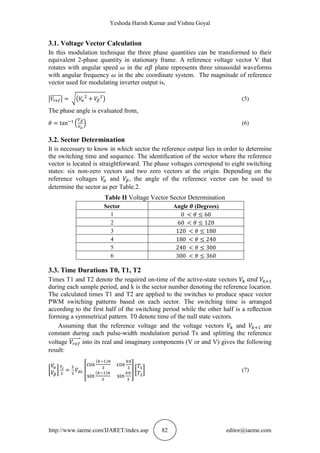
(7)
Speed Control of Induction Machine with Reduction In Torque Ripple Using Robust Space-
Vector Modulation DTC Scheme
http://www.iaeme.com/IJARET/index.asp 83 editor@iaeme.com
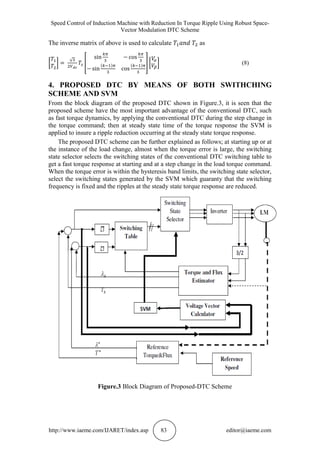
The inverse matrix of above is used to calculate as
(8)
4. PROPOSED DTC BY MEANS OF BOTH SWITHCHING
SCHEME AND SVM
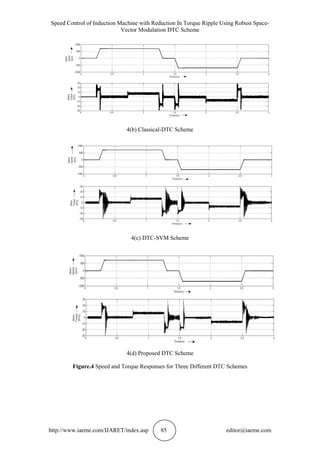
From the block diagram of the proposed DTC shown in Figure.3, it is seen that the
proposed scheme have the most important advantage of the conventional DTC, such
as fast torque dynamics, by applying the conventional DTC during the step change in
the torque command; then at steady state time of the torque response the SVM is
applied to insure a ripple reduction occurring at the steady state torque response.
The proposed DTC scheme can be further explained as follows; at starting up or at
the instance of the load change, almost when the torque error is large, the switching
state selector selects the switching states of the conventional DTC switching table to
get a fast torque response at starting and at a step change in the load torque command.
When the torque error is within the hysteresis band limits, the switching state selector,
select the switching states generated by the SVM which guaranty that the switching
frequency is fixed and the ripples at the steady state torque response are reduced.
Figure.3 Block Diagram of Proposed-DTC Scheme
Yeshoda Harish Kumar and Vishnu Goyal
http://www.iaeme.com/IJARET/index.asp 84 editor@iaeme.com
5. SIMULATION RESULTS
The system performance under the proposed DTC strategy is evaluated, and the
results are compared with the results obtained by the conventional DTC and DTC-
SVM schemes. MATLAB/SIMULINK models were developed to examine the
conventional and the proposed DTC algorithms. In simulation, the sampling time is
20 µs for both the conventional and proposed DTC schemes and the switching time
for the proposed DTC is 100 µs. The switching table used in [1] is employed for the
conventional DTC. The switching delays and the forward drop of the power switches,
the dead time of the inverter and the non-ideal effects of the Induction motor are
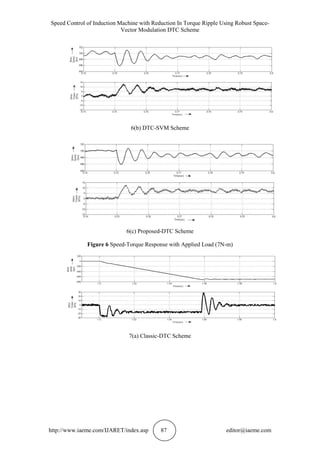
neglected in the models. The torque dynamics performances of the conventional and
proposed DTC schemes at 700 rpm are compared as shown in Figure.5 under the
same operation conditions. It is seen that the torque ripple is reduced by more than 50
% at no-load and load conditions in the proposed DTC.
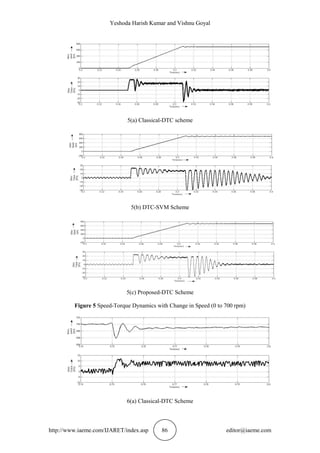
The speed and torque response for the classical DTC algorithm is given in Fig. 4
(b) and the Fig. 4 (c) show the torque response for the DTC algorithm with DTC-
SVM Scheme, and finally the proposed DTC algorithm torque response is given in
Fig. 4 (d). It can be seen from the figure that the proposed DTC has achieved a fast
speed response than that for the conventional DTC. The speed dynamic response and
their corresponding torque response for three algorithms more declaration is shown in
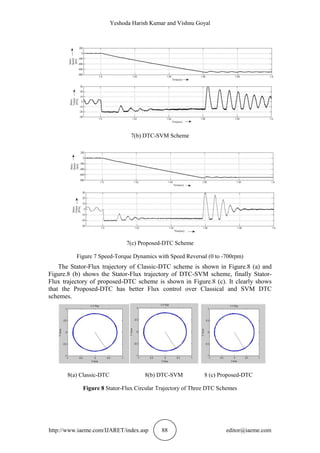
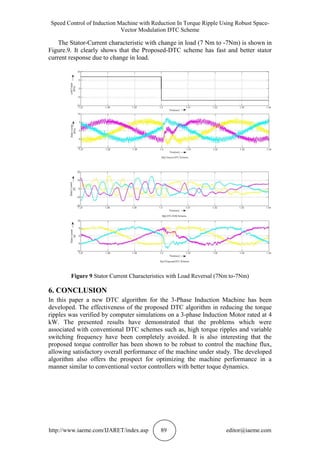
Figure.5 and Figure.7. It is seen that the torque ripple reduction is still valid at low
and high speed ranges. A speed reverse dynamics is carried out at two different speed
references, +700 rpm and -700 rpm, to indicate the validity of the controller operation
at both speed directions. The simulation results for the speed reversing dynamics are
shown in Figure.7.
Also a comparative simulation results between the proposed DTC algorithm and
other algorithms are shown in Figure.5 and Figure.6, where a reference speed of 700
rpm is applied to the motor then, a load torque of 7 Nm is applied at t = 0.75 sec.
4(a) Reference Speed and Load Torque
Speed Control of Induction Machine with Reduction In Torque Ripple Using Robust Space-
Vector Modulation DTC Scheme
http://www.iaeme.com/IJARET/index.asp 85 editor@iaeme.com
4(b) Classical-DTC Scheme
4(c) DTC-SVM Scheme
4(d) Proposed DTC Scheme
Figure.4 Speed and Torque Responses for Three Different DTC Schemes
Yeshoda Harish Kumar and Vishnu Goyal
http://www.iaeme.com/IJARET/index.asp 86 editor@iaeme.com
5(a) Classical-DTC scheme
5(b) DTC-SVM Scheme
5(c) Proposed-DTC Scheme
Figure 5 Speed-Torque Dynamics with Change in Speed (0 to 700 rpm)
6(a) Classical-DTC Scheme
Speed Control of Induction Machine with Reduction In Torque Ripple Using Robust Space-
Vector Modulation DTC Scheme
http://www.iaeme.com/IJARET/index.asp 87 editor@iaeme.com
6(b) DTC-SVM Scheme
6(c) Proposed-DTC Scheme
Figure 6 Speed-Torque Response with Applied Load (7N-m)
7(a) Classic-DTC Scheme
Yeshoda Harish Kumar and Vishnu Goyal
http://www.iaeme.com/IJARET/index.asp 88 editor@iaeme.com
7(b) DTC-SVM Scheme
7(c) Proposed-DTC Scheme
Figure 7 Speed-Torque Dynamics with Speed Reversal (0 to -700rpm)
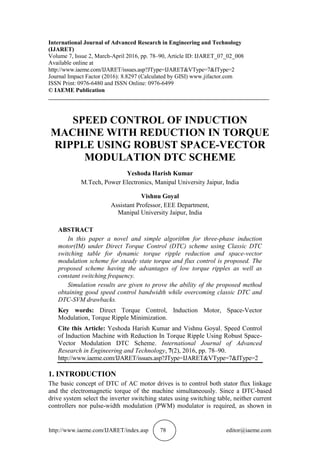
The Stator-Flux trajectory of Classic-DTC scheme is shown in Figure.8 (a) and
Figure.8 (b) shows the Stator-Flux trajectory of DTC-SVM scheme, finally Stator-
Flux trajectory of proposed-DTC scheme is shown in Figure.8 (c). It clearly shows
that the Proposed-DTC has better Flux control over Classical and SVM DTC
schemes.
8(a) Classic-DTC 8(b) DTC-SVM 8 (c) Proposed-DTC
Figure 8 Stator-Flux Circular Trajectory of Three DTC Schemes
Speed Control of Induction Machine with Reduction In Torque Ripple Using Robust Space-
Vector Modulation DTC Scheme
http://www.iaeme.com/IJARET/index.asp 89 editor@iaeme.com
The Stator-Current characteristic with change in load (7 Nm to -7Nm) is shown in
Figure.9. It clearly shows that the Proposed-DTC scheme has fast and better stator
current response due to change in load.
Figure 9 Stator Current Characteristics with Load Reversal (7Nm to-7Nm)
6. CONCLUSION
In this paper a new DTC algorithm for the 3-Phase Induction Machine has been
developed. The effectiveness of the proposed DTC algorithm in reducing the torque
ripples was verified by computer simulations on a 3-phase Induction Motor rated at 4
kW. The presented results have demonstrated that the problems which were
associated with conventional DTC schemes such as, high torque ripples and variable
switching frequency have been completely avoided. It is also interesting that the
proposed torque controller has been shown to be robust to control the machine flux,
allowing satisfactory overall performance of the machine under study. The developed
algorithm also offers the prospect for optimizing the machine performance in a
manner similar to conventional vector controllers with better toque dynamics.
Yeshoda Harish Kumar and Vishnu Goyal
http://www.iaeme.com/IJARET/index.asp 90 editor@iaeme.com
APPENDIX
Parameters of the used Induction Machine are given in below Table.3.
Table III Induction Motor Parameters
Nominal Power 4000W
Frequency 50Hz
Number of Pole Pairs 2
Stator Resistance 1.405ohm
Rotor Resistance 1.395ohm
Stator Inductance 5.839mH
Rotor Inductance 5.839mH
Mutual Inductance 172.2mH
REFERENCES
[1] L.Zhong, and M.F.Rahman, "Analysis of direct torque control in permanent
magnet synchronous motor drives," IEEE Trans. Power Elec., Vol. 12, No. 3,
May 1997.
[2] S. Dan, F.Weizhong, and H.Yikang, "Study on the direct torque control of
permanent magnet synchronous motor drives," 5th International Conference
on Electrical Machines, ICEMS, 2001.
[3] T. Noguchi, M. Yamamoto, S. Kondo, I. Takahashi, "Enlarging switching
frequency in direct torque controlled inverter by means of dithering," IEEE
Transaction on Industry Applications,1999.
[4] L.X.Tang, M.F.Rahman, Y.Zhiqing, and T.Cun, "In-depth research on direct
torque control of permanent magnet synchronous motor," IECON 02
Industrial Electronics Society, IEEE 28th
annual Conference, 2002.
[5] Brahim Metidji, Lotfi Baghli, and Seddik Bacha, “Low-Cost Direct Torque
Control Algorithm for Induction Motor without AC Phase Current Sensors”,
IEEE Transactions on Power Electronics, Vol.27.No.9, September 2012.
[6] M.Ramaprasad Reddy, T.Brahmananda Reddy and B.Brahmaiah,” discrete
Space Vector Modulation Algorithm Based Vector Controlled Induction
Motor Drive”, Journal of Electrical Engineering.
[7] D.A. Shahakar. Optimum Design Approach of Switched Reluctance Motors
by Torque Ripple Reduction. International Journal of Advanced Research in
Engineering and Technology, 5(4), 2014, pp. 190–197.
[8] Pradeep B Jyoti, J.Amarnath and D.Subbarayudu. Application of Neuro-
Fuzzy Controller In Torque Ripple Minimization of Vector Controlled Vsi
Induction Motor Drive. International Journal of Electrical Engineering and
Technology, 4(3), 2012, pp. 121–127.
[9] Hussain Shaik, S.Chaitanya and Dr. Sardar Ali. Speed Estimation Error of
Sensorless Induction Motor Drives Using Soft Computing Technique.
International Journal of Advanced Research in Engineering and Technology,
4(2), 2013, pp. 13–19.
[10] Anjana Manuel and Jebin Francis,” Simulation of Direct Torque Controlled
Induction Motor Drive by Using Space Vector Pulse Width Modulation for
Torque Ripple Reduction”, IJAREEIE Vol.2, Isuue.9, September 2013.

SPEED CONTROL OF INDUCTION MACHINE WITH REDUCTION IN TORQUE RIPPLE USING ROBUST SPACE-VECTOR MODULATION DTC SCHEME

  • 1.
    http://www.iaeme.com/IJARET/index.asp 78 editor@iaeme.com InternationalJournal of Advanced Research in Engineering and Technology (IJARET) Volume 7, Issue 2, March-April 2016, pp. 78–90, Article ID: IJARET_07_02_008 Available online at http://www.iaeme.com/IJARET/issues.asp?JType=IJARET&VType=7&IType=2 Journal Impact Factor (2016): 8.8297 (Calculated by GISI) www.jifactor.com ISSN Print: 0976-6480 and ISSN Online: 0976-6499 © IAEME Publication ___________________________________________________________________________ SPEED CONTROL OF INDUCTION MACHINE WITH REDUCTION IN TORQUE RIPPLE USING ROBUST SPACE-VECTOR MODULATION DTC SCHEME Yeshoda Harish Kumar M.Tech, Power Electronics, Manipal University Jaipur, India Vishnu Goyal Assistant Professor, EEE Department, Manipal University Jaipur, India ABSTRACT In this paper a novel and simple algorithm for three-phase induction motor(IM) under Direct Torque Control (DTC) scheme using Classic DTC switching table for dynamic torque ripple reduction and space-vector modulation scheme for steady state torque and flux control is proposed. The proposed scheme having the advantages of low torque ripples as well as constant switching frequency. Simulation results are given to prove the ability of the proposed method obtaining good speed control bandwidth while overcoming classic DTC and DTC-SVM drawbacks. Key words: Direct Torque Control, Induction Motor, Space-Vector Modulation, Torque Ripple Minimization. Cite this Article: Yeshoda Harish Kumar and Vishnu Goyal. Speed Control of Induction Machine with Reduction In Torque Ripple Using Robust Space- Vector Modulation DTC Scheme. International Journal of Advanced Research in Engineering and Technology, 7(2), 2016, pp. 78–90. http://www.iaeme.com/IJARET/issues.asp?JType=IJARET&VType=7&IType=2 1. INTRODUCTION The basic concept of DTC of AC motor drives is to control both stator flux linkage and the electromagnetic torque of the machine simultaneously. Since a DTC-based drive system select the inverter switching states using switching table, neither current controllers nor pulse-width modulation (PWM) modulator is required, as shown in
  • 2.
    Speed Control ofInduction Machine with Reduction In Torque Ripple Using Robust Space- Vector Modulation DTC Scheme http://www.iaeme.com/IJARET/index.asp 79 editor@iaeme.com Figure.1, thereby introducing fast torque dynamics response in comparison with the field oriented vector control technique. However, this conventional DTC approach has some disadvantages such as; high torque ripple and variable switching frequency, which is varying with speed, load torque and the selected hysteresis bands. On the other hand to reduce the torque ripple; the hysteresis torque and flux controller bands must be reduced to match the required torque performance, which requires reduction of the system sampling time and it is necessary to use a very fast processing controller. Although the system sampling frequency can be increased in the conventional DTC the inverter switching frequency is still low, approximately less than one third of the sampling frequency [1, 2]. The inverter switching frequency can be increased using a dithering signal, by adding a limited amplitude high frequency signal to the torque and flux error signals [3]. Although the switching frequency is increased it is still variable for small error bands. Other research concerns with these disadvantages using multilevel inverter, there are more voltage space vectors available to control the flux and torque [4]. However, these approaches require more power devices, which increase the cost of the system and make it more complex. In [5, 6] discrete space vector modulation DTC approach is used to reduce the torque ripple. However, there is a complexity of selecting the additional hysteresis controllers. On the other hand, space vector modulation (SVM) modulator is incorporated with direct torque control for Induction Motor drives to provide a constant inverter switching frequency and low torque ripple, a predictive PI controller is used to calculate the command voltage vector [7]. In this paper, a new and simple DTC algorithm with fixed switching frequency for Induction Motor is proposed to reduce the torque ripples. The well-developed SVM technique is applied to inverter control in the proposed DTC-based Induction Motor drive system, thereby dramatically reducing the torque ripples. The simulation results are carried out by modelling the drive systems using a Matlab/Simulink. 2. CLASSICAL DIRECT TORQUE CONTROL (DTC) OPERATION. The block diagram of classical DTC proposed by I. Takahashi and T. Nogouchi is presented in Figure.1. Figure 1 Block Diagram of Classical-DTC
  • 3.
    Yeshoda Harish Kumarand Vishnu Goyal http://www.iaeme.com/IJARET/index.asp 80 editor@iaeme.com The stator flux amplitude and the electromagnetic torque are the reference signals which are compared with the estimated values respectively. The flux and torque errors are delivered to the hysteresis controllers. The digitized output variables and the stator flux position sector selects the appropriate voltage vector from the switching table. Thus, the selection table generates pulses to control the power switches in the inverter. The stator flux vector and the torque produced by the motor can be estimated respectively. These equations only require the knowledge of the previously applied voltage vector Vs, measured stator current Is, stator resistance Rs, and the motor poles number p [5]. The components of stator flux are given by: (1) (2) The magnitude of the stator flux can be estimated by: (3) The flux vector zone can be obtained using the stator flux components. The electromagnetic torque can be calculated by: (4) For the flux is defined two-level hysteresis controller and for the torque three- level hysteresis controller is used. The output signals are defined as: Where is the total hysteresis bandwidth of the controller. The actual stator flux is constrained within the hysteresis band and tracks the command flux. The torque control loop has three levels of digital output represented by the following conditions. The above considerations allow construction of the selection table as presented in below Table-1. Table I Switching Scheme of Basic-DTC S(1) S(2) S(3) S(4) S(5) S(6) 1 1 0 -1 -1 1 0 -1
  • 4.
    Speed Control ofInduction Machine with Reduction In Torque Ripple Using Robust Space- Vector Modulation DTC Scheme http://www.iaeme.com/IJARET/index.asp 81 editor@iaeme.com The classical DTC method can be characterized as follows: Advantages: simple structure, no coordinate transformation, no separate voltage modulation block, no current control loops, very good flux and torque dynamic performance, Disadvantages: Variable switching frequency, problems during starting and low speed operation, high torque ripples, flux and current distortion caused by stator flux vector sector position change and high sampling frequency is required for digital implementation. 3. DTC-SVM SCHEME In the DTC-SVM system, the same flux and torque estimator which is used for the conventional DTC is still used in the proposed DTC scheme as shown in Figure.2. Instead of the switching table and hysteresis controllers, an optimal voltage vector calculator is used to calculate the reference voltage vector as a function of the torque and flux errors. The applied voltage vectors and their duration times are selected and calculated using the SVM modulator. From the block diagram of the DTC-SVM shown in Fig.4, it is seen that this scheme have the most important advantage over conventional DTC, such as at steady state time of the torque response the SVM is applied to insure a ripple reduction occurring at the steady state torque response[7]. Figure 2 Block Diagram of DTC-SVM Scheme The procedure for implementing a two-level space vector PWM can be summarized as follows: 1. Calculate the angle and reference voltage vector based on the input voltage components. 2. Find the sector in which lies and the adjacent space vectors of Vk and Vk + 1 based on the sector angle . 3. Find the time intervals , and the angle .
  • 5.
    Yeshoda Harish Kumarand Vishnu Goyal http://www.iaeme.com/IJARET/index.asp 82 editor@iaeme.com 3.1. Voltage Vector Calculation In this modulation technique the three phase quantities can be transformed to their equivalent 2-phase quantity in stationary frame. A reference voltage vector V that rotates with angular speed in the plane represents three sinusoidal waveforms with angular frequency in the abc coordinate system. The magnitude of reference vector used for modulating inverter output is, (5) The phase angle is evaluated from, (6) 3.2. Sector Determination It is necessary to know in which sector the reference output lies in order to determine the switching time and sequence. The identification of the sector where the reference vector is located is straightforward. The phase voltages correspond to eight switching states: six non-zero vectors and two zero vectors at the origin. Depending on the reference voltages and , the angle of the reference vector can be used to determine the sector as per Table.2. Table II Voltage Vector Sector Determination Sector Angle (Degrees) 1 2 3 4 5 6 3.3. Time Durations T0, T1, T2 Times T1 and T2 denote the required on-time of the active-state vectors during each sample period, and k is the sector number denoting the reference location. The calculated times T1 and T2 are applied to the switches to produce space vector PWM switching patterns based on each sector. The switching time is arranged according to the first half of the switching period while the other half is a reflection forming a symmetrical pattern. T0 denote time of the null state vectors. Assuming that the reference voltage and the voltage vectors and are constant during each pulse-width modulation period Ts and splitting the reference voltage into its real and imaginary components (V or and V) gives the following result: (7)
  • 6.
    Speed Control ofInduction Machine with Reduction In Torque Ripple Using Robust Space- Vector Modulation DTC Scheme http://www.iaeme.com/IJARET/index.asp 83 editor@iaeme.com The inverse matrix of above is used to calculate as (8) 4. PROPOSED DTC BY MEANS OF BOTH SWITHCHING SCHEME AND SVM From the block diagram of the proposed DTC shown in Figure.3, it is seen that the proposed scheme have the most important advantage of the conventional DTC, such as fast torque dynamics, by applying the conventional DTC during the step change in the torque command; then at steady state time of the torque response the SVM is applied to insure a ripple reduction occurring at the steady state torque response. The proposed DTC scheme can be further explained as follows; at starting up or at the instance of the load change, almost when the torque error is large, the switching state selector selects the switching states of the conventional DTC switching table to get a fast torque response at starting and at a step change in the load torque command. When the torque error is within the hysteresis band limits, the switching state selector, select the switching states generated by the SVM which guaranty that the switching frequency is fixed and the ripples at the steady state torque response are reduced. Figure.3 Block Diagram of Proposed-DTC Scheme
  • 7.
    Yeshoda Harish Kumarand Vishnu Goyal http://www.iaeme.com/IJARET/index.asp 84 editor@iaeme.com 5. SIMULATION RESULTS The system performance under the proposed DTC strategy is evaluated, and the results are compared with the results obtained by the conventional DTC and DTC- SVM schemes. MATLAB/SIMULINK models were developed to examine the conventional and the proposed DTC algorithms. In simulation, the sampling time is 20 µs for both the conventional and proposed DTC schemes and the switching time for the proposed DTC is 100 µs. The switching table used in [1] is employed for the conventional DTC. The switching delays and the forward drop of the power switches, the dead time of the inverter and the non-ideal effects of the Induction motor are neglected in the models. The torque dynamics performances of the conventional and proposed DTC schemes at 700 rpm are compared as shown in Figure.5 under the same operation conditions. It is seen that the torque ripple is reduced by more than 50 % at no-load and load conditions in the proposed DTC. The speed and torque response for the classical DTC algorithm is given in Fig. 4 (b) and the Fig. 4 (c) show the torque response for the DTC algorithm with DTC- SVM Scheme, and finally the proposed DTC algorithm torque response is given in Fig. 4 (d). It can be seen from the figure that the proposed DTC has achieved a fast speed response than that for the conventional DTC. The speed dynamic response and their corresponding torque response for three algorithms more declaration is shown in Figure.5 and Figure.7. It is seen that the torque ripple reduction is still valid at low and high speed ranges. A speed reverse dynamics is carried out at two different speed references, +700 rpm and -700 rpm, to indicate the validity of the controller operation at both speed directions. The simulation results for the speed reversing dynamics are shown in Figure.7. Also a comparative simulation results between the proposed DTC algorithm and other algorithms are shown in Figure.5 and Figure.6, where a reference speed of 700 rpm is applied to the motor then, a load torque of 7 Nm is applied at t = 0.75 sec. 4(a) Reference Speed and Load Torque
  • 8.
    Speed Control ofInduction Machine with Reduction In Torque Ripple Using Robust Space- Vector Modulation DTC Scheme http://www.iaeme.com/IJARET/index.asp 85 editor@iaeme.com 4(b) Classical-DTC Scheme 4(c) DTC-SVM Scheme 4(d) Proposed DTC Scheme Figure.4 Speed and Torque Responses for Three Different DTC Schemes
  • 9.
    Yeshoda Harish Kumarand Vishnu Goyal http://www.iaeme.com/IJARET/index.asp 86 editor@iaeme.com 5(a) Classical-DTC scheme 5(b) DTC-SVM Scheme 5(c) Proposed-DTC Scheme Figure 5 Speed-Torque Dynamics with Change in Speed (0 to 700 rpm) 6(a) Classical-DTC Scheme
  • 10.
    Speed Control ofInduction Machine with Reduction In Torque Ripple Using Robust Space- Vector Modulation DTC Scheme http://www.iaeme.com/IJARET/index.asp 87 editor@iaeme.com 6(b) DTC-SVM Scheme 6(c) Proposed-DTC Scheme Figure 6 Speed-Torque Response with Applied Load (7N-m) 7(a) Classic-DTC Scheme
  • 11.
    Yeshoda Harish Kumarand Vishnu Goyal http://www.iaeme.com/IJARET/index.asp 88 editor@iaeme.com 7(b) DTC-SVM Scheme 7(c) Proposed-DTC Scheme Figure 7 Speed-Torque Dynamics with Speed Reversal (0 to -700rpm) The Stator-Flux trajectory of Classic-DTC scheme is shown in Figure.8 (a) and Figure.8 (b) shows the Stator-Flux trajectory of DTC-SVM scheme, finally Stator- Flux trajectory of proposed-DTC scheme is shown in Figure.8 (c). It clearly shows that the Proposed-DTC has better Flux control over Classical and SVM DTC schemes. 8(a) Classic-DTC 8(b) DTC-SVM 8 (c) Proposed-DTC Figure 8 Stator-Flux Circular Trajectory of Three DTC Schemes
  • 12.
    Speed Control ofInduction Machine with Reduction In Torque Ripple Using Robust Space- Vector Modulation DTC Scheme http://www.iaeme.com/IJARET/index.asp 89 editor@iaeme.com The Stator-Current characteristic with change in load (7 Nm to -7Nm) is shown in Figure.9. It clearly shows that the Proposed-DTC scheme has fast and better stator current response due to change in load. Figure 9 Stator Current Characteristics with Load Reversal (7Nm to-7Nm) 6. CONCLUSION In this paper a new DTC algorithm for the 3-Phase Induction Machine has been developed. The effectiveness of the proposed DTC algorithm in reducing the torque ripples was verified by computer simulations on a 3-phase Induction Motor rated at 4 kW. The presented results have demonstrated that the problems which were associated with conventional DTC schemes such as, high torque ripples and variable switching frequency have been completely avoided. It is also interesting that the proposed torque controller has been shown to be robust to control the machine flux, allowing satisfactory overall performance of the machine under study. The developed algorithm also offers the prospect for optimizing the machine performance in a manner similar to conventional vector controllers with better toque dynamics.
  • 13.
    Yeshoda Harish Kumarand Vishnu Goyal http://www.iaeme.com/IJARET/index.asp 90 editor@iaeme.com APPENDIX Parameters of the used Induction Machine are given in below Table.3. Table III Induction Motor Parameters Nominal Power 4000W Frequency 50Hz Number of Pole Pairs 2 Stator Resistance 1.405ohm Rotor Resistance 1.395ohm Stator Inductance 5.839mH Rotor Inductance 5.839mH Mutual Inductance 172.2mH REFERENCES [1] L.Zhong, and M.F.Rahman, "Analysis of direct torque control in permanent magnet synchronous motor drives," IEEE Trans. Power Elec., Vol. 12, No. 3, May 1997. [2] S. Dan, F.Weizhong, and H.Yikang, "Study on the direct torque control of permanent magnet synchronous motor drives," 5th International Conference on Electrical Machines, ICEMS, 2001. [3] T. Noguchi, M. Yamamoto, S. Kondo, I. Takahashi, "Enlarging switching frequency in direct torque controlled inverter by means of dithering," IEEE Transaction on Industry Applications,1999. [4] L.X.Tang, M.F.Rahman, Y.Zhiqing, and T.Cun, "In-depth research on direct torque control of permanent magnet synchronous motor," IECON 02 Industrial Electronics Society, IEEE 28th annual Conference, 2002. [5] Brahim Metidji, Lotfi Baghli, and Seddik Bacha, “Low-Cost Direct Torque Control Algorithm for Induction Motor without AC Phase Current Sensors”, IEEE Transactions on Power Electronics, Vol.27.No.9, September 2012. [6] M.Ramaprasad Reddy, T.Brahmananda Reddy and B.Brahmaiah,” discrete Space Vector Modulation Algorithm Based Vector Controlled Induction Motor Drive”, Journal of Electrical Engineering. [7] D.A. Shahakar. Optimum Design Approach of Switched Reluctance Motors by Torque Ripple Reduction. International Journal of Advanced Research in Engineering and Technology, 5(4), 2014, pp. 190–197. [8] Pradeep B Jyoti, J.Amarnath and D.Subbarayudu. Application of Neuro- Fuzzy Controller In Torque Ripple Minimization of Vector Controlled Vsi Induction Motor Drive. International Journal of Electrical Engineering and Technology, 4(3), 2012, pp. 121–127. [9] Hussain Shaik, S.Chaitanya and Dr. Sardar Ali. Speed Estimation Error of Sensorless Induction Motor Drives Using Soft Computing Technique. International Journal of Advanced Research in Engineering and Technology, 4(2), 2013, pp. 13–19. [10] Anjana Manuel and Jebin Francis,” Simulation of Direct Torque Controlled Induction Motor Drive by Using Space Vector Pulse Width Modulation for Torque Ripple Reduction”, IJAREEIE Vol.2, Isuue.9, September 2013.