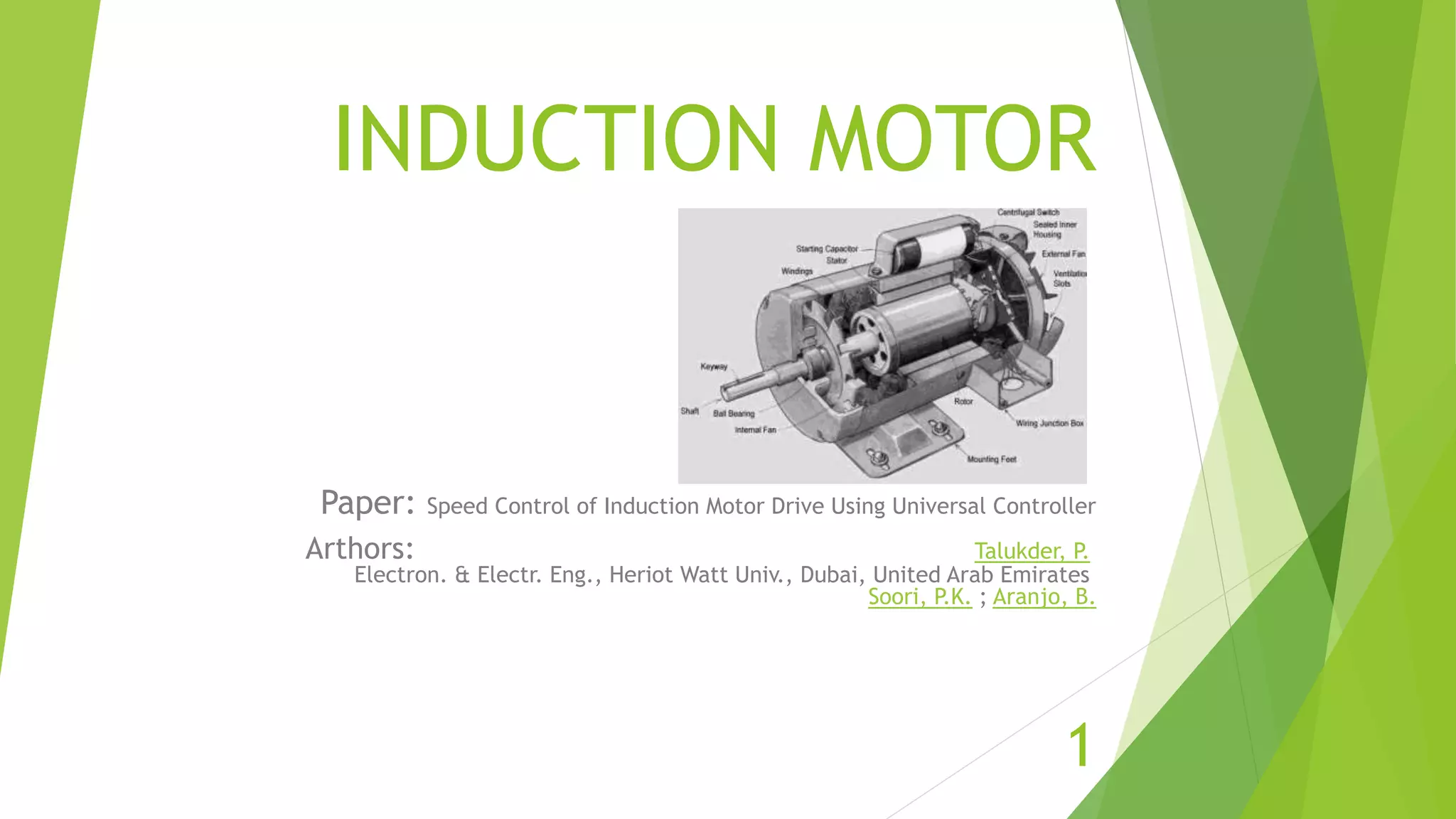
INDUCTION MOTOR
Paper: Speed Control of Induction Motor Drive Using Universal Controller
Arthors: Talukder, P.
Electron. & Electr. Eng., Heriot Watt Univ., Dubai, United Arab Emirates
Soori, P.K. ; Aranjo, B.
1
Presented by:
Group -01
Members:
Gauhar Ali 1403081
Arif Shahriar 1403094
Utsha Barua 1403095
Radheshyam Nath Jisu 1403098
Mustafizur Rahman 1403099
Nirvik Barua 1403118
2
Index terms:
Induction Motor
Microcontroller
Pulse Width Modulation Inverter
Speed control
3
Basic Principle of Induction Motor:
 Due to flow of 3 phase AC current through stator winding coils , a revolving
flux is created.
 This revolving flux is cut by rotor windings which creates a induced voltage
hence current flows
 According to Lorentz's law, a magnetic force produces torque that rotates the
rotor
4
At what speed the rotor will rotate?
 The rotor speed will never be equal to synchronous
speed. If rotor rotates at synchronous speed So there will
be no relative speed between rotor and revolving flux and
rotating loop will experience a constant magnetic field so
there will be no induced e.m.f and current. This means
zero force on rotor bars so the rotor will gradually slow
down, so induced e.m.f and voltage will rise again and the
rotor will speed up. In short the rotor will never be able
to catch up with the synchronous speed. It rotates with an
constant speed which is slightly less than the synchronous
speed
5
Speed of an induction motor
depends upon the the AC supply,
more specifically it changes with the
frequency of the Alternating Current
proportionally.
When connected to main power supply, induction motors run at their
rated speed, however there are many applications where variable speed
operations are required.
6
Speed Controlling of induction motor:
7
Although a range of induction motor control techniques
are available, generating variable frequency supply is a
popular control technique, having a constant voltage to
frequency ratio in order to attain constant (maximum)
torque throughout the operating period. This control
technique is called as variable frequency control.
The synchronous speed of the stator revolving flux is given
by,
Where f is the supply frequency in Hz and P is the number of
poles.
As the number of poles is not variable, varying the supply
frequency would result in the variation in speed of the
induction motor.
To maintain the motor flux, the (E1/f1) ratio has to be kept
constant 8
Micro-controller used:
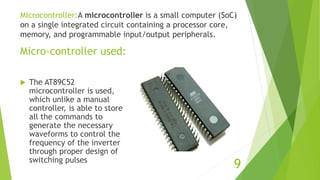
 The AT89C52
microcontroller is used,
which unlike a manual
controller, is able to store
all the commands to
generate the necessary
waveforms to control the
frequency of the inverter
through proper design of
switching pulses
9
Microcontroller:A microcontroller is a small computer (SoC)
on a single integrated circuit containing a processor core,
memory, and programmable input/output peripherals.
This paper presents the development of an
efficient and versatile universal board which
is used to control the speed of single or three
phase machines with very minor
modifications in software and hardware.
This paper is divided into two parts. The first part is
the MATLAB Simulink simulation. The second part is
the hardware implementation of the developed
circuit.
10
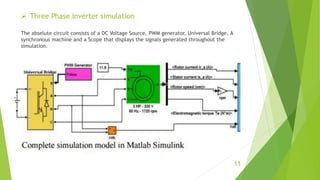
 Three Phase inverter simulation
The abselute circuit consists of a DC Voltage Source, PWM generator, Universal Bridge, A
synchronous machine and a Scope that displays the signals generated throughout the
simulation.
11
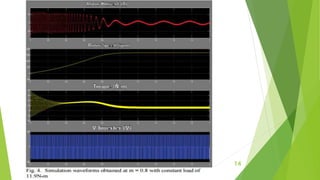
The technique used to control the frequency of the three
phase voltage supplied to the motor from the Insulated Gate
Bipolar Transistor (IGBT) inverter circuit is Pulse Width
Modulation (PWM), which allows the speed to be varied with
respect to the frequency of the reference signal, input to the
PWM generator. The carrier frequency and the modulation
index were set to 1080Hz and 0.8 respectively. The simulation
was done twice, first with no-load and then with a constant
torque of 11.9N-m
12
Insulated-Gate Bipolar Transistor (IGBT): is a three-terminal power
semiconductor device primarily used as an electronic switch .
Pulse Width Modulation ( PWM) : is a technique for getting analog
results with digital means.
Index Modulation : The modulation index of a modulation scheme
describes by how much the modulated variable of the carrier signal varies
around its unmodulated level.
Carrier Signal
Modulation Index ,h = _________________
Unmodulated Level
13
14
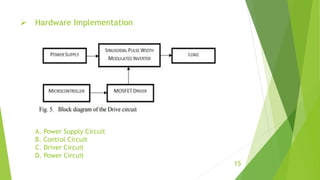
 Hardware Implementation
A. Power Supply Circuit
B. Control Circuit
C. Driver Circuit
D. Power Circuit
15
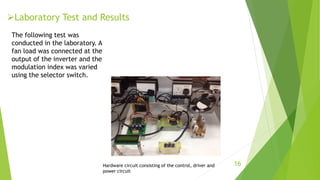
The following test was
conducted in the laboratory. A
fan load was connected at the
output of the inverter and the
modulation index was varied
using the selector switch.
Hardware circuit consisting of the control, driver and
power circuit
Laboratory Test and Results
16
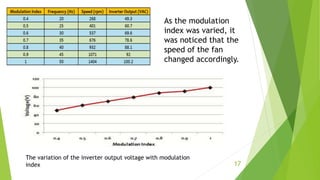
As the modulation
index was varied, it
was noticed that the
speed of the fan
changed accordingly.
The variation of the inverter output voltage with modulation
index 17
Applications:
 It can be used in many different applications like stepper motor control.
 This universal board can hence be used for different kinds of laboratory
applications and can also help in enhancing the learning of different courses
such as Electrical Energy Systems and Electromechanical system.
18
Many other variable frequency drive circuits have been
proposed by several authors, but none of them turned
out to be user friendly
References:
[1] B. Ismail, S.Taib, A.R Mohd Saad, M. Isa and I. Daut, “Development of Control
Circuit for Single Phase Inverter Using Atmel Microcontroller,” in Proc. 2006 ICoMMS
International Conference on Man-Machine Systems, September 15-16, Malaysia.
[2] Thida Win, Nang Sabai, and Hnin Nandar Maung, “Analysis of Variable
Frequency Three Phase Induction Motor Drive,” in Proc. 2008 World Academy of
Science, Engineering and Technology 42 2008.
[3] Mohd Fakhizan bin Romlie, Mohammad Fadhil Pesol, and Khairul Nisak Md
Hasan, “PWM Technique to Control Speed of Induction Motor using Matlab/xPC
Target Box,” in Proc. PECon 2008 Power and Energy Conference.
[4] Datasheet: Atmel 8-bit Microcontroller with 8K Bytes Flash
[5] Muhamad Zahim Bin Sujod, “Single-phase motor speed control using SPWM
inverter,” Honors dissertation, Dept. Electrical & Electronics Eng., Univ. of
Malaysia, Pahang, 2008.
19
The designed system was
successfully fabricated and tested in
the laboratory.
20
Thank you!

Speed Control of Induction Motor Drive Using Universal Controller

  • 1.
    INDUCTION MOTOR Paper: SpeedControl of Induction Motor Drive Using Universal Controller Arthors: Talukder, P. Electron. & Electr. Eng., Heriot Watt Univ., Dubai, United Arab Emirates Soori, P.K. ; Aranjo, B. 1
  • 2.
    Presented by: Group -01 Members: GauharAli 1403081 Arif Shahriar 1403094 Utsha Barua 1403095 Radheshyam Nath Jisu 1403098 Mustafizur Rahman 1403099 Nirvik Barua 1403118 2
  • 3.
    Index terms: Induction Motor Microcontroller PulseWidth Modulation Inverter Speed control 3
  • 4.
    Basic Principle ofInduction Motor:  Due to flow of 3 phase AC current through stator winding coils , a revolving flux is created.  This revolving flux is cut by rotor windings which creates a induced voltage hence current flows  According to Lorentz's law, a magnetic force produces torque that rotates the rotor 4
  • 5.
    At what speedthe rotor will rotate?  The rotor speed will never be equal to synchronous speed. If rotor rotates at synchronous speed So there will be no relative speed between rotor and revolving flux and rotating loop will experience a constant magnetic field so there will be no induced e.m.f and current. This means zero force on rotor bars so the rotor will gradually slow down, so induced e.m.f and voltage will rise again and the rotor will speed up. In short the rotor will never be able to catch up with the synchronous speed. It rotates with an constant speed which is slightly less than the synchronous speed 5
  • 6.
    Speed of aninduction motor depends upon the the AC supply, more specifically it changes with the frequency of the Alternating Current proportionally. When connected to main power supply, induction motors run at their rated speed, however there are many applications where variable speed operations are required. 6
  • 7.
    Speed Controlling ofinduction motor: 7 Although a range of induction motor control techniques are available, generating variable frequency supply is a popular control technique, having a constant voltage to frequency ratio in order to attain constant (maximum) torque throughout the operating period. This control technique is called as variable frequency control.
  • 8.
    The synchronous speedof the stator revolving flux is given by, Where f is the supply frequency in Hz and P is the number of poles. As the number of poles is not variable, varying the supply frequency would result in the variation in speed of the induction motor. To maintain the motor flux, the (E1/f1) ratio has to be kept constant 8
  • 9.
    Micro-controller used:  TheAT89C52 microcontroller is used, which unlike a manual controller, is able to store all the commands to generate the necessary waveforms to control the frequency of the inverter through proper design of switching pulses 9 Microcontroller:A microcontroller is a small computer (SoC) on a single integrated circuit containing a processor core, memory, and programmable input/output peripherals.
  • 10.
    This paper presentsthe development of an efficient and versatile universal board which is used to control the speed of single or three phase machines with very minor modifications in software and hardware. This paper is divided into two parts. The first part is the MATLAB Simulink simulation. The second part is the hardware implementation of the developed circuit. 10
  • 11.
     Three Phaseinverter simulation The abselute circuit consists of a DC Voltage Source, PWM generator, Universal Bridge, A synchronous machine and a Scope that displays the signals generated throughout the simulation. 11
  • 12.
    The technique usedto control the frequency of the three phase voltage supplied to the motor from the Insulated Gate Bipolar Transistor (IGBT) inverter circuit is Pulse Width Modulation (PWM), which allows the speed to be varied with respect to the frequency of the reference signal, input to the PWM generator. The carrier frequency and the modulation index were set to 1080Hz and 0.8 respectively. The simulation was done twice, first with no-load and then with a constant torque of 11.9N-m 12
  • 13.
    Insulated-Gate Bipolar Transistor(IGBT): is a three-terminal power semiconductor device primarily used as an electronic switch . Pulse Width Modulation ( PWM) : is a technique for getting analog results with digital means. Index Modulation : The modulation index of a modulation scheme describes by how much the modulated variable of the carrier signal varies around its unmodulated level. Carrier Signal Modulation Index ,h = _________________ Unmodulated Level 13
  • 14.
  • 15.
     Hardware Implementation A.Power Supply Circuit B. Control Circuit C. Driver Circuit D. Power Circuit 15
  • 16.
    The following testwas conducted in the laboratory. A fan load was connected at the output of the inverter and the modulation index was varied using the selector switch. Hardware circuit consisting of the control, driver and power circuit Laboratory Test and Results 16
  • 17.
    As the modulation indexwas varied, it was noticed that the speed of the fan changed accordingly. The variation of the inverter output voltage with modulation index 17
  • 18.
    Applications:  It canbe used in many different applications like stepper motor control.  This universal board can hence be used for different kinds of laboratory applications and can also help in enhancing the learning of different courses such as Electrical Energy Systems and Electromechanical system. 18 Many other variable frequency drive circuits have been proposed by several authors, but none of them turned out to be user friendly
  • 19.
    References: [1] B. Ismail,S.Taib, A.R Mohd Saad, M. Isa and I. Daut, “Development of Control Circuit for Single Phase Inverter Using Atmel Microcontroller,” in Proc. 2006 ICoMMS International Conference on Man-Machine Systems, September 15-16, Malaysia. [2] Thida Win, Nang Sabai, and Hnin Nandar Maung, “Analysis of Variable Frequency Three Phase Induction Motor Drive,” in Proc. 2008 World Academy of Science, Engineering and Technology 42 2008. [3] Mohd Fakhizan bin Romlie, Mohammad Fadhil Pesol, and Khairul Nisak Md Hasan, “PWM Technique to Control Speed of Induction Motor using Matlab/xPC Target Box,” in Proc. PECon 2008 Power and Energy Conference. [4] Datasheet: Atmel 8-bit Microcontroller with 8K Bytes Flash [5] Muhamad Zahim Bin Sujod, “Single-phase motor speed control using SPWM inverter,” Honors dissertation, Dept. Electrical & Electronics Eng., Univ. of Malaysia, Pahang, 2008. 19
  • 20.
    The designed systemwas successfully fabricated and tested in the laboratory. 20 Thank you!