ARM Training
CortexM3 Subsystem
Date – 28/03/2012
raghav.nayak@st.com
2
Agenda
 CortexM3 Subsystem
 Peripherals
 SW Development
 Debugging
 Tool Demo
CortexM3 Processor
 CortexM3 Core
 Nested Vector Interrupt Controller
 Bus Interface
 Debug Access Port
 Memory Protection Unit
 ETM, ITM and TPIU
 WIC
 Flash Patch Breakpoint
 Data Watchpoint and Trace
 ROM Table
3
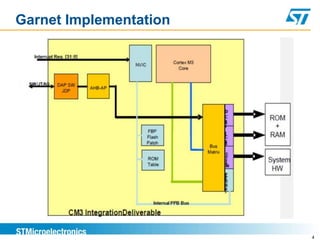
Garnet Implementation
4
5
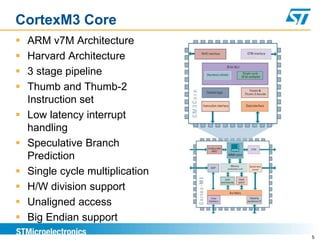
CortexM3 Core
 ARM v7M Architecture
 Harvard Architecture
 3 stage pipeline
 Thumb and Thumb-2
Instruction set
 Low latency interrupt
handling
 Speculative Branch
Prediction
 Single cycle multiplication
 H/W division support
 Unaligned access
 Big Endian support
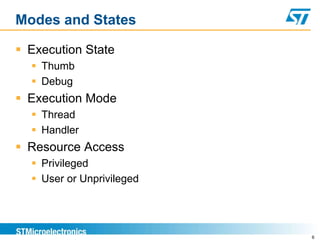
Modes and States
 Execution State
 Thumb
 Debug
 Execution Mode
 Thread
 Handler
 Resource Access
 Privileged
 User or Unprivileged
6
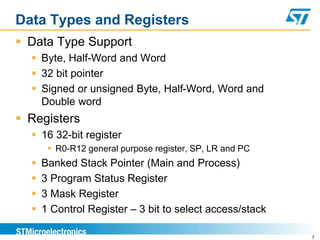
Data Types and Registers
 Data Type Support
 Byte, Half-Word and Word
 32 bit pointer
 Signed or unsigned Byte, Half-Word, Word and
Double word
 Registers
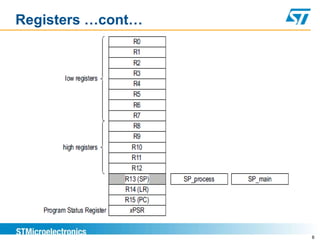
 16 32-bit register
 R0-R12 general purpose register, SP, LR and PC
 Banked Stack Pointer (Main and Process)
 3 Program Status Register
 3 Mask Register
 1 Control Register – 3 bit to select access/stack
7
Registers …cont…
8
Registers …cont…
 Program Status Register (PSR)
 Application PSR
 N, C, Z, V, Q and GE[3-0] Condition flags
 Interrupt PSR
 Holds the exception number of the currently executed
exception
 Execution PSR
 T and ICI/IT bit fields
9
Registers …cont…
10
 Mask Register
 PRIMASK
 1-bit Register
 changes the execution priority to 0(Highest Priority)
 FAULTMASK
 1-bit Register
 Changes the execution priority to -1(Hard Fault)
 BASEPRI
 8-bit Register
 Changes the priority level required for preemption
Instruction Set
11
 Unified Assembly Language Syntax
 16 bit or 32 bit Instructions
 Data Processing
 MOV, ASR, LSL, ROR, ADD, SUB, REV, MUL, UDIV, CMP,
TST, CMN, AND, ORR, BIC, BFI, EOR, CPY
 Process control
 B, BX, BL, CBNZ, CBZ
 Load/Store
 LDR, STR, LDRH, STRH, LDRB, STRB, LDRD, STRD, LDM,
STM, LDREX, STREX
 Serial/Miscellaneous
 DMB, DSB, ISB, WFI, WFE, MRS, MSR, CPS, SEV, CLREX,
SVC
Exception
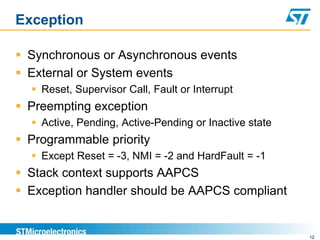
 Synchronous or Asynchronous events
 External or System events
 Reset, Supervisor Call, Fault or Interrupt
 Preempting exception
 Active, Pending, Active-Pending or Inactive state
 Programmable priority
 Except Reset = -3, NMI = -2 and HardFault = -1
 Stack context supports AAPCS
 Exception handler should be AAPCS compliant
12
Exception …cont…
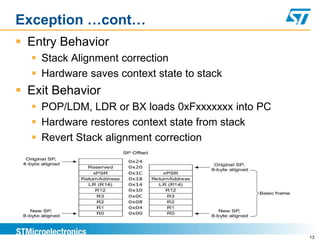
 Entry Behavior
 Stack Alignment correction
 Hardware saves context state to stack
 Exit Behavior
 POP/LDM, LDR or BX loads 0xFxxxxxxx into PC
 Hardware restores context state from stack
 Revert Stack alignment correction
13
Exception …cont…
14
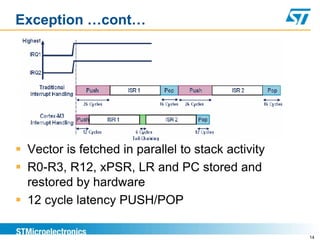
 Vector is fetched in parallel to stack activity
 R0-R3, R12, xPSR, LR and PC stored and
restored by hardware
 12 cycle latency PUSH/POP
Exception …cont…
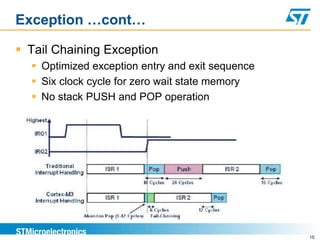
 Tail Chaining Exception
 Optimized exception entry and exit sequence
 Six clock cycle for zero wait state memory
 No stack PUSH and POP operation
15
Exception …cont…
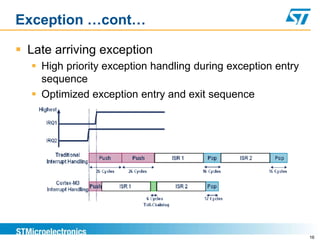
 Late arriving exception
 High priority exception handling during exception entry
sequence
 Optimized exception entry and exit sequence
16
Fault
17
 MemManage
 Generated by MPU
 instruction or data memory access
 BusFault
 Memory access failures due to error in Bus Activity
 Instruction and data transaction
 HardFault
 Generic fault used for escalation
 UsageFault
 Non-memory related events caused by instruction
 Undefined instruction, invalid state, exception return
Bit Banding
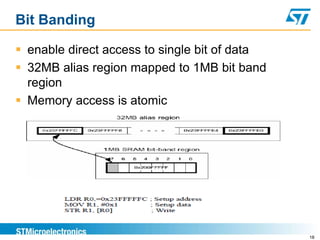
 enable direct access to single bit of data
 32MB alias region mapped to 1MB bit band
region
 Memory access is atomic
18
Nested Vector Interrupt Controller
 32 external interrupts and 5-bit priority level
 Reduced interrupt latency
 Supports nesting interrupt
 Supports dynamic priority
 Controls power management scheme
 Supports both level and edge triggered interrupt
 Privileged access
 Little endian register access
 Supports Non Maskable Interrupt (NMI)
 Provides 24-bit down timer (SysTick)
19
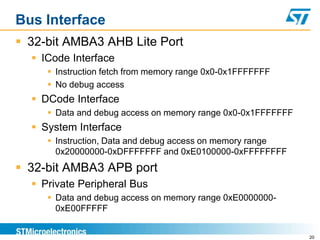
Bus Interface
 32-bit AMBA3 AHB Lite Port
 ICode Interface
 Instruction fetch from memory range 0x0-0x1FFFFFFF
 No debug access
 DCode Interface
 Data and debug access on memory range 0x0-0x1FFFFFFF
 System Interface
 Instruction, Data and debug access on memory range
0x20000000-0xDFFFFFFF and 0xE0100000-0xFFFFFFFF
 32-bit AMBA3 APB port
 Private Peripheral Bus
 Data and debug access on memory range 0xE0000000-
0xE00FFFFF
20
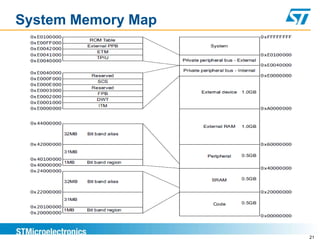
System Memory Map
21
System Control Space
 32 bit registers in 4KB address space
 CPUID and vendor Identification
 Fault detection and handling
 Interrupt configuration, detection and handling
 Exception priority control
 Sleep Mode handling
 Debug control and status
22
Debug
 Invasive debug
 2 hardware and 6 software breakpoint
 Based on CoreSight debug architecture
 Serial Wire and JTAG Debug Port
 FPB supports halt, single step execution
 AHB-AP provides access to memory and
registers in the system
 Target Identification
 Read the CPUID register from System Control Space
in ROM table
 Breakpoint information from FPB in ROM table
23
Peripherals
 DMA
 8 channels, 16 requests through 16 line
 2 Master and 1 Slave port
 2 interrupt request line
 Single and Burst request with burst length 1024 bytes
 Flow control and big endian support
 UART
 Max 460800 and Min 110 baud
 Programmable baud rate, stop bit, parity bit, FIFO
trigger level, flow control
 32X8 transmit and 32X12 receive FIFO
 DMA and Interrupt support
24
Peripherals …cont…
 Dual Timer
 2 configurable 32 or 16 bit down counters
 Free running, periodic or one-shot
 Programmable 1, 16 or 256 pre-scalar values
 Runs at Core clock
 interrupt signaling on zero count
 Watchdog
 32 bit down counter
 Enabled or disabled by software
 Reset the system to recover from software failure
 Provides mechanism to avoid unauthorise access
 Runs at Core clock
25
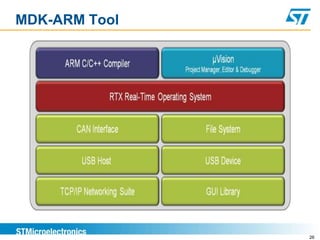
MDK-ARM Tool
26
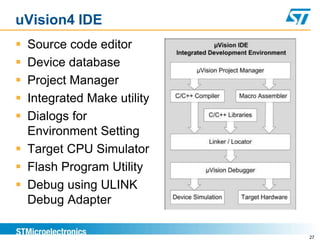
uVision4 IDE
 Source code editor
 Device database
 Project Manager
 Integrated Make utility
 Dialogs for
Environment Setting
 Target CPU Simulator
 Flash Program Utility
 Debug using ULINK
Debug Adapter
27
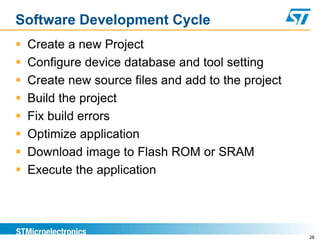
Software Development Cycle
 Create a new Project
 Configure device database and tool setting
 Create new source files and add to the project
 Build the project
 Fix build errors
 Optimize application
 Download image to Flash ROM or SRAM
 Execute the application
28
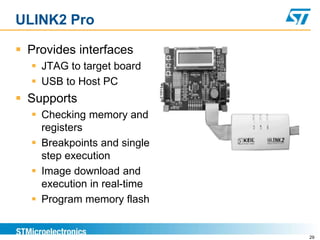
ULINK2 Pro
 Provides interfaces
 JTAG to target board
 USB to Host PC
 Supports
 Checking memory and
registers
 Breakpoints and single
step execution
 Image download and
execution in real-time
 Program memory flash
29
Coding Hint
 Speed optimization
 Size optimization
 Power optimization
 MicroLIB to reduce code size
 Use 32 bit variables for local and parameters
 Place scalars at the beginning of a struct variable
30
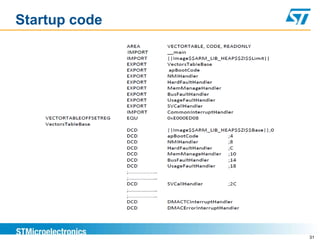
Startup code
31
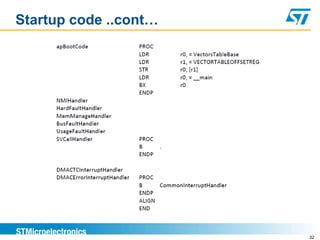
Startup code ..cont…
32
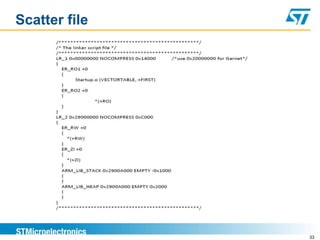
Scatter file
33
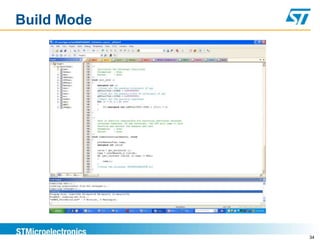
Build Mode
34
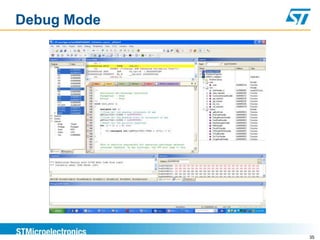
Debug Mode
35
IP Validation
 Stand alone validation
 Independent of OS
 Independent of Flash/ROM code
 CPU Startup and Interrupt Initialization code
 Scatter file for flexible code execution
 No additional latency due to OS
 Single test or All test execution
36
Questions?
37
Reference
 Garnet Architecture specification
 ARMv7-M architecture reference manual
 CortexM3 Technical reference manual
38
10.201.59.94specs

ARM Cortex-M3 Training

  • 1.
    ARM Training CortexM3 Subsystem Date– 28/03/2012 raghav.nayak@st.com
  • 2.
    2 Agenda  CortexM3 Subsystem Peripherals  SW Development  Debugging  Tool Demo
  • 3.
    CortexM3 Processor  CortexM3Core  Nested Vector Interrupt Controller  Bus Interface  Debug Access Port  Memory Protection Unit  ETM, ITM and TPIU  WIC  Flash Patch Breakpoint  Data Watchpoint and Trace  ROM Table 3
  • 4.
  • 5.
    5 CortexM3 Core  ARMv7M Architecture  Harvard Architecture  3 stage pipeline  Thumb and Thumb-2 Instruction set  Low latency interrupt handling  Speculative Branch Prediction  Single cycle multiplication  H/W division support  Unaligned access  Big Endian support
  • 6.
    Modes and States Execution State  Thumb  Debug  Execution Mode  Thread  Handler  Resource Access  Privileged  User or Unprivileged 6
  • 7.
    Data Types andRegisters  Data Type Support  Byte, Half-Word and Word  32 bit pointer  Signed or unsigned Byte, Half-Word, Word and Double word  Registers  16 32-bit register  R0-R12 general purpose register, SP, LR and PC  Banked Stack Pointer (Main and Process)  3 Program Status Register  3 Mask Register  1 Control Register – 3 bit to select access/stack 7
  • 8.
  • 9.
    Registers …cont…  ProgramStatus Register (PSR)  Application PSR  N, C, Z, V, Q and GE[3-0] Condition flags  Interrupt PSR  Holds the exception number of the currently executed exception  Execution PSR  T and ICI/IT bit fields 9
  • 10.
    Registers …cont… 10  MaskRegister  PRIMASK  1-bit Register  changes the execution priority to 0(Highest Priority)  FAULTMASK  1-bit Register  Changes the execution priority to -1(Hard Fault)  BASEPRI  8-bit Register  Changes the priority level required for preemption
  • 11.
    Instruction Set 11  UnifiedAssembly Language Syntax  16 bit or 32 bit Instructions  Data Processing  MOV, ASR, LSL, ROR, ADD, SUB, REV, MUL, UDIV, CMP, TST, CMN, AND, ORR, BIC, BFI, EOR, CPY  Process control  B, BX, BL, CBNZ, CBZ  Load/Store  LDR, STR, LDRH, STRH, LDRB, STRB, LDRD, STRD, LDM, STM, LDREX, STREX  Serial/Miscellaneous  DMB, DSB, ISB, WFI, WFE, MRS, MSR, CPS, SEV, CLREX, SVC
  • 12.
    Exception  Synchronous orAsynchronous events  External or System events  Reset, Supervisor Call, Fault or Interrupt  Preempting exception  Active, Pending, Active-Pending or Inactive state  Programmable priority  Except Reset = -3, NMI = -2 and HardFault = -1  Stack context supports AAPCS  Exception handler should be AAPCS compliant 12
  • 13.
    Exception …cont…  EntryBehavior  Stack Alignment correction  Hardware saves context state to stack  Exit Behavior  POP/LDM, LDR or BX loads 0xFxxxxxxx into PC  Hardware restores context state from stack  Revert Stack alignment correction 13
  • 14.
    Exception …cont… 14  Vectoris fetched in parallel to stack activity  R0-R3, R12, xPSR, LR and PC stored and restored by hardware  12 cycle latency PUSH/POP
  • 15.
    Exception …cont…  TailChaining Exception  Optimized exception entry and exit sequence  Six clock cycle for zero wait state memory  No stack PUSH and POP operation 15
  • 16.
    Exception …cont…  Latearriving exception  High priority exception handling during exception entry sequence  Optimized exception entry and exit sequence 16
  • 17.
    Fault 17  MemManage  Generatedby MPU  instruction or data memory access  BusFault  Memory access failures due to error in Bus Activity  Instruction and data transaction  HardFault  Generic fault used for escalation  UsageFault  Non-memory related events caused by instruction  Undefined instruction, invalid state, exception return
  • 18.
    Bit Banding  enabledirect access to single bit of data  32MB alias region mapped to 1MB bit band region  Memory access is atomic 18
  • 19.
    Nested Vector InterruptController  32 external interrupts and 5-bit priority level  Reduced interrupt latency  Supports nesting interrupt  Supports dynamic priority  Controls power management scheme  Supports both level and edge triggered interrupt  Privileged access  Little endian register access  Supports Non Maskable Interrupt (NMI)  Provides 24-bit down timer (SysTick) 19
  • 20.
    Bus Interface  32-bitAMBA3 AHB Lite Port  ICode Interface  Instruction fetch from memory range 0x0-0x1FFFFFFF  No debug access  DCode Interface  Data and debug access on memory range 0x0-0x1FFFFFFF  System Interface  Instruction, Data and debug access on memory range 0x20000000-0xDFFFFFFF and 0xE0100000-0xFFFFFFFF  32-bit AMBA3 APB port  Private Peripheral Bus  Data and debug access on memory range 0xE0000000- 0xE00FFFFF 20
  • 21.
  • 22.
    System Control Space 32 bit registers in 4KB address space  CPUID and vendor Identification  Fault detection and handling  Interrupt configuration, detection and handling  Exception priority control  Sleep Mode handling  Debug control and status 22
  • 23.
    Debug  Invasive debug 2 hardware and 6 software breakpoint  Based on CoreSight debug architecture  Serial Wire and JTAG Debug Port  FPB supports halt, single step execution  AHB-AP provides access to memory and registers in the system  Target Identification  Read the CPUID register from System Control Space in ROM table  Breakpoint information from FPB in ROM table 23
  • 24.
    Peripherals  DMA  8channels, 16 requests through 16 line  2 Master and 1 Slave port  2 interrupt request line  Single and Burst request with burst length 1024 bytes  Flow control and big endian support  UART  Max 460800 and Min 110 baud  Programmable baud rate, stop bit, parity bit, FIFO trigger level, flow control  32X8 transmit and 32X12 receive FIFO  DMA and Interrupt support 24
  • 25.
    Peripherals …cont…  DualTimer  2 configurable 32 or 16 bit down counters  Free running, periodic or one-shot  Programmable 1, 16 or 256 pre-scalar values  Runs at Core clock  interrupt signaling on zero count  Watchdog  32 bit down counter  Enabled or disabled by software  Reset the system to recover from software failure  Provides mechanism to avoid unauthorise access  Runs at Core clock 25
  • 26.
  • 27.
    uVision4 IDE  Sourcecode editor  Device database  Project Manager  Integrated Make utility  Dialogs for Environment Setting  Target CPU Simulator  Flash Program Utility  Debug using ULINK Debug Adapter 27
  • 28.
    Software Development Cycle Create a new Project  Configure device database and tool setting  Create new source files and add to the project  Build the project  Fix build errors  Optimize application  Download image to Flash ROM or SRAM  Execute the application 28
  • 29.
    ULINK2 Pro  Providesinterfaces  JTAG to target board  USB to Host PC  Supports  Checking memory and registers  Breakpoints and single step execution  Image download and execution in real-time  Program memory flash 29
  • 30.
    Coding Hint  Speedoptimization  Size optimization  Power optimization  MicroLIB to reduce code size  Use 32 bit variables for local and parameters  Place scalars at the beginning of a struct variable 30
  • 31.
  • 32.
  • 33.
  • 34.
  • 35.
  • 36.
    IP Validation  Standalone validation  Independent of OS  Independent of Flash/ROM code  CPU Startup and Interrupt Initialization code  Scatter file for flexible code execution  No additional latency due to OS  Single test or All test execution 36
  • 37.
  • 38.
    Reference  Garnet Architecturespecification  ARMv7-M architecture reference manual  CortexM3 Technical reference manual 38 10.201.59.94specs