FLUENCY
BY – ANANT ARUN
UNDERGRADUATE STUDENT OF ASLP
CONTENT
INTRODUCTION
DEFINITION
COMPONENTS
FLUENCY DISORDER
INTRODUCTION
Fluency – derived from Latin word ‘Flure’
Fluent speaker - some one whose speech is easy and that flows from
word to word without effort
The speech flows easily and smoothly in terms of both sound and
information
There are no disruptions of the message and the listener can attend
to the message
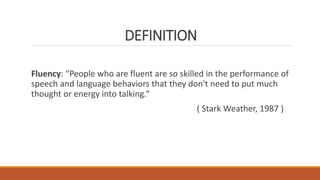
DEFINITION
Fluency: “People who are fluent are so skilled in the performance of
speech and language behaviors that they don't need to put much
thought or energy into talking.“
( Stark Weather, 1987 )
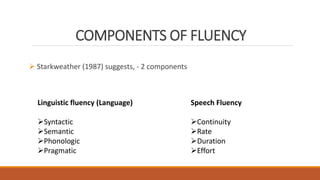
COMPONENTS OF FLUENCY
 Starkweather (1987) suggests, - 2 components
Linguistic fluency (Language)
Syntactic
Semantic
Phonologic
Pragmatic
Speech Fluency
Continuity
Rate
Duration
Effort
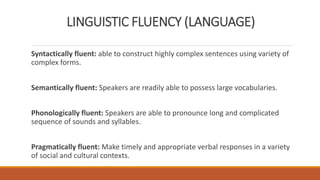
LINGUISTIC FLUENCY (LANGUAGE)
Syntactically fluent: able to construct highly complex sentences using variety of
complex forms.
Semantically fluent: Speakers are readily able to possess large vocabularies.
Phonologically fluent: Speakers are able to pronounce long and complicated
sequence of sounds and syllables.
Pragmatically fluent: Make timely and appropriate verbal responses in a variety
of social and cultural contexts.
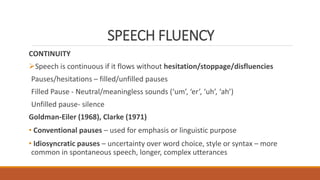
SPEECH FLUENCY
CONTINUITY
Speech is continuous if it flows without hesitation/stoppage/disfluencies
Pauses/hesitations – filled/unfilled pauses
Filled Pause - Neutral/meaningless sounds (‘um’, ‘er’, ‘uh’, ‘ah’)
Unfilled pause- silence
Goldman-Eiler (1968), Clarke (1971)
• Conventional pauses – used for emphasis or linguistic purpose
• Idiosyncratic pauses – uncertainty over word choice, style or syntax – more
common in spontaneous speech, longer, complex utterances
RATE
Refers to the speed in which the words are spoken
According to speaking task, there is considerable variability in rate in terms of
such factors as formality of speaking situation, time pressure,…
Rate is measured in terms of words or syllables per minute (WPM/SPM)
For Hindi-speaking adults, the mean overall speaking rate is 120 - 130
words/minute (wpm)
DURATION
Relates closely to the co articulation of the segments
The duration of CV of a language varies considerably with speech rate and
phonetic and linguistic context
Stressed syllables - longer than unstressed (Umeda, 1975)
EFFORT
It refers to the ease with which an act is performed
Stark weather (1987) distinguishes 2 types of effort:
- Physical effort (Muscle movement)
- Mental effort (Linguistic planning)
Mental effort: encoding process, difficult to measure
Physical effort : Refers to action in respiratory, articulatory and laryngeal
system.
FLUENCY DISORDER
STUTTERING
PSYCHOGENIC STUTTERING
NEUROGENIC STUTTERING
CLUTTERING
NORMAL NON FLUENCY (NNF)
STUTTERING
Stuttering is the most common fluency disorder , is an interruption in the flow
of speaking characterized by repetitions (speech , syllables , words , phrases ) ,
sound prolongations , blocks , interjections and revisions , which may affect the
rate & rhythm of speech .
These disfluencies may be accompanied by physical tension , negative reactions
, secondary behaviors & avoidance of sound , word or speaking situations .
ASHA 1993 / Yaruss 2004
PSYCHOGENIC STUTTERING
Psychogenic Stuttering is a type of stuttering, can be caused by emotional trauma
or problem with thought or reasoning.
( NIDCD – Fact Sheet Stuttering )
NEUROGENIC STUTTERING
Neurogenic stuttering is a type of fluency disorder in which a person has
difficulty in producing speech in a normal, smooth fashion. Individuals with
fluency disorders may have speech that sounds fragmented or halting, with
frequent interruptions and difficulty producing words without effort or struggle.
Neurogenic stuttering typically appears following some sort of injury or disease
to the central nervous system i.e. the brain and spinal cord, including cortex,
sub-cortex, cerebellar, and even the neural pathway regions.
( THE STUTTERING FOUNDATION )
CLUTTERING
Cluttering is a fluency disorder characterized by a rapid or irregular speaking rate
, excessive dys-fluencies & often other symptoms such as language or
phonological errors & attention deficits .
Characterized by repetitions of 6-10 units , poor concentrations , short attention
span , perceptual weakness , poorly organized thinking , jerky respiration ,
delayed speech / late talking .
ASHA 2000
NORMAL NON-FLUENCY
Normal non-fluency of speech between 2 - 7, with a heightened occurrence
between 2 ½ and 4 years.
(GUITAR 98)
THE END
THANK YOU
FOR ANY SUGGESTION
MAIL = anantarun27@gmail.com
Instagram = anant_arun27

Fluency introduction

  • 1.
    FLUENCY BY – ANANTARUN UNDERGRADUATE STUDENT OF ASLP
  • 2.
  • 3.
    INTRODUCTION Fluency – derivedfrom Latin word ‘Flure’ Fluent speaker - some one whose speech is easy and that flows from word to word without effort The speech flows easily and smoothly in terms of both sound and information There are no disruptions of the message and the listener can attend to the message
  • 4.
    DEFINITION Fluency: “People whoare fluent are so skilled in the performance of speech and language behaviors that they don't need to put much thought or energy into talking.“ ( Stark Weather, 1987 )
  • 5.
    COMPONENTS OF FLUENCY Starkweather (1987) suggests, - 2 components Linguistic fluency (Language) Syntactic Semantic Phonologic Pragmatic Speech Fluency Continuity Rate Duration Effort
  • 6.
    LINGUISTIC FLUENCY (LANGUAGE) Syntacticallyfluent: able to construct highly complex sentences using variety of complex forms. Semantically fluent: Speakers are readily able to possess large vocabularies. Phonologically fluent: Speakers are able to pronounce long and complicated sequence of sounds and syllables. Pragmatically fluent: Make timely and appropriate verbal responses in a variety of social and cultural contexts.
  • 7.
    SPEECH FLUENCY CONTINUITY Speech iscontinuous if it flows without hesitation/stoppage/disfluencies Pauses/hesitations – filled/unfilled pauses Filled Pause - Neutral/meaningless sounds (‘um’, ‘er’, ‘uh’, ‘ah’) Unfilled pause- silence Goldman-Eiler (1968), Clarke (1971) • Conventional pauses – used for emphasis or linguistic purpose • Idiosyncratic pauses – uncertainty over word choice, style or syntax – more common in spontaneous speech, longer, complex utterances
  • 8.
    RATE Refers to thespeed in which the words are spoken According to speaking task, there is considerable variability in rate in terms of such factors as formality of speaking situation, time pressure,… Rate is measured in terms of words or syllables per minute (WPM/SPM) For Hindi-speaking adults, the mean overall speaking rate is 120 - 130 words/minute (wpm)
  • 9.
    DURATION Relates closely tothe co articulation of the segments The duration of CV of a language varies considerably with speech rate and phonetic and linguistic context Stressed syllables - longer than unstressed (Umeda, 1975)
  • 10.
    EFFORT It refers tothe ease with which an act is performed Stark weather (1987) distinguishes 2 types of effort: - Physical effort (Muscle movement) - Mental effort (Linguistic planning) Mental effort: encoding process, difficult to measure Physical effort : Refers to action in respiratory, articulatory and laryngeal system.
  • 11.
    FLUENCY DISORDER STUTTERING PSYCHOGENIC STUTTERING NEUROGENICSTUTTERING CLUTTERING NORMAL NON FLUENCY (NNF)
  • 12.
    STUTTERING Stuttering is themost common fluency disorder , is an interruption in the flow of speaking characterized by repetitions (speech , syllables , words , phrases ) , sound prolongations , blocks , interjections and revisions , which may affect the rate & rhythm of speech . These disfluencies may be accompanied by physical tension , negative reactions , secondary behaviors & avoidance of sound , word or speaking situations . ASHA 1993 / Yaruss 2004
  • 13.
    PSYCHOGENIC STUTTERING Psychogenic Stutteringis a type of stuttering, can be caused by emotional trauma or problem with thought or reasoning. ( NIDCD – Fact Sheet Stuttering )
  • 14.
    NEUROGENIC STUTTERING Neurogenic stutteringis a type of fluency disorder in which a person has difficulty in producing speech in a normal, smooth fashion. Individuals with fluency disorders may have speech that sounds fragmented or halting, with frequent interruptions and difficulty producing words without effort or struggle. Neurogenic stuttering typically appears following some sort of injury or disease to the central nervous system i.e. the brain and spinal cord, including cortex, sub-cortex, cerebellar, and even the neural pathway regions. ( THE STUTTERING FOUNDATION )
  • 15.
    CLUTTERING Cluttering is afluency disorder characterized by a rapid or irregular speaking rate , excessive dys-fluencies & often other symptoms such as language or phonological errors & attention deficits . Characterized by repetitions of 6-10 units , poor concentrations , short attention span , perceptual weakness , poorly organized thinking , jerky respiration , delayed speech / late talking . ASHA 2000
  • 16.
    NORMAL NON-FLUENCY Normal non-fluencyof speech between 2 - 7, with a heightened occurrence between 2 ½ and 4 years. (GUITAR 98)
  • 17.
  • 18.
    FOR ANY SUGGESTION MAIL= anantarun27@gmail.com Instagram = anant_arun27