TAXONOMIC KEY
Submitted by
Saharshan P M
IV Z
TAXONOMIC KEY
• A taxonomic Key is a most useful tool in taxonomy for the identification of an
unknown organism.
• The object of the key is to separate and segregate diagnostic characters in
such a way that it provide a safe road to identification.
• The ultimate goal of taxonomic key is the identification of taxa ( species or
genus).
• It is a tabulation of diagnostic characters of a species in dichotomous
couplets facilitating rapid identification for classification.
• Taxonomic Key can be generally categorized into two;
I. Single access Key
II. Multi access Key
SINGLE ACCESS KEYS
• Also known as sequential key, analytical key , pathway key.
• Almost all single access keys are dichotomous(dividing into pairs)
keys.
• It consists of opposing statements(leads), each statements leading to
another pair of choices(couplets),sequentially narrowing the user’s
search down until a final statement identifies the organism.
• These days different kinds of keys are used in taxonomic works. Most
important ones are listed below.
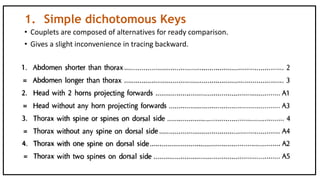
1. Simple dichotomous Keys
• Couplets are composed of alternatives for ready comparison.
• Gives a slight inconvenience in tracing backward.
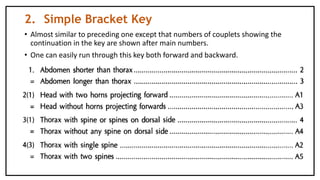
2. Simple Bracket Key
• Almost similar to preceding one except that numbers of couplets showing the
continuation in the key are shown after main numbers.
• One can easily run through this key both forward and backward.
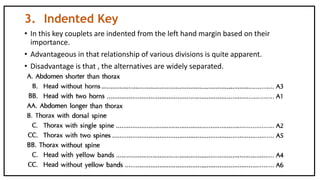
3. Indented Key
• In this key couplets are indented from the left hand margin based on their
importance.
• Advantageous in that relationship of various divisions is quite apparent.
• Disadvantage is that , the alternatives are widely separated.
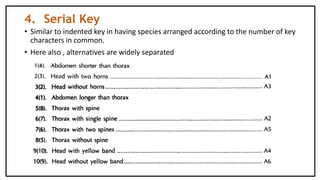
4. Serial Key
• Similar to indented key in having species arranged according to the number of key
characters in common.
• Here also , alternatives are widely separated
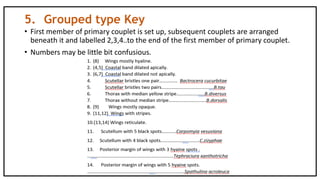
5. Grouped type Key
• First member of primary couplet is set up, subsequent couplets are arranged
beneath it and labelled 2,3,4..to the end of the first member of primary couplet.
• Numbers may be little bit confusious.
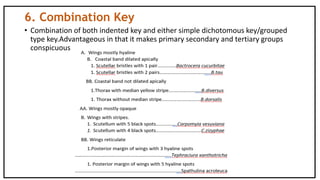
6. Combination Key
• Combination of both indented key and either simple dichotomous key/grouped
type key.Advantageous in that it makes primary secondary and tertiary groups
conspicuous
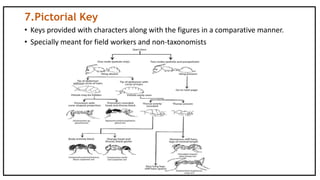
7.Pictorial Key
• Keys provided with characters along with the figures in a comparative manner.
• Specially meant for field workers and non-taxonomists
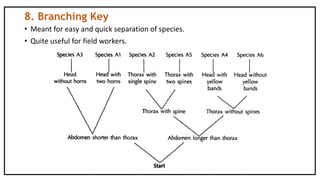
8. Branching Key
• Meant for easy and quick separation of species.
• Quite useful for field workers.
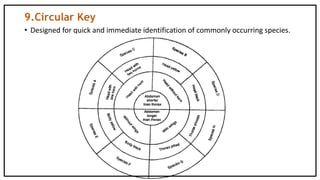
9.Circular Key
• Designed for quick and immediate identification of commonly occurring species.
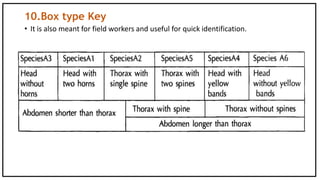
10.Box type Key
• It is also meant for field workers and useful for quick identification.
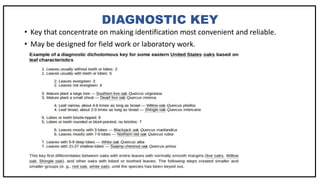
DIAGNOSTIC KEY
• Key that concentrate on making identification most convenient and reliable.
• May be designed for field work or laboratory work.
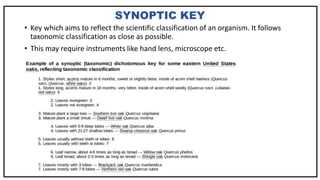
SYNOPTIC KEY
• Key which aims to reflect the scientific classification of an organism. It follows
taxonomic classification as close as possible.
• This may require instruments like hand lens, microscope etc.
TAXONOMIC KEY PRESENTATION
Single access keys can be presented in different styles.Most frequently
encountered styles are given.
I. Nested Style: All couplets immediately followed the lead at the expense of
separating the leads within a couplet. The most frequent sub-type of nested
keys are called ‘indented key’.
II. Linked Style: Leads within a couplet immediately follow each other making
polytomous keys easy to archieve.
COMPUTER AIDED KEY
• In recent years, computer technology has been used for constructing keys.
• Figures , photographs etc can be fed into computer with the help of appropriate
programmes.
• It is much more easier and less time consuming to compare the characters of
unknown taxa with known taxa.
• Scanners of computer can observe and record the characters of undetermined
taxa and compare these with those of already known
• DELTA( Description Language for Taxonomy) is a useful system of programmes for
recording taxonomic descriptions for processing by computer.
• It generates conventional identification keys.
MERITS OF KEYS
• Facilitates identification of specimen
• Key is dichotomous offering two alternatives at any point.
• Easy to apply
• Provides best assurance for correct identification.
• It provides tools for taxonomic analysis since in the preparation of key, one must
select, evaluate and arrange taxonomic characters.
• Key characters apply equally to all individuals of the population regardless of age
and size.
DEMERITS OF KEYS
• Construction of key is a time consuming task.
• Key does not provide biological and phylogenetic characters.
• It does not provide information of cytological and molecular characters of a
specimen.
• Not useful in identification of all specimens.
THANK YOU

Taxonomic key

  • 1.
  • 2.
    TAXONOMIC KEY • Ataxonomic Key is a most useful tool in taxonomy for the identification of an unknown organism. • The object of the key is to separate and segregate diagnostic characters in such a way that it provide a safe road to identification. • The ultimate goal of taxonomic key is the identification of taxa ( species or genus). • It is a tabulation of diagnostic characters of a species in dichotomous couplets facilitating rapid identification for classification. • Taxonomic Key can be generally categorized into two; I. Single access Key II. Multi access Key
  • 3.
    SINGLE ACCESS KEYS •Also known as sequential key, analytical key , pathway key. • Almost all single access keys are dichotomous(dividing into pairs) keys. • It consists of opposing statements(leads), each statements leading to another pair of choices(couplets),sequentially narrowing the user’s search down until a final statement identifies the organism. • These days different kinds of keys are used in taxonomic works. Most important ones are listed below.
  • 4.
    1. Simple dichotomousKeys • Couplets are composed of alternatives for ready comparison. • Gives a slight inconvenience in tracing backward.
  • 5.
    2. Simple BracketKey • Almost similar to preceding one except that numbers of couplets showing the continuation in the key are shown after main numbers. • One can easily run through this key both forward and backward.
  • 6.
    3. Indented Key •In this key couplets are indented from the left hand margin based on their importance. • Advantageous in that relationship of various divisions is quite apparent. • Disadvantage is that , the alternatives are widely separated.
  • 7.
    4. Serial Key •Similar to indented key in having species arranged according to the number of key characters in common. • Here also , alternatives are widely separated
  • 8.
    5. Grouped typeKey • First member of primary couplet is set up, subsequent couplets are arranged beneath it and labelled 2,3,4..to the end of the first member of primary couplet. • Numbers may be little bit confusious.
  • 9.
    6. Combination Key •Combination of both indented key and either simple dichotomous key/grouped type key.Advantageous in that it makes primary secondary and tertiary groups conspicuous
  • 10.
    7.Pictorial Key • Keysprovided with characters along with the figures in a comparative manner. • Specially meant for field workers and non-taxonomists
  • 11.
    8. Branching Key •Meant for easy and quick separation of species. • Quite useful for field workers.
  • 12.
    9.Circular Key • Designedfor quick and immediate identification of commonly occurring species.
  • 13.
    10.Box type Key •It is also meant for field workers and useful for quick identification.
  • 14.
    DIAGNOSTIC KEY • Keythat concentrate on making identification most convenient and reliable. • May be designed for field work or laboratory work.
  • 15.
    SYNOPTIC KEY • Keywhich aims to reflect the scientific classification of an organism. It follows taxonomic classification as close as possible. • This may require instruments like hand lens, microscope etc.
  • 16.
    TAXONOMIC KEY PRESENTATION Singleaccess keys can be presented in different styles.Most frequently encountered styles are given. I. Nested Style: All couplets immediately followed the lead at the expense of separating the leads within a couplet. The most frequent sub-type of nested keys are called ‘indented key’. II. Linked Style: Leads within a couplet immediately follow each other making polytomous keys easy to archieve.
  • 17.
    COMPUTER AIDED KEY •In recent years, computer technology has been used for constructing keys. • Figures , photographs etc can be fed into computer with the help of appropriate programmes. • It is much more easier and less time consuming to compare the characters of unknown taxa with known taxa. • Scanners of computer can observe and record the characters of undetermined taxa and compare these with those of already known • DELTA( Description Language for Taxonomy) is a useful system of programmes for recording taxonomic descriptions for processing by computer. • It generates conventional identification keys.
  • 18.
    MERITS OF KEYS •Facilitates identification of specimen • Key is dichotomous offering two alternatives at any point. • Easy to apply • Provides best assurance for correct identification. • It provides tools for taxonomic analysis since in the preparation of key, one must select, evaluate and arrange taxonomic characters. • Key characters apply equally to all individuals of the population regardless of age and size.
  • 19.
    DEMERITS OF KEYS •Construction of key is a time consuming task. • Key does not provide biological and phylogenetic characters. • It does not provide information of cytological and molecular characters of a specimen. • Not useful in identification of all specimens.
  • 20.