predation and
competition
Population interactions between organisms
01 This topic includes 3 sub topics.
03 This topic includes 1 sub topic.
02 Camouflage, Bluffing, Chemical adaptation
etc.
04 Gause’s Experiments and Mac Arthur’s
theory.
Table of contents
PREDATION
COMPETITION
ADAPTATIONS
EXPERIMENTS
PREDATION
Predation is the interaction between
prey and a predator, where the energy
flows from one organism to the other.
The predator is the organism that feeds
on other organisms called prey.
WHAT ARE PREDATORS
?
Predators are organisms that hunt and kill other
organisms for food. The organisms that are
consumed by the predators are known as the
prey. Predators can be carnivores and
omnivores. Lions, tigers, sharks, and snakes,
all are predators.
Predators can also fall prey to other large animals
depending on where they fall in the food chain.
E.g. a snake is a predator to a mouse, but prey
to a hawk.
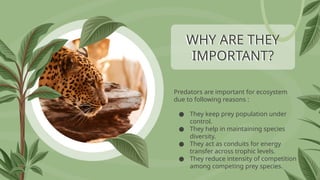
WHY ARE THEY
IMPORTANT?
Predators are important for ecosystem
due to following reasons :
● They keep prey population under
control.
● They help in maintaining species
diversity.
● They act as conduits for energy
transfer across trophic levels.
● They reduce intensity of competition
among competing prey species.
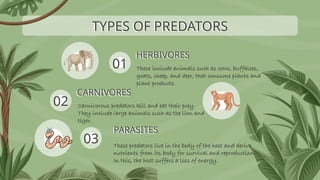
HERBIVORES
These include animals such as cows, buffaloes,
goats, sheep, and deer, that consume plants and
plant products.
Carnivorous predators kill and eat their prey.
They include large animals such as the lion and
tiger.
TYPES OF PREDATORS
CARNIVORES
PARASITES
01
02
03 These predators live in the body of the host and derive
nutrients from its body for survival and reproduction.
In this, the host suffers a loss of energy.
Predators and prey adapt in the following ways
in order to attack and defend :
PREDATORS:
● The predators use camouflage that helps
them to hide from their prey so that they
can make a sudden attack. This also
prevents them from any dangerous
defense mechanism a predator might
have.
● Their mechanical adaptations such as
sharp teeth, claws, thick skin and faster
speed and superior strength help them to
take over the prey.
● The chemical adaptations include venom,
toxins and poison to kill the prey. They
have also evolved chemical adaptations
that protect them from the chemical
defenses of the prey, e.g. monarch
PREDATOR AND PREY ADAPTATIONS
PREYS:
● Camouflage is an adaptation in which a
species evolves to resemble its
background. It is the technique used by
many animals of resembling and
blending in with their surroundings.
● Many animals live in groups, which
means that there are more eyes and
ears to look out for predators. If one
senses danger, the entire group is
alerted and can run for safety.
● Bluffing is used by some animals to
fool their predators into thinking they
are dangerous, already dead, or hurt.
Some may copy the behavior of a
dangerous animal.
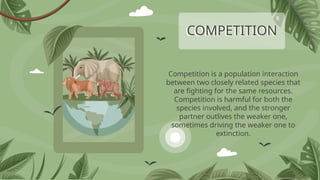
COMPETITION
Competition is a population interaction
between two closely related species that
are fighting for the same resources.
Competition is harmful for both the
species involved, and the stronger
partner outlives the weaker one,
sometimes driving the weaker one to
extinction.
TYPES OF COMPETITION
● Intraspecific Competition :- It is the competition between
individuals within a particular species. An example is the Silver
gorilla. The alpha or dominant male mates with the female
gorillas within a group.
● Interspecific competition :- It is the competition between individuals
of different species for a common resource. For example, in the South
American lakes, both the visiting flamingoes and the resident fishes feed
on zooplankton.
● Interference Competition :- The feeding efficiency of one species
might be reduced due to the interfering of another species. For
instance, the Abingdon tortoise in Galapagos Islands became extinct
after goats were introduced.
EXPERIMENTS ON COMPETITION
Gause’s Exclusion Principle :- The principle of competitive exclusion was
proposed by G.F. Gause which states that two species competing for the
same resources cannot coexist. This law is also known as Gause’s law. One
population will drive off the other one. If any of the members of the
depleted population remains, that would be because they have adapted
themselves according to the different niche.
Competitive Release :- A species restricted to a small geographical area
because of the presence of a competitively superior species, is found to
expand its distributional range when the competing species is
experimentally removed. This is called competitive release.
Resource Partitioning :- If one or both the species belonging to the same niche
evolve to use different resources or develop different feeding habits,
competitive exclusion can be avoided. Due to this evolution, the species start
using non-overlapping resources resulting in different niches. This is termed
a Resource Partitioning. This helps the species to exist together.
MacArthur’s Theory of Resource Partitioning :- According to the mechanism
of resource partitioning (supported by MacArthur), if two species compete
for the same resource, they could avoid competition by choosing, for
instance, different times for feeding or different foraging patterns.
MacArthur showed that five closely related species of warblers living on the
same tree were able to avoid competition and co-exist due to behavioral
differences in their foraging activities.
CREDITS: This presentation template was created by
Slidesgo, and includes icons by Flaticon and infographics &
images by Freepik
THANKS!
What’s your level of understanding this topic
?
Name :- Omansh Shukla Class :- XII ‘A’
Subject :- Biology
FACT :- Over 37,000 species are threatened with extinction. That is 28 % of all species.