A small change in the slide 3, Studied many years ago in 1859 Darwin has mentioned the interaction between flowering plant and insects in his book On the Origin of Species.
Contents:
Introduction
1. The Differentgrades of Co-evolution
1.1 Pairwise Co-evolution
1.2 Diffuse co-evolution
2. Pairwise Co-evolution
3. Diffuse Co-evolution
3.1 Mammalian Predator–Prey Diffuse Co-evolution
3.2 Red Queen Hypothesis
4. Insect Pollination & Co-evolution
4.1 Angiosperm–Pollinator Relationships
4.2 Early Evolution of Insect Pollination
4.3 Orchids and Hymenoptera
5. Introduced Species
5.1 Case studies of introduced species
6. Evolutionary Significances
3.
Introduction:
Coevolution isa process by which two or more species evolve together
by executing selection pressures by each other. It is a special kind of
adaptation. It occurs when two or more species reciprocally affect each
other evolution. Usually this implies that as one species evolves
particular characteristics, the other species also evolves in response to
this. The first species then evolves response to response of second, and
so on.
The term coevolution was coined by Paul R. Ehrlich and Peter H.
Reven in 1964. But these types of evolutionary interactions have been
studied many years ago in 1959. Darwin has mentioned the interaction
between flowering plant and insects in his book On the Origin of
Species.
4.
1. The Differentgrades of Co-evolution:
1.1 Pairwise Co-evolution:
ⅰ) Pairwise Co-evolution involves two ecologically close species
evolving in response to each other.
ii) Sometimes only one species shows evolutionary change,
making distinctions difficult due to observing only one time
point.
eg., Ants and acacias, Caterpillars and host plants, bees and
flowers, etc...
5.
1.2 Diffuse co-evolution:
i)Diffuse co-evolution includes more than two species evolving
together.
ii) For example an introduced insect from another geographical
area may find and eat a plant species because it has a Similar
Chemical composition to its normal food, or an introduced flower
will attract a pollinator which has never seen the species before.
eg., Predators and prey, Grazers and plants
6.
2. Pairwise Co-evolution:
Pairwise or one-on-one co-evolution refers to close ecological
interactions between two species.
Types of Relationships:
1. Mutualism:
This is often termed symbiosis.When both species benefit, the
relationship is mutualistic. Such co-evolution can result in highly complex
life cycles where one or both species become dependent on each other for
survival (e.g., ants and acacias).
7.
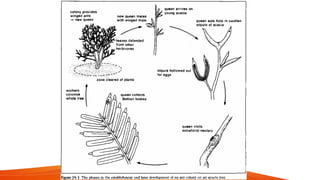
The Ant-Acacia Example:
Mutualism:Acacia cornigera and Pseudomyrmex ferruginea
Queen ant colonizes young swollen-thorn acacia.
Tree provides:
Swollen stipules for shelter.
Foliar nectaries (sugar source).
Beltian bodies (rich in proteins/lipids) for larvae.
Ants provide:
Defend acacia from insects, herbivores, and even neighboring plants.
Clear ground vegetation around the trunk.
8.
Co-evolutionary Benefits:
Acaciaavoids producing costly chemical or mechanical defenses.
Can invest more energy into growth.
Ants gain shelter and food, supporting colonies up to 30,000 workers.
Ants nest at plant base, not inside the plant.
Soil under nests has higher nitrate, ammonia, phosphorus and water due
to ant waste and nest activity
Result: both species benefit more than the energy they invest in the
partnership.
10.
Antagonism:
when oneharms the other, it's antagonistic (e.g., predator-prey or
parasite-host). Antagonistic relationships often lead to an evolutionary
“arms race,” where both species adapt in response to each other through
chemical, mechanical, or behavioral changes.Leads to stepwise co-
evolution in traits for attack and defense.
Evolved traits may be:
Chemical (toxins, antitoxins)
Mechanical (hard shells, claws)
Behavioral (camouflage, hunting techniques)
This is known as an evolutionary arms race (Dawkins & Krebs, 1979).
11.
Mimicry in Co-evolution:
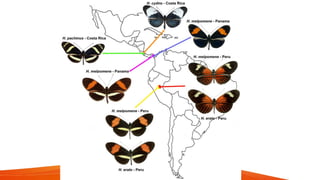
1.Müllerian Mimicry:
Distasteful or poisonous species evolve similar warning coloration.
Predators (e.g., birds) learn to avoid one pattern, reducing prey loss and
predator risk.
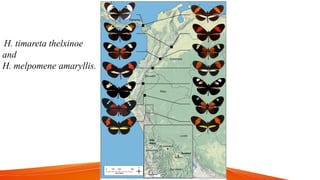
eg., Heliconius erato and H.melpomene butterflies in the Amazon basin. Races
of the two species living in the same area have very similar wing patterns. Both
species are poisonous, so this is an example of Mullerian Mimicry
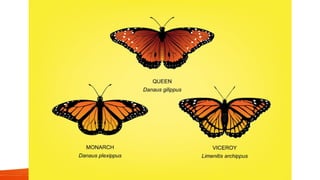
2. Batesian Mimicry:
Edible species mimic warning signals of toxic species to avoid predation.
Effective if true models are abundant.
Predators may evolve to recognize mimics, leading to an arms race that may
stabilize.
eg., Monarch and viceroy butterflies.
3. Diffuse Co-evolution:
Involves evolutionary changes between groups of species, rather than
tightly paired species (pairwise co-evolution).
Examples
Plants vs. Herbivores: Plants develop generalized defenses (e.g. thorns,
toxins), while herbivores evolve to tolerate various plant defenses.
Grasses and Grazers: Grasses develop silica and basal meristems; grazers
evolve high-crowned teeth.
Predators and Prey: Prey evolve speed/camouflage; predators evolve
speed/behavioral adaptations.
16.
3.1 Mammalian Predator–PreyDiffuse Co-evolution:
After the Cretaceous extinction, mammals diversified during the Tertiary,
adapting to new grassland habitats.
Forest-dwelling mammals gave rise to large grazers and pursuit
predators.
Herbivores evolved to live in open plains (e.g., deer, horses), increasing
speed and group behavior for safety.
Carnivores (e.g., wolves, lions, cheetahs) evolved traits for chasing prey.
Morphological changes: Longer limbs, reduced toes, and elongated
metatarsals for both herbivores and carnivores (more pronounced in
grazers).
Cheetah: A highly specialized predator for short-distance speed.
17.
3.2 Red QueenHypothesis:
Proposed by Leigh Van Valen (1973) to explain consistent extinction
rates over time.
Concept: Species must continuously evolve to keep pace with others in
their ecological community, especially under antagonistic interactions.
The name Red queen is named after the Red Queen in Lewis Carroll’s
Victorian children’s book “Through the Looking Glass”, who says: “It
takes all the running you can do, to stay in the same place.”
Implication: Ongoing evolutionary "arms race" between predators and
prey; species that fall behind may go extinct.
18.
4. Insect Pollination& Co-evolution:
4.1 Angiosperm–Pollinator Relationships
Entomophily: Pollination carried out by insects is called entamophily. Flowers
attract insects with nectar, pollen & colour.
Mutual Benefits:
Insect gets food (nectar/pollen).
Plant gains cross-pollination.
Floral Adaptations: Right shape/size for pollinator; efficient placement of
reproductive parts.
Pollinator Preferences: Insects favor flowers with high reward; plants aim to
offer minimal resources for maximum pollination.
19.
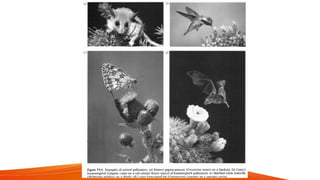
Examples:
Bees →zygomorphic tubular flowers.
Moths → white, night-scented flowers.
Butterflies → long corolla tubes.
Hummingbirds → red, tubular flowers.
Mammals → robust flowers on strong branches.
Shared Pollinators:
Two rare species may share one pollinator to maintain reproductive
success.
e.g., Costus species in Panama.
21.
Diffuse Co-evolution:
Leadsto flowering at different times or targeting different insect species.
Seen in tropical forests with either mass flowering or year-round
flowering with faithful pollinators.
Pairwise Co-evolution:
It is rare in flowering plants & insect coevolution.
e.g., fig trees & wasps like Blastophaga psenes. (Note: Each fig species
has a specific wasp pollinator).
22.
4.2 Early Evolutionof Insect Pollination:
Angiosperms and insects co-evolved, leading to immense diversity in
both.
Before Angiosperms:
Jurassic gymnosperms (e.g., cycadeoids) may have been beetle-
pollinated.
Insects likely transported spores/pollen incidentally before co-evolution
became more directed.
Cretaceous Flowers: Simple, radially symmetrical flowers likely
pollinated by small generalist insects.
Evidences are limited due to poor fossilization of flowers and insects.
23.
4.3 Orchids andHymenoptera (e.g., Bees & Wasps):
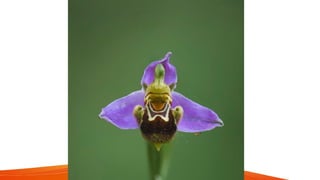
Orchids (Ophrys spp.) use deceit pollination, by mimicking female bees in
shape, colour and scent.
Male bees are tricked into trying to mate with the flower this phenomena is
called pseudocopulation.
While doing this, they unknowingly pick up pollen in their pollen sac and
transfer it to other flowers. This is only benefiting the plant, there are no reward
for the insect.
The flowers emit a large number of volatile chemicals. most notably terpenoids
and fatty acid derivatives. These odours mimic those of female bees, or they
may act as a super-stimulus.
Bergstrom suggests that, at an earlier evolutionary stage, a pre-Ophrys was
visited by both males and females; later favored male-focused attraction due to
higher pollination success.
25.
5. Introduced Species:
Species in a stable community co-evolve and function harmoniously like
parts of a single organism.
Any advantage gained by one species is usually countered by others,
keeping the ecosystem balanced.
Species are "boxed in" by evolutionary and environmental constraints.
Impact of Introduced Species
Introduced species enter ecosystems where they haven’t co-evolved.
Three possible outcomes while a new species introduced to a
environment, they are
1. No advantage → species may fail.
2. Similar level → coexistence possible.
3. More advanced → invades, dominates, or destroys native species.
26.
5.1 Case studiesof introduced species:
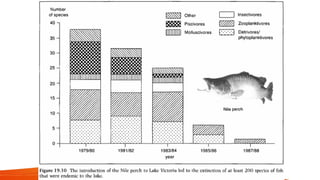
Case Study 1: Nile Perch in Lake Victoria (Since 1954)
Nile Perch is Introduced in the Lake Victoria in the year 1954.
Over the next 40 years the introduced Nile Perch caused
extinction of more than 200 endemic fish species.
Led to collapse of native biodiversity, though supported a
commercial fishery.
28.
🐜 Case Study2: Ants in the Hawaiian Islands
️ 🏝️
Native fauna of Hawaiian islands lacked ants.
The voracious feeding predatory ant Pheidole megacephala was
introduced to the Hawaiian islands, the introduced ant species
wiped out endemic flightless fly.
Other introduced species parasitic wasps threatened endemic
moths; Rats threatened endemic plants of Hawaiian Islands.
29.
🐇 Case Study3: Rabbits in Australia
Introduced in 1859, became a major pest due to fast breeding
and overgrazing.
Devastated native vegetation and endangered wildlife (e.g.,
rabbit-eared bandicoot).
Control efforts:
1. Myxomatosis virus (1950s): Killed 99%, but resistance
evolved.
2. Calicivirus (1996): Killed ~80% in infected areas; causes
blood clotting and death.
30.
6. Evolutionary Significances:
Itincreases own fitness with respect to each other
Adaptation and Specialization: Coevolution drives adaptive
radiation.
Species Diversification: Coevolution contributes to speciation.
It increases species diversity
Evolutionary Innovation: Coevolution leads to novel traits and
functions.



![Polymer [ बहुलक ] Chemistry Notes PDF - Irfanullah Mehar - JJ Sir Chemistry.pdf](https://cdn.slidesharecdn.com/ss_thumbnails/polymerchemistrynotespdf-irfanullahmehar-jjsirchemistry-260210172118-3f9b37f7-thumbnail.jpg?width=640&height=640&fit=bounds)


