IRON STAINING
MODERATOR:DRANEETASINGH
Presented by :Shikha Sharma
Introduction:
Iron is an essential element for humans that is
mainly absorbed from diet in the duodenal
enterocytes and is transported in the plasma by an
iron binding glycoprotein called transferrin,
synthesised in liver.
Transferrin delivers iron to the erythroid precursors,
which possess high affinity transferrin receptors that
mediate iron import through receptor mediated
endocytosis. The major sites of iron storage are liver
and mononuclear phagocytes.
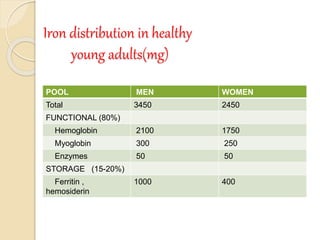
Iron distribution in healthy
young adults(mg)
POOL MEN WOMEN
Total 3450 2450
FUNCTIONAL (80%)
Hemoglobin 2100 1750
Myoglobin 300 250
Enzymes 50 50
STORAGE (15-20%)
Ferritin ,
hemosiderin
1000 400
STORAGE FORMS:
1.FERRITIN:
 Ferritin is the primary iron storage form .
 It is water-soluble protein-iron complex and contains a
spherical shell of apoprotein enclosing a core of
hydrated ferric phosphate. A single ferritin molecule can
hold upto 4500 iron atoms.
 Ferrous iron entering into ferritin is oxidised to ferric
form by molecular oxygen , with apoferritin catalysing
the oxidative process.
 Ferritin is present in circulation and serum ferritin levels
are used as a marker of the total amount of iron stored
in the body,hence serum ferritin is used as a diagnostic
test for IDA and also to control chelation therapy in
thalassemia major.
 Ferritin is found at highest levels in liver( 60%), and in
HEMOSIDERIN:
Hemosiderin is a brown pigment that is present in
reticuloendothelial cells of bone marrow, spleen and
liver.
HEMOSIDERIN is probably formed by partial
degradation
of aggregates of ferritin by lysosomes. It is a
conglomeration of iron, ferritin proteins and other
subcellular constituents.
 With normal iron stores ,only traces of hemosiderin
are
found in body and most of the iron is stored as
ferritin
Iron in hemosiderin is chemically reactive and turns
blue-black when exposed to Potassium ferrocyanide,
which forms the basis for the PRUSSIAN BLUE
STAIN.
Hemosiderin differs from ferritin
as-
1.Unlike ferritin , hemosiderin is visible , water insoluble,
crystalline protein-iron complex.
2.Hemosiderin has higher iron/protein ratio than ferritin.
3. Hemosiderin is more stable and less available form of
storage iron than ferritin.
IRON WITHIN NORMOBLASTS
80-90% of iron that is taken up by erythroid precursor cells is
ultimately taken up by mitochondria and incorporated into he
NORMOBLASTS with prussian blue positive granules
are called SIDEROBLASTS. These are normal erythroblasts
after prussian blue staining show a few blue granules scatte
cytoplasm, representing endosomes filled with excess iron n
utilized for heme synthesis.
If granules persist after enucleation,the mature cells are calle
SIDEROCYTES.
Now if, a nucleated red cell precursor has 5 or more iron
granules encircling more than 1/3rd of the nuclear circumfere
it is defined as a RINGED SIDEROBLAST. The abnormal
deposition of iron is shown to be in mitochondria which align
themselves around nuclei in a ringed fashion.
The most widely used stain for iron demonstration is
prussian blue stain.
 Also known as PERLS’ PRUSSIAN BLUE after its
inventor,
a German Pathologist , Max Perls.
IRON STAINING
 It is an extremely sensitive test, and can even
detect
single granules of iron in cells.
PRINCIPLE OF PRUSSIAN BLUE STAIN FOR
FERRIC IRON IN HEMOSIDERIN:
Hemosiderin forms the body’s iron stores.
When the tissue is treated with an acid- ferrocyanide
solution, it will result in the unmasking of ferric iron in
hemosiderin, in the form of ferric hydroxide,Fe(OH)3,
by dilute hydrochloric acid.
The ferric iron then reacts with a dilute potassium
ferrocyanide solution to produce an insoluble blue
compound ferric ferrocyanide (PRUSSIAN BLUE).
STAINING PROTOCOL OF IRON
for bm samples
FIXATIVE OF CHOICE:
FORMOL-METHANOL (ratio 1:9).
Methanol alone is also adequate.
STAINING SOLUTION:
Equal quantities of:
2% HCL and
4% potassium ferrocyanide.
WORKING SOLUTION :
Made by mixing 2 ml of each reagent.
Also used is Safranin(0.1% nuclear fast red) for counterstai
Procedure:
Fix the air dried bone marrow specimen in methanol for
15 min.
Dry the slides in room temperature.
Mix equal parts of HCL and potassium ferrocyanide
prepared immediately before use.
Immerse slides in this working solution for 15 min. in room
temperature.
Now wash the slides well with distilled water for 5 min.
Counter stain with aqueous solution of safranin (0.1% nuc
fast red) for 10-15 sec.
Wash with distilled water . Let the slides dry.
RESULTS:
FERRIC IRON : BLUE
NUCLEI : RED
CYTOPLASM : PINK
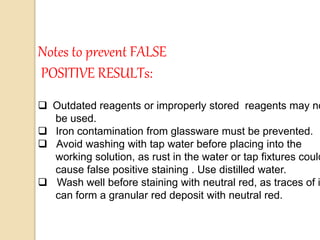
Notes to prevent FALSE
POSITIVE RESULTs:
 Outdated reagents or improperly stored reagents may no
be used.
 Iron contamination from glassware must be prevented.
 Avoid washing with tap water before placing into the
working solution, as rust in the water or tap fixtures could
cause false positive staining . Use distilled water.
 Wash well before staining with neutral red, as traces of i
can form a granular red deposit with neutral red.
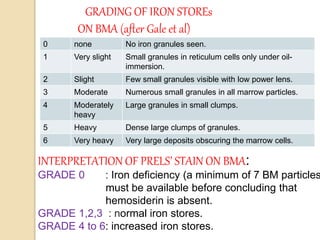
GRADING OF IRON STOREs
ON BMA (after Gale et al)
0 none No iron granules seen.
1 Very slight Small granules in reticulum cells only under oil-
immersion.
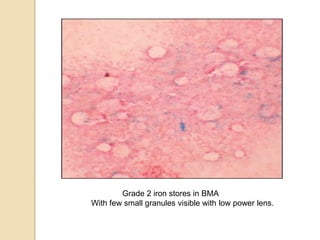
2 Slight Few small granules visible with low power lens.
3 Moderate Numerous small granules in all marrow particles.
4 Moderately
heavy
Large granules in small clumps.
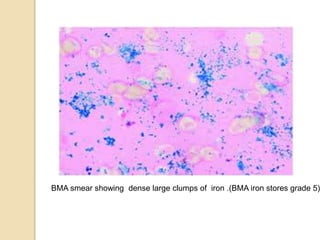
5 Heavy Dense large clumps of granules.
6 Very heavy Very large deposits obscuring the marrow cells.
INTERPRETATION OF PRELS’ STAIN ON BMA:
GRADE 0 : Iron deficiency (a minimum of 7 BM particles
must be available before concluding that
hemosiderin is absent.
GRADE 1,2,3 : normal iron stores.
GRADE 4 to 6: increased iron stores.
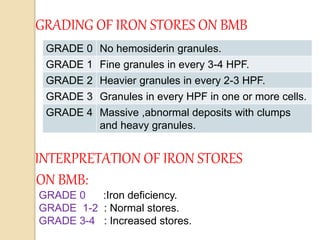
GRADING OF IRON STORES ON BMB
GRADE 0 No hemosiderin granules.
GRADE 1 Fine granules in every 3-4 HPF.
GRADE 2 Heavier granules in every 2-3 HPF.
GRADE 3 Granules in every HPF in one or more cells.
GRADE 4 Massive ,abnormal deposits with clumps
and heavy granules.
INTERPRETATION OF IRON STORES
ON BMB:
GRADE 0 :Iron deficiency.
GRADE 1-2 : Normal stores.
GRADE 3-4 : Increased stores.
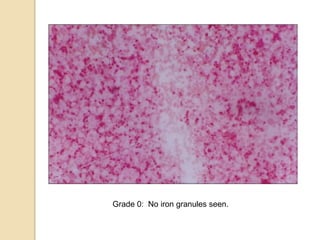
Grade 0: No iron granules seen.
Grade 2 iron stores in BMA
With few small granules visible with low power lens.
BMA smear showing dense large clumps of iron .(BMA iron stores grade 5)
Thank you.

iron staining.

  • 1.
  • 2.
    Introduction: Iron is anessential element for humans that is mainly absorbed from diet in the duodenal enterocytes and is transported in the plasma by an iron binding glycoprotein called transferrin, synthesised in liver. Transferrin delivers iron to the erythroid precursors, which possess high affinity transferrin receptors that mediate iron import through receptor mediated endocytosis. The major sites of iron storage are liver and mononuclear phagocytes.
  • 3.
    Iron distribution inhealthy young adults(mg) POOL MEN WOMEN Total 3450 2450 FUNCTIONAL (80%) Hemoglobin 2100 1750 Myoglobin 300 250 Enzymes 50 50 STORAGE (15-20%) Ferritin , hemosiderin 1000 400
  • 4.
    STORAGE FORMS: 1.FERRITIN:  Ferritinis the primary iron storage form .  It is water-soluble protein-iron complex and contains a spherical shell of apoprotein enclosing a core of hydrated ferric phosphate. A single ferritin molecule can hold upto 4500 iron atoms.  Ferrous iron entering into ferritin is oxidised to ferric form by molecular oxygen , with apoferritin catalysing the oxidative process.  Ferritin is present in circulation and serum ferritin levels are used as a marker of the total amount of iron stored in the body,hence serum ferritin is used as a diagnostic test for IDA and also to control chelation therapy in thalassemia major.  Ferritin is found at highest levels in liver( 60%), and in
  • 5.
    HEMOSIDERIN: Hemosiderin is abrown pigment that is present in reticuloendothelial cells of bone marrow, spleen and liver. HEMOSIDERIN is probably formed by partial degradation of aggregates of ferritin by lysosomes. It is a conglomeration of iron, ferritin proteins and other subcellular constituents.  With normal iron stores ,only traces of hemosiderin are found in body and most of the iron is stored as ferritin
  • 6.
    Iron in hemosiderinis chemically reactive and turns blue-black when exposed to Potassium ferrocyanide, which forms the basis for the PRUSSIAN BLUE STAIN. Hemosiderin differs from ferritin as- 1.Unlike ferritin , hemosiderin is visible , water insoluble, crystalline protein-iron complex. 2.Hemosiderin has higher iron/protein ratio than ferritin. 3. Hemosiderin is more stable and less available form of storage iron than ferritin.
  • 7.
    IRON WITHIN NORMOBLASTS 80-90%of iron that is taken up by erythroid precursor cells is ultimately taken up by mitochondria and incorporated into he NORMOBLASTS with prussian blue positive granules are called SIDEROBLASTS. These are normal erythroblasts after prussian blue staining show a few blue granules scatte cytoplasm, representing endosomes filled with excess iron n utilized for heme synthesis. If granules persist after enucleation,the mature cells are calle SIDEROCYTES. Now if, a nucleated red cell precursor has 5 or more iron granules encircling more than 1/3rd of the nuclear circumfere it is defined as a RINGED SIDEROBLAST. The abnormal deposition of iron is shown to be in mitochondria which align themselves around nuclei in a ringed fashion.
  • 9.
    The most widelyused stain for iron demonstration is prussian blue stain.  Also known as PERLS’ PRUSSIAN BLUE after its inventor, a German Pathologist , Max Perls. IRON STAINING  It is an extremely sensitive test, and can even detect single granules of iron in cells.
  • 10.
    PRINCIPLE OF PRUSSIANBLUE STAIN FOR FERRIC IRON IN HEMOSIDERIN: Hemosiderin forms the body’s iron stores. When the tissue is treated with an acid- ferrocyanide solution, it will result in the unmasking of ferric iron in hemosiderin, in the form of ferric hydroxide,Fe(OH)3, by dilute hydrochloric acid. The ferric iron then reacts with a dilute potassium ferrocyanide solution to produce an insoluble blue compound ferric ferrocyanide (PRUSSIAN BLUE).
  • 11.
    STAINING PROTOCOL OFIRON for bm samples FIXATIVE OF CHOICE: FORMOL-METHANOL (ratio 1:9). Methanol alone is also adequate. STAINING SOLUTION: Equal quantities of: 2% HCL and 4% potassium ferrocyanide. WORKING SOLUTION : Made by mixing 2 ml of each reagent. Also used is Safranin(0.1% nuclear fast red) for counterstai
  • 12.
    Procedure: Fix the airdried bone marrow specimen in methanol for 15 min. Dry the slides in room temperature. Mix equal parts of HCL and potassium ferrocyanide prepared immediately before use. Immerse slides in this working solution for 15 min. in room temperature. Now wash the slides well with distilled water for 5 min. Counter stain with aqueous solution of safranin (0.1% nuc fast red) for 10-15 sec. Wash with distilled water . Let the slides dry. RESULTS: FERRIC IRON : BLUE NUCLEI : RED CYTOPLASM : PINK
  • 13.
    Notes to preventFALSE POSITIVE RESULTs:  Outdated reagents or improperly stored reagents may no be used.  Iron contamination from glassware must be prevented.  Avoid washing with tap water before placing into the working solution, as rust in the water or tap fixtures could cause false positive staining . Use distilled water.  Wash well before staining with neutral red, as traces of i can form a granular red deposit with neutral red.
  • 14.
    GRADING OF IRONSTOREs ON BMA (after Gale et al) 0 none No iron granules seen. 1 Very slight Small granules in reticulum cells only under oil- immersion. 2 Slight Few small granules visible with low power lens. 3 Moderate Numerous small granules in all marrow particles. 4 Moderately heavy Large granules in small clumps. 5 Heavy Dense large clumps of granules. 6 Very heavy Very large deposits obscuring the marrow cells. INTERPRETATION OF PRELS’ STAIN ON BMA: GRADE 0 : Iron deficiency (a minimum of 7 BM particles must be available before concluding that hemosiderin is absent. GRADE 1,2,3 : normal iron stores. GRADE 4 to 6: increased iron stores.
  • 15.
    GRADING OF IRONSTORES ON BMB GRADE 0 No hemosiderin granules. GRADE 1 Fine granules in every 3-4 HPF. GRADE 2 Heavier granules in every 2-3 HPF. GRADE 3 Granules in every HPF in one or more cells. GRADE 4 Massive ,abnormal deposits with clumps and heavy granules. INTERPRETATION OF IRON STORES ON BMB: GRADE 0 :Iron deficiency. GRADE 1-2 : Normal stores. GRADE 3-4 : Increased stores.
  • 16.
    Grade 0: Noiron granules seen.
  • 17.
    Grade 2 ironstores in BMA With few small granules visible with low power lens.
  • 18.
    BMA smear showingdense large clumps of iron .(BMA iron stores grade 5)
  • 19.