SQUASH SMEAR
CYTOLOGY
DR. ANAMIKA DEV
INTRODUCTION
• Central nervous system (CNS) is one of the most
challenging domains for the neurosurgeon and
Pathologists
• The application of smear techniques as a means of
obtaining rapid diagnosis for neurosurgical biopsies
was first advocated by Dr Eisenhardt and Dr
Cushing in the USA in early 1930
• Since then, although the technique has been
modified by various individuals by changing the
fixative or stain, the basic principle has remained
unchanged
• Simple and rapid methodology for fairly accurate
intraoperative diagnosis of CNS space occupying
lesions.
• High accuracy  clinical and radiological
picture into consideration.
• Two procedures : open craniotomy or
stereotactic biopsy.
• Goal of intraoperative cyto-diagnosis in
stereotactic biopsies to confirm the adequacy
of the tissue.
• Use of intraoperative diagnosis in open biopsy:
–Additional tissue for ancillary techniques (for
infections and lymphomas),
–To decide on extent of resection and makes it
possible to institute adjuvant therapy in
immediate postoperative period.
–Last, but not the least, an intraoperative
pathological diagnosis is of great value to the
anxious family members of the patients.
SAMPLE IDENTIFICATION
AND TRANSPORTATION
• Transportation - sterile container on a saline-moistened
lens paper or telfa pad (never gauze) to prevent drying
• Request form - relevant clinico-radiologic data
–precise site of biopsy
–reason for which the intraoperative diagnosis was
sought – adequacy or guidance
–technique used : open biopsy, stereotactic-guided
needle aspiration biopsy ; fine-needle aspiration
biopsy
HOW TO PREPARE A
SQUASH SMEAR?
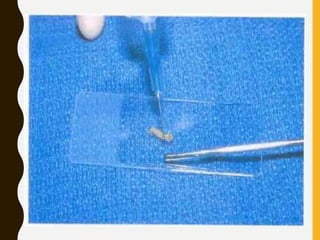
• The selected fragment is placed on a glass
slide and then divided into smaller pieces
(1–2 mm3)
• Sample is inspected with the help of a
magnifier or under dissecting microscope to
see whether specimen appears necrotic or
hemorrhagic or both
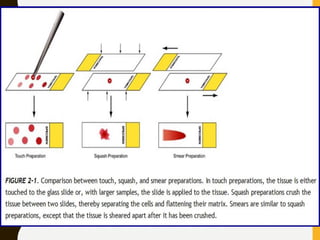
• Each of the smaller pieces is placed on a
newer slide
• A second labelled slide is placed over the
first slide on top of the tissue fragment
• Gently pull both the slides apart to produce
two thin well spread smears
• Fixative of choice : 95% Ethanol, 1-2 min
• Additional slides are air dried and stained
• Stain : H&E, Papanicolaou
• additional slides : WRIGHTs stain
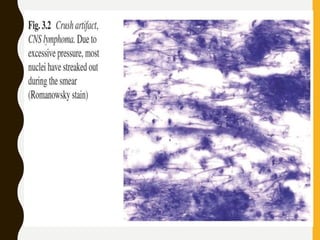
• Artifacts : crushing, overstretching and dry
artifacts
• When tissue spreads poorly, stain both slides
with H & E, as one smear will usually have
sufficiently thin areas to make interpretation
possible
• Note :
• Don’t smear too large a specimen slide too
thick for optimal cytological detail
• Thin specimen  recognition of fine
fibrillary process often a/w glial tumors
• tissue defy smearing having extensive
reticulin, collagen, or glial fibers
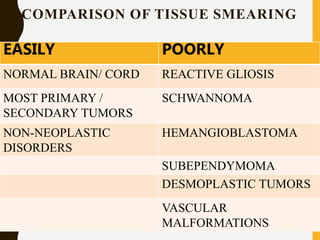
COMPARISON OF TISSUE SMEARING
EASILY POORLY
NORMAL BRAIN/ CORD REACTIVE GLIOSIS
MOST PRIMARY /
SECONDARY TUMORS
SCHWANNOMA
NON-NEOPLASTIC
DISORDERS
HEMANGIOBLASTOMA
SUBEPENDYMOMA
DESMOPLASTIC TUMORS
VASCULAR
MALFORMATIONS
ADVANTAGES OF SMEAR TECHNIQUE
• Improved cost-effectiveness
• More rapid and technically simpler
• Only small amount of tissue needed
• Far better preservation of cellular detail
• Best in demonstrating fibrillary cytoplasmic processes
• Provides additional information to the permanent sections
• If the case turns out to be infectious, contamination of the
cryostat and subsequent defrosting and sterilization can be
avoided
• Abrogate the risk of distorting valuable diagnostic
material during freezing, which compromise permanent
sections and immunomarkers
LIMITATIONS
• Relies on tissue soft enough to smear
• Histologic architecture not apparent
• Relies on accurate localization by the surgeon
• Low-magnification architecture is lost
• Some lesions do not smear well (especially those
having extensive reticulin or collagen)
• Specific training needed (many pathologists are
more familiar with frozen section techniques and
interpretation)
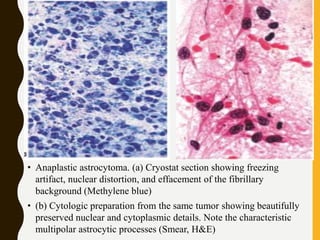
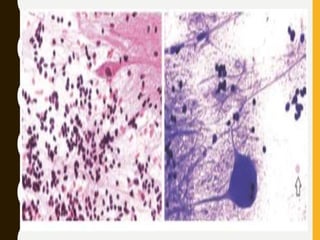
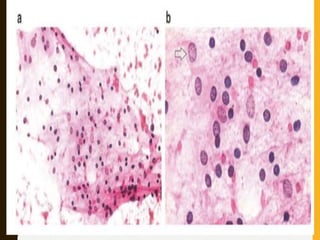
• Anaplastic astrocytoma. (a) Cryostat section showing freezing
artifact, nuclear distortion, and effacement of the fibrillary
background (Methylene blue)
• (b) Cytologic preparation from the same tumor showing beautifully
preserved nuclear and cytoplasmic details. Note the characteristic
multipolar astrocytic processes (Smear, H&E)
NORMAL CNS
CYTOLOGY
NORMAL BRAIN
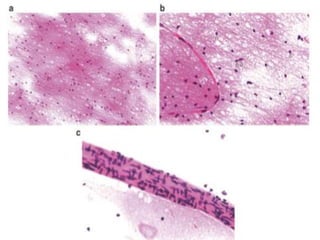
1. White matter pattern
1. Will smear easily
2. Felt like background
3. Small, empty vacuoles representing dissolved myelin –
scattered in background
4. Cellular population consisting basically of
oligodendrocytes and to a lesser extent of astrocytes
5. Delicate capillaries with elongated endothelial cells
arranged parallel to the capillary wall
6. Also seen few arterioles with thicker walls, in which cells
are arranged parallel (endothelial cells) or perpendicular
(muscle cells) to the lumen - bidirectional arrangement
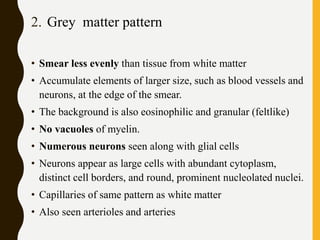
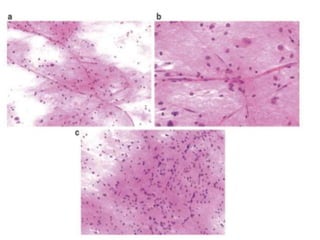
2. Grey matter pattern
• Smear less evenly than tissue from white matter
• Accumulate elements of larger size, such as blood vessels and
neurons, at the edge of the smear.
• The background is also eosinophilic and granular (feltlike)
• No vacuoles of myelin.
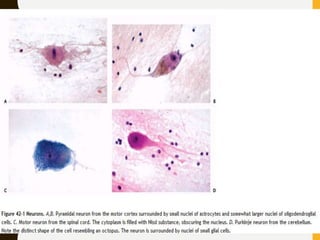
• Numerous neurons seen along with glial cells
• Neurons appear as large cells with abundant cytoplasm,
distinct cell borders, and round, prominent nucleolated nuclei.
• Capillaries of same pattern as white matter
• Also seen arterioles and arteries
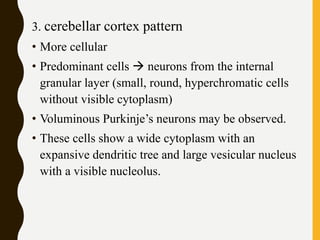
3. cerebellar cortex pattern
• More cellular
• Predominant cells  neurons from the internal
granular layer (small, round, hyperchromatic cells
without visible cytoplasm)
• Voluminous Purkinje’s neurons may be observed.
• These cells show a wide cytoplasm with an
expansive dendritic tree and large vesicular nucleus
with a visible nucleolus.
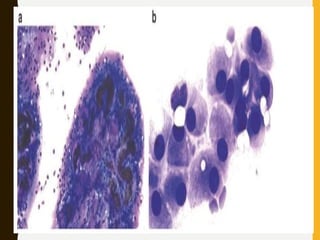
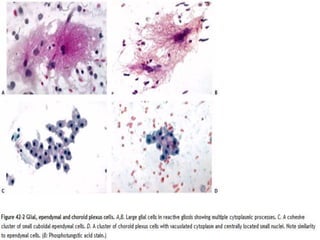
4. Choroid plexus pattern
• A normal choroid plexus may be present in biopsy specimens
from the ventricles
• Vascular-stromal framework tends to smear poorly and
results in a cohesive crush preparation
• Vessels  complex arched papillary appearance,
characteristic of a plexus, lined by a row of cuboidal
epithelial cells
• Cells that appear isolated, due to the squash trauma
– wide polygonal “cobblestone-shaped” cytoplasm
– small, round, basally located nuclei
– Can have single prominent paranuclear cytoplasmic vacuole
5. Leptomeningeal pattern
• Large cell clusters
• The cytoplasm of arachnoid cap cells is wide and
delicate
• Nuclei are round to ovoid with finely granular
dispersed chromatin, often giving the appearance of
central clearings.
• As against cells from the choroid plexus, arachnoidal
cells have poorly defined boundaries, giving rise to
sheets with a syncytial appearance
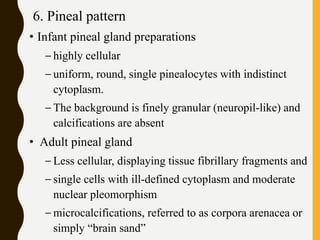
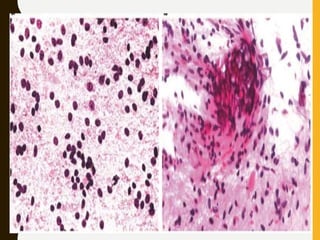
6. Pineal pattern
• Infant pineal gland preparations
– highly cellular
– uniform, round, single pinealocytes with indistinct
cytoplasm.
– The background is finely granular (neuropil-like) and
calcifications are absent
• Adult pineal gland
– Less cellular, displaying tissue fibrillary fragments and
– single cells with ill-defined cytoplasm and moderate
nuclear pleomorphism
– microcalcifications, referred to as corpora arenacea or
simply “brain sand”
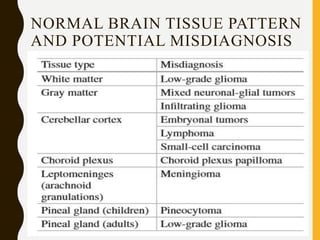
NORMAL BRAIN TISSUE PATTERN
AND POTENTIAL MISDIAGNOSIS
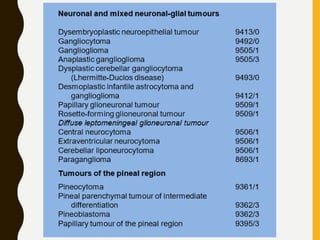
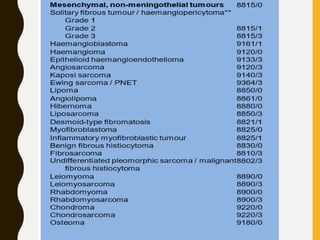
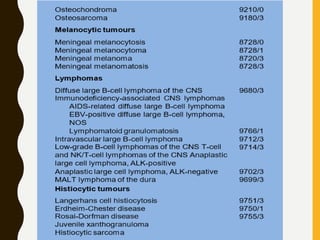
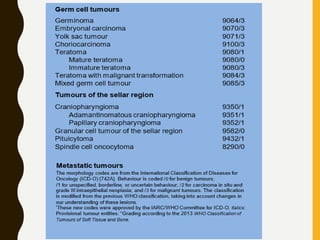
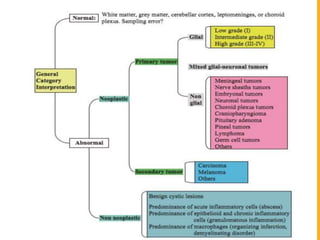
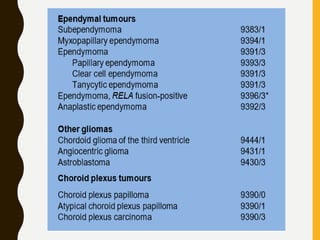
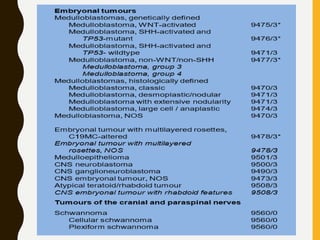
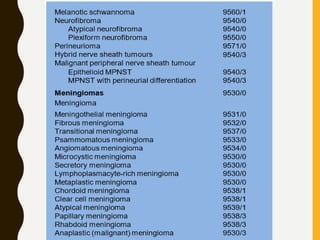
WHO 2016
CLASSIFICATION OF
CNS TUMORS
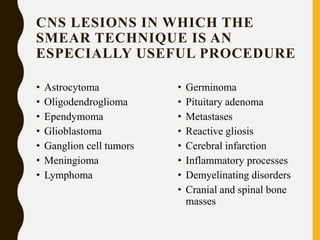
CNS LESIONS IN WHICH THE
SMEAR TECHNIQUE IS AN
ESPECIALLY USEFUL PROCEDURE
• Astrocytoma
• Oligodendroglioma
• Ependymoma
• Glioblastoma
• Ganglion cell tumors
• Meningioma
• Lymphoma
• Germinoma
• Pituitary adenoma
• Metastases
• Reactive gliosis
• Cerebral infarction
• Inflammatory processes
• Demyelinating disorders
• Cranial and spinal bone
masses
APPROACH TO
SMEAR
EVALUTAION
APPROACH TO SMEAR
EVALUTAION
• A complete evaluation of the smear requires the
study of six parameters:
1. Type of smearing
2. Type of background
3. Type of blood vessels
4. Presence of specific cell groups
5. Predominant type of cell
6. Presence of specific cellular elements
1.TYPE OF SMEARING
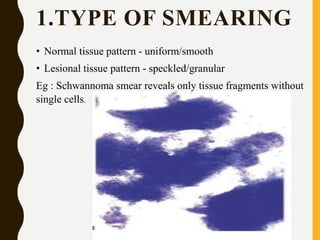
• Normal tissue pattern - uniform/smooth
• Lesional tissue pattern - speckled/granular
Eg : Schwannoma smear reveals only tissue fragments without
single cells.
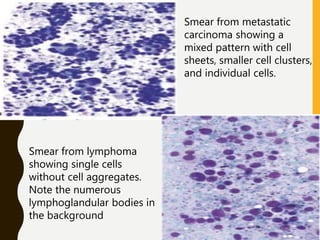
Smear from metastatic
carcinoma showing a
mixed pattern with cell
sheets, smaller cell clusters,
and individual cells.
Smear from lymphoma
showing single cells
without cell aggregates.
Note the numerous
lymphoglandular bodies in
the background
2.TYPE OF BACKGROUND
1. Finely granular (felt like) - normal neuroglial
tissue
2. Clear (empty) - In the case of lesions, if
intercellular space empty
–Schwannoma
–Meningioma
–Pineocytoma
–SFT/Hemangiopericytoma
–Choroid plexus papilloma
–Pituitary adenoma (if imprints)
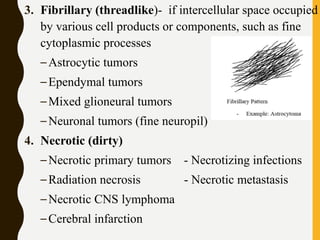
3. Fibrillary (threadlike)- if intercellular space occupied
by various cell products or components, such as fine
cytoplasmic processes
–Astrocytic tumors
–Ependymal tumors
–Mixed glioneural tumors
–Neuronal tumors (fine neuropil)
4. Necrotic (dirty)
–Necrotic primary tumors - Necrotizing infections
–Radiation necrosis - Necrotic metastasis
–Necrotic CNS lymphoma
–Cerebral infarction
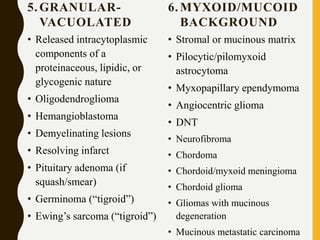
5. GRANULAR-
VACUOLATED
• Released intracytoplasmic
components of a
proteinaceous, lipidic, or
glycogenic nature
• Oligodendroglioma
• Hemangioblastoma
• Demyelinating lesions
• Resolving infarct
• Pituitary adenoma (if
squash/smear)
• Germinoma (“tigroid”)
• Ewing’s sarcoma (“tigroid”)
6. MYXOID/MUCOID
BACKGROUND
• Stromal or mucinous matrix
• Pilocytic/pilomyxoid
astrocytoma
• Myxopapillary ependymoma
• Angiocentric glioma
• DNT
• Neurofibroma
• Chordoma
• Chordoid/myxoid meningioma
• Chordoid glioma
• Gliomas with mucinous
degeneration
• Mucinous metastatic carcinoma
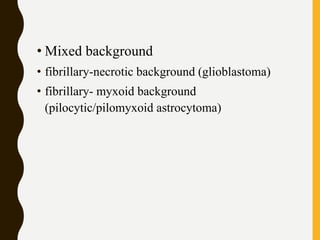
• Mixed background
• fibrillary-necrotic background (glioblastoma)
• fibrillary- myxoid background
(pilocytic/pilomyxoid astrocytoma)
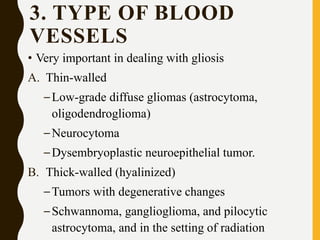
3. TYPE OF BLOOD
VESSELS
• Very important in dealing with gliosis
A. Thin-walled
–Low-grade diffuse gliomas (astrocytoma,
oligodendroglioma)
–Neurocytoma
–Dysembryoplastic neuroepithelial tumor.
B. Thick-walled (hyalinized)
–Tumors with degenerative changes
–Schwannoma, ganglioglioma, and pilocytic
astrocytoma, and in the setting of radiation
C. Endothelial cell proliferation (microvascular
hyperplasia/ proliferation [MVP])
–Criterion for anaplasia in diffuse astrocytoma and, to
a lesser degree, in oligodendroglioma and
ependymoma, but not in pilocytic astrocytoma.
–MVP occasionally seen in:
• metastatic cancer (mainly small-cell and renal cell
carcinomas)
• nonneoplastic processes (surrounding resolving
infarctions and abscesses).
D. Network of vascular channels
– Intricate network of thin-walled vascular channels
characteristic pattern of hemangioblastoma and
hemangiopericytoma.
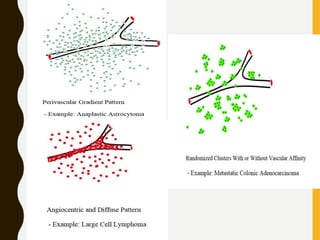
1.TUMOR DISTRIBUTION IN
RELATION TO BLOOD VESSELS
A. Perivascular gradient pattern
– Gliomas – especially astrocytoma
B. Angiocentric and diffuse pattern
– Lymphoma
C. Randomised clusters with and without vascular
affinity
– Metastatic carcinoma
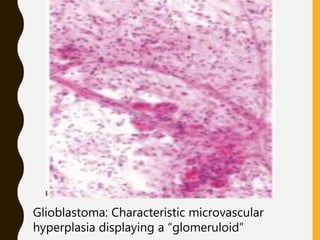
Glioblastoma: Characteristic microvascular
hyperplasia displaying a “glomeruloid”
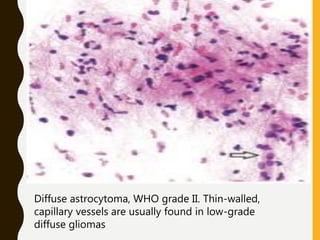
Diffuse astrocytoma, WHO grade II. Thin-walled,
capillary vessels are usually found in low-grade
diffuse gliomas
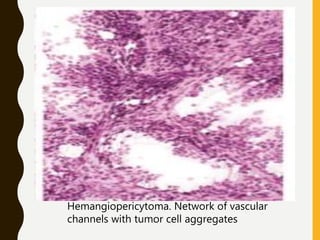
Hemangiopericytoma. Network of vascular
channels with tumor cell aggregates
4. SPECIFIC CELL GROUPS
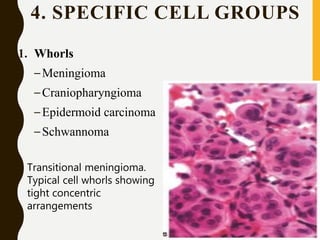
1. Whorls
–Meningioma
–Craniopharyngioma
–Epidermoid carcinoma
–Schwannoma
Transitional meningioma.
Typical cell whorls showing
tight concentric
arrangements
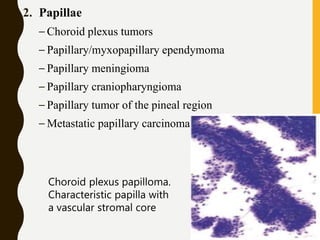
2. Papillae
– Choroid plexus tumors
– Papillary/myxopapillary ependymoma
– Papillary meningioma
– Papillary craniopharyngioma
– Papillary tumor of the pineal region
– Metastatic papillary carcinomas
Choroid plexus papilloma.
Characteristic papilla with
a vascular stromal core
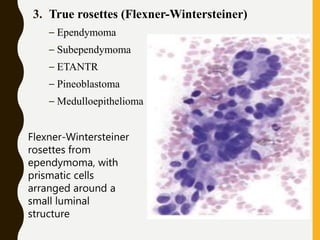
3. True rosettes (Flexner-Wintersteiner)
– Ependymoma
– Subependymoma
– ETANTR
– Pineoblastoma
– Medulloepithelioma
Flexner-Wintersteiner
rosettes from
ependymoma, with
prismatic cells
arranged around a
small luminal
structure
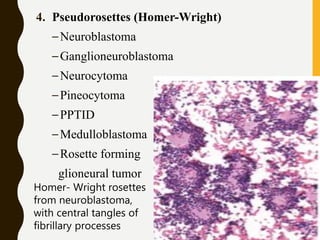
4. Pseudorosettes (Homer-Wright)
–Neuroblastoma
–Ganglioneuroblastoma
–Neurocytoma
–Pineocytoma
–PPTID
–Medulloblastoma
–Rosette forming
glioneural tumor
Homer- Wright rosettes
from neuroblastoma,
with central tangles of
fibrillary processes
5. Perivascular pseudorosettes
– Ependymoma
– Astroblastoma
– Subependymal giant cell astrocytoma
– Pilomyxoid astrocytoma
– Papillary glioneural tumor
– Rosette- forming glioneural tumor
– Angiocentric glioma
– Anaplastic astrocytoma
– Glioblastoma
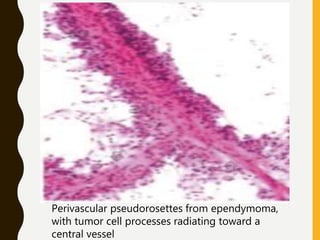
Perivascular pseudorosettes from ependymoma,
with tumor cell processes radiating toward a
central vessel
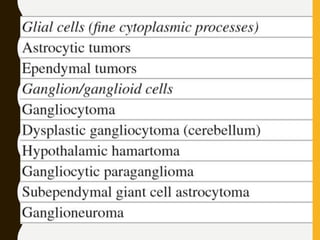
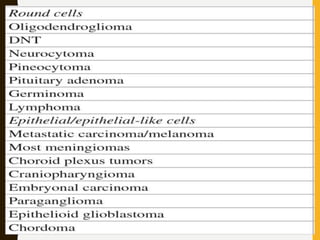
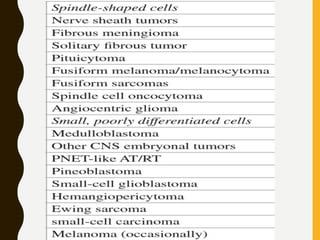
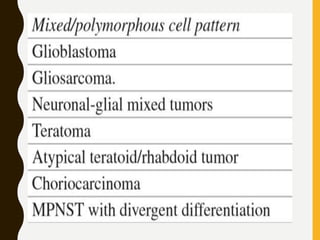
5.TYPE OF CELL
• Glial (fine processes)
• Ganglion/ganglion-like
• Round
• Epithelial/epithelial-like
• Fusiform
• Small poorly differentiated
• Mixed/polymorphic
6.SPECIFIC CELLULAR
ELEMENTS
• Rosenthal fibers
• Eosinophilic granular bodies
• Lymphoglandular bodies
• Keratin
• Melanin
• Mucin
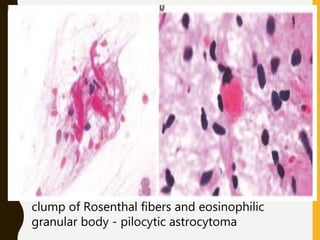
clump of Rosenthal fibers and eosinophilic
granular body - pilocytic astrocytoma
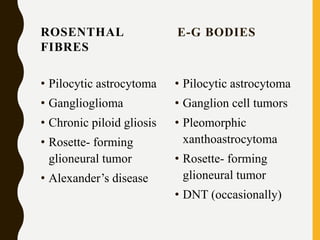
ROSENTHAL
FIBRES
• Pilocytic astrocytoma
• Ganglioglioma
• Chronic piloid gliosis
• Rosette- forming
glioneural tumor
• Alexander’s disease
E-G BODIES
• Pilocytic astrocytoma
• Ganglion cell tumors
• Pleomorphic
xanthoastrocytoma
• Rosette- forming
glioneural tumor
• DNT (occasionally)
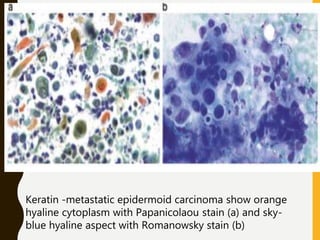
Keratin -metastatic epidermoid carcinoma show orange
hyaline cytoplasm with Papanicolaou stain (a) and sky-
blue hyaline aspect with Romanowsky stain (b)
KERATIN
• Craniopharyngioma
• Teratoma
• Epidermoid cyst
• Dermoid cyst
• Metastatic epidermoid
carcinoma
LYMPHOGLANDU
LAR BODIES
• Lymphomas
• Non-neoplastic
lymphoid infiltrations
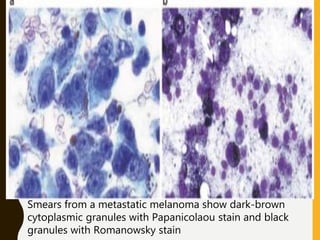
Smears from a metastatic melanoma show dark-brown
cytoplasmic granules with Papanicolaou stain and black
granules with Romanowsky stain
MELANIN
• Melanoma/
Melanocytoma
• Neurocutaneous
melanosis
• Teratoma
• Pineal anlage tumor
• Melanotic schwannoma
• Melanotic
medulloblatoma
• Melanotic ependymoma
• Melanotic paraganglioma
• Melanotic progonoma
MUCIN
• Mucinous metastatic
carcinoma
• Nonneoplastic cysts of
the neuroaxis
• Glandular component in
teratoma
• Gliomas with mucinous
degeneration
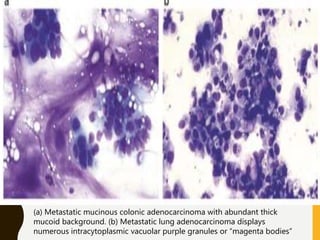
(a) Metastatic mucinous colonic adenocarcinoma with abundant thick
mucoid background. (b) Metastatic lung adenocarcinoma displays
numerous intracytoplasmic vacuolar purple granules or “magenta bodies”
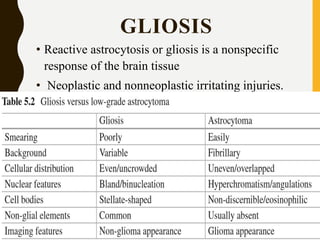
GLIOSIS
• Reactive astrocytosis or gliosis is a nonspecific
response of the brain tissue
• Neoplastic and nonneoplastic irritating injuries.
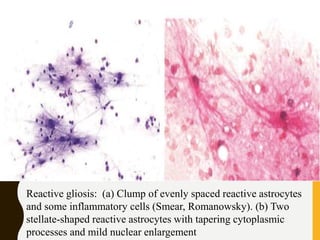
Reactive gliosis: (a) Clump of evenly spaced reactive astrocytes
and some inflammatory cells (Smear, Romanowsky). (b) Two
stellate-shaped reactive astrocytes with tapering cytoplasmic
processes and mild nuclear enlargement
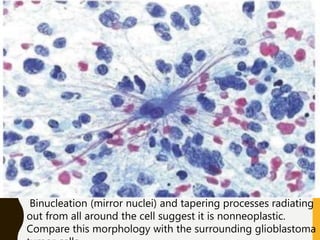
Binucleation (mirror nuclei) and tapering processes radiating
out from all around the cell suggest it is nonneoplastic.
Compare this morphology with the surrounding glioblastoma
PILOID GLIOSIS
• Chronic reactive gliosis with abundant Rosenthal fibers
(RFs).
• It is a common process adjacent to cysts and slow-growing
tumors (e.g., pineal cyst, craniopharyngioma,
hemangioblastoma)
• Particularly in the midline axis (third ventricle, brainstem,
cerebellum, and spinal cord)
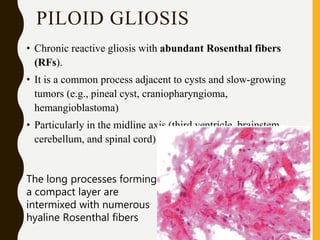
The long processes forming
a compact layer are
intermixed with numerous
hyaline Rosenthal fibers
ASTROCYTIC
TUMORS
1. DIFFUSE ASTROCYTOMA
• Cytologic features-
– Lumpy tissue fragments
– mature capillary vessels
• In comparison with normal brain, smears show:
– Fibrillary (no felt-like) background
– Increased cellularity with uneven cellular distribution
– Mild nuclear atypia
• Gemistocytic variant (at least 20% of the tumor cells)
– Large, plump cells with eccentric nuclei predominate
• Protoplasmic variant
– Small cells with short, cobweb-like processes predominate
– Myxoid background
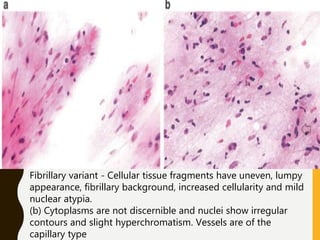
Fibrillary variant - Cellular tissue fragments have uneven, lumpy
appearance, fibrillary background, increased cellularity and mild
nuclear atypia.
(b) Cytoplasms are not discernible and nuclei show irregular
contours and slight hyperchromatism. Vessels are of the
capillary type
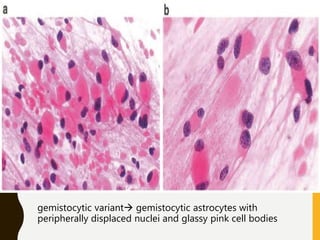
gemistocytic variant gemistocytic astrocytes with
peripherally displaced nuclei and glassy pink cell bodies
protoplasmic variant b)Evenly distributed preparation with small
cells showing round to oval nuclei and sparse cytoplasmic
processes (Smear, Papanicolaou)
(c) Metachromatic myxoid material surrounding the tumor cells
(Smear, Romanowsky)
• Diffuse astrocytoma – all 3 variants
– Absence of mitosis
– Absence of microvascular proliferation
– Absence of necrosis,
• Differential diagnosis and pitfalls
– Normal brain tissue
– Reactive gliosis
– Pilocytic astrocytoma
• Gemistocytic variant
– Subependymal giant cell astrocytoma
• Protoplasmic variant
– Oligodendroglioma
– Dysembryoplastic neuroepithelial tumor
2. ANAPLASTIC ASTROCYTOMA
• Cytologic features
– Fibrillary background
– Increased cellularity and pleomorphism
– Distinct nuclear atypia and mitotic activity
– Perivascular aggregates
– Microvascular proliferation and necrosis must be
absent
• Differential diagnosis and pitfalls
– Pleomorphic xanthoastrocytoma
– Pilocytic astrocytoma with degenerative-type atypia
– Anaplastic oligodendroglioma
– Undersampled glioblastoma
Dark, elongated and sometimes angulated nuclei without
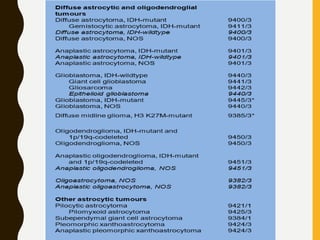
apparent nucleoli are typical of anaplastic astrocytoma and
glioblastoma, but in WHO grade III tumors, the vessels are still of
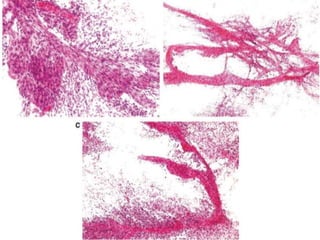
3.GLIOBLASTOMA
• Fibrillary and/or necrotic background
• Anomalous vessels
– Microvascular “glomeruloid” proliferation,
– Abnormal fistulous vessels with intraluminal
endothelial proliferation
– Vascular thrombosis
– Pseudopapillary appearance (atypical vessels appear
surrounded by a large number of tumor cells)
• Very high cellularity with discohesive pattern
• Marked cellular pleomorphism with Distinct nuclear atypia
(multilobed appearance, coarse chromatin)
• Often tumor cells conserve fibrillary processes (diagnostic
clue)
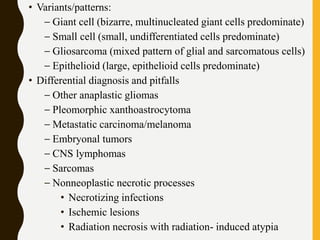
• Variants/patterns:
– Giant cell (bizarre, multinucleated giant cells predominate)
– Small cell (small, undifferentiated cells predominate)
– Gliosarcoma (mixed pattern of glial and sarcomatous cells)
– Epithelioid (large, epithelioid cells predominate)
• Differential diagnosis and pitfalls
– Other anaplastic gliomas
– Pleomorphic xanthoastrocytoma
– Metastatic carcinoma/melanoma
– Embryonal tumors
– CNS lymphomas
– Sarcomas
– Nonneoplastic necrotic processes
• Necrotizing infections
• Ischemic lesions
• Radiation necrosis with radiation- induced atypia
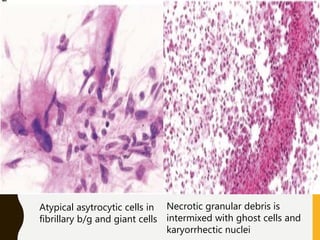
Atypical asytrocytic cells in
fibrillary b/g and giant cells
Necrotic granular debris is
intermixed with ghost cells and
karyorrhectic nuclei
4.PILOCYTIC ASTROCYTOMA
• Fibrillary-myxoid background
• Biphasic cellular pattern:
– Bipolar “piloid” cells
– Multipolar “protoplasmic” cells
• Oval to elongate (piloid) or round (protoplasmic) bland
nuclei
• Rosenthal fibers and eosinophilic granular bodies
• Regressive changes
– Hyalinized/glomeruloid vessels
– Degenerative-type atypia - including large or giant cells
with multiple nuclei circumferentially arranged (“pennies
on a plate”)
• Pilomyxoid astrocytoma
– Enhanced myxoid background
– Monomorphous cellular pattern of bipolar cells
– Angiocentric arrangements
– RFs and EGBs typically absent
• Differential diagnosis and pitfalls
– Diffuse astrocytoma (any grade)
– Ependymoma
– Piloid gliosis
A) Bipolar “piloid” cells exhibiting very long processes. Nuclei are
bland with smooth contours
B) Brightly eosinophilic Rosenthal fiber with one blunt pole and
one tapered end. It is surrounded by “protoplasmic” cells
exhibiting round nuclei and short, cobweb-like processes
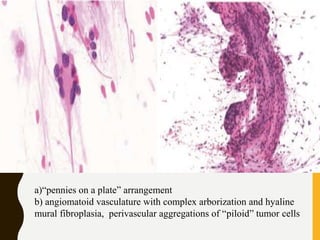
a)“pennies on a plate” arrangement
b) angiomatoid vasculature with complex arborization and hyaline
mural fibroplasia, perivascular aggregations of “piloid” tumor cells
OLI GODENDROGLI AL
TUMORS
OLIGODENDROGLIOMA
• Uniform single cell pattern without adhering to
blood vessels
• Round nuclei with finely granular (salt and pepper)
chromatin and small nucleoli
• Ill-defined, wispy cytoplasm (no perinuclear halos)
• Finely granular/vacoulated or mucoid background
• No fibrillary background
• Delicate branching “chicken-wire” capillary
network
• Microcalcifications
• Anaplastic oligodendroglioma
• Increased cellularity and pleomorphism
• Coarser chromatin
• Prominent mitotic activity
• Epithelioid features and minigemistocytes
• Microvascular proliferation
• Differential diagnosis and pitfalls
– Diffuse astrocytoma
– Subependymoma
– Dysembryoplastic neuroepithelial tumor
– Pituitary adenoma
– Neurocytoma
– Pineocytoma
– Lymphoma
– Macrophage-rich processes
• Anaplastic oligodendroglioma
– Anaplastic astrocytoma
– Glioblastoma
– Metastatic carcinoma/melanoma
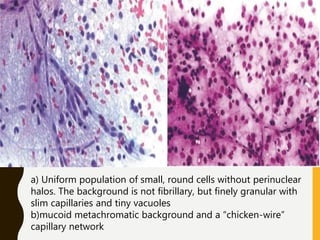
a) Uniform population of small, round cells without perinuclear
halos. The background is not fibrillary, but finely granular with
slim capillaries and tiny vacuoles
b)mucoid metachromatic background and a “chicken-wire”
capillary network
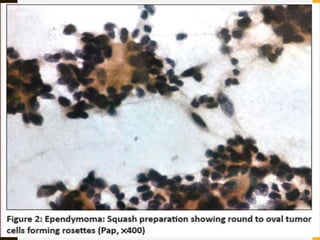
EPENDYMOMA
• Moderately cellular smears
• Fibrillary background
• Dual (glial-epithelial) cellular properties
• Small oval nuclei with stippled chromatin
• Key diagnostic clues
– Perivascular pseudorosettes “arboreal” or “caterpillar”
appearance
– Ependymal rosettes
• Anaplastic ependymoma
– Increased cellularity and coarser chromatin
– Nuclear grooves and indentations
– Mitotic figures and vascular hyperplasia
– Perivascular pseudorosettes
– Fibrillary background
Features retained
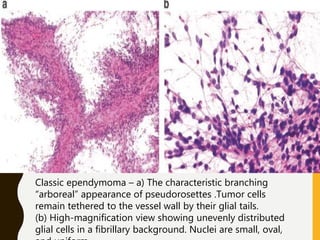
Classic ependymoma – a) The characteristic branching
“arboreal” appearance of pseudorosettes .Tumor cells
remain tethered to the vessel wall by their glial tails.
(b) High-magnification view showing unevenly distributed
glial cells in a fibrillary background. Nuclei are small, oval,
CHOROID
PLEXUS TUMOR
• Choroid plexus papilloma:
• Cellular smears with the joint presence of:
– Papillae with fibrovascular cores
– Monolayer fragments
– Single cells
• Columnar to cuboidal cells with:
– Smooth (nonciliated) epithelial surfaces
– Round to oval bland nuclei
• Clean background
• Atypical papillomas:
– Crowded and tall columnar epithelium with the additional
presence of mitoses
• Choroid plexus carcinoma
– Malignant cellular characteristics
– Areas of transition papilloma-carcinoma
– Hemorrhagic or granular (necrotic) background
• Differential diagnosis and pitfalls
– Normal choroid plexus
– Papillary ependymoma
– Choroid plexus carcinoma
• Metastatic carcinoma
• Melanoma
• Non-germinomatous (malignant) germ cell tumors
• Atypical teratoid/rhabdoid tumor
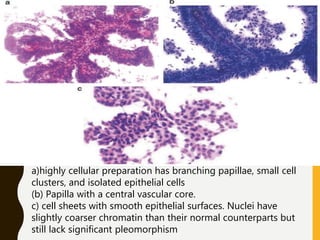
a)highly cellular preparation has branching papillae, small cell
clusters, and isolated epithelial cells
(b) Papilla with a central vascular core.
c) cell sheets with smooth epithelial surfaces. Nuclei have
slightly coarser chromatin than their normal counterparts but
still lack significant pleomorphism
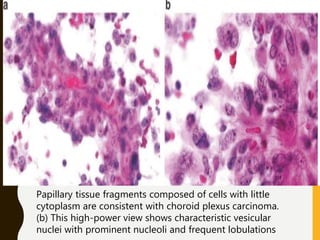
Papillary tissue fragments composed of cells with little
cytoplasm are consistent with choroid plexus carcinoma.
(b) This high-power view shows characteristic vesicular
nuclei with prominent nucleoli and frequent lobulations
EMBRYONAL
TUMOR
MEDULLOBLASTOMA
• Highly cellular
• Evenly distributed discohesive sheets of small, rounded or
wedge- shaped cells with minimal cytoplasm.
• Nuclei have a slightly coarse “salt-and- pepper” chromatin
and lack nucleoli, nuclear membranes show folds and
indentations
• Medulloblastoma nuclei often stick together forming short
chains or circles or conform around each other, giving the
characteristic nuclear molding
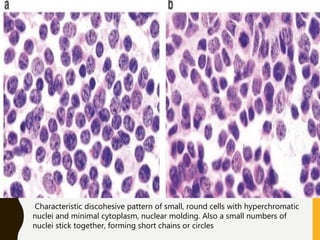
Characteristic discohesive pattern of small, round cells with hyperchromatic
nuclei and minimal cytoplasm, nuclear molding. Also a small numbers of
nuclei stick together, forming short chains or circles
MENINGIOMA
MENINGIOMA
• High cellularity
• Clear background
• Uniform, benign cellular aspect with
–Oval nuclei with delicate chromatin
–Nuclear pseudoinclusions and clearings
–Copious “tissue paper “cytoplasm with broad or
streaked processes
• Cell whorls and psammoma bodies
• Characteristic morphologic variants (fibrous,
secretory, chordoid….)
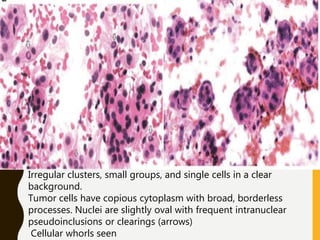
Irregular clusters, small groups, and single cells in a clear
background.
Tumor cells have copious cytoplasm with broad, borderless
processes. Nuclei are slightly oval with frequent intranuclear
pseudoinclusions or clearings (arrows)
Cellular whorls seen
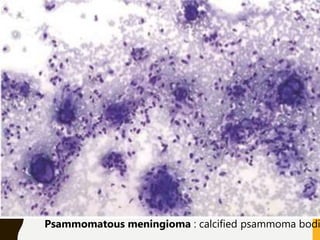
Psammomatous meningioma : calcified psammoma bodi
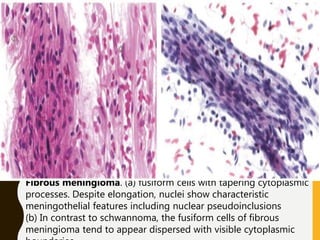
Fibrous meningioma. (a) fusiform cells with tapering cytoplasmic
processes. Despite elongation, nuclei show characteristic
meningothelial features including nuclear pseudoinclusions
(b) In contrast to schwannoma, the fusiform cells of fibrous
meningioma tend to appear dispersed with visible cytoplasmic
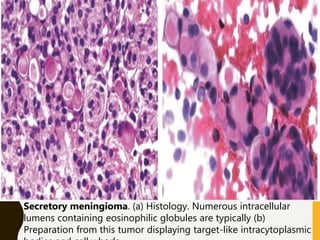
Secretory meningioma. (a) Histology. Numerous intracellular
lumens containing eosinophilic globules are typically (b)
Preparation from this tumor displaying target-like intracytoplasmic
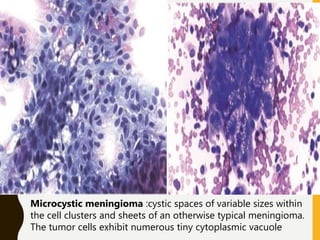
Microcystic meningioma :cystic spaces of variable sizes within
the cell clusters and sheets of an otherwise typical meningioma.
The tumor cells exhibit numerous tiny cytoplasmic vacuole
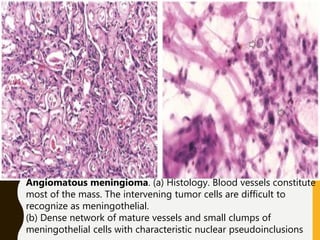
Angiomatous meningioma. (a) Histology. Blood vessels constitute
most of the mass. The intervening tumor cells are difficult to
recognize as meningothelial.
(b) Dense network of mature vessels and small clumps of
meningothelial cells with characteristic nuclear pseudoinclusions
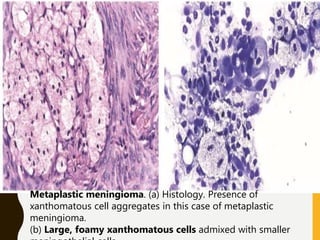
Metaplastic meningioma. (a) Histology. Presence of
xanthomatous cell aggregates in this case of metaplastic
meningioma.
(b) Large, foamy xanthomatous cells admixed with smaller
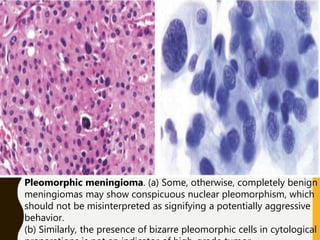
Pleomorphic meningioma. (a) Some, otherwise, completely benign
meningiomas may show conspicuous nuclear pleomorphism, which
should not be misinterpreted as signifying a potentially aggressive
behavior.
(b) Similarly, the presence of bizarre pleomorphic cells in cytological
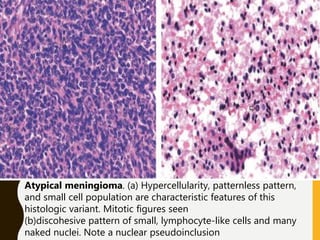
Atypical meningioma. (a) Hypercellularity, patternless pattern,
and small cell population are characteristic features of this
histologic variant. Mitotic figures seen
(b)discohesive pattern of small, lymphocyte-like cells and many
naked nuclei. Note a nuclear pseudoinclusion
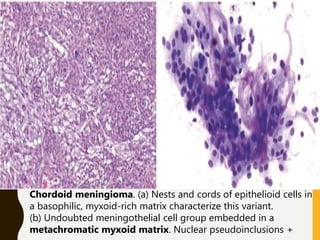
Chordoid meningioma. (a) Nests and cords of epithelioid cells in
a basophilic, myxoid-rich matrix characterize this variant.
(b) Undoubted meningothelial cell group embedded in a
metachromatic myxoid matrix. Nuclear pseudoinclusions +
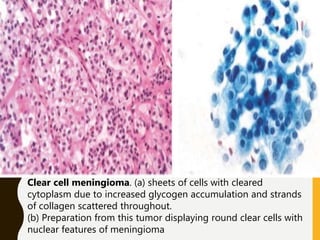
Clear cell meningioma. (a) sheets of cells with cleared
cytoplasm due to increased glycogen accumulation and strands
of collagen scattered throughout.
(b) Preparation from this tumor displaying round clear cells with
nuclear features of meningioma
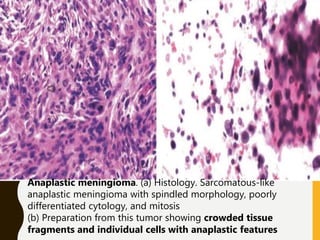
Anaplastic meningioma. (a) Histology. Sarcomatous-like
anaplastic meningioma with spindled morphology, poorly
differentiated cytology, and mitosis
(b) Preparation from this tumor showing crowded tissue
fragments and individual cells with anaplastic features
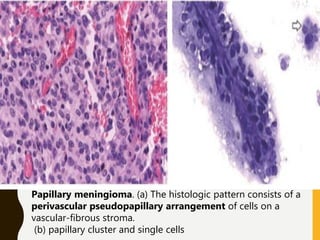
Papillary meningioma. (a) The histologic pattern consists of a
perivascular pseudopapillary arrangement of cells on a
vascular-fibrous stroma.
(b) papillary cluster and single cells
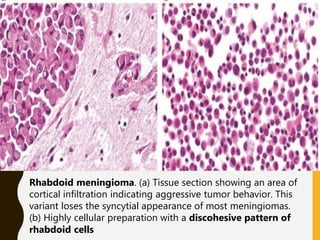
Rhabdoid meningioma. (a) Tissue section showing an area of
cortical infiltration indicating aggressive tumor behavior. This
variant loses the syncytial appearance of most meningiomas.
(b) Highly cellular preparation with a discohesive pattern of
rhabdoid cells
GERM CELL
TUMOR
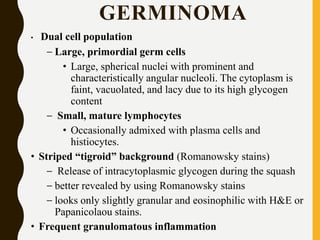
GERMINOMA
• Dual cell population
– Large, primordial germ cells
• Large, spherical nuclei with prominent and
characteristically angular nucleoli. The cytoplasm is
faint, vacuolated, and lacy due to its high glycogen
content
– Small, mature lymphocytes
• Occasionally admixed with plasma cells and
histiocytes.
• Striped “tigroid” background (Romanowsky stains)
– Release of intracytoplasmic glycogen during the squash
– better revealed by using Romanowsky stains
– looks only slightly granular and eosinophilic with H&E or
Papanicolaou stains.
• Frequent granulomatous inflammation
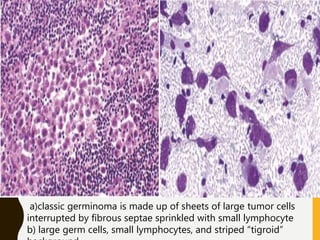
a)classic germinoma is made up of sheets of large tumor cells
interrupted by fibrous septae sprinkled with small lymphocyte
b) large germ cells, small lymphocytes, and striped “tigroid”
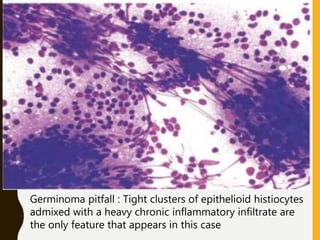
Germinoma pitfall : Tight clusters of epithelioid histiocytes
admixed with a heavy chronic inflammatory infiltrate are
the only feature that appears in this case
LYMPHOMA
DIFFUSE LARGE B CELL
LYMPHOMA
• The vast majority of PCNSLs (almost 98%) are high-grade
lymphoma of the diffuse large B-cell type (DLBCL)
• Highly cellular smears
• Perivascular cuffing and clearly discohesive cells
• Large, pleomorphic nuclei with prominent nucleoli
• Scant cytoplasm without processes
• Apoptotic bodies and tingible body macrophages
• Granular-vacuolated or necrotic background with LGBs
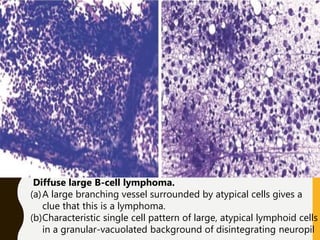
Diffuse large B-cell lymphoma.
(a)A large branching vessel surrounded by atypical cells gives a
clue that this is a lymphoma.
(b)Characteristic single cell pattern of large, atypical lymphoid cells
in a granular-vacuolated background of disintegrating neuropil
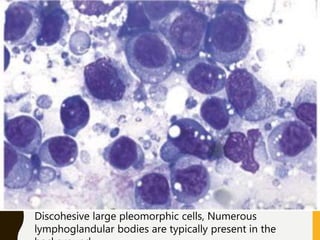
Discohesive large pleomorphic cells, Numerous
lymphoglandular bodies are typically present in the
NERVE SHEATH
TUMOR
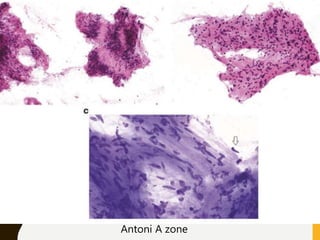
SCHWANNOMA
• Conventional schwannoma (>90%)
– Very difficult to smear
– Antoni A areas:
• Cohesive tissue fragments without single cells
• Spindle cells with club-shaped nuclei
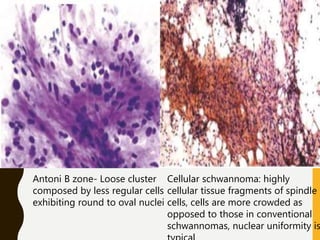
– Antoni B areas:
• Loosely cellular sheets
• Round to oval nuclei and stellate processes
• Cellular schwannoma (5-10%)
– Only highly cellular Antoni A-type groups
– Mild to moderate hyperchromatism
– Absence of anaplastic features
Antoni A zone
Antoni B zone- Loose cluster
composed by less regular cells
exhibiting round to oval nuclei
Cellular schwannoma: highly
cellular tissue fragments of spindle
cells, cells are more crowded as
opposed to those in conventional
schwannomas, nuclear uniformity is
PITUITARY
ADENOMA
• Third most common tumor in the CNS
• Highly cellular smears
• Discohesive monolayer pattern
• Round nuclei with stippled chromatin
• Small “peppery” nucleoli
• Granular background with many bare nuclei
• Plasmacytoid cell appearance
–When cytoplasm is preserved, looks well-
defined with an oval or round morphology
without processes along with the frequent
nuclear eccentric position
(a)Discohesive pattern of small cells and numerous bare
nuclei.
(b)Plasmacytoid features with oval cytoplasm and eccentric
REFERENCES
• César R. Lacruz, Javier Saénz de Santamaría, Ricardo
H. Bardales, editors. Central Nervous System Intraoperative
Cytopathology. 2nd ed. Switzerland: Springer, 2018.
• Squash preparation; a reliable diagnostic tool in the
intraoperative diagnosis of central nervous system tumors;
journal of cytology/ July 2010/volume 27/issue 3
• Washington manual of surgical pathology
• Internet sources
Squash smear cytology - By Anamika dev

Squash smear cytology - By Anamika dev

  • 1.
  • 2.
    INTRODUCTION • Central nervoussystem (CNS) is one of the most challenging domains for the neurosurgeon and Pathologists • The application of smear techniques as a means of obtaining rapid diagnosis for neurosurgical biopsies was first advocated by Dr Eisenhardt and Dr Cushing in the USA in early 1930 • Since then, although the technique has been modified by various individuals by changing the fixative or stain, the basic principle has remained unchanged
  • 3.
    • Simple andrapid methodology for fairly accurate intraoperative diagnosis of CNS space occupying lesions. • High accuracy  clinical and radiological picture into consideration. • Two procedures : open craniotomy or stereotactic biopsy. • Goal of intraoperative cyto-diagnosis in stereotactic biopsies to confirm the adequacy of the tissue.
  • 4.
    • Use ofintraoperative diagnosis in open biopsy: –Additional tissue for ancillary techniques (for infections and lymphomas), –To decide on extent of resection and makes it possible to institute adjuvant therapy in immediate postoperative period. –Last, but not the least, an intraoperative pathological diagnosis is of great value to the anxious family members of the patients.
  • 5.
    SAMPLE IDENTIFICATION AND TRANSPORTATION •Transportation - sterile container on a saline-moistened lens paper or telfa pad (never gauze) to prevent drying • Request form - relevant clinico-radiologic data –precise site of biopsy –reason for which the intraoperative diagnosis was sought – adequacy or guidance –technique used : open biopsy, stereotactic-guided needle aspiration biopsy ; fine-needle aspiration biopsy
  • 6.
    HOW TO PREPAREA SQUASH SMEAR? • The selected fragment is placed on a glass slide and then divided into smaller pieces (1–2 mm3) • Sample is inspected with the help of a magnifier or under dissecting microscope to see whether specimen appears necrotic or hemorrhagic or both
  • 8.
    • Each ofthe smaller pieces is placed on a newer slide • A second labelled slide is placed over the first slide on top of the tissue fragment • Gently pull both the slides apart to produce two thin well spread smears
  • 10.
    • Fixative ofchoice : 95% Ethanol, 1-2 min • Additional slides are air dried and stained • Stain : H&E, Papanicolaou • additional slides : WRIGHTs stain • Artifacts : crushing, overstretching and dry artifacts • When tissue spreads poorly, stain both slides with H & E, as one smear will usually have sufficiently thin areas to make interpretation possible
  • 11.
    • Note : •Don’t smear too large a specimen slide too thick for optimal cytological detail • Thin specimen  recognition of fine fibrillary process often a/w glial tumors • tissue defy smearing having extensive reticulin, collagen, or glial fibers
  • 12.
    COMPARISON OF TISSUESMEARING EASILY POORLY NORMAL BRAIN/ CORD REACTIVE GLIOSIS MOST PRIMARY / SECONDARY TUMORS SCHWANNOMA NON-NEOPLASTIC DISORDERS HEMANGIOBLASTOMA SUBEPENDYMOMA DESMOPLASTIC TUMORS VASCULAR MALFORMATIONS
  • 14.
    ADVANTAGES OF SMEARTECHNIQUE • Improved cost-effectiveness • More rapid and technically simpler • Only small amount of tissue needed • Far better preservation of cellular detail • Best in demonstrating fibrillary cytoplasmic processes • Provides additional information to the permanent sections • If the case turns out to be infectious, contamination of the cryostat and subsequent defrosting and sterilization can be avoided • Abrogate the risk of distorting valuable diagnostic material during freezing, which compromise permanent sections and immunomarkers
  • 15.
    LIMITATIONS • Relies ontissue soft enough to smear • Histologic architecture not apparent • Relies on accurate localization by the surgeon • Low-magnification architecture is lost • Some lesions do not smear well (especially those having extensive reticulin or collagen) • Specific training needed (many pathologists are more familiar with frozen section techniques and interpretation)
  • 16.
    • Anaplastic astrocytoma.(a) Cryostat section showing freezing artifact, nuclear distortion, and effacement of the fibrillary background (Methylene blue) • (b) Cytologic preparation from the same tumor showing beautifully preserved nuclear and cytoplasmic details. Note the characteristic multipolar astrocytic processes (Smear, H&E)
  • 17.
  • 18.
    NORMAL BRAIN 1. Whitematter pattern 1. Will smear easily 2. Felt like background 3. Small, empty vacuoles representing dissolved myelin – scattered in background 4. Cellular population consisting basically of oligodendrocytes and to a lesser extent of astrocytes 5. Delicate capillaries with elongated endothelial cells arranged parallel to the capillary wall 6. Also seen few arterioles with thicker walls, in which cells are arranged parallel (endothelial cells) or perpendicular (muscle cells) to the lumen - bidirectional arrangement
  • 20.
    2. Grey matterpattern • Smear less evenly than tissue from white matter • Accumulate elements of larger size, such as blood vessels and neurons, at the edge of the smear. • The background is also eosinophilic and granular (feltlike) • No vacuoles of myelin. • Numerous neurons seen along with glial cells • Neurons appear as large cells with abundant cytoplasm, distinct cell borders, and round, prominent nucleolated nuclei. • Capillaries of same pattern as white matter • Also seen arterioles and arteries
  • 22.
    3. cerebellar cortexpattern • More cellular • Predominant cells  neurons from the internal granular layer (small, round, hyperchromatic cells without visible cytoplasm) • Voluminous Purkinje’s neurons may be observed. • These cells show a wide cytoplasm with an expansive dendritic tree and large vesicular nucleus with a visible nucleolus.
  • 24.
    4. Choroid plexuspattern • A normal choroid plexus may be present in biopsy specimens from the ventricles • Vascular-stromal framework tends to smear poorly and results in a cohesive crush preparation • Vessels  complex arched papillary appearance, characteristic of a plexus, lined by a row of cuboidal epithelial cells • Cells that appear isolated, due to the squash trauma – wide polygonal “cobblestone-shaped” cytoplasm – small, round, basally located nuclei – Can have single prominent paranuclear cytoplasmic vacuole
  • 26.
    5. Leptomeningeal pattern •Large cell clusters • The cytoplasm of arachnoid cap cells is wide and delicate • Nuclei are round to ovoid with finely granular dispersed chromatin, often giving the appearance of central clearings. • As against cells from the choroid plexus, arachnoidal cells have poorly defined boundaries, giving rise to sheets with a syncytial appearance
  • 28.
    6. Pineal pattern •Infant pineal gland preparations – highly cellular – uniform, round, single pinealocytes with indistinct cytoplasm. – The background is finely granular (neuropil-like) and calcifications are absent • Adult pineal gland – Less cellular, displaying tissue fibrillary fragments and – single cells with ill-defined cytoplasm and moderate nuclear pleomorphism – microcalcifications, referred to as corpora arenacea or simply “brain sand”
  • 32.
    NORMAL BRAIN TISSUEPATTERN AND POTENTIAL MISDIAGNOSIS
  • 33.
  • 42.
    CNS LESIONS INWHICH THE SMEAR TECHNIQUE IS AN ESPECIALLY USEFUL PROCEDURE • Astrocytoma • Oligodendroglioma • Ependymoma • Glioblastoma • Ganglion cell tumors • Meningioma • Lymphoma • Germinoma • Pituitary adenoma • Metastases • Reactive gliosis • Cerebral infarction • Inflammatory processes • Demyelinating disorders • Cranial and spinal bone masses
  • 43.
  • 44.
    APPROACH TO SMEAR EVALUTAION •A complete evaluation of the smear requires the study of six parameters: 1. Type of smearing 2. Type of background 3. Type of blood vessels 4. Presence of specific cell groups 5. Predominant type of cell 6. Presence of specific cellular elements
  • 45.
    1.TYPE OF SMEARING •Normal tissue pattern - uniform/smooth • Lesional tissue pattern - speckled/granular Eg : Schwannoma smear reveals only tissue fragments without single cells.
  • 46.
    Smear from metastatic carcinomashowing a mixed pattern with cell sheets, smaller cell clusters, and individual cells. Smear from lymphoma showing single cells without cell aggregates. Note the numerous lymphoglandular bodies in the background
  • 47.
    2.TYPE OF BACKGROUND 1.Finely granular (felt like) - normal neuroglial tissue 2. Clear (empty) - In the case of lesions, if intercellular space empty –Schwannoma –Meningioma –Pineocytoma –SFT/Hemangiopericytoma –Choroid plexus papilloma –Pituitary adenoma (if imprints)
  • 48.
    3. Fibrillary (threadlike)-if intercellular space occupied by various cell products or components, such as fine cytoplasmic processes –Astrocytic tumors –Ependymal tumors –Mixed glioneural tumors –Neuronal tumors (fine neuropil) 4. Necrotic (dirty) –Necrotic primary tumors - Necrotizing infections –Radiation necrosis - Necrotic metastasis –Necrotic CNS lymphoma –Cerebral infarction
  • 49.
    5. GRANULAR- VACUOLATED • Releasedintracytoplasmic components of a proteinaceous, lipidic, or glycogenic nature • Oligodendroglioma • Hemangioblastoma • Demyelinating lesions • Resolving infarct • Pituitary adenoma (if squash/smear) • Germinoma (“tigroid”) • Ewing’s sarcoma (“tigroid”) 6. MYXOID/MUCOID BACKGROUND • Stromal or mucinous matrix • Pilocytic/pilomyxoid astrocytoma • Myxopapillary ependymoma • Angiocentric glioma • DNT • Neurofibroma • Chordoma • Chordoid/myxoid meningioma • Chordoid glioma • Gliomas with mucinous degeneration • Mucinous metastatic carcinoma
  • 50.
    • Mixed background •fibrillary-necrotic background (glioblastoma) • fibrillary- myxoid background (pilocytic/pilomyxoid astrocytoma)
  • 51.
    3. TYPE OFBLOOD VESSELS • Very important in dealing with gliosis A. Thin-walled –Low-grade diffuse gliomas (astrocytoma, oligodendroglioma) –Neurocytoma –Dysembryoplastic neuroepithelial tumor. B. Thick-walled (hyalinized) –Tumors with degenerative changes –Schwannoma, ganglioglioma, and pilocytic astrocytoma, and in the setting of radiation
  • 52.
    C. Endothelial cellproliferation (microvascular hyperplasia/ proliferation [MVP]) –Criterion for anaplasia in diffuse astrocytoma and, to a lesser degree, in oligodendroglioma and ependymoma, but not in pilocytic astrocytoma. –MVP occasionally seen in: • metastatic cancer (mainly small-cell and renal cell carcinomas) • nonneoplastic processes (surrounding resolving infarctions and abscesses). D. Network of vascular channels – Intricate network of thin-walled vascular channels characteristic pattern of hemangioblastoma and hemangiopericytoma.
  • 53.
    1.TUMOR DISTRIBUTION IN RELATIONTO BLOOD VESSELS A. Perivascular gradient pattern – Gliomas – especially astrocytoma B. Angiocentric and diffuse pattern – Lymphoma C. Randomised clusters with and without vascular affinity – Metastatic carcinoma
  • 55.
  • 56.
    Diffuse astrocytoma, WHOgrade II. Thin-walled, capillary vessels are usually found in low-grade diffuse gliomas
  • 57.
    Hemangiopericytoma. Network ofvascular channels with tumor cell aggregates
  • 58.
    4. SPECIFIC CELLGROUPS 1. Whorls –Meningioma –Craniopharyngioma –Epidermoid carcinoma –Schwannoma Transitional meningioma. Typical cell whorls showing tight concentric arrangements
  • 59.
    2. Papillae – Choroidplexus tumors – Papillary/myxopapillary ependymoma – Papillary meningioma – Papillary craniopharyngioma – Papillary tumor of the pineal region – Metastatic papillary carcinomas Choroid plexus papilloma. Characteristic papilla with a vascular stromal core
  • 60.
    3. True rosettes(Flexner-Wintersteiner) – Ependymoma – Subependymoma – ETANTR – Pineoblastoma – Medulloepithelioma Flexner-Wintersteiner rosettes from ependymoma, with prismatic cells arranged around a small luminal structure
  • 61.
    4. Pseudorosettes (Homer-Wright) –Neuroblastoma –Ganglioneuroblastoma –Neurocytoma –Pineocytoma –PPTID –Medulloblastoma –Rosetteforming glioneural tumor Homer- Wright rosettes from neuroblastoma, with central tangles of fibrillary processes
  • 62.
    5. Perivascular pseudorosettes –Ependymoma – Astroblastoma – Subependymal giant cell astrocytoma – Pilomyxoid astrocytoma – Papillary glioneural tumor – Rosette- forming glioneural tumor – Angiocentric glioma – Anaplastic astrocytoma – Glioblastoma
  • 63.
    Perivascular pseudorosettes fromependymoma, with tumor cell processes radiating toward a central vessel
  • 64.
    5.TYPE OF CELL •Glial (fine processes) • Ganglion/ganglion-like • Round • Epithelial/epithelial-like • Fusiform • Small poorly differentiated • Mixed/polymorphic
  • 69.
    6.SPECIFIC CELLULAR ELEMENTS • Rosenthalfibers • Eosinophilic granular bodies • Lymphoglandular bodies • Keratin • Melanin • Mucin
  • 70.
    clump of Rosenthalfibers and eosinophilic granular body - pilocytic astrocytoma
  • 71.
    ROSENTHAL FIBRES • Pilocytic astrocytoma •Ganglioglioma • Chronic piloid gliosis • Rosette- forming glioneural tumor • Alexander’s disease E-G BODIES • Pilocytic astrocytoma • Ganglion cell tumors • Pleomorphic xanthoastrocytoma • Rosette- forming glioneural tumor • DNT (occasionally)
  • 72.
    Keratin -metastatic epidermoidcarcinoma show orange hyaline cytoplasm with Papanicolaou stain (a) and sky- blue hyaline aspect with Romanowsky stain (b)
  • 73.
    KERATIN • Craniopharyngioma • Teratoma •Epidermoid cyst • Dermoid cyst • Metastatic epidermoid carcinoma LYMPHOGLANDU LAR BODIES • Lymphomas • Non-neoplastic lymphoid infiltrations
  • 74.
    Smears from ametastatic melanoma show dark-brown cytoplasmic granules with Papanicolaou stain and black granules with Romanowsky stain
  • 75.
    MELANIN • Melanoma/ Melanocytoma • Neurocutaneous melanosis •Teratoma • Pineal anlage tumor • Melanotic schwannoma • Melanotic medulloblatoma • Melanotic ependymoma • Melanotic paraganglioma • Melanotic progonoma MUCIN • Mucinous metastatic carcinoma • Nonneoplastic cysts of the neuroaxis • Glandular component in teratoma • Gliomas with mucinous degeneration
  • 76.
    (a) Metastatic mucinouscolonic adenocarcinoma with abundant thick mucoid background. (b) Metastatic lung adenocarcinoma displays numerous intracytoplasmic vacuolar purple granules or “magenta bodies”
  • 78.
    GLIOSIS • Reactive astrocytosisor gliosis is a nonspecific response of the brain tissue • Neoplastic and nonneoplastic irritating injuries.
  • 79.
    Reactive gliosis: (a)Clump of evenly spaced reactive astrocytes and some inflammatory cells (Smear, Romanowsky). (b) Two stellate-shaped reactive astrocytes with tapering cytoplasmic processes and mild nuclear enlargement
  • 80.
    Binucleation (mirror nuclei)and tapering processes radiating out from all around the cell suggest it is nonneoplastic. Compare this morphology with the surrounding glioblastoma
  • 81.
    PILOID GLIOSIS • Chronicreactive gliosis with abundant Rosenthal fibers (RFs). • It is a common process adjacent to cysts and slow-growing tumors (e.g., pineal cyst, craniopharyngioma, hemangioblastoma) • Particularly in the midline axis (third ventricle, brainstem, cerebellum, and spinal cord) The long processes forming a compact layer are intermixed with numerous hyaline Rosenthal fibers
  • 82.
  • 83.
    1. DIFFUSE ASTROCYTOMA •Cytologic features- – Lumpy tissue fragments – mature capillary vessels • In comparison with normal brain, smears show: – Fibrillary (no felt-like) background – Increased cellularity with uneven cellular distribution – Mild nuclear atypia • Gemistocytic variant (at least 20% of the tumor cells) – Large, plump cells with eccentric nuclei predominate • Protoplasmic variant – Small cells with short, cobweb-like processes predominate – Myxoid background
  • 84.
    Fibrillary variant -Cellular tissue fragments have uneven, lumpy appearance, fibrillary background, increased cellularity and mild nuclear atypia. (b) Cytoplasms are not discernible and nuclei show irregular contours and slight hyperchromatism. Vessels are of the capillary type
  • 85.
    gemistocytic variant gemistocyticastrocytes with peripherally displaced nuclei and glassy pink cell bodies
  • 86.
    protoplasmic variant b)Evenlydistributed preparation with small cells showing round to oval nuclei and sparse cytoplasmic processes (Smear, Papanicolaou) (c) Metachromatic myxoid material surrounding the tumor cells (Smear, Romanowsky)
  • 87.
    • Diffuse astrocytoma– all 3 variants – Absence of mitosis – Absence of microvascular proliferation – Absence of necrosis, • Differential diagnosis and pitfalls – Normal brain tissue – Reactive gliosis – Pilocytic astrocytoma • Gemistocytic variant – Subependymal giant cell astrocytoma • Protoplasmic variant – Oligodendroglioma – Dysembryoplastic neuroepithelial tumor
  • 88.
    2. ANAPLASTIC ASTROCYTOMA •Cytologic features – Fibrillary background – Increased cellularity and pleomorphism – Distinct nuclear atypia and mitotic activity – Perivascular aggregates – Microvascular proliferation and necrosis must be absent • Differential diagnosis and pitfalls – Pleomorphic xanthoastrocytoma – Pilocytic astrocytoma with degenerative-type atypia – Anaplastic oligodendroglioma – Undersampled glioblastoma
  • 89.
    Dark, elongated andsometimes angulated nuclei without apparent nucleoli are typical of anaplastic astrocytoma and glioblastoma, but in WHO grade III tumors, the vessels are still of
  • 90.
    3.GLIOBLASTOMA • Fibrillary and/ornecrotic background • Anomalous vessels – Microvascular “glomeruloid” proliferation, – Abnormal fistulous vessels with intraluminal endothelial proliferation – Vascular thrombosis – Pseudopapillary appearance (atypical vessels appear surrounded by a large number of tumor cells) • Very high cellularity with discohesive pattern • Marked cellular pleomorphism with Distinct nuclear atypia (multilobed appearance, coarse chromatin) • Often tumor cells conserve fibrillary processes (diagnostic clue)
  • 91.
    • Variants/patterns: – Giantcell (bizarre, multinucleated giant cells predominate) – Small cell (small, undifferentiated cells predominate) – Gliosarcoma (mixed pattern of glial and sarcomatous cells) – Epithelioid (large, epithelioid cells predominate) • Differential diagnosis and pitfalls – Other anaplastic gliomas – Pleomorphic xanthoastrocytoma – Metastatic carcinoma/melanoma – Embryonal tumors – CNS lymphomas – Sarcomas – Nonneoplastic necrotic processes • Necrotizing infections • Ischemic lesions • Radiation necrosis with radiation- induced atypia
  • 92.
    Atypical asytrocytic cellsin fibrillary b/g and giant cells Necrotic granular debris is intermixed with ghost cells and karyorrhectic nuclei
  • 94.
    4.PILOCYTIC ASTROCYTOMA • Fibrillary-myxoidbackground • Biphasic cellular pattern: – Bipolar “piloid” cells – Multipolar “protoplasmic” cells • Oval to elongate (piloid) or round (protoplasmic) bland nuclei • Rosenthal fibers and eosinophilic granular bodies • Regressive changes – Hyalinized/glomeruloid vessels – Degenerative-type atypia - including large or giant cells with multiple nuclei circumferentially arranged (“pennies on a plate”)
  • 95.
    • Pilomyxoid astrocytoma –Enhanced myxoid background – Monomorphous cellular pattern of bipolar cells – Angiocentric arrangements – RFs and EGBs typically absent • Differential diagnosis and pitfalls – Diffuse astrocytoma (any grade) – Ependymoma – Piloid gliosis
  • 96.
    A) Bipolar “piloid”cells exhibiting very long processes. Nuclei are bland with smooth contours B) Brightly eosinophilic Rosenthal fiber with one blunt pole and one tapered end. It is surrounded by “protoplasmic” cells exhibiting round nuclei and short, cobweb-like processes
  • 97.
    a)“pennies on aplate” arrangement b) angiomatoid vasculature with complex arborization and hyaline mural fibroplasia, perivascular aggregations of “piloid” tumor cells
  • 98.
  • 99.
    OLIGODENDROGLIOMA • Uniform singlecell pattern without adhering to blood vessels • Round nuclei with finely granular (salt and pepper) chromatin and small nucleoli • Ill-defined, wispy cytoplasm (no perinuclear halos) • Finely granular/vacoulated or mucoid background • No fibrillary background • Delicate branching “chicken-wire” capillary network • Microcalcifications
  • 100.
    • Anaplastic oligodendroglioma •Increased cellularity and pleomorphism • Coarser chromatin • Prominent mitotic activity • Epithelioid features and minigemistocytes • Microvascular proliferation
  • 101.
    • Differential diagnosisand pitfalls – Diffuse astrocytoma – Subependymoma – Dysembryoplastic neuroepithelial tumor – Pituitary adenoma – Neurocytoma – Pineocytoma – Lymphoma – Macrophage-rich processes • Anaplastic oligodendroglioma – Anaplastic astrocytoma – Glioblastoma – Metastatic carcinoma/melanoma
  • 102.
    a) Uniform populationof small, round cells without perinuclear halos. The background is not fibrillary, but finely granular with slim capillaries and tiny vacuoles b)mucoid metachromatic background and a “chicken-wire” capillary network
  • 103.
  • 104.
    • Moderately cellularsmears • Fibrillary background • Dual (glial-epithelial) cellular properties • Small oval nuclei with stippled chromatin • Key diagnostic clues – Perivascular pseudorosettes “arboreal” or “caterpillar” appearance – Ependymal rosettes • Anaplastic ependymoma – Increased cellularity and coarser chromatin – Nuclear grooves and indentations – Mitotic figures and vascular hyperplasia – Perivascular pseudorosettes – Fibrillary background Features retained
  • 105.
    Classic ependymoma –a) The characteristic branching “arboreal” appearance of pseudorosettes .Tumor cells remain tethered to the vessel wall by their glial tails. (b) High-magnification view showing unevenly distributed glial cells in a fibrillary background. Nuclei are small, oval,
  • 107.
  • 108.
    • Choroid plexuspapilloma: • Cellular smears with the joint presence of: – Papillae with fibrovascular cores – Monolayer fragments – Single cells • Columnar to cuboidal cells with: – Smooth (nonciliated) epithelial surfaces – Round to oval bland nuclei • Clean background • Atypical papillomas: – Crowded and tall columnar epithelium with the additional presence of mitoses
  • 109.
    • Choroid plexuscarcinoma – Malignant cellular characteristics – Areas of transition papilloma-carcinoma – Hemorrhagic or granular (necrotic) background • Differential diagnosis and pitfalls – Normal choroid plexus – Papillary ependymoma – Choroid plexus carcinoma • Metastatic carcinoma • Melanoma • Non-germinomatous (malignant) germ cell tumors • Atypical teratoid/rhabdoid tumor
  • 110.
    a)highly cellular preparationhas branching papillae, small cell clusters, and isolated epithelial cells (b) Papilla with a central vascular core. c) cell sheets with smooth epithelial surfaces. Nuclei have slightly coarser chromatin than their normal counterparts but still lack significant pleomorphism
  • 111.
    Papillary tissue fragmentscomposed of cells with little cytoplasm are consistent with choroid plexus carcinoma. (b) This high-power view shows characteristic vesicular nuclei with prominent nucleoli and frequent lobulations
  • 112.
  • 113.
    MEDULLOBLASTOMA • Highly cellular •Evenly distributed discohesive sheets of small, rounded or wedge- shaped cells with minimal cytoplasm. • Nuclei have a slightly coarse “salt-and- pepper” chromatin and lack nucleoli, nuclear membranes show folds and indentations • Medulloblastoma nuclei often stick together forming short chains or circles or conform around each other, giving the characteristic nuclear molding
  • 114.
    Characteristic discohesive patternof small, round cells with hyperchromatic nuclei and minimal cytoplasm, nuclear molding. Also a small numbers of nuclei stick together, forming short chains or circles
  • 115.
  • 116.
    MENINGIOMA • High cellularity •Clear background • Uniform, benign cellular aspect with –Oval nuclei with delicate chromatin –Nuclear pseudoinclusions and clearings –Copious “tissue paper “cytoplasm with broad or streaked processes • Cell whorls and psammoma bodies • Characteristic morphologic variants (fibrous, secretory, chordoid….)
  • 117.
    Irregular clusters, smallgroups, and single cells in a clear background. Tumor cells have copious cytoplasm with broad, borderless processes. Nuclei are slightly oval with frequent intranuclear pseudoinclusions or clearings (arrows) Cellular whorls seen
  • 118.
    Psammomatous meningioma :calcified psammoma bodi
  • 119.
    Fibrous meningioma. (a)fusiform cells with tapering cytoplasmic processes. Despite elongation, nuclei show characteristic meningothelial features including nuclear pseudoinclusions (b) In contrast to schwannoma, the fusiform cells of fibrous meningioma tend to appear dispersed with visible cytoplasmic
  • 120.
    Secretory meningioma. (a)Histology. Numerous intracellular lumens containing eosinophilic globules are typically (b) Preparation from this tumor displaying target-like intracytoplasmic
  • 121.
    Microcystic meningioma :cysticspaces of variable sizes within the cell clusters and sheets of an otherwise typical meningioma. The tumor cells exhibit numerous tiny cytoplasmic vacuole
  • 122.
    Angiomatous meningioma. (a)Histology. Blood vessels constitute most of the mass. The intervening tumor cells are difficult to recognize as meningothelial. (b) Dense network of mature vessels and small clumps of meningothelial cells with characteristic nuclear pseudoinclusions
  • 123.
    Metaplastic meningioma. (a)Histology. Presence of xanthomatous cell aggregates in this case of metaplastic meningioma. (b) Large, foamy xanthomatous cells admixed with smaller
  • 124.
    Pleomorphic meningioma. (a)Some, otherwise, completely benign meningiomas may show conspicuous nuclear pleomorphism, which should not be misinterpreted as signifying a potentially aggressive behavior. (b) Similarly, the presence of bizarre pleomorphic cells in cytological
  • 125.
    Atypical meningioma. (a)Hypercellularity, patternless pattern, and small cell population are characteristic features of this histologic variant. Mitotic figures seen (b)discohesive pattern of small, lymphocyte-like cells and many naked nuclei. Note a nuclear pseudoinclusion
  • 126.
    Chordoid meningioma. (a)Nests and cords of epithelioid cells in a basophilic, myxoid-rich matrix characterize this variant. (b) Undoubted meningothelial cell group embedded in a metachromatic myxoid matrix. Nuclear pseudoinclusions +
  • 127.
    Clear cell meningioma.(a) sheets of cells with cleared cytoplasm due to increased glycogen accumulation and strands of collagen scattered throughout. (b) Preparation from this tumor displaying round clear cells with nuclear features of meningioma
  • 128.
    Anaplastic meningioma. (a)Histology. Sarcomatous-like anaplastic meningioma with spindled morphology, poorly differentiated cytology, and mitosis (b) Preparation from this tumor showing crowded tissue fragments and individual cells with anaplastic features
  • 129.
    Papillary meningioma. (a)The histologic pattern consists of a perivascular pseudopapillary arrangement of cells on a vascular-fibrous stroma. (b) papillary cluster and single cells
  • 130.
    Rhabdoid meningioma. (a)Tissue section showing an area of cortical infiltration indicating aggressive tumor behavior. This variant loses the syncytial appearance of most meningiomas. (b) Highly cellular preparation with a discohesive pattern of rhabdoid cells
  • 131.
  • 132.
    GERMINOMA • Dual cellpopulation – Large, primordial germ cells • Large, spherical nuclei with prominent and characteristically angular nucleoli. The cytoplasm is faint, vacuolated, and lacy due to its high glycogen content – Small, mature lymphocytes • Occasionally admixed with plasma cells and histiocytes. • Striped “tigroid” background (Romanowsky stains) – Release of intracytoplasmic glycogen during the squash – better revealed by using Romanowsky stains – looks only slightly granular and eosinophilic with H&E or Papanicolaou stains. • Frequent granulomatous inflammation
  • 133.
    a)classic germinoma ismade up of sheets of large tumor cells interrupted by fibrous septae sprinkled with small lymphocyte b) large germ cells, small lymphocytes, and striped “tigroid”
  • 134.
    Germinoma pitfall :Tight clusters of epithelioid histiocytes admixed with a heavy chronic inflammatory infiltrate are the only feature that appears in this case
  • 135.
  • 136.
    DIFFUSE LARGE BCELL LYMPHOMA • The vast majority of PCNSLs (almost 98%) are high-grade lymphoma of the diffuse large B-cell type (DLBCL) • Highly cellular smears • Perivascular cuffing and clearly discohesive cells • Large, pleomorphic nuclei with prominent nucleoli • Scant cytoplasm without processes • Apoptotic bodies and tingible body macrophages • Granular-vacuolated or necrotic background with LGBs
  • 137.
    Diffuse large B-celllymphoma. (a)A large branching vessel surrounded by atypical cells gives a clue that this is a lymphoma. (b)Characteristic single cell pattern of large, atypical lymphoid cells in a granular-vacuolated background of disintegrating neuropil
  • 138.
    Discohesive large pleomorphiccells, Numerous lymphoglandular bodies are typically present in the
  • 139.
  • 140.
    SCHWANNOMA • Conventional schwannoma(>90%) – Very difficult to smear – Antoni A areas: • Cohesive tissue fragments without single cells • Spindle cells with club-shaped nuclei – Antoni B areas: • Loosely cellular sheets • Round to oval nuclei and stellate processes • Cellular schwannoma (5-10%) – Only highly cellular Antoni A-type groups – Mild to moderate hyperchromatism – Absence of anaplastic features
  • 141.
  • 142.
    Antoni B zone-Loose cluster composed by less regular cells exhibiting round to oval nuclei Cellular schwannoma: highly cellular tissue fragments of spindle cells, cells are more crowded as opposed to those in conventional schwannomas, nuclear uniformity is
  • 143.
  • 144.
    • Third mostcommon tumor in the CNS • Highly cellular smears • Discohesive monolayer pattern • Round nuclei with stippled chromatin • Small “peppery” nucleoli • Granular background with many bare nuclei • Plasmacytoid cell appearance –When cytoplasm is preserved, looks well- defined with an oval or round morphology without processes along with the frequent nuclear eccentric position
  • 145.
    (a)Discohesive pattern ofsmall cells and numerous bare nuclei. (b)Plasmacytoid features with oval cytoplasm and eccentric
  • 146.
    REFERENCES • César R.Lacruz, Javier Saénz de Santamaría, Ricardo H. Bardales, editors. Central Nervous System Intraoperative Cytopathology. 2nd ed. Switzerland: Springer, 2018. • Squash preparation; a reliable diagnostic tool in the intraoperative diagnosis of central nervous system tumors; journal of cytology/ July 2010/volume 27/issue 3 • Washington manual of surgical pathology • Internet sources

Editor's Notes

  • #4 History – age of pt and location of lesion; type and duration of clinical symptoms; for eg h/o seizure indicate a slow growing lesion like low grade astrocytoma compared to glioblastoma The volume of tissue available for the pathologist varies with the procedure adopted - open craniotomy or stereotactic biopsy.
  • #5 , helps the surgeon to decide
  • #6 Transportation from operating room to pathology dept Should specify the reason
  • #11 Artifacts with loss of cytological details, applying excessive pressure or rapidly pulling the slides apart
  • #19  Shearing forces in the smear rip neuropil (a complex of axons, dendrites, and synapses) into tiny spherules, appearing as a finely granular background with a distinctive feltlike appearance Both of them appear to have small, round to oval nuclei with little, if any, recognizable cytoplasm and with no visible cytoplasmic processes (naked nuclei).
  • #20 Evenly distributed smear, finely granular “feltlike” background, small vacuoles, and sparse isomorphic cellularity. High-magnification view demonstrating astrocytes with oblong nuclei (arrows), oligodendrocytes with round nuclei (arrowheads), and empty vacuoles representing dissolved myelin. Also note the very long axons and a slim capillary lined by endothelial cells. Muscular arteriole displaying bidirectional arrangement of the cells in the vessel wall, parallel (endothelial cells) and perpendicular (muscle cells) to the direction of the vessel
  • #22 less evenly distributed cell aggregates and anisocytosis. high magnification, the larger cells are neurons admixed with small glial cells. Unlike white matter, the fine granular background is devoid of myelin vacuoles. In preparations from the hippocampus, the admixture of small and large neurons may look remarkably like astrocytoma. However, the finely granular “feltlike” background is characteristic of normal neuropil
  • #24 Cerebellar cortex. (a) Characteristic findings include small internal granular cell neurons and large Purkinje’s neurons. Note the homogeneous pink neuropil at the right upper corner (Smear, H&E). b. A rotund Purkinje’s neuron exhibits a fine axon and coarser dendritic tree. Compare the erythrocyte size (arrow) with that of internal granular cell neurons (Smear, Romanowsky)
  • #25 Choroid plexus papilloma  highly cellular and show papillae, monolayer fragments, tridimensional aggregates, and single cells. On the other hand, the cells in the papillae tend to be arranged in a more piled-up and pseudostratified fashion than in the normal choroid plexus.
  • #26 Choroid plexus. (a) Cohesive tissue fragments with central vascular stroma lined by low-prismatic epithelium. (b) A high- magnification view shows normal choroid epithelium with round nuclei and polygonal “cobblestone” cell bodies. Also note large paranuclear cytoplasmic vacuoles (Romanowsky)
  • #28 Leptomeninges. (a) Arachnoid cell sheet with characteristic syncytial appearance. (b) High-magnification view showing oval nuclei with finely granular chromatin. Note nuclear clearings giving the appearance of pseudoinclusions (arrow)
  • #30  (a) Children. Single cell pattern of round cells with indistinct cytoplasm in a loose finely granular background. Note the moderate anisokaryosis of normal pinealocytes. (b) Adults. In this preparation the nuclear pleomorphism, microcalcifications (“brain sand”), and fibrillary background of the aging pineal gland are well seen
  • #32 in samples of deep normal periventricular white matter, ependymal nests may be found. Ependymal cells lines the ventricular system, are small columnar or cuboidal epithelial cells with spherical small nuclei Cells of choroid plexus responsible for formation of CSF,Morphologically similar to ependymal cells
  • #46 Normal brain/cord smears easily and evenly with preparations displaying a uniform/smooth pattern to the naked eye. On the contrary, in reactive states and in neoplasms, tissues tend to smear with an irregular consistency producing preparations with a speckled/granular pattern, microscopic appearance will depend on the nature and degree of intercellular adhesion and the varying proportions of stromal elements. tumors with strong attachments and cohesive stroma (i.e., schwannoma) will spread little, if any, yielding tissue fragments
  • #47 Tmr with little cohesion and stroma (i.e., lymphoma) will spread into single cells. Tumors whose cells have widespread but relatively weak attachments and scant, less cohesive stroma (i.e., meningioma, carcinoma) will result in a mixed pattern with cell sheets, smaller cell clusters, and individual cells
  • #48 SFT solitary fibrous tumor
  • #50  A special type of granular/ vacuolated background is the so-called striped “tigroid” background that originates by the released intracytoplasmic contents of glycogen-rich tumors during the squash technique. DNT dysembryoplastic neuroepithelial tumor
  • #54 Aggregation of tmr cells close to bld vsls. Concentration of the tumor cells decreases farther away Tmr cells infiltrate blood vessel walls but are often dispersed in a discohesive fashion away from blood vessels also Clusters of malignant cells are distributed close to and away from blood vessel variable with tumor type
  • #61 ETANTR embryonal tumor with abundant neuropil and true rosettes
  • #62 PPTID pineal parenchymal tumor of intermediate differentiation
  • #67 DNT dysembryoplastic neuroepithelial tumor
  • #68 PNET primitive neuroectodermal tumor, AT/RT atypical teratoid/rhabdoid tumor
  • #69 MPNST malignant peripheral nerve sheath tumor
  • #71  RFs are intensely eosinophilic, wormlike cords of aggregated proteins composed of GFAP, ubiquitin, and alpha B-crystallin EGBs, of lysosomal derivation, are brightly eosinophilic, spherical protein droplets that occur in aggregates or as larger single globules. They are composed of ubiquitinated α1-chymotrypsin and α1-antitrypsin
  • #73 HE - PINK
  • #74  LGBs represent small, membrane-delimited cytoplasmic fragments of lymphoid cells produced by the squash technique, LGBs are not entirely specific for lymphoid tissue or lymphomas since they may also be seen in small-cell carcinoma, melanoma, germinoma, and “small round blue cell tumors” of childhood. However, in all of these tumors, their number is considerably less than in smears of lymphoid proliferations.
  • #75  Melanin pigment forms finely granular dark-brown intracytoplasmic aggregates with H&E and Papanicolaou stains, or black aggregates with Romanowsky stain
  • #77  Mucin forms intracytoplasmic globular deposits or else is observed as amorphous extracellular aggregates. Mucin stains light with Papanicolaou or H&E stain but intensely (magenta) with Romanowsky-type stains
  • #78  hyper cellular - lesional tissue. Exception- cerebellar cortex, whose smears are very cellular. hypocellular smears - schwannoma, hemangioblastoma, and subependymoma. NEOPLASTIC – MONOMORPHIC EXCEPTION MIXED TUMORS. NON NEOPLASTIC USUALLY POLYMORPHOUS glial from non-glial tumors is the presence of a fibrillary matrix. All glial tumors, with the exception of oligodendroglioma and some glioblastomas, show a fibrillary background caused by the crisscrossing of the long cytoplasmic processes of glial cells. “AMEN criteria” of atypia, mitosis, endothelial hyperplasia, and necrosis indicates high-grade tumors. The presence of a large number of inflammatory cells leads the diagnosis in the direction of inflammatory/reactive processes. The few exceptions to this (i.e., lymphoplasmacytic-rich meningioma, some germinomas abundant macrophages is unusual in tumors and should suggest a nonneoplastic necrotizing process (i.e., evolving infarction) or a demyelinating disease.
  • #79 Astrocytoma in smears spreads well, whereas reactive gliosis spreads poorly and tends to remain as cohesive “fluffy” clusters Variable – depend on the cause reactive astrocytes appear uncrowded and evenly dispersed, displaying well-defined radial processes Binucleation or mirror nuclei non-glial elements such as inflammatory or neoplastic cells, foamy macrophages, hemosiderin pigment, or necrotic debris,
  • #84 Smears show fibrillary tissue fragments with a characteristic lumpy appearance The pure forms of protoplasmic astrocytoma are very infrequent. The tumor is so named because its cells resemble the small “protoplasmic” astrocytes of the cortex. Because of the scarcity of glial filaments, specimens from this variant have a low consistency and spread very easily on the glass slide producing a myxoid background that is poor in fibers.
  • #85 histology - Fibrillary variant. Hyperchromatic nuclei with irregular contours are embedded in a dense fibrillary matrix. Also note characteristic microcystic changes and a capillary vessel
  • #86 Gemistocytic variant. Pleomorphic astrocytes with plump bellies of eosinophilic cytoplasm and eccentric nuclei predominate
  • #87  Histology. Characteristic appearance with numerous microcysts and small tumor cells.
  • #91  necrotic debris often appears amorphous, somewhat granular, and thick acellular
  • #92 The glial component is astrocytic, often with gemistocytes, whereas the sarcomatous component is usually undifferentiated and spindle shaped but may be rhabdoid, chondroid, or osteoblastic epithelioid cells with plump cytoplasm, sharp cell borders, and round “open” nuclei with nucleoli predominat
  • #93 HISTOLOGY- Pleomorphic astrocytic cells and anomalous vessels are characteristic features. (b) Palisading necrosis, the hallmark feature of glioblastoma, appears surrounded by densely packed small tumor cells in this case. (c) Typical microvascular hyperplasia characterized by small multilayered vessels with plump, mitotically active
  • #94 Microvascular “glomeruloid” proliferation , fistulous vessels with intraluminal endothelial proliferation, and thrombosed vessels, these abnormal vessels are surrounded by abundant tumor cell
  • #95 The name pilocytic astrocytoma is due to the fact that this neoplasia is composed mostly of bipolar astrocytes with extremely long cytoplasmic processes (piloid/hair cells The tumor cells are bipolar with thin, very long hair-like processes (piloid cells) or multipolar with a small cell body and short cobweb-like processes (protoplasmic cells).
  • #96 PMA – m/c location hypothalamus/ chiasmatic region
  • #98 A large cell with degenerative-type atypia displays multiple nuclei with peripheral “pennies on a plate” arrangement (as if a stack of pennies was played out peripherally on a plate).
  • #100 the cytoplasm is ill-defined and wispy with few glial processes (oligo = few)
  • #103 Histology- monomorphic cells with round nuclei, “chicken wire.” branching capillary network . perinuclear halos giving a honeycomb appearance, fried egg appearance) , minigemistocytes, perineuronal satellitosis
  • #105  ependymoma of the fourth ventricle (about 60%) predominates in the pediatric age Histology round to oval nuclei arranged against a fibrillary background. perivascular pseudorosettes and ependymal rosettes Perivascular pseudorosettesfibrillary zone separating tumor cell nuclei from vessels walls, “arboreal” or “caterpillar” appearance seen in the smears These tumor-coated vascular tubes are best preserved at the thicker, less traumatized end of the smear. Tumor cells typically have round to oval nuclei with granular “salt and pepper” chromatin, inconspicuous to small nucleoli, and long tapering processes
  • #106 Variants – pappilary, tancytic and clear cell
  • #109  large sheets or monolayer fragments with smooth epithelial surfaces, and isolated columnar to cuboidal (nonciliated) cells arranged in a clear background,
  • #114 Medulloblastoma is the most common embryonal tumor (over 60–70% of all cases), with a peak age at diagnosis of 7–9 years Histology- monotonous sea of undifferentiated tumors cells
  • #134 Large, spherical nuclei with prominent and characteristically angular nucleoli. The cytoplasm is faint, vacuolated, and lacy due to its high glycogen content
  • #138 Histology : featuring malignant cells in an angiocentric and diffuse pattern
  • #142 Antoni A zone: a)Thick cohesive tissue fragments with sharp borders. There are no single cells (b) Cluster composed of tightly packed spindle cells without visible cytoplasmic borders (c) Higher magnification showing characteristic club-shaped nuclei with tapering or curved ends(arrow)
  • #145 The cytoplasm is fragilebare nuclei due to spilled cytoplasmic contents.