Special Senses
INTRODUCTION
 Special sense organ are characterised by large & complex organs each
with a unique function.
Sensory organs have special receptors that allow us to smell, taste
,see,hear and maintain equilibrium or balance
Information conveyed from these receptors to the CNS is used to help to
maintain homeostasis.
Special senses are:
vision (the eye)
hearing and balance (the ear, which includes the auditory
system and vestibular system)
smell (the nose)
taste (the tongue)
Sensory Receptors
 Receive input , generate receptor potencials and with enough
summation, generate action potentials in the neurons they are part of or
synapse with.
5 Types of Sensory receptors (based on the types of stimuli they detect:
Mechanoreceptors : pressure receptors,stretch receptors, and specialized
mechanoreceptors involved in movement and balance.
Thermoreceptors: skin and viscera , respond to both external and internal
temperature
Pain receptors: stimulated by lack of O2, chemical released from damaged
cells and inflammatory cells.
Chemoreceptors: detect changes in levels of O2,CO2, and H+ ions (pH) as
well as that stimulate taste and smell receptors[.
Photoreceptors : stimulated by Light.
Distribution of Receptors in the body
 SPECIAL SENSES:
 Mediated by relatively complex sense organs of the head , innervated by cranial
nerves
 Vision, Hearing, Equilibrium, taste, and smell
 Sensation and perception: EYE , EAR, NOSE, TONGUE
 GENERAL ( Somesthetic, Somatosensory)
 Receptors widely distributed in skin , muscles, tendons, joints, and viscera
 they detect touch, pressure, stretch, heat, cold and pain
 Skin : Hot , cold , pressure , pain
 Muscles ,Joints and tendons : - stretch receptors respond to stretch or
compression
EYE : VISION
Human eyes are complex, and it takes many parts
working together correctly for you to see.
Eye : The organ used to sense light
It consist of Three layers:
OUTER LAYER : Consists of sclera and cornea
MIDDLE LAYER : consists of choroid , cilliary
body and iris
INNER LAYER : consists of Retina
EXTRAOCULAR MUSCLES: attached to the
eye and skull and allow movement.
Eye anatomy
Cornea. This protects the inside of eye like a
windshield.The tearfluid lubricates corneas. The corneas also do part of
the work bending light as it enters in eyes.
Sclera. This is the white part of eye that forms the general shape and
structure of eyeball.
Conjunctiva. This clear, thin layer covers the sclera and lines the inside
of your eyelids.
Aqueous humor. This is fluid that fills a space called the anterior
chamber. The pressure of the aqueous humor helps maintain your eye’s
shape.
Iris. This part contains the muscles that control the size of pupil. It’s also
responsible for eye color. The iris can be brown, blue, green or hazel (a
blend of brown, yellow and green).
Pupil. This is the black circle inside the iris. It’s like an adjustable window to the inside of the
eye. It widens and narrows to control how much light enters in eye.
Lens. This focuses light that enters in eye and directs it to the back of eye.
Vitreous humor. This clear, gel-like fluid fills the space between the lens and retina. It
helps eye hold its shape. It’s also sometimes known simply as “the vitreous.”
Retina. This thin layer of light-sensitive cells at the back of the eyes converts light into
electrical signals. It contains rods (which help to see in low light i.e black and white) and cones
(which help to see colors).
Macula. This small area of your retina is key to vision. It’s responsible for the center of
visual field. It also helps to see color and fine details.
Optic nerve. This connects your retinas to your brain. It’s nerve that carries electrical
signals from retina, to multiple brain areas.
COMMON EYE DEFECTS
The diseases or a disorder that destroy eye tissue and other parts of
the eyes can be classified as eye diseases.
 There are different types of eye diseases, which can either be
minor, which don’t last for a longer time or some can also lead to
a permanent loss of vision.
There are different factors behind the causes of eye diseases.
 These factors include age, stress, infections, heredity,
nutritional deficiencies, injuries or accidents, etc.
1. Age-Related Macular Degeneration
 Macular degeneration is also known as an irregularity that affects the centre of the
retina, which is called the Macula. The Macula is responsible for everyday acute vision.
 There are two types of Macular Degeneration-
 Dry Macular degeneration.
 Wet Macular degeneration.
 Causes of Macular Degeneration
 Age, Smoking, Obesity, High blood pressure, Exposure to sunlight.
 Symptoms of Macular Degeneration
 Blurred vision
 A dark or empty area in the central area of vision
 Distortion of straight lines
Glaucoma
 It is a situation which is caused by the damage to the eye’s optic nerve which gets
severer over time. It is often associated with an increase in the pressure inside the eye.
 Causes of Glaucoma
 All four types of glaucoma are caused by different reasons :
 Chronic open-angle glaucoma results from a pressure build-up in the eye and causes
severe vision loss without any symptoms.
 Acute closed glaucoma appears all of a sudden which is very painful and extremely
serious.
 Secondary glaucoma arrives as a result of something else like medical conditions and
injuries
 Normal-tension glaucoma is a unique condition of the eye which is caused by damage to
an optic nerve. This may result in the loss of vision, caused by the intraocular pressure in
the eye.
Presbyopia
Presbyopia is a refractive error often related to aging that results in the
inability to focus properly on close objects. Onset of symptoms usually
begins in a patient’s 40s and gets worse until around 65.
Symptoms of Presbyopia
Symptoms progress slowly and include:
Blurry vision when reading at normal distance
Eyestrain (sometimes with headaches) after reading.
 Achromatopsia: Also known as color blindness, this genetic condition affects
the cone cells. A person has difficulty distinguishing between certain colors.
Amblyopia: This begins in childhood and is often called “lazy eye.” One eye
does not develop fully because the other, stronger eye dominates.
Anisocoria: This occurs when the pupils are an unequal size. It can be harmless,
but it may indicate a more serious medical problem, such as a stroke.
Astigmatism: The cornea or lens is incorrectly curved, so light does not focus
properly on the retina.
Cataracts: This is a clouding of the lens. It can lead to vision loss.
Chalazion: This is a condition in which the oil-producing glands of the eye become
blocked due to an injury or other pathological action..
Conjunctivitis: Also called pink eye, this involves an infection of the
conjunctiva, which covers the front of the eyeball.
 Detached retina : The retina can come loose, possibly due to an injury. It requires urgent
treatment.
 Diabetic retinopathy : High blood glucose levels can lead to retinal damage and
degeneration. This can lead to vision loss.
 Diplopia: This is also called double vision.
 Mydriasis : Both pupils dilate or contract in an unusual way.
 Myopia : Also known as nearsightedness, myopia makes it difficult to see things clearly at
a distance.
 Optic neuritis : The optic nerve becomes inflamed, often due to an overactive immune
system.
 Strabismus : The eyes point in different directions.
 Uveitis : The uvea becomes inflamed, causing swelling and redness in the eye. .
 Hyperopia : This condition is also referred to as farsightedness. Because the lens
is so small in this case, the eye is unable to see nearby objects clearly because either
the light cannot properly penetrate the lens or the lens itself is too small.
 Hyphema : Hyphema is typically caused by trauma to the eye, which leads to
bleeding into the front of the eye, specifically in the space between the iris and the
cornea.
 Retinitis : It is a condition of the eye known as retinitis, which occurs when there is
inflammation of the retina as a result of an infection, a long-term genetic disorder
known as retinitis pigmentosa
 Stye : The painful condition known as stye is caused by a bacterial infection that
manifests as a red lump at the corner of the eyelid.
FUNCTION OF EYE
 The main functions of the eye are given below:-
 Capture light and convert it into electrical signals that can be interpreted by the brain.
This process is known as vision.
 Adjust the amount of light that enters the eye through the pupil, which dilates or
constricts in response to light levels. This helps to protect the retina from being
damaged by too much light.
 Focus incoming light onto the retina at the back of the eye. The retina contains
photoreceptors called rods and cones, which convert light into electrical signals that are
sent to the brain via the optic nerve.
 Provide visual cues for depth perception and spatial awareness, which help us to
navigate and interact with our environment.
 Help us to see color by separating light into its different wavelengths and detecting the
relative intensity of each wavelength.
CONT..
 M The primary purposes of the eye are to focus on light waves and to
stimulate the photoreceptors that are located in the retina. This requires five
fundamental processes, which are as follows:
The passage of light waves through the transparent media that makes up the eyeball.
The bending of light waves as they travel through various refractive media of varying
densities.
The ability of the lens to accommodate for changes in the distance in order to focus light
waves
The iris diaphragm is responsible for controlling the amount of light that comes into the
eye through the pupil.
The eyeballs coming closer together. When photoreceptors in the retina are stimulated,
action potentials are produced. These action potentials are then transmitted to the visual
cortex of the brain via the optic pathways. The visual cortex is where an image is formed.
Visual impairment may be the end result if any one of these processes, or more than one of
Ear : Hearing and Equilibrium
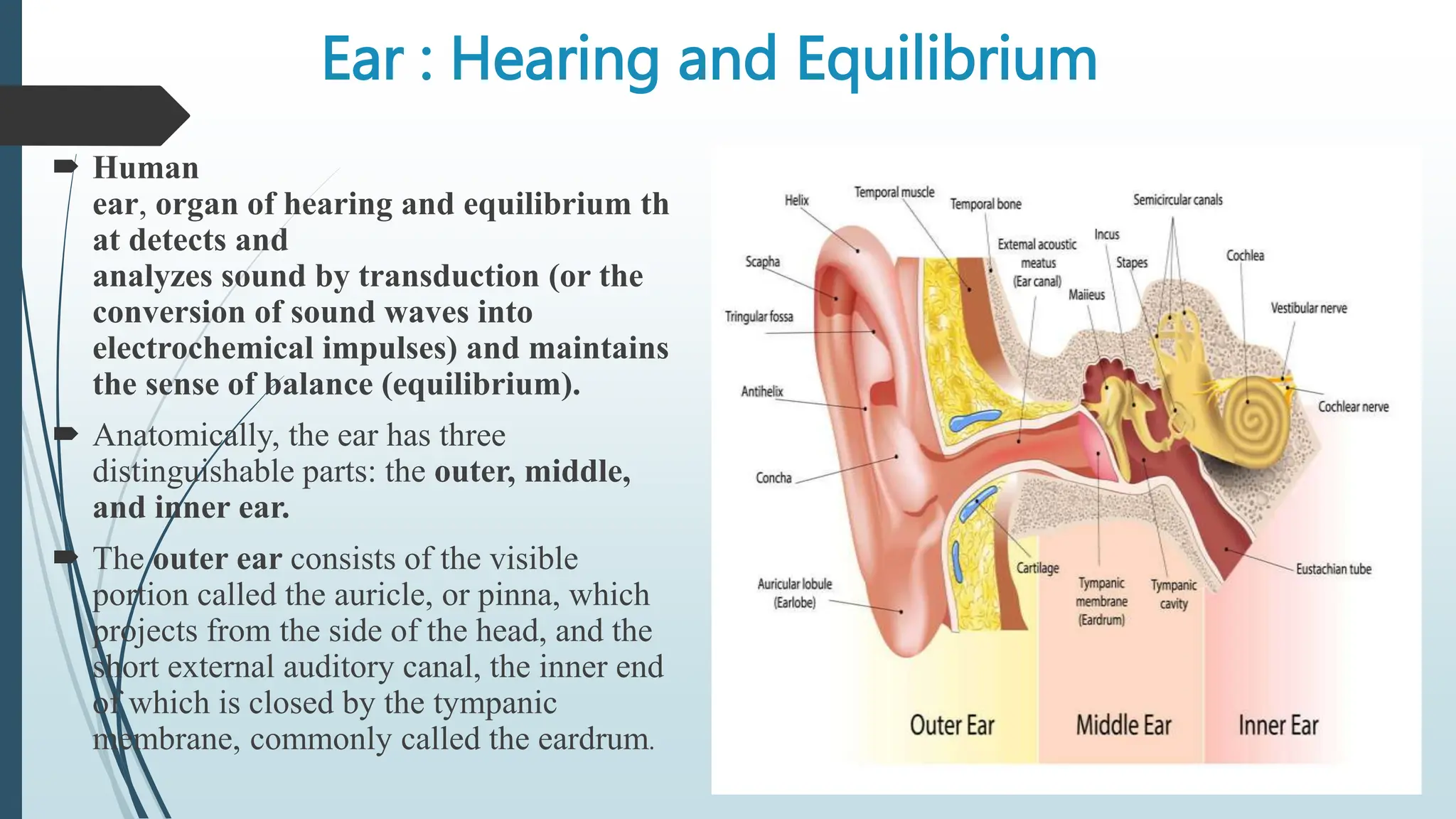
 Human
ear, organ of hearing and equilibrium th
at detects and
analyzes sound by transduction (or the
conversion of sound waves into
electrochemical impulses) and maintains
the sense of balance (equilibrium).
 Anatomically, the ear has three
distinguishable parts: the outer, middle,
and inner ear.
 The outer ear consists of the visible
portion called the auricle, or pinna, which
projects from the side of the head, and the
short external auditory canal, the inner end
of which is closed by the tympanic
membrane, commonly called the eardrum.
Outer Ear
 The function of the outer ear is to collect sound waves and guide them to the tympanic
membrane. The middle ear is a narrow air-filled cavity in the temporal bone.
Auricle (Pinna)
 The auricle comprises a thin plate of elastic cartilage covered by a layer of skin. It consists of
funnel-like curves that collect sound waves and transmits them to the middle ear. The lobule
consists of adipose and fibrous tissues supplied with blood capillaries.
 External Auditory Meatus
 It is a slightly curved canal supported by bone in its interior part and cartilage in the exterior part.
The meatus or the canal is lined with stratified epithelium and wax glands.
 Tympanic Membrane
 This membrane separates the middle ear and the external ear. This part receives and amplifies the
sound waves.
Middle Ear
 The middle ear comprises the following parts:
 Tympanic Cavity
 It is a narrow air-filled cavity separated from the external ear by tympanic membrane and from inner ear by
the bony wall. The tympanic cavity has an auditory tube known as the eustachian tube in its anterior wall.
 Eustachian Tube
 The eustachian tube is a 4cm long tube that equalizes air pressure on either side of the tympanic membrane.
It connects the tympanic cavity with the nasopharynx.
 Ear Ossicles
 These are responsible for transmitting sound waves from the eardrum to the middle ear. There are three ear
ossicles in the human ear:
 Malleus: A hammer-shaped part that is attached to the tympanic membrane through the handle and
incus through the head. It is the largest ear ossicle.
 Incus: An anvil-shaped ear ossicle connected with the stapes.
 Stapes: It is the smallest ossicle and also the smallest bone in the human body.
Inner Ear
 The inner ear has two main components – the
bony labyrinth and membranous labyrinth.
 Bony labyrinth – consists of a series of bony
cavities within the petrous part of the temporal
bone.
 It is composed of the cochlea, vestibule and
three semi-circular canals.
 All these structures are lined internally with
periosteum and contain a fluid called perilymph.
 Membranous labyrinth – lies within the bony
labyrinth. It consists of the cochlear duct, semi-
circular ducts, utricle and the saccule.
 The membranous labyrinth is filled with fluid
called endolymph.
Bony Labyrinth
 Vestibule
 The vestibule is the central part of the bony labyrinth.
 It is separated from the middle ear by the oval window, and communicates anteriorly
with the cochlea and posteriorly with the semi-circular canals.
 Two parts of the membranous labyrinth; the saccule and utricle, are located within the
vestibule.
 Cochlea
 The cochlea houses the cochlea duct of the membranous labyrinth – the auditory part of
the inner ear.
 It twists upon itself around a central portion of bone called the modiolus, producing a
cone shape which points in an anterolateral direction.
 Branches from the cochlear portion of the vestibulocochlear (VIII) nerve are found at
the base of the modiolus.
 Extending outwards from the modiolus is a ledge of bone known as spiral lamina, which
to the cochlear duct, holding it in position.
 The presence of the cochlear duct creates two perilymph-filled chambers above
and below:
 Scala vestibuli: Located superiorly to the cochlear duct. As its name suggests, it is
continuous with the vestibule.
 Scala tympani: Located inferiorly to the cochlear duct. It terminates at the round window.
Semi-circular Canals
 There are three semi-circular canals: anterior, lateral and posterior.
 They contain the semi-circular ducts, which are responsible for balance (along with the
utricle and saccule).
 The canals are situated superoposterior to the vestibule, at right angles to each other.
 They have a swelling at one end, known as the ampulla.
Membranous Labyrinth
 The cochlear duct is situated within the cochlea and is the organ of hearing.
 The semi-circular ducts, saccule and utricle are the organs of balance (also known as
the vestibular apparatus).
 Cochlear Duct
 The cochlear duct is located within the bony scaffolding of the cochlea. It is held in
place by the spiral lamina.
 The presence of the duct creates two canals above and below it – the scala
vestibuli and scala tympani respectively.
 The cochlear duct can be described as having a triangular shape:
 Lateral wall – Formed by thickened periosteum, known as the spiral ligament.
 Roof – Formed by a membrane which separates the cochlear duct from the scala
vestibuli, known as the Reissner’s membrane.
 Floor – Formed by a membrane which separates the cochlear duct from the
scala tympani, known as the basilar membrane.
Saccule and Utricle
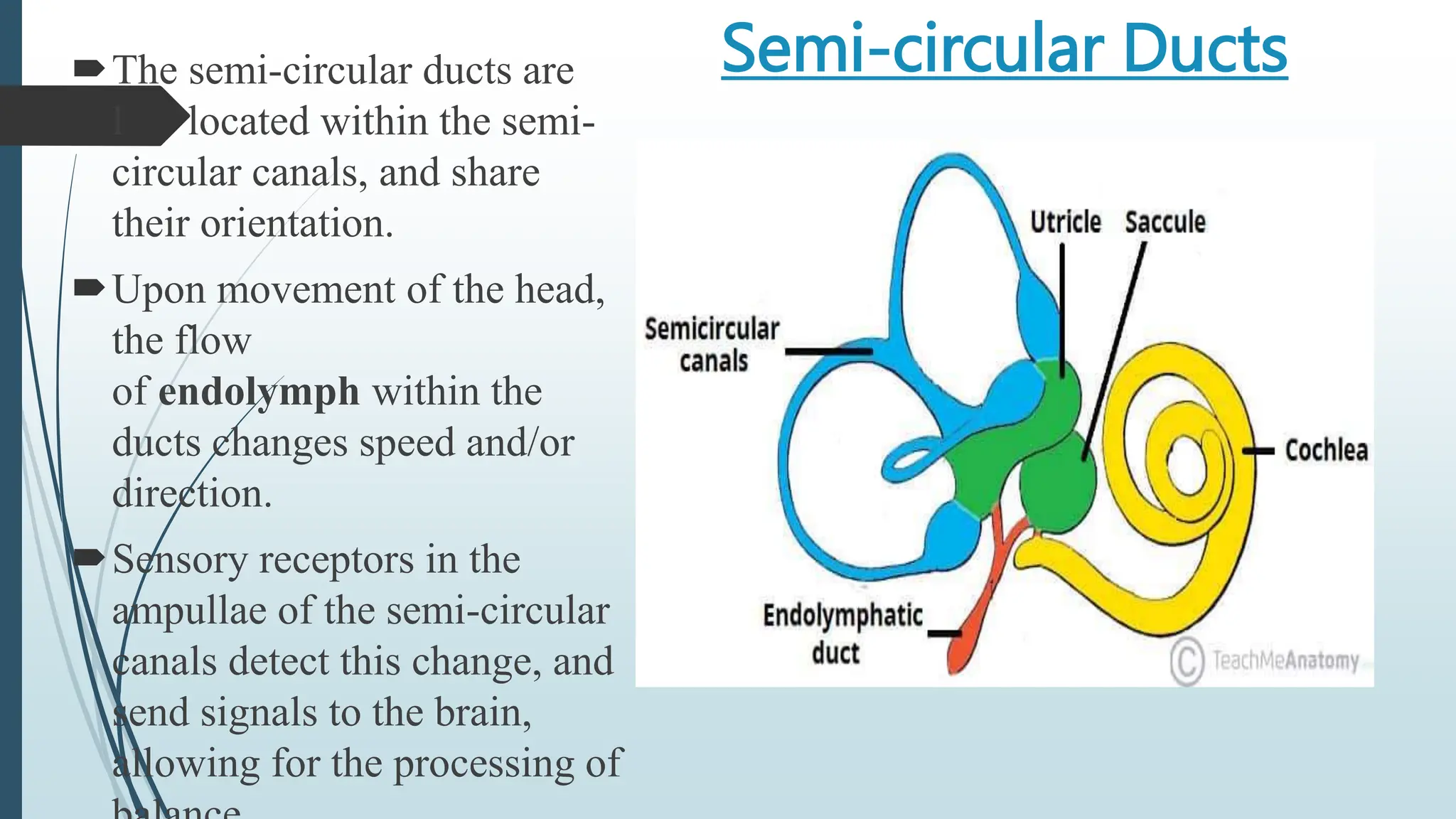
The saccule and utricle are two membranous sacs located in the vestibule.
 They are organs of balance which detect movement or acceleration of the
head in the vertical and horizontal planes, respectively.
The utricle is the larger of the two, receiving the three semi-circular ducts.
 The saccule is globular in shape and receives the cochlear duct.
Endolymph drains from the saccule and utricle into the endolymphatic duct.
The duct travels through the vestibular aqueduct to the posterior aspect of
the petrous part of the temporal bone.
Here, the duct expands to a sac where endolymph can be secreted and
absorbed.
Semi-circular Ducts
The semi-circular ducts are
l located within the semi-
circular canals, and share
their orientation.
Upon movement of the head,
the flow
of endolymph within the
ducts changes speed and/or
direction.
Sensory receptors in the
ampullae of the semi-circular
canals detect this change, and
send signals to the brain,
allowing for the processing of
Function of Ear
Hearing
The mechanism of hearing involves the following steps:
The sound waves pass through the auditory canal and reach the eardrum.
The vibrations produced pass through the tympanic membrane to the
tympanic cavity.
The ear ossicles in the tympanic cavity receive the vibrations and the
stapes pushes the oval window in and out.
This action is passed on to the organ of corti, the receptor of hearing, that
contains tiny hair cells that translate the vibrations into an electrical
impulse that are transmitted to the brain by sensory nerves.
Cont..
Balance
The eustachian tube and the vestibular complex are the
important parts of the ear responsible for the balance.
The eustachian tube equalizes the air pressure in the middle
ear and maintains the balance.
The vestibular complex contains receptors that maintain body
balance.
HEARING DEFECTS
 There are four types of hearing loss:
 Conductive Hearing Loss
Hearing loss caused by something that stops sounds from getting through the
outer or middle ear. This type of hearing loss can often be treated with medicine
or surgery.
 Sensorineural Hearing Loss
Hearing loss that occurs when there is a problem in the way the inner ear or
hearing nerve works.
 Mixed Hearing Loss
Hearing loss that includes both a conductive and a sensorineural hearing loss.
 Auditory Neuropathy Spectrum Disorder
Hearing loss that occurs when sound enters the ear normally, but because of
damage to the inner ear or the hearing nerve, sound isn’t organized in a way that
the brain can understand.
QUESTION BANK
 2 MARKS
 Define : special sense, sensory receptor, humar ear, bony labyrinth, membranous
labyrinth
 Enlist different types of sensory receptor.
 what are the factors that affect common eye defects?
 Enlist 6 common eye diseases?
 Distinguish outer and middle ear.
 what do you mean by vestibule apparatus?
 Discuss Hearing defects.
 What are perilymph and endolymph?
 Discuss about cochlear duct.
QUESTION BANK
5 marks
 Draw a label diagram of eye-ball.
 Describe physiology of hearing with suitable diagram.
 Write a note on Internal Ear
 Compare and contrast Bony labyrinth & Membranous labyrinth
 Discuss in detail common eye defects ?
 Write function of ear.
 Describe physiology of eye.
10 marks
 Write a note on Ear with suitable diagram .
 Discuss in detail about eye with suitable diagram.
 Enumerate common eye disorders.

Special Senses (Eye -vision & Ear-hearing).

  • 1.
  • 2.
    INTRODUCTION  Special senseorgan are characterised by large & complex organs each with a unique function. Sensory organs have special receptors that allow us to smell, taste ,see,hear and maintain equilibrium or balance Information conveyed from these receptors to the CNS is used to help to maintain homeostasis. Special senses are: vision (the eye) hearing and balance (the ear, which includes the auditory system and vestibular system) smell (the nose) taste (the tongue)
  • 3.
    Sensory Receptors  Receiveinput , generate receptor potencials and with enough summation, generate action potentials in the neurons they are part of or synapse with. 5 Types of Sensory receptors (based on the types of stimuli they detect: Mechanoreceptors : pressure receptors,stretch receptors, and specialized mechanoreceptors involved in movement and balance. Thermoreceptors: skin and viscera , respond to both external and internal temperature Pain receptors: stimulated by lack of O2, chemical released from damaged cells and inflammatory cells. Chemoreceptors: detect changes in levels of O2,CO2, and H+ ions (pH) as well as that stimulate taste and smell receptors[. Photoreceptors : stimulated by Light.
  • 4.
    Distribution of Receptorsin the body  SPECIAL SENSES:  Mediated by relatively complex sense organs of the head , innervated by cranial nerves  Vision, Hearing, Equilibrium, taste, and smell  Sensation and perception: EYE , EAR, NOSE, TONGUE  GENERAL ( Somesthetic, Somatosensory)  Receptors widely distributed in skin , muscles, tendons, joints, and viscera  they detect touch, pressure, stretch, heat, cold and pain  Skin : Hot , cold , pressure , pain  Muscles ,Joints and tendons : - stretch receptors respond to stretch or compression
  • 5.
    EYE : VISION Humaneyes are complex, and it takes many parts working together correctly for you to see. Eye : The organ used to sense light It consist of Three layers: OUTER LAYER : Consists of sclera and cornea MIDDLE LAYER : consists of choroid , cilliary body and iris INNER LAYER : consists of Retina EXTRAOCULAR MUSCLES: attached to the eye and skull and allow movement.
  • 6.
    Eye anatomy Cornea. Thisprotects the inside of eye like a windshield.The tearfluid lubricates corneas. The corneas also do part of the work bending light as it enters in eyes. Sclera. This is the white part of eye that forms the general shape and structure of eyeball. Conjunctiva. This clear, thin layer covers the sclera and lines the inside of your eyelids. Aqueous humor. This is fluid that fills a space called the anterior chamber. The pressure of the aqueous humor helps maintain your eye’s shape. Iris. This part contains the muscles that control the size of pupil. It’s also responsible for eye color. The iris can be brown, blue, green or hazel (a blend of brown, yellow and green).
  • 7.
    Pupil. This isthe black circle inside the iris. It’s like an adjustable window to the inside of the eye. It widens and narrows to control how much light enters in eye. Lens. This focuses light that enters in eye and directs it to the back of eye. Vitreous humor. This clear, gel-like fluid fills the space between the lens and retina. It helps eye hold its shape. It’s also sometimes known simply as “the vitreous.” Retina. This thin layer of light-sensitive cells at the back of the eyes converts light into electrical signals. It contains rods (which help to see in low light i.e black and white) and cones (which help to see colors). Macula. This small area of your retina is key to vision. It’s responsible for the center of visual field. It also helps to see color and fine details. Optic nerve. This connects your retinas to your brain. It’s nerve that carries electrical signals from retina, to multiple brain areas.
  • 8.
    COMMON EYE DEFECTS Thediseases or a disorder that destroy eye tissue and other parts of the eyes can be classified as eye diseases.  There are different types of eye diseases, which can either be minor, which don’t last for a longer time or some can also lead to a permanent loss of vision. There are different factors behind the causes of eye diseases.  These factors include age, stress, infections, heredity, nutritional deficiencies, injuries or accidents, etc.
  • 9.
    1. Age-Related MacularDegeneration  Macular degeneration is also known as an irregularity that affects the centre of the retina, which is called the Macula. The Macula is responsible for everyday acute vision.  There are two types of Macular Degeneration-  Dry Macular degeneration.  Wet Macular degeneration.  Causes of Macular Degeneration  Age, Smoking, Obesity, High blood pressure, Exposure to sunlight.  Symptoms of Macular Degeneration  Blurred vision  A dark or empty area in the central area of vision  Distortion of straight lines
  • 10.
    Glaucoma  It isa situation which is caused by the damage to the eye’s optic nerve which gets severer over time. It is often associated with an increase in the pressure inside the eye.  Causes of Glaucoma  All four types of glaucoma are caused by different reasons :  Chronic open-angle glaucoma results from a pressure build-up in the eye and causes severe vision loss without any symptoms.  Acute closed glaucoma appears all of a sudden which is very painful and extremely serious.  Secondary glaucoma arrives as a result of something else like medical conditions and injuries  Normal-tension glaucoma is a unique condition of the eye which is caused by damage to an optic nerve. This may result in the loss of vision, caused by the intraocular pressure in the eye.
  • 11.
    Presbyopia Presbyopia is arefractive error often related to aging that results in the inability to focus properly on close objects. Onset of symptoms usually begins in a patient’s 40s and gets worse until around 65. Symptoms of Presbyopia Symptoms progress slowly and include: Blurry vision when reading at normal distance Eyestrain (sometimes with headaches) after reading.
  • 12.
     Achromatopsia: Alsoknown as color blindness, this genetic condition affects the cone cells. A person has difficulty distinguishing between certain colors. Amblyopia: This begins in childhood and is often called “lazy eye.” One eye does not develop fully because the other, stronger eye dominates. Anisocoria: This occurs when the pupils are an unequal size. It can be harmless, but it may indicate a more serious medical problem, such as a stroke. Astigmatism: The cornea or lens is incorrectly curved, so light does not focus properly on the retina. Cataracts: This is a clouding of the lens. It can lead to vision loss. Chalazion: This is a condition in which the oil-producing glands of the eye become blocked due to an injury or other pathological action.. Conjunctivitis: Also called pink eye, this involves an infection of the conjunctiva, which covers the front of the eyeball.
  • 13.
     Detached retina: The retina can come loose, possibly due to an injury. It requires urgent treatment.  Diabetic retinopathy : High blood glucose levels can lead to retinal damage and degeneration. This can lead to vision loss.  Diplopia: This is also called double vision.  Mydriasis : Both pupils dilate or contract in an unusual way.  Myopia : Also known as nearsightedness, myopia makes it difficult to see things clearly at a distance.  Optic neuritis : The optic nerve becomes inflamed, often due to an overactive immune system.  Strabismus : The eyes point in different directions.  Uveitis : The uvea becomes inflamed, causing swelling and redness in the eye. .
  • 14.
     Hyperopia :This condition is also referred to as farsightedness. Because the lens is so small in this case, the eye is unable to see nearby objects clearly because either the light cannot properly penetrate the lens or the lens itself is too small.  Hyphema : Hyphema is typically caused by trauma to the eye, which leads to bleeding into the front of the eye, specifically in the space between the iris and the cornea.  Retinitis : It is a condition of the eye known as retinitis, which occurs when there is inflammation of the retina as a result of an infection, a long-term genetic disorder known as retinitis pigmentosa  Stye : The painful condition known as stye is caused by a bacterial infection that manifests as a red lump at the corner of the eyelid.
  • 15.
    FUNCTION OF EYE The main functions of the eye are given below:-  Capture light and convert it into electrical signals that can be interpreted by the brain. This process is known as vision.  Adjust the amount of light that enters the eye through the pupil, which dilates or constricts in response to light levels. This helps to protect the retina from being damaged by too much light.  Focus incoming light onto the retina at the back of the eye. The retina contains photoreceptors called rods and cones, which convert light into electrical signals that are sent to the brain via the optic nerve.  Provide visual cues for depth perception and spatial awareness, which help us to navigate and interact with our environment.  Help us to see color by separating light into its different wavelengths and detecting the relative intensity of each wavelength.
  • 16.
    CONT..  M Theprimary purposes of the eye are to focus on light waves and to stimulate the photoreceptors that are located in the retina. This requires five fundamental processes, which are as follows: The passage of light waves through the transparent media that makes up the eyeball. The bending of light waves as they travel through various refractive media of varying densities. The ability of the lens to accommodate for changes in the distance in order to focus light waves The iris diaphragm is responsible for controlling the amount of light that comes into the eye through the pupil. The eyeballs coming closer together. When photoreceptors in the retina are stimulated, action potentials are produced. These action potentials are then transmitted to the visual cortex of the brain via the optic pathways. The visual cortex is where an image is formed. Visual impairment may be the end result if any one of these processes, or more than one of
  • 17.
    Ear : Hearingand Equilibrium  Human ear, organ of hearing and equilibrium th at detects and analyzes sound by transduction (or the conversion of sound waves into electrochemical impulses) and maintains the sense of balance (equilibrium).  Anatomically, the ear has three distinguishable parts: the outer, middle, and inner ear.  The outer ear consists of the visible portion called the auricle, or pinna, which projects from the side of the head, and the short external auditory canal, the inner end of which is closed by the tympanic membrane, commonly called the eardrum.
  • 19.
    Outer Ear  Thefunction of the outer ear is to collect sound waves and guide them to the tympanic membrane. The middle ear is a narrow air-filled cavity in the temporal bone. Auricle (Pinna)  The auricle comprises a thin plate of elastic cartilage covered by a layer of skin. It consists of funnel-like curves that collect sound waves and transmits them to the middle ear. The lobule consists of adipose and fibrous tissues supplied with blood capillaries.  External Auditory Meatus  It is a slightly curved canal supported by bone in its interior part and cartilage in the exterior part. The meatus or the canal is lined with stratified epithelium and wax glands.  Tympanic Membrane  This membrane separates the middle ear and the external ear. This part receives and amplifies the sound waves.
  • 20.
    Middle Ear  Themiddle ear comprises the following parts:  Tympanic Cavity  It is a narrow air-filled cavity separated from the external ear by tympanic membrane and from inner ear by the bony wall. The tympanic cavity has an auditory tube known as the eustachian tube in its anterior wall.  Eustachian Tube  The eustachian tube is a 4cm long tube that equalizes air pressure on either side of the tympanic membrane. It connects the tympanic cavity with the nasopharynx.  Ear Ossicles  These are responsible for transmitting sound waves from the eardrum to the middle ear. There are three ear ossicles in the human ear:  Malleus: A hammer-shaped part that is attached to the tympanic membrane through the handle and incus through the head. It is the largest ear ossicle.  Incus: An anvil-shaped ear ossicle connected with the stapes.  Stapes: It is the smallest ossicle and also the smallest bone in the human body.
  • 21.
    Inner Ear  Theinner ear has two main components – the bony labyrinth and membranous labyrinth.  Bony labyrinth – consists of a series of bony cavities within the petrous part of the temporal bone.  It is composed of the cochlea, vestibule and three semi-circular canals.  All these structures are lined internally with periosteum and contain a fluid called perilymph.  Membranous labyrinth – lies within the bony labyrinth. It consists of the cochlear duct, semi- circular ducts, utricle and the saccule.  The membranous labyrinth is filled with fluid called endolymph.
  • 22.
    Bony Labyrinth  Vestibule The vestibule is the central part of the bony labyrinth.  It is separated from the middle ear by the oval window, and communicates anteriorly with the cochlea and posteriorly with the semi-circular canals.  Two parts of the membranous labyrinth; the saccule and utricle, are located within the vestibule.  Cochlea  The cochlea houses the cochlea duct of the membranous labyrinth – the auditory part of the inner ear.  It twists upon itself around a central portion of bone called the modiolus, producing a cone shape which points in an anterolateral direction.  Branches from the cochlear portion of the vestibulocochlear (VIII) nerve are found at the base of the modiolus.
  • 23.
     Extending outwardsfrom the modiolus is a ledge of bone known as spiral lamina, which to the cochlear duct, holding it in position.  The presence of the cochlear duct creates two perilymph-filled chambers above and below:  Scala vestibuli: Located superiorly to the cochlear duct. As its name suggests, it is continuous with the vestibule.  Scala tympani: Located inferiorly to the cochlear duct. It terminates at the round window. Semi-circular Canals  There are three semi-circular canals: anterior, lateral and posterior.  They contain the semi-circular ducts, which are responsible for balance (along with the utricle and saccule).  The canals are situated superoposterior to the vestibule, at right angles to each other.  They have a swelling at one end, known as the ampulla.
  • 24.
    Membranous Labyrinth  Thecochlear duct is situated within the cochlea and is the organ of hearing.  The semi-circular ducts, saccule and utricle are the organs of balance (also known as the vestibular apparatus).  Cochlear Duct  The cochlear duct is located within the bony scaffolding of the cochlea. It is held in place by the spiral lamina.  The presence of the duct creates two canals above and below it – the scala vestibuli and scala tympani respectively.  The cochlear duct can be described as having a triangular shape:  Lateral wall – Formed by thickened periosteum, known as the spiral ligament.  Roof – Formed by a membrane which separates the cochlear duct from the scala vestibuli, known as the Reissner’s membrane.  Floor – Formed by a membrane which separates the cochlear duct from the scala tympani, known as the basilar membrane.
  • 26.
    Saccule and Utricle Thesaccule and utricle are two membranous sacs located in the vestibule.  They are organs of balance which detect movement or acceleration of the head in the vertical and horizontal planes, respectively. The utricle is the larger of the two, receiving the three semi-circular ducts.  The saccule is globular in shape and receives the cochlear duct. Endolymph drains from the saccule and utricle into the endolymphatic duct. The duct travels through the vestibular aqueduct to the posterior aspect of the petrous part of the temporal bone. Here, the duct expands to a sac where endolymph can be secreted and absorbed.
  • 27.
    Semi-circular Ducts The semi-circularducts are l located within the semi- circular canals, and share their orientation. Upon movement of the head, the flow of endolymph within the ducts changes speed and/or direction. Sensory receptors in the ampullae of the semi-circular canals detect this change, and send signals to the brain, allowing for the processing of
  • 28.
    Function of Ear Hearing Themechanism of hearing involves the following steps: The sound waves pass through the auditory canal and reach the eardrum. The vibrations produced pass through the tympanic membrane to the tympanic cavity. The ear ossicles in the tympanic cavity receive the vibrations and the stapes pushes the oval window in and out. This action is passed on to the organ of corti, the receptor of hearing, that contains tiny hair cells that translate the vibrations into an electrical impulse that are transmitted to the brain by sensory nerves.
  • 29.
    Cont.. Balance The eustachian tubeand the vestibular complex are the important parts of the ear responsible for the balance. The eustachian tube equalizes the air pressure in the middle ear and maintains the balance. The vestibular complex contains receptors that maintain body balance.
  • 30.
    HEARING DEFECTS  Thereare four types of hearing loss:  Conductive Hearing Loss Hearing loss caused by something that stops sounds from getting through the outer or middle ear. This type of hearing loss can often be treated with medicine or surgery.  Sensorineural Hearing Loss Hearing loss that occurs when there is a problem in the way the inner ear or hearing nerve works.  Mixed Hearing Loss Hearing loss that includes both a conductive and a sensorineural hearing loss.  Auditory Neuropathy Spectrum Disorder Hearing loss that occurs when sound enters the ear normally, but because of damage to the inner ear or the hearing nerve, sound isn’t organized in a way that the brain can understand.
  • 31.
    QUESTION BANK  2MARKS  Define : special sense, sensory receptor, humar ear, bony labyrinth, membranous labyrinth  Enlist different types of sensory receptor.  what are the factors that affect common eye defects?  Enlist 6 common eye diseases?  Distinguish outer and middle ear.  what do you mean by vestibule apparatus?  Discuss Hearing defects.  What are perilymph and endolymph?  Discuss about cochlear duct.
  • 32.
    QUESTION BANK 5 marks Draw a label diagram of eye-ball.  Describe physiology of hearing with suitable diagram.  Write a note on Internal Ear  Compare and contrast Bony labyrinth & Membranous labyrinth  Discuss in detail common eye defects ?  Write function of ear.  Describe physiology of eye.
  • 33.
    10 marks  Writea note on Ear with suitable diagram .  Discuss in detail about eye with suitable diagram.  Enumerate common eye disorders.