COAGULANTS AND
ANTICOAGULANTS
INTRODUCTION
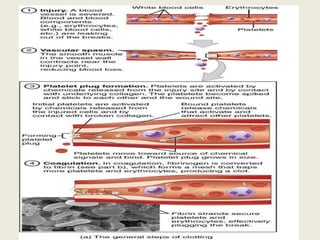
What is Haemostasis?
Stoppage of bleeding from vessels at the site of
injury OR
Hemostasis is the process in which the body
repairs a damaged blood vessel to prevent the
blood. This process is found with smaller
 3 steps
1.Initially vasospasm of small capillarie
2.Formation of platelet plug
3.Blood clot
• Coagulation: The process of changing of blood
from a fluid state to a solid state is known as
coagulation. Normally, this is a natural process in
the body to prevent blood loss by plugging the
injured site.
• The vascular system must maintain an intricate
balance between the tendency to clot or form a
solid state, and the need to “unclot,” or reverse
coagulation, to keep the vessels open and the
blood flowing.
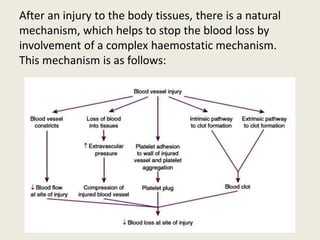
After an injury to the body tissues, there is a natural
mechanism, which helps to stop the blood loss by
involvement of a complex haemostatic mechanism.
This mechanism is as follows:
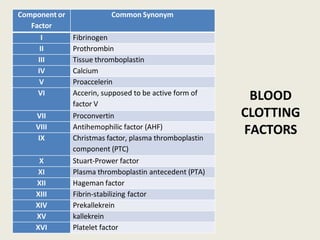
BLOOD
CLOTTING
FACTORS
Component or
Factor
Common Synonym
I Fibrinogen
II Prothrombin
III Tissue thromboplastin
IV Calcium
V Proaccelerin
VI Accerin, supposed to be active form of
factor V
VII Proconvertin
VIII Antihemophilic factor (AHF)
IX Christmas factor, plasma thromboplastin
component (PTC)
X Stuart-Prower factor
XI Plasma thromboplastin antecedent (PTA)
XII Hageman factor
XIII Fibrin-stabilizing factor
XIV Prekallekrein
XV kallekrein
XVI Platelet factor
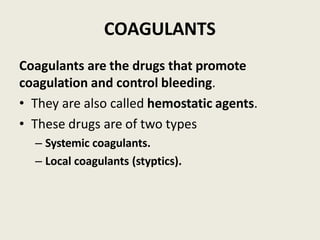
COAGULANTS
Coagulants are the drugs that promote
coagulation and control bleeding.
• They are also called hemostatic agents.
• These drugs are of two types
– Systemic coagulants.
– Local coagulants (styptics).
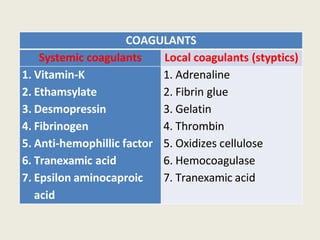
COAGULANTS
Systemic coagulants Local coagulants (styptics)
1. Vitamin-K
2. Ethamsylate
3. Desmopressin
4. Fibrinogen
5. Anti-hemophillic factor
6. Tranexamic acid
7. Epsilon aminocaproic
acid
1. Adrenaline
2. Fibrin glue
3. Gelatin
4. Thrombin
5. Oxidizes cellulose
6. Hemocoagulase
7. Tranexamic acid
Systemic coagulants
Vitamin-K
• Vitamin K (Coagulation vitamin) is essential for
the coagulation process.
• It is not directly involved in the clotting
process but required for the synthesis of four
clotting factors in the liver: Factor II,VII,IX and
X.
• It occurs naturally in two forms:
– Phylloquinone (K1) from plant source and
– Menaquinone (K2) which is synthesized by colonic
bacteria (E.coli) in the colon.
• K3 is the synthetic form and is available as
– Fat-soluble forms (Menadione,
Acetomenaphthone) and
– water-soluble forms (Menadione sod. Bisulfate
and Menadione sod. Diphosphate).
• Dietary sources:
– Green leafy vegetables such as cabbage, spinach
and liver, cheese, cereals, nuts, and egg yolk etc.
– Wheat germ oil is the richest source.
• Physiological functions:
– Vit-K is essential for formation of clotting factor-II,
VII, IX, X, protein-C & S.
Deficiency Symptoms
• Vit-K is only temporarily concentrated in liver and
this store can be exhausted within one week.
• The deficiency of vit-K occurs due to liver disease,
obstructive jaundice, malabsorption, long-term
antimicrobial therapy, which alters intestinal
flora.
• The most important manifestation is bleeding
tendency due to lowering of the levels of
prothrombin and other clotting factors in blood.
• Haematuria is usually first to occur; other
common sites of bleeding are gastrointestinal
tract, nose and under the skin where it
presents in the form of haemorrhagic spots.
• Recommended dietary allowance (RDA)
– Normal adult requirement is 50–100 μg/day.
– As it can be synthesized in the colon, even 3–10
μg/day may be sufficient.
Vit-K use:
• For prevention of haemorrhagic disease of
the newborn: All newborns especially
premature infants have low levels of
prothrombin and other clotting factors.
– Vit- K: 1 mg IM soon after birth has been
recommended routinely.
– Alternatively, 5–10 mg IM to the mother 4–12
hours before delivery can be given.
• As an antidote in overdose of oral
anticoagulants.
• In patients suffering from liver disease .
• Patients with obstructive jaundice or
malabsorption syndromes.
– The therapy given is Vit-K 10 mg IM/day, or
orally along with bile salts for better absorption.
Ethamsylate
• It increases capillary wall stability by
antihyaluronidase action.
• It decreases PGI2 synthesis, and corrects
abnormalities of platelet adhesion and
promotes platelet aggregation.
• It is used in the prevention and treatment of
capillary bleeding.
Desmopressin
• It is an analogue to vasopressin &
increases the plasma concentration of
factor-VIII, and directly activates platelets.
• Desmopressin is useful for the treatment of
hemophilia-A and von-willebrand
disease.(bleeding disorder caused by low
levels of clotting protein in the blood)
Fibrinogen
• It is obtained from human plasma and is a
promising haemostatic agent.
• It is used to control bleeding in
– Haemophilia
– Hypofibrinogenemia
– Antihaemophilic globulin deficiency.
• It is available as IV infusion 0.5 per bottle.
Anti-hemophillic factor
• It contains coagulation factor VIII and is
concentrated human (Antihaemophilic globulin)
AHG obtained from pooled human plasma.
• It is therapeutically used in haemophilia and AHG
deficiency.
• It is given in a dose of 10–20 IU/kg by IV infusion,
repeated 6–12 hourly.
Tranexamic acid & Epsilon aminocaproic acid
• They are antifibrinolytic agent.
• They inhibit the activation of plasminogen and
the process that dissolves clots,thereby
reducing bleeding.
• They are available as oral and IV form.
• Tranexamic acid is given in a dose of 500-1000mg
orally & IV.
• Side effects
– nausea, vomiting, allergic
reactions, disturbed colour vision, etc.
LOCAL COAGULANTS (STYPTICS)
• Local coagulants are also known as styptics or
haemostatics (haemo-blood and statics- to
stop).
• These substances are used locally to stop the
bleeding from the oozing surfaces such as
abrasions, bleeding tooth socket after tooth
extraction etc.
Role of adrenaline
• Control of bleeding may be aided by applying
adrenaline locally as it causes local vasoconstriction.
• A cotton pad soaked with 0.1% adrenaline is used to
control capillary bleeding such as epistaxis(nose
bleeding) and after tooth extraction etc.
• Adrenaline is available in combination with
lignocaine to provide better surgical field, but should
be avoided in patients suffering from hypertension or
cardiovascular disease.
Thrombin
• Obtained from bovine plasma is used topically
to control capillary bleeding.
• It activates platelets and catalyzes the
conversion of fibrinogen to fibrin which are
essential steps for clot formation.
Gelatin foam, oxidized cellulose
• Theses are absorbable materials, available as film or
sponge and are used in surgical procedures to
control the bleeding of capillaries or arterioles.
• After applied dry, they swell up and form meshwork,
which helps in the clotting mechanism and stops
bleeding.
• The main adverse effects seen with these are tissue
necrosis, vascular stenosis & nerve damage.
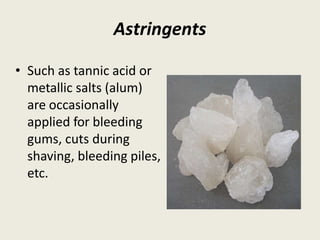
Astringents
• Such as tannic acid or
metallic salts (alum)
are occasionally
applied for bleeding
gums, cuts during
shaving, bleeding piles,
etc.
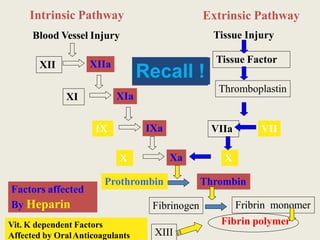
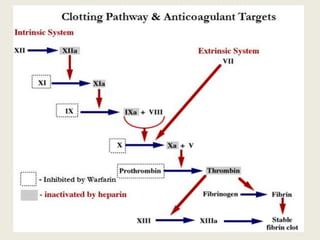
Intrinsic and Extrinsic Pathway
• The intrinsic pathway is activated by factors in
the blood while extrinsic is activated by tissue
factor.
• Both Pathways result in activation of factor X
leading into the common pathway, which ends
with converting fibrinogen into fibrin to form a
stabilise the blood clot.
Blood Vessel Injury
IX IXa
XI XIa
X Xa
XII XIIa Tissue Factor
Thromboplastin
VIIa VII
X
Prothrombin Thrombin
Fibrinogen Fribrin monomer
Fibrin polymer
XIII
Intrinsic Pathway Extrinsic Pathway
Tissue Injury
Factors affected
By Heparin
Vit. K dependent Factors
Affected by OralAnticoagulants
Recall !
ANTI-COAGULANTS
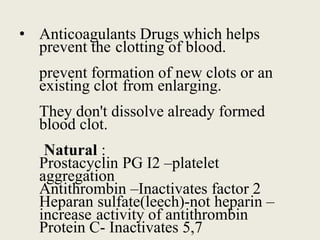
• Anticoagulants Drugs which helps
prevent the clotting of blood.
prevent formation of new clots or an
existing clot from enlarging.
They don't dissolve already formed
blood clot.
Natural :
Prostacyclin PG I2 –platelet
aggregation
Antithrombin –Inactivates factor 2
Heparan sulfate(leech)-not heparin –
increase activity of antithrombin
Protein C- Inactivates 5,7
Why anticoagulants ?
⚫To reduce the coagulability of blood
⚫Blood clots – Thrombus
⚫Arterial Thrombosis:
⚫Adherence of platelets to arterial walls – “White” in color -
Often associated with MI, stroke and ischemia
⚫ Venous Thrombosis:
⚫Develops in areas of stagnated blood flow (deep vein
thrombosis), “Red” in color- Associated with Congestive
Heart Failure, Cancer,
⚫THROMBOEMBOLISM : when a blood clot (thrombus) that
forms in a blood vessel breaks loose, is carried by the blood
stream and blocks another blood vessel.
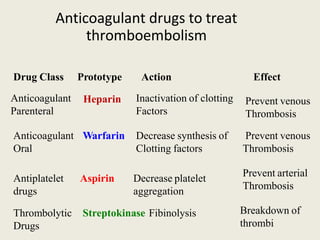
Anticoagulant drugs to treat
thromboembolism
Effect
Drug Class
Anticoagulant
Parenteral
Prototype
Heparin
Action
Inactivation of clotting
Factors
Prevent venous
Thrombosis
Anticoagulant
Oral
Warfarin Decrease synthesis of
Clotting factors
Prevent venous
Thrombosis
Antiplatelet
drugs
Aspirin Decrease platelet
aggregation
Prevent arterial
Thrombosis
Thrombolytic
Drugs
Streptokinase Fibinolysis Breakdown of
thrombi
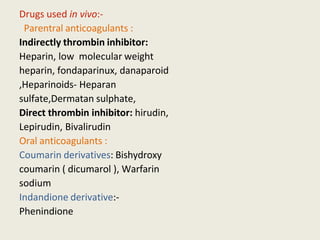
Drugs used in vivo:-
Parentral anticoagulants :
Indirectly thrombin inhibitor:
Heparin, low molecular weight
heparin, fondaparinux, danaparoid
,Heparinoids- Heparan
sulfate,Dermatan sulphate,
Direct thrombin inhibitor: hirudin,
Lepirudin, Bivalirudin
Oral anticoagulants :
Coumarin derivatives: Bishydroxy
coumarin ( dicumarol ), Warfarin
sodium
Indandione derivative:-
Phenindione
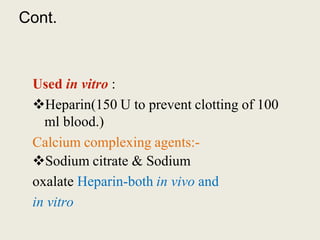
Cont.
Used in vitro :
Heparin(150 U to prevent clotting of 100
ml blood.)
Calcium complexing agents:-
Sodium citrate & Sodium
oxalate Heparin-both in vivo and
in vitro
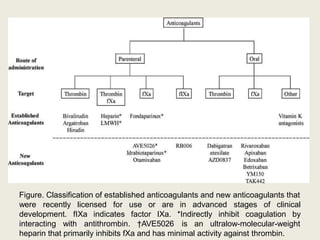
Figure. Classification of established anticoagulants and new anticoagulants that
were recently licensed for use or in advanced stages of clinical
are
development. fIXa indicates factor IXa. *Indirectly inhibit coagulation by
interacting with antithrombin. †AVE5026 is an ultralow-molecular-weight
heparin that primarily inhibits fXa and has minimal activity against thrombin.
Available Anticoagulants
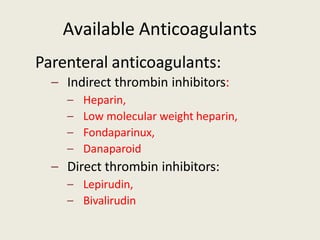
Parenteral anticoagulants:
– Indirect thrombin inhibitors:
– Heparin,
– Low molecular weight heparin,
– Fondaparinux,
– Danaparoid
– Direct thrombin inhibitors:
– Lepirudin,
– Bivalirudin
HEPARIN
• Heparin McLean, a medical student ,discovered that liver
contains a powerful anticoagulant.Howell and Holt named it
‘HEPARIN’ -obtained from liver.
• Mixture of mucopolysaccharides with MW 10,000 to 20,000.
• It contains D-glucosamine-L-iduronic acid and D-glucosamine- D-
glucuronic acid
• It carries strong electronegative charge and is the strongest
organic acid present in the body.
• Found in the secretory granules of mast cells. Richest sources are
lung, liver and intestinal mucosa.
• Commercially produced from ox lung and pig intestinal
mucosa.
• Heparin produces its anticoagulant effect by activating plasma
antithrombin iii and inhibiting factors 2A and XA
Mechanism of action
• Heparin binds to antithrombin III (natural
endogenous anticoagulant) and heparin-antithrombin-
III complex is formed.
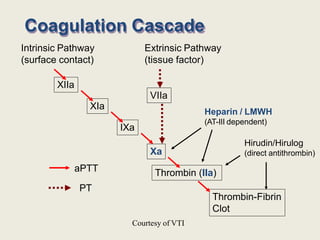
• This heparin-antithrombin-III complex inactivates the
clotting factors of both intrinsic & common pathway
(XIIa, XIa, IX, Xa, XIIIa, II) by binding to them.
• Thus, the anticoagulant effect is exerted mainly by
inhibition of factor Xa & thrombin mediated
conversion of fibrinogen to fibrin (refer coagulation
cascade).
Coagulation Cascade
XIIa
XIa
IXa
Intrinsic Pathway
(surface contact)
Xa
Extrinsic Pathway
(tissue factor)
VIIa
Thrombin (IIa)
Thrombin-Fibrin
Clot
aPTT
PT
Heparin / LMWH
(AT-III dependent)
Hirudin/Hirulog
(direct antithrombin)
Courtesy of VTI
Other actions of heparin
• It is also known as unfractionated heparin
(UFH).
ANTIPLATELET:-
 Higher doses inhibits platelet aggregation
 prolongs bleeding time
 Thrombocytopenia
LIPAEMIA CLEARING
 Injection of heparin clears turbid post-prandial
lipaemia by releasing
a lipoprotein lipase from the vessel wall
• Heparin induced thrombocytopenia is a
common entity and was generally manifested
as decreased platelet count. In this condition,
withdrawal of drug is helpful.
• On intramuscular injection, it may cause
hematomas.
• The monitoring of activated partial
thromboplastin time (aPTT) ratio is
mandatory, if the ratio of aPTT is greater than
three, there is increase risk of bleeding.
Protamine sulfate (heparin
antagonist)
• It is a strong base and obtained from fish
sperm.
• Protamine sulfate acts as an antidote for
heparin overdose and is given in a dose of 1
mg IV for every 100 IU of heparin.
• It is used after cardiovascular surgeries when
it has been administered in higher doses and
the action needs to be terminated rapidly.
Pharmacokinetics
• It is not absorbed by oral route due to its large size &
highly ionized nature.
• Therefore, it is given by IV route (acts immediately)
and subcutaneous route (acts within an hour).
• It does not cross BBB & placenta. Hence, can be given
safely in pregnancy.
• It is metabolized in liver by heparinase enzyme and
excreted through kidneys.
• The plasma t ½ is 1-2 hours and is dose dependent.
• It is prolonged in kidney & liver diseases and shortened
in pulmonary embolism.
Dose
dose
 Adult: 5000–10,000 IU, IV bolus
followed by 750–1000 IU/hr IV infusion.
 Children: 50–100 IU/kg.
Adverse effects
• First clinical sign of adverse effect of heparin
is: hematuria.
• The other side effects are
– bleeding,
– thrombocytopenia,
– reversible alopecia,
– osteoporosis,
– hepatotoxicity, and
– rarely hypersensitivity reaction.
Indications
• Prophylaxis of postoperative venous
thrombosis.
• Post MI.
• Pulmonary embolism.
• Deep venous thrombosis.
• Heparinization of center line & chemo-pods.
LOW MOLECULAR WEIGHT
HEPARIN
• Commercially prepared by fractionation (molecular weight
4000 - 6500)
Advantages over conventional heparin:
• Uniform absorption
• Longer duration of action.
• Less antigenic,
• less interaction with platelets- Less risk of thrombocytopenia
• Examples: ENOXAPARIN, DALTEPARIN, TINZAPARIN,
PARNAPARIN
,REVIPARIN .
Advantages of LMWH over UH
• Decreased “heparin resistance”
– pharmacokinetics of UH are influenced by its
bindings to plasma protein, endothelial cell
surfaces, macrophages, and other acute phase
reactants
– LMWH has decreased binding to
nonanticoagulant-related plasma proteins
Advantages of LMWH over UH
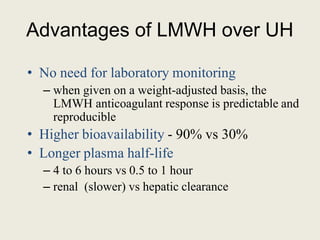
• No need for laboratory monitoring
– when given on a weight-adjusted basis, the
LMWH anticoagulant response is predictable and
reproducible
• Higher bioavailability - 90% vs 30%
• Longer plasma half-life
– 4 to 6 hours vs 0.5 to 1 hour
– renal (slower) vs hepatic clearance
Advantages of LMWH over UH
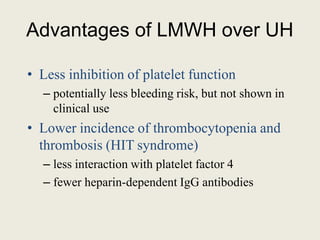
• Less inhibition of platelet function
– potentially less bleeding risk, but not shown in
clinical use
• Lower incidence of thrombocytopenia and
thrombosis (HIT syndrome)
– less interaction with platelet factor 4
– fewer heparin-dependent IgG antibodies
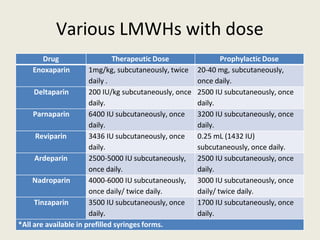
Various LMWHs with dose
Drug Therapeutic Dose Prophylactic Dose
Enoxaparin 1mg/kg, subcutaneously, twice
daily .
20-40 mg, subcutaneously,
once daily.
Deltaparin 200 IU/kg subcutaneously, once
daily.
2500 IU subcutaneously, once
daily.
Parnaparin 6400 IU subcutaneously, once
daily.
3200 IU subcutaneously, once
daily.
Reviparin 3436 IU subcutaneously, once
daily.
0.25 mL (1432 IU)
subcutaneously, once daily.
Ardeparin 2500-5000 IU subcutaneously,
once daily.
2500 IU subcutaneously, once
daily.
Nadroparin 4000-6000 IU subcutaneously,
once daily/ twice daily.
3000 IU subcutaneously, once
daily/ twice daily.
Tinzaparin 3500 IU subcutaneously, once
daily.
1700 IU subcutaneously, once
daily.
*All are available in prefilled syringes forms.
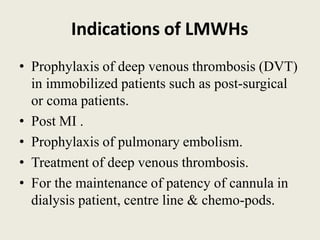
Indications of LMWHs
• Prophylaxis of deep venous thrombosis (DVT)
in immobilized patients such as post-surgical
or coma patients.
• Post MI .
• Prophylaxis of pulmonary embolism.
• Treatment of deep venous thrombosis.
• For the maintenance of patency of cannula in
dialysis patient, centre line & chemo-pods.
Fondaparinux
• It is a synthetic derivative of heparin.
• It has pharmacological similarity to LMWHs with
longer plasma half-life (17-21 hours).
• It has 100% bioavailability.
• It is given in a dose of 5-10mg SC, OD.
• The adverse effects like thrombocytopenia &
osteoporosis are even lesser than LMWHs.
• Idraparinux is an ultra long acting derivative of
fondaparinux with t ½ of 5-6 days.
Danaparoid
• It is a mixture of heparin like natural
substances (84% heparin sulfate +12%
dermatan salfate + 4% chondroitin sulfate).
• It is obtained from pig intestinal mucosa.
• It has longer plasma t ½ of 24 hours.
• It is used in patient with heparin induced
thrombocytopenia as an alternative therapy.
DIRECT THROMBIN INHIBITORS
(Lepirudin, Bivalirudin, Argatroban)
Lepirudin
• It is a recombinant preparation of hirudin.
• It inhibits thrombin directly.
• Indicated in heparin induced
thrombocytopenia.
• It cannot be given repeatedly due to formation
of anti-hirudin antibodies and higher risk of
anaphylaxis.
• There is no antidote available against
lepirudin.
Bivalirudin
• Synthetic analogue of hirudin with
pharmacological actions similar to lepirudin.
• It has fast onset & offset of action due to its
reversible binding nature.
• It does not form anti-hirudin antibodies.
Argatroban
• It is a reversible direct thrombin inhibitor and
given by IV infusion.
• It is used in-patients with heparin-induced
thrombocytopenia as an alternative therapy.
ORAL ANTI-COAGULANTS
 Oral anticoagulants Given by oral route
Teratogenic More drug interactions
 Eg : Warfarin sodium,
 Bishydroxycoumarin ( Dicumarol )
 Acenocoumarol / Nicomalone ,
 Phenindione
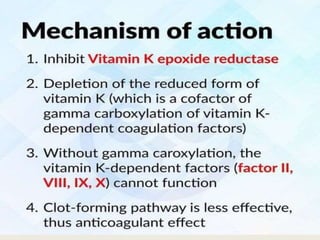
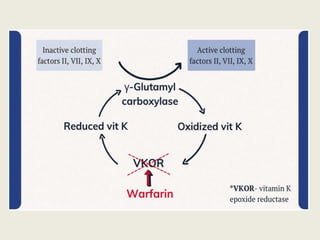
WARFARIN
• 1948: synthesis of warfarin by student Harold
Campbell.
• Most widely used anticoagulant in the world
• Coumarin derivative, water soluble vit K
antagonist.
• Low cost and highly effective, if given in right
way.
The name warfarin is derived from WARF (Wisconsin Alumni
Research Foundation) and –arin from coumarin.
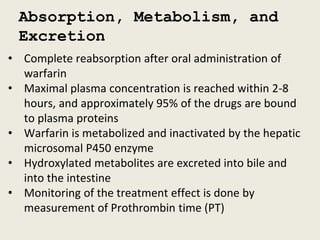
Absorption, Metabolism, and
Excretion
• Complete reabsorption after oral administration of
warfarin
• Maximal plasma concentration is reached within 2-8
hours, and approximately 95% of the drugs are bound
to plasma proteins
• Warfarin is metabolized and inactivated by the hepatic
microsomal P450 enzyme
• Hydroxylated metabolites are excreted into bile and
into the intestine
• Monitoring of the treatment effect is done by
measurement of Prothrombin time (PT)
Indications
• Deep vein Thrombosis
• Pulmonary Embolism
• Arterial Fibrillation
• Mitral Stenosis
• Prosthetic valve
replacement
Side effects of Warfarin
 Bleeding
 Skin necrosis
 Purple toe syndrome
 Teratogenicity
 Osteoporosis
 Others: Agranulocytosis, leukopenia, diarrhoea,
nausea, anorexia.
ACENOCOUMAROL (acitrom)
• Same as warfarin with following differences:
– Shorter half life 10-16 hrs
– More rapid onset of action
– Shorter duration of action (2 days)
– Causes GI disturbances, oral ulcerations and
dermatitis
• 4 mg on day one, 4-8 mg on the day 2nd then
maintenance dose 1-8 mg according to
response by PT test
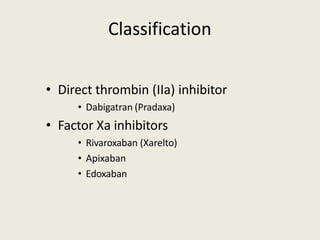
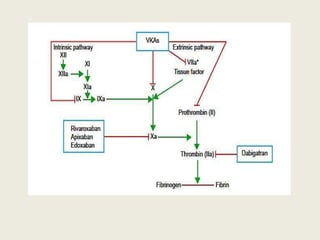
Newer Oral Anticoagulants
Classification
• Direct thrombin (IIa) inhibitor
• Dabigatran (Pradaxa)
• Factor Xa inhibitors
• Rivaroxaban (Xarelto)
• Apixaban
• Edoxaban
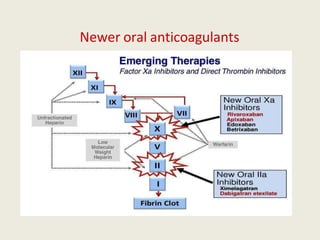
Newer oral anticoagulants
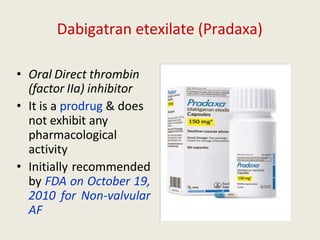
Dabigatran etexilate (Pradaxa)
• Oral Direct thrombin
(factor IIa) inhibitor
• It is a prodrug & does
not exhibit any
pharmacological
activity
• Initially recommended
by FDA on October 19,
2010 for Non-valvular
AF
Mechanism of Action
• Dabigatran and its acyl glucuronides are competitive,
direct thrombin inhibitors.
• Both free and clot-bound thrombin, and thrombin-
induced platelet aggregation are inhibited by the
active moieties.
Pharmacokinetics
• Dabigatran etexilate mesylate is absorbed as the
dabigatran etexilate ester.
• The ester is then hydrolyzed, forming dabigatran,
the active moiety.
• The t1/2 is 15 to 17 hrs.
• 90% is excreted unchanged in urine.
• The absolute bioavailability of dabigatran following
oral administration is approximately 3 to 7% .
ADVERSE EFFECTS OF ANTI
COGULANTS
 Bleeding
 Alopecia
 Hypersenstivity - Dermatitis, Urticaria
Thrombocytopenia
 Teratogenecity (warfarin)-Fetal warfarin
syndrome-hypoplasia of nasal bridge,
 heart defects,
 Growth retardation, laryngomalacia
THERAPEUTIC USES OF ANTI
COAGULANTS
 Heparin and warfarin both are started simultaneously, later
heparin is discontinued after 5 days and warfarin continued
.warfarin action starts only after 3-4 days
USES :-
1.Prophylaxis of Deep vein thrombosis and pulmonary embolism.
In bed ridden patients and those undergoing knee, hip
replacement surgeries
2.Myocardial infarction
3.Unstable angina
4.Rheumatic heart disease; Atrial fibrillation 5.During
bypass surgery ,Vascular surgery 6.prostatic heart
valves, retinal vessel thrombosis,
hemodialysis.