Bienvenidos!
Live Class- Semana 18
El Plan- Español I:
1. Preguntas de semana 17 (gramática/vocabulario)
2. Reminder: best contact njwiemann@gmail.com
3. Mid-term grades (if ungraded)
4. Two-verb practice
5. Review
6. Preguntas?
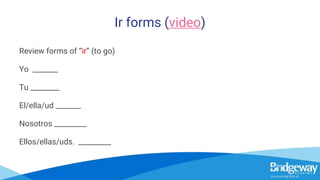
Ir forms (video)
Review forms of “ir” (to go)
Yo _______
Tu ________
El/ella/ud _______
Nosotros _________
Ellos/ellas/uds. _________
Irregular verbs in the present tense (video)
Stem-Changing Verbs
In a regular verb, only the ending of the verb changes when you conjugate it. With stem-changing verbs, the verb stem will
sometimes change a little bit as well. It is important to note that these verbs do not have a stem change in the nosotros and
vosotros forms.
There are three common types of stem-changing verbs: O to UE, E to IE, and E to I. There are some verbs that stem-change
from I to IE (adquirir - to acquire), from U to UE (jugar – to play), and from O to HUE (oler – to smell). This lesson will focus on the
more common stem-changing verbs.
O-UE
Most verbs that undergo a stem-change from o to ue (such as dormir [to sleep]) still use the regular verb endings in the present
tense. They simply undergo a stem change in all forms except nosotros and vosotros. The following chart shows the present
tense conjugation of the verb dormir:
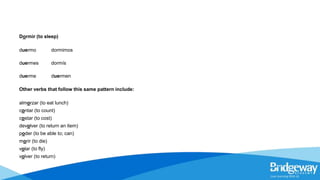
Dormir (to sleep)
duermo dormimos
duermes dormís
duerme duermen
Other verbs that follow this same pattern include:
almorzar (to eat lunch)
contar (to count)
costar (to cost)
devolver (to return an item)
poder (to be able to; can)
morir (to die)
volar (to fly)
volver (to return)
E-IE
Most verbs that undergo a stem-change from e to ie (such as comenzar [to begin]) still use the regular verb endings in the present
tense. They simply undergo a stem change in all forms except nosotros and vosotros. The following chart shows the present
tense conjugation of the verb comenzar:
Comenzar (to begin)
comienzo comenzamos
comienzas comenzáis
comienza comienzan
Other verbs that follow this same pattern include:
comenzar (to begin)
divertirse (to enjoy oneself; to have fun)
empezar (to begin)
entender (to understand)
perder (to lose)
preferir (to prefer)
querer (to want)
tener (to have) (tener is also irregular in the "yo" form - yo tengo)
E-I
All verbs that undergo a stem-change from e to i (such as pedir [to ask for]) are -IR verbs, and still use the regular verb endings in
the present tense. They simply undergo a stem change in all forms except nosotros and vosotros. The following chart shows the
present tense conjugation of the verb pedir:
Pedir (to order/request)
pido pedimos
pides pedís
pide piden
Other verbs that follow this same pattern include:
decir (to say; tell) *Remember, decir has an irregular yo conjugation - digo
repetir (to repeat)
Rules for Two-Verb sentences
1. ONLY conjugate the 1st verb
2. The second verb DOES NOT CHANGE! (stays in the -ar, -ir, or -er ending)
3. Makes sure the first verb is conjugated to agree with the subject pronoun (yo,
tu, el/ella/ud, etc)
Ex. yo necesito cocinar
Nosotros vamos a estudiar
*extra pdf reference
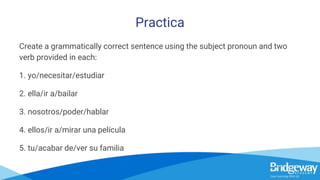
Practica
Create a grammatically correct sentence using the subject pronoun and two
verb provided in each:
1. yo/necesitar/estudiar
2. ella/ir a/bailar
3. nosotros/poder/hablar
4. ellos/ir a/mirar una película
5. tu/acabar de/ver su familia
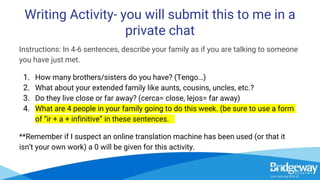
Writing Activity- you will submit this to me in a
private chat
Instructions: In 4-6 sentences, describe your family as if you are talking to someone
you have just met.
1. How many brothers/sisters do you have? (Tengo…)
2. What about your extended family like aunts, cousins, uncles, etc.?
3. Do they live close or far away? (cerca= close, lejos= far away)
4. What are 4 people in your family going to do this week. (be sure to use a form
of “ir + a + infinitive” in these sentences.
**Remember if I suspect an online translation machine has been used (or that it
isn’t your own work) a 0 will be given for this activity.
Steps for this week
*Saber vs. Conocer (video in Moodle- day 2)
*Pedir vs. Preguntar
*HW- submit conjugation charts of these 4 verbs in Day 3 in Moodle
**If you feel you need help keeping track of all the verb tenses, here’s a super
handy verb chart: Sparknotes Verb Chart
(will cover all tenses learned in Sp. I-IV)
Decide if you would use saber or conocer in each sentence:
● I know how to dance
● I know Maria
● I know facts about Spain
● I am familiar with Texas
El Plan- Español II
1. Preguntas de semana 14-16 (gramática/vocabulario)
2. Powerspeak- problemas
3. Vacaciones
4. Verbos Reflexivos repaso
5. Práctica
6. Esta semana- el futuro
7. Preguntas?
Que hicieron durante las vacaciones?
En 6-8 frases, díganme que hicieron durante las vacaciones.
When a reflexive verb is conjugated, the pronoun will change to match the subject of the
sentence.
Reflexive Pronouns-
me (myself) Nos (ourselves)
te (yourself) Os (yourselves)
se (himself, herself, yourself- polite) Se (themselves, yourselves)
Daily Routine Examples:
● When you conjugate a reflexive verb (i.e. levantarse), you must remove the -se from the end of the
verb and place it in front of the conjugated verb.
● Ejemplo (levantarse- to get up):
○ Me levanto * Nosotros nos levantamos
○ Tu te levantas *Os levantais
○ El/Ella/Ud. se levanta * Ellos/Ellas/Uds. se levantan
Using reflexive verbs with infinitive verbs like
necesitar, querer, deber, pensar, tener que, ir a, etc.
● When you use a reflexive verb after an
infinitive such as the ones above, you must
remove the ‘se’ from the end of the
infinitive reflexive verb and replace it with
the correct reflexive pronoun.
● Remember- it must match the subject
Ejemplo:
● I need to brush my teeth
● Yo necesito cepillarme los dientes.
● You have to shower.
● Tú necesitas ducharte.
Ejemplos:
Reflexive Verb only
● Me pongo la ropa
● Tu te pones la ropa
● El/ella/ud. se pone la ropa
● Nosotros nos ponemos la ropa
● ellos/ellas/uds. se ponen la ropa
Reflexive Verb following another verb (already
conjugated)
● Necesito ponerme la ropa
● Necesitas ponerte la ropa
● Necesita ponerse la ropa
● Necesitamos ponernos la ropa
● Necesitan ponerse la ropa
Repaso de los verbos reflexivos
INDEPENDENT PRACTICE: REFLEXIVE VERB CONJUGATION (in present tense and preterite tense)
CONJUGATE THE VERBS TO THE RIGHT IN THE BLANK SPACE BELOW BASED ON THE SUBJECT PRONOUN
(HINT: SOME OF THE VERBS WILL BE STEM-CHANGERS!).
1. YO ____________________________ POR LA MANANA. (ACOSTARSE) (O UE)
2. ELLOS ____________________________ A LA MEDIANOCHE. (DORMIRSE) (O UE)
3. NOSOTROS ______________________________ EN EL BANO. (LAVARSE LA CARA)
4. ELLA _____________________________________. (MAQUILLARSE)
5. YO __________________________ A LAS SEIS Y MEDIA DE LA MAÑANA. (DESPERTARSE) (E IE)
6. NOSOTROS _________________________ A LAS SIETE. (LEVANTARSE)
7. ELLOS _____________________ Y ______________________. (AFEITARSE Y DUCHARSE)
8. ELLA ________________________ AL SALON DE BELLEZA. (PINTARSE LAS UÑAS)
9. MARIA Y MIGUEL _______________________ PARA LA ESCUELA. (PREPARARSE)
10. TÚ ___________________________ TRES VECES AL DIA. (CEPILLARSE LOS DIENTES)
11 YO ___________________________ CADA VERANO. (CORTARSE EL PELO)
12. TU ______________________________ EN LA MANANA. (VESTIRSE) (E I)
13. USTEDES _________________________ DESPUÉS DE DUCHARSE. (SECARSE).
14. MARIA Y YO _______________________ ANTES DE LA ESCUELA. (ARREGLARSE EL PELO)
15. TÚ ___________________________ POR LA NOCHE. (BANARSE)

Spanish 1 Class 18

  • 1.
  • 2.
    El Plan- EspañolI: 1. Preguntas de semana 17 (gramática/vocabulario) 2. Reminder: best contact njwiemann@gmail.com 3. Mid-term grades (if ungraded) 4. Two-verb practice 5. Review 6. Preguntas?
  • 3.
    Ir forms (video) Reviewforms of “ir” (to go) Yo _______ Tu ________ El/ella/ud _______ Nosotros _________ Ellos/ellas/uds. _________
  • 4.
    Irregular verbs inthe present tense (video) Stem-Changing Verbs In a regular verb, only the ending of the verb changes when you conjugate it. With stem-changing verbs, the verb stem will sometimes change a little bit as well. It is important to note that these verbs do not have a stem change in the nosotros and vosotros forms. There are three common types of stem-changing verbs: O to UE, E to IE, and E to I. There are some verbs that stem-change from I to IE (adquirir - to acquire), from U to UE (jugar – to play), and from O to HUE (oler – to smell). This lesson will focus on the more common stem-changing verbs. O-UE Most verbs that undergo a stem-change from o to ue (such as dormir [to sleep]) still use the regular verb endings in the present tense. They simply undergo a stem change in all forms except nosotros and vosotros. The following chart shows the present tense conjugation of the verb dormir:
  • 5.
    Dormir (to sleep) duermodormimos duermes dormís duerme duermen Other verbs that follow this same pattern include: almorzar (to eat lunch) contar (to count) costar (to cost) devolver (to return an item) poder (to be able to; can) morir (to die) volar (to fly) volver (to return)
  • 6.
    E-IE Most verbs thatundergo a stem-change from e to ie (such as comenzar [to begin]) still use the regular verb endings in the present tense. They simply undergo a stem change in all forms except nosotros and vosotros. The following chart shows the present tense conjugation of the verb comenzar: Comenzar (to begin) comienzo comenzamos comienzas comenzáis comienza comienzan Other verbs that follow this same pattern include: comenzar (to begin) divertirse (to enjoy oneself; to have fun) empezar (to begin) entender (to understand) perder (to lose) preferir (to prefer) querer (to want) tener (to have) (tener is also irregular in the "yo" form - yo tengo)
  • 7.
    E-I All verbs thatundergo a stem-change from e to i (such as pedir [to ask for]) are -IR verbs, and still use the regular verb endings in the present tense. They simply undergo a stem change in all forms except nosotros and vosotros. The following chart shows the present tense conjugation of the verb pedir: Pedir (to order/request) pido pedimos pides pedís pide piden Other verbs that follow this same pattern include: decir (to say; tell) *Remember, decir has an irregular yo conjugation - digo repetir (to repeat)
  • 8.
    Rules for Two-Verbsentences 1. ONLY conjugate the 1st verb 2. The second verb DOES NOT CHANGE! (stays in the -ar, -ir, or -er ending) 3. Makes sure the first verb is conjugated to agree with the subject pronoun (yo, tu, el/ella/ud, etc) Ex. yo necesito cocinar Nosotros vamos a estudiar *extra pdf reference
  • 9.
    Practica Create a grammaticallycorrect sentence using the subject pronoun and two verb provided in each: 1. yo/necesitar/estudiar 2. ella/ir a/bailar 3. nosotros/poder/hablar 4. ellos/ir a/mirar una película 5. tu/acabar de/ver su familia
  • 10.
    Writing Activity- youwill submit this to me in a private chat Instructions: In 4-6 sentences, describe your family as if you are talking to someone you have just met. 1. How many brothers/sisters do you have? (Tengo…) 2. What about your extended family like aunts, cousins, uncles, etc.? 3. Do they live close or far away? (cerca= close, lejos= far away) 4. What are 4 people in your family going to do this week. (be sure to use a form of “ir + a + infinitive” in these sentences. **Remember if I suspect an online translation machine has been used (or that it isn’t your own work) a 0 will be given for this activity.
  • 11.
    Steps for thisweek *Saber vs. Conocer (video in Moodle- day 2) *Pedir vs. Preguntar *HW- submit conjugation charts of these 4 verbs in Day 3 in Moodle **If you feel you need help keeping track of all the verb tenses, here’s a super handy verb chart: Sparknotes Verb Chart (will cover all tenses learned in Sp. I-IV)
  • 12.
    Decide if youwould use saber or conocer in each sentence: ● I know how to dance ● I know Maria ● I know facts about Spain ● I am familiar with Texas
  • 13.
    El Plan- EspañolII 1. Preguntas de semana 14-16 (gramática/vocabulario) 2. Powerspeak- problemas 3. Vacaciones 4. Verbos Reflexivos repaso 5. Práctica 6. Esta semana- el futuro 7. Preguntas?
  • 14.
    Que hicieron durantelas vacaciones? En 6-8 frases, díganme que hicieron durante las vacaciones.
  • 15.
    When a reflexiveverb is conjugated, the pronoun will change to match the subject of the sentence. Reflexive Pronouns- me (myself) Nos (ourselves) te (yourself) Os (yourselves) se (himself, herself, yourself- polite) Se (themselves, yourselves)
  • 16.
    Daily Routine Examples: ●When you conjugate a reflexive verb (i.e. levantarse), you must remove the -se from the end of the verb and place it in front of the conjugated verb. ● Ejemplo (levantarse- to get up): ○ Me levanto * Nosotros nos levantamos ○ Tu te levantas *Os levantais ○ El/Ella/Ud. se levanta * Ellos/Ellas/Uds. se levantan
  • 17.
    Using reflexive verbswith infinitive verbs like necesitar, querer, deber, pensar, tener que, ir a, etc. ● When you use a reflexive verb after an infinitive such as the ones above, you must remove the ‘se’ from the end of the infinitive reflexive verb and replace it with the correct reflexive pronoun. ● Remember- it must match the subject Ejemplo: ● I need to brush my teeth ● Yo necesito cepillarme los dientes. ● You have to shower. ● Tú necesitas ducharte.
  • 18.
    Ejemplos: Reflexive Verb only ●Me pongo la ropa ● Tu te pones la ropa ● El/ella/ud. se pone la ropa ● Nosotros nos ponemos la ropa ● ellos/ellas/uds. se ponen la ropa Reflexive Verb following another verb (already conjugated) ● Necesito ponerme la ropa ● Necesitas ponerte la ropa ● Necesita ponerse la ropa ● Necesitamos ponernos la ropa ● Necesitan ponerse la ropa
  • 19.
    Repaso de losverbos reflexivos INDEPENDENT PRACTICE: REFLEXIVE VERB CONJUGATION (in present tense and preterite tense) CONJUGATE THE VERBS TO THE RIGHT IN THE BLANK SPACE BELOW BASED ON THE SUBJECT PRONOUN (HINT: SOME OF THE VERBS WILL BE STEM-CHANGERS!). 1. YO ____________________________ POR LA MANANA. (ACOSTARSE) (O UE) 2. ELLOS ____________________________ A LA MEDIANOCHE. (DORMIRSE) (O UE) 3. NOSOTROS ______________________________ EN EL BANO. (LAVARSE LA CARA) 4. ELLA _____________________________________. (MAQUILLARSE) 5. YO __________________________ A LAS SEIS Y MEDIA DE LA MAÑANA. (DESPERTARSE) (E IE) 6. NOSOTROS _________________________ A LAS SIETE. (LEVANTARSE) 7. ELLOS _____________________ Y ______________________. (AFEITARSE Y DUCHARSE) 8. ELLA ________________________ AL SALON DE BELLEZA. (PINTARSE LAS UÑAS) 9. MARIA Y MIGUEL _______________________ PARA LA ESCUELA. (PREPARARSE) 10. TÚ ___________________________ TRES VECES AL DIA. (CEPILLARSE LOS DIENTES) 11 YO ___________________________ CADA VERANO. (CORTARSE EL PELO) 12. TU ______________________________ EN LA MANANA. (VESTIRSE) (E I) 13. USTEDES _________________________ DESPUÉS DE DUCHARSE. (SECARSE). 14. MARIA Y YO _______________________ ANTES DE LA ESCUELA. (ARREGLARSE EL PELO) 15. TÚ ___________________________ POR LA NOCHE. (BANARSE)

Editor's Notes

  • #3 Sp I
  • #14 Sp II
  • #16 In order to use reflexive verbs, it is important to know the reflexive pronouns.