
FRENCH I REVIEW
NCVPS Fall 2012
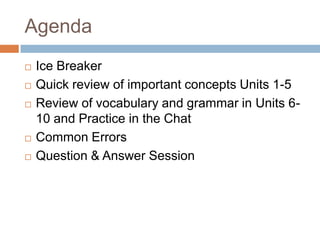
Agenda
   Ice Breaker
   Quick review of important concepts Units 1-5
   Review of vocabulary and grammar in Units 6-
    10 and Practice in the Chat
   Common Errors
   Question & Answer Session
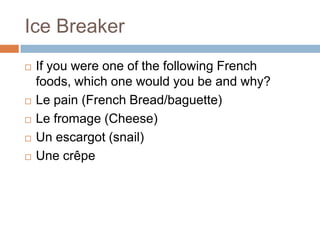
Ice Breaker
   If you were one of the following French
    foods, which one would you be and why?
   Le pain (French Bread/baguette)
   Le fromage (Cheese)
   Un escargot (snail)
   Une crêpe
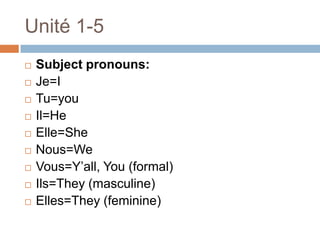
Unité 1-5
   Subject pronouns:
   Je=I
   Tu=you
   Il=He
   Elle=She
   Nous=We
   Vous=Y‟all, You (formal)
   Ils=They (masculine)
   Elles=They (feminine)
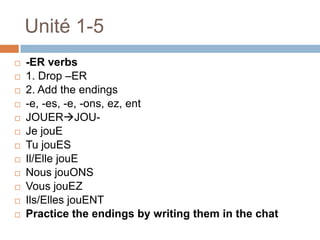
Unité 1-5
   -ER verbs
   1. Drop –ER
   2. Add the endings
   -e, -es, -e, -ons, ez, ent
   JOUERJOU-
   Je jouE
   Tu jouES
   Il/Elle jouE
   Nous jouONS
   Vous jouEZ
   Ils/Elles jouENT
   Practice the endings by writing them in the chat
Unité 1-5
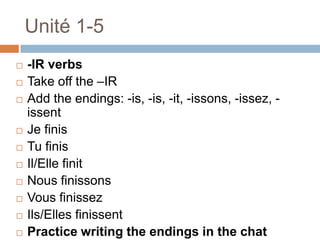
   -IR verbs
   Take off the –IR
   Add the endings: -is, -is, -it, -issons, -issez, -
    issent
   Je finis
   Tu finis
   Il/Elle finit
   Nous finissons
   Vous finissez
   Ils/Elles finissent
   Practice writing the endings in the chat
Unité 1-5
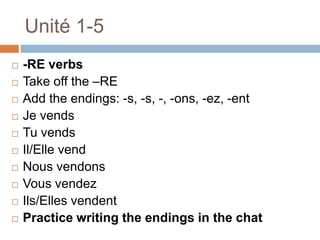
   -RE verbs
   Take off the –RE
   Add the endings: -s, -s, -, -ons, -ez, -ent
   Je vends
   Tu vends
   Il/Elle vend
   Nous vendons
   Vous vendez
   Ils/Elles vendent
   Practice writing the endings in the chat
Unité 1-5
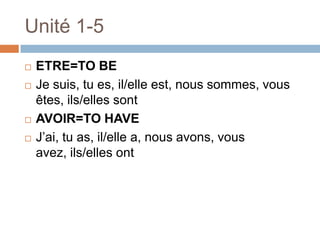
   ETRE=TO BE
   Je suis, tu es, il/elle est, nous sommes, vous
    êtes, ils/elles sont
   AVOIR=TO HAVE
   J‟ai, tu as, il/elle a, nous avons, vous
    avez, ils/elles ont
Unité 1-5
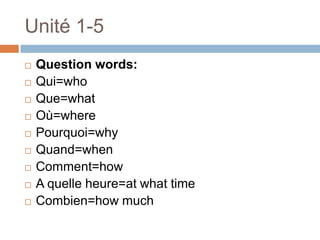
   Question words:
   Qui=who
   Que=what
   Où=where
   Pourquoi=why
   Quand=when
   Comment=how
   A quelle heure=at what time
   Combien=how much
Unité 1-5
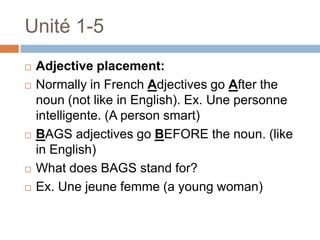
   Adjective placement:
   Normally in French Adjectives go After the
    noun (not like in English). Ex. Une personne
    intelligente. (A person smart)
   BAGS adjectives go BEFORE the noun. (like
    in English)
   What does BAGS stand for?
   Ex. Une jeune femme (a young woman)
Unité 1-5
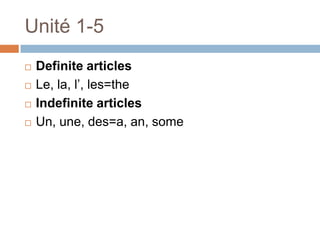
   Definite articles
   Le, la, l‟, les=the
   Indefinite articles
   Un, une, des=a, an, some
Unité 6-Les Endroits
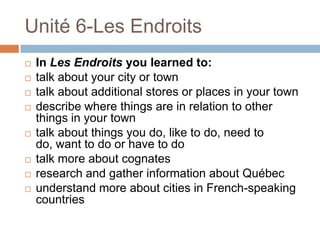
   In Les Endroits you learned to:
   talk about your city or town
   talk about additional stores or places in your town
   describe where things are in relation to other
    things in your town
   talk about things you do, like to do, need to
    do, want to do or have to do
   talk more about cognates
   research and gather information about Québec
   understand more about cities in French-speaking
    countries
Unité 6-Les Endroits
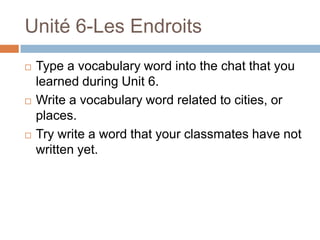
   Type a vocabulary word into the chat that you
    learned during Unit 6.
   Write a vocabulary word related to cities, or
    places.
   Try write a word that your classmates have not
    written yet.
Unité 6-Les Endroits
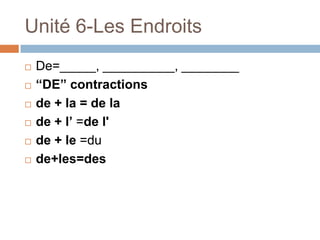
   De=_____, __________, ________
   “DE” contractions
   de + la = de la
   de + l’ =de l'
   de + le =du
   de+les=des
Unité 6-Les Endroits
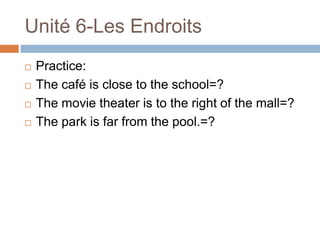
   Practice:
   The café is close to the school=?
   The movie theater is to the right of the mall=?
   The park is far from the pool.=?
Unité 6-Les Endroits
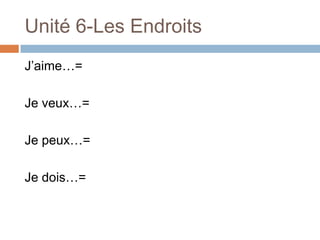
J‟aime…=

Je veux…=

Je peux…=

Je dois…=
Unité 6-Les Endroits
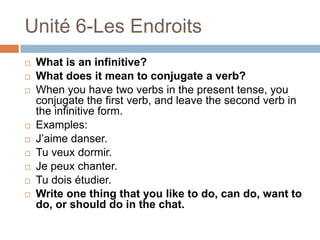
   What is an infinitive?
   What does it mean to conjugate a verb?
   When you have two verbs in the present tense, you
    conjugate the first verb, and leave the second verb in
    the infinitive form.
   Examples:
   J‟aime danser.
   Tu veux dormir.
   Je peux chanter.
   Tu dois étudier.
   Write one thing that you like to do, can do, want to
    do, or should do in the chat.
Unité 6-Les Endroits
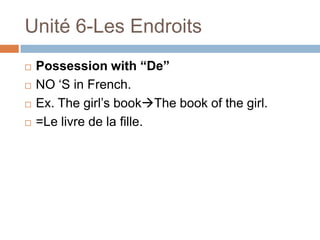
   Possession with “De”
   NO „S in French.
   Ex. The girl‟s bookThe book of the girl.
   =Le livre de la fille.
Unité 6-Les Endroits
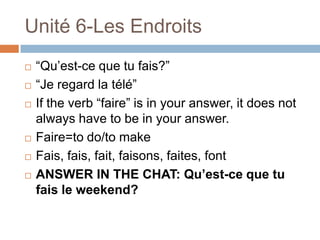
   “Qu‟est-ce que tu fais?”
   “Je regard la télé”
   If the verb “faire” is in your answer, it does not
    always have to be in your answer.
   Faire=to do/to make
   Fais, fais, fait, faisons, faites, font
   ANSWER IN THE CHAT: Qu’est-ce que tu
    fais le weekend?
Unité 6-Les Endroits
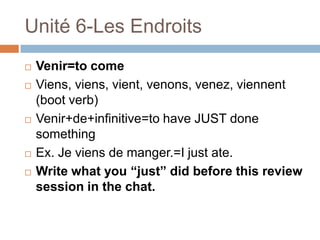
   Venir=to come
   Viens, viens, vient, venons, venez, viennent
    (boot verb)
   Venir+de+infinitive=to have JUST done
    something
   Ex. Je viens de manger.=I just ate.
   Write what you “just” did before this review
    session in the chat.
Unité 7-La Famille
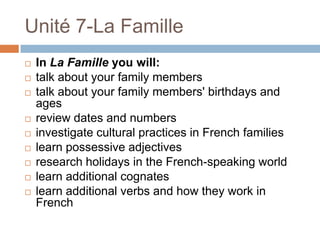
   In La Famille you will:
   talk about your family members
   talk about your family members' birthdays and
    ages
   review dates and numbers
   investigate cultural practices in French families
   learn possessive adjectives
   research holidays in the French-speaking world
   learn additional cognates
   learn additional verbs and how they work in
    French
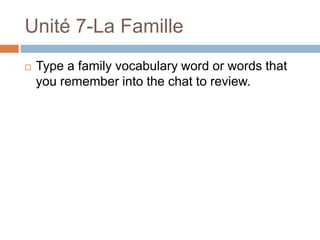
Unité 7-La Famille
   Type a family vocabulary word or words that
    you remember into the chat to review.
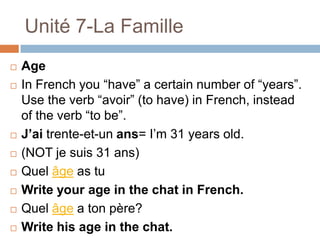
Unité 7-La Famille
   Age
   In French you “have” a certain number of “years”.
    Use the verb “avoir” (to have) in French, instead
    of the verb “to be”.
   J’ai trente-et-un ans= I‟m 31 years old.
   (NOT je suis 31 ans)
   Quel âge as tu
   Write your age in the chat in French.
   Quel âge a ton père?
   Write his age in the chat.
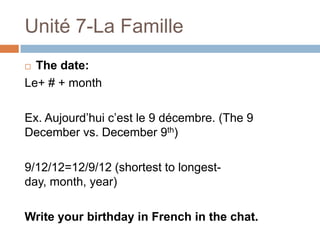
Unité 7-La Famille
 The date:
Le+ # + month

Ex. Aujourd‟hui c‟est le 9 décembre. (The 9
December vs. December 9th)

9/12/12=12/9/12 (shortest to longest-
day, month, year)

Write your birthday in French in the chat.
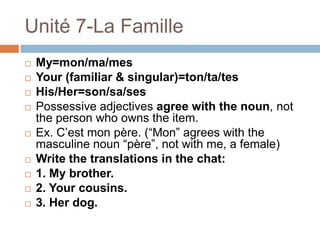
Unité 7-La Famille
   My=mon/ma/mes
   Your (familiar & singular)=ton/ta/tes
   His/Her=son/sa/ses
   Possessive adjectives agree with the noun, not
    the person who owns the item.
   Ex. C‟est mon père. (“Mon” agrees with the
    masculine noun “père”, not with me, a female)
   Write the translations in the chat:
   1. My brother.
   2. Your cousins.
   3. Her dog.
Unité 7-La Famille
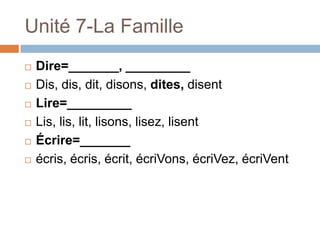
   Dire=_______, _________
   Dis, dis, dit, disons, dites, disent
   Lire=_________
   Lis, lis, lit, lisons, lisez, lisent
   Écrire=_______
   écris, écris, écrit, écriVons, écriVez, écriVent
Unité 7-La Famille
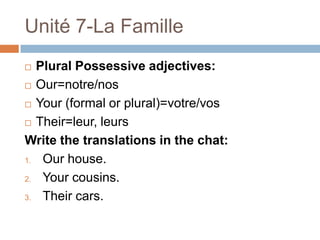
 Plural Possessive adjectives:
 Our=notre/nos

 Your (formal or plural)=votre/vos

 Their=leur, leurs

Write the translations in the chat:
1. Our house.

2. Your cousins.

3. Their cars.
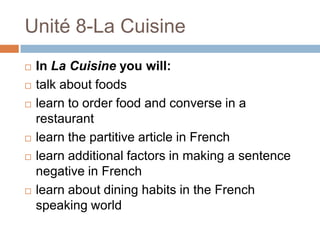
Unité 8-La Cuisine
   In La Cuisine you will:
   talk about foods
   learn to order food and converse in a
    restaurant
   learn the partitive article in French
   learn additional factors in making a sentence
    negative in French
   learn about dining habits in the French
    speaking world
Unité 8-La Cuisine
   Write a food, drink, or restaurant vocabulary
    word in French in the chat.
Unité 8-La Cuisine
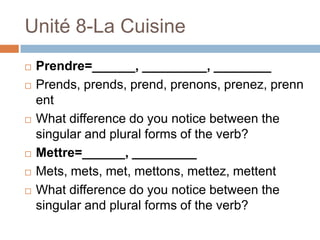
   Prendre=______, _________, ________
   Prends, prends, prend, prenons, prenez, prenn
    ent
   What difference do you notice between the
    singular and plural forms of the verb?
   Mettre=______, _________
   Mets, mets, met, mettons, mettez, mettent
   What difference do you notice between the
    singular and plural forms of the verb?
Unité 8-La Cuisine
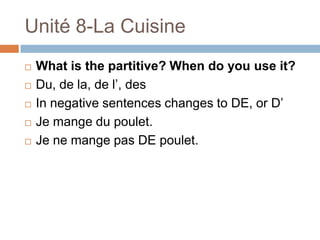
   What is the partitive? When do you use it?
   Du, de la, de l‟, des
   In negative sentences changes to DE, or D‟
   Je mange du poulet.
   Je ne mange pas DE poulet.
Unité 8-La Cuisine
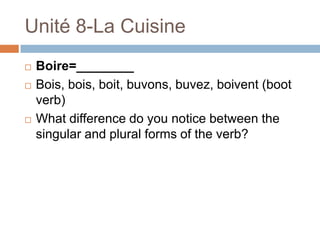
   Boire=________
   Bois, bois, boit, buvons, buvez, boivent (boot
    verb)
   What difference do you notice between the
    singular and plural forms of the verb?
Unité 9-Les Passetemps
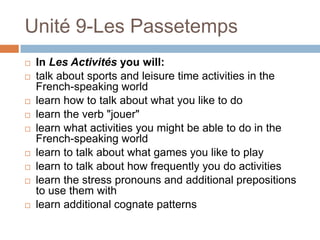
   In Les Activités you will:
   talk about sports and leisure time activities in the
    French-speaking world
   learn how to talk about what you like to do
   learn the verb "jouer"
   learn what activities you might be able to do in the
    French-speaking world
   learn to talk about what games you like to play
   learn to talk about how frequently you do activities
   learn the stress pronouns and additional prepositions
    to use them with
   learn additional cognate patterns
Unité 9-Les Passetemps
   Write a vocabulary word related to free-time
    activities in the chat.
Unité 9-Les Passetemps
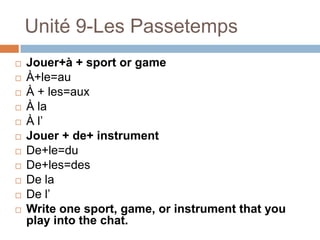
   Jouer+à + sport or game
   À+le=au
   À + les=aux
   À la
   À l‟
   Jouer + de+ instrument
   De+le=du
   De+les=des
   De la
   De l‟
   Write one sport, game, or instrument that you
    play into the chat.
Unité 9-Les Passetemps
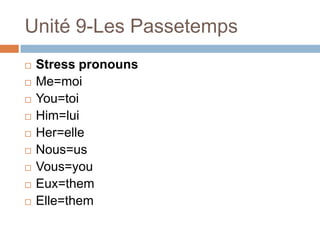
   Stress pronouns
   Me=moi
   You=toi
   Him=lui
   Her=elle
   Nous=us
   Vous=you
   Eux=them
   Elle=them
Unité 9-Les Passetemps
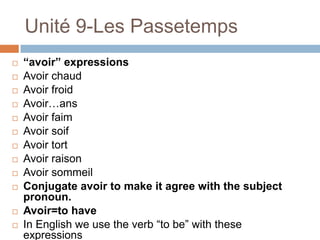
   “avoir” expressions
   Avoir chaud
   Avoir froid
   Avoir…ans
   Avoir faim
   Avoir soif
   Avoir tort
   Avoir raison
   Avoir sommeil
   Conjugate avoir to make it agree with the subject
    pronoun.
   Avoir=to have
   In English we use the verb “to be” with these
    expressions
Unité 10-L‟école
   In L'école et La routine you will:
   talk about schools and school activities in the
    French speaking world
   learn to talk about your school day in more detail
   learn to talk about your house
   learn to talk about chores and responsibilities you
    have at home
   learn to talk about your plans
   review verb structures we have had in this year of
    French
   learn additional cognate patterns
Unité 10-L‟école
   Write school, house, or chore related
    vocabulary into the chat.
Unité 10-L‟école
   Savoir=
   Sais, sais, sait, savons, savez, savent
   Je sais parler français.=I know how to speak
    French.
Common Errors
   Accent Marks: très, mère, père, frère, à…
   Conjugating verbs
   Articles before nouns (le, la, les, l‟)
   Adjective Agreement (-, -E, -S, -ES) Ex. unE
    joliE fillE
   Writing the date=le + # + month
   Using “avoir” for age, hot, cold, hungry, and
    thirsty
   Both parts of the negative-ne….pas
   Je---J‟ and nen‟ before a vowel sound
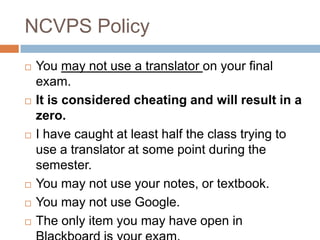
NCVPS Policy
   You may not use a translator on your final
    exam.
   It is considered cheating and will result in a
    zero.
   I have caught at least half the class trying to
    use a translator at some point during the
    semester.
   You may not use your notes, or textbook.
   You may not use Google.
   The only item you may have open in
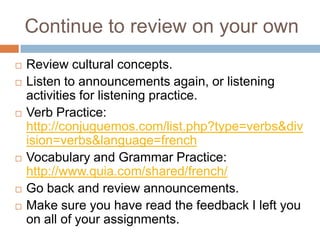
Continue to review on your own
   Review cultural concepts.
   Listen to announcements again, or listening
    activities for listening practice.
   Verb Practice:
    http://conjuguemos.com/list.php?type=verbs&div
    ision=verbs&language=french
   Vocabulary and Grammar Practice:
    http://www.quia.com/shared/french/
   Go back and review announcements.
   Make sure you have read the feedback I left you
    on all of your assignments.
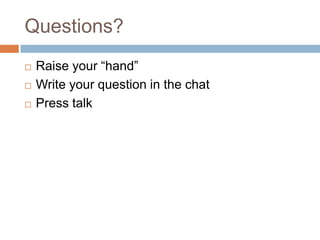
Questions?
   Raise your “hand”
   Write your question in the chat
   Press talk

Fr i final exam review

  • 1.
  • 2.
    Agenda  Ice Breaker  Quick review of important concepts Units 1-5  Review of vocabulary and grammar in Units 6- 10 and Practice in the Chat  Common Errors  Question & Answer Session
  • 3.
    Ice Breaker  If you were one of the following French foods, which one would you be and why?  Le pain (French Bread/baguette)  Le fromage (Cheese)  Un escargot (snail)  Une crêpe
  • 4.
    Unité 1-5  Subject pronouns:  Je=I  Tu=you  Il=He  Elle=She  Nous=We  Vous=Y‟all, You (formal)  Ils=They (masculine)  Elles=They (feminine)
  • 5.
    Unité 1-5  -ER verbs  1. Drop –ER  2. Add the endings  -e, -es, -e, -ons, ez, ent  JOUERJOU-  Je jouE  Tu jouES  Il/Elle jouE  Nous jouONS  Vous jouEZ  Ils/Elles jouENT  Practice the endings by writing them in the chat
  • 6.
    Unité 1-5  -IR verbs  Take off the –IR  Add the endings: -is, -is, -it, -issons, -issez, - issent  Je finis  Tu finis  Il/Elle finit  Nous finissons  Vous finissez  Ils/Elles finissent  Practice writing the endings in the chat
  • 7.
    Unité 1-5  -RE verbs  Take off the –RE  Add the endings: -s, -s, -, -ons, -ez, -ent  Je vends  Tu vends  Il/Elle vend  Nous vendons  Vous vendez  Ils/Elles vendent  Practice writing the endings in the chat
  • 8.
    Unité 1-5  ETRE=TO BE  Je suis, tu es, il/elle est, nous sommes, vous êtes, ils/elles sont  AVOIR=TO HAVE  J‟ai, tu as, il/elle a, nous avons, vous avez, ils/elles ont
  • 9.
    Unité 1-5  Question words:  Qui=who  Que=what  Où=where  Pourquoi=why  Quand=when  Comment=how  A quelle heure=at what time  Combien=how much
  • 10.
    Unité 1-5  Adjective placement:  Normally in French Adjectives go After the noun (not like in English). Ex. Une personne intelligente. (A person smart)  BAGS adjectives go BEFORE the noun. (like in English)  What does BAGS stand for?  Ex. Une jeune femme (a young woman)
  • 11.
    Unité 1-5  Definite articles  Le, la, l‟, les=the  Indefinite articles  Un, une, des=a, an, some
  • 12.
    Unité 6-Les Endroits  In Les Endroits you learned to:  talk about your city or town  talk about additional stores or places in your town  describe where things are in relation to other things in your town  talk about things you do, like to do, need to do, want to do or have to do  talk more about cognates  research and gather information about Québec  understand more about cities in French-speaking countries
  • 13.
    Unité 6-Les Endroits  Type a vocabulary word into the chat that you learned during Unit 6.  Write a vocabulary word related to cities, or places.  Try write a word that your classmates have not written yet.
  • 14.
    Unité 6-Les Endroits  De=_____, __________, ________  “DE” contractions  de + la = de la  de + l’ =de l'  de + le =du  de+les=des
  • 15.
    Unité 6-Les Endroits  Practice:  The café is close to the school=?  The movie theater is to the right of the mall=?  The park is far from the pool.=?
  • 16.
    Unité 6-Les Endroits J‟aime…= Jeveux…= Je peux…= Je dois…=
  • 17.
    Unité 6-Les Endroits  What is an infinitive?  What does it mean to conjugate a verb?  When you have two verbs in the present tense, you conjugate the first verb, and leave the second verb in the infinitive form.  Examples:  J‟aime danser.  Tu veux dormir.  Je peux chanter.  Tu dois étudier.  Write one thing that you like to do, can do, want to do, or should do in the chat.
  • 18.
    Unité 6-Les Endroits  Possession with “De”  NO „S in French.  Ex. The girl‟s bookThe book of the girl.  =Le livre de la fille.
  • 19.
    Unité 6-Les Endroits  “Qu‟est-ce que tu fais?”  “Je regard la télé”  If the verb “faire” is in your answer, it does not always have to be in your answer.  Faire=to do/to make  Fais, fais, fait, faisons, faites, font  ANSWER IN THE CHAT: Qu’est-ce que tu fais le weekend?
  • 20.
    Unité 6-Les Endroits  Venir=to come  Viens, viens, vient, venons, venez, viennent (boot verb)  Venir+de+infinitive=to have JUST done something  Ex. Je viens de manger.=I just ate.  Write what you “just” did before this review session in the chat.
  • 21.
    Unité 7-La Famille  In La Famille you will:  talk about your family members  talk about your family members' birthdays and ages  review dates and numbers  investigate cultural practices in French families  learn possessive adjectives  research holidays in the French-speaking world  learn additional cognates  learn additional verbs and how they work in French
  • 22.
    Unité 7-La Famille  Type a family vocabulary word or words that you remember into the chat to review.
  • 23.
    Unité 7-La Famille  Age  In French you “have” a certain number of “years”. Use the verb “avoir” (to have) in French, instead of the verb “to be”.  J’ai trente-et-un ans= I‟m 31 years old.  (NOT je suis 31 ans)  Quel âge as tu  Write your age in the chat in French.  Quel âge a ton père?  Write his age in the chat.
  • 24.
    Unité 7-La Famille The date: Le+ # + month Ex. Aujourd‟hui c‟est le 9 décembre. (The 9 December vs. December 9th) 9/12/12=12/9/12 (shortest to longest- day, month, year) Write your birthday in French in the chat.
  • 25.
    Unité 7-La Famille  My=mon/ma/mes  Your (familiar & singular)=ton/ta/tes  His/Her=son/sa/ses  Possessive adjectives agree with the noun, not the person who owns the item.  Ex. C‟est mon père. (“Mon” agrees with the masculine noun “père”, not with me, a female)  Write the translations in the chat:  1. My brother.  2. Your cousins.  3. Her dog.
  • 26.
    Unité 7-La Famille  Dire=_______, _________  Dis, dis, dit, disons, dites, disent  Lire=_________  Lis, lis, lit, lisons, lisez, lisent  Écrire=_______  écris, écris, écrit, écriVons, écriVez, écriVent
  • 27.
    Unité 7-La Famille Plural Possessive adjectives:  Our=notre/nos  Your (formal or plural)=votre/vos  Their=leur, leurs Write the translations in the chat: 1. Our house. 2. Your cousins. 3. Their cars.
  • 28.
    Unité 8-La Cuisine  In La Cuisine you will:  talk about foods  learn to order food and converse in a restaurant  learn the partitive article in French  learn additional factors in making a sentence negative in French  learn about dining habits in the French speaking world
  • 29.
    Unité 8-La Cuisine  Write a food, drink, or restaurant vocabulary word in French in the chat.
  • 30.
    Unité 8-La Cuisine  Prendre=______, _________, ________  Prends, prends, prend, prenons, prenez, prenn ent  What difference do you notice between the singular and plural forms of the verb?  Mettre=______, _________  Mets, mets, met, mettons, mettez, mettent  What difference do you notice between the singular and plural forms of the verb?
  • 31.
    Unité 8-La Cuisine  What is the partitive? When do you use it?  Du, de la, de l‟, des  In negative sentences changes to DE, or D‟  Je mange du poulet.  Je ne mange pas DE poulet.
  • 32.
    Unité 8-La Cuisine  Boire=________  Bois, bois, boit, buvons, buvez, boivent (boot verb)  What difference do you notice between the singular and plural forms of the verb?
  • 33.
    Unité 9-Les Passetemps  In Les Activités you will:  talk about sports and leisure time activities in the French-speaking world  learn how to talk about what you like to do  learn the verb "jouer"  learn what activities you might be able to do in the French-speaking world  learn to talk about what games you like to play  learn to talk about how frequently you do activities  learn the stress pronouns and additional prepositions to use them with  learn additional cognate patterns
  • 34.
    Unité 9-Les Passetemps  Write a vocabulary word related to free-time activities in the chat.
  • 35.
    Unité 9-Les Passetemps  Jouer+à + sport or game  À+le=au  À + les=aux  À la  À l‟  Jouer + de+ instrument  De+le=du  De+les=des  De la  De l‟  Write one sport, game, or instrument that you play into the chat.
  • 36.
    Unité 9-Les Passetemps  Stress pronouns  Me=moi  You=toi  Him=lui  Her=elle  Nous=us  Vous=you  Eux=them  Elle=them
  • 37.
    Unité 9-Les Passetemps  “avoir” expressions  Avoir chaud  Avoir froid  Avoir…ans  Avoir faim  Avoir soif  Avoir tort  Avoir raison  Avoir sommeil  Conjugate avoir to make it agree with the subject pronoun.  Avoir=to have  In English we use the verb “to be” with these expressions
  • 38.
    Unité 10-L‟école  In L'école et La routine you will:  talk about schools and school activities in the French speaking world  learn to talk about your school day in more detail  learn to talk about your house  learn to talk about chores and responsibilities you have at home  learn to talk about your plans  review verb structures we have had in this year of French  learn additional cognate patterns
  • 39.
    Unité 10-L‟école  Write school, house, or chore related vocabulary into the chat.
  • 40.
    Unité 10-L‟école  Savoir=  Sais, sais, sait, savons, savez, savent  Je sais parler français.=I know how to speak French.
  • 41.
    Common Errors  Accent Marks: très, mère, père, frère, à…  Conjugating verbs  Articles before nouns (le, la, les, l‟)  Adjective Agreement (-, -E, -S, -ES) Ex. unE joliE fillE  Writing the date=le + # + month  Using “avoir” for age, hot, cold, hungry, and thirsty  Both parts of the negative-ne….pas  Je---J‟ and nen‟ before a vowel sound
  • 42.
    NCVPS Policy  You may not use a translator on your final exam.  It is considered cheating and will result in a zero.  I have caught at least half the class trying to use a translator at some point during the semester.  You may not use your notes, or textbook.  You may not use Google.  The only item you may have open in
  • 43.
    Continue to reviewon your own  Review cultural concepts.  Listen to announcements again, or listening activities for listening practice.  Verb Practice: http://conjuguemos.com/list.php?type=verbs&div ision=verbs&language=french  Vocabulary and Grammar Practice: http://www.quia.com/shared/french/  Go back and review announcements.  Make sure you have read the feedback I left you on all of your assignments.
  • 44.
    Questions?  Raise your “hand”  Write your question in the chat  Press talk