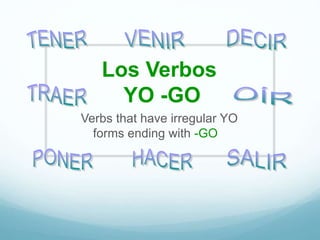
Los Verbos
YO -GO
Verbs that have irregular YO
forms ending with -GO
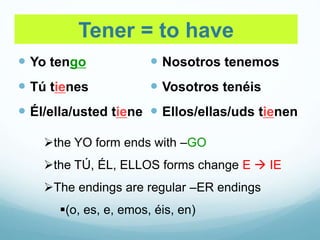
 Yo tengo
 Tú tienes
 Él/ella/usted tiene
 Nosotros tenemos
 Vosotros tenéis
 Ellos/ellas/uds tienen
Tener = to have
the YO form ends with –GO
the TÚ, ÉL, ELLOS forms change E  IE
The endings are regular –ER endings
(o, es, e, emos, éis, en)
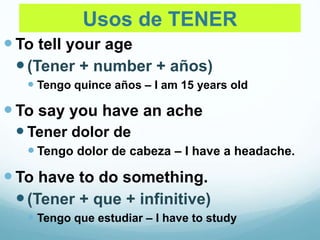
Usos de TENER
To tell your age
(Tener + number + años)
 Tengo quince años – I am 15 years old
To say you have an ache
 Tener dolor de
 Tengo dolor de cabeza – I have a headache.
To have to do something.
(Tener + que + infinitive)
 Tengo que estudiar – I have to study
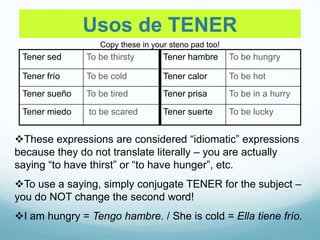
Usos de TENER
Tener sed To be thirsty Tener hambre To be hungry
Tener frío To be cold Tener calor To be hot
Tener sueño To be tired Tener prisa To be in a hurry
Tener miedo to be scared Tener suerte To be lucky
These expressions are considered “idiomatic” expressions
because they do not translate literally – you are actually
saying “to have thirst” or “to have hunger”, etc.
To use a saying, simply conjugate TENER for the subject –
you do NOT change the second word!
I am hungry = Tengo hambre. / She is cold = Ella tiene frío.
Copy these in your steno pad too!
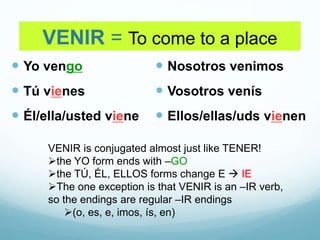
VENIR = To come to a place
 Yo vengo
 Tú vienes
 Él/ella/usted viene
 Nosotros venimos
 Vosotros venís
 Ellos/ellas/uds vienen
VENIR is conjugated almost just like TENER!
the YO form ends with –GO
the TÚ, ÉL, ELLOS forms change E  IE
The one exception is that VENIR is an –IR verb,
so the endings are regular –IR endings
(o, es, e, imos, ís, en)
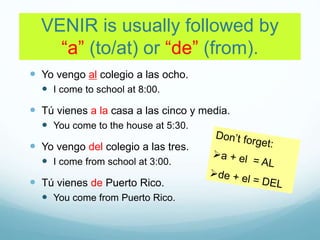
VENIR is usually followed by
“a” (to/at) or “de” (from).
 Yo vengo al colegio a las ocho.
 I come to school at 8:00.
 Tú vienes a la casa a las cinco y media.
 You come to the house at 5:30.
 Yo vengo del colegio a las tres.
 I come from school at 3:00.
 Tú vienes de Puerto Rico.
 You come from Puerto Rico.
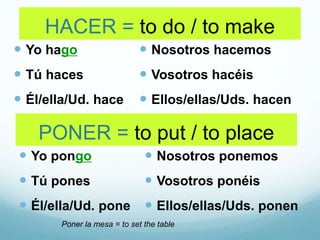
HACER = to do / to make
 Yo hago
 Tú haces
 Él/ella/Ud. hace
 Nosotros hacemos
 Vosotros hacéis
 Ellos/ellas/Uds. hacen
 Yo pongo
 Tú pones
 Él/ella/Ud. pone
 Nosotros ponemos
 Vosotros ponéis
 Ellos/ellas/Uds. ponen
PONER = to put / to place
Poner la mesa = to set the table
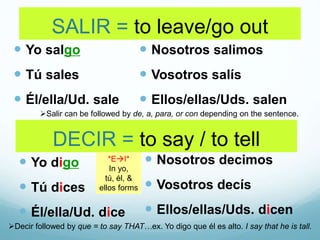
SALIR = to leave/go out
 Yo salgo
 Tú sales
 Él/ella/Ud. sale
 Nosotros salimos
 Vosotros salís
 Ellos/ellas/Uds. salen
 Yo digo
 Tú dices
 Él/ella/Ud. dice
 Nosotros decimos
 Vosotros decís
 Ellos/ellas/Uds. dicen
DECIR = to say / to tell
*EI*
In yo,
tú, él, &
ellos forms
Salir can be followed by de, a, para, or con depending on the sentence.
Decir followed by que = to say THAT…ex. Yo digo que él es alto. I say that he is tall.
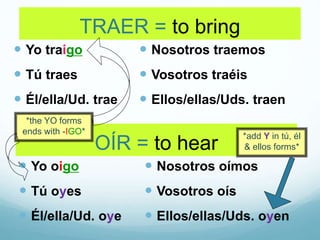
TRAER = to bring
 Yo traigo
 Tú traes
 Él/ella/Ud. trae
 Nosotros traemos
 Vosotros traéis
 Ellos/ellas/Uds. traen
 Yo oigo
 Tú oyes
 Él/ella/Ud. oye
 Nosotros oímos
 Vosotros oís
 Ellos/ellas/Uds. oyen
OÍR = to hear
*add Y in tú, él
& ellos forms*
*the YO forms
ends with -IGO*

Yo go verbs

  • 1.
    Los Verbos YO -GO Verbsthat have irregular YO forms ending with -GO
  • 2.
     Yo tengo Tú tienes  Él/ella/usted tiene  Nosotros tenemos  Vosotros tenéis  Ellos/ellas/uds tienen Tener = to have the YO form ends with –GO the TÚ, ÉL, ELLOS forms change E  IE The endings are regular –ER endings (o, es, e, emos, éis, en)
  • 3.
    Usos de TENER Totell your age (Tener + number + años)  Tengo quince años – I am 15 years old To say you have an ache  Tener dolor de  Tengo dolor de cabeza – I have a headache. To have to do something. (Tener + que + infinitive)  Tengo que estudiar – I have to study
  • 4.
    Usos de TENER Tenersed To be thirsty Tener hambre To be hungry Tener frío To be cold Tener calor To be hot Tener sueño To be tired Tener prisa To be in a hurry Tener miedo to be scared Tener suerte To be lucky These expressions are considered “idiomatic” expressions because they do not translate literally – you are actually saying “to have thirst” or “to have hunger”, etc. To use a saying, simply conjugate TENER for the subject – you do NOT change the second word! I am hungry = Tengo hambre. / She is cold = Ella tiene frío. Copy these in your steno pad too!
  • 5.
    VENIR = Tocome to a place  Yo vengo  Tú vienes  Él/ella/usted viene  Nosotros venimos  Vosotros venís  Ellos/ellas/uds vienen VENIR is conjugated almost just like TENER! the YO form ends with –GO the TÚ, ÉL, ELLOS forms change E  IE The one exception is that VENIR is an –IR verb, so the endings are regular –IR endings (o, es, e, imos, ís, en)
  • 6.
    VENIR is usuallyfollowed by “a” (to/at) or “de” (from).  Yo vengo al colegio a las ocho.  I come to school at 8:00.  Tú vienes a la casa a las cinco y media.  You come to the house at 5:30.  Yo vengo del colegio a las tres.  I come from school at 3:00.  Tú vienes de Puerto Rico.  You come from Puerto Rico.
  • 7.
    HACER = todo / to make  Yo hago  Tú haces  Él/ella/Ud. hace  Nosotros hacemos  Vosotros hacéis  Ellos/ellas/Uds. hacen  Yo pongo  Tú pones  Él/ella/Ud. pone  Nosotros ponemos  Vosotros ponéis  Ellos/ellas/Uds. ponen PONER = to put / to place Poner la mesa = to set the table
  • 8.
    SALIR = toleave/go out  Yo salgo  Tú sales  Él/ella/Ud. sale  Nosotros salimos  Vosotros salís  Ellos/ellas/Uds. salen  Yo digo  Tú dices  Él/ella/Ud. dice  Nosotros decimos  Vosotros decís  Ellos/ellas/Uds. dicen DECIR = to say / to tell *EI* In yo, tú, él, & ellos forms Salir can be followed by de, a, para, or con depending on the sentence. Decir followed by que = to say THAT…ex. Yo digo que él es alto. I say that he is tall.
  • 9.
    TRAER = tobring  Yo traigo  Tú traes  Él/ella/Ud. trae  Nosotros traemos  Vosotros traéis  Ellos/ellas/Uds. traen  Yo oigo  Tú oyes  Él/ella/Ud. oye  Nosotros oímos  Vosotros oís  Ellos/ellas/Uds. oyen OÍR = to hear *add Y in tú, él & ellos forms* *the YO forms ends with -IGO*