

Bienvenidos!
Live Class- Semana 25
El Plan- Español I:
1. Preguntas de semana 24 (gramática/vocabulario)
2. Las Fallas (sharing sentences/response)
3. Direct and Indirect Object Pronouns (repaso y practica)
4. Moodle- PS days 151-155
5. Language Learning with Netflix
6. Preguntas
Contact: njwiemann@gmail.com
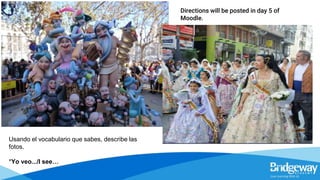
Usando el vocabulario que sabes, describe las
fotos.
*Yo veo.../I see…
Directions will be posted in day 5 of
Moodle.
Direct and Indirect
object pronouns
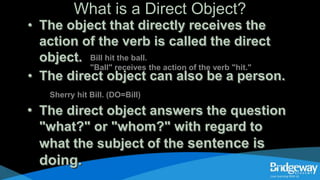
What is a Direct Object?
• The object that directly receives the
action of the verb is called the direct
object.
• The direct object can also be a person.
• The direct object answers the question
"what?" or "whom?" with regard to
what the subject of the sentence is
doing.
Bill hit the ball.
"Ball" receives the action of the verb "hit."
Sherry hit Bill. (DO=Bill)
DOPNs
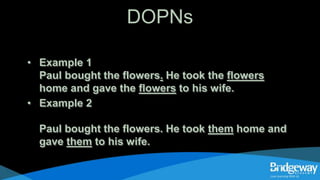
• Example 1
Paul bought the flowers. He took the flowers
home and gave the flowers to his wife.
• Example 2
Paul bought the flowers. He took them home and
gave them to his wife.
DOPNS
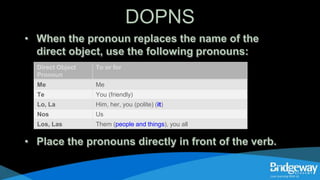
• When the pronoun replaces the name of the
direct object, use the following pronouns:
• Place the pronouns directly in front of the verb.
Direct Object
Pronoun
To or for
Me Me
Te You (friendly)
Lo, La Him, her, you (polite) (it)
Nos Us
Los, Las Them (people and things), you all
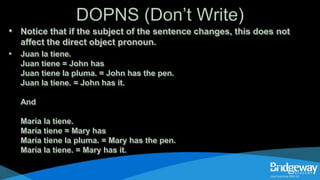
DOPNS (Don’t Write)
• Notice that if the subject of the sentence changes, this does not
affect the direct object pronoun.
• Juan la tiene.
Juan tiene = John has
Juan tiene la pluma. = John has the pen.
Juan la tiene. = John has it.
And
María la tiene.
María tiene = Mary has
María tiene la pluma. = Mary has the pen.
María la tiene. = Mary has it.
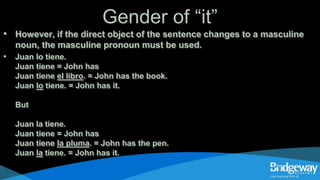
Gender of “it”
• However, if the direct object of the sentence changes to a masculine
noun, the masculine pronoun must be used.
• Juan lo tiene.
Juan tiene = John has
Juan tiene el libro. = John has the book.
Juan lo tiene. = John has it.
But
Juan la tiene.
Juan tiene = John has
Juan tiene la pluma. = John has the pen.
Juan la tiene. = John has it.
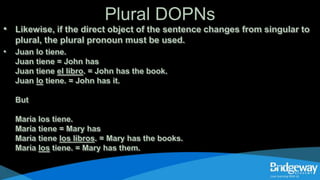
Plural DOPNs
• Likewise, if the direct object of the sentence changes from singular to
plural, the plural pronoun must be used.
• Juan lo tiene.
Juan tiene = John has
Juan tiene el libro. = John has the book.
Juan lo tiene. = John has it.
But
María los tiene.
María tiene = Mary has
María tiene los libros. = Mary has the books.
María los tiene. = Mary has them.
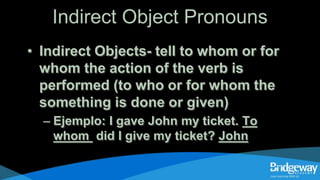
Indirect Object Pronouns
• Indirect Objects- tell to whom or for
whom the action of the verb is
performed (to who or for whom the
something is done or given)
– Ejemplo: I gave John my ticket. To
whom did I give my ticket? John
Indirect Object Pronouns
• In English, nouns are replaced by
pronouns. If we didn’t have
pronouns, we would have to keep
repeating the noun.
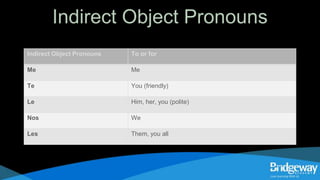
Indirect Object Pronouns
Indirect Object Pronouns To or for
Me Me
Te You (friendly)
Le Him, her, you (polite)
Nos We
Les Them, you all
Indirect Object Pronouns
• Sometimes Spanish uses an indirect
object pronoun when English would
have used a preposition
– Ejemplo: I write him a letter. Le escribo
una carta. I write a letter to him. Le
escribo una carta.
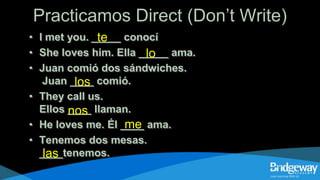
Practicamos Direct (Don’t Write)
• I met you. _____ conocí
• She loves him. Ella _____ ama.
• Juan comió dos sándwiches.
Juan ____ comió.
• They call us.
Ellos ____ llaman.
• He loves me. Él ____ ama.
• Tenemos dos mesas.
____tenemos.
te
lo
los
nos
me
las
El Plan- Español II
1. Preguntas de semana 24 (gramática/vocabulario)
2. Las Fallas (compartimos)
3. Mandatos (formal e informal)- practica
4. Language Learning with Netflix
5. Preguntas
Contact: njwiemann@gmail.com
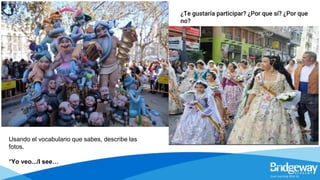
Usando el vocabulario que sabes, describe las
fotos.
*Yo veo.../I see…
¿Te gustaría participar? ¿Por que sí? ¿Por que
no?
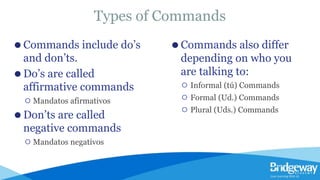
Types of Commands
⚫ Commands include do’s
and don’ts.
⚫ Do’s are called
affirmative commands
⚪ Mandatos afirmativos
⚫ Don’ts are called
negative commands
⚪ Mandatos negativos
⚫ Commands also differ
depending on who you
are talking to:
⚪ Informal (tú) Commands
⚪ Formal (Ud.) Commands
⚪ Plural (Uds.) Commands
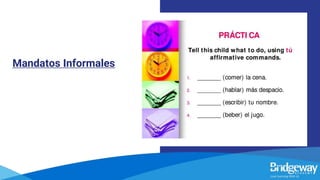
Mandatos Informales
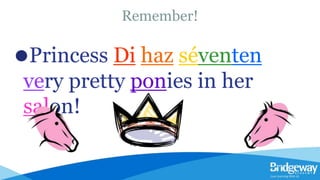
Remember!
⚫Princess Di haz séventen
very pretty ponies in her
salon!
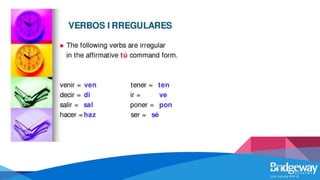
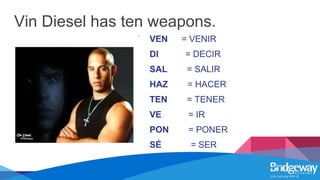
Vin Diesel has ten weapons.
VEN = VENIR
DI = DECIR
SAL = SALIR
HAZ = HACER
TEN = TENER
VE = IR
PON = PONER
SÉ = SER
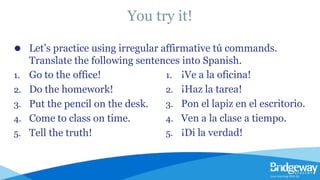
You try it!
⚫ Let’s practice using irregular affirmative tú commands.
Translate the following sentences into Spanish.
1. Go to the office!
2. Do the homework!
3. Put the pencil on the desk.
4. Come to class on time.
5. Tell the truth!
1. ¡Ve a la oficina!
2. ¡Haz la tarea!
3. Pon el lapiz en el escritorio.
4. Ven a la clase a tiempo.
5. ¡Di la verdad!
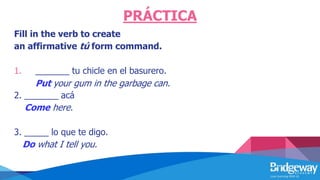
PRÁCTICA
Fill in the verb to create
an affirmative tú form command.
1. _______ tu chicle en el basurero.
Put your gum in the garbage can.
2. _______ acá
Come here.
3. _____ lo que te digo.
Do what I tell you.
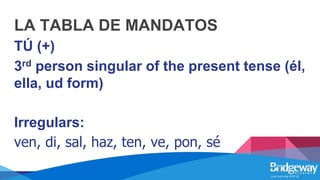
LA TABLA DE MANDATOS
TÚ (+)
3rd person singular of the present tense (él,
ella, ud form)
Irregulars:
ven, di, sal, haz, ten, ve, pon, sé
MANDATOS AFIRMATIVOS
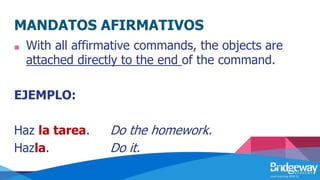
■ With all affirmative commands, the objects are
attached directly to the end of the command.
EJEMPLO:
Haz la tarea. Do the homework.
Hazla. Do it.
MANDATOS AFIRMATIVOS
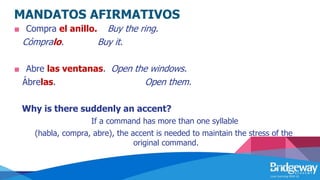
■ Compra el anillo. Buy the ring.
Cómpralo. Buy it.
■ Abre las ventanas. Open the windows.
Ábrelas. Open them.
Why is there suddenly an accent?
If a command has more than one syllable
(habla, compra, abre), the accent is needed to maintain the stress of the
original command.
PRÁCTICA
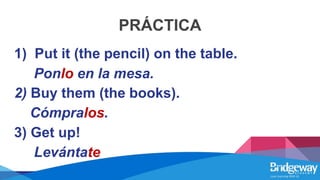
1) Put it (the pencil) on the table.
Ponlo en la mesa.
2) Buy them (the books).
Cómpralos.
3) Get up!
Levántate
¿CÓMO FORMAMOS LOS MANDATOS
NEGATIVOS (TÚ)
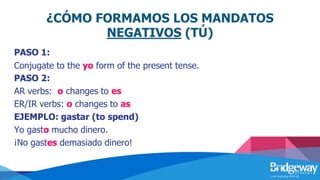
PASO 1:
Conjugate to the yo form of the present tense.
PASO 2:
AR verbs: o changes to es
ER/IR verbs: o changes to as
EJEMPLO: gastar (to spend)
Yo gasto mucho dinero.
¡No gastes demasiado dinero!
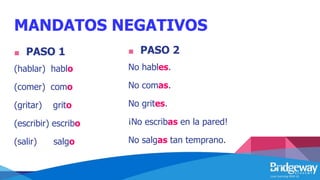
MANDATOS NEGATIVOS
■ PASO 1
(hablar) hablo
(comer) como
(gritar) grito
(escribir) escribo
(salir) salgo
■ PASO 2
No hables.
No comas.
No grites.
¡No escribas en la pared!
No salgas tan temprano.
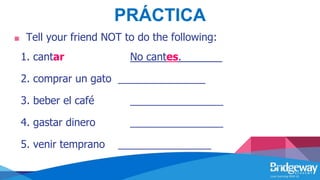
PRÁCTICA
■ Tell your friend NOT to do the following:
1. cantar No cantes._______
2. comprar un gato _______________
3. beber el café ________________
4. gastar dinero ________________
5. venir temprano ________________
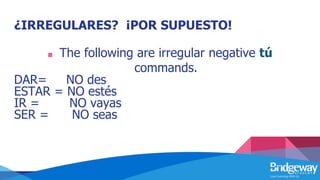
¿IRREGULARES? ¡POR SUPUESTO!
■ The following are irregular negative tú
commands.
DAR= NO des
ESTAR = NO estés
IR = NO vayas
SER = NO seas
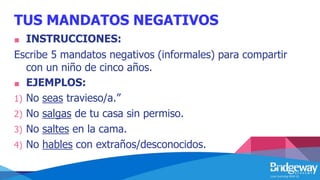
TUS MANDATOS NEGATIVOS
■ INSTRUCCIONES:
Escribe 5 mandatos negativos (informales) para compartir
con un niño de cinco años.
■ EJEMPLOS:
1) No seas travieso/a.”
2) No salgas de tu casa sin permiso.
3) No saltes en la cama.
4) No hables con extraños/desconocidos.
MANDATOS NEGATIVOS
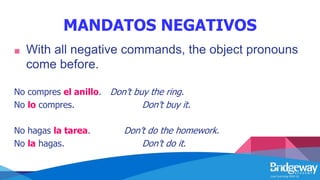
■ With all negative commands, the object pronouns
come before.
No compres el anillo. Don’t buy the ring.
No lo compres. Don’t buy it.
No hagas la tarea. Don’t do the homework.
No la hagas. Don’t do it.
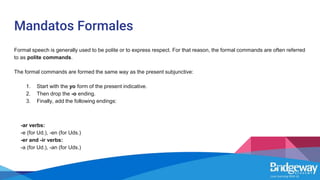
Mandatos Formales
Formal speech is generally used to be polite or to express respect. For that reason, the formal commands are often referred
to as polite commands.
The formal commands are formed the same way as the present subjunctive:
1. Start with the yo form of the present indicative.
2. Then drop the -o ending.
3. Finally, add the following endings:
-ar verbs:
-e (for Ud.), -en (for Uds.)
-er and -ir verbs:
-a (for Ud.), -an (for Uds.)
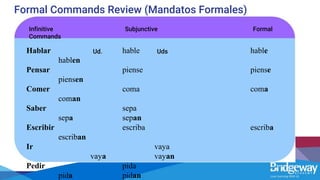
Formal Commands Review (Mandatos Formales)
Hablar hable hable
hablen
Pensar piense piense
piensen
Comer coma coma
coman
Saber sepa
sepa sepan
Escribir escriba escriba
escriban
Ir vaya
vaya vayan
Pedir pida
pida pidan
Infinitive Subjunctive Formal
Commands
Ud. Uds
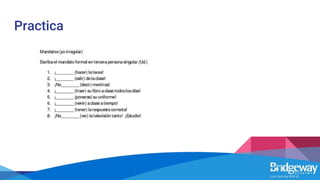
Practica
Spanish 1 Class 25

Spanish 1 Class 25

  • 1.
  • 2.
    El Plan- EspañolI: 1. Preguntas de semana 24 (gramática/vocabulario) 2. Las Fallas (sharing sentences/response) 3. Direct and Indirect Object Pronouns (repaso y practica) 4. Moodle- PS days 151-155 5. Language Learning with Netflix 6. Preguntas Contact: njwiemann@gmail.com
  • 3.
    Usando el vocabularioque sabes, describe las fotos. *Yo veo.../I see… Directions will be posted in day 5 of Moodle.
  • 4.
  • 5.
    What is aDirect Object? • The object that directly receives the action of the verb is called the direct object. • The direct object can also be a person. • The direct object answers the question "what?" or "whom?" with regard to what the subject of the sentence is doing. Bill hit the ball. "Ball" receives the action of the verb "hit." Sherry hit Bill. (DO=Bill)
  • 6.
    DOPNs • Example 1 Paulbought the flowers. He took the flowers home and gave the flowers to his wife. • Example 2 Paul bought the flowers. He took them home and gave them to his wife.
  • 7.
    DOPNS • When thepronoun replaces the name of the direct object, use the following pronouns: • Place the pronouns directly in front of the verb. Direct Object Pronoun To or for Me Me Te You (friendly) Lo, La Him, her, you (polite) (it) Nos Us Los, Las Them (people and things), you all
  • 8.
    DOPNS (Don’t Write) •Notice that if the subject of the sentence changes, this does not affect the direct object pronoun. • Juan la tiene. Juan tiene = John has Juan tiene la pluma. = John has the pen. Juan la tiene. = John has it. And María la tiene. María tiene = Mary has María tiene la pluma. = Mary has the pen. María la tiene. = Mary has it.
  • 9.
    Gender of “it” •However, if the direct object of the sentence changes to a masculine noun, the masculine pronoun must be used. • Juan lo tiene. Juan tiene = John has Juan tiene el libro. = John has the book. Juan lo tiene. = John has it. But Juan la tiene. Juan tiene = John has Juan tiene la pluma. = John has the pen. Juan la tiene. = John has it.
  • 10.
    Plural DOPNs • Likewise,if the direct object of the sentence changes from singular to plural, the plural pronoun must be used. • Juan lo tiene. Juan tiene = John has Juan tiene el libro. = John has the book. Juan lo tiene. = John has it. But María los tiene. María tiene = Mary has María tiene los libros. = Mary has the books. María los tiene. = Mary has them.
  • 11.
    Indirect Object Pronouns •Indirect Objects- tell to whom or for whom the action of the verb is performed (to who or for whom the something is done or given) – Ejemplo: I gave John my ticket. To whom did I give my ticket? John
  • 12.
    Indirect Object Pronouns •In English, nouns are replaced by pronouns. If we didn’t have pronouns, we would have to keep repeating the noun.
  • 13.
    Indirect Object Pronouns IndirectObject Pronouns To or for Me Me Te You (friendly) Le Him, her, you (polite) Nos We Les Them, you all
  • 14.
    Indirect Object Pronouns •Sometimes Spanish uses an indirect object pronoun when English would have used a preposition – Ejemplo: I write him a letter. Le escribo una carta. I write a letter to him. Le escribo una carta.
  • 15.
    Practicamos Direct (Don’tWrite) • I met you. _____ conocí • She loves him. Ella _____ ama. • Juan comió dos sándwiches. Juan ____ comió. • They call us. Ellos ____ llaman. • He loves me. Él ____ ama. • Tenemos dos mesas. ____tenemos. te lo los nos me las
  • 16.
    El Plan- EspañolII 1. Preguntas de semana 24 (gramática/vocabulario) 2. Las Fallas (compartimos) 3. Mandatos (formal e informal)- practica 4. Language Learning with Netflix 5. Preguntas Contact: njwiemann@gmail.com
  • 17.
    Usando el vocabularioque sabes, describe las fotos. *Yo veo.../I see… ¿Te gustaría participar? ¿Por que sí? ¿Por que no?
  • 18.
    Types of Commands ⚫Commands include do’s and don’ts. ⚫ Do’s are called affirmative commands ⚪ Mandatos afirmativos ⚫ Don’ts are called negative commands ⚪ Mandatos negativos ⚫ Commands also differ depending on who you are talking to: ⚪ Informal (tú) Commands ⚪ Formal (Ud.) Commands ⚪ Plural (Uds.) Commands
  • 19.
  • 21.
    Remember! ⚫Princess Di hazséventen very pretty ponies in her salon!
  • 22.
    Vin Diesel hasten weapons. VEN = VENIR DI = DECIR SAL = SALIR HAZ = HACER TEN = TENER VE = IR PON = PONER SÉ = SER
  • 23.
    You try it! ⚫Let’s practice using irregular affirmative tú commands. Translate the following sentences into Spanish. 1. Go to the office! 2. Do the homework! 3. Put the pencil on the desk. 4. Come to class on time. 5. Tell the truth! 1. ¡Ve a la oficina! 2. ¡Haz la tarea! 3. Pon el lapiz en el escritorio. 4. Ven a la clase a tiempo. 5. ¡Di la verdad!
  • 24.
    PRÁCTICA Fill in theverb to create an affirmative tú form command. 1. _______ tu chicle en el basurero. Put your gum in the garbage can. 2. _______ acá Come here. 3. _____ lo que te digo. Do what I tell you.
  • 25.
    LA TABLA DEMANDATOS TÚ (+) 3rd person singular of the present tense (él, ella, ud form) Irregulars: ven, di, sal, haz, ten, ve, pon, sé
  • 26.
    MANDATOS AFIRMATIVOS ■ Withall affirmative commands, the objects are attached directly to the end of the command. EJEMPLO: Haz la tarea. Do the homework. Hazla. Do it.
  • 27.
    MANDATOS AFIRMATIVOS ■ Comprael anillo. Buy the ring. Cómpralo. Buy it. ■ Abre las ventanas. Open the windows. Ábrelas. Open them. Why is there suddenly an accent? If a command has more than one syllable (habla, compra, abre), the accent is needed to maintain the stress of the original command.
  • 28.
    PRÁCTICA 1) Put it(the pencil) on the table. Ponlo en la mesa. 2) Buy them (the books). Cómpralos. 3) Get up! Levántate
  • 29.
    ¿CÓMO FORMAMOS LOSMANDATOS NEGATIVOS (TÚ) PASO 1: Conjugate to the yo form of the present tense. PASO 2: AR verbs: o changes to es ER/IR verbs: o changes to as EJEMPLO: gastar (to spend) Yo gasto mucho dinero. ¡No gastes demasiado dinero!
  • 30.
    MANDATOS NEGATIVOS ■ PASO1 (hablar) hablo (comer) como (gritar) grito (escribir) escribo (salir) salgo ■ PASO 2 No hables. No comas. No grites. ¡No escribas en la pared! No salgas tan temprano.
  • 31.
    PRÁCTICA ■ Tell yourfriend NOT to do the following: 1. cantar No cantes._______ 2. comprar un gato _______________ 3. beber el café ________________ 4. gastar dinero ________________ 5. venir temprano ________________
  • 32.
    ¿IRREGULARES? ¡POR SUPUESTO! ■The following are irregular negative tú commands. DAR= NO des ESTAR = NO estés IR = NO vayas SER = NO seas
  • 33.
    TUS MANDATOS NEGATIVOS ■INSTRUCCIONES: Escribe 5 mandatos negativos (informales) para compartir con un niño de cinco años. ■ EJEMPLOS: 1) No seas travieso/a.” 2) No salgas de tu casa sin permiso. 3) No saltes en la cama. 4) No hables con extraños/desconocidos.
  • 34.
    MANDATOS NEGATIVOS ■ Withall negative commands, the object pronouns come before. No compres el anillo. Don’t buy the ring. No lo compres. Don’t buy it. No hagas la tarea. Don’t do the homework. No la hagas. Don’t do it.
  • 35.
    Mandatos Formales Formal speechis generally used to be polite or to express respect. For that reason, the formal commands are often referred to as polite commands. The formal commands are formed the same way as the present subjunctive: 1. Start with the yo form of the present indicative. 2. Then drop the -o ending. 3. Finally, add the following endings: -ar verbs: -e (for Ud.), -en (for Uds.) -er and -ir verbs: -a (for Ud.), -an (for Uds.)
  • 36.
    Formal Commands Review(Mandatos Formales) Hablar hable hable hablen Pensar piense piense piensen Comer coma coma coman Saber sepa sepa sepan Escribir escriba escriba escriban Ir vaya vaya vayan Pedir pida pida pidan Infinitive Subjunctive Formal Commands Ud. Uds
  • 37.