1
Tenses
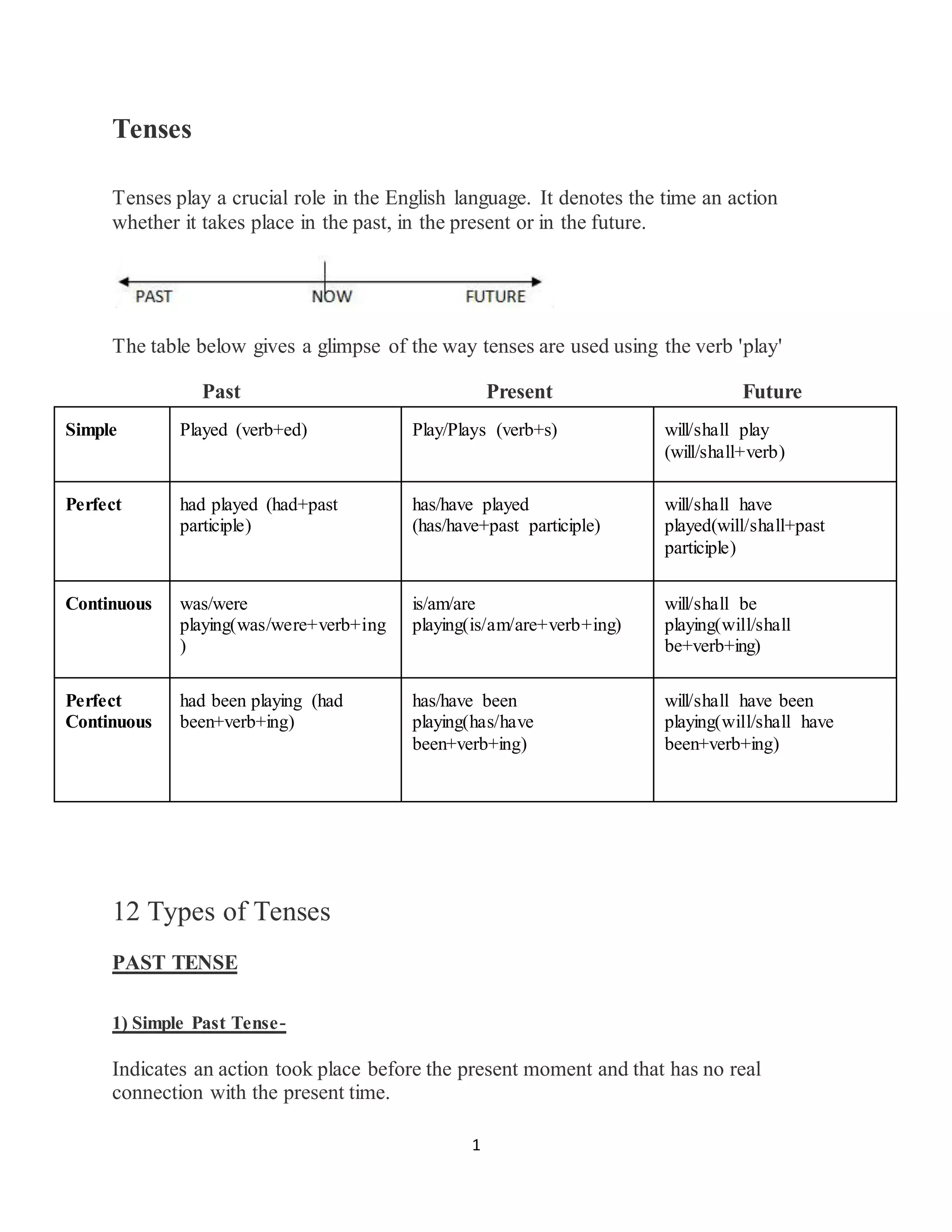
Tenses play a crucial role in the English language. It denotes the time an action
whether it takes place in the past, in the present or in the future.
The table below gives a glimpse of the way tenses are used using the verb 'play'
Past Present Future
12 Types of Tenses
PAST TENSE
1) Simple Past Tense-
Indicates an action took place before the present moment and that has no real
connection with the present time.
Simple Played (verb+ed) Play/Plays (verb+s) will/shall play
(will/shall+verb)
Perfect had played (had+past
participle)
has/have played
(has/have+past participle)
will/shall have
played(will/shall+past
participle)
Continuous was/were
playing(was/were+verb+ing
)
is/am/are
playing(is/am/are+verb+ing)
will/shall be
playing(will/shall
be+verb+ing)
Perfect
Continuous
had been playing (had
been+verb+ing)
has/have been
playing(has/have
been+verb+ing)
will/shall have been
playing(will/shall have
been+verb+ing)
2
For example, "He danced in the function." (The action took place in the past, is
finished and is completely unrelated to the present)
"He flew to London yesterday."
Note
a. The verb 'flew' is an irregular verb which does not take 'ed' in the past tense like
regular verbs.
b. The form of Simple Past Tense is - verb + ed
2) Past Perfect Tense-
Indicates an action in the past that had been completed before another time or event in
the past.
For example, "He had exercised before it started to rain."
"He had slept before I came back from the market."
Note
a. The form of Past Perfect Tense is- had + verb (past participle form or the 3rd form
of the verb)
3) Past Continuous Tense-
Indicates an action going on at some time in the past or an action in the past that is
longer in duration than another action in the past.
For example, "It was getting darker."
"The light went out while they were reading."
Note
a. The form of Past Continuous Tense is- was/were + verb + ing
4) Past Perfect Continuous Tense-
Indicates an action in the past that took place before another time or event in the past
and continued during the second event/time point in the past.
For example, "At that time, he had been writing a novel for two months."
"He had been exercising when I called."
Note
a. The form of Past Perfect Continuous Tense is- had + been + verb + ing
3
PRESENT TENSE
1) Simple Present Tense-
Indicates an action that is generally true or habitual. That is, it takes/continues to take
place in the present or will take place in the future. This tense is used to denote
-a habitual action- for instance, "He walks to school."
-general truths- for instance, "The sun rises in the east", "Honesty is the best policy."
-a future event that is part of a fixed timetable- for instance, "The match starts at 9 o'
clock."
Note
a. The form of Simple Present Tense is- verb (infinitive without 'to' and agreeable with
the subject)
2) Present Perfect Tense-
Indicates an action that has been completed sometime before the present moment,
with a result that affects the present situation.
For example, "He has finished the work."
"He has slept."
Note
a. The form of Present Perfect Tense is- has/have + verb (past participle form or 3rd
form of the verb)
3) Present Continuous Tense-
Indicates an action that is taking place at the moment of speaking.
For example, "She is walking."
"I am studying."
Note
a. the form of Present Continuous Tense is- is/am/are + verb + ing
4) Present Perfect Continuous Tense-
Indicates an action that started in the past and is continuing at the present time.
For example, "He has been sleeping for an hour."
Note
a. The form of Present Perfect Continuous Tense is- has/have + been + verb + ing
FUTURE TENSE
1) Simple Future Tense-
4
Indicates an action that will take place after the present time and that has no real
connection with the present time.
For example, "She will visit her ailing grandmother soon."
"He will walk home."
Note
a. the form of Simple Future Tense is- will/shall + verb
2) Future Perfect Tense-
Indicates an action in the future that will have been completed before another time or
event in the future.
For example, "By the time we arrive, he will have studied."
Note
a. The form of Future Perfect Tense is- will/shall have + verb(past participle form or
3rd form of the verb)
3) Future Continuous Tense-
Indicates an action in the future that is longer in duration than another action in the
future.
For example, "He will be walking when it starts to rain."
Note
a. The form of Future Continuous Tense is-will/shall be + verb + ing
4) Future Perfect Continuous Tense-
Indicates an action in the future that will have been continuing until another time or
event in the future.
For example, "He will have been exercising for one hour."
Note
a. The form of Future Perfect Continuous Tense is- will/shall have been + verb + ing
Exercise on tenses
Q1. Choose the correct verb from those in brackets:
a. The earth _____ round the sun. (move, moves, moved)
b. My friends _____ the film yesterday. (see, saw, have seen)
5
c. It started to rain while we _____ tennis. (are playing, had played, were playing)
d. I _____ English for five years. (have been studying, study, am studying)
e. The train _____ before we reach the station. (arrives, will have arrived, had
arrived)
f. Don't disturb me. I _____ my work. (do, did, am doing)
g. Fortune _____ the brave. (isfavouring, will favour, favours)
h. I _____ the letter before you arrived. (had written, wrote, will write)
i. He _____ us next week. (will have met, will have been meeting, will be meeting)
j. Perhaps we _____ Delhi next month. (visit, will visit, visited)
Q2. Correct the following sentences:
i. I lived in Calcutta since 1930.
ii. She died before her husband came.
iii. I have written a letter to her last Monday.
iv. I am reading Kalidasa for the last six days.
v. The new hotel has been opened last Saturday.
vi. He had gone to Madras last week.
vii. The train leave the station before I reached there.
viii. I wish my men had been coming quickly and find us.
ix. At the moment the baby sleep in the cradle.
x. He goes out for ten minutes

Tenses rules and exercises

  • 1.
    1 Tenses Tenses play acrucial role in the English language. It denotes the time an action whether it takes place in the past, in the present or in the future. The table below gives a glimpse of the way tenses are used using the verb 'play' Past Present Future 12 Types of Tenses PAST TENSE 1) Simple Past Tense- Indicates an action took place before the present moment and that has no real connection with the present time. Simple Played (verb+ed) Play/Plays (verb+s) will/shall play (will/shall+verb) Perfect had played (had+past participle) has/have played (has/have+past participle) will/shall have played(will/shall+past participle) Continuous was/were playing(was/were+verb+ing ) is/am/are playing(is/am/are+verb+ing) will/shall be playing(will/shall be+verb+ing) Perfect Continuous had been playing (had been+verb+ing) has/have been playing(has/have been+verb+ing) will/shall have been playing(will/shall have been+verb+ing)
  • 2.
    2 For example, "Hedanced in the function." (The action took place in the past, is finished and is completely unrelated to the present) "He flew to London yesterday." Note a. The verb 'flew' is an irregular verb which does not take 'ed' in the past tense like regular verbs. b. The form of Simple Past Tense is - verb + ed 2) Past Perfect Tense- Indicates an action in the past that had been completed before another time or event in the past. For example, "He had exercised before it started to rain." "He had slept before I came back from the market." Note a. The form of Past Perfect Tense is- had + verb (past participle form or the 3rd form of the verb) 3) Past Continuous Tense- Indicates an action going on at some time in the past or an action in the past that is longer in duration than another action in the past. For example, "It was getting darker." "The light went out while they were reading." Note a. The form of Past Continuous Tense is- was/were + verb + ing 4) Past Perfect Continuous Tense- Indicates an action in the past that took place before another time or event in the past and continued during the second event/time point in the past. For example, "At that time, he had been writing a novel for two months." "He had been exercising when I called." Note a. The form of Past Perfect Continuous Tense is- had + been + verb + ing
  • 3.
    3 PRESENT TENSE 1) SimplePresent Tense- Indicates an action that is generally true or habitual. That is, it takes/continues to take place in the present or will take place in the future. This tense is used to denote -a habitual action- for instance, "He walks to school." -general truths- for instance, "The sun rises in the east", "Honesty is the best policy." -a future event that is part of a fixed timetable- for instance, "The match starts at 9 o' clock." Note a. The form of Simple Present Tense is- verb (infinitive without 'to' and agreeable with the subject) 2) Present Perfect Tense- Indicates an action that has been completed sometime before the present moment, with a result that affects the present situation. For example, "He has finished the work." "He has slept." Note a. The form of Present Perfect Tense is- has/have + verb (past participle form or 3rd form of the verb) 3) Present Continuous Tense- Indicates an action that is taking place at the moment of speaking. For example, "She is walking." "I am studying." Note a. the form of Present Continuous Tense is- is/am/are + verb + ing 4) Present Perfect Continuous Tense- Indicates an action that started in the past and is continuing at the present time. For example, "He has been sleeping for an hour." Note a. The form of Present Perfect Continuous Tense is- has/have + been + verb + ing FUTURE TENSE 1) Simple Future Tense-
  • 4.
    4 Indicates an actionthat will take place after the present time and that has no real connection with the present time. For example, "She will visit her ailing grandmother soon." "He will walk home." Note a. the form of Simple Future Tense is- will/shall + verb 2) Future Perfect Tense- Indicates an action in the future that will have been completed before another time or event in the future. For example, "By the time we arrive, he will have studied." Note a. The form of Future Perfect Tense is- will/shall have + verb(past participle form or 3rd form of the verb) 3) Future Continuous Tense- Indicates an action in the future that is longer in duration than another action in the future. For example, "He will be walking when it starts to rain." Note a. The form of Future Continuous Tense is-will/shall be + verb + ing 4) Future Perfect Continuous Tense- Indicates an action in the future that will have been continuing until another time or event in the future. For example, "He will have been exercising for one hour." Note a. The form of Future Perfect Continuous Tense is- will/shall have been + verb + ing Exercise on tenses Q1. Choose the correct verb from those in brackets: a. The earth _____ round the sun. (move, moves, moved) b. My friends _____ the film yesterday. (see, saw, have seen)
  • 5.
    5 c. It startedto rain while we _____ tennis. (are playing, had played, were playing) d. I _____ English for five years. (have been studying, study, am studying) e. The train _____ before we reach the station. (arrives, will have arrived, had arrived) f. Don't disturb me. I _____ my work. (do, did, am doing) g. Fortune _____ the brave. (isfavouring, will favour, favours) h. I _____ the letter before you arrived. (had written, wrote, will write) i. He _____ us next week. (will have met, will have been meeting, will be meeting) j. Perhaps we _____ Delhi next month. (visit, will visit, visited) Q2. Correct the following sentences: i. I lived in Calcutta since 1930. ii. She died before her husband came. iii. I have written a letter to her last Monday. iv. I am reading Kalidasa for the last six days. v. The new hotel has been opened last Saturday. vi. He had gone to Madras last week. vii. The train leave the station before I reached there. viii. I wish my men had been coming quickly and find us. ix. At the moment the baby sleep in the cradle. x. He goes out for ten minutes