Bienvenidos!
Live Class- Semana 20
El Plan- Español I:
1. Preguntas de semana 19 (gramática/vocabulario)
2. Missing work/activities in Powerspeak- final warning
3. Life Long Learner Plan (follow example)
4. Actividad- sharing answers
5. Proyecto - discussion (reminder due by 2/20- NO submissions will be
accepted after)
6. Practica- comparisons
Contact: njwiemann@gmail.com
Actividad
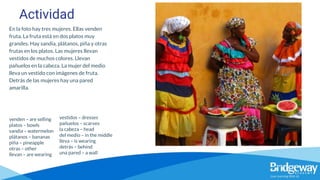
En la foto hay tres mujeres. Ellas venden
fruta. La fruta está en dos platos muy
grandes. Hay sandía, plátanos, piña y otras
frutas en los platos. Las mujeres llevan
vestidos de muchos colores. Llevan
pañuelos en la cabeza. La mujer del medio
lleva un vestido con imágenes de fruta.
Detrás de las mujeres hay una pared
amarilla.
venden – are selling
platos – bowls
sandía – watermelon
plátanos – bananas
piña – pineapple
otras – other
llevan – are wearing
vestidos – dresses
pañuelos – scarves
la cabeza – head
del medio – in the middle
lleva – is wearing
detrás – behind
una pared – a wall
Sharing Responses
Responde usando frases completas:
¿Cuántas mujeres hay en la foto?
¿Cuántos platos con fruta hay?
¿La sandía está en un plato grande?
¿Las mujeres llevan pañuelos en la cabeza?
¿Los platos son grandes o pequeños?
¿El vestido de la mujer del medio tiene imágenes de
fruta o imágenes de animales?
¿La pared es roja o amarilla?
Las mujeres tienen vestidos de muchos colores.
¿Cuál es tu color favorito?
¿Te gusta la sandía?
¿Te gustan los plátanos (bananas)?
¿Cuál es tu fruta favorita?
Tu casa
In Spanish, describe your house. What rooms are there? How many
bedrooms? How many bathrooms are there? In addition, make at least 2
comparisons (my room is bigger than the bathroom, etc)
Your response should be at least 5 complete sentences.
COMPARATIVES
Pattern: Comparatives are used to express inferiority, superiority, and equality. There are slightly different rules for comparing
different things.
Mi dormitorio es más/menos grande que mi baño
In Spanish, the following basic pattern is used to express inequality: yo tengo más/menos libros
que mi amiga
más/menos + adjective, adverb, noun + que = more/less _____ than yo soy más/menos simpática que mi
hermana
To express equality, use these basic patterns:
tan + adjective, adverb + como = as _____ as yo soy tan
simpática como mi hermana
Mi dormitorio es… tan grande como mi baño
(comparing quantity)tanto(-a, -os, -as) + noun(s) + como = as much/many _____ as yo tengo tantos libros como mi amiga
Equating actions
When comparing actions (verbs), the word order changes slightly to:
verb + más/menos + que = _____ more than Taylor canta más/menos que (tanto como) Iva
Me gusta
mirar la tele más/menos que (tanto como) escuchar la música
verb + tanto + como = _____ as much as
If the action (verb) comparison also involves a description (adverb), use this pattern:
verb + tan + adverb + como = _____ as _____ as
1. Bailar o estudiar
2. Pollo o pescado
3. Escuchar música o mirar la tele
4. Ropa deportiva (sport) o ropa
formal
5. El salón o la cocina
Comparatives Practice
Compare the things the below. Tell me what you like more, less, or the same as:
1. Bailar o estudiar
2. Pollo o pescado
3. Escuchar música o mirar la tele
4. Ropa deportiva (sport) o ropa formal
5. El salón o la cocina
Proyecto- to submit in Moodle
1. Go to the following website: https://www.thespanishexperiment.com/stories
2. Choose 1 of the following short stories:
a. Pollito Tito
b. El pájaro y la ballena
c. Los tres cerditos
d. Ricitos de Oro y los Tres Ositos
3. After choosing 1 of the stories, you will listen to the audio version as many
times as needed.
4. You will record yourself reading the story for 2 minutes (you can stop at 2
mins. or you can read the entire story.
5. 50 pts.- (25 pts.-at least 2 mins, 10 pts- fluency, 15 pts.- pronunciation)
Discussion- Proyecto Follow-up Questions
* What did you enjoy about this project?
* What was difficult about this project?
* What can you do to help improve your speaking skills?
* How does taking an online class help/not help speaking skills?
El Plan- Español II
1. Preguntas de semana 19 (gramática/vocabulario)
2. Powerspeak- missing assignments/work
3. Carmen Lomas Garza- discutimos
4. Proyecto- presentaciones
5. Actividad- practicando el condicional
6. Preguntas
Contact: njwiemann@gmail.com
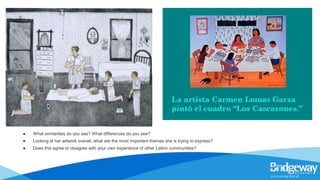
Carmen Lomas Garza
Today, you will be studying the work of Chicana artist
Carmen Lomas Garza, and discovering what her art can tell
us about Chicano culture and heritage.
Video
● What similarities do you see? What differences do you see?
● Looking at her artwork overall, what are the most important themes she is trying to express?
● Does this agree or disagree with your own experience of other Latino communities?
● What similarities do you see? What differences do you see?
● Looking at her artwork overall, what are the most important themes she is trying to express?
● Does this agree or disagree with your own experience of other Latino communities?
● Why do you think traditions and displays of heritage are important in so many cultures? What would happen if
people couldn’t display their heritage or practice their traditions?
● Why is art a good medium for communicating about culture and tradition?
● Can you relate to her artwork? Do you express your own culture heritage in another way?
● How do other communities in the US (or where you live) express (or repress) their cultural heritages?
Today, you have successfully interpreted works of art, compared various perspectives, made some important conclusions and
maybe even found connections to your own culture.
● What is one thing from this class they found interesting or would like to learn more about.
Discussion:
Presentación de proyectos
To share:
● how does your artwork express your cultural heritage,
and how is it the same or different from the art we saw in
this class.
Practica
En 6-8 oraciones, qué harías o qué verías si fueras a las
montañas? (usa el vocabulario de esta unidad)

Spanish 1 Class 20

  • 1.
  • 2.
    El Plan- EspañolI: 1. Preguntas de semana 19 (gramática/vocabulario) 2. Missing work/activities in Powerspeak- final warning 3. Life Long Learner Plan (follow example) 4. Actividad- sharing answers 5. Proyecto - discussion (reminder due by 2/20- NO submissions will be accepted after) 6. Practica- comparisons Contact: njwiemann@gmail.com
  • 3.
    Actividad En la fotohay tres mujeres. Ellas venden fruta. La fruta está en dos platos muy grandes. Hay sandía, plátanos, piña y otras frutas en los platos. Las mujeres llevan vestidos de muchos colores. Llevan pañuelos en la cabeza. La mujer del medio lleva un vestido con imágenes de fruta. Detrás de las mujeres hay una pared amarilla. venden – are selling platos – bowls sandía – watermelon plátanos – bananas piña – pineapple otras – other llevan – are wearing vestidos – dresses pañuelos – scarves la cabeza – head del medio – in the middle lleva – is wearing detrás – behind una pared – a wall
  • 4.
    Sharing Responses Responde usandofrases completas: ¿Cuántas mujeres hay en la foto? ¿Cuántos platos con fruta hay? ¿La sandía está en un plato grande? ¿Las mujeres llevan pañuelos en la cabeza? ¿Los platos son grandes o pequeños? ¿El vestido de la mujer del medio tiene imágenes de fruta o imágenes de animales? ¿La pared es roja o amarilla? Las mujeres tienen vestidos de muchos colores. ¿Cuál es tu color favorito? ¿Te gusta la sandía? ¿Te gustan los plátanos (bananas)? ¿Cuál es tu fruta favorita?
  • 5.
    Tu casa In Spanish,describe your house. What rooms are there? How many bedrooms? How many bathrooms are there? In addition, make at least 2 comparisons (my room is bigger than the bathroom, etc) Your response should be at least 5 complete sentences.
  • 6.
    COMPARATIVES Pattern: Comparatives areused to express inferiority, superiority, and equality. There are slightly different rules for comparing different things. Mi dormitorio es más/menos grande que mi baño In Spanish, the following basic pattern is used to express inequality: yo tengo más/menos libros que mi amiga más/menos + adjective, adverb, noun + que = more/less _____ than yo soy más/menos simpática que mi hermana To express equality, use these basic patterns: tan + adjective, adverb + como = as _____ as yo soy tan simpática como mi hermana Mi dormitorio es… tan grande como mi baño (comparing quantity)tanto(-a, -os, -as) + noun(s) + como = as much/many _____ as yo tengo tantos libros como mi amiga
  • 7.
    Equating actions When comparingactions (verbs), the word order changes slightly to: verb + más/menos + que = _____ more than Taylor canta más/menos que (tanto como) Iva Me gusta mirar la tele más/menos que (tanto como) escuchar la música verb + tanto + como = _____ as much as If the action (verb) comparison also involves a description (adverb), use this pattern: verb + tan + adverb + como = _____ as _____ as 1. Bailar o estudiar 2. Pollo o pescado 3. Escuchar música o mirar la tele 4. Ropa deportiva (sport) o ropa formal 5. El salón o la cocina
  • 8.
    Comparatives Practice Compare thethings the below. Tell me what you like more, less, or the same as: 1. Bailar o estudiar 2. Pollo o pescado 3. Escuchar música o mirar la tele 4. Ropa deportiva (sport) o ropa formal 5. El salón o la cocina
  • 9.
    Proyecto- to submitin Moodle 1. Go to the following website: https://www.thespanishexperiment.com/stories 2. Choose 1 of the following short stories: a. Pollito Tito b. El pájaro y la ballena c. Los tres cerditos d. Ricitos de Oro y los Tres Ositos 3. After choosing 1 of the stories, you will listen to the audio version as many times as needed. 4. You will record yourself reading the story for 2 minutes (you can stop at 2 mins. or you can read the entire story. 5. 50 pts.- (25 pts.-at least 2 mins, 10 pts- fluency, 15 pts.- pronunciation)
  • 10.
    Discussion- Proyecto Follow-upQuestions * What did you enjoy about this project? * What was difficult about this project? * What can you do to help improve your speaking skills? * How does taking an online class help/not help speaking skills?
  • 11.
    El Plan- EspañolII 1. Preguntas de semana 19 (gramática/vocabulario) 2. Powerspeak- missing assignments/work 3. Carmen Lomas Garza- discutimos 4. Proyecto- presentaciones 5. Actividad- practicando el condicional 6. Preguntas Contact: njwiemann@gmail.com
  • 12.
    Carmen Lomas Garza Today,you will be studying the work of Chicana artist Carmen Lomas Garza, and discovering what her art can tell us about Chicano culture and heritage. Video
  • 13.
    ● What similaritiesdo you see? What differences do you see? ● Looking at her artwork overall, what are the most important themes she is trying to express? ● Does this agree or disagree with your own experience of other Latino communities?
  • 14.
    ● What similaritiesdo you see? What differences do you see? ● Looking at her artwork overall, what are the most important themes she is trying to express? ● Does this agree or disagree with your own experience of other Latino communities?
  • 15.
    ● Why doyou think traditions and displays of heritage are important in so many cultures? What would happen if people couldn’t display their heritage or practice their traditions? ● Why is art a good medium for communicating about culture and tradition? ● Can you relate to her artwork? Do you express your own culture heritage in another way? ● How do other communities in the US (or where you live) express (or repress) their cultural heritages? Today, you have successfully interpreted works of art, compared various perspectives, made some important conclusions and maybe even found connections to your own culture. ● What is one thing from this class they found interesting or would like to learn more about. Discussion:
  • 16.
    Presentación de proyectos Toshare: ● how does your artwork express your cultural heritage, and how is it the same or different from the art we saw in this class.
  • 17.
    Practica En 6-8 oraciones,qué harías o qué verías si fueras a las montañas? (usa el vocabulario de esta unidad)

Editor's Notes