THE PRESENT SIMPLE TENSE
(Affirmative)
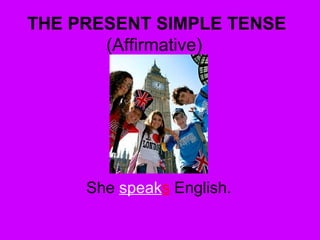
She speaks English.
THE PRESENT SIMPLE TENSE
AFFIRMATIVE: WORK
I
YOU
SPEAK
SHE
HE
IT
SPEAKS
WE
YOU
THEY
SPEAK
3rd
person singular - spelling
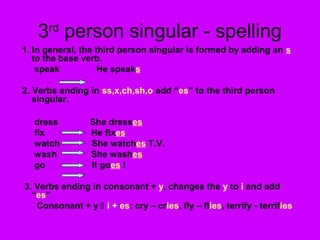
1. In general, the third person singular is formed by adding an s
to the base verb.
speak He speaks
2. Verbs ending in ss,x,ch,sh,o add “es” to the third person
singular.
dress She dresses
fix He fixes
watch She watches T.V.
wash She washes
go It goes !
3. Verbs ending in consonant + y, changes the y to i and add
“es”
Consonant + y  i + es: cry – cries, fly – flies, terrify - terrifies
What’s the 3rd
person singular?
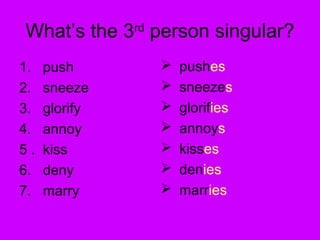
1. push
2. sneeze
3. glorify
4. annoy
5 . kiss
6. deny
7. marry
 pushes
 sneezes
 glorifies
 annoys
 kisses
 denies
 marries
THE PRESENT SIMPLE TENSE
(Interrogative)
DODOESES HEHE WORKWORK AS A DOCTOR?
YES, HE DOES.
THE PRESENT SIMPLE TENSE
INTERROGATIVE: WORK
DO I
YOU
WORK?
DOES
SHE
HE
IT
WORK?
DO
WE
YOU
THEY
WORK?
THE PRESENT SIMPLE TENSE
(Negative)
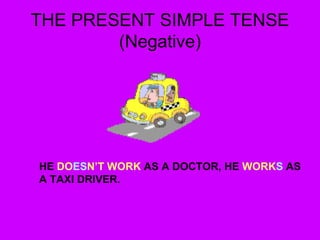
HE DOESN’T WORK AS A DOCTOR, HE WORKS AS
A TAXI DRIVER.
THE PRESENT SIMPLE TENSE
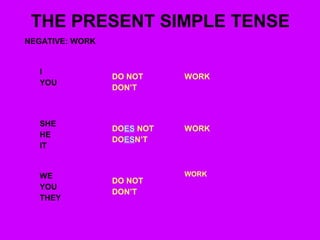
NEGATIVE: WORK
I
YOU
DO NOT
DON’T
WORK
SHE
HE
IT
DOES NOT
DOESN’T
WORK
WE
YOU
THEY
DO NOT
DON’T
WORK
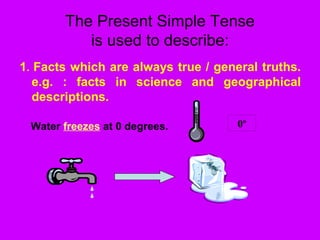
The Present Simple Tense
is used to describe:
1. Facts which are always true / general truths.
e.g. : facts in science and geographical
descriptions.
Water freezes at 0 degrees. 0º
The Present Simple Tense
is used to describe:
2. Actions that happen regularly (Habitual
actions). A frequency adverb is often
used.
They usually take a
walk with their son
The Present Simple Tense
is used to describe:
3. Opinions, likes and feelings.
She likes making
snowmen.
THE PRESENT SIMPLE TENSE
TIME EXPRESSIONS:
FREQUENCY ADVERBS:
ALWAYS, OFTEN, GENERALLY, USUALLY, NORMALLY, SOMETIMES, NEVER.
HE NORMALLY COOKS PASTA. (they come before
the main verb, except the verb to be)
OTHER TIME EXPRESSIONS:
EVERY DAY, EVERY MONTH, EVERY YEAR, ON SUNDAYS,
AT THE WEEKENDS ETC.
MUSICIANS SOMETIMES WORK ON SUNDAYS.

The present-simple-tense

  • 1.
    THE PRESENT SIMPLETENSE (Affirmative) She speaks English.
  • 2.
    THE PRESENT SIMPLETENSE AFFIRMATIVE: WORK I YOU SPEAK SHE HE IT SPEAKS WE YOU THEY SPEAK
  • 3.
    3rd person singular -spelling 1. In general, the third person singular is formed by adding an s to the base verb. speak He speaks 2. Verbs ending in ss,x,ch,sh,o add “es” to the third person singular. dress She dresses fix He fixes watch She watches T.V. wash She washes go It goes ! 3. Verbs ending in consonant + y, changes the y to i and add “es” Consonant + y  i + es: cry – cries, fly – flies, terrify - terrifies
  • 4.
    What’s the 3rd personsingular? 1. push 2. sneeze 3. glorify 4. annoy 5 . kiss 6. deny 7. marry  pushes  sneezes  glorifies  annoys  kisses  denies  marries
  • 5.
    THE PRESENT SIMPLETENSE (Interrogative) DODOESES HEHE WORKWORK AS A DOCTOR? YES, HE DOES.
  • 6.
    THE PRESENT SIMPLETENSE INTERROGATIVE: WORK DO I YOU WORK? DOES SHE HE IT WORK? DO WE YOU THEY WORK?
  • 7.
    THE PRESENT SIMPLETENSE (Negative) HE DOESN’T WORK AS A DOCTOR, HE WORKS AS A TAXI DRIVER.
  • 8.
    THE PRESENT SIMPLETENSE NEGATIVE: WORK I YOU DO NOT DON’T WORK SHE HE IT DOES NOT DOESN’T WORK WE YOU THEY DO NOT DON’T WORK
  • 9.
    The Present SimpleTense is used to describe: 1. Facts which are always true / general truths. e.g. : facts in science and geographical descriptions. Water freezes at 0 degrees. 0º
  • 10.
    The Present SimpleTense is used to describe: 2. Actions that happen regularly (Habitual actions). A frequency adverb is often used. They usually take a walk with their son
  • 11.
    The Present SimpleTense is used to describe: 3. Opinions, likes and feelings. She likes making snowmen.
  • 12.
    THE PRESENT SIMPLETENSE TIME EXPRESSIONS: FREQUENCY ADVERBS: ALWAYS, OFTEN, GENERALLY, USUALLY, NORMALLY, SOMETIMES, NEVER. HE NORMALLY COOKS PASTA. (they come before the main verb, except the verb to be) OTHER TIME EXPRESSIONS: EVERY DAY, EVERY MONTH, EVERY YEAR, ON SUNDAYS, AT THE WEEKENDS ETC. MUSICIANS SOMETIMES WORK ON SUNDAYS.