SOLAR
POWER
Created by TOP team
Ahmed Atef Kamal
Ahmed Hamada Ahmed
Ahmed Mohammed Nafea
Eslam Ahmed Hassan
Presented to Eng/ Hani Salem
The Sun
• Sun 149.6 × 10⁶ km away from us.
• The total solar energy absorbed by
Earth's atmosphere, oceans and land
masses is approximately
3,850,000 joules (EJ) per year. In
2002, this was more energy in one
hour than the world used in one year.
Why Solar?
1. This type of energy is clean, renewable, and
environmentally friendly.
2.Solar systems save money by reducing the need for
buying electricity.
3. A solar system requires very little maintenance,
only needing cleaned when dust or dirt has
accumulated. Plus, they have a lifespan well over
25 years!
How Does The Sun Work?
• The sun is effectively a massive nuclear reactor .
• About three quarters of the Sun's mass consists
of hydrogen, while the rest is mostly helium.
• The Sun's colour is white, although from the
surface of the Earth it may appear yellow
because of atmospheric scattering of blue light.
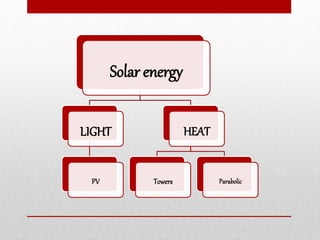
Solar energy
LIGHT
PV
HEAT
Towers Parabolic
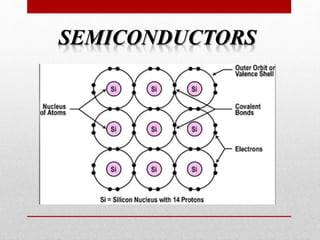
SEMICONDUCTORS
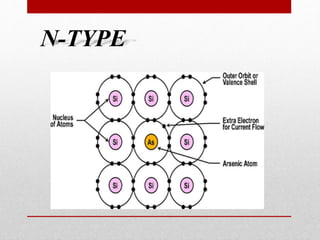
N-TYPE
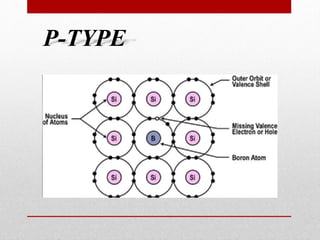
P-TYPE
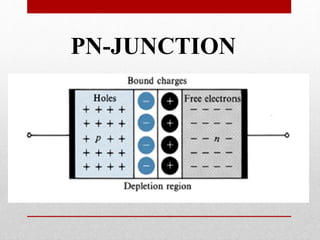
PN-JUNCTION
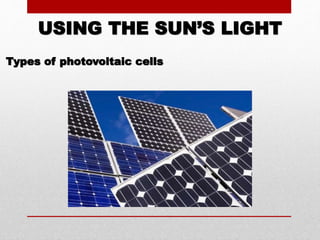
USING THE SUN’S LIGHT
Types of photovoltaic cells
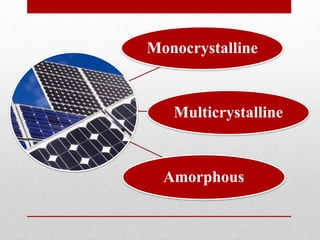
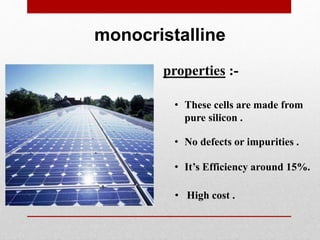
Monocrystalline
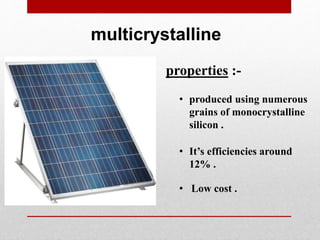
Multicrystalline
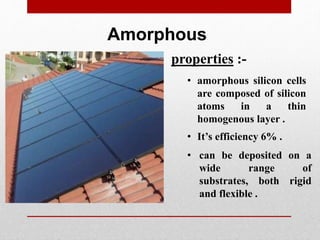
Amorphous
• These cells are made from
pure silicon .
• No defects or impurities .
• It’s Efficiency around 15%.
properties :-
monocristalline
• High cost .
multicrystalline
properties :-
• produced using numerous
grains of monocrystalline
silicon .
• It’s efficiencies around
12% .
• Low cost .
Amorphous
• amorphous silicon cells
are composed of silicon
atoms in a thin
homogenous layer .
properties :-
• It’s efficiency 6% .
• can be deposited on a
wide range of
substrates, both rigid
and flexible .
Related Equipment
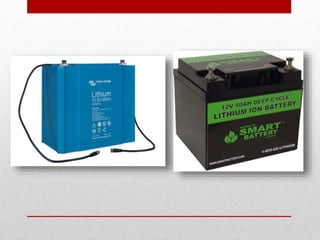
Batteries :-
• Batteries are required in many PV systems to supply
power at night or when the PV system cannot meet
the demand.
• lithium. Deep-cycle lead-acid batteries are the most
commonly used.
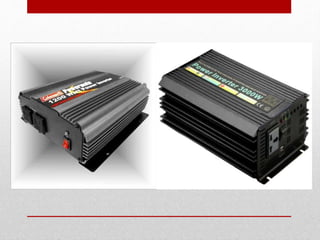
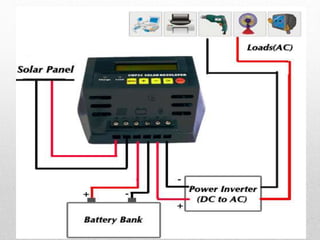
Inverter :-
• An inverter is used to convert the direct current into
alternating current electricity.
• The output of the inverter can be single or three phase.
Charge Controller
• Controllers regulate the power from PV modules to
prevent the batteries from overcharging.
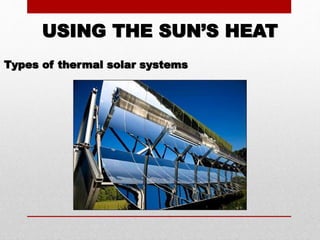
USING THE SUN’S HEAT
Types of thermal solar systems
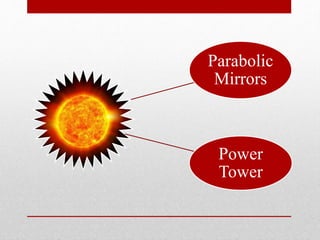
Parabolic
Mirrors
Power
Tower
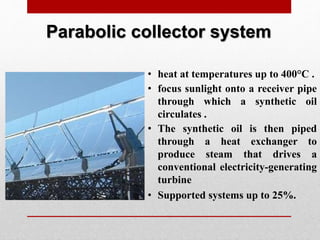
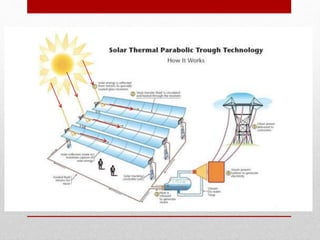
Parabolic collector system
• heat at temperatures up to 400°C .
• focus sunlight onto a receiver pipe
through which a synthetic oil
circulates .
• The synthetic oil is then piped
through a heat exchanger to
produce steam that drives a
conventional electricity-generating
turbine
• Supported systems up to 25%.
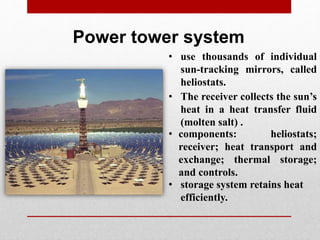
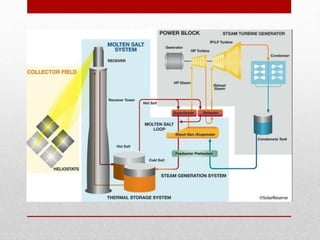
Power tower system
• use thousands of individual
sun-tracking mirrors, called
heliostats.
• The receiver collects the sun’s
heat in a heat transfer fluid
(molten salt) .
• components: heliostats;
receiver; heat transport and
exchange; thermal storage;
and controls.
• storage system retains heat
efficiently.
Top 10 world’s largest solar PV
power plants
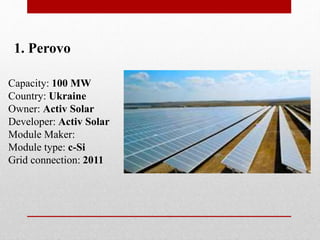
Capacity: 100 MW
Country: Ukraine
Owner: Activ Solar
Developer: Activ Solar
Module Maker:
Module type: c-Si
Grid connection: 2011
1. Perovo
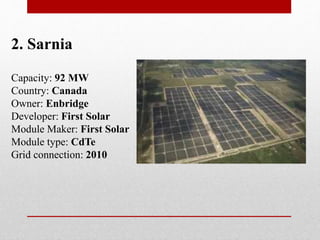
Capacity: 92 MW
Country: Canada
Owner: Enbridge
Developer: First Solar
Module Maker: First Solar
Module type: CdTe
Grid connection: 2010
2. Sarnia
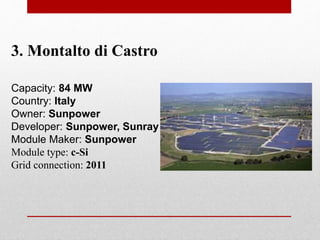
3. Montalto di Castro
Capacity: 84 MW
Country: Italy
Owner: Sunpower
Developer: Sunpower, Sunray
Module Maker: Sunpower
Module type: c-Si
Grid connection: 2011
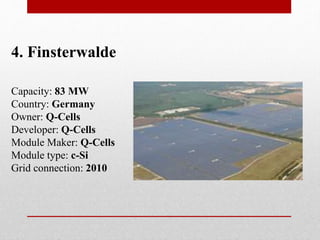
4. Finsterwalde
Capacity: 83 MW
Country: Germany
Owner: Q-Cells
Developer: Q-Cells
Module Maker: Q-Cells
Module type: c-Si
Grid connection: 2010
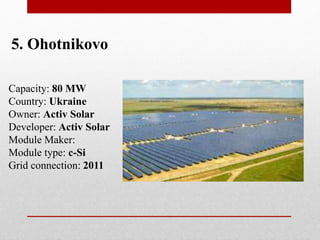
5. Ohotnikovo
Capacity: 80 MW
Country: Ukraine
Owner: Activ Solar
Developer: Activ Solar
Module Maker:
Module type: c-Si
Grid connection: 2011
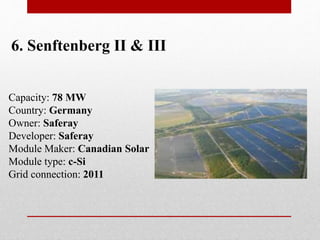
6. Senftenberg II & III
Capacity: 78 MW
Country: Germany
Owner: Saferay
Developer: Saferay
Module Maker: Canadian Solar
Module type: c-Si
Grid connection: 2011
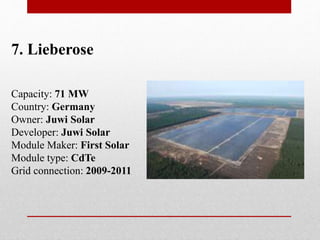
7. Lieberose
Capacity: 71 MW
Country: Germany
Owner: Juwi Solar
Developer: Juwi Solar
Module Maker: First Solar
Module type: CdTe
Grid connection: 2009-2011
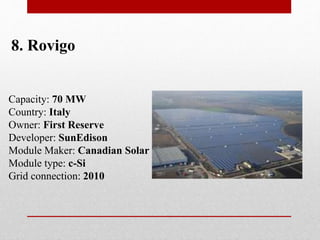
8. Rovigo
Capacity: 70 MW
Country: Italy
Owner: First Reserve
Developer: SunEdison
Module Maker: Canadian Solar
Module type: c-Si
Grid connection: 2010
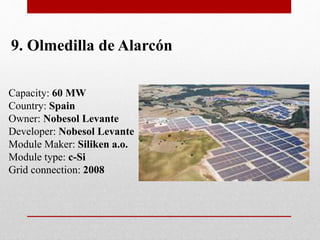
9. Olmedilla de Alarcón
Capacity: 60 MW
Country: Spain
Owner: Nobesol Levante
Developer: Nobesol Levante
Module Maker: Siliken a.o.
Module type: c-Si
Grid connection: 2008
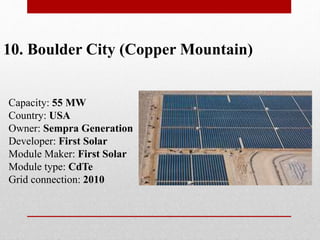
10. Boulder City (Copper Mountain)
Capacity: 55 MW
Country: USA
Owner: Sempra Generation
Developer: First Solar
Module Maker: First Solar
Module type: CdTe
Grid connection: 2010
Applications of solar energy
systems
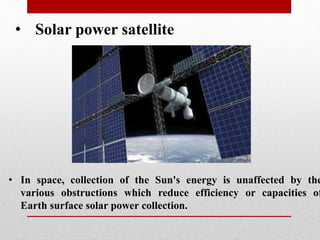
• Solar power satellite
• In space, collection of the Sun's energy is unaffected by the
various obstructions which reduce efficiency or capacities of
Earth surface solar power collection.
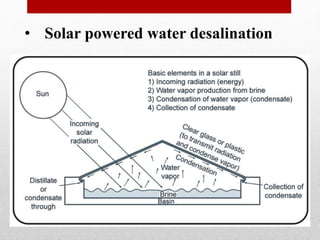
• Solar powered water desalination
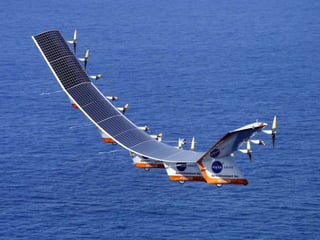
• Solar planes
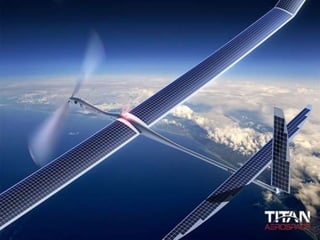
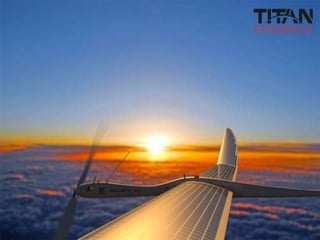
• The Titan Solara 50 solar plane is huge. The wingspan is about
150 feet! It can carry a payload of around 250lbs to "atmospheric
orbit" and then stay operational up there thanks to its 3,000 solar
cells that can produce 7 kW of electricity.
• The Solara is intended to loft a payload to 20,000 meters and then
keep it [there] for five years, running entirely on solar power. It
functions a bit like a satellite, except substantially cheaper and
much more versatile. And, you can get it back when you're done.
• Basically a lot of things that you can do with a satellite, but
cheaper, and if your mission is limited in time, you can then land
the plane and change up the equipment instead of having a
useless/obsolete satellite in orbit.
• Applications for these types of solar planes are very varied, from
disaster rapid response to anti-piracy (the real kind, out at sea)
surveillance, to crop monitoring, fire monitoring, providing
internet access to remote regions, all kinds of scientific missions
(ocean monitoring, cosmic ray monitoring, atmospheric science,
weather monitoring.
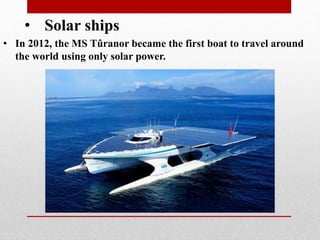
• Solar ships
• In 2012, the MS Tûranor became the first boat to travel around
the world using only solar power.
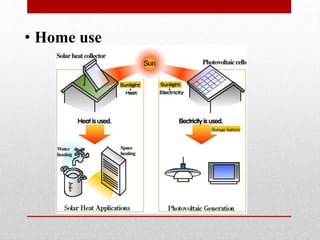
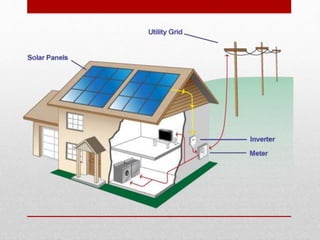
• Home use
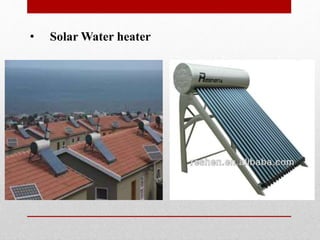
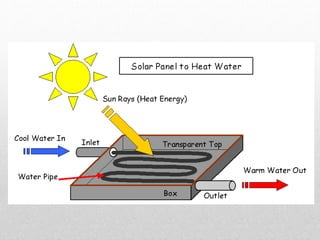
• Solar Water heater
Future of solar
energy in
Egypt
Solar power technology

Solar power technology

  • 1.
  • 2.
    Created by TOPteam Ahmed Atef Kamal Ahmed Hamada Ahmed Ahmed Mohammed Nafea Eslam Ahmed Hassan Presented to Eng/ Hani Salem
  • 3.
    The Sun • Sun149.6 × 106 km away from us. • The total solar energy absorbed by Earth's atmosphere, oceans and land masses is approximately 3,850,000 joules (EJ) per year. In 2002, this was more energy in one hour than the world used in one year.
  • 4.
    Why Solar? 1. Thistype of energy is clean, renewable, and environmentally friendly. 2.Solar systems save money by reducing the need for buying electricity. 3. A solar system requires very little maintenance, only needing cleaned when dust or dirt has accumulated. Plus, they have a lifespan well over 25 years!
  • 5.
    How Does TheSun Work? • The sun is effectively a massive nuclear reactor . • About three quarters of the Sun's mass consists of hydrogen, while the rest is mostly helium. • The Sun's colour is white, although from the surface of the Earth it may appear yellow because of atmospheric scattering of blue light.
  • 6.
  • 7.
  • 8.
  • 9.
  • 10.
  • 11.
    USING THE SUN’SLIGHT Types of photovoltaic cells
  • 12.
  • 13.
    • These cellsare made from pure silicon . • No defects or impurities . • It’s Efficiency around 15%. properties :- monocristalline • High cost .
  • 14.
    multicrystalline properties :- • producedusing numerous grains of monocrystalline silicon . • It’s efficiencies around 12% . • Low cost .
  • 15.
    Amorphous • amorphous siliconcells are composed of silicon atoms in a thin homogenous layer . properties :- • It’s efficiency 6% . • can be deposited on a wide range of substrates, both rigid and flexible .
  • 17.
    Related Equipment Batteries :- •Batteries are required in many PV systems to supply power at night or when the PV system cannot meet the demand. • lithium. Deep-cycle lead-acid batteries are the most commonly used.
  • 19.
    Inverter :- • Aninverter is used to convert the direct current into alternating current electricity. • The output of the inverter can be single or three phase.
  • 21.
    Charge Controller • Controllersregulate the power from PV modules to prevent the batteries from overcharging.
  • 23.
    USING THE SUN’SHEAT Types of thermal solar systems
  • 24.
  • 25.
    Parabolic collector system •heat at temperatures up to 400°C . • focus sunlight onto a receiver pipe through which a synthetic oil circulates . • The synthetic oil is then piped through a heat exchanger to produce steam that drives a conventional electricity-generating turbine • Supported systems up to 25%.
  • 27.
    Power tower system •use thousands of individual sun-tracking mirrors, called heliostats. • The receiver collects the sun’s heat in a heat transfer fluid (molten salt) . • components: heliostats; receiver; heat transport and exchange; thermal storage; and controls. • storage system retains heat efficiently.
  • 30.
    Top 10 world’slargest solar PV power plants
  • 31.
    Capacity: 100 MW Country:Ukraine Owner: Activ Solar Developer: Activ Solar Module Maker: Module type: c-Si Grid connection: 2011 1. Perovo
  • 32.
    Capacity: 92 MW Country:Canada Owner: Enbridge Developer: First Solar Module Maker: First Solar Module type: CdTe Grid connection: 2010 2. Sarnia
  • 33.
    3. Montalto diCastro Capacity: 84 MW Country: Italy Owner: Sunpower Developer: Sunpower, Sunray Module Maker: Sunpower Module type: c-Si Grid connection: 2011
  • 34.
    4. Finsterwalde Capacity: 83MW Country: Germany Owner: Q-Cells Developer: Q-Cells Module Maker: Q-Cells Module type: c-Si Grid connection: 2010
  • 35.
    5. Ohotnikovo Capacity: 80MW Country: Ukraine Owner: Activ Solar Developer: Activ Solar Module Maker: Module type: c-Si Grid connection: 2011
  • 36.
    6. Senftenberg II& III Capacity: 78 MW Country: Germany Owner: Saferay Developer: Saferay Module Maker: Canadian Solar Module type: c-Si Grid connection: 2011
  • 37.
    7. Lieberose Capacity: 71MW Country: Germany Owner: Juwi Solar Developer: Juwi Solar Module Maker: First Solar Module type: CdTe Grid connection: 2009-2011
  • 38.
    8. Rovigo Capacity: 70MW Country: Italy Owner: First Reserve Developer: SunEdison Module Maker: Canadian Solar Module type: c-Si Grid connection: 2010
  • 39.
    9. Olmedilla deAlarcón Capacity: 60 MW Country: Spain Owner: Nobesol Levante Developer: Nobesol Levante Module Maker: Siliken a.o. Module type: c-Si Grid connection: 2008
  • 40.
    10. Boulder City(Copper Mountain) Capacity: 55 MW Country: USA Owner: Sempra Generation Developer: First Solar Module Maker: First Solar Module type: CdTe Grid connection: 2010
  • 41.
    Applications of solarenergy systems
  • 42.
    • Solar powersatellite • In space, collection of the Sun's energy is unaffected by the various obstructions which reduce efficiency or capacities of Earth surface solar power collection.
  • 43.
    • Solar poweredwater desalination
  • 45.
    • Solar planes •The Titan Solara 50 solar plane is huge. The wingspan is about 150 feet! It can carry a payload of around 250lbs to "atmospheric orbit" and then stay operational up there thanks to its 3,000 solar cells that can produce 7 kW of electricity. • The Solara is intended to loft a payload to 20,000 meters and then keep it [there] for five years, running entirely on solar power. It functions a bit like a satellite, except substantially cheaper and much more versatile. And, you can get it back when you're done.
  • 47.
    • Basically alot of things that you can do with a satellite, but cheaper, and if your mission is limited in time, you can then land the plane and change up the equipment instead of having a useless/obsolete satellite in orbit. • Applications for these types of solar planes are very varied, from disaster rapid response to anti-piracy (the real kind, out at sea) surveillance, to crop monitoring, fire monitoring, providing internet access to remote regions, all kinds of scientific missions (ocean monitoring, cosmic ray monitoring, atmospheric science, weather monitoring.
  • 50.
    • Solar ships •In 2012, the MS Tûranor became the first boat to travel around the world using only solar power.
  • 52.
  • 53.
  • 56.