


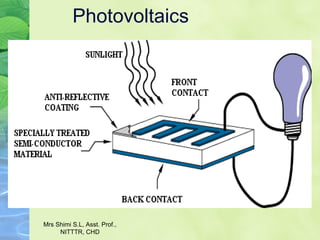

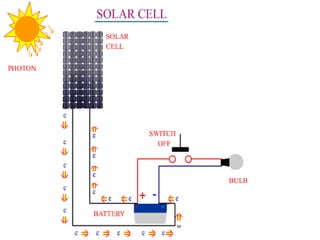
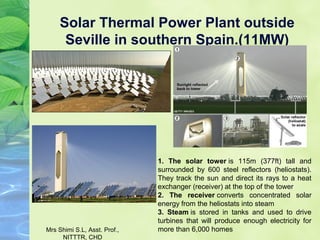
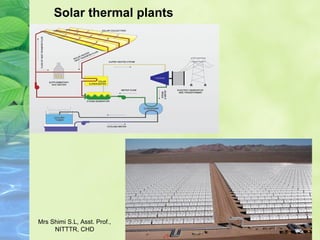
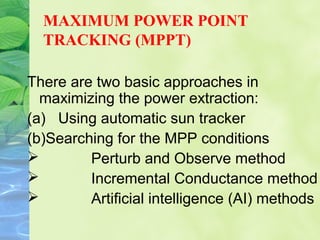







![The photovoltaic effect is the creation of voltage or electric current in
a material upon exposure to light. Though the photovoltaic effect is
directly related to the photoelectric effect, they are different processes.
In the photoelectric effect, electrons are ejected from a material's
surface upon exposure to radiation. The photovoltaic effect differs in
that electrons are transferred between different bands (i.e., from the
valence to conduction bands) within the material, resulting in the
buildup of voltage between two electrodes.[1]
In most photovoltaic applications the radiation is sunlight, which is why
the devices are known as solar cells. In the case of a p-n junction
solar cell, illuminating the material creates an electric current as
excited electrons and the remaining holes are swept in different
directions by the built-in electric field of the depletion region.[2]
The photovoltaic effect was first observed by
Alexandre-Edmond Becquerel in 1839.[3][4]
Mrs Shimi S.L, Asst. Prof.,
NITTTR, CHD](https://image.slidesharecdn.com/solarenergyapplicationforelectricpowergeneration-150423005223-conversion-gate01/85/Solar-energy-application-for-electric-power-generation-36-320.jpg)
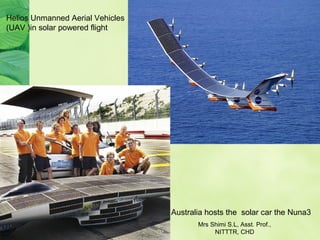
![An unmanned aerial vehicle (UAV), commonly known as
a drone, is an aircraft without a human pilot on board. Its flight
is either controlled autonomously by computers in the vehicle,
or under the remote control of a navigator, or pilot (in military
UAVs called a Combat Systems Officer on UCAVs) on the
ground or in another vehicle.
There are a wide variety of drone shapes, sizes, configurations,
and characteristics. Historically, UAVs were simple remotely
pilotedaircraft, but autonomous control is increasingly being
employed.[1]
Their largest use is within military applications. UAVs are also
used in a small but growing number of civil applications, such
as firefightingor nonmilitary security work, such as surveillance
of pipelines. UAVs are often preferred for missions that are too
"dull, dirty, or dangerous" for manned aircraft.Mrs Shimi S.L, Asst. Prof.,
NITTTR, CHD](https://image.slidesharecdn.com/solarenergyapplicationforelectricpowergeneration-150423005223-conversion-gate01/85/Solar-energy-application-for-electric-power-generation-41-320.jpg)
!["Geothermal Engineering" redirects here. For the British company specializing in the development of geothermal resources, see
Geothermal Engineering Ltd..
Steam rising from the Nesjavellir Geothermal Power Station in Iceland.
Geothermal energy is thermal energy generated and stored in the Earth. Thermal energy is the energy that determines the
temperature of matter. The geothermal energy of the Earth's crust originates from the original formation of the planet (20%) and
from radioactive decay of minerals (80%).[1][2]
The geothermal gradient, which is the difference in temperature between the core of
the planet and its surface, drives a continuous conduction of thermal energy in the form of heat from the core to the surface. The
adjective geothermal originates from the Greek roots γη (ge), meaning earth, and θερμος (thermos), meaning hot.
At the core of the Earth, thermal energy is created by radioactive decay[1]
and temperatures may reach over 5000 °C (9,000 °F).
Heat conducts from the core to surrounding cooler rock. The high temperature and pressure cause some rock to melt, creating
magma convection upward since it is lighter than the solid rock. The magma heats rock and water in the crust, sometimes up to
370 °C (700 °F).[3]
From hot springs, geothermal energy has been used for bathing since Paleolithic times and for space heating since ancient
Roman times, but it is now better known for electricity generation. Worldwide, about 10,715 megawatts (MW) of geothermal
power is online in 24 countries. An additional 28 gigawatts of direct geothermal heating capacity is installed for district heating,
space heating, spas, industrial processes, desalination and agricultural applications.[4]
Mrs Shimi S.L, Asst. Prof.,
NITTTR, CHD](https://image.slidesharecdn.com/solarenergyapplicationforelectricpowergeneration-150423005223-conversion-gate01/85/Solar-energy-application-for-electric-power-generation-43-320.jpg)
![Applications of the Stirling engine range from mechanical propulsion to
heating and cooling to electrical generation systems. A Stirling engine is a
heat engine operating by cyclic compression and expansion of air or other gas,
the "working fluid", at different temperature levels such that there is a net
conversion of heat energy to mechanical work.[1][2]
The Stirling cycle heat engine
can also be driven in reverse, using a mechanical energy input to drive heat
transfer in a reversed direction (i.e. a heat pump, or refrigerator).
There are several design configurations for Stirling engines that can be built,
many of which require rotary or sliding seals, which can introduce difficult
tradeoffs between frictional losses and refrigerant leakage. A free-piston variant
of the Stirling engine can be built, which can be completely hermetically sealed,
reducing friction losses and completely eliminating refrigerant leakage. For
example, a Free Piston Stirling Cooler (FPSC) can convert an electrical energy
input into a practical heat pump effect, used for high-efficiency portable
refrigerators and freezers. Conversely, a free-piston electrical generator could
be built, converting a heat flow into mechanical energy, and then into electricity.
In both cases, energy is usually converted from/to electrical energy using
magnetic fields in a way that avoids compromising the hermetic seal.
Mrs Shimi S.L, Asst. Prof.,
NITTTR, CHD](https://image.slidesharecdn.com/solarenergyapplicationforelectricpowergeneration-150423005223-conversion-gate01/85/Solar-energy-application-for-electric-power-generation-45-320.jpg)
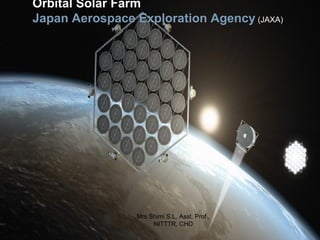
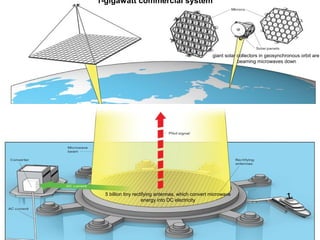
![Imagine looking out over Tokyo Bay from high above and seeing a man-made island in the harbor, 3 kilometers long. A
massive net is stretched over the island and studded with 5 billion tiny rectifying antennas, which convert microwave energy
into DC electricity. Also on the island is a substation that sends that electricity coursing through a submarine cable to Tokyo,
to help keep the factories of the Keihin industrial zone humming and the neon lights of Shibuya shining bright.
But you can’t even see the most interesting part. Several giant solar collectors in geosynchronous orbit are beaming
microwaves down to the island from 36 000 km above Earth.
It’s been the subject of many previous studies and the stuff of sci-fi for decades, but space-based solar power could at last
become a reality—and within 25 years, according to a proposal from researchers at the
Japan Aerospace Exploration Agency (JAXA). The agency, which leads the world in research on space-based solar power
systems, now has a technology road map that suggests a series of ground and orbital demonstrations leading to the
development in the 2030s of a 1-gigawatt commercial system—about the same output as a typical nuclear power plant.
It’s an ambitious plan, to be sure. But a combination of technical and social factors is giving it currency, especially in Japan.
On the technical front, recent advances in wireless power transmission allow moving antennas to coordinate in order to
send a precise beam across vast distances. At the same time, heightened public concerns about the climatic effects of
greenhouse gases produced by the burning of fossil fuels are prompting a look at alternatives. Renewable energy
technologies to harvest the sun and the wind are constantly improving, but large-scale solar and wind farms occupy huge
swaths of land, and they provide only intermittent power. Space-based solar collectors in geosynchronous orbit, on the other
hand, could generate power nearly 24 hours a day. Japan has a particular interest in finding a practical clean energy source:
The accident at the Fukushima Daiichi nuclear power plant prompted an exhaustive and systematic search for alternatives,
yet Japan lacks both fossil fuel resources and empty land suitable for renewable power installations.
Soon after we humans invented silicon-based photovoltaic cells to convert sunlight directly into electricity, more than
60 years ago, we realized that space would be the best place to perform that conversion. The concept was first proposed
formally in 1968 by the American aerospace engineer Peter Glaser. In a seminal paper, he acknowledged the challenges of
constructing, launching, and operating these satellites but argued that improved photovoltaics and easier access to space
would soon make them achievable. In the 1970s, NASA and the U.S. Department of Energy carried out serious studies on
space-based solar power, and over the decades since, various types of solar power satellites (SPSs) have been proposed.
No such satellites have been orbited yet because of concerns regarding costs and technical feasibility. The relevant
technologies have made great strides in recent years, however. It’s time to take another look at space-based solar power.
A commercial SPS capable of producing 1 GW would be a magnificent structure weighing more than 10 000 metric tons
and measuring several kilometers across. To complete and operate an electricity system based on such satellites, we would
have to demonstrate mastery of six different disciplines: wireless power transmission, space transportation, construction of
large structures in orbit, satellite attitude and orbit control, power generation, and power management. Of those six
challenges, it’s the wireless power transmission that remains the most daunting. So that’s where JAXA has focused its
research.
Illustration: John MacNeillThe Japan Aerospace Exploration Agency is working on several models for solar-collecting
satellites, which would fly in geosynchronous orbit 36 000 kilometers above their receiving stations. With the basic model
[top left-hand side], the photovoltaic-topped panel’s efficiency would decrease as the world turned away from the sun. The
advanced model [top right-hand side] would feature two mirrors to reflect sunlight onto two photovoltaic panels. This model
would be more difficult to build, but it could generate electricity continuously.
In either model, the photovoltaic panels would generate DC current, which would be converted to microwaves aboard the
satellite. The satellite’s many microwave-transmitting antenna panels would receive a pilot signal from the ground, allowing
Mrs Shimi S.L, Asst. Prof.,
NITTTR, CHD](https://image.slidesharecdn.com/solarenergyapplicationforelectricpowergeneration-150423005223-conversion-gate01/85/Solar-energy-application-for-electric-power-generation-46-320.jpg)

The document discusses various topics related to solar energy generation including: - Solar energy is generated through nuclear fusion reactions inside the sun and can be harnessed using technologies like solar cells, solar heat collectors, and solar power plants. - Applications of solar energy include generating electricity at utility-scale solar power plants as well as powering vehicles, heating homes and water, and providing power in remote locations. - Maximizing the power extracted from solar panels requires techniques like automatic sun tracking and searching for maximum power point conditions. - Emerging solar technologies include solar farms in space that beam microwave energy to receivers on Earth and solar panels integrated into buildings.


