Space Based Solar Power
Sakthi
Manikandan M
Introduction
• Solar energy is the energy generated
due to the thermonuclear fusion
reactions occurring in the sun.
• Space-based solar power (SBSP) is
the concept of collecting solar power
in space using an “SPS”, that is a
“Solar Power Satellite” or a “Satellite
power system” for use on earth.
• SBSP would differ from current solar
collection methods in that the means
used to collect energy would reside
on an orbiting satellite instead of on
Earth’s Surface.
Sunlight
Solar array
Microwave circuits
Spacetenna
Rectenna
DC-RF conversion
To Power conversion
Space
Segmen
t
Ground
Segmen
t
Block
Diagram
Components
Space-based solar power system
essentiallyconsists of three elements
A means of collecting solar power in
space , for example solar concentrators
or solar cells.
A medium of transmitting power to
earth, for example microwaves.
A means for receiving power on earth,
for example an antenna (rectenna)
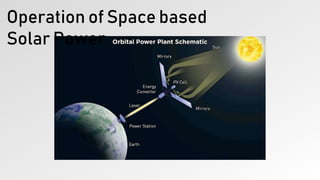
Operation of Space based
Solar Power
Stage 1 – Solar Panel
• Sunlight gets captured by the
solar panels.
• Panels will remain in sunlight
24 hours a day, producing a
constant source of base-load
power. This is because there
is no nightie in space.
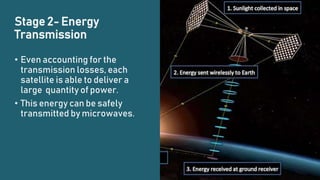
Stage 2- Energy
Transmission
• Even accounting for the
transmission losses, each
satellite is able to deliver a
large quantity of power.
• This energy can be safely
transmitted by microwaves.
Stage 3- Energy
Receiving and
Distribution
• Energy is received on the
earth by large, easy-to-
assemble grids called
Rectenna.
• The energy is, then delivered
to the consumers.
• Its is assumed that more than
90% of sunlight will pass
through to the rectenna.
S.No Factors
Space based solar
power system
Earth based
solar power
system
1 Efficiency 8-10 times more Less
2
Effect of external
conditions
No effect High
3
Effect of Earth’s
movement
No Effect
Unable to
capture energy
during night
4 Energy loss No loss
Distored energy
waves
Comparative Study
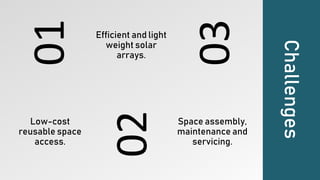
01
02
03
Low-cost
reusable space
access.
Efficient and light
weight solar
arrays.
Space assembly,
maintenance and
servicing.
Challenges
01
02
03
There is no air in
space, so the
collecting
surfaces could
receive mush
more intense
sunlight.
Orbiting satellites
can be exposed to
a consistently
high degree of
solar radiation,
generally for 24
hours per day.
Elimination of
plant and wildlife
interface.
Advantages
01
02
03
Constuction and
maintenance on a
solar panel in
space could
possibly be done
only
telerobotically.
After being
decommissioned,
parts of it may
stay in orbit as
space debris and
can cause trouble
The large size and
the cost of the
receiving station
on the ground.
Disadvantages
01
02
03
Concentrating the
microwaves at the
specified location
of the rectenna.
Fencing zone can
be made on the
ground to protect
the terrestrial
organisms.
We can also locate
the rectenna
offshore
Safety
and
Precautions
Presently Working SBSP
Project
• Japan is currently the world leader of the
Space Based Solar Power System Projects.
• These space based solar panels would be
around 5-10 times more efficient than ground-
based solar conversion systems. CO2
emissions will also be low.
• It’s predicted that it will process around 1
gigawatt of power, which is a similar to the
Thank
you

Space based solar power | Project#2

  • 1.
    Space Based SolarPower Sakthi Manikandan M
  • 2.
    Introduction • Solar energyis the energy generated due to the thermonuclear fusion reactions occurring in the sun. • Space-based solar power (SBSP) is the concept of collecting solar power in space using an “SPS”, that is a “Solar Power Satellite” or a “Satellite power system” for use on earth. • SBSP would differ from current solar collection methods in that the means used to collect energy would reside on an orbiting satellite instead of on Earth’s Surface.
  • 3.
    Sunlight Solar array Microwave circuits Spacetenna Rectenna DC-RFconversion To Power conversion Space Segmen t Ground Segmen t Block Diagram
  • 4.
    Components Space-based solar powersystem essentiallyconsists of three elements A means of collecting solar power in space , for example solar concentrators or solar cells. A medium of transmitting power to earth, for example microwaves. A means for receiving power on earth, for example an antenna (rectenna)
  • 5.
    Operation of Spacebased Solar Power
  • 6.
    Stage 1 –Solar Panel • Sunlight gets captured by the solar panels. • Panels will remain in sunlight 24 hours a day, producing a constant source of base-load power. This is because there is no nightie in space.
  • 7.
    Stage 2- Energy Transmission •Even accounting for the transmission losses, each satellite is able to deliver a large quantity of power. • This energy can be safely transmitted by microwaves.
  • 8.
    Stage 3- Energy Receivingand Distribution • Energy is received on the earth by large, easy-to- assemble grids called Rectenna. • The energy is, then delivered to the consumers. • Its is assumed that more than 90% of sunlight will pass through to the rectenna.
  • 9.
    S.No Factors Space basedsolar power system Earth based solar power system 1 Efficiency 8-10 times more Less 2 Effect of external conditions No effect High 3 Effect of Earth’s movement No Effect Unable to capture energy during night 4 Energy loss No loss Distored energy waves Comparative Study
  • 10.
    01 02 03 Low-cost reusable space access. Efficient andlight weight solar arrays. Space assembly, maintenance and servicing. Challenges
  • 11.
    01 02 03 There is noair in space, so the collecting surfaces could receive mush more intense sunlight. Orbiting satellites can be exposed to a consistently high degree of solar radiation, generally for 24 hours per day. Elimination of plant and wildlife interface. Advantages
  • 12.
    01 02 03 Constuction and maintenance ona solar panel in space could possibly be done only telerobotically. After being decommissioned, parts of it may stay in orbit as space debris and can cause trouble The large size and the cost of the receiving station on the ground. Disadvantages
  • 13.
    01 02 03 Concentrating the microwaves atthe specified location of the rectenna. Fencing zone can be made on the ground to protect the terrestrial organisms. We can also locate the rectenna offshore Safety and Precautions
  • 14.
    Presently Working SBSP Project •Japan is currently the world leader of the Space Based Solar Power System Projects. • These space based solar panels would be around 5-10 times more efficient than ground- based solar conversion systems. CO2 emissions will also be low. • It’s predicted that it will process around 1 gigawatt of power, which is a similar to the
  • 15.