A seminar on space based solar power
system
Submitted To
Mr. Santosh Singh Mourya
EC Department
Submitted By
Deepak Chouhan
EC 8th Sem
0823EC 101012
Space based solar power
system.
 Introduction.
 History.
 What is Satellite.
 Working of solar power system.
 rectenna.
 Advantages.
 Disadvantages.
 References.
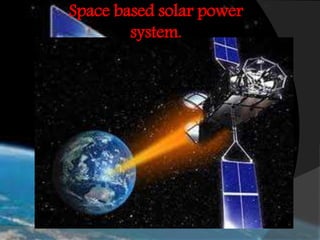
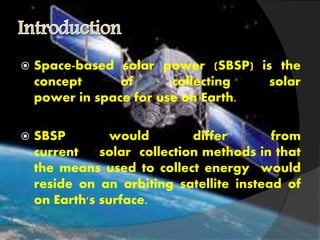
 Space-based solar power (SBSP) is the
concept of collecting solar
power in space for use on Earth.
 SBSP would differ from
current solar collection methods in that
the means used to collect energy would
reside on an orbiting satellite instead of
on Earth's surface.
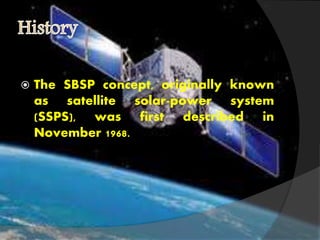
 The SBSP concept, originally known
as satellite solar-power system
(SSPS), was first described in
November 1968.
 A satellite is an artificial object which
has been intentionally placed into
orbit such object are some times
called artificial satellite.
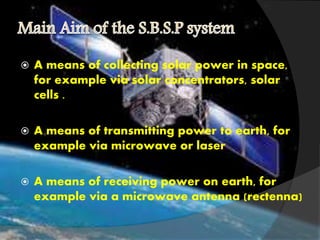
 A means of collecting solar power in space,
for example via solar concentrators, solar
cells .
 A means of transmitting power to earth, for
example via microwave or laser
 A means of receiving power on earth, for
example via a microwave antenna (rectenna)
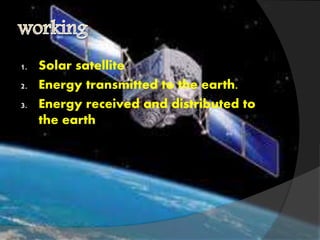
1. Solar satellite
2. Energy transmitted to the earth.
3. Energy received and distributed to
the earth
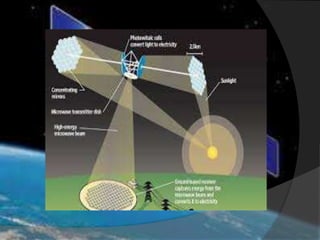
 Large arrays of photovoltaic cells
mounted on a satellite.
 Sun light will be capture and converted
into electricity by photovoltaic panel.
 Panel will remain in sun light 24 hours a
day. Producing a constant source of
base load power.
 There is no transmission losses so
each satellite is able to deliver a
quantity of power similar to the
nuclear power plant.
 This energy will safely transmitted by
the radio waves.
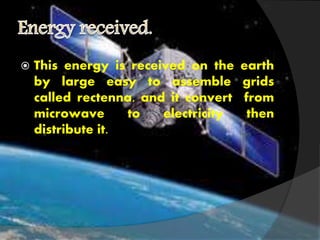
 This energy is received on the earth
by large easy to assemble grids
called rectenna. and it convert from
microwave to electricity then
distribute it.
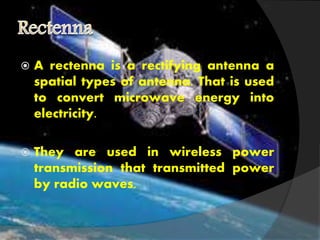
 A rectenna is a rectifying antenna a
spatial types of antenna. That is used
to convert microwave energy into
electricity.
 They are used in wireless power
transmission that transmitted power
by radio waves.
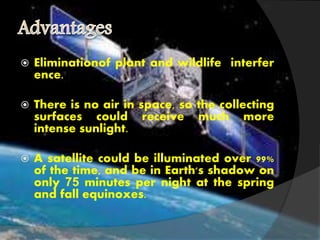
 Eliminationof plant and wildlife interfer
ence.
 There is no air in space, so the collecting
surfaces could receive much more
intense sunlight.
 A satellite could be illuminated over 99%
of the time, and be in Earth's shadow on
only 75 minutes per night at the spring
and fall equinoxes.
 The large cost of launching a satellite
into space.
 The space environment is hostile ;
panels suffer about 8 times the
degradation they would on Earth.
 www.wikipedia.com
 www.google.com
Space based solar power system

Space based solar power system

  • 1.
    A seminar onspace based solar power system Submitted To Mr. Santosh Singh Mourya EC Department Submitted By Deepak Chouhan EC 8th Sem 0823EC 101012
  • 2.
    Space based solarpower system.
  • 3.
     Introduction.  History. What is Satellite.  Working of solar power system.  rectenna.  Advantages.  Disadvantages.  References.
  • 4.
     Space-based solarpower (SBSP) is the concept of collecting solar power in space for use on Earth.  SBSP would differ from current solar collection methods in that the means used to collect energy would reside on an orbiting satellite instead of on Earth's surface.
  • 5.
     The SBSPconcept, originally known as satellite solar-power system (SSPS), was first described in November 1968.
  • 6.
     A satelliteis an artificial object which has been intentionally placed into orbit such object are some times called artificial satellite.
  • 7.
     A meansof collecting solar power in space, for example via solar concentrators, solar cells .  A means of transmitting power to earth, for example via microwave or laser  A means of receiving power on earth, for example via a microwave antenna (rectenna)
  • 8.
    1. Solar satellite 2.Energy transmitted to the earth. 3. Energy received and distributed to the earth
  • 9.
     Large arraysof photovoltaic cells mounted on a satellite.  Sun light will be capture and converted into electricity by photovoltaic panel.  Panel will remain in sun light 24 hours a day. Producing a constant source of base load power.
  • 11.
     There isno transmission losses so each satellite is able to deliver a quantity of power similar to the nuclear power plant.  This energy will safely transmitted by the radio waves.
  • 13.
     This energyis received on the earth by large easy to assemble grids called rectenna. and it convert from microwave to electricity then distribute it.
  • 14.
     A rectennais a rectifying antenna a spatial types of antenna. That is used to convert microwave energy into electricity.  They are used in wireless power transmission that transmitted power by radio waves.
  • 15.
     Eliminationof plantand wildlife interfer ence.  There is no air in space, so the collecting surfaces could receive much more intense sunlight.  A satellite could be illuminated over 99% of the time, and be in Earth's shadow on only 75 minutes per night at the spring and fall equinoxes.
  • 16.
     The largecost of launching a satellite into space.  The space environment is hostile ; panels suffer about 8 times the degradation they would on Earth.
  • 17.