CHAPTER FIVE
SOLAR ENERGY
BY: MESFIN MEGRA1/28/2018 1
WHAT IS SOLAR ENERGY?
âť–Originates with the thermo-nuclear fusion reactions
occurring in the sun.
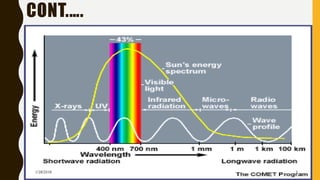
âť–Represents the entire electromagnetic radiation.
âť–This energy consists of radiant light and heat energy
from the sun.
1/28/2018 2
CONT.….
1/28/2018 3
WHAT IS SOLAR POWER?
âť–Solar power is the conversion of sunlight into electricity
either directly by using photovoltaics or concentrated
solar power.
âť–A solar cell, or photovoltaic cell (PV), is a device that
converts light into electric current using the photoelectric
effect.
1/28/2018 4
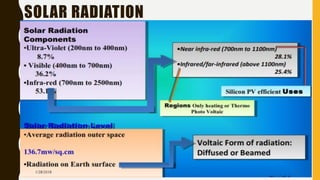
SOLAR RADIATION
1/28/2018 5
CONT.….
âť– Solar Insolation is the amount of solar radiation
reaching earth. also called incident solar radiation.
âť– Maximum value is 1000 KW/M2.
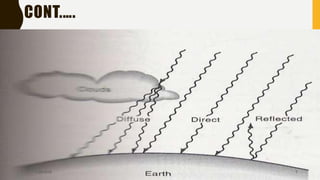
âť– Components of solar radiation:
Direct radiation
Diffuse radiation
Reflect radiation1/28/2018 6
CONT.….
1/28/2018 7
CONT.….
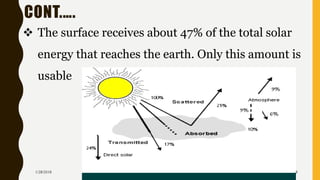
âť– The surface receives about 47% of the total solar
energy that reaches the earth. Only this amount is
usable
1/28/2018 8
HOW SOLAR ENERGY IS USED?
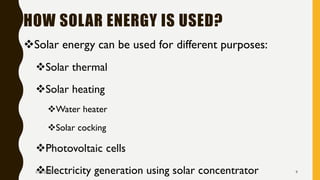
âť–Solar energy can be used for different purposes:
âť–Solar thermal
âť–Solar heating
âť–Water heater
âť–Solar cocking
âť–Photovoltaic cells
âť–Electricity generation using solar concentrator1/28/2018 9
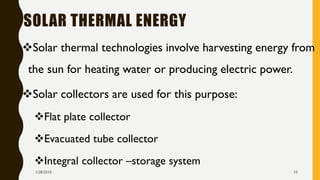
SOLAR THERMAL ENERGY
âť–Solar thermal technologies involve harvesting energy from
the sun for heating water or producing electric power.
âť–Solar collectors are used for this purpose:
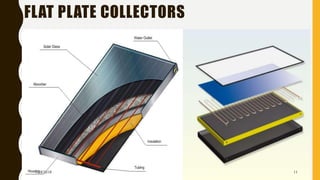
âť–Flat plate collector
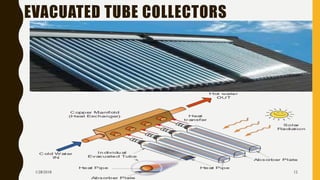
âť–Evacuated tube collector
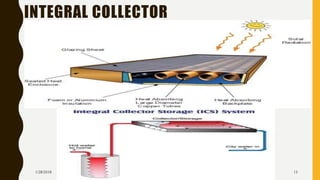
❖Integral collector –storage system
1/28/2018 10
FLAT PLATE COLLECTORS
1/28/2018 11
EVACUATED TUBE COLLECTORS
1/28/2018 12
INTEGRAL COLLECTOR
1/28/2018 13
ELECTRICITY FROM SOLAR ENERGY
âť–Solar power is described as the conversion of sunlight
into electricity.
âť–Sunlight can be changed to electricity with the use of:
âť–Directly using photovoltaic cell (PV cells)
âť–Indirectly by concentrated solar power (CSPs)
1/28/2018 14
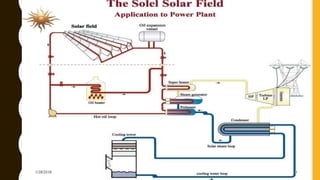
CONCENTRATED SOLAR POWERS
âť–Concentrating solar power system is made up of lenses,
mirrors, and tracking systems focusing a large amount of
sunlight into a smaller beam.
âť–The concentrated light heat up a working fluid and is
then used as the heat source for power generation or
energy storage.
1/28/2018 15
CONCENTRATED SOLAR POWERS
âť–The sunlight from the sun will heat the fluid and produce
steam.
âť–The steam drives a turbine and generates power in the
same way as conventional power plants.
âť–The most developed methods for CSP are solar trough,
parabolic dish, and solar power tower.
1/28/2018 16
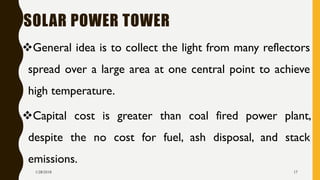
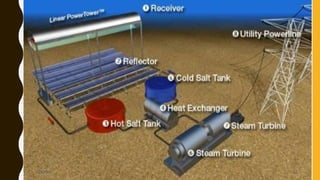
SOLAR POWER TOWER
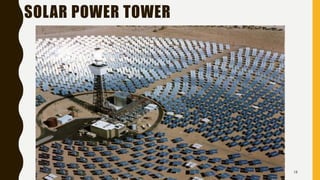
âť–General idea is to collect the light from many reflectors
spread over a large area at one central point to achieve
high temperature.
âť–Capital cost is greater than coal fired power plant,
despite the no cost for fuel, ash disposal, and stack
emissions.
1/28/2018 17
SOLAR POWER TOWER
1/28/2018 18
PARABOLIC DISHES AND TROUGHS
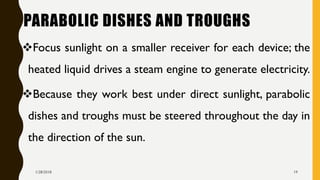
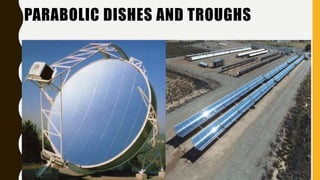
âť–Focus sunlight on a smaller receiver for each device; the
heated liquid drives a steam engine to generate electricity.
âť–Because they work best under direct sunlight, parabolic
dishes and troughs must be steered throughout the day in
the direction of the sun.
1/28/2018 19
PARABOLIC DISHES AND TROUGHS
1/28/2018 20
1/28/2018 21
1/28/2018 22
SOLAR CELLS AND PHOTOVOLTAICS
âť–Photovoltaic cells are capable of directly converting
sunlight into electricity.
âť–A simple wafer of silicon with wires attached to the
layers. current is produced based on types of silicon (n-
and p-types) used for the layers. each cell=0.5 volts.
âť–Battery needed as storage.
1/28/2018 23
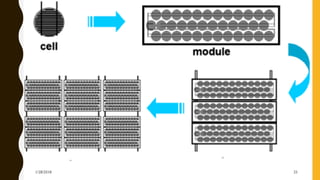
HOW DOES A CELL BECOME A MODULE?
âť–A solar cell is the basic building block of a PV system.
âť–A typical cell produces .5 to 1V of electricity.
âť–Solar cells are combined together to become modules
or if large enough, known as an array.
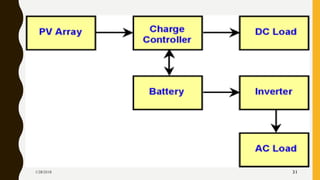
âť–A structure to point the modules towards the sun is
necessary, as well as electricity converters, which convert
DC power to AC.1/28/2018 24
1/28/2018 25
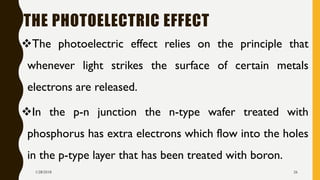
THE PHOTOELECTRIC EFFECT
âť–The photoelectric effect relies on the principle that
whenever light strikes the surface of certain metals
electrons are released.
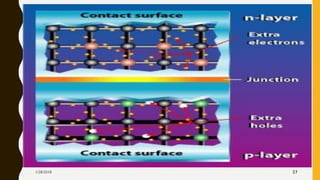
âť–In the p-n junction the n-type wafer treated with
phosphorus has extra electrons which flow into the holes
in the p-type layer that has been treated with boron.
1/28/2018 26
1/28/2018 27
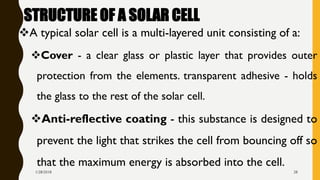
STRUCTURE OF A SOLAR CELL
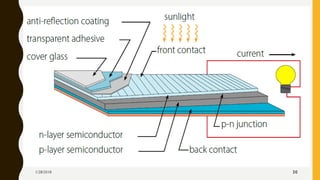
âť–A typical solar cell is a multi-layered unit consisting of a:
âť–Cover - a clear glass or plastic layer that provides outer
protection from the elements. transparent adhesive - holds
the glass to the rest of the solar cell.
âť–Anti-reflective coating - this substance is designed to
prevent the light that strikes the cell from bouncing off so
that the maximum energy is absorbed into the cell.
1/28/2018 28
CONT.….
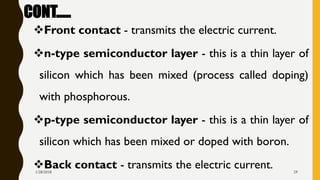
âť–Front contact - transmits the electric current.
âť–n-type semiconductor layer - this is a thin layer of
silicon which has been mixed (process called doping)
with phosphorous.
âť–p-type semiconductor layer - this is a thin layer of
silicon which has been mixed or doped with boron.
âť–Back contact - transmits the electric current.1/28/2018 29
1/28/2018 30
1/28/2018 31
1/28/2018 32
THANKYOU

Solar power Plant

  • 1.
    CHAPTER FIVE SOLAR ENERGY BY:MESFIN MEGRA1/28/2018 1
  • 2.
    WHAT IS SOLARENERGY? âť–Originates with the thermo-nuclear fusion reactions occurring in the sun. âť–Represents the entire electromagnetic radiation. âť–This energy consists of radiant light and heat energy from the sun. 1/28/2018 2
  • 3.
  • 4.
    WHAT IS SOLARPOWER? âť–Solar power is the conversion of sunlight into electricity either directly by using photovoltaics or concentrated solar power. âť–A solar cell, or photovoltaic cell (PV), is a device that converts light into electric current using the photoelectric effect. 1/28/2018 4
  • 5.
  • 6.
    CONT.…. ❖ Solar Insolationis the amount of solar radiation reaching earth. also called incident solar radiation. ❖ Maximum value is 1000 KW/M2. ❖ Components of solar radiation: Direct radiation Diffuse radiation Reflect radiation1/28/2018 6
  • 7.
  • 8.
    CONT.…. ❖ The surfacereceives about 47% of the total solar energy that reaches the earth. Only this amount is usable 1/28/2018 8
  • 9.
    HOW SOLAR ENERGYIS USED? âť–Solar energy can be used for different purposes: âť–Solar thermal âť–Solar heating âť–Water heater âť–Solar cocking âť–Photovoltaic cells âť–Electricity generation using solar concentrator1/28/2018 9
  • 10.
    SOLAR THERMAL ENERGY ❖Solarthermal technologies involve harvesting energy from the sun for heating water or producing electric power. ❖Solar collectors are used for this purpose: ❖Flat plate collector ❖Evacuated tube collector ❖Integral collector –storage system 1/28/2018 10
  • 11.
  • 12.
  • 13.
  • 14.
    ELECTRICITY FROM SOLARENERGY âť–Solar power is described as the conversion of sunlight into electricity. âť–Sunlight can be changed to electricity with the use of: âť–Directly using photovoltaic cell (PV cells) âť–Indirectly by concentrated solar power (CSPs) 1/28/2018 14
  • 15.
    CONCENTRATED SOLAR POWERS âť–Concentratingsolar power system is made up of lenses, mirrors, and tracking systems focusing a large amount of sunlight into a smaller beam. âť–The concentrated light heat up a working fluid and is then used as the heat source for power generation or energy storage. 1/28/2018 15
  • 16.
    CONCENTRATED SOLAR POWERS âť–Thesunlight from the sun will heat the fluid and produce steam. âť–The steam drives a turbine and generates power in the same way as conventional power plants. âť–The most developed methods for CSP are solar trough, parabolic dish, and solar power tower. 1/28/2018 16
  • 17.
    SOLAR POWER TOWER âť–Generalidea is to collect the light from many reflectors spread over a large area at one central point to achieve high temperature. âť–Capital cost is greater than coal fired power plant, despite the no cost for fuel, ash disposal, and stack emissions. 1/28/2018 17
  • 18.
  • 19.
    PARABOLIC DISHES ANDTROUGHS âť–Focus sunlight on a smaller receiver for each device; the heated liquid drives a steam engine to generate electricity. âť–Because they work best under direct sunlight, parabolic dishes and troughs must be steered throughout the day in the direction of the sun. 1/28/2018 19
  • 20.
    PARABOLIC DISHES ANDTROUGHS 1/28/2018 20
  • 21.
  • 22.
  • 23.
    SOLAR CELLS ANDPHOTOVOLTAICS âť–Photovoltaic cells are capable of directly converting sunlight into electricity. âť–A simple wafer of silicon with wires attached to the layers. current is produced based on types of silicon (n- and p-types) used for the layers. each cell=0.5 volts. âť–Battery needed as storage. 1/28/2018 23
  • 24.
    HOW DOES ACELL BECOME A MODULE? âť–A solar cell is the basic building block of a PV system. âť–A typical cell produces .5 to 1V of electricity. âť–Solar cells are combined together to become modules or if large enough, known as an array. âť–A structure to point the modules towards the sun is necessary, as well as electricity converters, which convert DC power to AC.1/28/2018 24
  • 25.
  • 26.
    THE PHOTOELECTRIC EFFECT âť–Thephotoelectric effect relies on the principle that whenever light strikes the surface of certain metals electrons are released. âť–In the p-n junction the n-type wafer treated with phosphorus has extra electrons which flow into the holes in the p-type layer that has been treated with boron. 1/28/2018 26
  • 27.
  • 28.
    STRUCTURE OF ASOLAR CELL âť–A typical solar cell is a multi-layered unit consisting of a: âť–Cover - a clear glass or plastic layer that provides outer protection from the elements. transparent adhesive - holds the glass to the rest of the solar cell. âť–Anti-reflective coating - this substance is designed to prevent the light that strikes the cell from bouncing off so that the maximum energy is absorbed into the cell. 1/28/2018 28
  • 29.
    CONT.…. ❖Front contact -transmits the electric current. ❖n-type semiconductor layer - this is a thin layer of silicon which has been mixed (process called doping) with phosphorous. ❖p-type semiconductor layer - this is a thin layer of silicon which has been mixed or doped with boron. ❖Back contact - transmits the electric current.1/28/2018 29
  • 30.
  • 31.
  • 32.