SSE的那些事儿
Use SIMD to boost your program!
CPU-Z
What all these
about?
Outline
• What is SSE?
• Why SSE?
• How to use SSE?
• CPUID
• Useful References
• Discussions
Outline
• What is SSE?
• Why SSE?
• How to use SSE?
• CPUID
• Useful References
• Discussions
SSE
• Streaming SIMD Extensions
A set of CPU instructions dedicated to applications like signal
processing, scientific computation or 3D graphics.
SIMD
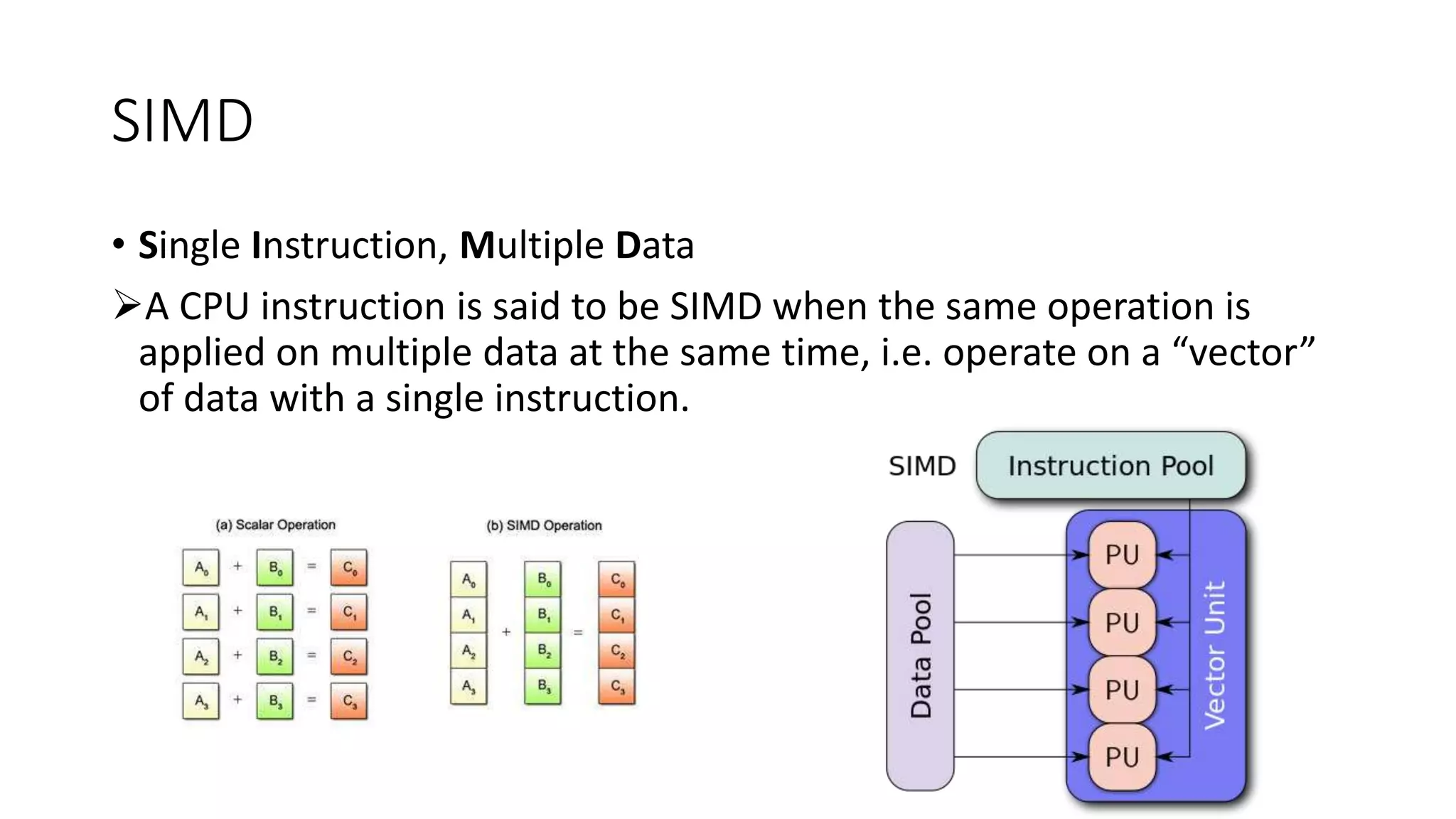
• Single Instruction, Multiple Data
A CPU instruction is said to be SIMD when the same operation is
applied on multiple data at the same time, i.e. operate on a “vector”
of data with a single instruction.
Flynn’s taxonomy
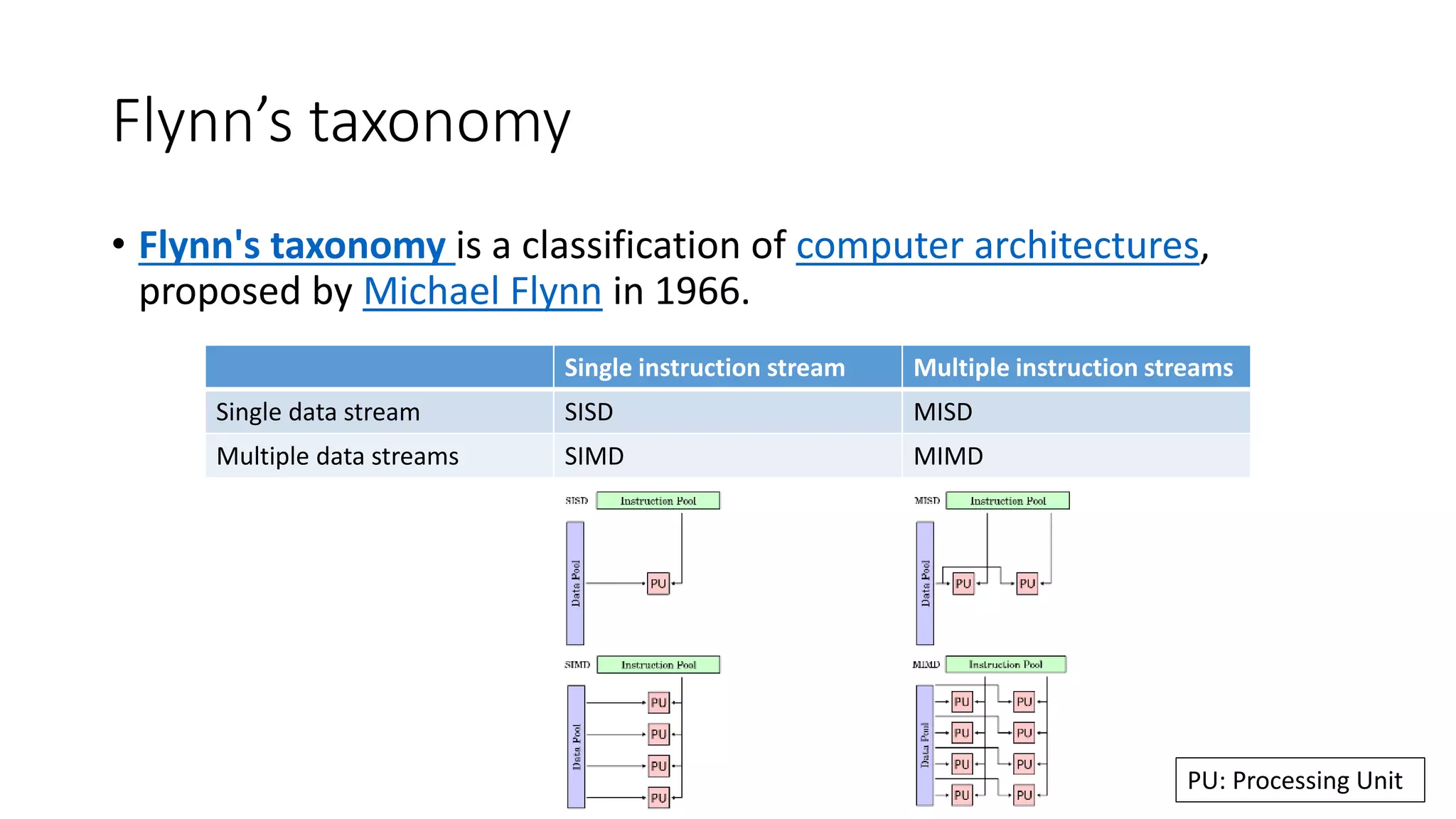
• Flynn's taxonomy is a classification of computer architectures,
proposed by Michael Flynn in 1966.
Single instruction stream Multiple instruction streams
Single data stream SISD MISD
Multiple data streams SIMD MIMD
PU: Processing Unit
More on SSE
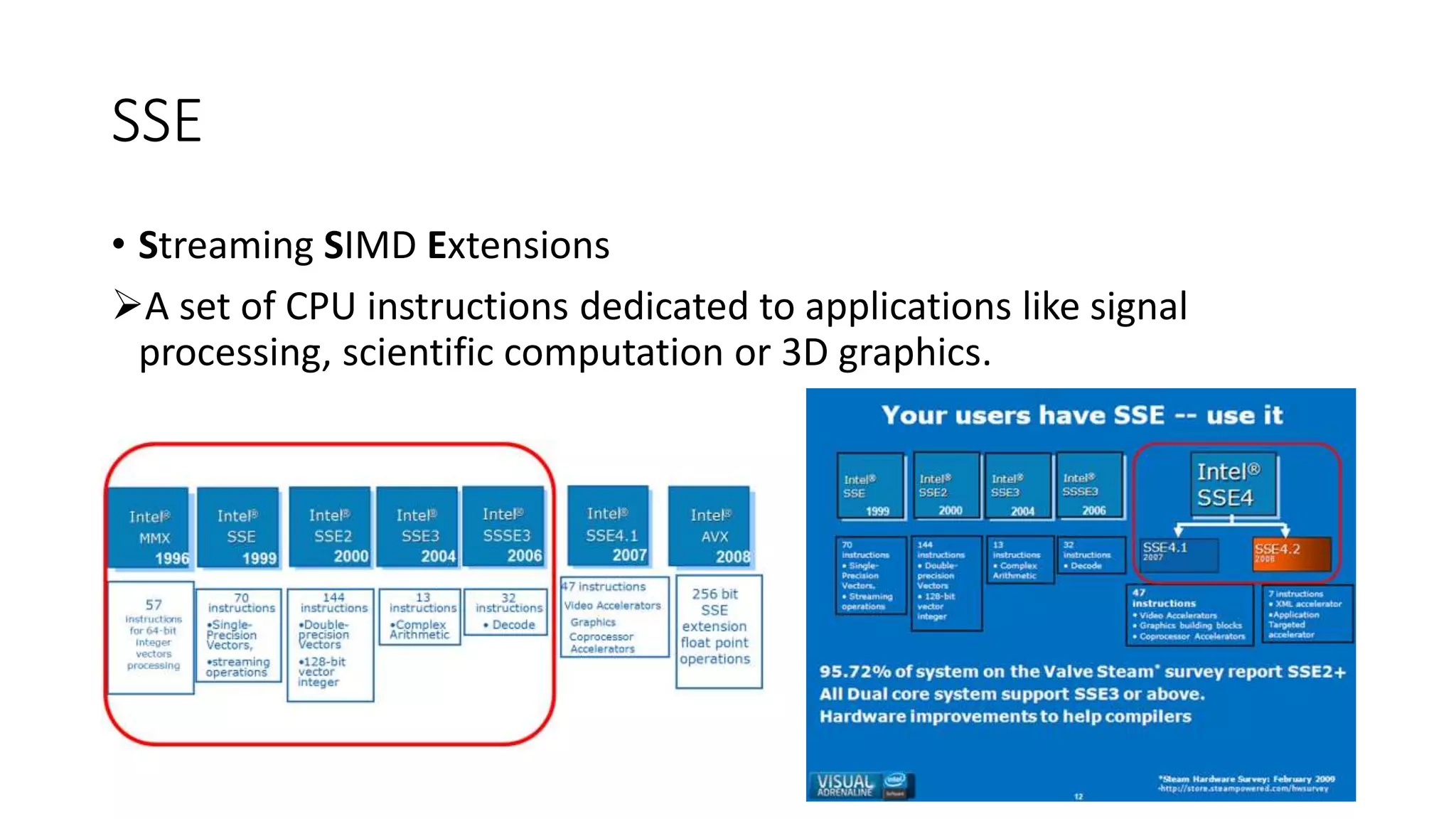
• Streaming SIMD Extensions (SSE) is an SIMD instruction set extension
to the x86 architecture, designed by Intel and introduced in 1999 in
their Pentium III series processors as a reply to AMD's 3DNow!
• SSE contains 70 new instructions, most of which work on single
precision floating point data.
• Intel's first IA-32 SIMD effort was the MMX instruction set.
• SSE was subsequently expanded by Intel to SSE2, SSE3, SSSE3, SSE4
and AVX.
• SSE was originally called Katmai New Instructions (KNI), Katmai being
the code name for the first Pentium III core revision.
SSE Registers
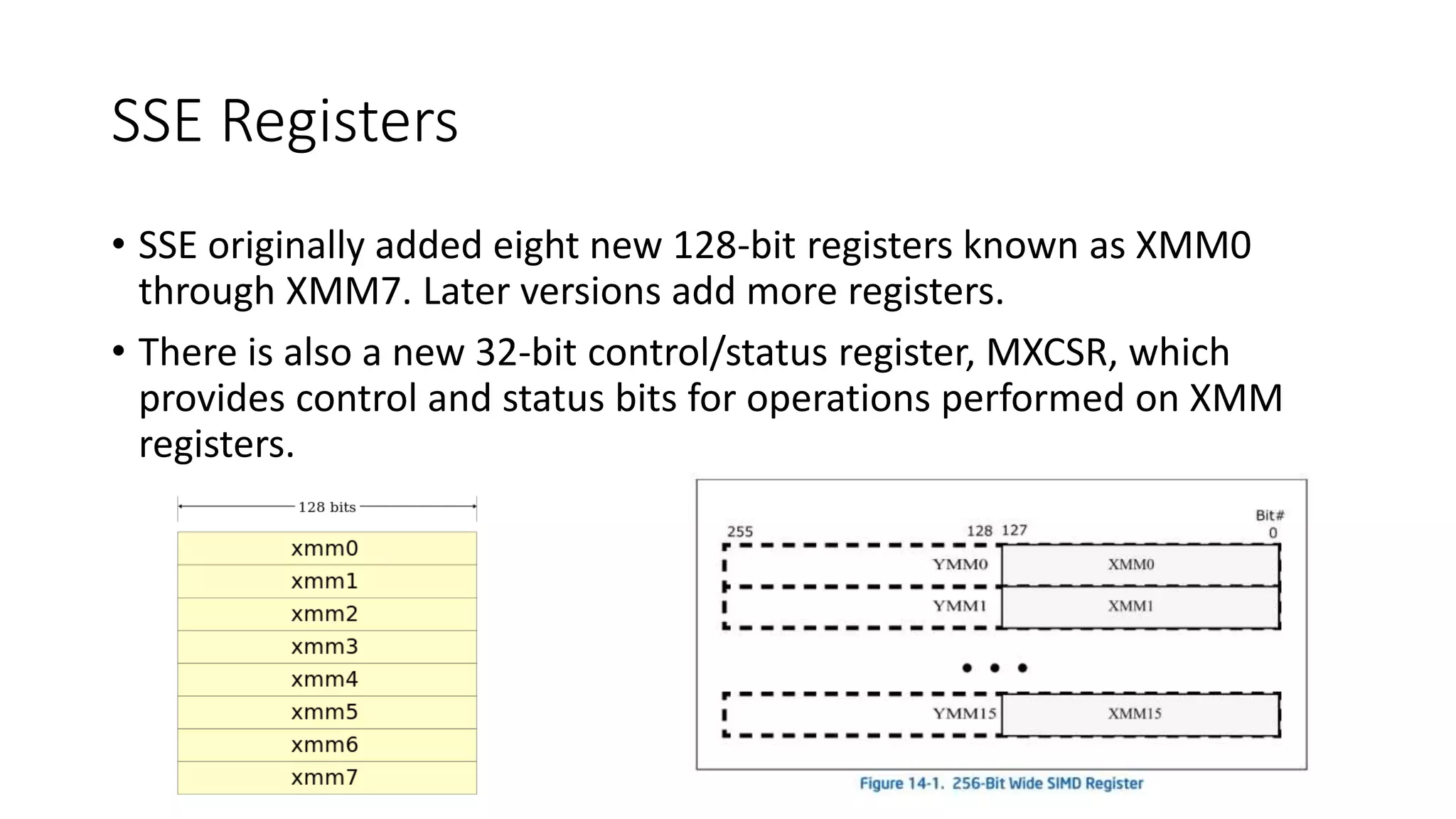
• SSE originally added eight new 128-bit registers known as XMM0
through XMM7. Later versions add more registers.
• There is also a new 32-bit control/status register, MXCSR, which
provides control and status bits for operations performed on XMM
registers.
SSE instructions
• Packed and scalar single-precision floating-point instructions
 Data movement instructions
 Arithmetic instructions
 Logical instructions
 Comparison instructions
 Shuffle instructions
 Conversion instructions
• 64-bit SIMD integer instructions
 Operate on data in MMX registers and 64-bit memory locations.
• State management instructions
 LDMXCSR
 STMXCSR
• Cacheability control, prefetch, and memory ordering instructions
 Give programs more control over the caching of data
Intel CPU SIMD technology evolution
Outline
• What is SSE?
• Why SSE?
• How to use SSE?
• CPUID
• Useful References
• Discussions
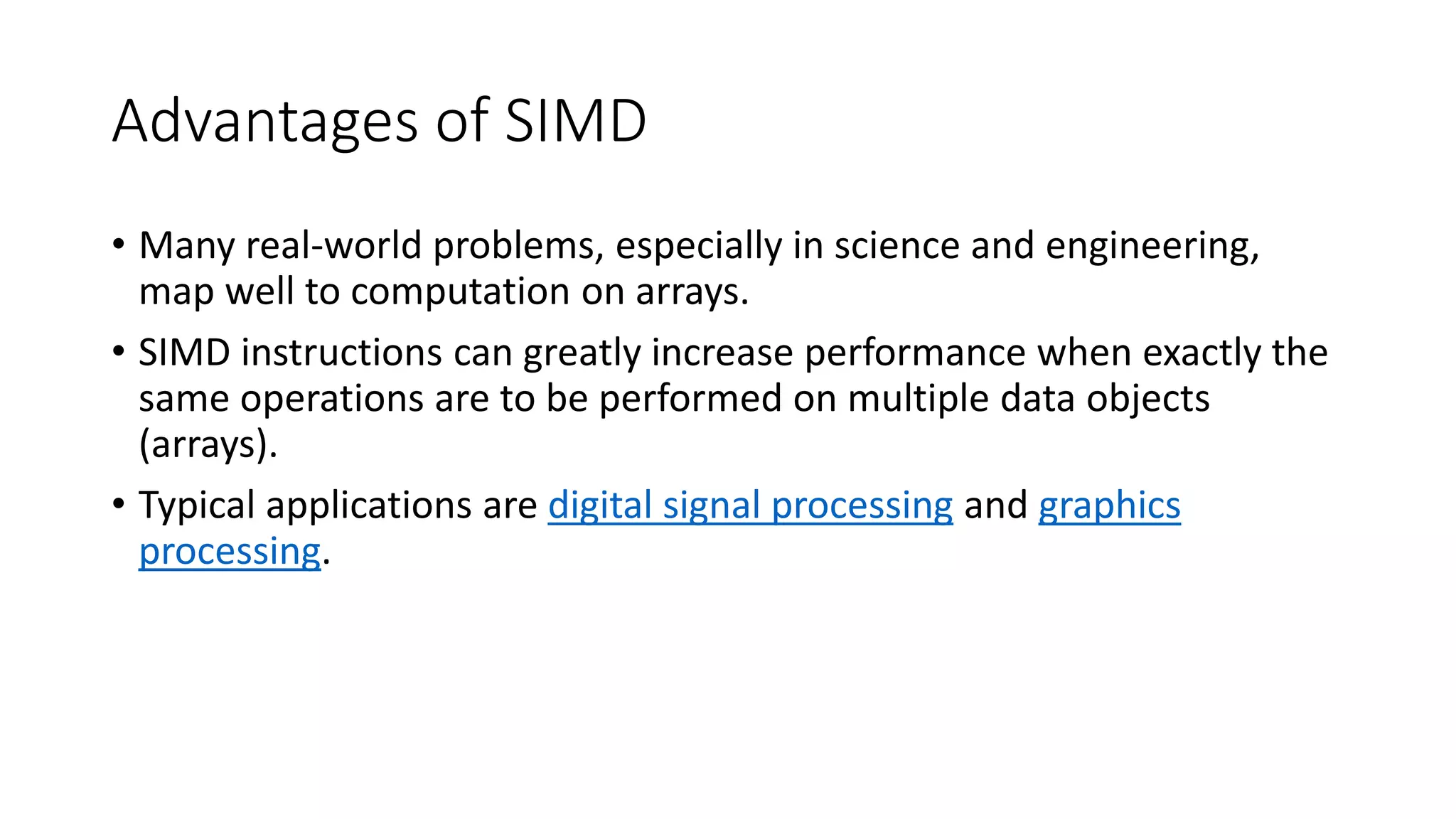
Advantages of SIMD
• Many real-world problems, especially in science and engineering,
map well to computation on arrays.
• SIMD instructions can greatly increase performance when exactly the
same operations are to be performed on multiple data objects
(arrays).
• Typical applications are digital signal processing and graphics
processing.
Outline
• What is SSE?
• Why SSE?
• How to use SSE?
• CPUID
• Useful References
• Discussions
Think twice before you go
• What is your application?
• Is there better algorithm?
• Will the effort get performance gain eventually? How much?
• Which SSE version suites best?
• Does your CPU support SSE? If, up to what version?
• Does you operating system have SSE support?
• How will you code the SSE programs? Assembly or high level?
• …
Identity if applicable
• SIMD improves the performance of 3D
graphics, speech recognition, image
processing, scientific applications and
applications that have the following
characteristics:
Inherently parallel.
Recurring memory access patterns.
Localized recurring operations performed on
the data.
Data-independent control flow.
• Support must be ensured on:
CPU
Operating System
• SIMD application candidates:
Speech compression algorithms and filters.
Speech recognition algorithms.
Video display and capture routines.
Rendering routines.
3D graphics (geometry).
Image and video processing algorithms.
Spatial (3D) audio.
Physical modeling (graphics, CAD).
Workstation applications.
Encryption algorithms.
Complex arithmetic.
Choose the right instructions – Refer to Intel
Optimization Manual 2.9
• MMX
• SSE
• SSE2
• SSE3
• SSSE3
• SSE4
• AESNI and PCLMULQDQ
• AVX, FMA and AVX2
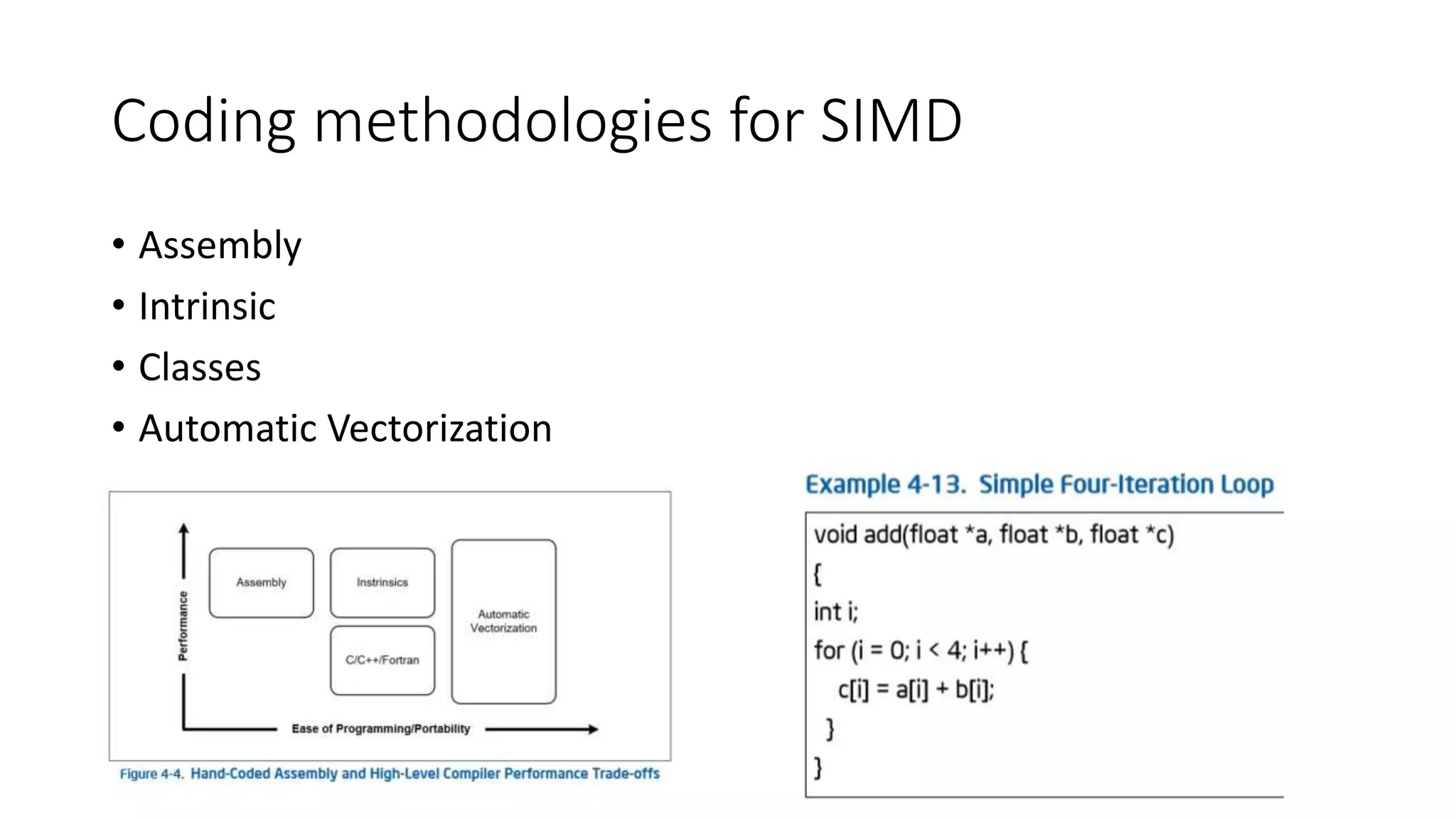
Coding methodologies for SIMD
• Assembly
• Intrinsic
• Classes
• Automatic Vectorization
Assembly
• Key loops can be coded directly in assembly language using an
assembler or by using inline assembly (C-ASM) in C/C++ code.
• This model offers the opportunity for attaining greatest performance,
but this performance is not portable across the different processor
architectures.
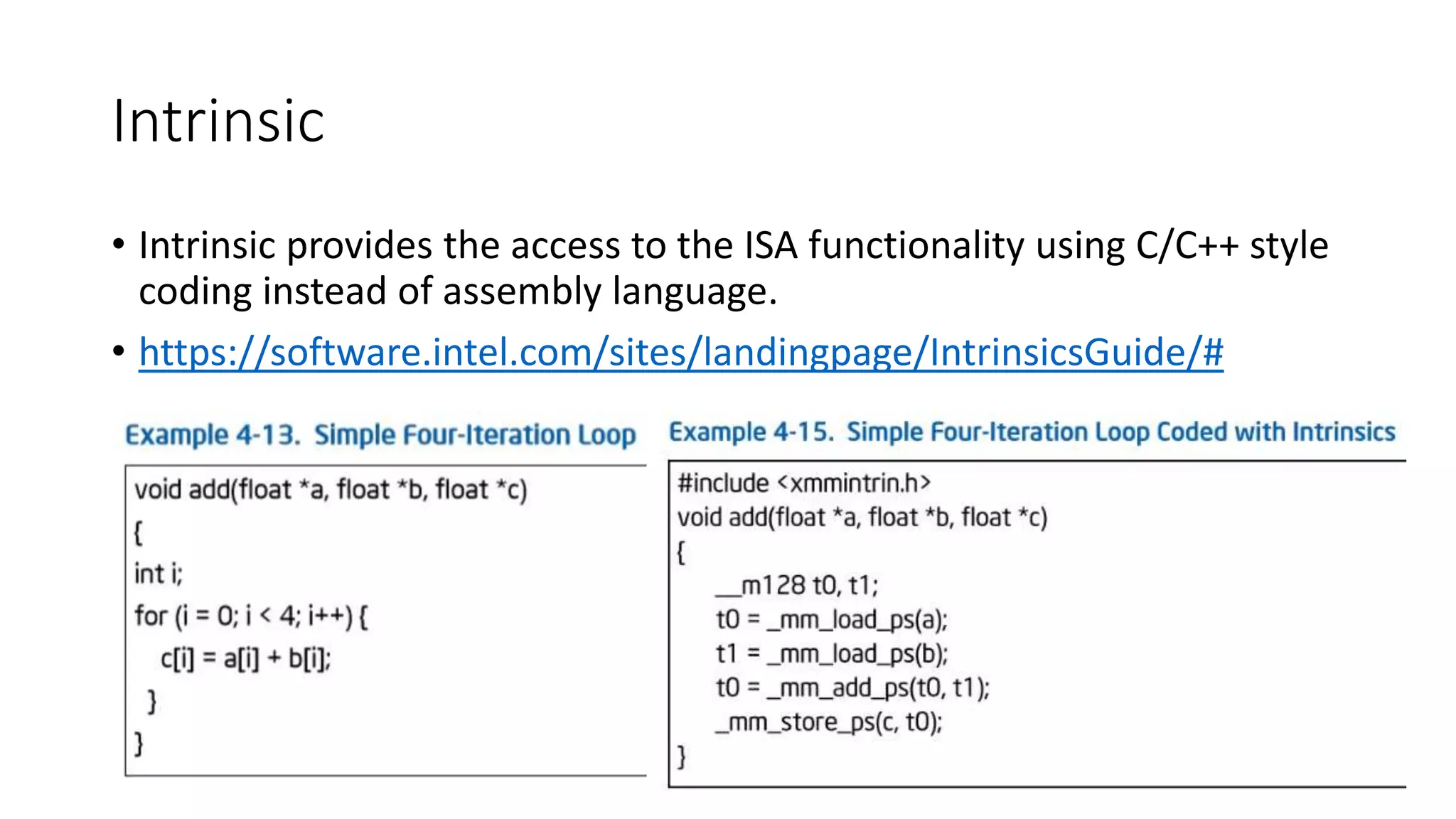
Intrinsic
• Intrinsic provides the access to the ISA functionality using C/C++ style
coding instead of assembly language.
• https://software.intel.com/sites/landingpage/IntrinsicsGuide/#
Header File Instructions & CPU
x86intrin.h x86 instructions
mmintrin.h MMX (Pentium MMX!)
mm3dnow.h 3dnow! (K6-2) (deprecated)
xmmintrin.h SSE + MMX (Pentium 3, Athlon XP)
emmintrin.h SSE2 + SSE + MMX (Pentiuem 4, Ahtlon 64)
pmmintrin.h SSE3 + SSE2 + SSE + MMX (Pentium 4 Prescott, Ahtlon 64 San
Diego)
tmmintrin.h SSSE3 + SSE3 + SSE2 + SSE + MMX (Core 2, Bulldozer)
popcntintrin.h POPCNT (Core i7, Phenom subset of SSE4.2 and SSE4A)
ammintrin.h SSE4A + SSE3 + SSE2 + SSE + MMX (Phenom)
smmintrin.h SSE4_1 + SSSE3 + SSE3 + SSE2 + SSE + MMX (Core i7,
Bulldozer)
nmmintrin.h SSE4_2 + SSE4_1 + SSSE3 + SSE3 + SSE2 + SSE + MMX (Core i7,
Bulldozer)
wmmintrin.h AES (Core i7 Westmere, Bulldozer)
immintrin.h AVX, SSE4_2 + SSE4_1 + SSSE3 + SSE3 + SSE2 + SSE + MMX
(Core i7 Sandy Bridge, Bulldozer)
Classes
• A set of C++ classes has been defined and available in Intel C++
Compiler to provide both a higher-level abstraction and more
flexibility for programming with SIMD technology.
Automatic Vectorization
• The Intel C++ Compiler provides an optimization mechanism by which
loops, such as in Example 4-13 can be automatically vectorized, or
converted into Streaming SIMD Extensions code.
• Compile this code using the -QAX and -QRESTRICT switches of the
Intel C++ Compiler, version 4.0 or later.
SSE Demo
Outline
• What is SSE?
• Why SSE?
• How to use SSE?
• CPUID
• Useful References
• Discussions
CPUID
• CPU IDentification
• The CPUID instruction can be used to retrieve various amount of
information about your CPU, like its vendor string and model number,
the size of internal caches and (more interesting), the list of CPU
features supported.
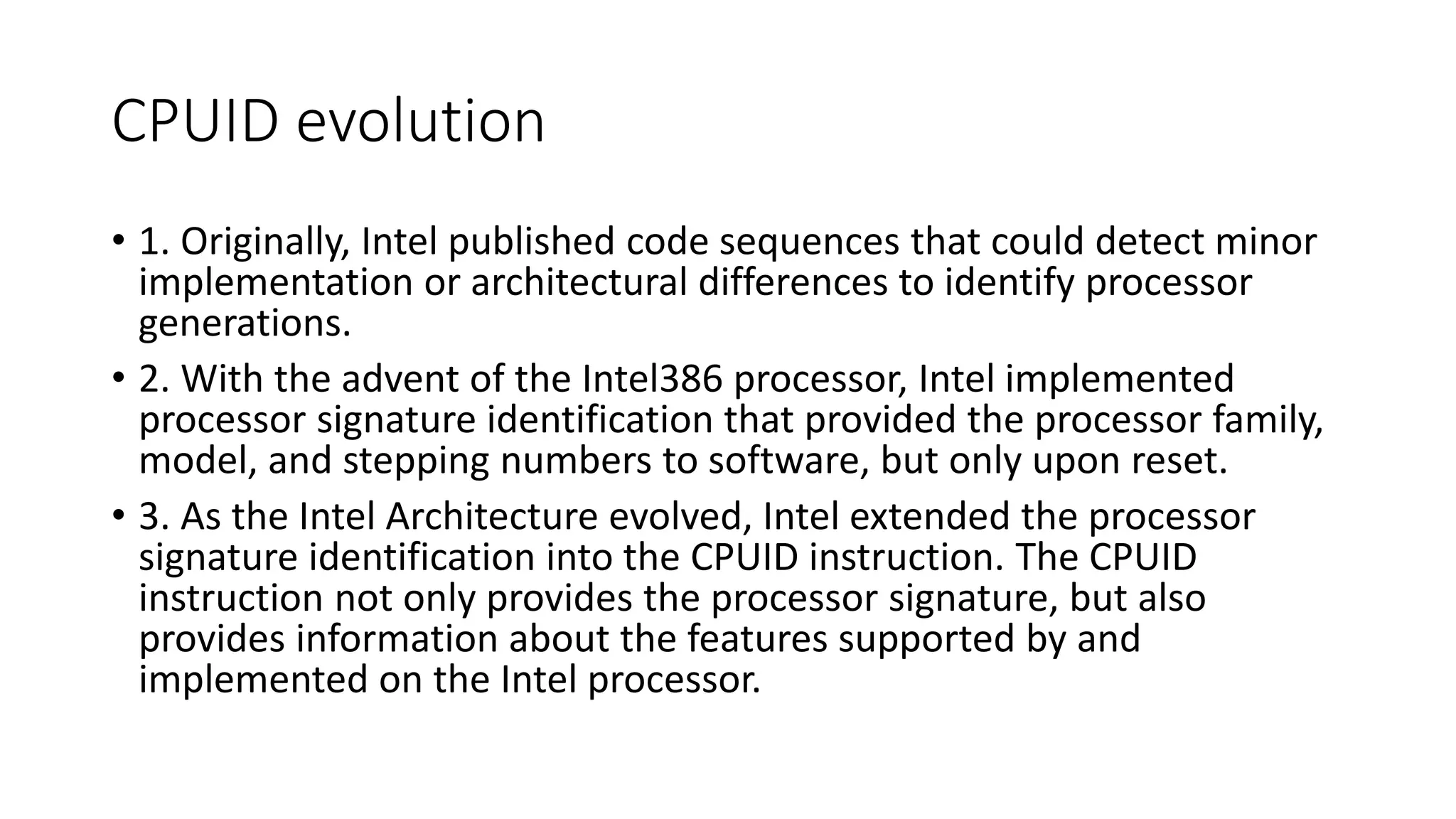
CPUID evolution
• 1. Originally, Intel published code sequences that could detect minor
implementation or architectural differences to identify processor
generations.
• 2. With the advent of the Intel386 processor, Intel implemented
processor signature identification that provided the processor family,
model, and stepping numbers to software, but only upon reset.
• 3. As the Intel Architecture evolved, Intel extended the processor
signature identification into the CPUID instruction. The CPUID
instruction not only provides the processor signature, but also
provides information about the features supported by and
implemented on the Intel processor.
CPUID Demo
Outline
• What is SSE?
• Why SSE?
• How to use SSE?
• CPUID
• Useful References
• Discussions
Useful References
• http://www.intel.com/content/www/us/en/processors/architectures-software-developer-
manuals.html
• http://www.intel.com/content/dam/www/public/us/en/documents/manuals/64-ia-32-
architectures-optimization-manual.pdf (Chapter 4 Coding For SIMD Architectures, Chapter 5 & 6
& 10 & 11)
• https://software.intel.com/en-us/isa-extensions
• https://www.scss.tcd.ie/Jeremy.Jones/CS4021/processor-identification-cpuid-instruction-note.pdf
• https://software.intel.com/en-us/articles/intel-software-development-emulator
• http://supercomputingblog.com/optimization/getting-started-with-sse-programming/
• http://felix.abecassis.me/2011/09/cpp-getting-started-with-sse/
• http://wiki.osdev.org/CPUID
• http://sandpile.org/x86/cpuid.htm
• http://www.etallen.com/cpuid.html
More to explore
• Memory alignment
• AVX
• FMA
• ARM NEON
• Intel® SHA Extensions
• Intel® VTune™ Amplifier
• Intel® VTune™ Performance Analyzer
• Intel® Software Development Emulator
• …
Thank You!
Lihang Li @ IEG

Something about SSE and beyond

  • 1.
    SSE的那些事儿 Use SIMD toboost your program!
  • 2.
  • 3.
    Outline • What isSSE? • Why SSE? • How to use SSE? • CPUID • Useful References • Discussions
  • 4.
    Outline • What isSSE? • Why SSE? • How to use SSE? • CPUID • Useful References • Discussions
  • 5.
    SSE • Streaming SIMDExtensions A set of CPU instructions dedicated to applications like signal processing, scientific computation or 3D graphics.
  • 6.
    SIMD • Single Instruction,Multiple Data A CPU instruction is said to be SIMD when the same operation is applied on multiple data at the same time, i.e. operate on a “vector” of data with a single instruction.
  • 7.
    Flynn’s taxonomy • Flynn'staxonomy is a classification of computer architectures, proposed by Michael Flynn in 1966. Single instruction stream Multiple instruction streams Single data stream SISD MISD Multiple data streams SIMD MIMD PU: Processing Unit
  • 8.
    More on SSE •Streaming SIMD Extensions (SSE) is an SIMD instruction set extension to the x86 architecture, designed by Intel and introduced in 1999 in their Pentium III series processors as a reply to AMD's 3DNow! • SSE contains 70 new instructions, most of which work on single precision floating point data. • Intel's first IA-32 SIMD effort was the MMX instruction set. • SSE was subsequently expanded by Intel to SSE2, SSE3, SSSE3, SSE4 and AVX. • SSE was originally called Katmai New Instructions (KNI), Katmai being the code name for the first Pentium III core revision.
  • 9.
    SSE Registers • SSEoriginally added eight new 128-bit registers known as XMM0 through XMM7. Later versions add more registers. • There is also a new 32-bit control/status register, MXCSR, which provides control and status bits for operations performed on XMM registers.
  • 10.
    SSE instructions • Packedand scalar single-precision floating-point instructions  Data movement instructions  Arithmetic instructions  Logical instructions  Comparison instructions  Shuffle instructions  Conversion instructions • 64-bit SIMD integer instructions  Operate on data in MMX registers and 64-bit memory locations. • State management instructions  LDMXCSR  STMXCSR • Cacheability control, prefetch, and memory ordering instructions  Give programs more control over the caching of data
  • 11.
    Intel CPU SIMDtechnology evolution
  • 12.
    Outline • What isSSE? • Why SSE? • How to use SSE? • CPUID • Useful References • Discussions
  • 13.
    Advantages of SIMD •Many real-world problems, especially in science and engineering, map well to computation on arrays. • SIMD instructions can greatly increase performance when exactly the same operations are to be performed on multiple data objects (arrays). • Typical applications are digital signal processing and graphics processing.
  • 14.
    Outline • What isSSE? • Why SSE? • How to use SSE? • CPUID • Useful References • Discussions
  • 15.
    Think twice beforeyou go • What is your application? • Is there better algorithm? • Will the effort get performance gain eventually? How much? • Which SSE version suites best? • Does your CPU support SSE? If, up to what version? • Does you operating system have SSE support? • How will you code the SSE programs? Assembly or high level? • …
  • 16.
    Identity if applicable •SIMD improves the performance of 3D graphics, speech recognition, image processing, scientific applications and applications that have the following characteristics: Inherently parallel. Recurring memory access patterns. Localized recurring operations performed on the data. Data-independent control flow. • Support must be ensured on: CPU Operating System • SIMD application candidates: Speech compression algorithms and filters. Speech recognition algorithms. Video display and capture routines. Rendering routines. 3D graphics (geometry). Image and video processing algorithms. Spatial (3D) audio. Physical modeling (graphics, CAD). Workstation applications. Encryption algorithms. Complex arithmetic.
  • 17.
    Choose the rightinstructions – Refer to Intel Optimization Manual 2.9 • MMX • SSE • SSE2 • SSE3 • SSSE3 • SSE4 • AESNI and PCLMULQDQ • AVX, FMA and AVX2
  • 18.
    Coding methodologies forSIMD • Assembly • Intrinsic • Classes • Automatic Vectorization
  • 19.
    Assembly • Key loopscan be coded directly in assembly language using an assembler or by using inline assembly (C-ASM) in C/C++ code. • This model offers the opportunity for attaining greatest performance, but this performance is not portable across the different processor architectures.
  • 20.
    Intrinsic • Intrinsic providesthe access to the ISA functionality using C/C++ style coding instead of assembly language. • https://software.intel.com/sites/landingpage/IntrinsicsGuide/#
  • 21.
    Header File Instructions& CPU x86intrin.h x86 instructions mmintrin.h MMX (Pentium MMX!) mm3dnow.h 3dnow! (K6-2) (deprecated) xmmintrin.h SSE + MMX (Pentium 3, Athlon XP) emmintrin.h SSE2 + SSE + MMX (Pentiuem 4, Ahtlon 64) pmmintrin.h SSE3 + SSE2 + SSE + MMX (Pentium 4 Prescott, Ahtlon 64 San Diego) tmmintrin.h SSSE3 + SSE3 + SSE2 + SSE + MMX (Core 2, Bulldozer) popcntintrin.h POPCNT (Core i7, Phenom subset of SSE4.2 and SSE4A) ammintrin.h SSE4A + SSE3 + SSE2 + SSE + MMX (Phenom) smmintrin.h SSE4_1 + SSSE3 + SSE3 + SSE2 + SSE + MMX (Core i7, Bulldozer) nmmintrin.h SSE4_2 + SSE4_1 + SSSE3 + SSE3 + SSE2 + SSE + MMX (Core i7, Bulldozer) wmmintrin.h AES (Core i7 Westmere, Bulldozer) immintrin.h AVX, SSE4_2 + SSE4_1 + SSSE3 + SSE3 + SSE2 + SSE + MMX (Core i7 Sandy Bridge, Bulldozer)
  • 22.
    Classes • A setof C++ classes has been defined and available in Intel C++ Compiler to provide both a higher-level abstraction and more flexibility for programming with SIMD technology.
  • 23.
    Automatic Vectorization • TheIntel C++ Compiler provides an optimization mechanism by which loops, such as in Example 4-13 can be automatically vectorized, or converted into Streaming SIMD Extensions code. • Compile this code using the -QAX and -QRESTRICT switches of the Intel C++ Compiler, version 4.0 or later.
  • 24.
  • 25.
    Outline • What isSSE? • Why SSE? • How to use SSE? • CPUID • Useful References • Discussions
  • 26.
    CPUID • CPU IDentification •The CPUID instruction can be used to retrieve various amount of information about your CPU, like its vendor string and model number, the size of internal caches and (more interesting), the list of CPU features supported.
  • 27.
    CPUID evolution • 1.Originally, Intel published code sequences that could detect minor implementation or architectural differences to identify processor generations. • 2. With the advent of the Intel386 processor, Intel implemented processor signature identification that provided the processor family, model, and stepping numbers to software, but only upon reset. • 3. As the Intel Architecture evolved, Intel extended the processor signature identification into the CPUID instruction. The CPUID instruction not only provides the processor signature, but also provides information about the features supported by and implemented on the Intel processor.
  • 28.
  • 29.
    Outline • What isSSE? • Why SSE? • How to use SSE? • CPUID • Useful References • Discussions
  • 30.
    Useful References • http://www.intel.com/content/www/us/en/processors/architectures-software-developer- manuals.html •http://www.intel.com/content/dam/www/public/us/en/documents/manuals/64-ia-32- architectures-optimization-manual.pdf (Chapter 4 Coding For SIMD Architectures, Chapter 5 & 6 & 10 & 11) • https://software.intel.com/en-us/isa-extensions • https://www.scss.tcd.ie/Jeremy.Jones/CS4021/processor-identification-cpuid-instruction-note.pdf • https://software.intel.com/en-us/articles/intel-software-development-emulator • http://supercomputingblog.com/optimization/getting-started-with-sse-programming/ • http://felix.abecassis.me/2011/09/cpp-getting-started-with-sse/ • http://wiki.osdev.org/CPUID • http://sandpile.org/x86/cpuid.htm • http://www.etallen.com/cpuid.html
  • 31.
    More to explore •Memory alignment • AVX • FMA • ARM NEON • Intel® SHA Extensions • Intel® VTune™ Amplifier • Intel® VTune™ Performance Analyzer • Intel® Software Development Emulator • …
  • 32.

Editor's Notes

  • #7 The first use of SIMD instructions was in vector supercomputers of the early 1970s such as the CDC Star-100 and the Texas Instruments ASC, which could operate on a "vector" of data with a single instruction. Supercomputing moved away from the SIMD approach when inexpensive scalar MIMD approaches based on commodity processors such as the Intel i860 XP [3] became more powerful, and interest in SIMD waned. The current era of SIMD processors grew out of the desktop-computer market rather than the supercomputer market. As desktop processors became powerful enough to support real-time gaming and video processing, demand grew for this particular type of computing power, and microprocessor vendors turned to SIMD to meet the demand. The first widely-deployed desktop SIMD was with Intel's MMX extensions to the x86 architecture in 1996. This sparked the introduction of the much more powerful AltiVec system in the Motorola PowerPC's and IBM's POWER systems. Intel responded in 1999 by introducing the all-new SSE system. Since then, there have been several extensions to the SIMD instruction sets for both architectures.
  • #9 MMX had two main problems: it re-used existing floating point registers making the CPU unable to work on both floating point and SIMD data at the same time, and it only worked on integers. SSE floating point instructions operate on a new independent register set (the XMM registers), and it adds a few integer instructions that work on MMX registers. During the Katmai project Intel sought to distinguish it from their earlier product line, particularly their flagship Pentium II. It was later renamed Intel Streaming SIMD Extensions (ISSE), then SSE. AMD eventually added support for SSE instructions, starting with its Athlon XP and Duron (Morgan core) processors.
  • #12  英特尔在1996年率先引入了MMX(Multi Media eXtensions)多媒体扩展指令集,也开创了SIMD(Single Instruction Multiple Data,单指令多数据)指令集之先河,即在一个周期内一个指令可以完成多个数据操作,MMX指令集的出现让当时的MMX Pentium大出风头。  SSE(Streaming SIMD Extensions,流式单指令多数据扩展)指令集是1999年英特尔在Pentium III处理器中率先推出的,并将矢量处理能力从64位扩展到了128位。在Willamette核心的Pentium 4中英特尔又将扩展指令集升级到SSE2(2000年),而SSE3指令集(2004年)是从Prescott核心的Pentium 4开始出现。  SSE4(2007年)指令集是自SSE以来最大的一次指令集扩展,它实际上分成Penryn中出现的SSE4.1和Nehalem中出现的SSE4.2,其中SSE4.1占据了大部分的指令,共有47条,Nehalem中的SSE4指令集更新很少,只有7条指令,这样一共有54条指令,称为SSE4.2。 当我们还在惯性的认为英特尔将推出SSE5时,不料半路杀出来个程咬金,2007年8月,AMD抢先宣布了SSE5指令集(SSE到SSE4均为英特尔出品),英特尔当即黑脸表示不支持SSE5,转而在2008年3月宣布Sandy Bridge微架构将引入全新的AVX指令集,同年4月英特尔公布AVX指令集规范,随后开始不断进行更新,业界普遍认为支持AVX指令集是Sandy Bridge最重要的进步,没有之一。
  • #19 For the optimal use of the Streaming SIMD Extensions that need data alignment on the 16-byte boundary.
  • #23 These classes provide an easy-to-use and flexible interface to the intrinsic functions, allowing developers to write more natural C++ code without worrying about which intrinsic or assembly language instruction to use for a given operation. Since the intrinsic functions underlie the implementation of these C++ classes, the performance of applications using this methodology can approach that of one using the intrinsic. Here, fvec.h is the class definition file and F32vec4 is the class representing an array of four floats. The “+” and “=” operators are overloaded so that the actual Streaming SIMD Extensions implementation in the previous example is abstracted out, or hidden, from the developer. Note how much more this resembles the original code, allowing for simpler and faster programming.
  • #24 The compiler uses similar techniques to those used by a programmer to identify whether a loop is suitable for conversion to SIMD. This involves determining whether the following might prevent vectorization: • The layout of the loop and the data structures used. • Dependencies amongst the data accesses in each iteration and across iterations.
  • #27 By taking advantage of the CPUID instruction, software developers can create software applications and tools that can execute compatibly across the widest range of Intel processor generations and models, past, present, and future.