• A Processor or central processing unit (CPU) is said to be
the brain of any Computer.
• A Computer processor analyzes data and controls data flow
in a computer
• It Handles the central management functions of a high-
powered PC
The working of processor mainly consist four steps
i.e. Fetch, Decode, Execute and Write back.
These steps are discussed below :
•Fetch : During the fetch step, the processor
retrieves program instructions from memory.
•Decode : In this step, the instruction is broken down into parts.
•Execute : In the execute step, CPU performs the operation implied by the program
instructions.
•Write back : During the write back step, the Processor writes back the results of
execution, to the computer's memory.
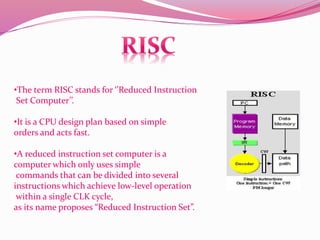
•The term RISC stands for ‘’Reduced Instruction
Set Computer’’.
•It is a CPU design plan based on simple
orders and acts fast.
•A reduced instruction set computer is a
computer which only uses simple
commands that can be divided into several
instructions which achieve low-level operation
within a single CLK cycle,
as its name proposes “Reduced Instruction Set”.
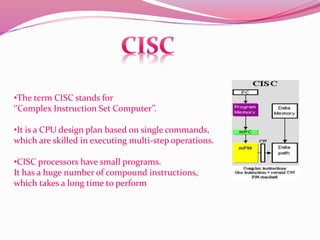
•The term CISC stands for
‘’Complex Instruction Set Computer’’.
•It is a CPU design plan based on single commands,
which are skilled in executing multi-step operations.
•CISC processors have small programs.
It has a huge number of compound instructions,
which takes a long time to perform
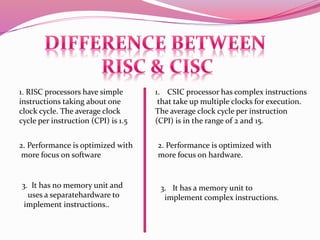
1. RISC processors have simple
instructions taking about one
clock cycle. The average clock
cycle per instruction (CPI) is 1.5
1. CSIC processor has complex instructions
that take up multiple clocks for execution.
The average clock cycle per instruction
(CPI) is in the range of 2 and 15.
2. Performance is optimized with
more focus on software
2. Performance is optimized with
more focus on hardware.
3. It has no memory unit and
uses a separatehardware to
implement instructions..
3. It has a memory unit to
implement complex instructions.
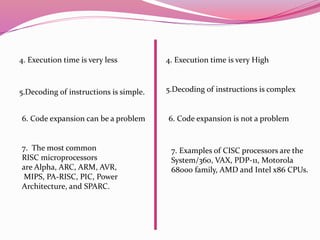
4. Execution time is very less 4. Execution time is very High
5.Decoding of instructions is simple. 5.Decoding of instructions is complex
7. The most common
RISC microprocessors
are Alpha, ARC, ARM, AVR,
MIPS, PA-RISC, PIC, Power
Architecture, and SPARC.
7. Examples of CISC processors are the
System/360, VAX, PDP-11, Motorola
68000 family, AMD and Intel x86 CPUs.
6. Code expansion can be a problem 6. Code expansion is not a problem
Risc and cisc

Risc and cisc

  • 2.
    • A Processoror central processing unit (CPU) is said to be the brain of any Computer. • A Computer processor analyzes data and controls data flow in a computer • It Handles the central management functions of a high- powered PC
  • 7.
    The working ofprocessor mainly consist four steps i.e. Fetch, Decode, Execute and Write back. These steps are discussed below : •Fetch : During the fetch step, the processor retrieves program instructions from memory. •Decode : In this step, the instruction is broken down into parts. •Execute : In the execute step, CPU performs the operation implied by the program instructions. •Write back : During the write back step, the Processor writes back the results of execution, to the computer's memory.
  • 8.
    •The term RISCstands for ‘’Reduced Instruction Set Computer’’. •It is a CPU design plan based on simple orders and acts fast. •A reduced instruction set computer is a computer which only uses simple commands that can be divided into several instructions which achieve low-level operation within a single CLK cycle, as its name proposes “Reduced Instruction Set”.
  • 9.
    •The term CISCstands for ‘’Complex Instruction Set Computer’’. •It is a CPU design plan based on single commands, which are skilled in executing multi-step operations. •CISC processors have small programs. It has a huge number of compound instructions, which takes a long time to perform
  • 10.
    1. RISC processorshave simple instructions taking about one clock cycle. The average clock cycle per instruction (CPI) is 1.5 1. CSIC processor has complex instructions that take up multiple clocks for execution. The average clock cycle per instruction (CPI) is in the range of 2 and 15. 2. Performance is optimized with more focus on software 2. Performance is optimized with more focus on hardware. 3. It has no memory unit and uses a separatehardware to implement instructions.. 3. It has a memory unit to implement complex instructions.
  • 11.
    4. Execution timeis very less 4. Execution time is very High 5.Decoding of instructions is simple. 5.Decoding of instructions is complex 7. The most common RISC microprocessors are Alpha, ARC, ARM, AVR, MIPS, PA-RISC, PIC, Power Architecture, and SPARC. 7. Examples of CISC processors are the System/360, VAX, PDP-11, Motorola 68000 family, AMD and Intel x86 CPUs. 6. Code expansion can be a problem 6. Code expansion is not a problem